‘Cute hoorism’ is alive and well in Ireland

Spotlight on corruption inside Irish state institutions

Controversy surrounding Irish public broadcaster RTE involving hidden payments and secret slush funds for music concerts, sports tickets, car loans, expensive hotels and restaurants reminds me of an investigation I conducted into misspending by another state body. 

The two examples underscore the constant need for vigilance over the spending of public money by such bodies.

Misuse of public money – a major problem in Ireland. Here RTE officials prepare to face a grilling.

Having moved to Donegal in the northwestern part of the country – an Irish speaking area known as a Gaeltacht, one of several in Ireland – I was approached as a journalist by many angry local people to investigate the spending of tens of millions of euro by Údarás na Gaeltachta, a national Irish-language organisation responsible for economic, social and cultural development.  

After comprehensive research including a series of interviews and detailed Freedom of Information (FOI) requests, I was stunned to discover the extent of financial waste and utter misuse of public money by Údarás – corruption by any another name, some might say – including all-expenses paid holidays in Florida for some executives and board members and their spouses, which was counter to existing regulations. 

During the year I conducted my investigation, pensions alone for 136 former Údarás employees amounted to 9.8 million euro, half that year’s entire budget, which caused then Public Accounts Committee (PAC) member Sinn Fein Senator Trevor Ó Clochartaigh to declare, “I nearly fell off the chair when I heard that.

Five Donegal board members alone were paid more than half a million euro in fees and expenses over a five-year period between 2004 and 2009.
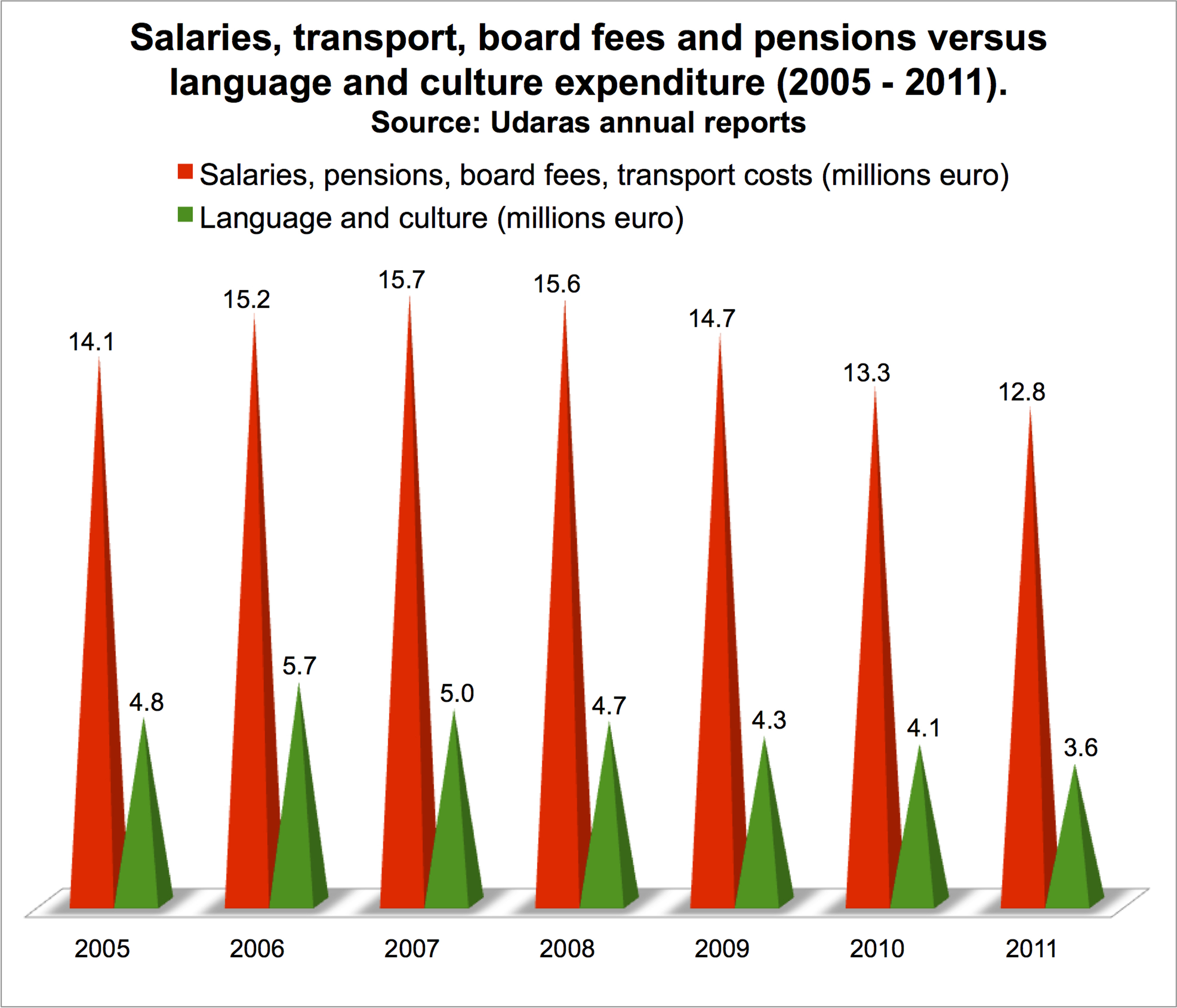
Shocking statistics I uncovered about spending on Údarás staff compared to project funding.
Key question remains: has the situation changed?

Údarás said each job it helped create back then cost around 8,000 euro, but the actual figure turned out to be 88,000 euro, ten times that number. It also spent more than 30,000 euro on all-expenses paid trips including business-class flights to Halifax, Canada to look at seaweed projects, as well as hefty expenses to other international cities including Las Vegas, Shanghai, Los Angeles and Chicago. Such was the absolute accounting mess, Bernard Allen, former Fine Gael TD and head of the PAC back then told me the expenses system of Údarás was “simply incomprehensible.” 

Údarás had become a free-for-all feeding trough for some board members and executive managers, with blatant conflicts of interest abundant. In short, the situation seemed to have become one of ‘you scratch my back and I’ll scratch yours.’

Liam O’Cuinneagain, chairperson of  Údarás for ten years then and founder of Oideas Gael in in Glencolmcille, Donegal described the investigation into his organisation’s spending as “paranoia” and said he was “satisfied” with its performance. 

After approaching the editor of the ‘Donegal News,’ a leading newspaper in the region, I completed a three-part investigation into the situation but then had to face highly-paid spin doctors for Údarás which did its very worst to prevent the series from being published, including threatening late-night calls to my home.

Padded expenses, lucrative pensions and international trips were only the tip of the ice-berg of misspending. Imagine how a small community centre or school offering classes and activities as Gaeilge or an Irish-language theatre such as Amharclann in Donegal could have used such scarce money. 

You can see some of my stories below.

Údarás na Gaeltachta, like RTE over the last few weeks, came under scrutiny by the Public Accounts Committee (PAC) back then but the government fell in the midst of the investigation, the PAC was disbanded and the investigation was never resumed after the subsequent election.

Some of those leading Údarás na Gaeltachta, both in Donegal and nationally at that time, have retired or resigned, all on very generous pensions, among the highest in Ireland’s civil service. It is hoped the present leaders are honest and transparent in their dealings. Only time will tell. Or another investigation by an enterprising journalist or a concerned citizen.

Shocking revelations at RTE and at Údarás na Gaeltachta should be a stark warning to us all. Sadly, leaders of such state and semi-state organisations with huge budgets at their disposal, if left unexamined, are tempted to misuse public money for personal gain. It is up to each one of us – private individuals and our elected representatives – to keep a close eye on how they spend that money. As both examples clearly demonstrated, we cannot rely on board member oversight alone. 

Both RTE and Údarás na Gaeltachta managed for many years to avoid public examination, the former because it was the all-powerful state broadcaster with political cronyism being a major factor in executive employment there, the latter because it was involved in the Irish language, a sacred cow in Ireland not to be questioned or criticised and it had – and still has – a big bucket of money to hand out in grants which can, in itself, buy silence.

What saddens me most is that both these organisations – RTE and Údarás na Gaeltachta – have vital roles to play in the economic, cultural and social development of Ireland so when they mislead the public, the very people who pay their high salaries and expenses, it is even more unforgivable. 

Suck key institutions should be supported, but not unquestionably so. 

After the RTE shambles, should Údarás na Gaeltachta and other such state bodies not come under extensive examination on a regular basis to make sure public money is being spent properly?

Should Údarás na Gaeltachta, for its own benefit, not be subject to the oversight of the National Treasury Management Agency (NTMA)’s NewEra unit, which provides financial and commercial advice to Government ministers and departments, the primary goal of the NTMA being to deliver long-term value to the Irish people?

Cute hoorism definition

Half million euro missing in Donegal, 250 euro returned

Half a million euro would be considered a miraculous life-saver by Mary, the tireless community worker struggling on behalf of cancer patients from Donegal who can barely afford the hefty cost of travel to Galway for specialised treatments.

If the hardworking managers of local community centres in the Donegal Gaeltacht received half a million euro, they could hire additional full-time Irish, and English-language, staff for several years and expand exponentially their range of services and activities in support of local people. 

If Amharclann, the Irish-language theatre in Bunbeg, received half a million euro, it could run an exciting cultural programme of dance, music, cinematic and theatrical performances for the next five years.

Not to mention how hard-pressed individual artists and musicians bereft of gigs due to Covid could use that money. Or indeed the Donegal office of Irish-language organisation, Foras na Gaeilge, whose local members help keep our native language alive here. And as for those unfortunate people whose homes and businesses have been destroyed by mica ….

But none of these groups have the luxury of half a million euro. 

Such a notion would be considered pure and utter fantasy, especially in the hard financial times in which we now live. 

Yet that is about the sum of money former Donegal Fianna Fail Senator, Brian O’Donnell, from Falcarragh in the heart of the Donegal Gaeltacht, has just wasted. ‘Snatched brutally, selfishly and greedily’ some are saying, from the public purse. Others use the term ‘stolen,’ but in this article I wish to be diplomatic.

How did he do this?

Ironically, over the Irish language.

O’Donnell was caught taking money from the public purse by duplicating travel and subsistence expenses as both board member of Irish-language economic group, Údarás na Gaeltachta, and Donegal County Council. 

The accusations – and this beggars belief – investigated by the Standards in Public Office Commission (SIPO) – was that it would have been impossible for him to have been in two different parts of the country at exactly the same time, at two different conferences. 

And there I thought teleportation – where matter is de-materialised at one place and recreated instantly at another – happened only in science-fiction movies and fantasy comics.

If that wasn’t enough, the former Fianna Fail Senator then cowardly left the scene of an accident while driving his car in a drunken state.

But that’s only the beginning of the saga.

O’Donnell, with the aid of well-paid lawyers, fought the accusations against him, not on the basis of whether they were right or wrong, true or false, but on the simple basis that the cases should be heard as Gaeilge (in Irish) not English. The fact that both languages are official languages of the Republic of Ireland didn’t matter a damn to him, nor them. Nor the eventual cost to ordinary Irish citizens, including those unfortunate people suffering from cancer.

The rest of the story is spread across years of newsprint.

After deploying numerous tactics to delay the ‘claims investigation’ many times, he then decided to do the same to the ‘leaving the scene of an accident’ investigation, not once but a total of 20 times.

As a result, the total bill to the ordinary Irishman, woman and child has been estimated at around – yes, you’ve guessed it – half a million euro, the amount the board of trustees of Amharclann, Donegal’s proud Irish-language theatre, the hardworking staff of the county’s community centres and the many severely sick people – all dream of having to help them.

In the meantime, craftily devising his delaying tactics, which eventually spanned a massive eight years, did O’Donnell quietly planned his ‘get-out-of-jail card’ – his emigration to Canada? In fact, O’Donnell being found guilty could perhaps have led to a short prison sentence and would have prevented him emigrating to Canada. And certainly would have prevented him getting a Canadian driving license.

Was his delaying tactics also related to avoidance of his share of the legal costs? For example, I’ve been trying to find out if he ever paid a legal bill placed upon him by three judges who threw out of court his claim that the SIPO was not entitled to investigate his duplicitous behaviour because, he claimed, the allegations arose from ‘an anonymous complaint by a member of the public.’ 

I’d like to know not only if Mr. O’Donnell has paid his full legal bill but how much it was. If Mr O’Donnell is reading this, please get in touch. It’s only fair to hear his side of the story. And transparency is something we all should strive for.

Mysteriously the court hearing that finally put an end to one of the most ludicrous and wasteful cases in Irish legal history, almost went under the radar earlier this month, slipped quietly and quickly onto the docket of a mundane court sitting.

How did this happen? Donegal media said simply that, “according to court papers.. O’Donnell’s case was not due to be heard until the Wednesday after during a sitting  of Falcarragh District Court.” That’s when his (O’Donnell’s) solicitor, Sean Cannon, “brought the matter up with Judge Paul Kelly …during a family law sitting of Letterkenny District Court.” And the judge conveniently and quickly moved the case forward.

‘Brought the matter matter up?’ What the hell does that mean? And does such a serious case merit being in a sitting on family law? The mind boggles.

And this Judge Paul Kelly? Who is he? Was he appointed under a previous Fianna Fail government? Does it look like it from this article? But then again, that doesn’t matter, surely. After all, the Irish legal system is separate from the political one, isn’t it?

Though, as we well know, it is not unknown in Ireland for political favours and indeed, brown envelopes, or both, to pass hands.

The result of the long-delayed case: a ridiculously low fine, in my opinion, of 250 euro for charges of drunken driving leaving the scene of an accident and providing misinformation the police. I dare you to find any court case where such a laughable decision has been made in such a serious case. 

As for the short ban from driving, does it really matter? O’Donnell is sitting pretty in another country. Did an infamous Irish ‘brown envelope’ pass hands to facilitate this convenient legal accommodation in Letterkenny? No-one knows, and unfortunately no-one will probably ever know. Is this just an example of the old adage, ‘there’s a law for the ordinary working citizen but a very different one for the elite, well-connected in Irish society?’ 

So, while O’Donnell enjoys his new life in Quebec, Irish men, women and children in his very own constituency in the heart of the Donegal Gaeltacht continue to struggle to make ends meet, people continue to suffer pain and hardship, some desperately trying to raise enough money to help them avail of specialised life-saving cancer treatments. And young, talented teachers from the Donegal Gaeltacht, and other parts of the county, are forced to go abroad, to places like Quatar in the Middle East, because there’s no money to employ them here at home.

Is this called ‘fairness’ in Ireland today? 

Among all this misconduct (there are stronger words to describe O’Donnell’s behaviour), there are two other guilty parties that should not escape blame and require stronger scrutiny by the public at large and by themselves. 

At the very least, both Údarás na Gaeltachta and Donegal Council obviously urgently require a proper Code of Practice for Good Governance. And, more importantly, to enforce it. Want to know more about the failings of Údarás na Gaeltachta, an organisation that receives tens of millions of euro from the public purse every year? Read more here. Has it cleaned up its act since then? Time will tell.

There’s little anyone can do now about the regrettable situation surrounding the O’Donnell controversy, except two things.

Firstly, as a citizen you have the right to appeal to the relevant authorities about a court decision you consider overly-lenient and unfair and to have the case reviewed. One place to start is writing to the Complaints Department of the Law Society of Ireland at complaints@lsra.iethe

Then the Judicial Conduct Committee established by The Judicial Council recently. You can write a short email to: info@judicialcouncil.ie You can ask to remain anonymous in both instances. It’s time to stand up and speak out, don’t you think?

I have already sent a complaint about Judge Paul Kelly’s decision as I consider a 250 euro fine to be utterly ridiculous and a 3-year driving ban to be insignificant, considering that Mr. O’Donnell can simply come to Ireland in the intervening years and drive with no problems using a Canadian driving license I presume he will obtain quite easily, thus posing a danger yet again to ordinary people on our roads. On both sides of the Atlantic.  

Secondly, when election time comes round, and it will come quicker than you think, consider carefully which political party and candidates you vote for. Is it not better to avoid the Brian O’Donnells of this world and choose others with a much greater sense of decency and honesty? 

Was Columba gay?

Thousands of euro of public money are pouring into diverse celebrations this year throughout Ireland to celebrate the life of a 6th century Celtic monk called Columba (or Colmcille) – a strange and elusive man we know almost nothing about.

Even though schools, community centres, Christian churches, local councils and other groups celebrate the 1,500th year of the mystical monk’s birth, no-one knows exactly when he was born. Nor do we know exactly where. We think it was Donegal but we don’t know for sure what part. We know he left Ireland for the Scottish island of Iona where he spent a good part of his life. But we don’t know the real reasons why.

Sitting on the Torr an Aba (Hill of the Abbott) in front of Iona Abbey where it is said Columba did most of his meditating.

We don’t even know for sure if Columba had a mistress, a wife, children, or indeed whether he was gay or bisexual like many of the monks of his time. (Celibacy was not compulsory then, monks/priests could marry and have families and homosexuality was not denigrated as it is today by the Catholic Church).

Nor do we know where Columba is buried. It was thought his bones (or at least the smaller ones) were wrapped up inside a wooden casket covered with silver and copper-alloy designs known as a reliquary and carried by Scottish soldiers at the Battle of Bannockburn where they famously defeated the English. But we now learn there was nothing in the box, which now sits behind a glass case wired to a sophisticated security alarm system in the National Museum of Scotland in Edinburgh and labelled as the ‘Monymusk Reliquary.’

Make no bones about it – Columba’s relics are not in the ‘Monymusk Reliquary.’

The reason we know so little about Columba is that while he and his followers attracted a worldwide reputation for penning and illustrating magnificent books of all kinds including the famous Book of Kells, there are no records whatsoever of Columba’s own personal writing, not even a simple diary.

So, how is it then we’re spending so much public money celebrating a man we know nothing about, indeed a man who was never even declared a saint, though most people think he was. Why would the Vatican canonise him anyhow? After all, the Celtic Christian church Columba represented stood firmly against the Roman version, battling tooth and nail for ultimate supremacy, that issue being eventually settled at the Synod of Whitby in 664 with Rome being the victor.

Who knows, perhaps Columba, a lover of herbs, specially St. John’s Wort, followed too many Pagan practices, maybe even believing in faeries, and his writings were wilfully destroyed by the powers that be in Rome.

This brings me to another man, a man of our time.

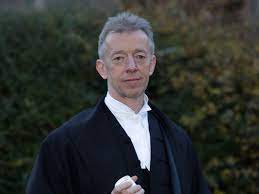
Dr. Brian Lacey relaxes at his rural west Donegal home in the shadow of Errigal mountain.

Lively septuagenarian, author, archaeologist and historian, Brian Lacey is an exceptional dinner guest. A fine raconteur with quirky views of the world, he’s a man at ease with laughter and story-telling.

And he has just penned his latest book, on a spin-doctor called Adomnán (or Eunan) who single-handedly raised Columba’s name to ‘the High Heavens’ by inventing a series of mostly fictional or at the very least, highly-exaggerated, stories about the founder of Iona Monastery and the ‘miracles’ he supposedly performed.

Rather than it being a selfless literary endeavour, Adomnán’s reasons for writing his book were directly linked to both politics and money. In raising the profile of Columba, he also raised the public profile of the community of monks on Iona that he presided over 100 years after its founder had passed on, thus no doubt encouraging new recruits to sign up and more money donated to the monastery’s coffers.

Meeting the man himself, academic celebrity par excellence.

Some in Ireland might use local slang and call Adomnán ‘a cute hoor,’ loosely translated as ‘a shrewd scoundrel, especially in business or politics.’ Probably he was, but he also achieved much more, as you can see from the article below I wrote for the ‘Donegal News’ recently.

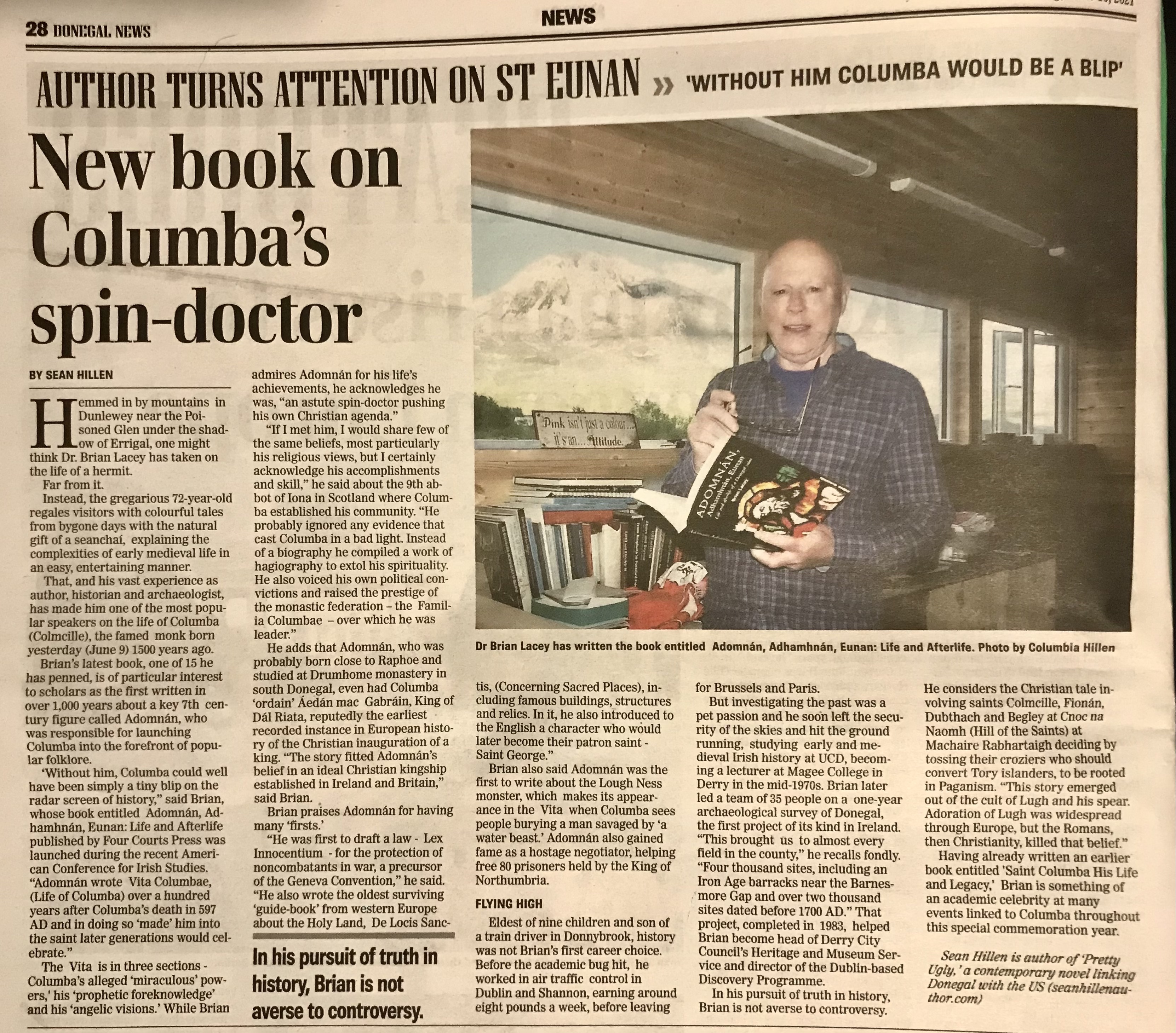
New Book On Columba’s Spin-doctor 

By Sean Hillen

Hemmed in by mountains in Dunlewey near the Poisoned Glen under the shadow of Errigal, one might think Dr. Brian Lacey has taken on the life of a hermit.

Far from it.

Instead, the gregarious 72-year-old regales visitors with colourful tales from bygone days with the natural gift of a seanchaí, explaining the complexities of early medieval life in an easy, entertaining manner.

That, and his vast experience as author, historian and archaeologist, has made him one of the most popular speakers on the life of Columba (Colmcille), the famed monk born yesterday (June 9) 1500 years ago.

Brian’s latest book, one of 15 he has penned, is of particular interest to scholars as the first written in over 1,000 years about a key 7th century figure called Adomnán, who was responsible for launching Columba into the forefront of popular folklore.

‘Without him, Columba could well have been simply a tiny blip on the radar screen of history,” said Brian, whose book entitled Adomnán, Adhamhnán, Eunan: Life and Afterlife published by Four Courts Press was launched during the recent American Conference for Irish Studies. “Adomnán wrote Vita Columbae, (Life of Columba) over a hundred years after Columba’s death in 597 AD and in doing so ‘made’ him into the saint later generations would celebrate.”

The Vita is in three sections – Columba’s alleged ‘miraculous’ powers,’ his ‘prophetic foreknowledge’ and his ‘angelic visions.’ While Brian admires Adomnán for his life’s achievements, he acknowledges he was, “an astute spin-doctor pushing his own Christian agenda.”

“If I met him, I would share few of the same beliefs, most particularly his religious views, but I certainly acknowledge his accomplishments and skill,” he said about the 9th abbot of Iona in Scotland where Columba established his community. “He probably ignored any evidence that cast Columba in a bad light. Instead of a biography he compiled a work of hagiography to extol his spirituality. He also voiced his own political convictions and raised the prestige of the monastic federation – the Familia Columbae – over which he was leader.”

He adds that Adomnán, who was probably born close to Raphoe and studied at Drumhome monastery in south Donegal, even had Columba ‘ordain’ Áedán mac Gabráin, King of Dál Riata, reputedly the earliest recorded instance in European history of the Christian inauguration of a king. “The story fitted Adomnán’s belief in an ideal Christian kingship established in Ireland and Britain,” said Brian.

Brian praises Adomnán for having many ‘firsts.’ 

“He was first to draft a law – Lex Innocentium – for the protection of noncombatants in war, a precursor of the Geneva Convention,” he said. “He also wrote the oldest surviving ‘guide-book’ from western Europe about the Holy Land, De Locis Sanctis, (Concerning Sacred Places), including famous buildings, structures and relics. In it, he also introduced to the English a character who would later become their patron saint – Saint George.”

Brian also said Adomnán was the first to write about the Lough Ness monster, which makes its appearance in the Vita when Columba sees people burying a man savaged by ‘a water beast.’ Adomnán also gained fame as a hostage negotiator, helping free 80 prisoners held by the King of Northumbria.

Flying  high

Eldest of nine children and son of a train driver in Donnybrook, history was not Brian’s first career choice. Before the academic bug hit, he worked in air traffic control in Dublin and Shannon, earning around eight pounds a week, before leaving for Brussels and Paris.

But investigating the past was a pet passion and he soon left the security of the skies and hit the ground running, studying early and medieval Irish history at UCD, becoming a lecturer at Magee College in Derry in the mid-1970s. Brian later led a team of 35 people on a one-year archaeological survey of Donegal, the first project of its kind in Ireland. “This brought us to almost every field in the county,” he recalls fondly. “Four thousand sites, including an Iron Age barracks near the Barnesmore Gap and over two thousand sites dated before 1700 AD.” That project, completed in 1983, helped Brian become head of Derry City Council’s Heritage and Museum Service and director of the Dublin-based Discovery Programme. 

In his pursuit of truth in history, Brian is not averse to controversy. He considers the Christian tale involving saints Colmcille, Fionán, Dubthach and Begley at Cnoc na Naomh (Hill of the Saints) at Machaire Rabhartaigh deciding by tossing their croziers who should convert Tory islanders, to be rooted in Paganism. “This story emerged out of the cult of Lugh and his spear. Adoration of Lugh was widespread through Europe, but the Romans, then Christianity, killed that belief.” 

Having already written an earlier book entitled ‘Saint Columba His Life and Legacy,’ Brian is something of an academic celebrity at many events linked to Columba throughout this special commemoration year.

Published in the ‘Donegal News’

If you want to know more about skulduggery disguised as religion and furious political struggles between Celtic Christians and their Roman counterparts, read the excellent series of Sister Fidelma novels by Peter Tremayne (pseudonym for Peter Berresford Ellis, historian, literary biographer and novelist). 

Fidelma is a ‘dálaigh’ or judge in ancient Ireland, a sexy red-haired female version of Sherlock Holmes in a habit.

Intrigued by the reputation of this early Irish mystic monk known as Columba, I decided as a travel writer to head for Iona, the Scottish island where he established his community of like-minded people. Here’s what I found after landing on a little stony pier after taking the ferry from Mull last autumn, a massive, treacherous sea crossing that took all of five minutes.

Click on the photo to read the story

Journalism: a funny thing, sometimes

Sometimes it’s not writing about political showmanship and skullduggery or economic booms and busts that create good journalism.

Sometimes, it’s the simple quirks of everyday life that make for a good story.

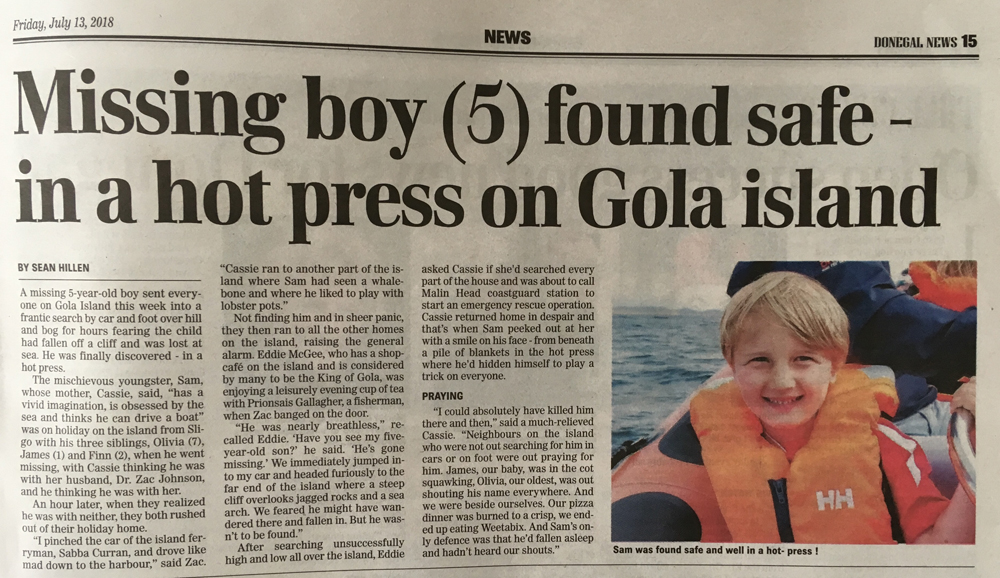
You can imagine my delight in unearthing these two tales of near disaster in Donegal that end happily.

They give new meaning to the term ‘missing people.’

Missing boy (5) found safe – in a hot press on Gola Island

gola island donegal, donegal tourism, gaeltacht tourism,

He almost ‘missed the boat’ 

gaeltacht tourism, gola island, donegal tourism


Wizards of Lies, or nightmare accountancy?

Would you approve almost one million euro in public money for a company with liabilities of half a million and a cash shortfall of around 200,000?

Hardly.

Strangely, that’s what seems to have happened in the case of SLM, the English call center that closed several weeks ago without warning in the Donegal Gaeltacht leaving many local people still owed a big chunk of back salaries.

Helluva Christmas gift Mr. Scrooge!

And here’s something even more intriguing…

Michael Gallagher, from the coastal village of Falcarragh, is an intelligent and likeable fellow, a man deeply concerned about social justice.

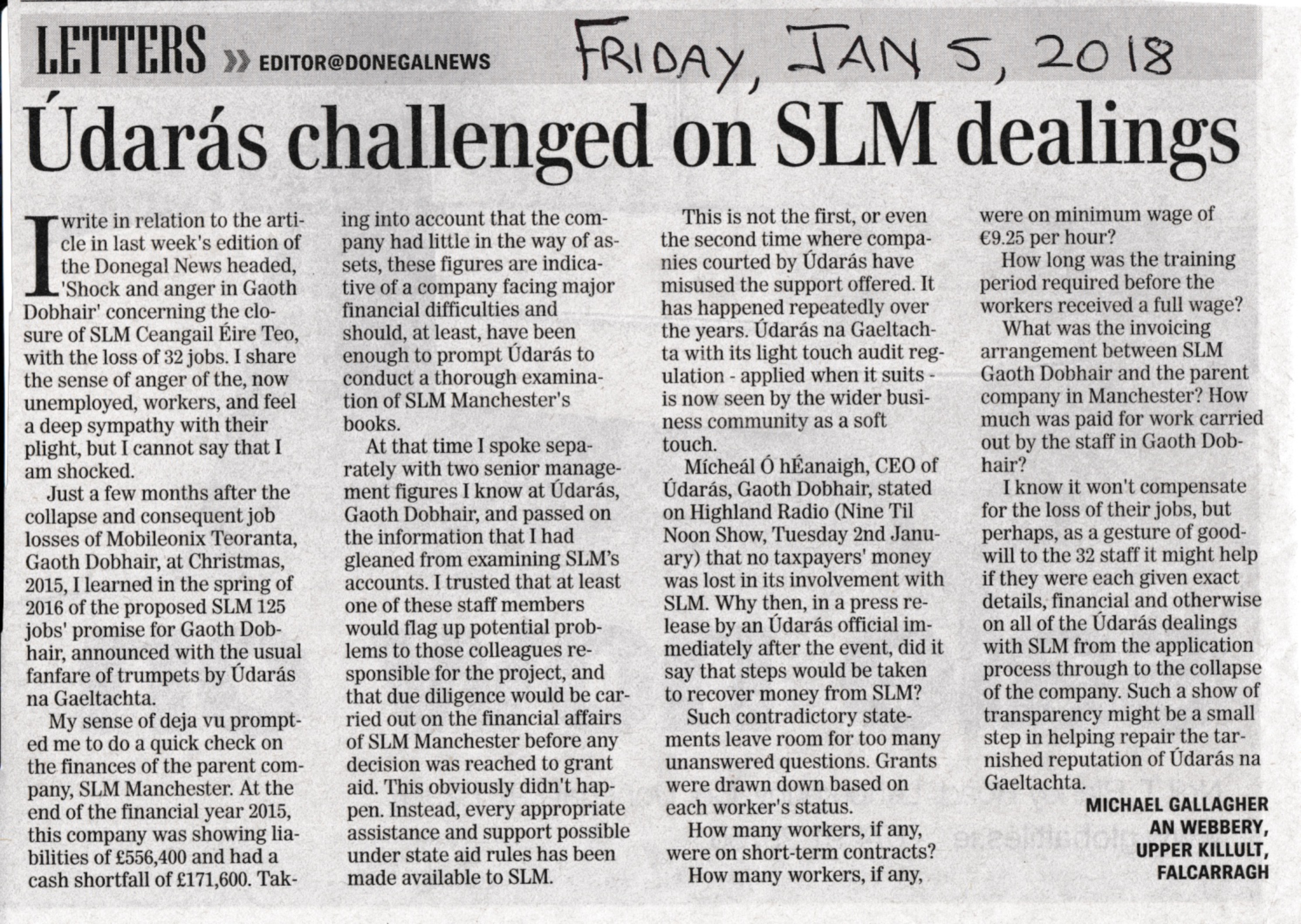
Sensing something amiss, Michael decided to carry out his civic duty and promptly investigated the financials of the Manchester-based company in the official register. Shocked by what he unearthed, he quickly warned two senior staff members at the economic group, Údarás na Gaeltachta, which intended to hand the company close to a million euro of scarce public money.

Michael Gallagher letter about SLM, Udaras and SLM

Alas, Michael’s timely and crucially important information seemed to have been promptly ignored as Údarás went full-steam ahead with its earlier decision to pour 842,000 euro into the company – strongly supported, maybe even led, by Minister of the Gaeltacht, Joe McHugh.

The award was announced with fancy fanfare, with screaming national and local newspaper headlines. Written by Greg Harkin, now a spin doctor for Minister McHugh, an article in ‘The Irish Independent’ read, ‘125 new jobs announced at SLM Éire Teo in Donegal.’  Not surprisingly, McHugh – who seemingly went to school with SLM manager James Moran and flew to Manchester to seal the deal – was given a pretty quote about being ‘delighted.’

The Údarás website blasted, ‘UK Digital Marketing company to create 125 jobs in Gaoth Dobhair, Co. Donegal,’ with its then CEO  Steve Ó Cúláin saying, “Today’s announcement is the result of Údarás’ enterprise strategy for this vibrant Gaeltacht region. I wish the promoters of SLM Éire every success and wish to thank the Údarás employees whose dedication is helping to make this jobs announcement become a reality.”

Cupán Tae

Meanwhile, quite separately, my interest in SLM began in the most innocent of ways – over a welcome cup of tea shared with a fellow jogger after a challenging morning run. The person worked at the call centre and complained training was lax, pay was the legal minimum, bonus targets were pretty much unreachable and on-the-floor Manchester managers were as scarce as a prickly cactus growing in the turf bogs. Adding that only around 30 people worked there, a far cry from the 125 promised more than a year before.

Two weeks later, on December 3, an article appeared in the ‘Donegal News,’ with the surprising headline ‘SLM Eire Teo Plans To Increase Its Workforce.

Strangely – considering the company closed its doors permanently in Donegal a few short weeks later, barely one year into operations – local SLM manager, James Moran and Paid O’ NeachtainÚdarás public relations director, both said the company would employ more people.

Sheer ignorance? Spin doctoring? Who knows?

Out of the quagmire that has resulted, a key question remains: why did a supposedly experienced, national economic organization such as Údarás award such a formidable grant to a company obviously struggling to make ends meet?

Michael Gallagher discovered SLM Manchester at end financial year 2015 had liabilities of 556,400 pounds sterling and a cash shortfall of 171,600. My Freedom of Information request showed Údarás approved an employment grant for SLM of 614,000 euro, plus a 60,000 employment grant for managers, a training grant of 100,000 and rent subsidy of 68,000.

budget for SLM Donegal, Udaras funding SLM Donegal

Is no-one at Údarás trained in simple analytical accountancy? Did they simply choose to ignore SLM’s shaky financial situation? Or did Minister McHugh – for political kudos through positive media coverage – override concerns that may have been raised by Údarás staff? Or indeed, did everyone involved truly believe this was an employment bonanza for the Donegal Gaeltacht but were duped by SLM owners?

The answer my friend – to use the words of a well-known song ‘…is blowin’ in the wind.’ And, as usual in modern Ireland, no-one’s taking responsibility for failings.

Isn’t this exactly what got Ireland into economic quicksand? Isn’t this why the World Bank and the IMF own us? Isn’t this why health and education are underfunded, why sick people with IVs in their arms are sleeping on chairs in hospital corridors?

If you want to know more about how Údarás spends scarce public money, simply e-mail Cathal O Gallachóir c.ogall (at) udaras.ie and ask for information under FOI. With what you find out, you might even be encouraged to do what Michael Gallagher did, write a letter to the editor Údarás challenged on SLM dealings thus placing important information in the public arena, or notifying concerned councilors such as new Údarás board member, John Sheamais O’Fearraigh.

John Sheamais O’Fearraigh, Udaras Donegal

Curious to know how many SLM jobs that Údarás included in its annual summary, I have requested the much-delayed 2016 report, which 13 months later has still not been published.

It’s still blowin’ in the wind…

Are yoga, thai chai and reiki dreaded Druidic distractions? Is the anti-cervical cancer vaccine, HPV, the Devil’s poison?

Glancing through last Friday’s edition of the ‘Donegal News,’ I was dazzled by the sheer creativity of people from Ireland, (see a particularly interesting article on page 47 focusing on a man who lasted 70 days in prison without food and is now a Doctor in Sociology and a well-known Irish playwright and film and documentary script writer).

It’s as if the artists of every shade throughout Ireland and particularly in my resident county, Donegal – musicians, actors, painters, dancers et al – feel they have a deep, abiding, age-old responsibility to uphold our ancient rich Gael culture, and in doing so, prevent its dilution.

And I don’t mean – wonderful though it is – simply the native folk music and song of the lauded, award-winning Frosses-native Rita Gallagher and Gaoth Dobhair’s Mairead Ni Mhaonaigh (who play this Thursday at the Balor Arts Centre as part of the Bluestacks Festival).

rita Gallagher, Mairead Ni Mhaonaigh

Winners of TG4 Gradam Ceoil Awards.

I mean our vast spread of artistic talent, first brought here to these shores when definitive Celtic traditions arrived from places such as Romania and Gaul (Gallia) in the fourth century B.C.

Then, unlike all other islands, Alice Stopford Green tells us in her work ‘Irish Nationality,’ Ireland, “was circled round with mountains, whose precipitous cliffs rose sheer above the water standing as bulwarks against the immeasurable sea, providing a bulwark – though sadly not an invincible one – against invaders of all kinds. And certainly, helping far-flung places such as Donegal escape foreign domination.” (unlike the Pale of Dublin which followed a completely different tract).

Irish chroniclers tell of a vast Celtic antiquity, with a shadowy line of monarchs reaching back some two thousand years before Christ: legends of lakes springing forth; of lowlands cleared of wood; the appearance of rivers, the making of roads and causeways, the first digging of wells: the making of forts; invasions and battles and plagues.

The Celts or Gaels exalted and encouraged learning in national life. Professors of every school roamed freely here and the warrior’s duty was to protect them. There were periodical exhibitions of everything the people esteemed—democracy, literature, tradition, art, commerce, law, sport, the Druid religion, even rustic buffoonery. The years between one festival and another were spent in serious preparation for the next.

Innovative arts programme at the Balor Arts Center, Ballybofey, Donegal.

The law of the Celts was the law of the people. They never lost their trust in it. They never followed a central authority, for their law needed no such sanction. A multitude of maxims were drawn up to direct the conduct of the people.

While the code was one for the whole race, the administration on the other hand was divided into the widest possible range of self-governing communities, which were bound together in a willing federation. The forces of union were not material but spiritual, and the life of the people consisted not in its military cohesion but in its joint spiritual inheritance—in the union of those who shared the same tradition, the same glorious memory of heroes, the same unquestioned law, and the same pride of literature.

So deeply was their importance felt, the Irish have kept these tradition diligently, and even in the darkest times of our history, down to the 17th century, still gathered to ‘meetings on hills’ to exercise their law and hear their learned men.

Not-to-be-missed performer.

So please think of this rich vein of cultural tradition that we’ve inherited when you read this week about the wealth of artistic talent on display here in Donegal and throughout Ireland – the multi-talented Pat Kinevane from Temple Bar-based Fishamble enacting not one but three separate one-man plays beginning this Friday with ‘Forgotten,’ at An Grianan in Letterkenny, a fine venue under the organization of Patricia McBride, Helene McMenamin, Daithi Ramsay and other staff members; Fishamble’s literary officer, Gavin Kostick, hosting playwriting masterclasses this Saturday there; the Regional Cultural Centre in Letterkenny, under the direction of Shaun Hannigan, presenting a feast of autumn concerts, kicking-off with the duet of Eliza Carty and Tim Eriksen this Friday evening; and ‘The Ghostlight Sessions’ at the Balor Arts Centre in Ballybofey tonight, an evening of original music curated by Nikki Pollock (Mojo Gogo) and Dean Maywood and featuring ‘In Their Thousands’ and ‘Without Willow.’

Not to mention ‘The Donegal Voices’ this Friday in Ballyshannon performing Handel’s magnificent ‘Coronation Anthems’ and the ‘Hallelujah Chorus.’ Many of the performances are funded by the Donegal County Council/An Comhairle Ealaion.

First Lady of Celtic music – Donegal-born Moya Brennan.

And if you missed Moya Brennan of Clannad performing a few days ago with her husband, Tim, daughter Aisling and son Paul, in Teac Leo in Crolly, in support of the Inishowen Floods Fund, you’ll surely get the chance again to hear this brilliantly talented family in the future. The same goes for ‘Shoot The Gear,’ a fine piece of theater with a fishing-community based theme facilitated by the Killybegs Fishermen’s Organization, written by An Grianan Theatre artist-in-residence, Guy Le Jeune, and performed by a cast of local actors, singers and musicians including Fionn Robinson, Louise Conaghan, Orlaith Gilchreest and Ronan Carr.

Speaking of music, what a terrific accomplishment by Donegal Music Education Partnership (DMEP) manager, Martin McGinley, and his team, including tutor and pianist, Ellen Quinn, Maureen Fryer-Kelsey and James Sarsteiner , with help from Marianne Lynch of Donegal County Council Library Services in putting together a new online library of more than 1,500 musical items that the public can easily access.

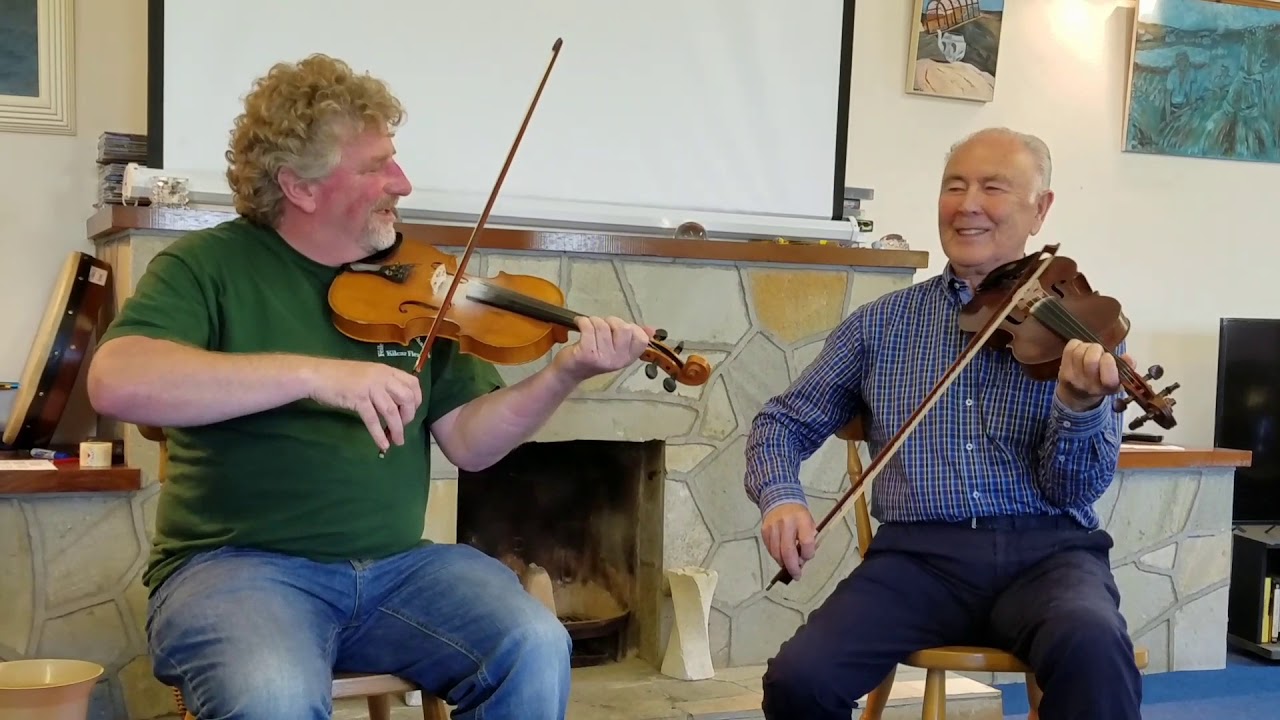
Martin McGinley (left) – Journalist, editor, fiddle player par excellence, now manager of Donegal Music Education Partnership.

However, as we rightly attempt to emulate our rich, multi-layered Celtic past, I would issue a sharp warning. While the keystone of our proud ancestors’ beliefs was based on the premise of democracy, each individual having a fair say, let us beware.

The Catholic Church – so long dominant in Irish society after vanquishing Druidic life, more so in rural Irish society – must now learn to accept – in turn – its rapidly changing place. And that place is no longer its own self-styled, unquestioning right to direct all community groups, especially on sensitive matters of finance. Too often have I heard complaints here in the Donegal Gaeltacht and elsewhere in Ireland about frocked priests and bishops sitting at the heads of tables, making vital decisions, often cunningly in an underhand way ahead of the formal committee meetings, on where vital monies should go. And not always to the benefit of the community as a whole – but to the church in particular.

My own area, Cnoc Fola, has just received a grant of 40,000 euro from Fine Gael Minister Joe McHugh. Considering the rather incestuous relationship between the Catholic Church and successive ruling political parties in Ireland – Fianna Fail and Fine Gael – is it reasonable for me to expect there is no payback expected, from both church and state, for this money, in terms of votes and support?

Is it also reasonable for me to trust the word of men in long black coats who describe yoga, thai chai and reiki as activities that ‘endanger our souls’ and who also discourage women from taking the HPV vaccine against cervical cancer, saying it simply encourages widespread promiscuity and immorality? And who move child abusing clergy from parish to parish?

Some months ago in a previous blog, I invited a well-known, rather affable west Donegal Gaeltacht priest, Brian O’Fearraigh, to join community members in our weekly yoga sessions at An Crann Og in Gaoth Dobhair. He hasn’t made an appearance yet. My offer is still open. He’d receive a warm ‘Cead Mile Failte’ from very friendly people there.

What do these seemingly unrelated issues – yoga, thai chai, reiki and the HPV vaccine – have in common, anyway? Freedom of mind and body, of course. And such displays of individual identity are perceived as hot, red-light dangers by most major corporation and institutions, especially the more conservative ones.
Wait for it, it’ll be swimming, cycling, swing dancing and jazz next. Oh, I forgot, the latter was already forbidden by the Church to all God-fearing people some years ago.

Does that mean God-loving people can enjoy such relaxing music? Even if they are Druids, Pagans, atheists, agnostics or pantheists and their God is Mother Nature herself?

Notes 

Hope you like my latest published novel, the suspense Pretty Ugly, linking Donegal and other parts of Ireland, including Belfast, with the US cities of Boston, New York, Kansas City and Washington DC.

Interested in creative writing? A novel? Biographical memoir? Play or movie script? See Ireland Writing Retreat

Who’s the mystery whistle-blower inside the corridors of Údarás na Gaeltachta?

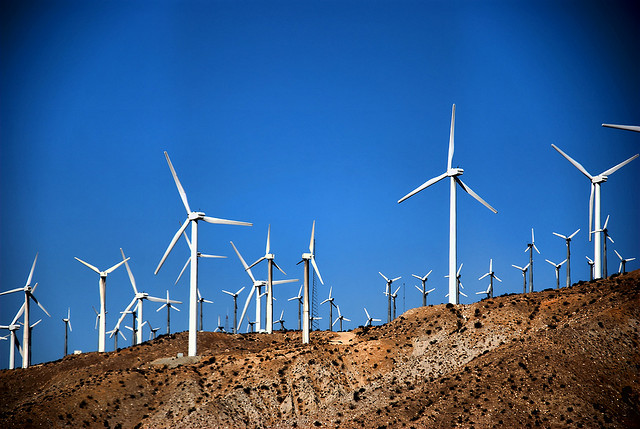
Seems as if Donegal’s leading newspaper and Údarás na Gaeltachta are on a head-on collision over truth following publication by the ‘Donegal News’ recently of sensitive, confidential correspondence indicating the Irish language group has been planning wind-farms on many sites throughout the county and an immediate rebuttal of the article in a press release issued by the Irish language group.

Údarás na Gaeltachta has wind turbine plans for six sites

An tÚdarás dismisses wind turbine talks

If not for strong protest meetings by Stad An Tuirbín Gaoithe, a community-based Donegal group opposing Galway company, Lir Energy Ltd’s plans to construct 123- meter turbines on publicly-owned land in Gweedore and a flood of more than 100 objection letters to the county council, a forest of turbines could have gone up ‘under the radar’ – some in scenic sites and some close to homes.

According to the confidential correspondence obtained by the newspaper, these could include Ardara, Kilcar, Fintown, Cloghan, Termon and Glencolmcille.

A string of shady dealings have left many people disturbed by the clandestine way in which Údarás now seems to operate, both locally in Donegal and out of its Galway headquarters.

Following the secrecy of the sale by Údarás of Irish seaweed rights to Canadian multinational Acadian Seaplants, with an unprecedented ten-year confidentiality clause attached to the contract, by which no documents can be accessed, some observers say the Irish language economic group has lost public confidence.

An Oireachtas Public Accounts Committee (PAC) investigation queried why 30,000 euro was spent by Údarás on seven different trips by senior officials to look at “seaweed projects” in Halifax, Canada, according to a report in The Irish Times.

These suspicious situations plus behind-the-scenes talks with a Catholic Church group to construct what some say was to be an alcohol, sex-addiction and drugs rehabilitation clinic in Falcarragh in a landscaped green area now used for community walks and jogging, has left some wondering if the publicly-funded group has reneged on its responsibilities in terms of transparency and fairness.

Landscaped area in Falcarragh that was being earmarked for an addiction center to be funded by Udaras.

“This organization is funded out of the public pocket so at the very least it should be open about how exactly it’s spending that money,” said one irate Gaoth Dobhair resident at the recent ‘Scoil Gheimridh’ (Winter School) music festival. “People are also questioning the ownership of this Galway company, Lir, and what its connections might be to top executives of Údarás. It could be a re-run of the seaweed scandal.”

It has also become known that the Údarás office in Donegal is to be paid a whopping 600,000 euro for managing a 2.3 million euro EU LEADER scheme in the county, almost a quarter of the total funding, aside from several million euro it receives annually out of the national public coffers.

“Is the wind-farms’ project simply another way for Údarás executives to make money?” said a resident of Bunbeg earlier this week. “There’s no proof at all they’ll help reduce energy costs as we’ve had wide turbines for years in the area and there’s been no obvious public benefit at all. It’s long past time people were told just how much money is being used by Údarás for projects that create jobs and how much is simply being used to top up executive salaries and expenses. For God’s sake, Údarás staff have the highest salaries of any group under the Department of Arts, Heritage, Regional, Rural and Gaeltacht Affairs.”

While many criticize Údarás for its poor record in job creation in Donegal, it must be acknowledged that it is not easy to attract companies to Ireland’s most northwesterly region, but few would disagree that greater transparency is necessary to calm rising fears that scarce public money is being misspent.


If you’re interested in political and corporate corruption in a suspense novel linking Donegal to the US, read newly-published ‘Pretty Ugly,’ to be launched also in Dublin this month.  Can be purchased direct from Amazon, in eBook or print form and locally, in Donegal from Gallaghers or Matt Bonners Bunbeg, or Easons Letterkenny.


Grassroots initiative promotes men’s health and well-being

Few things deserve greater praise than a community-led initiative that helps increase the quality of life of its members – thus the Men’s Sheds concept.

Started only five years ago, the idea has enjoyed phenomenal growth with more than 350 such sheds throughout Ireland already with an amazing 10,000 people attending activities every week, and a growth rate of 1.5 sheds per week. Donegal alone has 10 sheds.

What’s the aim? A simple, yet admirable one – improving members’ mental and physical health through diverse activities.

See article below I wrote for this week’s edition of the ‘Donegal News.’ It contains a couple of Donegal contacts for those interested in finding out more.

Making Lives Better in the Shed

Many men throughout Donegal travelled to Belfast this past weekend for the biggest international gathering of ‘Men’s Shed’ members with the goal of developing diverse activities and closer links with each other to help improve members’ physical and mental health.

Embracing the traditional concept that the garden shed has long served as a sanctuary for men, a place where they ease the everyday stresses of life, ‘Men’s Sheds’ are spaces where men meet and work together on diverse projects. Community-based and non-profit, they are open to all men who want to enjoy a safe, friendly and inclusive environment.

Sheds without Borders, Gaobh Dobhair Men’s Shed

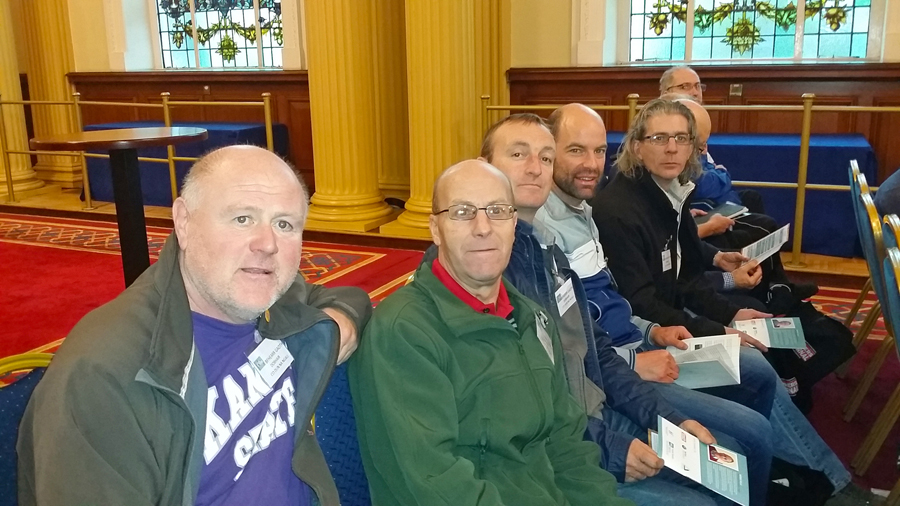
Members of Gaobh Dobhair Men’s Shed (Scioból na bFhear), Liam Ó Gógáin, Paul Treacy, Michael Coll, Dónal Clancy and Austin O’Donnell, at Belfast international ‘Sheds without Borders’ conference.

Founded just five years ago, the Irish Men’s Sheds Association (IMSA) organized the Belfast event, entitled ‘Sheds without Borders,’ which was attended by several hundred people from countries such as Scotland, Wales, Australia and Ireland. The association has experienced phenomenal growth and now represents sheds both here and across the border with a rapidly-increasing membership of 350, with around 10,000 ‘shedders’ attending weekly. It is growing at a rate of 1.5 sheds per week. Membership is also expanding in Northern Ireland, with 44 sheds and around 1,000 attending weekly. Donegal now has about 10 sheds county-wide.

Reflecting on their growing popularity, Liam O’Gogain, a member of Gaobh Dobhair shed (Scioból na bFhear) in the local industrial estate who went to Belfast with several colleagues, said, “Worldwide, sheds have a proven positive mental health dividend for members countering feelings of isolation with a relaxed, community spirit and an opportunity to share your skills and learn new ones.” He said “increasing public awareness” about them was key, with the shed he attends meeting every Monday and Thursday evening 7-10 pm. Anyone interested can contact sciobolgaothdobhair@gmail.com or call Liam on Mobile 087 254 3997 for details.

Liam Ó Gógáin Donegal, Men's Sheds

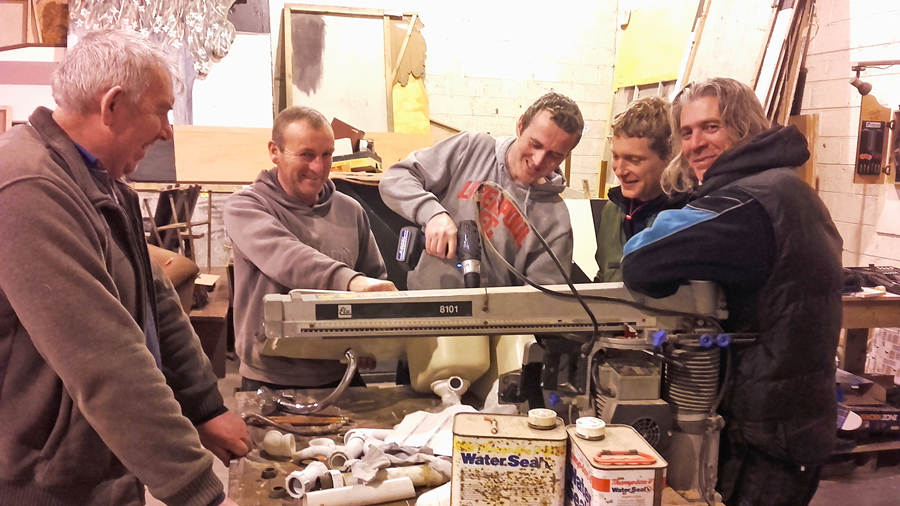
Shedders enjoy a joke while converting a disused room into a tea-room using bits and pieces.

Enthused by the Belfast conference, O’Gogain said he heard, “endless stories from men of all ages about how their shed has transformed their lives, through friendship, conversation and simply having fun with projects,” which, he added, “creates effusive, natural companionship.”

Asked why Men’s Sheds’ are particularly important in Donegal, he added, “With the loss of the manufacturing jobs base here, Scioból na Bfhear, like other such sheds, provides a welcoming environment for men from every background from their mid-30s to their 80s, any age, to gather and work together through craic and collaboration.” As to the benefits of last weekend’s international event at Belfast City Hall, he said, “We made friends and contacts with other sheds in Donegal and throughout the country who offered information, ideas and support to fledgling sheds. Interesting talks ranged from mental health to adult learning.”

Back from Belfast and speaking about inclusiveness and easing social isolation, Gerry Connolly, chairperson of the Ballybofey-Stranorlar shed established last year, now with 30 members, said, “We started, in part, because may men here in the area suddenly became unemployed either out of illness or redundancy when the crash happened but we also have many retirees.” Members completely renovated and rewired a Portacabin for meetings, which is also used by other community groups, and will make ‘buddy benches’ for schools with the help of a skilled woodturner. Those wishing to know more can contact Gerry at Mobile 086 825 0550.

Shed activities nationwide range from boat-building to making ornamental crafts from wood such as candle-holders and toolboxes to simply playing pool or table-tennis and creating choral groups.

Good writing gives me goose-bumps

Having arrived in picturesque west Donegal – Bun na Leaca to be precise – over six years ago and recognizing it for the artists’ haven that it is, my wife, Columbia, and I thought about establishing a creative writers’ retreat.
After all, surely such a pristine and bucolic landscape could inspire great prose. 

Ireland Writing Retreat participants enjoy a special Celtic legend coastal walk with guide, Seamus Doohan.

Not that such an idea hadn’t been done before.  Poet partners, Janice Fitzpatrick Simmons and her late departed husband, James, had done so many years previous, setting up a ‘Poet’s House’ in a refurbished cottage at Clonbarra, outside Falcarragh.

Then funding was more generous and tens of thousands of euro annually wasn’t much of a problem for Udaras na Gaeltachta, the Arts Council, Donegal County Council, LEADER, and other sources.
Times have changed, however, and the public funding pump is dripping slowly, a mere trickle at best. Seanie FitzPatrick and Co. and Fianna Fail made sure of that.

Rose Sweeney teaches future members of the ‘Riverdance’ cast the basic ‘sevens’ of Irish ceilidhe dancing.

County Librarian and Divisional Manager of Cultural Services, Eileen Burgess, a keen supporter of our idea, issued warnings: “It’s a wonderful project but there’s simply no money in the kitty. You’d pretty much be on your own.”

But you know how it is – an intriguing idea comes along, sticks to you like furze in a meadow and simply won’t fall away no matter how hard you try.
So, even though there are more than one hundred creative writing conferences and book festivals throughout Ireland – many in the much-publicized, tourist-centric counties of Dublin, Cork, Galway and Kerry – we took the plunge.
After all, isn’t Donegal the prettiest of them all?

Washington-based triple book author and former CNN editor, John DeDakis, enjoys a leisurely trip on ‘The Cricket’ to Gola Island with other writing retreat participants.

Of course, wisdom told us to delay until better economic times were upon us. But passion drove us forward, screaming, ‘tempus fugit.’ We swayed for a while between the two.

We’re going into our third year now and have managed to attract participants from far off fields, many of whom had never been to Ireland before never mind the back-roads of the Donegal Gaeltacht – Wyoming, Sydney, Utah, Perth, Stoke-on-Trent, New Jersey to name but a few.
Not bad for a project without public funding of any kind.

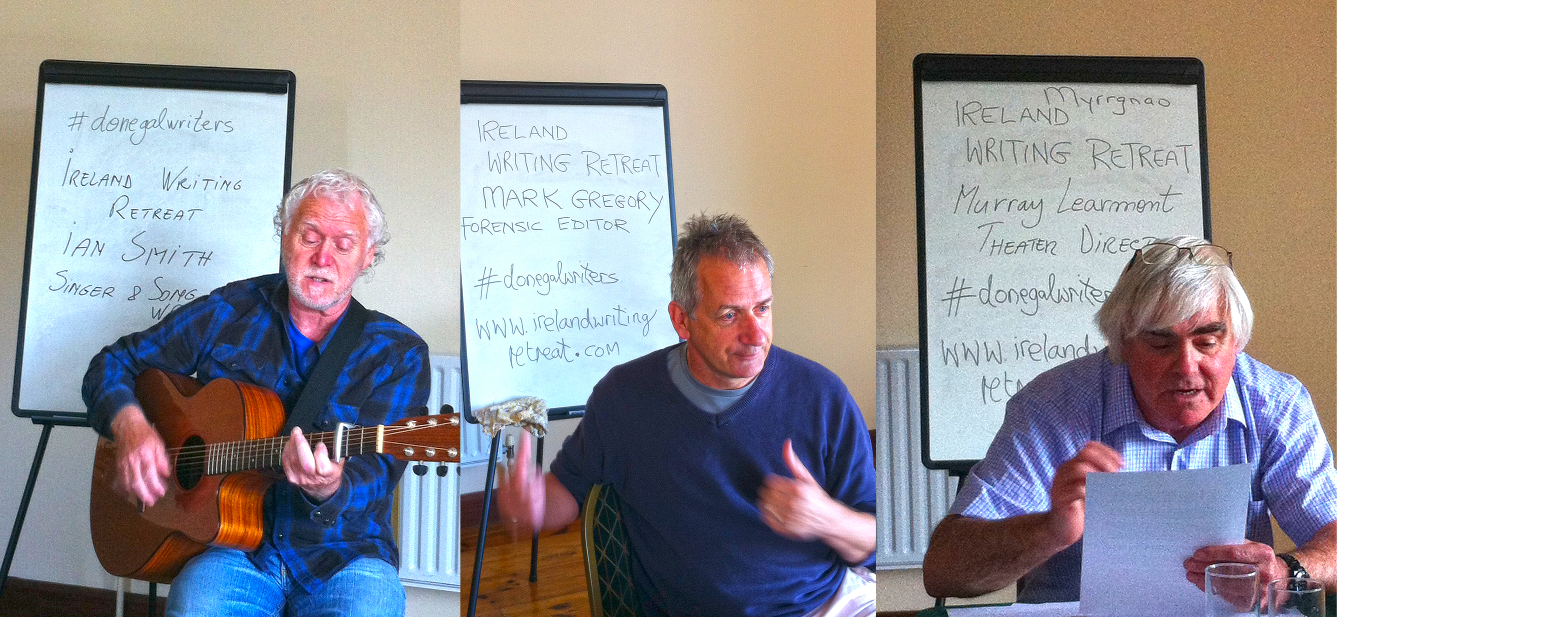
Guest speakers at the Ireland Writing Retreat held at Teac Jack, Gaoth Dobhair. (l to r) Singer-songwriter-guitarist, Ian Smith; Mark Gregory, forensic editor; actor/director Murray Learmont.

Imagine where it could go with a bit of financial support – but perhaps only if it’s located in one of the aforementioned counties.

As for this year, international stars of the week-long retreat included John DeDakis, triple book author and former senior editor at CNN for 25 years who flew directly from Washington to be at Teac Jack’s, the retreat location; Anthony Quinn, experienced author of crime fiction with a crafty literary twist; and Mark Gregory, a much-heralded forensic editor (the person who reads book manuscripts minutely word by word, syllable by syllable).

Plot, character, suspense – (l to r) Authors John DeDakis and Anthony Quinn discuss the challenging task of writing novels.

But committed locals also loaned their weight enthusiastically to the endeavor – actor and drama group director, Murray Learmont, guided participants on improving their public reading skills; singer-songwriter-guitarist, Ian Smith granted insights into the challenging task of lyric writing; Rose Sweeney taught participants their ‘sevens’ in preparation for a ceilidhe in the backroom of the popular Glassagh venue; Pól Ó Muireasáin gave an enlightening tour of Gola Island; and Seamus Doohan led participants on a Celtic legend coastal walk – all of which was grist to the mill for writers’ creativity.

Eddie, the uncrowned King of Gola Island (in blue) with walking guide, Pol O’Muiresean, (r) talk about life on the west Donegal island many years ago.

The ‘Donegal News’ considered this year’s ‘Ireland Writing Retreat,’ which ended last week, worthy of an article in today’s edition.
article
Onward to 2016.
 

Whale sightings off Donegal coast encourage educational and tourism efforts

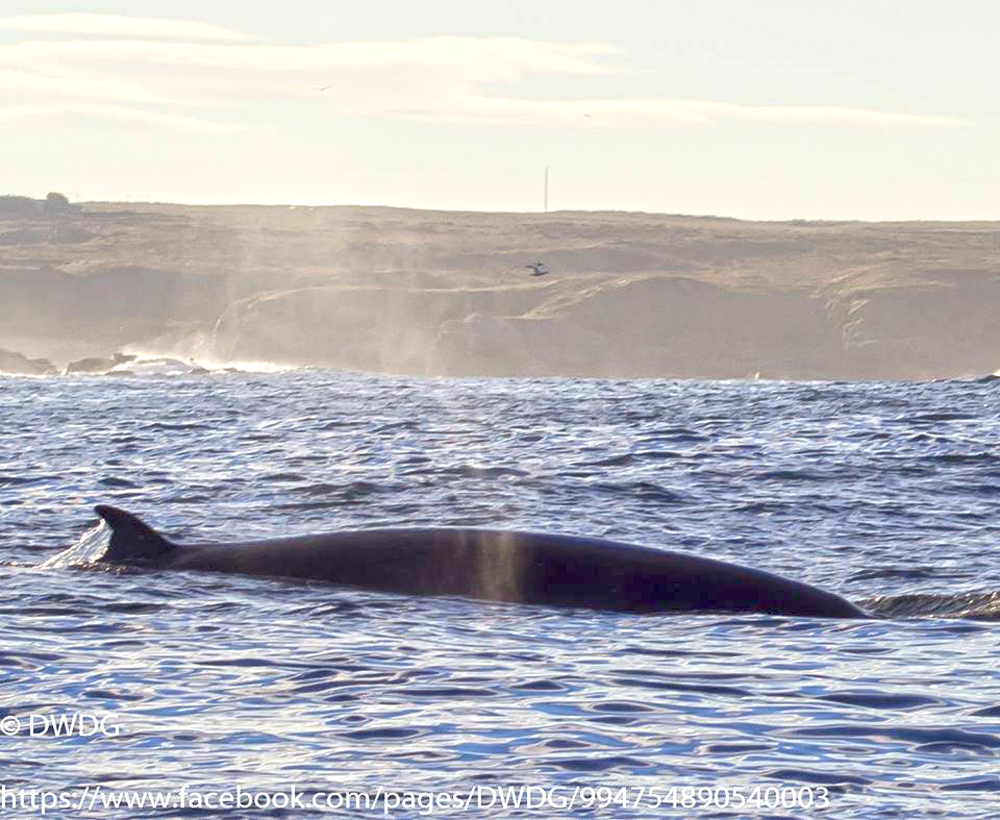
Approaching within 30 feet of a minky whale out on the Atlantic takes courage – but such is his concern for the welfare of local marine life that’s exactly what Gareth Doherty did recently.

With the sighting of so many such baleen whales off the northwest Donegal coast over the last few weeks, Doherty, a skilled seaman (he manages Selkie Sailing in Gaoth Dobhair) and knowledgeable environmentalist, realized it would be a prime opportunity to try to identify them and monitor their movements and thus understand better the thriving whale population off Irish coastal waters.

whales 1

“It is only by recording the twenty-four cetacean species recorded thus far in Irish waters that we can protect them,” he said. “The fact that so many are now visiting us is wonderful news.”

whales 6

Doherty also believes that greater numbers of such healthy marine animals locally means greater opportunities to both educate people about this vital segment of sea-life and strengthen environmental tourism efforts throughout Donegal.

Here is yet another local cultural tourism-cum-educational project worthy of financial support. Udaras na Gaeltachta, the state-sponsored economic support group in the area, has refused to pay for much-needed equipment for Selkie Sailing.

Readers of this blog and of a series of articles I penned for the Donegal News will remember Gareth for the sterling work he and others did to bring important publicity about the plight of a pod of stranded whales at Ballyness beach in Falcarragh earlier this year.

whales 2

Not only did Gareth and colleagues highlight the stark inadequacies, both in equipment and training, of the National Parks and Wildlife Service to deal with such incidents (it has since become known that Donegal wildlife officials didn’t even take sample tissue from any of the dead whales to ascertain what may have stranded them and led to their slow suffocation) but they also banded together to organize marine lifesaving training programs for people that continue even now.

Visiting my Bun na Leaca home recently, Gareth said his intention was also to launch a series of educational visits to local schools to make presentations about the importance of marine life around our shores. It is an excellent idea and there seems no more qualified and enthusiastic a person to host such a program than Gareth.

whales 3

Minke whales grow to about nine meters in length, weigh around 10 tons and can live about 50 years. Their bodies are dark grey to black on the back and lightening to white on the belly and undersides of the flippers. There are often areas of light grey on the flanks, one just above and behind the flippers and the other behind the head. Those in the northern hemisphere usually have a diagonal white band on the upper surface of each flipper. Smallest of the seven great whales, minkes often enter estuaries, bays and inlets and feed around headlands and small islands.

Updates can be checked on Selkie Sailing.

The Irish Whale and Dolphin Group assisted with local training programs.