Stranded pilot whales buried alive?

Below is a more extensive story to the one I wrote for the front page of yesterday’s (Monday) ‘Donegal News’ on the seeming lack of co-ordination, expertise and simple know-how that led to the tragic deaths of a pod of 12 young and adult pilot whales from slow suffocation at Ballyness beach near Falcarragh last week.

Following public outcry over how 12 pilot whales were left by conservation officials to suffocate over the last week at a west Donegal beach, talks have been initiated between the Irish Whale and Dolphin Group (IWDG) and the National Parks and Wildlife Service (NWPS) over alleged mistreatment.

In a message from the founder and executive officer of IWDG, Professor Simon Berrow voicing concerns over the handling of some of the stranded whales at Ballyness beach near Falcarragh and the need for an immediate meeting with the NWPS.

IMG_1721

Wildlife service and Donegal county officials on whale death watch

One wildlife service official, who declined to be named out of fear his job would be in jeopardy, acknowledged “it was a disgusting situation, terrible decisions were made,” adding “management heads at the service should roll over this debacle.” The official added, however, that calls were made to the IWDG seeking guidance and were not returned. “Where were the experts when we desperately needed them?” the official added. “We could have done with that, a simple phone call back to talk us through what we should do. Even a picture, a video on a smart phone would have helped.”

It is believed internal reports – mainly critical of the overall operation at Ballyness beach – are to be submitted within the next few days to higher levels of national management within the wildlife service. “We have so many lessons to learn for this mess,” one official said.

Referring to two stranded pilot whales – highly-intelligent members of the dolphin family – that were helped back into the water by Gareth Doherty, local environmentalist and wildlife enthusiast with Selkie Sailing in Derrybeg, Berrow wrote: “Gareth, well done with all your efforts on the beach. These whales should have been euthanized after they re-stranded. It is not that difficult. Pentabarbitone or shooting would have been effective. The Irish Whale and Dolphin Group are seeking a meeting with NPWS to try and establish who is legally responsible for managing these live stranding events. IWDG think it is NPWS. It is simply not good enough to say there was nothing that could be done.”
whale 2

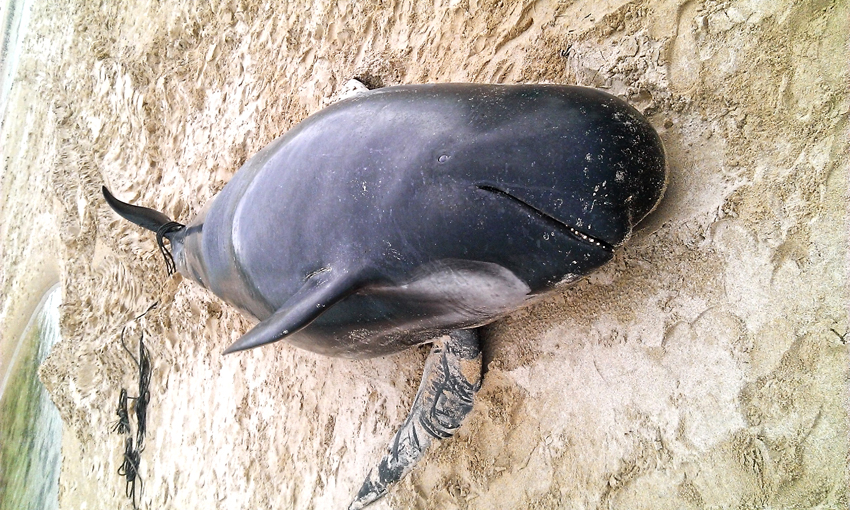
Tortured whale draws its last breath.

In contrast, Pat Vaughan, a local district conservation officer for the National Parks and Wildlife Service in charge of the stranded whale operation at Ballyness, said during the week that ‘mercy killing’ could not be used as “it is hard to find the drug and no vet has been trained locally to administer it as it requires special skill.” Vaughan acknowledged that no vet was consulted before the decision was made to allow “nature to take its course” and the whales to suffocate. “No vets are trained for this kind of thing here in Donegal,” he said. “No local vets want to be involved in situations like this.”

The Donegal county vet nor any of his associates offered to help deal with the tragic situation. This being the case, with no expert advice on hand, wildlife and environmental officials say it is quite likely some whales were buried alive. “Without the proper training and because the mammals are so large, knowing when they have died is not easy,” one official said. “What might have happened doesn’t bear thinking about. Their agony must have been excruciating.”

The message on the Selkie Facebook left by Berrow – a national expert on marine life who is a full-time lecturer at the Galway-Mayo Institute of Technology and has worked with the British Antarctic Survey and the International Whaling Commission – reflects confusion surrounding the handling of the situation at Ballyness beach. His communication highlights the lack of clear policy on such incidents in Ireland, not only with regard to which organization should be in charge but how to conduct a proper assessment about how the whales should be treated. After founding the IWDG in 1990, Berrow also helped establish the Irish Basking Shark Study Group in 2009.
whales 2.1

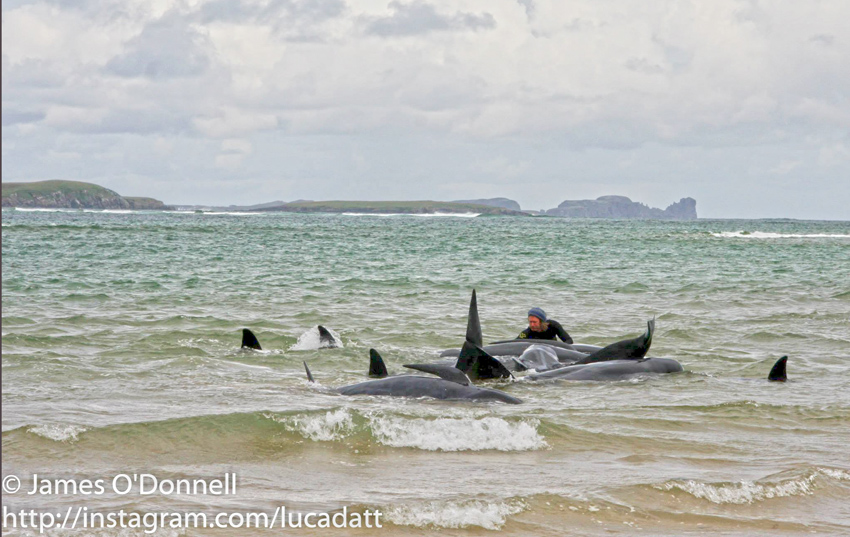
Environmentalist and wildlife lover, Gareth Doherty, tries to assist struggling whales at Ballyness beach.

A clear SOP (standard operating procedure) for dealing with whale strandings has become ever more important in Donegal as the ‘Ballyness tragedy’ is the 13th such incident in the county this year, not to mention the pod of 32 whales that died in Rutland Island two years ago that were cut up and transported to Cavan for incineration. A minke whale’s body was discovered off Bloody Foreland and left there on the rocks below a cliff to rot for two months and sperm whale was washed up on Magheraroarty beach and died.

“Statutory bodies – health, county officials, the Gardai, the coastguard, the whale and dolphin, wildlife services – we all need to sit down and work out what should be done and by whom in such situations,” said Vaughan, who added, “Our (the wildlife service) remit is just to measure the whales, identify the species and take blood and tissue samples.”

In a further development, the international Whale and Dolphin Conservation (WDC) group, active in over 25 countries globally, said after being contacted that it had provided the IWDG with a formal protocol procedure for cetacean (whales, dolphins, and porpoises) strandings. That policy clearly states, “IWDG will normally only consider reflotation after looking at individual circumstances (eg coastal or offshore species, body condition, location etc) and recommends consultation with an experienced veterinarian.”
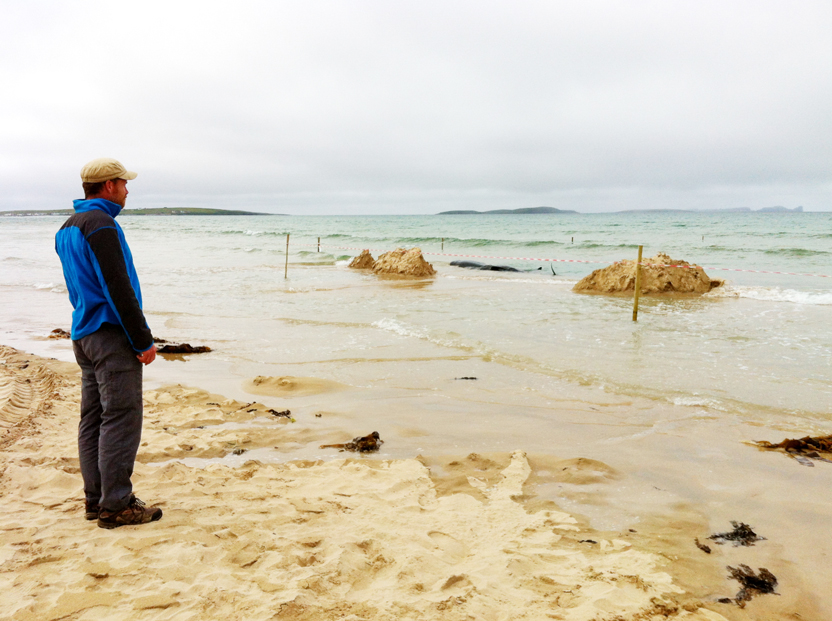
IMG_1739

Outdated protocol? Wildlife service official watches on while whales die slowly from suffocation.

In addition, those in charge at Ballyness could have availed of one the IWDG’s ‘live stranding kits.’  These kits are located in three strategic places around the country and “are designed to cater for animals up to 4m long and contain air mattresses, tarpaulins, veterinary equipment, torches, buckets etc. The pontoons are used for reflotation of larger animals, to about 6m in length, and if necessary, the smaller kits may be used to stabilize these animals while waiting for the pontoons to arrive.” Reports indicate that no such equipment was brought to Ballyness beach nor concerted efforts made to transport the whales back to deeper water. None of these three locations is in Donegal, even though so many whale strandings take place here every year.

Also, while in other parts of Ireland, the coastguard service is used to bring stranded whales out to sea to try to save them, in Donegal last week, the service was not asked to do this. “We follow best practise but bringing them out to sea is a futile exercise,” said Vaughan. “Rules are rules. We have to follow protocol.”

While in other parts of the world people assist in saving stranded whales, (see video of a humpback whale successfully rescued after being beached for 38 hours in Australia), at Ballyness beach wildlife authorities in charge deliberately discouraged people from helping, with one woman who was bathing a dying whale’s eye in saltwater to comfort the mammal was told to leave the scene or she’d be forced to do so.

Meanwhile, hundreds of people who arrived at the scene of the carnage at Ballyness, many of whom came there to help, were left disgusted at what they witnessed, as reflected in letters to the editor printed in local newspapers and on-air radio and television comments. Their concern for better co-ordination and more humane treatment of the mammals, including euthanasia where necessary, is being harnessed in a special petition that has been launched HERE. It is a petition well worth signing.

In a future blog: Toxic waste dumped at sea off Donegal’s coast – hazard to human as well as marine animal health? The inside story.

International guests from three continents are immersed in Irish culture at ‘Forgotten Land, Remembered Words’ Ireland Writing Retreat in Gaoth Dobhair

“These kind of events (Goitse go Gaoth Dobhair festival and ‘Forgotten Land, Remembered Words’ Ireland Writing Retreat) reflect cultural tourism as its best. With a rich tapestry of culture, history and legend in Donegal, the powers that be should be investing heavily in these kinds of activities. Any other place in the world would be delighted to have such a rich background as a platform to promote tourism and the economic benefits it brings.” Jane Gilgun, Professor of Sociology, University of Minnesota and participant at the recent writing retreat

group with Jane

International participants at the ‘Forgotten Land, Remembered Words’ writing retreat enjoy blue skies and sunshine outside Teac Jack.

From creative writing workshops and authors’ talks to ceildhe dancing, from hillwalking to studying the secrets of lyric writing, from performance of Irish seannós singing to learning ‘cúpla focal’ as Gaeilge and insights into Celtic mythology – such were some of the experiences of international participants at the inaugural ‘Ireland Writing Retreat’ held last week in Donegal.

group with Ronan

Raidió na Gaeltachta’s Rónán Mac Aodha Bhuí chats with writing retreat guests at Cabaret Craicailte in Teach Hiúdaí Beag.

A host of local people helped guests from three different continents – Australia, America and Europe – immerse themselves in local Irish tradition. They included Eileen Burgess, Divisional Manager of Donegal County Council Cultural Services; Pat Gallagher singer-songwriter and band leader of ‘Goats Don’t Shave’; Mary Nic Phaidin, former school principal and prime organizer of ceildhes in Teac Jack; Noeleen ni Cholla, seannós performer and Foras na Gaeilge representative; Rónán Mac Aodha Bhuí, RnG broadcaster and founder of the dynamic Cabaret Craicailte; Seamus Doohan, walking guide and local historian; Moya Brennan, singer-songwriter, formerly of Clannad fame; Màirin Ó Fearraigh and Síle ui Ghallchóir, sisters and Gola Island guides; Caitlin Ui Dhuibhir, leader of An Crann Óg music group; Martin Ridge, long-time detective and author with transport provided mainly by Grace Bonner, winner of this year’s ‘Gaelforce’ event (over 40s category).

group with noeleen

Noeleen ni Cholla, sings sean-nós and explains to guests about the activities of Foras na Gaeilge.

While most of the creative writing, language, music and dance classes took place inside Teac Jack’s in Glassagh, participants also enjoyed hiking around the base of Lugh’s Mount (Errigal) where they learned about native flora, local history and Celtic legend. Time spent at Leo’s Tavern in Crolly, Teach Hiúdaí Beag in Bunbeg and a day over on Oileán Ghabhla (Gola Island) during the ‘Goitse go Gaoth Dobhair’ festival added to the depth of their overall experience.

Group with Mary

Retreat speaker, award-winning author and movie expert, Rachael Kelly, enjoys an informal get-together with Mary NicPhaidin, friends and family in the lobby of Teac Jack.

The next ‘Forgotten Land. Remembered Words’ Ireland Writing Retreat takes place this September. Spread the gospel and help attract more international tourists to your area.

For those unable to attend the week-long ‘Forgotten Land, Remembered Words’ Ireland Writing Retreat, here is a reproduction of a feature story published in Monday’s ‘Donegal News’ indicating some of the many highlights from it.

Donegal News after event

Donegal’s largest circulation newspaper, Donegal News, focuses Monday’s edition on the ‘Forgotten Land, Remembered Words’ Ireland Writing Retreat.

Cultural tourism – its time is nigh

There are some among us (either through ignorance or greed) who consider Donegal unfit for cultural tourism – but a quick glance at what’s happening right now in the area proves them wrong.

Take, for example, the Slí Cholmcille (Slighe Chaluim Chille) project.

As I started writing this, many people – tourism and community leaders, teachers, retired air-force pilots, sociologists, photographers, authors, solicitors, doctors and academics – were gathered at Óstán Loch Altan, Gortahork, in the scenic northwest of the county, talking enthusiastically about developing Ireland’s very own ‘Santiago Columba’ into a successful cultural tourism pilgrimage project that could attract thousands to both western Scotland and Ireland.

Speakers at the conference air their views as to how the proposed pilgrimage trail could be developed.

Organized by The Islands Book Trust, led by John Randall and ably assisted by the ever-helpful Mairi NicChoinnich, in association with Colmcille Éirinn is Alba and supported by Bòrd na Gàidhlig and Foras na Gaeilge, this three-day conference which ended today (Sunday) aims to develop a heritage trail based on the travels and travails of the Celtic mystic, Columba. Such a project could not only inform Irish and foreign visitors about local history, archaeology, folklore and heritage but also create employment and business for hotels, B&Bs, cafes, restaurants, museums and bars alike in the two regions.

“We have a wonderful opportunity to expand our learning and to attract visitors on a significant historical route from south-west Donegal to the Isle of Lewis in north-west Scotland,” said Randall, chairman of the Islands Book Trust.

This united effort is supported by renown authors-cum-academics such as University College Cork’s Máire Herbert (Iona, Kells, and Derry: The History and Hagiography of the Monastic Familia of Columba) and Brian Lacey (Saint Columba: His Life & Legacy).

Renown University of Cork researcher and author Máire Herbert beside the old stone cross on Tory Island with her groundbreaking book on the mystic monk Columba (Colmcille).

With additional speakers such as University of Galway’s Mícheál Ó Dónaill, Calum MacGilleain, Tristan ap Rheinallt and Aidan O’Hara from Scotland, Noel O’Gallchoir from Gaoth Dobhair, Noleen Ni Cholla, Moira Ni Ghallchoir, Maolcholaim Scott, Liam O’Cuinneagain and even the King of Tory Island himself, Patsy Dan MacRuaidhri, the conference comprehensively analyzed the tantalizing persona of Columba from the sociological, archaeological, historical, religious and mythological perspectives. And, more importantly, how interest in the fellow can be turned into a dollars and cents/euros and pennies booster for local tourism.

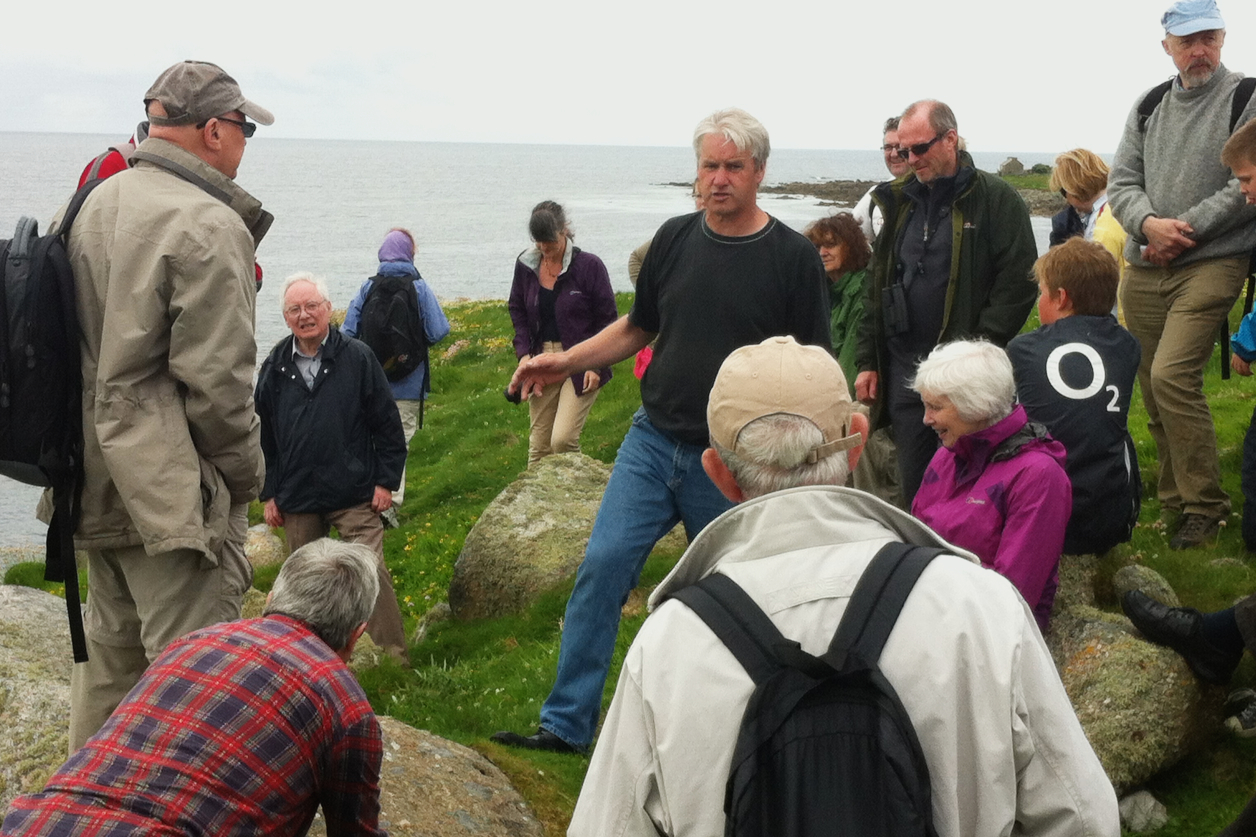
Brian Lacey, medieval historian and author, informs guests at the Sli Cholmcille conference about Pagan and druidic practices in and around Errigal and Muckish mountains.

The only drawback to an otherwise excellent symposium of speakers was the often poor technics, the out-of-focus projection of some otherwise well-researched multi-media presentations.

But the development of Sli Cholmcille is just the tip of the iceberg.

A quick glance at the local newspapers – the Donegal News and the Donegal Democrat – this weekend alone, shows a rich vein of cultural tourism – including the weekly music seisúns and this summer’s ‘Gaelturas’ initiative at Teach Hiudai Beag; the year-long programme of music and dance at Teac Jack and Leo’s Tavern; the ‘Goitse Gaoth Dobhair’ events in Bunbeg this coming weekend, which emerged from the ‘Dearg le Fearg’ language equality campaign, as well as ‘Luinneog Lunasa’ in the same area; the ‘Swell Festival’ on Arranmore; and ‘FestiFál’ and ‘Evil Eye Festival’ in Falcarragh to name but a few. Other local diverse activities with strong potential range from rock-climbing, wind-surfing and kayaking with Rock agus Roam; horse and pony riding at the Dunlewey Trekking Centre and elsewhere; the craft demonstrations at Ionad Cois Locha; and the educational Walking Donegal, the hill, coast and lake hikes with informed guide, Seamus Doohan; as well as specialty walks such as the ‘Tullaghbegley Heritage Walking Weekend.’

The list is endless.

And that’s not to mention the many literary tourism opportunities based on the art of creative writing.

Antonia Leitner from Carinthia in Austria is not shy to show her love of books and learning at Magheroarty Beach.

The idyllic landscapes and seascapes of Donegal have been an inspiration to many best-selling novelists and short story authors who have set their plots within or around the county, in genres ranging from sci-fi to literary fiction and fantasy, as well as plays. These writers include Brian Friel, Edna O’Brien, Sophia Hillan, Kenneth Gregory, Emma Heatherington, Michael Harding and Laurence Donaghy, some of whom will speak at Ireland’s newest writing retreat ‘Forgotten County, Remembered Words’ from June 28th to July 4th in Gaoth Dobhair.

With the national initiative ‘The Wild Atlantic Way’ now well underway and Donegal an integral part of it, there’s only one thing stopping the cultural tourism momentum that’s building up – a continued reluctance by Údarás na Gaeltachta, the primary economic development organisation in the Gaeltacht – to fund the many projects with serious money not just the few pennies it has been doling out until now to stave off a rising tide of protest.

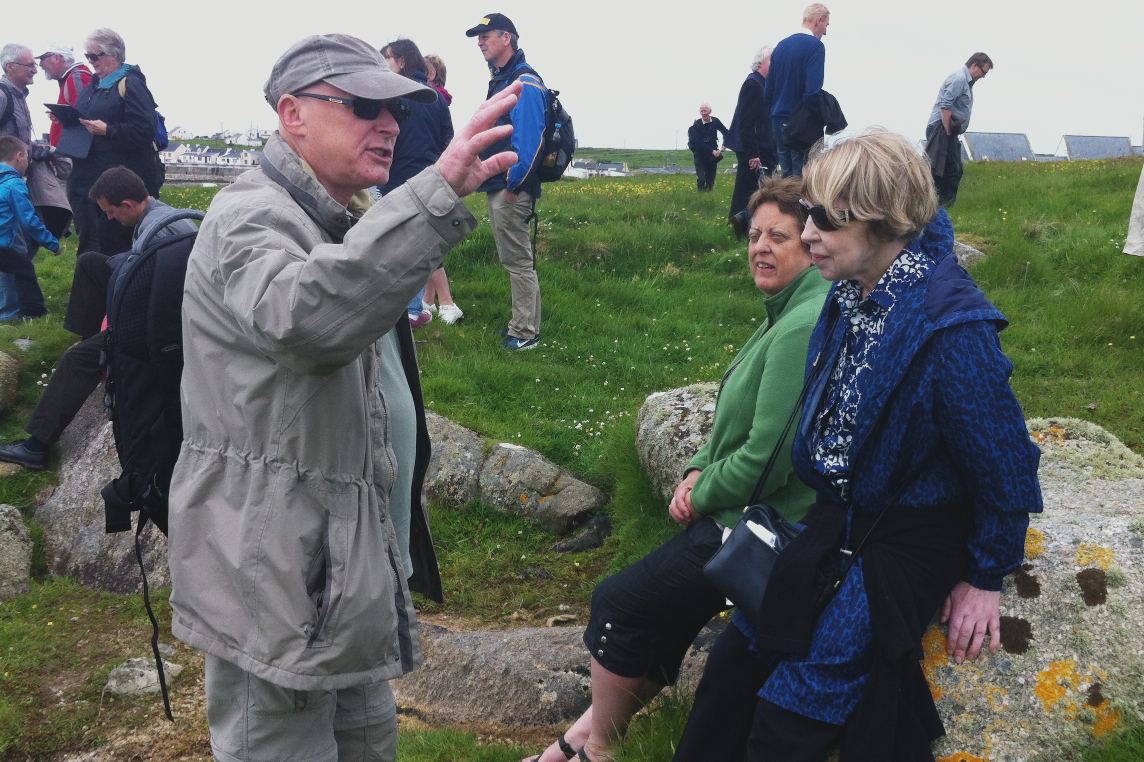
‘Acupuncture of the body, acupuncture of the earth’ – author Brian Lacey describes a theory he learned from a Slovenian artist.

As many people are now saying, this organisation must host regular, open, community meetings and really listen to what local people – the very people they are there to serve – want in terms of more innovative community development; provide much greater transparency in its spending of an estimated 1.2 billion euro in public money, than it has to date; and an end to kow-towing to political parties and their funders (first Fianna Fail and now Fine Gael) which has resulted in far too much money going into the pockets of a rich elite of developers/builders who make easy profits from building simplistic, unneeded, industrial estates.

A new direction is required and a Catholic Church-run sex, drugs and alcohol addiction center in Falcarragh, with no guarantee of decent local jobs – especially as such a centre already exists in Donegal and research indicates this is sufficient for need – is hardly the panacea for high unemployment and emigration from the area. Some say real investment in local cultural tourism means shelving the proposed investment of three million euro by Údarás in the addiction centre and putting those euro millions into local tourism projects, the one sector a beautiful region like Donegal can benefit widely from, now and in the long-term (if that three million euro is spent on the proposed addiction centre, it spells the end for any real investment in anything else – no other board members of Údarás in other Gaeltachts will vote for any further significant monies for Donegal).

In this regard, it is quite sad to see how much Tory Island has fallen below its full potential – far behind many other attractive island retreats dotted around Ireland. The dismissive attitude of relevant funding authorities – and perhaps the disunity and lack of concerted lobbying and effort by local people (full burden cannot rest solely on the shoulders of one man, King Patsy Dan) – has meant its tourism income has suffered greatly, with accompanying lack of promotion (not even a regular newsletter on events or significant signage on the mainland and on the island itself).

“I am tired of trying to persuade Udaras na Gaeltachta officials to properly fund projects here on Tory Island, their ears are deaf, they simply don’t understand,” said King Patsy Dan MacRuaidhri. “The people here deserve such support. Our ancient and colourful history calls out for it.”

Befriending Royalty. Modern version of the horse-drawn carriage?

It’s make-or-break time for northwest Donegal.

Let’s put an end to the notion that cultural tourism is an unimportant, peripheral activity, the kind of mind-think that Údarás officials are stuck on, and have been for decades. This specialized sector has the potential to provide immense, long-term economic benefits for this hard-hit, hard-pressed part of the county and country, but it requires serious commitment and financial support.

In a future post I will give specific examples from my extensive sojourns in other parts of the world as an international travel writer where cultural tourism has transformed and enlivened a local and often paralyzed economy.

Meanwhile the next post will focus on what precisely various speakers at the conference said about Columba, this larger-than-life monk who seems to defy description, someone about whose background we know very little, either because documents were destroyed by marauding, book-burning Vikings, or were deftly confiscated by church abbots on a precise propaganda campaign.

To read more of Sean’s work, check these sites:

Digging for Dracula

World Itineraries

Examiner

JustLuxe

Ireland Writing Retreat

Fios Training and Coaching Organization

IMG_1269

IMG_1381

IMG_1320

IMG_1334IMG_1426

IMG_1342

IMG_1359

IMG_1363

IMG_1374

IMG_1379

IMG_1382

IMG_1390

IMG_1417

IMG_1432

IMG_1472IMG_1478

Údarás na Gaeltachta – a secret society?

Living in Gaoth Dobhair, the heart of the Irish-speaking Gaeltacht area of Donegal in northwest Ireland, I take a strong interest in how this beautiful region – arguably the most scenic part of the entire country – is governed and develops, both economically and socially.

As such, I have vested considerable investigative journalistic experience, gained after 30 years in the media sector, in analyzing the workings of the largest economic development organization here – namely Údarás na Gaeltachta, an organization that has benefited from a spending budget of around one billion euro, mainly for job creation, since it was first established in 1980.

I have penned many news and feature articles on the organization over the last five years, the latest (below) published today (Friday) in the largest circulation newspaper in Donegal, the Donegal News.

For context, it’s probably worth reading the much more comprehensive, three-part series on Údarás that I wrote for the same newspaper. You’ll find it in the earlier posts below.

Pulling the ropes

Údarás na Gaeltachta – a secret society?

Like Br’er Rabbit, west Donegal’s largest economic development group is captive.

Captive to the belief that call centres and large manufacturing companies are the only way to create jobs – and to a golden circle that benefits from such thinking.

As such, Údarás na Gaeltachta is a Tar-baby, ever-more entangled in a sticky situation.

With the recent announcement that Largo Foods in the Gaoth Dobhair industrial estate will now close, with the loss of over 140 jobs, and after spending more than two million euro in the Donegal Gaeltacht over the last year, the Irish-language organisation has suffered a net loss of 78 jobs, according to its own figures, the worst record for many years.

So what has gone wrong? Seemingly, plenty!

Remoteness, poor infrastructure and a narrow skills’ set are the reasons most often given for few companies coming to the rural Gaeltacht of west Donegal. But does this excuse Údarás’ poor performance and lack of transparency as a public body?

After announcing recently it created 220 jobs in Donegal last year, Údarás promptly declined to give a breakdown of the figure. Following a Freedom of Information (FOI) request I made earlier this year seeking a list of funded companies and their job numbers, as well as pension payments, it replied, “For data protection and commercial sensitivity reasons. We do not release specific information collated for the purposes of the Údarás employment survey to the general public,” adding that pensions, while funded by the taxpayer, were private matters.

I asked Sinn Féin Senator Trevor Ó Clochartaigh of the Oireachtas Joint Committee, which revealed Údarás pays half its annual budget in pensions for 136 former executives, to follow-up. His party leader, Gerry Adams TD, submitted Dail question Nr. 127, as well as Questions 416 and 417, asking the Minister for Arts, Heritage and the Gaeltacht to “detail final salaries levels, lump sum or additional payments and the pension payments made to each chief executive officer or regional executive of Údarás who retired in the past three years.” Minister Jimmy Deenihan answered: “I have been advised by Údarás na Gaeltachta it considers the payments referred to are covered under the Data Protection Acts 1988 and 2003. Accordingly, it is not in a position to supply the information requested.”

Mary Lou Nolan, TD, Sinn Féin’s spokesperson on public expenditure and reform, then submitted yet another Parliamentary question, Nr. 148, asking the Minister to “reference the specific provisions of the Data Protection Acts to which he refers; the basis on which he believes Údarás na Gaeltachta does not, unlike all other senior managers across the civil and public sector, have to make public, details of public service pension arrangements.” A full answer is still awaited.

Such lack of co-operation by Údarás is disconcerting and leads inevitably to suspicion, making the words of its Arranmore Island-born chairperson Anna Ní Ghallchóir to me – “utter transparency is a given” – seem pale.

About one billion euro has poured into the Donegal Gaeltacht since Údarás was founded – for a population of 24,000. Result: the highest unemployment rate nationally, ugly, empty, ghost-like industrial estates blighting a rural landscape and a horrendously under-developed tourism sector.

Two years ago, under the Fine Gael-Labour ruling coalition, a new board promised change, with both ni Ghallchoir and fellow board member John Curran saying to me in separate interviews that widespread funding for ‘cultural tourism’ projects would be given to create sustainability by attracting more visitors to west Donegal. Two years later, less than five per cent of Údarás’ budget has gone to such projects, leading people at a recent EU-backed cultural tourism CeangalG (ConnectG) conference at An Chuirt Hotel in Gaoth Dobhair to complain of dwindling support.

In the case of Largo Foods, where is the sustainability that Údarás grants totaling 6.2 million euro to it (over 43,000 euro per job) should have created, and what business-sense does it make for Údarás to allocate half a million euro for two years for this company, which didn’t even bother to draw it down? With call centers and large manufacturing units merely band-aids for local unemployment problems, why has Údarás shown so little trust in small businesses forming the backbone of the local area’s economy? Especially so when a national economist who completed her Doctorate on Údarás operations, concluded, “on supply chain factors alone, a long-term, job creation strategy based on manufacturing was, and will continue to be, insane.” Could the fixation with short-term job numbers be linked to retention of Údarás’ own staff jobs, whose salaries average 80,000 euro annually, excluding expenses?

Instead of cultural tourism being expanded with serious money, Gearóid Ó Smaoláin, the organisation’s tourism officer, said in a recent public forum that “discussions are well-advanced” on building an alcohol and drug addiction clinic in the coastal town of Falcarragh, beside an existing golf course in the Ballyconnell House estate. It is believed Údarás, having already turned down several tourism ideas for the area, will allocate between several hundred thousand and one million euro to the project, which will be run by an arm of the Catholic Church.

Ultimately, decent Donegal people deserve better. How many more millions of euro must be wasted, how many more years lost, before Údarás changes its vision, and for transparency and accountability to be achieved? Perhaps only then will the ceaseless brain-drain halt and our native language escape from withering on the vine.

Published in Donegal News

Udaras na Gaeltachta consider challenges of creating new jobs

Meeting for the first time this morning (Friday), members of the new board of Udaras na Gaeltachta face the challenging tasks of analysing the organisation’s performance and brainstorming on ways to accomplish the goals for which the Irish-language body was established.

One priority is employment in Gaeltacht areas. “Job creation and language promotion go hand-in-hand,” Anna Ni Ghallchoir, 55, the new chairperson, told the Donegal News. “With my new board colleagues, I will be examining very closely if past strategies have been successful and come up with innovative ones to help us move forward.”

Depending on whom you speak to, Udaras has either an acceptable record on job creation, or a very poor one, reflecting the age-old comment that statistics are like sausages – they look good but you’re never quite sure what’s in them.

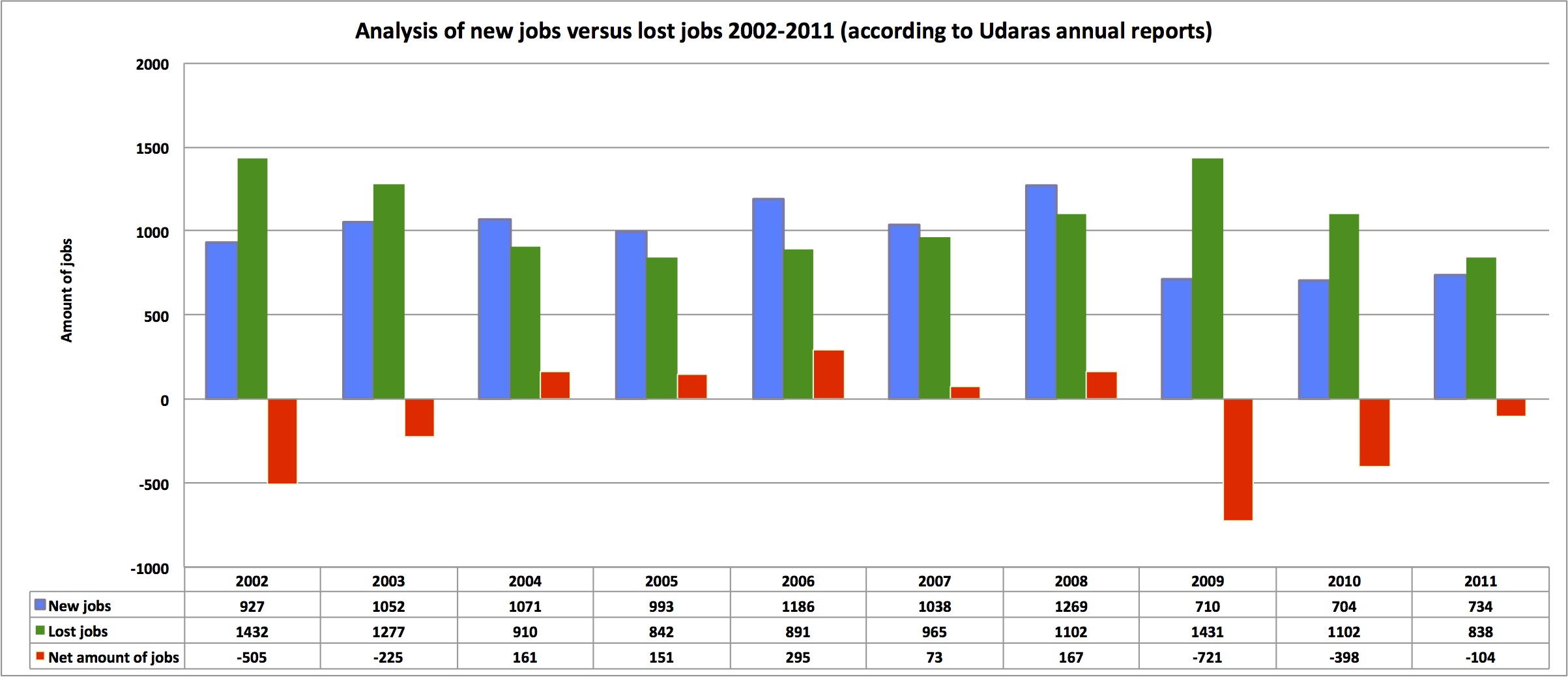
New jobs versus lost jobs

With total funding of around one billion euro so far, Udaras reported it had created 6,970 jobs as of last year in what it terms ‘client companies,’ defined as any company receiving support. When examined in the context of unemployment in Gaeltacht regions, this represents 7.75 per cent of the population there. As of last year, Udaras’ website shows it supported 1,876 jobs in the Donegal Gaeltacht, which represents 7.89 per cent of almost 24,000 people. Donegal Gaeltacht has the second largest number of Irish speakers, but ranks fifth in jobs created among the seven Gaeltacht regions.

Liam O‘Cuinneagain, Udaras chairperson for the last ten years, told the Donegal News he is “satisfied with our job creation performance,” adding, “It’s not easy to get companies to locate to rural Ireland, in part because of its remoteness and lack of transport links and limited skill-sets there.” As evidence in Donegal, he points to sectors Udaras has invested in – seafood processing, call centres (VHI), IT, sea angling, boat repair, even potato-crisp/fast food manufacturing (Largo Foods).

Other business analysts, however, are less satisfied with Udaras’ performance, including Tom Fitzgerald, fluent Irish speaker and business owner employing 50 people at Bard na nGleann, his information-management company in Béal Átha’n Ghaorthaidh in the Cork Gaeltacht. “A strong, well-run economic development organisation is important for the preservation and promotion of the Irish-language and for job creation in marginalized areas such as the Gaeltachts, including Donegal, but there’s no shying away from facts, Udaras is an extraordinarily expensive organisation,” Fitzgerald, whose company has an annual turnover of between one and two million euro, told the Donegal News. “There is little evidence of effectiveness in the statistics. By normal business practice standards, Udaras’ record so far is very poor.”

Expenditure

Fitzgerald points to the fact that the total number of jobs Údarás says it created was lower in 2010 than in 1996. “Furthermore, there’s no indication that the amount of money spent by Údarás in a single year has any impact on job creation in the Gaeltacht.  For example: Údarás spent more than 84 million euro in 2002 according to its own annual report. Yet there is no corresponding spike in jobs either in that year or following years.”

O‘Cuinneagain says during his tenure as chairperson, “cost per job was around eight thousand euro.” However, a simple look at Udaras’s total expenditure for the last ten years (613.5 million euro) relative to the number of jobs it reports creating by the end of last year (6,970) equates to 88,000 euro cost per job. As only around 10 per cent of budget goes to language-cultural activities, the final cost per job figure may be as much as ten times higher than stated. In Donegal, a case study in job costs is Largo Foods, headquartered in Ashbourne, Meath, but with facilities in the Gaoth Dobhair Industrial Estate. According to Udaras, it has received over 6.2 million euro in funding between 1999 and 2011 – with another half-million euro to be paid soon for automated equipment. Udaras said last year the company employed 120 people. Taking those figures, that works out to be over 55,000 euro investment per job created, not considering funding from other bodies for Largo. Ironically, following the installation of the automated equipment earlier this year, media reported 36 jobs were lost at Largo.

As some of Udaras’s ‘client companies’ are also the ‘client companies’ of other organisations, foreign and domestic, from whom they receive additional support, it is difficult to evaluate what specific job numbers Udaras contributions amount to. “The term ‘client companies’ is a loose one, easily manipulated to suit purpose,” said Fitzgerald. “Some organisations that partly support companies in the Gaeltachts often claim all the jobs as their own making, which is quite misleading.”

O’Cuinneagain acknowledges that criticisms of Udaras for not supporting enough micro companies – entrepreneurs wishing to hire a handful of people – are valid. “We’re not getting what we should be getting – smaller businesses,” he said. “We’ve focused too much trying to get big companies that might employ hundreds. Even though the finance and support system is there, Udaras has not been welcoming enough. Staff have not been as pro-active as they should be, have not scoured their Gaeltacht communities to find such entrepreneurs. Unfortunately, we have remained in a culture of factory jobs.”

Asked why, the director of Oideas Gael, a language group in Glencolmcille, lay the blame on factors outside Udaras ranging from lack of business teaching in education “Greek and Latin instead of entrepreneurialism” to lack of bank finance. But he did not rule out the possibility that as funding a small company with thousands of euro amounted to nearly as much paperwork for Udaras staff as funding large companies with millions of euro, there may have be a Udaras propensity for avoiding small business applications. Asked if the push for larger companies could have been simply a strategy to keep employment figures up and for Udaras to retain its all-important job-creation remit, which accounts for most of its annual budget, he said, “That’s ridiculous, sounds more like a conspiracy theory to me.”

Fitzgerald’s opinion differs, “About the only goal that Údarás is measured on is the creation of 800 or so new jobs per year, so they focus on doing just that. The problem is that this strategy doesn’t take into account what kind of jobs they are. In theory, Údarás is better off creating jobs that disappear quickly so they can place the same people again in a year or two.”

Analysts also say the Udaras board members may not have had enough business experience to spearhead a successful jobs-creation strategy. Of the Donegal members on the previous board, none could be identified as having long-time corporate management experience. O’Cuinneagain waved aside concerns that the previous national board was too large, numbering twenty, which some analysts said made it unwieldy to manage and hampered decision-making. “I did not find our board meetings too difficult to manage, but then again my experience as a teacher in inner city Dublin for many years helped a lot,” he said.

Lack of fiscal clarity within Udaras concerns some observers.

“I spent several years studying the organisation and found its finances extremely difficult to understand,” one leading business researcher told the Donegal News. “I also found frequent errors in its calculations. Some figures on spending simply did not add up. There’s really no excuse for that when we have so many accounting software programs such as Excel at our disposal.”

When the Donegal News requested a breakdown of Udaras spending for the seven Gaeltacht regions, particularly Donegal, for the last three years, Siubhán Nic Grianna, national communications and marketing manager, responded, “The distribution of total monies is not segregated on a county by county or Gaeltacht by Gaeltacht basis therefore I cannot provide breakdown for Donegal for this period.”

Bernard Allen, former TD and head of the multi-party Public Accounts Committee (PAC), which oversees the proper spending of public money, told the Donegal News that lack of transparency at Udaras may have hindered job-creation efforts. “We found its expenses system to be incomprehensible and could not understand how it was spending so much money on trips for so-called job creation efforts.”  Referring to the scandal over misspending by another state body, he added, “Udaras’ expenses read like a mini-FAS and it seemed to stymy our efforts to find out the truth and avoid disclosing pertinent facts and figures to us, especially related to board member, staff and associated expenses. With better accounting practices, perhaps its job creation efforts could have been more effective. ”

Some questions concerning expenses, including 30,000 euro over two years on trips to Halifax, Canada, to look at seaweed projects, costly business-class flights, trips to many international cities including Las Vegas, Shanghai, Los Angeles and Chicago, and expenses for spouses – which is counter to existing regulations – have still not been fully answered, Allen said.

Nic Grianna said such concerns lack basis. Describing the first story in this newspaper series as, “a slanted view, full of insinuations,” she added, “There was no reprimand from the Public Accounts Committee (PAC). We are very open and transparent and explained everything. There has been no abuse of public money.” In response, Allen said simply, “We did not get all our questions answered satisfactorily and a national election was called and the PAC disbanded before we could investigate fully.” Even though the information is in the public domain, Nic Grianna declined a request for a breakdown of pensions for 136 Udaras former executives costing around 4.3 million euro this year, half of this year’s current budget. Efforts to contact retired executives Cathal MacSuibhne in Donegal and CEO Padraig O’hAolain through Udaras for comment, were unsuccessful.

With allegations of cronyism and clintelism tainting many public bodies, O’Cuinneagain said he did not experience conflicts of interest while Udaras chairperson. “My organisation, Oideas Gael, did not receive any money from Udaras so I certainly did not feel the need to excuse myself from board discussions on funding, nor did any of the other board members as they did not receive any money either.”

As the Udaras board meeting gets underway this morning, Sean O’Cuirean, a new member from Falcarragh, remains optimistic. “A good thing about this board is that there are a new set of eyes looking at the situation. Such fresh perspectives often result in greater success and money well spent.”

Published in Donegal News