Good writing gives me goose-bumps

Having arrived in picturesque west Donegal – Bun na Leaca to be precise – over six years ago and recognizing it for the artists’ haven that it is, my wife, Columbia, and I thought about establishing a creative writers’ retreat.
After all, surely such a pristine and bucolic landscape could inspire great prose. 

Ireland Writing Retreat participants enjoy a special Celtic legend coastal walk with guide, Seamus Doohan.

Not that such an idea hadn’t been done before.  Poet partners, Janice Fitzpatrick Simmons and her late departed husband, James, had done so many years previous, setting up a ‘Poet’s House’ in a refurbished cottage at Clonbarra, outside Falcarragh.

Then funding was more generous and tens of thousands of euro annually wasn’t much of a problem for Udaras na Gaeltachta, the Arts Council, Donegal County Council, LEADER, and other sources.
Times have changed, however, and the public funding pump is dripping slowly, a mere trickle at best. Seanie FitzPatrick and Co. and Fianna Fail made sure of that.

Rose Sweeney teaches future members of the ‘Riverdance’ cast the basic ‘sevens’ of Irish ceilidhe dancing.

County Librarian and Divisional Manager of Cultural Services, Eileen Burgess, a keen supporter of our idea, issued warnings: “It’s a wonderful project but there’s simply no money in the kitty. You’d pretty much be on your own.”

But you know how it is – an intriguing idea comes along, sticks to you like furze in a meadow and simply won’t fall away no matter how hard you try.
So, even though there are more than one hundred creative writing conferences and book festivals throughout Ireland – many in the much-publicized, tourist-centric counties of Dublin, Cork, Galway and Kerry – we took the plunge.
After all, isn’t Donegal the prettiest of them all?

Washington-based triple book author and former CNN editor, John DeDakis, enjoys a leisurely trip on ‘The Cricket’ to Gola Island with other writing retreat participants.

Of course, wisdom told us to delay until better economic times were upon us. But passion drove us forward, screaming, ‘tempus fugit.’ We swayed for a while between the two.

We’re going into our third year now and have managed to attract participants from far off fields, many of whom had never been to Ireland before never mind the back-roads of the Donegal Gaeltacht – Wyoming, Sydney, Utah, Perth, Stoke-on-Trent, New Jersey to name but a few.
Not bad for a project without public funding of any kind.

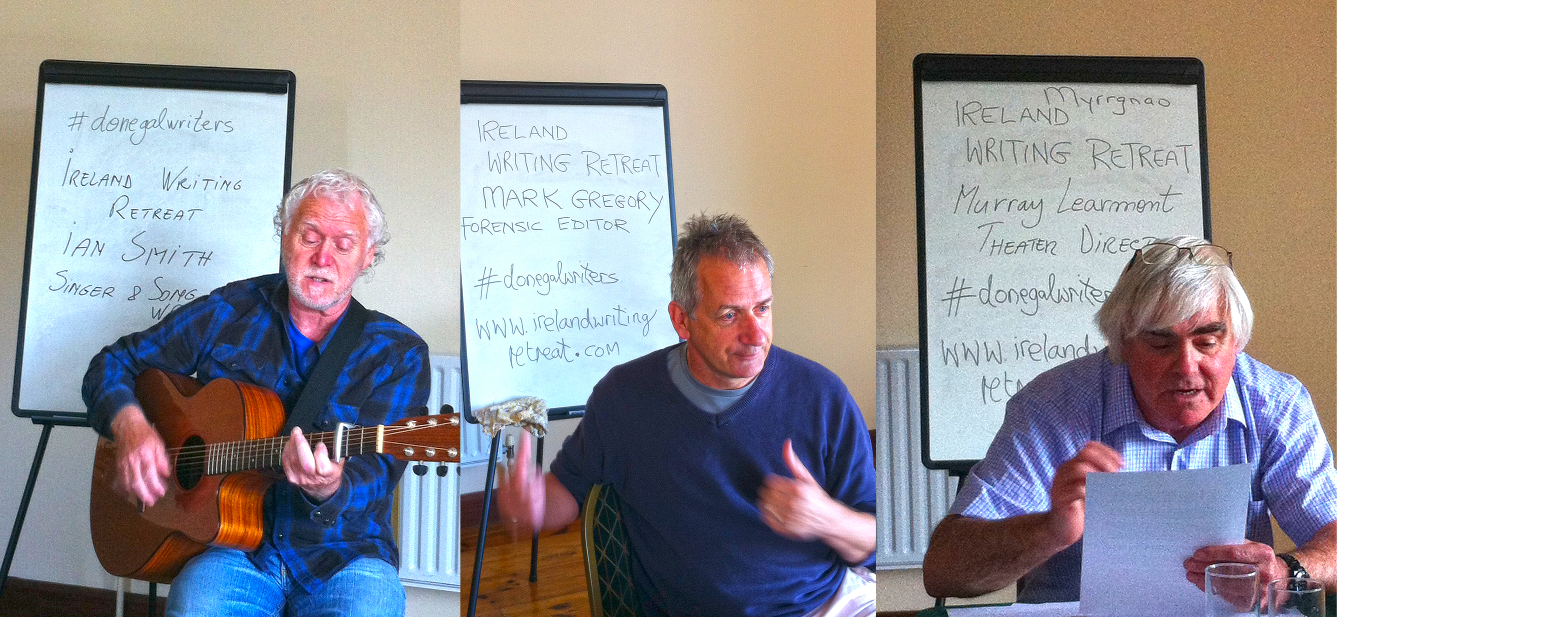
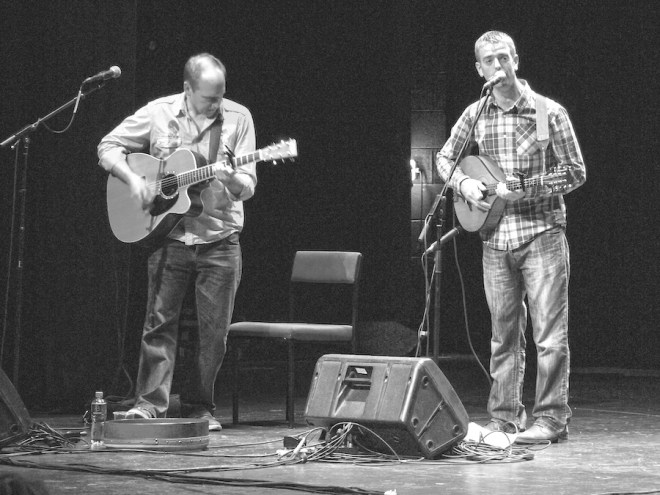
Guest speakers at the Ireland Writing Retreat held at Teac Jack, Gaoth Dobhair. (l to r) Singer-songwriter-guitarist, Ian Smith; Mark Gregory, forensic editor; actor/director Murray Learmont.

Imagine where it could go with a bit of financial support – but perhaps only if it’s located in one of the aforementioned counties.

As for this year, international stars of the week-long retreat included John DeDakis, triple book author and former senior editor at CNN for 25 years who flew directly from Washington to be at Teac Jack’s, the retreat location; Anthony Quinn, experienced author of crime fiction with a crafty literary twist; and Mark Gregory, a much-heralded forensic editor (the person who reads book manuscripts minutely word by word, syllable by syllable).

Plot, character, suspense – (l to r) Authors John DeDakis and Anthony Quinn discuss the challenging task of writing novels.

But committed locals also loaned their weight enthusiastically to the endeavor – actor and drama group director, Murray Learmont, guided participants on improving their public reading skills; singer-songwriter-guitarist, Ian Smith granted insights into the challenging task of lyric writing; Rose Sweeney taught participants their ‘sevens’ in preparation for a ceilidhe in the backroom of the popular Glassagh venue; Pól Ó Muireasáin gave an enlightening tour of Gola Island; and Seamus Doohan led participants on a Celtic legend coastal walk – all of which was grist to the mill for writers’ creativity.

Eddie, the uncrowned King of Gola Island (in blue) with walking guide, Pol O’Muiresean, (r) talk about life on the west Donegal island many years ago.

The ‘Donegal News’ considered this year’s ‘Ireland Writing Retreat,’ which ended last week, worthy of an article in today’s edition.
article
Onward to 2016.
 

Unique chance to meet Washington-based author and former CNN editor in west Donegal

Wandering through a dappled glade in Glenveigh National Park a short while back, Lugh and Siog, our two loving, lively, not-so-shy Irish collies – as is their habit – found some new friends. A bearded man, his wife and his daughter.
That man turned out to be Washington-based former CNN senior editor and triple-book author, John DeDakis, a friendly fellow over on this side of the Pond on a short holiday – his first foray into Donegal.
He must have liked what he saw, for that same man I am delighted to say, will now speak at a special public event hosted by ‘Ireland Writing Retreat’ at Teac Jack in Gaoth Dobhair this Monday evening, June 29, at 8pm, sharing his decades-long experiences in American TV and radio broadcasting – including interviewing Alfred Hitchcock – as well as writing three crime suspense novels.
Interestingly, the protagonist in John’s three crime novels is a young woman, so – having honed his writing skills from a female perspective – he will talk about what he learned about the mistakes men make in trying to forge meaningful relationships with women.
In his fourth novel, which he is working on now, John deals with the death of his 22-year-old son. During his talk, he will explain why he wanted to tackle such a personal and painful topic.
John will also offer advice to those who feel they have an interesting story to tell, but are confused about how to get started writing it.
 
Staffed 24 hours, seven days a week at CNN‘s world headquarters in Atlanta, Georgia, and in bureaus worldwide, the television and online news network has a global team of almost 4,000 news professionals. Its news and information services are available in five different languages across all major TV, internet and mobile platforms reaching more than 380 million households worldwide.
“It is a delight to be a part of the Ireland Writing Retreat in Donegal,” said John earlier this week, several days before he departed from the US capital. “It is wonderful that such an international event as this takes place amid such a beautiful landscape, a perfect backdrop for artists of all kinds, including creative writers.” 
His exciting and informative multi-media presentation is entitled ‘From Journalist to Novelist Or How I Learned to Start Making it Up.’ If you’re interested in news, journalism, current events or creative writing – don’t miss it.
Among the many roles, John played at CNN was as senior script editor of the popular Emmy and Peabody-Award winning programme, ‘The Situation Room,’ hosted by Wolf Blitzer, which offered expert analysis of the world’s top news and current affairs stories, both national and international.
John is travelling direct to west Donegal from Washington this weekend to join a line-up of top-notch published authors in diverse genres, including crime, magic realism and science fiction, for the week-long ‘Ireland Writing Retreat’ where they will help retreat participants improve their creative writing skills.
His interest in the crime suspense genre began long before he finished the first of his three published novels, ‘Fast Track,’ ‘Bluff’ and ‘Troubled Water.’ He enjoyed the rare privilege of conducting a 40-minute, one-on-one interview with the man who has been nicknamed the ‘Master of Suspense,’ Alfred Hitchcock. The career of this British director, who pioneered many techniques in psychological thriller movie genres, spanned half a century and included such film successes as ‘The Birds,’ ‘Dial M for Murder’ and ‘Psycho.’
John was also White House correspondent for CBN News during the last three years of Ronald Reagan’s presidency. He is an adjunct journalism faculty member at the University of Maryland-College Park and has been a lecturer at the American University, Washington, D.C. and Writer-in-Residence at the Callanwolde Fine Arts Center in Atlanta, teaching fiction writing classes and holding one-on-one writing tutorials.
For details on how to book your place see Ireland Writing Retreat

Banned in the US and UK, but coming to Donegal soon – sex, profanity and fireworks

Ever tried reading James Joyce’s ‘Ulysses’?
Only 800 pages, more or less, a quarter of a million words, characterised by convoluted, stream-of-consciousness prose, meaning some sentences aren’t really sentences and those that are seem like they’re not.
Not to mention every chapter relates to an organ of the human body and also that while it’s about a day in the life of Dubliner Leopold Bloom, it’s also about the Mediterranean Sea adventures of the ancient Greek hero in Homer’s epic poem.
Like me, you probably stopped reading after 10 pages or so.
Now try imagining not only reading all 800, often unpunctuated, pages but transforming it into a captivating play entitled ‘Extracts from Ulysses,’ then coaching a large group of amateur actors in the backroom of a community center in a rural west Donegal Gaeltacht to deliver a delightful 90-minute theatrical production.

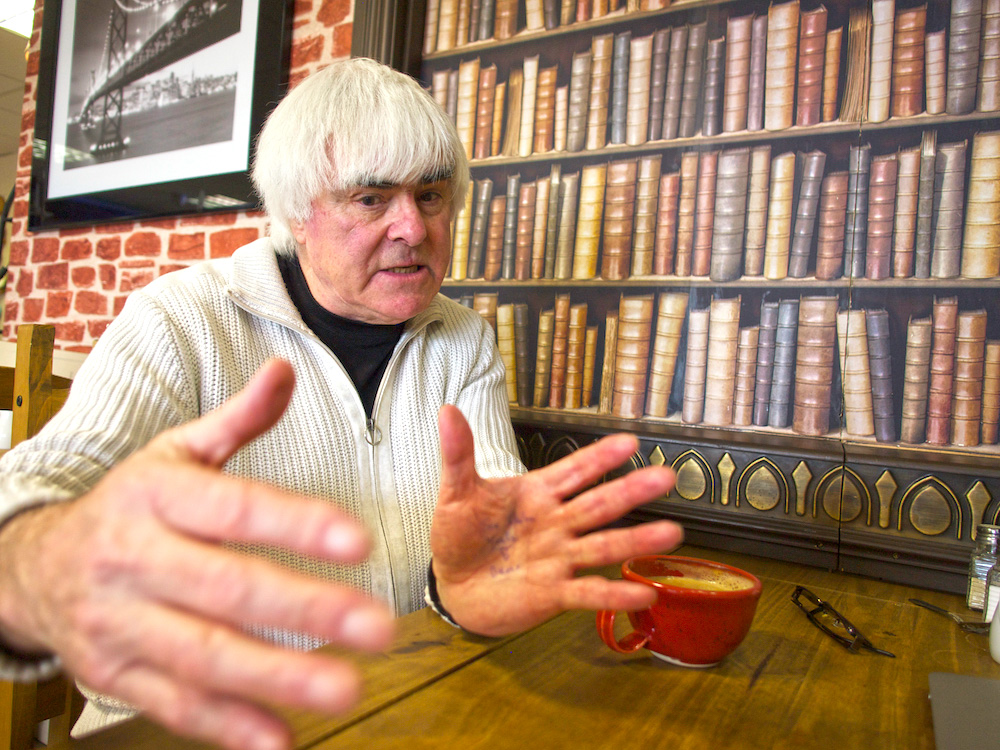
Roy Orbison-like, Learmont Murray stirs his coffee, the way he stirs life – in ever-widening circles (Photo by Columbia Hillen)

Enter stage left, Murray Learmont, thespian extraordinaire who turned 69 a few days ago and has not only directed a plethora of theatrical productions during his 20-plus years in the drama field, but has himself played roles as diverse as Captain Renault in ‘Casablanca,’ Polonius in ‘Hamlet,’ a preacher in ‘High Noon’ and Simon Dedalus, father of Stephen Dedalus, the hero in ‘A Portrait Of the Artist As A Young Man.’
On Bloomsday (Tuesday, June 16), Learmont and his enthusiastic, skilled troupe, the Cloughaneely Players, will perform their unique production before a hoped-for capacity audience in Arnold’s Hotel, Dunfanaghy Donegal, at 9pm. Don’t miss it. It’s a rare dramatic treat.
Photo by Moses Alcorn

Together as One. (Photo by Moses Alcorn)

So why tackle such a complex literary challenge?
It’s such a wonderful story of human experience, with such powerful dialogue,” says Murray, sitting over a coffee and a huge chunk of chocolate cake (mine, he was much more disciplined) at ‘Moonshine Café’ in Letterkenny last week. “It contains so many worlds within it, being the classic tale of Ulysses in a colourful turn-of-the-20th century Dublin setting with even a biscuit-tossing scene in the bar in the first chapter relating to Polyphemus, the one-eyed giant, hurling a huge rock at Ulysses.
Photo by Columbia Hillen

Ever-passionate about matters of the stage (Photo by Columbia Hillen)

Speaking passionately, he adds, “In Joyce’s novel you never lose the sense of surprise. While scenes fit into nicely one another, he surprises your expectations. The pitiful blind boy swearing at someone who accidently bumps into him – “God’s curse on you, whoever you are! You’re blinder nor I am, you bitch’s bastard!” being but one example. The author also makes no concessions, leaving it up to the reader to find things out. It is a modern piece both in thoughts and ideas, about relationships, and many of its themes are still very much relevant today.
ulysses 9

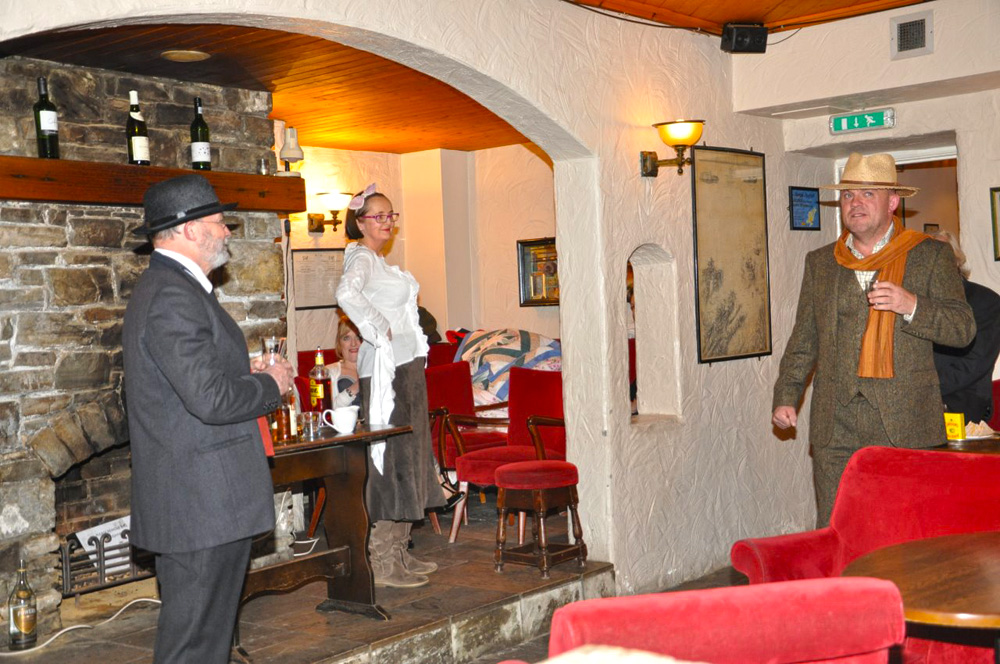
Production even features risque bedroom scenes (Photo by Moses Alcorn)

As for the task of reducing 800 hefty pages into theater form? “ I must say, the cut-and-paste capabilities of a modern-day computer really helped,” says Murray modestly, smiling. “But what I was really looking for was memorable dialogue and there’s just so much of that it wasn’t too difficult. Joyce captures exactly the way people speak. Of course, there were certain scenes I definitely wanted in like the bar scene where the one-eyed citizen abuses bloom in an anti-Semitic rant and the scene in the Ormond Hotel with the two barmaids laughing, saying ‘ “Aren’t men frightful idiots,’ which relates to the song of the Sirens in the classic myth.
Photo by Moses Alcorn

What’s that you say? (Photo by Moses Alcorn)

With a previous performance several weeks ago having met with strong positive reaction and the next due soon, how does he feel? “Very happy. It has been great fun doing what is, in effect, an ensemble production. Around 20 people, with everyone putting in their ideas. It has been a labour of love and, of course, I’m delighted it has been received so well.

Photo by Columbia Hillen

Murray Learmont: Serious about the stage, but with a ready laugh  (Photo by Columbia Hillen)

Murray, who first read ‘Ulysses’ while in his 20s studying English literature at Glasgow University, had particular praise for lead actor, Pearse McGee, who plays Bloom and is on-stage throughout and for Maggie McKinney, who plays his wife, and has a challenging soliloquy at the end.  Aside from the actors, Murray also praises Robert Shields, owner of Clady Media in Crolly, who supervised the sound system and Joanne Lindsay-Butler for set design.
Photo by Moses Alcorn

Whatever you do, don’t look the other way! (Photo by Moses Alcorn)

Speaking about Joyce’s work and his role in the production, McGee said, “The novel deserves its reputation. It is a law onto itself. While it is, granted, a dense, multi-layered and hard-to-handle beast of a book, the sheer exuberance of the language can carry you through it, if you let it.
On playing Bloom, he added, “It was a tough ask to get into the head of one of the great everyman characters, especially then having to portray him as the public man without showing the audience his inner thinking. Murray’s patience and boundless enthusiasm were invaluable to me in getting there and his sheer love of the source material clearly shone through at rehearsal, which helped to take a tough job and make it fun.
Photo by Moses Alcorn

Pretty as a picture, but what’s that in your hand? (Photo by Moses Alcorn)

McKinney, whose previous diverse roles have included Lady Macbeth, Ophelia and Helena in the Shakespearian classics “Macbeth,’ ‘Hamlet’ and ‘Midsummer Night’s Dream’ and a chorus girl in ‘Some Like It Hot,’ said she “loved” playing Molly Bloom. “I had not read the book, so it was interesting to learn about it. To begin with, the soliloquy was a little challenging, as it is Molly Bloom’s stream of consciousness and James Joyce left it unpunctuated and her thinking often flits from one memory to another, so it took a while to decipher this. Also, some of my lines were a bit risqué and I was a little concerned I might be shunned in the local community for using such improper language, but in context of everything else I had to say it worked and wasn’t too shocking, thankfully!
Photo by Moses Alcorn

Honestly, hand on heart – if I can but find it, I know it’s here somewhere! (Photo by Moses Alcorn)

‘Ulysses’ takes place at Arnold’s Hotel in Dunfanaghy, west Donegal, on Tuesday evening, June 16, commencing at 9pm. Book your tickets early by calling 00353 74 913 6208 as venue room capacity is 60 people. A second performance will take place on Thursday evening, June 25, at the Church of Ireland hall in Dunfanaghy.

Photo by Moses Alcorn

You’re sooooo serious, you make me smile! (Photo by Moses Alcorn)

Maybe, upon advance request, they might even serve up the traditional ‘Bloomsday Irish breakfast’ of kidneys and gizzards.
Photo by Moses Alcorn

Well-behaved angels all in a row! (Photo by Moses Alcorn)

Photo by

Who’s that dapper, fashion guru (Photo by Moses Alcorn)

Giant green Easter bunnies roam the Hills of Donegal

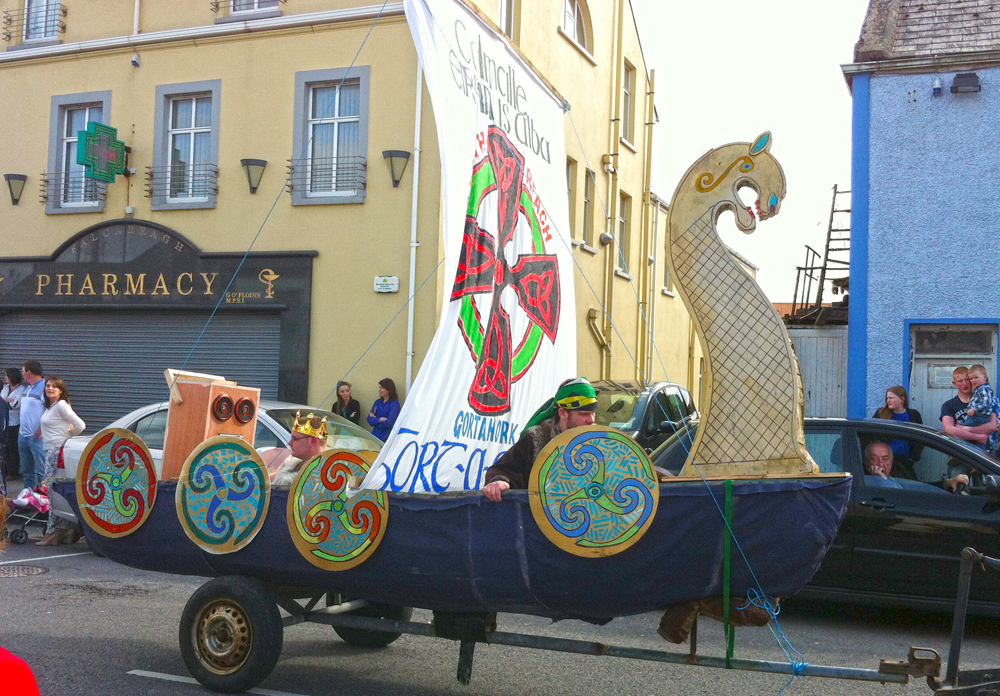
Having to postpone their March 17 national day celebrations didn’t dampen the indomitable spirit of many people in Falcarragh this past weekend – they simply doubled up for Easter and held a bigger parade then. As a reward for such creativity and can-do attitude, the weather was immensely kind, with the rare sight of azure blue skies, a few fluffy white clouds and warm temperatures well into the teens.

Photo by Tony Hillen

Photo by Tony Hillen

So successful was the event, some say there’s now a move afoot to keep the ‘two-fer’ tradition alive – thus making the Donegal Gaeltacht town unique throughout Ireland by unifying twin celebrations in a single grand one. photo 2

Scouts have now been sent out to find a friendly green bunny that has been seen hopping around the area recently to be next year’s Parade Grand Marshall.

photo 4

So if you’re a Pantheist, a Christian or follow any other faith, whether you believe in the Pagan fertility Goddess Eastre (otherwise known as Easter, Eostur, Eastra, Eastur, Eostra or Eostre), Yeshua (otherwise known as Jesus Christ), Gautama Buddha, Muhammad, Horus, Brahma, Vishnu or Shiva or any other spiritual mentor you admire, then maybe Falcarragh is the place to be next year.

Photo by Tony Hillen

Photo by Tony Hillen

In the immortal words of the Almighty Long-Eared God of Disguise himself, “Eh, what’s up Doc? Don’t take life too seriously. You’ll never get out alive.” bunny

From Donegal to Transylvania – Irish music helps lift the veil

Organizing the first-ever Saint Patrick’s Day celebrations in Romania and pairing it with the nation’s inaugural Corporate Citizen Awards was how I first came to appreciate the skilled musicianship of the wonderful Donegal group, Arcanadh, which launched its third album, ‘Light From The Water,’ at An Grianan this past Saturday.

Having gone to the eastern European country from the US after the fall of Communism as a volunteer to establish the first journalism schools and train evolving charities and NGOs in media relations skills, I thought I’d raise the flag and launch the first-ever March 17 celebrations.

But that’s hard to do unless you have some very fine Irish musicians.

OLYMPUS DIGITAL CAMERA

So I searched the length and breadth of the country for some of the best, flying over traditional musicians from Belfast to Dublin, betwixt and beyond, for a nationwide tour that encompassed the capital, Bucharest; the Black Sea port of Constanta; Cluj-Napoca, in the very heart of Transylvania; and other towns and cities besides.

When I bought my house in Bun na Leaca, Gaoth Dobhair, my search was over.

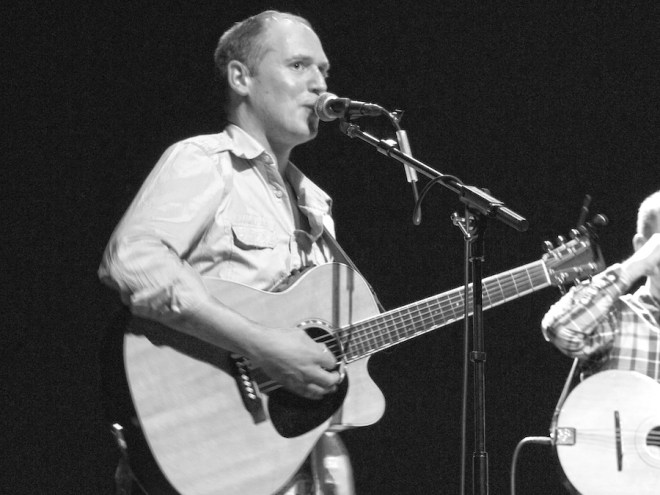
Among the excellent Donegal musicians who have mightily entertained thousands of delighted Romanians including Presidents, Prime Ministers, Ambassadors and Mayors throughout the land of Vlad the Impaler have been singer-songwriter-guitarist Ian Smith from Keadu; fiddle player extraordinaire Theresa Kavanagh from Gortahork; accordionist Marie Clarke; as well as Letterkenny-based singer and banjo-mandola player Colm Breathnach; his wife, singer-guitar-whistle player, Sinead Gibson; harpist and singer, Maria Corbet, and the other multi-talented members of what must surely be voted the most accomplished traditional band in all Ireland.

Then Arcanadh had no albums to its name, now they have three quality ones – ‘Soundings,’ ‘Turning Of A Day’ and now ‘Light From The Water.’ So good are they, they’re invited to play at venues and festivals from Boston to Brittany (luckily, you can hear them in concert as part of their promotional tour at Westport House, Westport, Mayo, this Friday evening at 8 pm).

Being fortunate enough to see them in concert at An Grianan in Letterkenny a few nights ago, I wrote an appreciation of that standing ovation performance.

To whet your appetite, read on –

Irish traditional group, Arcanadh, acclaimed with standing ovation in Donegal

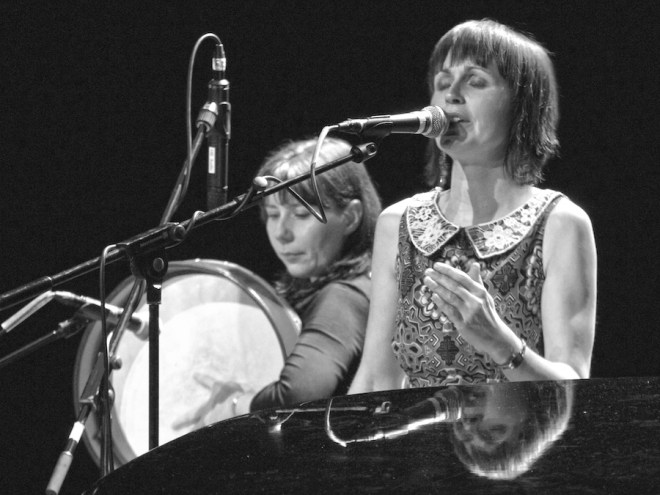
Versatile and multi-talented, deftly harmonious, wholesome, warm and welcoming – the album-launching concert by Arcanadh, one of Ireland’s leading traditional music groups, at An Grianan theatre Donegal this past weekend brought all these adjectives to mind, and more.
OLYMPUS DIGITAL CAMERA

From ancient classics to modern contemporary, from songs in English to others in Irish, from tear-jerking ballads to foot-tapping sing-alongs, the diverse repertoire of this six-member band is truly impressive.

And with the launch of their third album ‘Light From the Water,’ more people will have the good fortune to hear them as they continue a national promotional tour, with the next stop being Gracy’s Bar, Westport House, Westport, Mayo, this Friday evening, 8p.m

OLYMPUS DIGITAL CAMERA

A haunting quality pervaded Waterford-man Colm Breathnach’s beautiful opening of ‘The Swallow’ enhanced by the echoing voices of the others as they coalesced to create soothing, multi-layered complexities. Master of mandola and banjo and the main on-stage interlocutor, Colm’s family background provides him with a sound platform for his musical endeavors. As he informed a packed audience good humoredly in Letterkenny, he is one of 11 children and his mother would often sing to help keep peace among them. It is from her he learned many of the songs he performs including ‘Barr na Sráide’ (Top of the Street).

OLYMPUS DIGITAL CAMERA

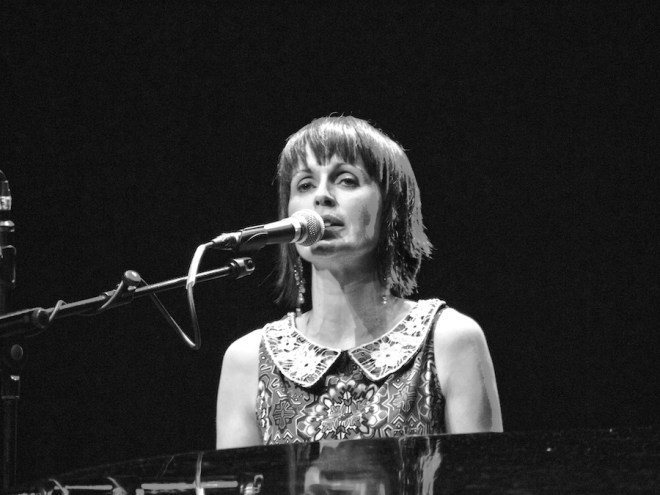
In contrast to the strong masculine tonality of his voice, his wife and fellow schoolteacher, Sinead Gibson’s can best be described as  ‘whispery,’ somewhat akin to feathers rustling in a breeze, as in her version of the Gaeilge ballad ‘Méilte Cheann Dubhrann’ (Sandy Hills of Ceann Dubhrann).
OLYMPUS DIGITAL CAMERA

With eyes closed, I could almost imagine her breaking into a soft, breathy, seductive rendition of “Happy birthday, Mister President, happy birthday to you.’ At other times, however, her voice is downright sultry-sexy Southern as when she skipped nimbly along the lyrics of the American Bluegrass song ‘One More Dollar.

A strong hallmark of an Arcanadh concert is not only their musical prowess and collective light-heartedness but the interesting anecdotes they tell before each song, which grants the listener added insights through context.
OLYMPUS DIGITAL CAMERA

Of this, Colm is a master in the telling. A classic example at An Grianan was the Gaeilge song ‘Trathnona Aoine’ (Friday Evening), written by Paidin, one of Colm’s brothers, with music composed by Sinead about two teenager boys lost at sea near Waterford while out on currach boats lobster fishing.

OLYMPUS DIGITAL CAMERA

Award-winning Mags Gallen, who completed a Masters degree at the Irish World Music Centre at the University of Limerick, sang a wonderful version of the Scottish poet Robert Burns’ classic ballad, ‘My Love is Like a A Red, Red Rose’ while accompanying herself on grand piano, as well as ‘County Down’ by Tommy Sands.
OLYMPUS DIGITAL CAMERA

Her brother, Martin, a guitarist, displayed his singer-song-writing skills with his homespun ‘Turning Of A Day’ and his soothing version of Christine Kane’s ‘She Don’t Like Roses.’

OLYMPUS DIGITAL CAMERA

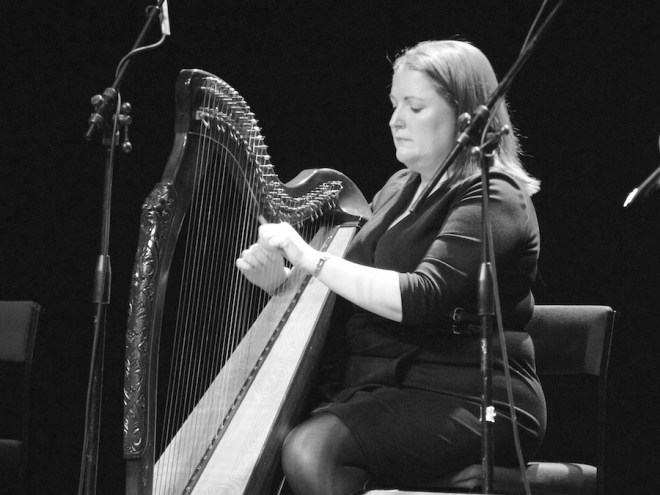
Musician and band manager, Maria Corbet, not only weaves an almost ethereal tapestry of melodies from her harp but is an accomplished singer to boot, as evidenced by her lovely interpretation of ‘Anachie Gordon’ and the poignant ‘John Condon,’ the heart-breaking story of 14-year-old Irish boy who finagles his way into the British Army during World War One only to die on his very first day of battle in the fields of Picardy, Belgium.

OLYMPUS DIGITAL CAMERA

Adding even greater variety to the timbres of the gathered ensemble, Fiona Walsh, who plays fiddle and tin whistle, sang ‘Horo Johnny’ impeccably and enlivened an appreciative audience with her dizzying lilting on ‘Ceol An Phíobaire’ (Music of the Piper).

Appropriately, the band finished off a terrific evening of entertainment with their arrangement of ‘The Parting Glass,’ drawing a well-deserved and enthusiastic standing ovation.
OLYMPUS DIGITAL CAMERA

To sum up Arcanadh and their intricate interweaving vocal and instrumental harmonies, I borrow the words from a song the group performed bilingually, ‘Coinleach Ghlas an Fhomhair,’ (From Time to Time), with the single change of one word, from ‘love’ to ‘music’  – ‘If this be music, then there go I.’ 

Arcanadh’s album, ‘Light From The Water,’ was recorded at Stiuideo Cuisle Ceoil in Gaoth Dobhair, west Donegal, by Hughie Boyle, assisted by Brid Ferry and Padraig Grogan, with graphics by Ali Deegan.
Colmcille: mysterious monk, mystic and mischief-maker

Though his name has become well known down through the centuries, nobody seems to know much about him – one of the reasons he has become a figure of legend.

But efforts are now underway to unmask the mysterious Irish monk known as Colmcille and in so doing create a special pilgrimage aka the Camino of Santiago de Compostela that could provide a much needed boost to the ailing tourism sector amid the rugged beauty of northwest Ireland.

To this end, a launch event will take place this Friday at 12.30 in An Crann Og in Derrybeg, west Donegal, where all will be revealed.

invitation

Much of the information about the enigmatic fellow was written many years after his death in the middle of the 6th century and as such, as often happens when attempts are made to enhance an individual’s saintly credentials, is either embellished or simply inaccurate. But the result has been even greater intrigue and heightened interest in the fellow – what he did and what he stood for.

One absorbing element is that his name is linked to the ‘illegal’ copying of a secret manuscript – with many observers saying it may have been the first-ever case of copyright infringement. But nobody is certain whether it really happened as described or, if it did, what the sacred document was, belonging to Finian, the monk’s former teacher, that Colmcille felt such a great need to copy, and why.

Following the incident, Diarmuid, High King of Tara, is supposed to have handed down an edict, “To every cow her calf, and to every book its transcript. And therefore to Finian of Moville belongeth the book.” Not surprisingly, this decision was not to the liking of certain interested parties, including the revered monk himself. Records indicate fighting erupted over this bizarre case of intellectual theft with Colmcille facing the High King at the ‘Battle of the Book’ on the slopes of Benbulben in Sligo.

Some also say this – a bloody battle that left several thousand dead – was the reason Colmcille left Ireland for Scotland voluntarily and with great remorse, to establish his own settlement on the island of Iona. Others say he was ordered, or ‘advised,’ to get out of town fast or have assassins forever chasing his tail. After all, a spear to the head or sword to the gut were pretty strong persuaders in the dark days when rival monks were also fighters well trained in the art of swift and agonizing chop-chop.

Colmcille’s story by most accounts began in Gartan, Donegal, where he was born into the northern branch of the O’Neill Clann around 521. His mother, Eithne, was believed to be a princess from Leinster, and his father, Fedelmidh, a prince of Tír Conaill and the great grandson of Niall of the Nine Hostages, the pagan king who brought Patrick, he of shamrock fame, as a slave to Ireland. Christened Criomhthann (meaning ‘fox’), Colmcille certainly lived up to his name, jumping in among the chickens as he did and causing such a furor.

Scholar, warrior, mischief-maker, prince, diplomat – Colmcille seems to have been a man of many parts. If you want to learn more about him, be at Crannog, this Friday where Brian Lacey, renown historian, author and expert in the era, and Moira Ní Ghallachóir, founder of outdoors tourism group, mng.ie which organises ‘Rock agus Roam,’ will speak at the launch of an innovative tourism venture entitled ‘Connecting Colmcille.’

In addition, a special exhibition entitled ‘Amra Cholium Chille’ – a modern translation of a poem composed after the monk’s death with paintings by Brian Ferran and caligraphy by Donald Murray – will be opened at An Gailearai in Aislann Ghaoth Dobhair at 8pm this Friday evening. The event is free and open to the public with wine and refreshments served.

For further reading, see the works of University College Cork’s Máire Herbert (Iona, Kells, and Derry: The History and Hagiography of the Monastic Familia of Columba) and Brian Lacey (Saint Columba: His Life & Legacy).

Connecting Colmcille 1

Michael the modern Messiah

With gray beard, tousled hair and wrinkled coat and pants, writer Michael Harding descended upon Donegal Friday night looking all the world like the modern risen Messiah and promptly mesmerized his disciples.

As one who enjoys a night at the theatre  – pointing my rickety but faithful jalopy weekly out my pebble-stoned driveway enroute to one venue or another – it has been a long while since I last saw An Grianan theatre so packed (a shame really as it hosts so many enjoyable performances).

Photo courtesy of Michael Harding

Photo courtesy of Michael Harding

On this occasion, rightly, theatre director Patricia McBride and her marketing adjutant, Daithi Ramsay, should be marching triumphantly all the way to the bank. Or at least to the office of Traolach O’Fionnan, arts officer at Donegal County Council, with hands outstretched for a somewhat larger annual stipend.

So what magical message did the Messiah from Cavan (via Leitrim) bring northwards to have created such a keen fan base that left nary a seat unoccupied. Notwithstanding the writer-cum-playwright-cum-columnist-cum-actor’s obvious charisma, down-to-earth homeliness and ageless, sage-like physical bearing, I’ve narrowed his popularity in Donegal down to several things –

  • Humanism:  Harding carries a soothing, spiritual message that – in the stress-bedraggled world we inhabit – is manna from heaven. In this respect, he is suitably qualified – as a priest, a calling he abandoned after some years, then as a Buddhist, a calling he continues still. Summing up his lifestyle message Friday night, the author of ‘Staring at Lakes’ and ‘Hanging with the Elephant,’ said, “The ultimate wisdom is that there is no wisdom, so fuck it, just relax,” adding that his secret to contented living was following what he termed “the ancient Gaelic tradition of meditation” – in a word, ‘dozing.’ “I think I’ll start organising workshops training people how to doze properly,” he said tongue-in-cheek.
  • Nostalgia – he recounts homespun, heart-warming tales about life, love and growing old; about mothers and families and childhood, suggestions of innocence reminiscent of our own youth, of those fading bygone years we’ll never experience again but in which we bathe joyously for the remembering and the re-telling. In this respect, Harding is a wistful humourist, the Irish equivalent of Garrison Keillor whose radio programme, ‘A Prairie Home Companion,’ I listened to faithfully on National Public Radio each Saturday evening when I lived across the Atlantic.

OLYMPUS DIGITAL CAMERA

  • Empathy – the performer’s first words after coming on stage Friday evening were, “I’m not well,” said with a downright doleful expression. Immediately he’d captured the audience’s undivided attention. After all, having all been sick at one time or another, hearing someone else who’s sick makes us feel both empathy for that person and better about ourselves, either because, fortunately, we are no longer sick or because we are still sick but as Mephistopheles tells Faustus in Christopher Marlowe’s classic tale “Misery loves company.”
  • Sympathy – one of Harding’s strengths is that he is unafraid to bear his soul, to show his vulnerable side. With a hint of melancholy, he touches – often poignantly – upon self-doubts, mistakes, indecisions, depression and the other suitcases of distress that life tends to carry with it. And we feel for him and support him and want him so dearly to succeed because – aside from altruism – if he emerges okay at the other end, then there’s hope for the rest of us.

OLYMPUS DIGITAL CAMERA

  • Hilarity – Harding can be belly-wobblingly funny – no more so when he is in a self-deprecating mood or on a sudden flight of fancy. The aisles rocked with fits of laughter Friday night as he launched into a story about how – in the muddled midst of a mid-life crisis  – he read that shaving one’s pubic hair helped expand exponentially one’s erotic experiences.  So, fortified by a bottle of wine, he sallied forth, “with a Wilkinson triple blade.” Unfortunately, the mirror he was using was not tall enough so he had to balance himself precariously on a chair to accomplish the feat. The result: “fresh breezes in the nether regions and a boil from an ingrowing hair that had to be pierced by a doctor – a lady.”

OLYMPUS DIGITAL CAMERA

  • Familiarity – Michael has been to Donegal on several occasions, last year at An Earagail Arts Festival with singer Tommy Sands and in late 2013, speaking after the launch of ‘Staring at Lakes.’ He also spent some time previously on holiday in the county and opened the Scoil Gheimhridh Ghaoth Dobhair a few months ago.

OLYMPUS DIGITAL CAMERA

Overall the evening with Michael Harding was a most enjoyable occasion ripe with amusing, philosophical ramblings that left the audience departing the theatre wrapped in added layers of warmth to fend off the cold, biting weather outside.

With but a mysterious suitcase on the floor stage centre, a padded armchair and his lectern as props, Harding took his listeners on a delightful stroll down ‘Nostalgia Avenue,’ his deft turns of phrase encapsulating many-layered meanings in a flurry of simple-seeming words.

His ability to mix ‘n match moods, swinging rapidly from melancholy to bittersweet to outright hilarity was impressive, all part and parcel of personal anecdotes gleaned from the trials and tribulations of his own life. One illustrative example was when he described how his mother would make him wait in the street in front of a draper’s shop while she went in to buy “women’s things” leaving him “to develop childhood neuroses outside,” then in response to the shop-owner asking if he was her son, she’d say yes but that she would have preferred a daughter.

OLYMPUS DIGITAL CAMERA

And how, not having sisters, it took a visit by three Letterkenny girls to his home for him to see “women’s things” first-hand. “Their bras hanging in the bathroom like a line of dead rabbits,” as he amusingly put it.

The writer’s description of rummaging through his mother’s belongs soon after her death was emotive by its sheer simplicity. “I found my dead mother in little boxes and drawers,” he said, before recounting exactly what he found.

Harding’s terse turns of phrase can be poetic as when he talks about his Aunt Molly, as “a woman like a tree with so many shaking bits” or love in Cavan as “not many hugs but a lot of apple tarts and extra portions of potatoes.” Or even a dead chicken hanging on an assembly line in a meat factory as “wrinkled and naked like an old man’s neck.” His sharp observations of everyday life are also impressive as when he describes his uncle sleeping as “heavy on the bed like a hammock” or the danger of men “having ideas” especially in the toilet, leading him to warn women to beware of men emerging saying, “I was just thinking…..”

His insights on Irish rural life are delightfully illuminating whether they about the tradition of “throwing cocks over neighbours walls” to keep a healthy gene pool or the differences between the rural walk (“with chakras open”) and the urban one – both of which were accompanied by amusing on-stage simulations. Or even the annual ‘Blessing of the Graves” which he describes as, “Getting out the deckchairs and sitting on top of the dead to keep them down.”

MICHAEL HARDING  07B

Photo courtesy of Michael Harding

Harding, not surprisingly, has a love for his native Cavan, though he admits, with himself foremost in mind, that, “you’re not going up in the world merely by going from Cavan to Leitrim,” adding that he is more “a refugee seeking asylum.”

An oft-quoted saying is that ‘one can never go back home,’ but Harding achieves the next best thing, resurrecting vivid memories of places and people from his past that help bring an audience on an enjoyable and entertaining journey of nostalgia.

Minister of Public Expenditure raps Údarás na Gaeltachta for lack of transparency

Minister of Public Expenditure and Reform, Brendan Howlin, has rapped Údarás na Gaeltachta on the knuckles for failing to release vital information on spending of public money affecting Donegal and other Gaeltacht areas.

Following a refusal by Údarás to provide details on hefty pension payments to former executives that accounts for more than half its annual budget under a Freedom of Information (FOI) request I filed, formal written parliamentary questions were submitted by TDs angry about the lack of transparency by the Gaeltacht economic development group.

FOI

Such questions culminated in one by Mary Lou McDonald, Sinn Fein TD and member of the Public Accounts Committee (PAC) on my behalf, directly to the Minister, “To ask the Minister for Public Expenditure and Reform in view of his stated commitment to transparency and accountability in the spending of public moneys, his views that it is acceptable for a public body fully funded by the Exchequer to withhold from the public record details of public service pension arrangements on retirement for senior managers; and if he will legislate to require all publicly funded bodies to make such information public in the interests of open Government.”

A formal written response has just been received from Minister Howlin, in which he, in effect, tacitly states that Údarás was wrong to turn down my FOI request seeking details of pensions for former executives paid wholly out of public funds, and that it should release the information forthwith.

The Minister writes, “Under the 2014 (Freedom of Information) Act, the terms and conditions of any individual who holds or held any office or other position remunerated from public funds in a public body, rather than just those of a Director or member of staff as provided for under the 1997 Act, are not afforded the protections under the Act in relation to personal information. On that basis, the type of information to which the Deputy’s question refers i.e. public service pension arrangements on retirement for senior managers which would be part of remuneration, would be available from a public body that was subject to FOI, other than where a specific exemption applies against the release of such information.

The Minister elaborates further, “Under the Freedom of Information Act 2014, as was the case in the original Freedom of Information Act in 1997, an exemption from the provisions of Freedom Of Information (FOI) is provided for personal information. The 2014 Act also expanded the definition of what does not constitute personal information in the context of FOI.”

In answer to McDonald’s question as to whether the Minister “will legislate to require all publicly funded bodies to make such information public in the interests of open Government,” the Minister writes, “Given the matter is already provided for by the Freedom of Information Act 2014, I do not consider further legislative action is required.

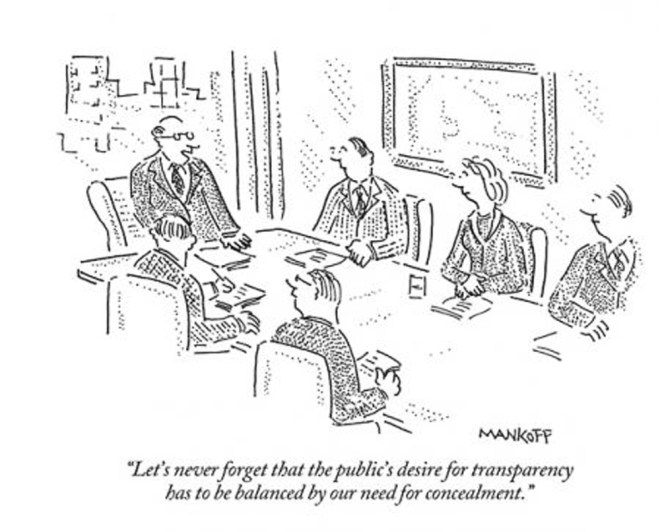
As we have seen with scandal-hit FAS and other Irish state bodies that abused peoples’ trust and misspent public money, the only way to prevent corruption is by creating greater transparency. The government coalition of Fine Gael and Labour made this a central issue in their electoral platform. In the three years since they took office, little progress has been made.

cartoon

Several weeks ago, Ireland was placed 31st position ‘in the league of transparent nations’ following research by the World Wide Web Foundation. It is the worst of any European nation, even behind countries such as Russia, Mexico and Brazil. The group’s categorized Ireland as a country that faces challenges to “mainstreaming open data across government and institutionalizing it as a sustainable practice.” It also said “core data on how the government is spending taxpayers’ money and how public services are performing remains inaccessible or pay-walled even though such information is critical to fight corruption and promote fair competition is even harder to get.”

Tim Berners-Lee, Web, founder of the Web Foundation and the London-based Open Data Institute, said, “Governments continue to shy away from publishing the very data that can be used to enhance accountability and trust” and highlighted the power of open data “to put power in the hands of citizens.”

Údarás is a classic case in point.

lenses

Dinny McGinley, former junior minister for the Gaeltacht, wrote back in a vague response to my FOI request saying simply that Údarás had informed him it was “a data controller, defined under the Acts as a person who either alone or with others controls the contents and use of personal data.

For so many years untouchable hidden behind a veil of Irish-language support, Údarás perhaps is in many ways no different to FAS in terms of greed and individual self-interests. According to Údarás sources, former board members in Donegal remained in boardroom meetings during discussions on lucrative payments to their very own companies and organisations. In addition, not one but at least three Donegal Údarás board members have been up before the Standards in Public Office Commission on corruption charges relating to double dipping on expenses. When one considers the expense claims for board members, particularly under the long-time chairmanship of Liam Cunningham from Glencolmbcille (from 2005 to 2010 he received more than 155,000 euro in fees and expenses, according to Highland Radio), one has an idea of the unchecked, proliferate spending that went on.

Some details as already reported by Highland Radio –

  • Four former Donegal members of the Údarás board each received in excess of 100,000 euro each, over a four-year period, in travel expenses.
  • Fianna Fáil member Daithi Alcorn earned nearly €120,000 between 2005 and 2009;
  • Fianna Fail Senator Brian O Domhnaill received €115,000 while independent Donegal member Padraig O Dochartaigh received €105,000.

Over one billion euro of public money has already gone into supporting Udaras na Gaeltachta yet unemployment rates in Gaetachts are consistently highest in the nation.

Misspending of public money (an issue brought up by the former head of the PAC, see 3-part series article series), includes all-expenses trips to Las Vegas for Udaras board members and their spouses – supposedly to meet a delegation of the IDA;

In truth, Údarás was – and perhaps still is – a cash cow for well-to-do insiders in west Donegal.

It is long past time Údarás prepared proper annual reports instead of the porous documents it now produces that disguise the spending picture and that it holds open public meetings to allow the people of the Gaeltacht to know exactly how their hard-earned money is being spent.

TV3’s Vincent Browne ‘People’s Debate’ in Donegal attracts lively discussion

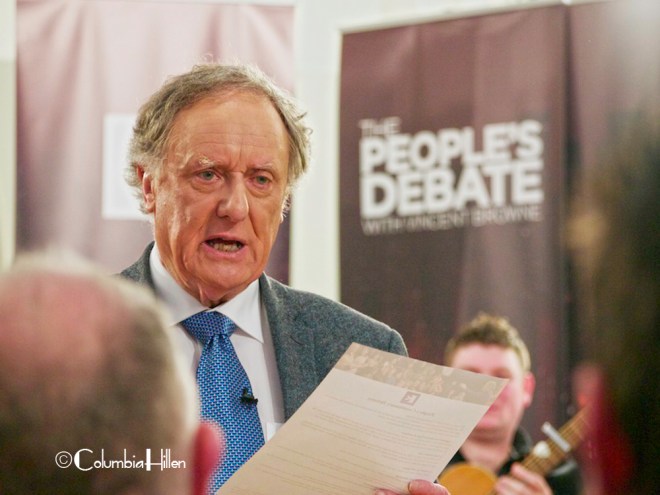
While Fine Gael and Labour were expected to take a beating at yesterday evening’s Vincent Browne-hosted ‘People’s Debate’ in Letterkenny – in part deserved as the two parties refused to participate – Fianna Fail also took a drubbing.

OLYMPUS DIGITAL CAMERA

At one point, after listening to the party’s TD Charlie McConalogue berate government policies, the veteran TV host exclaimed, “I cannot understand how you can make these criticisms. Fine Gael is simply following Fianna Fail policies. Fianna Fail laid down the strategy for dealing with the banking bailout and Fine Gael and Labour are merely following it.”

McConalogue made another mistake later in the debate saying, “the agreement with the Troika was negotiable,” thus contradicting what the public had been told by Fianna Fail that the deal under former Taoiseach Brian Cowen and Minster of Finance, Brian Lenihan, was non-negotiable. Browne was quick to make the point, “Your party said details of the agreement with the Troika were non-negotiable, yet now you say they were. Make up your mind.”

On the emotive issue of water charges, McConalogue – after much fudging said he would halt Irish Water and suspend water charges. Again, Browne responded, “Your party, Fianna Fail, already had a plan in place in 2010 to impose water charges, but now you’re saying you’re having second thoughts.”

OLYMPUS DIGITAL CAMERA

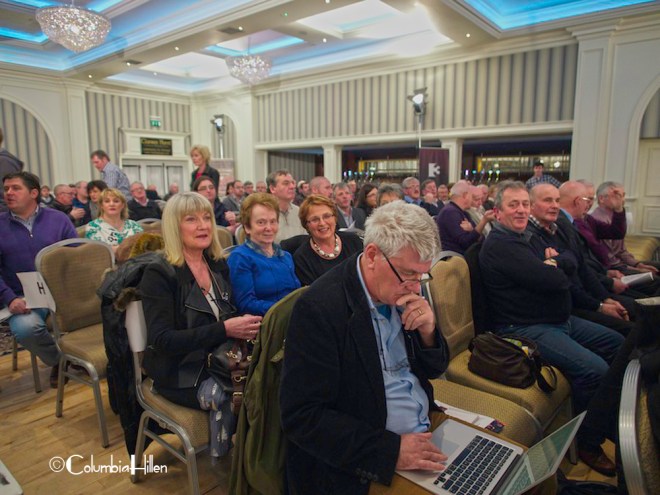
Browne, at his best as a current affairs host when pushing political guests for a clear-cut answer, didn’t let the lively capacity audience down, especially when badgering the four-member panel for their views on a potential coalition after the next election. Asked whether he would take a ministerial seat under a Fine Gael or Fianna Fail led coalition Sinn Fein’s Pearse Doherty seemed somewhat uncomfortable in his seat.

“That is a hypothetical question and such decisions are made at our party Ard Fheis,” he said finally, as if caught by surprise, but recovering. “What we have agreed is that unless water and property charges are dropped, we will not go into any coalition.” He acknowledged, “Some members have voiced their opinion that they would go into a coalition as a minority party. We are a party hungry for change, we are not hungry for power.”

When asked the same question, his Sinn Fein colleague TD Pádraig MacLochlainn was more direct, unhesitatingly replying, “I will not participate in a government led by either Fianna Fail or Fine Gael.” As if taking strength from this, Doherty later stated categorically, “If asked by a government led by Fianna Fail or Fine Gael to be a minister, I would refuse.”

OLYMPUS DIGITAL CAMERA

After chastising the two Sinn Fein members for not giving a straight ‘yes’ or ‘no’ answer, McConalogue himself began the dance of the slippery eel until, under bombardment from host and audience, he finally said, “I would not like to participate in a Fine Gael-Fianna Fail coalition but if I was outvoted by my party colleagues I’d have to go along.”

In his two-minute intro, Doherty said “four years ago we were promised a democratic revolution yet all we have had is more of the same with cronyism, stealth taxes and high levels of unemployment, no more so than right here in Donegal. There is a fairer and better way of moving forward and Sinn Fein’s job strategy can reshape this county.” He added that it was little wonder Donegal was known as ‘The Forgotten County.’ “I know Vincent you didn’t come here by train because this is one of only five counties in all Ireland without a mainline railway service.” Under an FOI request he said he has asked for a government paper produced on the future of small schools, adding that Donegal has the second largest number of such schools, with four teacher or less.

When corruption and lack of transparency within Údarás na Gaeltachta was brought up, including its refusal to release key information on its public spending such as lucrative pension payments to former executives which amount to half of its entire annual budget, Doherty said his party had tabled formal parliamentary questions on the issue, adding, “there should be full disclosure about people in receipt of high public pensions, it is important to have complete transparency so such payments can be scrutinized by the public.”

McConalogue said in his intro, “the last four years of government have been an attack on Donegal with post office closures, agriculture being hard hit and worsening heath services,” adding, “we have strong potential here but we need better infrastructure including the A5 project up and running and wider broadband.”

Referring to the pre-election catchphrase ‘Frankfurt’s Way or Labour’s Way,’ MacLochlainn said the government’s record has proved very different, “with a reduction in classrooms, budget cuts across the board and Donegal having the lowest allocation of medical staff of any county.” He added, “Donegal people are hard-working and passionate. All we’re asking is a fair chance and for Dublin to meet us halfway.”

Regarding the water charges, he added, “For thirty years, Sinn Fein has opposed these charges and now it has become the straw that broke the camel’s back. There has simply been too much austerity. Irish Water is a white elephant. My message is ‘scrap the water charges and go back to the drawing board.’ ”

While decrying the lack of proper health services and unfair stealth taxes, Independent TD Thomas Pringle said renewable energy had tremendous potential for Donegal as had the biomass wood industry. Speaking of Killybegs, he also said the fishing industry had been “hard-hit.’ He said water conservation should be a top priority because so much is being lost through poor network connectivity. He also said he was proud of challenging the bank bail-out through the courts and being in the forefront of water charge protests (continuing the momentum, a major ‘Right2Water’ protest took place earlier today – Saturday – in Letterkenny, with others elsewhere nationwide).

All four TDs, when asked directly, said they would vote ‘yes’ in the upcoming referendum on same-sex marriage.

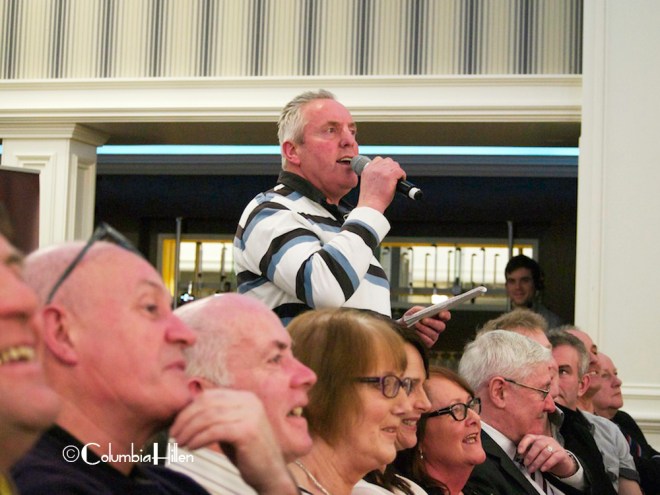
Over the lively, two-hour event at the Clanree Hotel, there was no shortage of questions from the floor with periodic rambunctious catcalls, cheering and booing, which caused short stoppages and words of warning from the presenter.

OLYMPUS DIGITAL CAMERA

True to his word, Browne attempted to cover as many topics as possible such as equality, including the upcoming same-sex marriage referendum; family services, education, employment and health. Speakers ranged from parents of terminally-ill children; school teachers, social workers and community activists working on behalf of people as diverse as lesbians, gay, bisexuals, transgender, cancer sufferers, the disabled, and many others.

Some light-hearted moments and biting comments helped take the edge of emotions as when a thirsty Vincent Browne ran out of water and promised he’d even pay for some and when James Woods from Gortahork commented that with so much emigration, Donegal was turning into a wildlife refuge.

OLYMPUS DIGITAL CAMERA

All in all, ‘People’s Debate’ is an excellent initiative by TV3, no doubt demanding detailed planning to host such shows in all the constituencies of Ireland.

Fine Gael and Labour’s decision to spurn them, indicating fear and a lack of understanding of the difficulties facing ordinary people, could ultimately cost them vital votes in the polling booths.

OLYMPUS DIGITAL CAMERA

OLYMPUS DIGITAL CAMERA

OLYMPUS DIGITAL CAMERA

OLYMPUS DIGITAL CAMERA

OLYMPUS DIGITAL CAMERA

OLYMPUS DIGITAL CAMERA

OLYMPUS DIGITAL CAMERA

OLYMPUS DIGITAL CAMERA

OLYMPUS DIGITAL CAMERA

OLYMPUS DIGITAL CAMERA

‘Whatever you say, say nothing!’ – motto of Údarás na Gaeltachta

‘People have no right to ask how we spend their money.’

That’s the attitude of Údarás na Gaeltachta, which has once again refused to release key information about how it spends public funds.

Udaras

A Senate committee revealed that Údarás pays millions of euro every year in pensions to former executives, some of whom were local Donegal employees including Cathal MacSuibhne, former regional manager based in Gaoth Dobhair.

cathal

Sinn Fein’s Trevor Ó Clochartaigh, a member of that Senate committee, exclaimed, “I nearly fell off the chair when I heard that almost half the current expenditure goes on pension payments to 136 people who are no longer employed by the organisation. Small wonder Údarás is not able to function more effectively.

He added, “This raises serious concerns regarding the levels of monies being paid and who is receiving them.”

Under transparency rules, other public bodies have made a breakdown of such pension figures available for examination, but in response to a Freedom of Information (FOI) request I made, Údarás refused to do so, citing gobbledegook about data protection.

As a result, having brought the matter to the attention of a number of TDs, the Údarás pension issue has risen to the highest levels of national government, to the office of Brendan Howlin, Minister for Public Expenditure.

I can reveal in this blog that on my behalf various leading politicians including Public Accounts Committee (PAC) member, Mary Lou McDonald, have attempted to find out the individual pension figures but Údarás has stonewalled every request, preventing their release.

MaryLou

How it happened

Údarás responded to my initial FOI request last year seeking details on pension and lump sum payments to former executives in a letter signed by Padraic O’Conghaile – a ‘cinnteoir’ at the organisation’s headquarters in Galway.

In the letter, he wrote, “I am refusing these records as they relate to the pension of an individual under Section 28.1 (Personal Information). The FOI Act defines personal information as information about an identifiable individual that: ‘would, in the ordinary course of events, be known only to individuals or members of the family or friends, of the individual.’ I believe that the right to privacy of these persons with regard to such information far outweighs any public interest there may be in this matter.

The fact, that all the pensions and payments are publicly-funded and thus not “known only to individuals or members of the family or friends, of the individual” as he asserts – did not seem to enter Mr. O’Conghaile’s thinking. Or, perhaps, did, but he refused to acknowledge it.

Following this response, I requested several TD’s to present formal written parliamentary questions in the Dail on the same issue.

For example, Mary Lou McDonald, a member of the Public Accounts Committee (PAC), submitted her parliamentary question to the Minister for Arts, Heritage and the Gaeltacht asking the Minister to “reference the specific provisions of the Data Protection Acts 1988 and 2003 to which he referred (supporting Údarás’ denial of information); the basis on which he believes Údarás na Gaeltachta does not, unlike in the case of all other senior managers across the civil and public sector, have to make public the details of public service pension arrangements on retirement for senior management.

Dinny McGinley, then junior minister, wrote back in a vague response saying simply that Údarás had informed him it was “a data controller, defined under the Acts as a person who either alone or with others controls the contents and use of personal data.

dinny

Put in simple words, it means Údarás, while deriving all its funding from public money, considers ‘People have no right to ask how we spend their money.’ McGinley’s response also has no logical meaning whatsoever under present Irish law. Instead it is a classic delaying tactic. The former Minister did not bother to question it or seek elaboration.

That response led McDonald to submit a follow-up question, this time to Minister Howlin, reading, “given the Minister’s stated commitment to transparency and accountability in the spending of public monies, whether in his view it is acceptable for a public body fully funded by the exchequer to withhold from the public record details of public service pension arrangements on retirement for senior managers; and if he is prepared to legislate to require all publicly funded bodies to make such information public in the interests of open government.

HOWLINBRENDAN

It is most disappointing that a simple request to a fully publicly funded body about its spending has led to such a reactionary response from an organisation such as Údarás, which is responsible for the economic, social and cultural development of the Gaeltacht.

Such utter lack of transparency and disregard for public concerns has already led to such widespread corruptive practices as those at FAS when it was discovered hundreds of thousands of euro went on lavish holidays including first-class travel and expensive rounds of golf for executives and their wives. Údarás itself has yet to account for trips paid out of public funds for board members, executives and wives to visit attractive international destinations, including Las Vegas.

Public money is a precious thing and every penny of it ought to be properly accounted for and judiciously spent.

I will reprint Minister Howlin’s response on this blog when it is received. It should provide a most interesting read.