Gangsters, journalism and the Pulitzer prize

Kevin Cullen is my kind of journalist – unafraid to lay bare corrupt activities  – especially at public institutions that profess to be paragons of probity and morality such as the Catholic Church – yet also quick to highlight the extraordinary achievements of ordinary people.

When the twice Pulitzer-winning columnist for ‘The Boston Globe’ writes, his words leap off the page and with a resounding thump, smack you full in your emotional center, somewhere between heart and brain.
Such prose power is amply illustrated by his column on the quiet, dignified testimony of Bill Richard during the trial of Boston marathon bomber, Dzhokhar Tsarnaev, whose dastardly work killed the Dorchester father’s 8-year-old son, Martin, ripped the leg of his 6-year-old daughter, Jane, and blinded his wife, Denise, in one eye.
Kevin Cullen Boston Globe, Pullizer Prize winner

Kevin Cullen – one of the most informed American journalists on Irish affairs.

Or on Tim Davis from Taunton, who from the age of six lived in 15 different foster homes, was cruelly treated in some, yet went on to establish the ‘Teddy Bear Foundation for Foster Children,’ which, among other things, delivers gifts to kids every Christmas.
 
Irish culture in America faces challenges
 
As one of the most informed American journalists on Irish affairs, Cullen is also concerned about the dilution of Irish culture in the US due to the dramatic drop in the number of emigrants from here – a subject he’ll address this Friday evening at the ‘TransAtlantic Connections 3‘ conference in Bundoran. A multi-disciplinary event embracing the connections between Ireland and the US, it is organized by Drew University and hosted by the Institute of Study Abroad Ireland and takes place at the Atlantic Aparthotel and Bundoran Cineplex from Wednesday until Saturday.
Event speakers include Christine Kinealy, author of more than 16 books and director of Ireland’s Great Hunger Institute at Quinnipiac University in Connecticut, Mike Nesbitt, leader of the Ulster Unionist Party, authors, Michael MacDonald and Turtle Bunbury, Micheal O’hEanaigh, director of enterprise, employment and property at Údarás na Gaeltachta, Liam Kennedy, director of the Clinton Institute at UCD, Barbara Franz, politics professor at Rider University, New Jersey,  Mary Hickman, Irish Studies professor at St. Mary’s University, London and Tommy Graham, founder and editor of ‘History Ireland’ magazine.  
The institute’s founder, Professor Niamh Hamill, a lecturer in Irish history and culture, completed her Doctorate studies at the New Jersey-based Drew University and established the institute in Bundoran in 1996. “While there, I became aware that the narrative about Ireland in the US was somewhat outdated and that a more contemporary and accurate one was necessary, thus the idea for a multi-disciplinary conference such as this one and the formation of the institute itself,” she told me this week.

But why Donegal?

“I am from the county and my view is that a border location is essential for a comprehensive understanding of Ireland,” she replied. “This is an authentic yet undervalued corner of the country and – being close to cities such as Derry – a greater dimension, both culturally and historically, can be added to an educational endeavor such as this.”

Hamill said Donegal County Council helped fund this week’s conference and Fáilte Ireland helps fund an annual familiarization trip in October for American educators to come to Donegal to help her institute to establish relations with US schools and universities.

As for Cullen, he told me in a telephone interview from Boston this weekend. “Ten years ago, there were around a quarter of a million Irish-born people living in the US. That has now dropped by over one hundred thousand, with major cultural ramifications.” As evidence, he cited the reduction in the number of GAA teams in New York and Boston as well as fewer Irish pubs in what were once considered traditionally Irish neighborhoods such as Dorchester in Boston and Sunnyside in New York. “Fifteen years ago, there would have been Irish music sessions every night. Not now, and in those, very few Irish-born musicians.”
 Cullen is not optimistic this situation will change any time soon.
“Ever since the Famine the Irish diaspora has always been both wide and deep in the US, constantly replenishing itself, with historic deals such as the Donnelly and Morrison visas in the ‘80s and 90s a major benefit,” he said. “But since 9/11, the creation of Homeland Security and the Republican Party’s anti-emigration, anti-amnesty stance, the situation has changed radically and this trend is expected to continue even if the Democrats take over in Washington. This is in stark contrast to Australia and Canada where specific visa strategies for Irish emigrants have been established.”
His words sadden me deeply. I was one of those people lucky enough to emigrate to America in the 1980s, forging a decent career in print and broadcast media there and launching an Irish newspaper and cultural center. I also became an adviser to the Irish Immigration Reform Movement (IIRM) led by the effervescent and charismatic, Cork-born Sean Minihane, that performed such sterling work on behalf of Irish men, women and children, both legal and undocumented. Other IIRM leaders included Mae O’Driscoll and Sean Benson. 
While the developing situation as explained by Cullen is undoubtedly bad news, fortunately he doesn’t consider this dilution of Irishness in the US will affect American investment here. “Such investment has nothing to do with sentimentality. It is finance, pure and simple, in a phrase: low corporate tax rate and other tax shelter options that Ireland offers.”
National policies permitting such shady tax shelters, which companies like Starbucks, Google, Microsoft, Pfizer and Apple have taken full advantage of, are under siege by both EU and US authorities, perhaps rightly so, and may not last. They have cost America more than 500 billion euro in lost tax revenue over the last year alone.
 
Making of a Mafia
 
Cullen is co-author with fellow reporter, Shelley Murphy, of the New York Times best-seller, ‘Whitey Bulger: America’s Most Wanted Gangster and the Manhunt That Brought Him to Justice,’ focusing on one of the most infamous of American gangsters dramatically captured six years ago after eluding the FBI for 16 years. 
Kevin Cullen, Shelley Murphy, Boston Globe journalists

Kevin Cullen and Shelley Murphy, co-authors of a book on gangster, Whitey Bulger, relax on the South Boston waterfront. Photo by Stan Grossfeld

“I wrote the book with Shelley because between the two of us, we broke most of the stories about Bulger over his long criminal career,” Cullen informed me. “I was the one who first figured out he was a protected FBI informant, and Shelley broke everything about his 16 years on the run and the manhunt that finally led to his capture in 2011. The book we wrote was more than a biography of Bulger, it was a biography of South Boston, the Irish-American neighborhood that produced him, and the culture of law enforcement and politics in Boston at that time which allowed him to become the biggest gangster in the city at the same time his brother was the most powerful politician. The book was more about culture than crime.”
 
Brilliant investigative reporting
 
A model for Irish people and journalists in particular is Cullen’s persistence and that of his Globe colleagues which led to their winning the coveted Pulitzer Prize for Public Service in 2003 for revealing, through 600 articles 14 years ago, the horrendous cover-up by the Catholic Church in Boston of priests sexually abusing young children.
That five-month investigation, which is now the subject of a new movie to be released here over the next week or so, entitled ‘Spotlight,’ led to the resignation of Cardinal Bernard Law and a global crisis for the church that continues to this day, with scandals in more than 100 cities across America and at least 100 more around the world.

Cullen informed me, “Regarding the Catholic Church cover-up, as usual, whether you’re talking about Bloody Sunday or Watergate or whatever, it isn’t the crime, it’s the cover-up. The way that bishops, including Cardinal Law, enabled abusive priests by moving them from parish to parish was shocking. The way they treated victims and survivors was worse. As part of the investigative team, I spent much of my time trying to show the deference that was shown the church and the Catholic hierarchy by the leaders of law enforcement, politics and business, most of whom were Irish Catholic in Boston. We tried to explain that beyond the crimes of the priests and enabling bishops, the wider society was somewhat complicit in not challenging them more forcefully over the years. The same thing happened in Ireland.”
Cullen was also a member of ‘The Boston Globe’ reporting team that won another Pulitzer Prize for Breaking News Reporting in 2104 for its marathon bombing coverage. He was one of three finalists for the 2014 Pulitzer for Commentary.  “As it would have been for reporters in Ireland covering The Troubles, the Marathon bombings were very personal for us in the Globe newsroom, because we knew people who were injured,” he told me. “I knew several, and vaguely knew of the Richard family, which suffered so grievously in losing 8-year-old Martin. I was also very friendly with a number of first responders who were traumatized by what they saw. The Globe’s news coverage in that first week after the bombings was recognized for its depth and breadth, from the victims to the medical people who saved them. I was just part of that team, supplying a lot of information about the investigation and the shootout that ended the threat from the bombers.”
 
Lessons to be learned
 
In my discussion with Cullen and in my overall reading of the events mentioned above, one key element stands out – the importance of vigilance in holding powerful institutions and individuals accountable for their actions.
Admirably, the Globe’s ‘Spotlight’ investigation of the church started with four reporters and expanded to eight shortly after the initial stories were published. That group stayed on the story for the rest of the year. In contrast, newspapers today, mainly due to declining circulations and ad revenues, cannot afford to have investigative reporters. But it is vitally important that local, as well as national, newspapers do not shy away from controversial stories. They remain the trusted protectors of the public domain and such stories are the lifeblood of real journalism.
Also, as the US media commentator said, “The Boston Globe’s clergy abuse investigation provided an early lesson in the power of the Internet. Although it may seem all-too-obvious today, its decision to post church documents used in its reporting provided readers with powerful, direct evidence that Law and other church officials had spent decades covering up the abuses. The Internet also helped spread the Spotlight Team’s stories — and the church’s internal records — worldwide, spurring lawsuits, investigations by other news organizations, and complaints from thousands of victims.”
In this regard, a recent blog posted by me, ‘Crooks, citizens or celebrities?– which had key documents attached – attracted more than 1,000 dedicated readers, illustrating the kind of power that technology has provided us with to help right public wrongs.
The same US media commentator continued, “The Globe investigation underscored the importance of old-fashioned, shoe-leather reporting. Though new technologies have provided investigative reporters with an array of shiny tools, it showed there is no substitute for knocking on doors for face-to-face encounters with reluctant sources who needed to be assured of a reporter’s sincerity or determination. Perhaps most important, the investigation highlighted the need for vigilance, or a continuing commitment to cover and advance the story.”
Cullen himself added, “It’s important to write about process, it’s important to write about institutions …but I’m not going to sit and explain to you the ins and outs of our great political system. I will, however, tell you stories about people who got screwed by that same system, because I like writing columns that stick up for those who have no juice, no power, no influence.” 
We here in Donegal – already severely marginalized and ravaged by high unemployment, depression, alcoholism and suicide – cannot afford to stay quiet about greedy people placed in positions of trust who steal scarce money from the public pocket.
All of us – encouraged by passionate local councillors such as Dessie Shiels, Frank McBrearty Jnr. and Micheál Cholm Mac Giolla Easbuig – must constantly be on our guard and speak – nay shout – out, when we see something wrong.
 
In the end, we only get what we accept.
 

Praise and prise

As one year ends and another begins I look back at the privilege I’ve had of writing in this blog about exceptional individuals who – through skill, initiative, invention, passion and sheer persistence – deserve great praise.

They’ve brought added color and a refreshing sense of diversity to Donegal, one of the most remote parts of Ireland straddling its most northwesterly Atlantic seaboard.

Consider Sabba Curran from Dore, who some years ago, without knowing much about boats drove down through England at exactly this time of year and returned with one in tow. Now he owns ‘The Cricket’ one of the largest passenger boats in the area and brings people for enjoyable excursions to Gola Island and much farther out on leisure fishing trips.

The Cricket boat to Gola Island, ferry to Gola Island, Donegal islands

Or Gareth Doherty, whose boat-trips with his grandfather unwittingly launched him on a series of sea-loving escapades. Now, with a plethora of certificates to his name as master of different crafts, Gareth takes visitors, young and old alike, on sailing and canoeing adventures, teaching them the skills he himself has learned over the years and showing them the beauty of the bird and sea-life population all around us.

Selkie Sailing, Gareth Doherty

Then there’s Pól Ó Muireasáin, one of the most refined Irish speakers in the entire Donegal Gaeltacht, or indeed any Gaeltacht for that matter. Having taught as Gaeilge at university and worked as a translator in Brussels on complex European issues, there’s very little Pól doesn’t know about our native language, grammar, linguistic or etymology.

Brimming with civic spirit, there’s few challenges Pól won’t try, including line-dancing as a nun and a cowboy, then imitating that most famous of seasonal characters, Santa, thus bringing untold pleasure to young and old alike.

fishing in Donegal, Gola Island Ferry, sea foreger

Photo by Sean Hillen

Trips with these three men over the last few years has filled me with the kind of exhilaration and child-like exuberance one rarely finds in the bland concrete-and-glass urban settings I’ve often lived in.

But it’s not just lovers of the sea that help restore one’s faith in humanity. There’s also lovers of the land. Such people as Seamus Doohan, walking guide and lover of all things Celtic.

Seamus Doohan walking guide, walking Donegal

Having had the pleasure of experiencing his tours for an article in ‘The Irish Times’ as well as for this blog, I can guarantee a right-royal good time in his company, meandering among the hills of Donegal while learning about the colorful history of the area – including flesh-eating plants, soaring eagles and Pagan wishing stones.

Treading a different terrain altogether is Kathleen Gallagher.

Kathleen Gallagher Falcarragh,

Standing at Falcarragh crossroads just before sunset one year, I – like hundreds of others – was astounded to see a dramatic spectacle unfold before our eyes. At the edge of the hazy horizon, slowly coming into view, appeared wave upon wave of grisly, shapeless, blood-spattered zombies, horrible-looking members of the UnDead who, as they drew near, suddenly burst into a frenzy of brilliantly-choreographed dance moves to the pounding music of Michael Jackson’s ‘Thriller.’ Such a mesmerizing event, part of a community festival, is but one example of the sheer creativity of this lively, zesty individual who’s probably the envy of Galway’s ‘Macnas.’

Kathleen’s artistic talent brings me conveniently to another transplant to Donegal, this time from the heart of Scotland – a man who has brought Kings, Queens, medieval murderers and even ‘Cold War’ spies to this small part of the world. From James Joyce’s ‘Ulysses’ to Shakespeare’s ‘Macbeth’ to Graham Greene’s ‘The Third Man,’ Murray Learmont is a stage supremo directing members of the Cloughaneely Players to theatrical success.

Murray Learmont theatre director, theatre in Donegal

‘Toss a stone and you’ll hit a musician on the head.’ Such were the memorable words I recall hearing from someone after first setting up home in Bun na Leaca fifteen years ago. It’s an understatement. ‘Toss a stone and it’ll bounce from the head of one musician to another, to another, to another….’ is a more accurate depiction of the situation.

I’ve had the pleasure of hearing so many performing, it would be impossible to name them all here, but two whose lives I’ve written about deserve mention.

Few around here, nor in places beyond Ireland, don’t remember ‘Goats Don’t Shave’ and its founding member, singer and songwriter extraordinaire, Pat Gallagher, who penned the immortal tribute, ‘Las Vegas in the Hills of Donegal’ that became an instant national hit. Such is his musical prowess Pat can meander effortlessly from one genre to another, from ballads and blues to folk rock and country. Listen to ‘A Returning Islander,’ ‘Turfman’s Blues,’ ‘Children of the Highways,’ and ‘Let the World Keep on Turning’ and you’ll understand just what I mean.

Pat Gallagher musician, Goats don't Shave

Then there’s Ian Smith. Not managing to become a native of west Donegal, he did the next best thing – married beann álainn, Breda, from here. Formerly a guitarist and singer with a rock band in England, Ian left thousands of groupies broken-hearted and settled near Burtonport – and has never looked back, well, hardly ever. During that time he has played with some of the best musicians in the world and has cut not one but three full CDs, one of which ‘Restless Heart’ showcases his immense song-writing talent, with many of the titles his own work.

Ian Smith musician, folk music Donegal

That’s the praise bit of the headline. What about the prising bit?

Such talented people as mentioned have not received the kind of support they deserve from those with their hands on the cash that is meant to enrich the cultural, social and economic soil of west Donegal.

Instead of providing generous funding for touristic and artistic initiatives that help attract welcome visitors to the area and create jobs, the powers-that-be at the Gaeltacht’s leading funder, Údarás na Gaeltachta have either repeatedly fed the billion euro they’ve received to well-known, rich elites; to themselves or acquaintances; to developers to build now derelict, deserted industrial estates; and to companies which have gladly accepted the hand-outs, then promptly left the area, leaving out-of-work unfortunates in their wake.

Perturbed by the stories I’ve been told by local people about such discrimination and the wall of informational silence constructed by Údarás – I began prising apart, bit-by-bit, snippets of information through the Freedom of Information Act about the spending policies of aforesaid economic development organization.

To say I was surprised and disappointed at what I found is a distinct understatement. Astonishment would be a more suitable word. Lack of strategy, absence of clarity, cases of cronyism and nepotism – in fact, all the dubious goings-on that continue to bedevil Ireland and prevent its healthy development.

With the New Year approaching, I’ll continue to praise and prise. Perhaps, in doing so, I’ll help create a bit more transparency as well as highlighting some more of the real heroes of the area and thus contribute something to the area where I live.

I hope so cos’ I’m a terrible singer, can’t play a musical instrument if my life depended on it. As for gardening, what’s the difference between a parsnip and the tail of a donkey? Don’t even mention boating.

In the meantime, have a happy and contented New Year, wherever you are, whatever you do!

Crooks, citizens or celebrities?

Ethics, or lack thereof, has been the raging catchphrase in Donegal recently with county councilor John O’Donnell  caught on RTE camera allegedly offering lobbying services for cash and Bunbeg-based, EU-funded former school principal, Finbarr Boyle, stealing more than 200,000 euro from a village school, including money earmarked for childrens’ food.

But what’s all the commotion about? Hasn’t there been such unsavory goings-on right here in Donegal for years? Why the shock? Or is there any, really?

In last weekend’s edition of ‘The Irish Times,’ columnist Fintan O’Toole, painted a scary scenario, a malaise spreading nationwide.

…other cultures criminalise the things they find unacceptable; we find unacceptable only the things that have been criminalized. If you can get away with it, we reckon, it can’t be all that bad.” He then quoted Central Bank Governor, Patrick Honohan on white-collar crime, saying, “It is remarkable, first of all, how long it takes, how heavy the procedures are and how light the consequences.

Back in Donegal.

Ardara-born Finbarr Boyle’s story is well-publicized “School principal pleads guilty to 7 counts of theft and forgery.”

As a journalist and editor for over thirty years, I thought sharpened instincts had made me a good judge of character – boy, was I ever wrong.

Sitting at a lunch prepared by my wife in my home with Mr. Boyle as guest some time ago, I would never have guessed the man across from me would stoop to such lows as using a village school’s money where he was principal to treat himself royally to holidays in England, Spain and other fine places, car and house payments and expensive golf equipment.

Finbarr Boyle Donegal, CeangalG,

(l to r): Concubhar Ó LIatháin, CeangalG Marketing Manager, Claire Nic Neacail, Alasdair Morrison CeangalG Director, Dinny McGinley Fine Gael TD and Fionbar Ó Baoill – CeangalG Training Manager.

Mr. Boyle was given space inside the headquarters of Údarás na Gaeltachta in the Gweedore Industrial Estate, Bunbeg as a training manager – surprising, as that particular organisation has refused to gave any free space to small, local entrepreneurs in that same estate, a situation local Sinn Fein TD Pearse Doherty, has consistently taken issue with.

I must admit, Mr. Boyle impressed me then, a fast talker, assertive and supremely confident. Yes, I know what you’re probably thinking – ‘Sounds like a conman to me.’ As things turned out, you are absolutely right. But I was left sad and disillusioned after learning of his multiple theft. He struck me then as the kind of person who could be a positive force for change, especially as we discussed the importance of ethics and the need for the Donegal Gaeltacht to rid itself of its historic cronyism and nepotism which have warped normal economic development of the region.

Yet this is the same person found guilty of seven counts of theft over a number of years (he admitted to many more as part of his plea bargain), for whom Judge John Aymler may not impose a custodial sentence because, in part, 25,000 euro of the money taken may be paid back within a year. That’s around a tenth of what was stolen.

Who says crime doesn’t pay?

A key question, however, still remains unanswered: Mr. Boyle was caught red-handed several years ago (the investigation has been ongoing for at least seven (7) years), so how did he obtain a well-paying position as training manager of a lucrative, multi-million euro, tax-payer supported EU funded project – ironically, one aimed at helping economically disadvantaged people? Was this , in itself, a classic case of nepotism and cronyism? Regardless of the multiple thefts, people have asked, “Does a school principal have the business credentials to train entrepreneurs?”

When contacted by me this week on the issue, Dr D. Munro, chair of the CeangalG Steering Group, Sabhal Mor Ostaig in Scotland, e-mailed back, saying, “Mr. Boyle’s actual contract of employment, for the post of Training Officer, with the wider CeangalG Project, was formally and directly managed through our Project Partners, Údarás na Gaeltachta.” He added that Mr. Boyle was “employed by the project between 9th Sept 2013 and 31st March 2015.” The Gardai investigation began as late as 2008 and Mr. Boyle, according to media reports, admitted his thefts almost two years ago (January last year).

Mr. Munro added, “At no stage in either the recruitment process or during his subsequent period of employment, was CeangalG ever made aware of there being any on-going police investigation.” Mr. Munro cc his email to the law company of Wright, Johnston & Mackenzie and to the University of the Highlands. Have I touched a red button?

Entitled CeangalG (ConenctG), this project is funded by the EU’s INTERREG IVA, Bòrd na Gàidhlig, MG ALBA, the Scottish Government, Sabhal Mòr Ostaig and Cultúrlann McAdam Ó Fiaich and focuses on the Gaeltachts of Donegal, Scotland and Belfast. On it’s website, it states:

CeangalG Donegal, INTERREG IVAAs for independent councilor John O’Donnell, the ball is largely in his court. He can do the dignified thing and bow out. If he stays, he places the entire council under a shadow. Independent councillor Frank McBrearty says he should be removed from all committees. But it seems resigning is the last thing O’Donnell will do. Another Independent councillor, Micheál Cholm Mac Giolla Easbuic, is right in asking fellow councilors to walk out of the chamber at the next meeting in protest. Someone has to stand up, otherwise – due to blatant impunity – it will get much worse. Let’s see if that happens. If not, then Fintan O’Toole’s words ring frighteningly true.

John O Donnell Donegal, independent councilor Donegal

Independent councilor John O Donnell: will he do the right thing?

But questionable dealings are nothing new in Donegal, as many local people have told me.

Under the auspices of the former Fianna Fáil government, Liam Cunningham (Liam Ó Cuinneagáin), was paid substantial sums for his services as member and long-time chairperson of Údarás na Gaeltachta – more than a quarter of a million euro. Between 2002 to 2012, his travel expenses alone amounted to 131,730 euro. His fees amounted to 206,962 euro.

More than that, documents requested by me under the Freedom of Information Act also now show that at least one company he established, Oideas Gael, received generous amounts of money – more than 350,000 euro in a series of payments – from the very same organization he chaired for so long. Mr. Cunningham said Oideas Gael was a hobby. With a financial return like that, that’s quite a hobby.

In stock market terms, is this not a case of insider trading, and therefore unethical? After all, no better-placed person to access money from a group than the person who’s on the inside track of that very same group, knowing intimately its budgets, its strategy and its key staff. When called by me about this situation in a phone interview, Liam said, “Sean, things were different then. I don’t see it as a conflict of interest.” Different then? How is it different? The question was never answered.
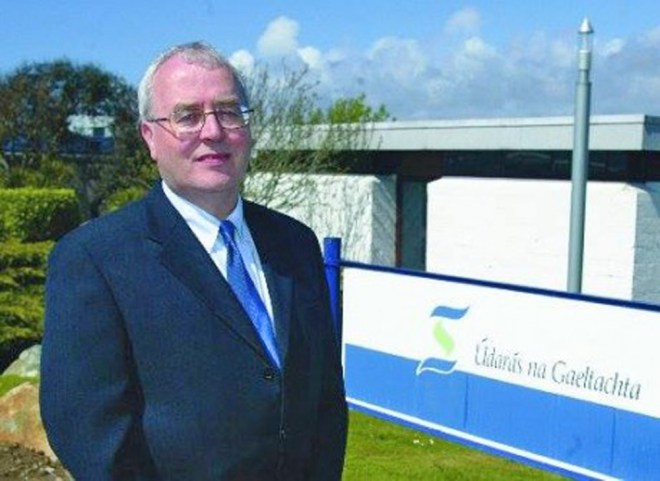
Oideas Gael, Liam Cunningham Donegal

Liam Cunningham: is it wrong to lobby for money from the very funding organisation that you chair?

Some readers might say, ‘Liam hosts Irish-language classes.’ That’s true, but so do many others and they don’t benefit from the rich financial backing Oideas Gael received so handily. Still others could do so – if they had that kind of money. Is such treatment fair and ethical? Is the playing ground a level one? How many times has Údarás said there’s not enough money for your project?

The particular situation of Mr. Cunningham also raises an inevitable question: was it linked to an ongoing quid pro quo agreement among local Údarás board members then? And has anything changed since? Interested to find out? You have the right to know, and here’s how. (See below).

Mr. Cunningham has since been named, ‘Donegal Person of the Year.’ Considering the dire economic development of the Gaeltacht, where I live, under his watch, the question must be asked, ‘Is this how we want the term ‘model citizen’ to be defined?”

Michael Heaney, formerly a director of services with Donegal County Council, has recently been appointed director of Enterprise & Investment with Údarás. Will his leadership change the way Údarás doles out money, how it selects projects to fund? Or will the same old cadre of elites be the recipients? Time will tell.

As Údarás is helping DLDC select projects for funding under the EU’s upcoming LEADER programme, it will be operating under much tighter European regulations than the rather loose Irish ones it has been working under thus far. It will be interesting to monitor the quality of their project selection process for LEADER.

As O’Toole writes in last Saturday’s column, “If corruption is very low on the list of priorities for criminal justice, it is little higher on the list of political priorities…. So long as impunity reigns, the rare eejit who gets caught will always evoke sympathy… What marks out (Ireland) is the breathtaking degree of impunity for all white-collar crimes.

Isn’t it long past time this situation changed? The upcoming election gives us the chance to affect such change. In  ofthis regard, it is worth noting the words  ‘Donegal News’ columnist Martin McGinley’s in Friday’s edition, “We get what we accept.”

You have the right to know:

You can find out additional information on the dealings of Údarás by e-mailing Judy Ní Dhubháin at judy(at)udaras.ie. Quoting the FOI Act 2014, you can ask for any information you like, financial or otherwise. The service is free.

Anyone wanting answers from CeangalG, can contact Dr D. Munro, chair of the CeangalG Steering Group at dm.smo(at)uhi.ac.uk or +44 (0) 1471 888352. Claire Nicolson is the organisation’s administrator claire(at)ceangalg.net Alasdair Morrison, a former minister in the Government of Scotland, is its director. Or through Údarás na Gaeltachta, Donegal. Tel: 074-9560100. Fax: 074-9560101. Email: dnag(at)udaras.ie

Be sure to tell me what you find out. I’d be curious to know.

Donegal entrepreneur Moira Ní Ghallachóir pushes for local tourism diversity

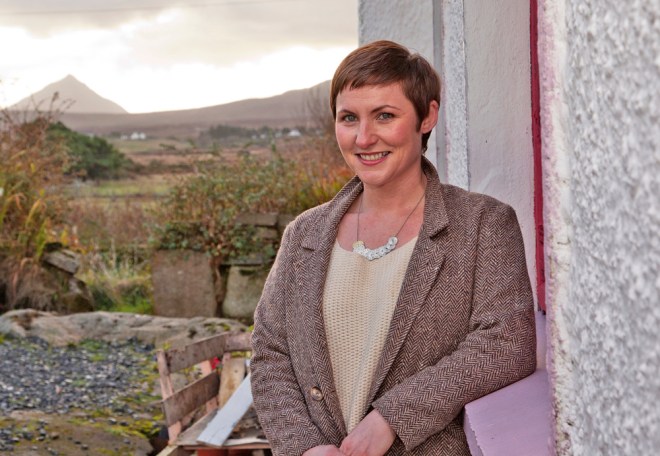
With no particular experience in tourism and no specific agenda, Edinburgh-born Moira Ní Ghallachóir bravely packed up her bags in London four years ago and returned to west Donegal where she grew up, to re-invent herself – and says she has never looked back.

Moira Ní Ghallachóir Donegal,

Back home, and lovin’ it! Photo by Philip Mulligan

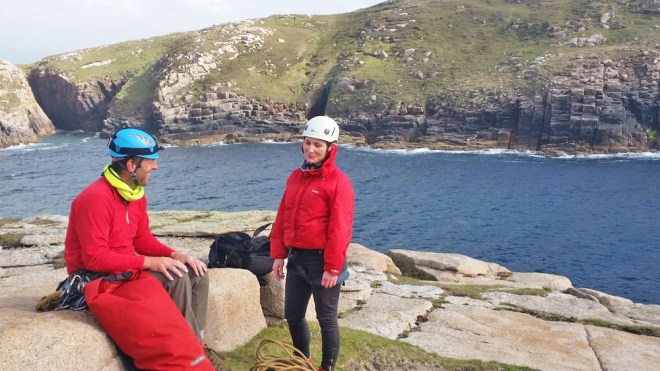
Living in her grandmother’s home in Derryconnor just outside Gortahork in the Gaeltacht, she noticed the large number of local people with outdoors skills such as Iain Miller, an experienced mountaineer, and Gareth Doherty, a sailing instructor, so she launched mng Ventures to organize outdoor adventures linking their skills to clients.

mng Ventures, Donegal outdoor activities

Iain Miller puts Moira ‘through the ropes.’

“I looked at my life in London, the work-week, then partying all weekend, and asked myself, ‘Is this it?’ ” said the petite, short-haired 39-year-old woman sitting in An Crannog, a community-based complex in the coastal town of Bunbeg under the management of Cathal Ó Gallchóir, where she was given free office space for a year to help develop her business. “If someone had told me I’d be earning as little as I have over the last three years, however, I’d have said, ‘You must be joking.’ But, honestly, I feel more fulfilled, happier and healthier than I’ve ever been. With islands, mountains, lakes and the Atlantic Ocean right beside us, this place is truly world class. That’s what inspired me to set up a business.”

While Moira is armed with plenty of enthusiasm and networking links gained from living in Ranafast from age 8 to 18, she is concerned at what some describe as ‘generational grant dependency,’ the over-reliance on public hand-outs for projects rather than sheer entrepreneurial spirit.

mng Ventures, Rock agus Roam

Ready to ‘Rock agus Roam, a project organised by mng Ventures!

“Many people feel they have to be supported by government grants and if there is none, then ‘game over’ it cannot be done,” she said forthrightly. “We need to realize what we have and build on it. Some people say, ‘We need an adventure centre,’ not realizing that the adventure centre is all around them. Many also don’t appreciate what a beautiful landscape they have here. How can they then expect tourists to appreciate it? They’ve got to believe in their business and tell it as it is, get the word out there, with honesty and an authentic voice. Why be quiet about generating jobs or being environmentally-friendly? With today’s technology we can promote ourselves at the click of a button.”

Moira also believes greater co-operation among local people is required for group success. “We need to work together more closely, we’re still not doing enough of that. We need to start clustering.”

activities in Donegal, Donegal people,

Captivating seascapes around the northwest coast of Donegal.

Taking language as a cultural issue, she adds, “There is a lot of fear here in the Gaeltacht around the Irish language issue. Yet it can be our greatest strength, an important part of our cultural landscape. I have never viewed the Irish language as central to the growth of my business, but I embrace it with respect, with ‘meas.’”

In fact, Moira says having a bilingual business is “a challenge, double the effort as it’s often difficult to marry English and Irish,” with even announcements having to be written, edited and designed in both languages.

rock-climbing, sea kayaking, sailing, island hopping, whale watching

Speaker Finbarr Bradley captures his audience on Saturday.

Her statement inadvertently raises an important issue for Gaeltacht areas. Is too much precedence given to Irish-speaking-only entrepreneurs for funding from grant-awarding bodies such as Údarás na Gaeltachta, than local non-Irish speaking applicants or ‘blow-ins’ as they are referred to locally? In terms of larger grants, language doesn’t seem to be a barrier, with English-speaking call centers having received millions of euro over the years from Údarás. With smaller entrepreneurs, however, ‘blow-ins’ report having very little success accessing grants from the organization for projects that they say could create badly needed employment.

While Moira admits to it being, “hard to make a decent living here,” she is optimistic things will get better. “About three hundred are already booked for outdoor pursuits next year,” she says proudly. While she says success so far has been ‘built on my own investment and initiative,” she adds that she has accessed grant funding from Foras na Gaeilge for the Colmcille Trail (Colmcille Eirinn is Alba) project launched recently and from Údarás for a three-month pilot programme, which ends in January.

entrepreneurs Donegal, outdoor activities Donegal

She also says she will probably apply for the upcoming EU-funded LEADER programme aimed at economically regenerating rural areas.

Though mng Ventures organizes a wide variety of activities including rock-climbing, sea kayaking, sailing, island hopping, whale watching and hill walking, Moira believes there is still not enough diversity of tourism offer in west Donegal. “We need more choice and we need to work from the inside out to achieve that.”

where to eat in Gweedore Donegal, Donegal cafes

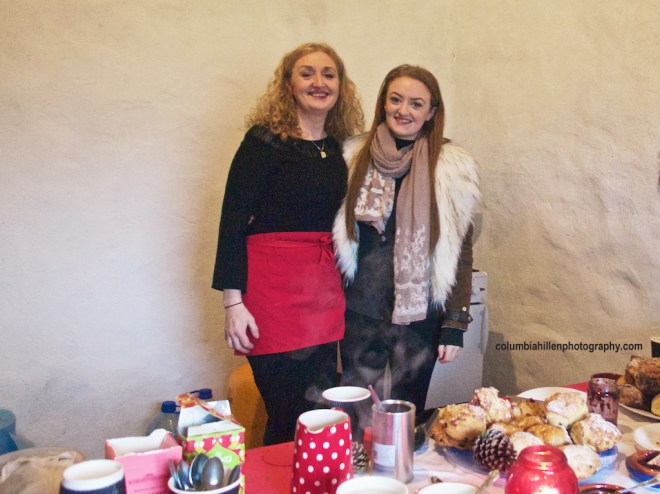
Caitlin Gallagher, owner of Caife Kitty, and her daughter served up delicious food and drinks to everyone Saturday.

Her words were echoed by Finbarr Bradley, professor and co-author of ‘The Irish Edge’ and a mentor to Moira’s fledgling company. At an event Saturday organized by Moira at Sean Teach Niall O’Domhnaill Loch an Iúir where fine food was prepared by Caitlin Gallagher of Caife Kitty in Bunbeg, he said, “This area of Donegal is rich in landscape and culture and that’s what many people are searching for now, something experiential, something spiritual, something authentic. Building upon all that you already have here so naturally is the best way forward.”

Finbarr Bradley author, University College Dublin

Watched by excellent singer Noeleen Ni Cholla (centre), Finbarr Bradley talks about the importance of ‘cultural authenticity’ in tourism development.

Howls of Halloween are upon us….

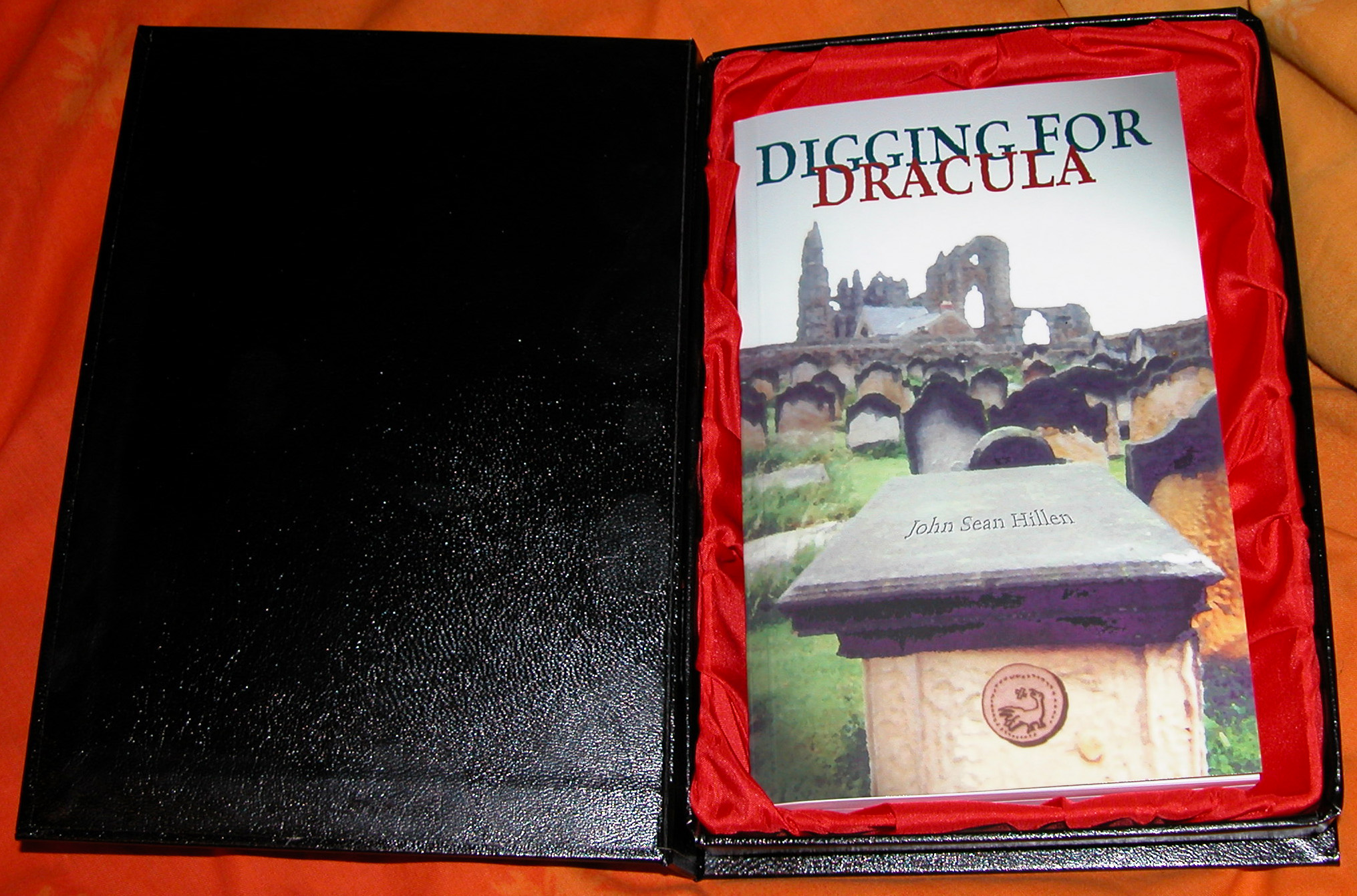
With the spine-chilling howls of Halloween approaching and the door between the living and the dead opening ever so slightly, I’m reminded of midnight hours cutting my teeth on research for a proposed book later published under the title ‘DIGGING FOR DRACULA.

I had been living in Romania for several years, wearing two hats – professor of journalism at the University of Bucharest and foreign correspondent for The Times – when a fax came through from the news desk in London (those were the days before emails).

Halloween gift, book in a coffin

Funky Christmas gift for vampire-lovers! A book-in-a-coffin.

Under the headline ‘First-ever World Congress of Dracula’ were details of an upcoming, week long international event focusing on those strange Long-Toothed creatures that simply refuse to die.

Being from Ireland, the homeland of the famous vampire’s maker, Bram Stoker, I was intrigued, so much so I promptly set off on an adventure – to find out why his classic character created more than a century ago could attract such global fame.

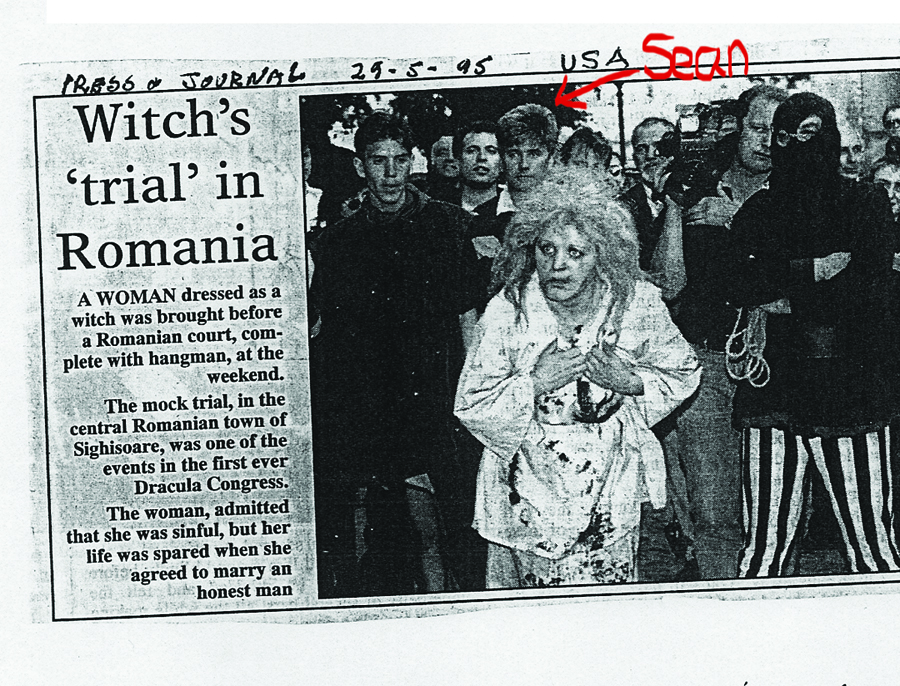
Whitch trial, Transylvania vampires stories

Daily Telegraph, London. I ended up marrying this sexy witch. It was the only way to save her from being burned at the stake. Or worse.

That adventure brought me through the breathtaking landscapes of Transylvania to the princely lair of Vlad the Impaler within the craggy peaks of the Carpathian Mountains; to a seat beside Bram on a cliff-edge in the eastern port of Whitby, England, a place pivotal in the unfolding vampire drama; and to ‘Tinseltown’ Hollywood where Stoker’s creation won immortality on stage and screen.

Along the way, I visited the Mummies of Dublin; the ‘Agony Aunt’ of vampire lovers in New York; voodoo artists in New Orleans; a Los Angeles graveyard filled with larger than life characters; and the world’s largest garlic festival.

On a search for literary truths and the meanings of centuries-old myths, I learned that Celticism might just explain the elusive meaning of the word ‘Dracula’ – ‘droch fhola’ (pronounced ‘druc ula’) meaning ‘bad blood’ in Gaeilge, the native language of Ireland.

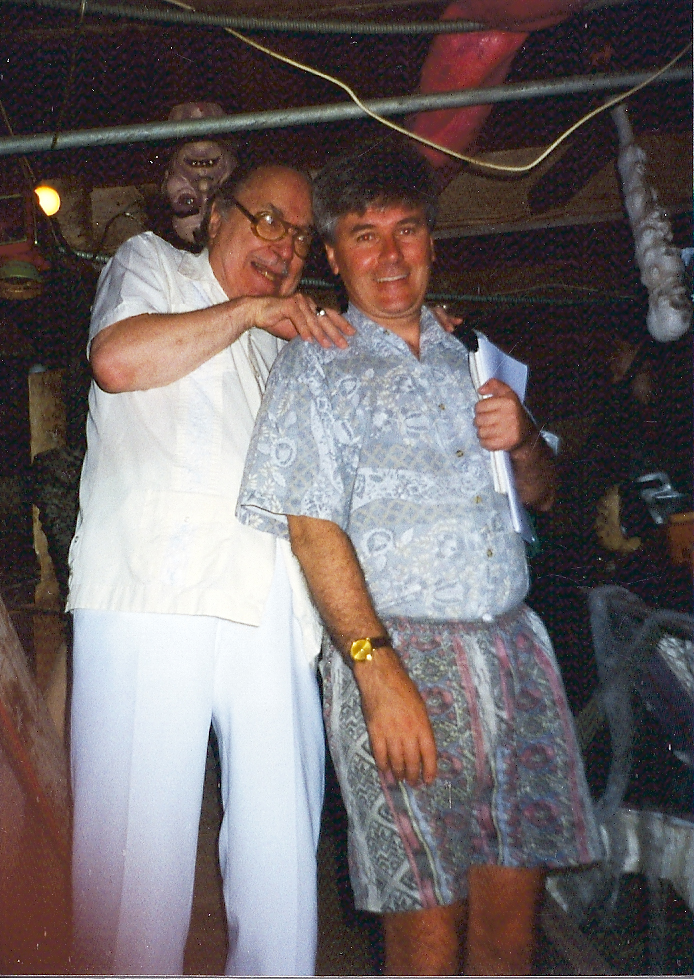
Forrest Ackerman science fiction, Los Angeles science fiction museum

Hollywood, California. Forrest Ackerman (left), known as the ‘Father of Science Fiction,’ famous collector of vampire books and movie memorabilia, shows me how vampires trap their prey.

As for the ‘First–ever World Congress of Dracula,’ it attracted many idiosyncratic people from all walks of life – professors, psychologists, writers, historians and teachers from many countries including Japan, France, Canada, Germany and the USA.

Some had their teeth artificially sharpened. Some slept in coffins. One man offered 10,000 dollars for anyone who could bring him a vampire, having arranged doctors in California to verify the find.

Digging for Dracula book, Vincent Hilliard Los Banos

Vincent Hilliard (left) offered 10,000 dollars to anyone who’d bring him a vampire. He lined up some doctors to verify the find. Here he poses in his home in Los Banos California, with Columbia, a Transylvanian visitor.

Those were just some of my experiences. So grasp your garlic and join me on a journey. Prepare to enter the ‘Lovable House of Horror’ and the ‘Land of the Living Dead.

Scuba-diving plankton make Donegal waters sparkle

Ever seen luminescent plankton sparkle at night like scuba-diving fireflies?
If not, then maybe you should take an island tour with Captain Gareth Doherty of Selkie Sailing as I did several days ago on his 22-foot Drascombe long boat.

Land ahead! Captain ‘Columbus’ Doherty’s first sighting of America, or some such landmark (Photo courtesy Selkie Sailing).

Setting off from what I call ‘Ernie’s Place’ (Bun An Inver harbor, opposite Teac Jack) just as the sun was setting, we headed across tranquil water to Sceard Iompainn (Umfin’s Blowhole) near Béal Scealp Uí Dhúgáin (Duggan’s Sea-Arch), its russet-red rocks sliding smoothly to the sea.
sunset on the wild atlantic way, Donegal boat trips,
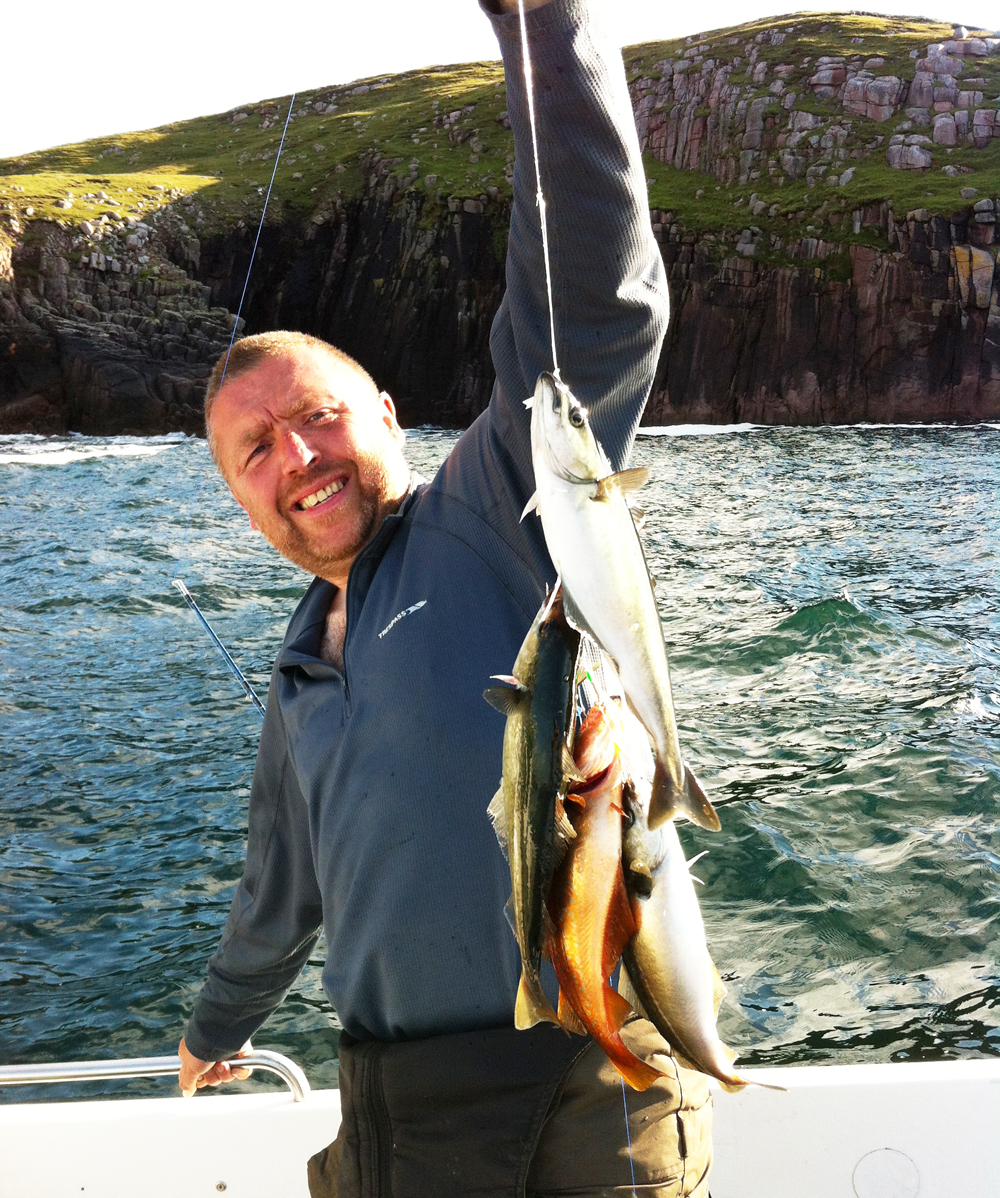
Interestingly, as Pól Ó Muireasáin, our Gaelic linguist on board, pointed out, the island of Iompainn may have derived its name from the older spelling, ‘Iompthoinn,’ meaning ‘turning wave.’ Opposite Béal Scealp Uí Dhúgáin is where I normally fish off the side of my boat ‘Radharch na Coco’, catching sizeable pollock, but also losing plenty of lures and weights in the process, tangled in the heavy seaweed there.
Pól Ó Muireasáin, Gareth Doherty, Selkie Sailing

(l to r) Sea-mates Gareth Doherty and Pól Ó Muireasáin enjoy a light-hearted moment. Photo by Sean Hillen

Dare I say it for fear of ridicule, but once I even lost a fine rod there – left unattended in the stern of the boat, a group of conspiratorial avenging fish dragged it down to the murky depths before I could scamper back and rescue it.
From Béal Scealp Uí Dhúgáin, we floated gently on the placid surface for a while indulging in a spot of fishing while marveling at the glittering plankton in the water beside us dancing mightily as if high on ecstasy at a fairy rave party.
Our night tour then took us to Gola (Gabhla – the place of the fork, alluding to the two hills as seen from the mainland); Tororragaun (Tor Uí Arragáin, Harrigan’s Outcrop); Inishmeane (Inis Meáin, Middle Island); and Inishsirrer (Inis Oirthir, East Island).
sailing in Donegal, boats on Wild Atlantic Way

A chat at sea with local coastguard, Joe Curran (in orange) and Antonia Leitner from Austria (front left) helps pass the day away. Photo by Sean Hillen

There’s nothing as peaceful on a lovely evening than to be on a boat on calm seas in good company, chatting idly about this and that. And that’s exactly what we did, with subjects ranging from the fate of the Irish language to the wealth of wildlife off Donegal’s shoreline and Gareth’s peck on the nose from a nervous gannet (And, on a more cultural vein, needless to say Daniel ‘Travolta’ O’Donnell’s chances of capturing the Sam Maguire Cup of classical dance for the glory of Donegal – just joking).
Several things impressed me about Strabane-born Gareth Doherty on this trip.
The slim, bearded sailor loves the sea and all things associated with it, including a heartfelt concern for the environment and the birds and sea creatures that inhabit it.
 As a keen naturalist, the bird and wildlife around the coast here is truly spectacular,” he says. “And there’s so many different ways to enjoy them. Every time I cast off from the shore I have a feeling of anticipation, knowing the rewards that await me. The moment I switch off the engine and hoist sail, this transformation encapsulates for me an ancient tradition.”
Fishing on Wild Atlantic Way, Gareth Doherty

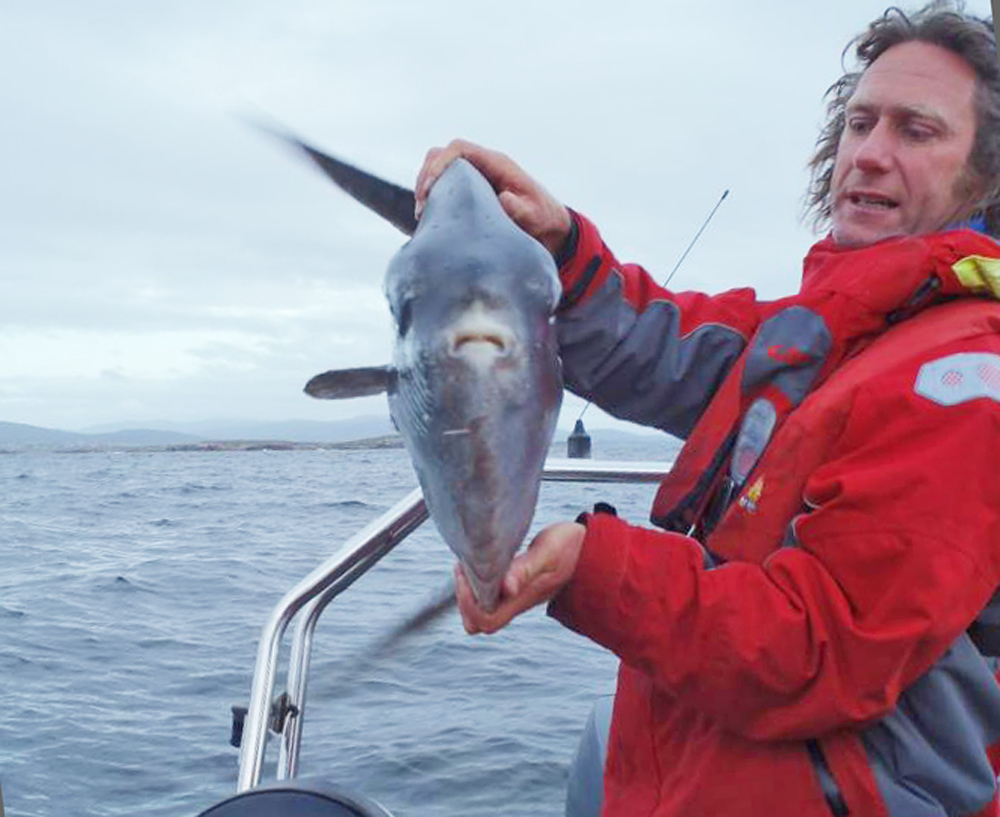
Gareth hand-catches a 15-pound sunfish near Umfin. Photo courtesy of Selkie Sailing

Illustrating his concern for wildlife, Gareth and his wife, Amanda, from Sunderland, helped establish the ‘North West Whale & Dolphin Support Group’ consisting of local like-minded people keen to learn how to save stranded sea mammals. The initiative followed the ill-treatment of a pod of 13 pilot whales left to suffocate after five days on Ballyness beach near Falcarragh. It was the 13th such stranding last year in Donegal.
wild life northwest Donegal, birds and sea life

Gareth’s son, Aran, watches over a young Great Black-backed Gull. The bird’s tongue got tangled in fishing lure, which Gareth skillfully removed. Photo courtesy of Selkie Sailing

Gareth, who lived in Black Isle, near Inverness and Dunoon in Argyll before moving to Donegal seven years ago, (his three children are named after Scottish islands – Skye, Rona and Arran) is a gold mine of marine information.
Well-qualified – he is a dinghy instructor, day-skipper, offshore yachts-master and is trained in advanced power-boating – his deep knowledge ranges from details on wildlife to be found around the Continental Shelf lying 50 miles off the Donegal coast to the characteristics of the waxy oil that dripped from a sperm whale stranded on Magheraroarty (Machaire Rabhartaigh) beach several weeks ago.
The 44-year-old’s passion for the sea originates in great part with his grandfather, Paddy McCauley, who spent much time in Inver, Donegal. “As he was a keen sailor and fisherman, some of my earliest memories are of being on the sea,” he recalls.
Now Gareth has transformed his indefatigable passion into a creative entrepreneurial venture. Aside from the Drascombe long boat, Selkie Sailing, based in Derrybeg, has many other craft – a gaff rig, topper sailboats, a catamaran, kayaks, a rib and a banana boat: more than enough to host guests on adventurous excursions among the many islands, sea arches and caves. Sailing classes take up much of Selkie’s activities.
Gareth Doherty saving sea life, Donegal wild life

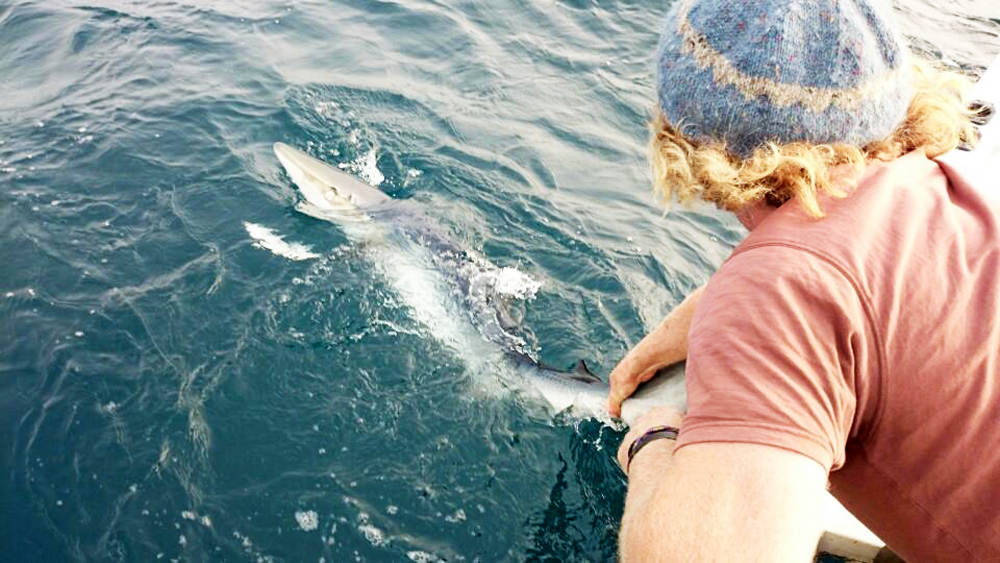
Gareth caresses a blue shark, four miles off Inishsirrer near the wreck of the steamship, Boniface, torpedoed during World War One. Photo courtesy of Selkie Sailing

Gareth says different seasons bring different sights. “Spring sees a migration of Arctic Skuas, Sandwich Terns and Gannets with occasional rare visitors like the Short-Eared Owl,” he explains. “Summer days are filled with the song of the Skylark and ground-nesting birds like Oyster Catchers and Ring Plovers, with sea-cliffs harboring colonies of shags, cormorants and fulmars. Chances of seeing an otter, a basking shark, a bottlenose dolphin or a porpoise are higher then. With autumn come Sandlins and Dunlins while seal pups rest on the rocks and the sandy beaches of the islands. Brent and Barnacle Geese rule winter, taking advantage of the sea swells to feed. Sometimes, a long-tailed duck may make an appearance.”
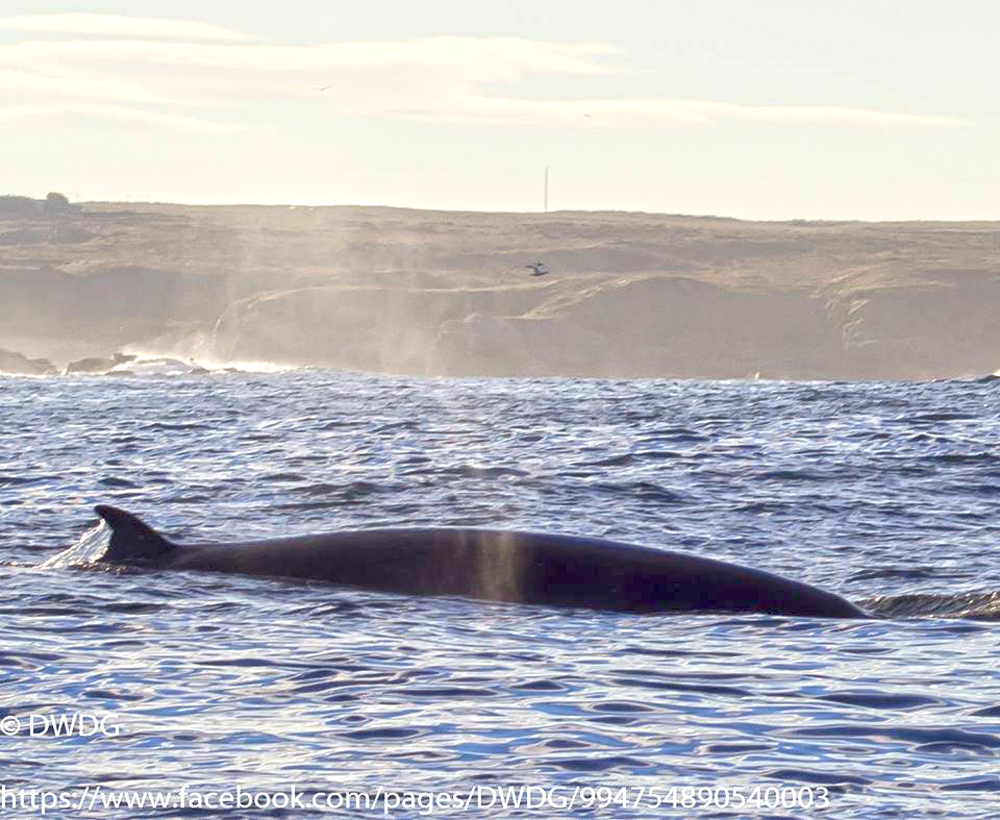
Two proposed projects excite Gareth. One is in education – to teach children in local schools about the marine environment and its sea and air inhabitants. The other focuses on Minke whales. “They’ll start to appear over the next month and I’ve organised two underwater photographers and a cameraman on a drone helicopter to shoot their behaviour,” he says excitedly. “It may be the first time this has ever been done in Ireland.”
whales Donegal, Minke whales

Efforts by Amanda and Gareth Doherty aim to save many stranded whales, dolphins and other sea life such as this.

As to the name ‘Selkie.’ It’s a mythical creature; half man, half seal which comes on to the land and removes its outer layer of skin to reveal itself as a beautiful, dark-eyed human. Like the mermaid, selkies have been both praised and feared. Stories describe how they helped sailors in rough storms but also how they lured people into the sea. Another yarn tells of a man stealing the skin of a female selkie to trick her into being his wife.  
As Selkie Sailing’s motto states – “Where the shore ends, the advenure begins,’ you never know, perhaps a trip with Gareth might end up in a fortuitous meeting with one of these intriguing creatures.

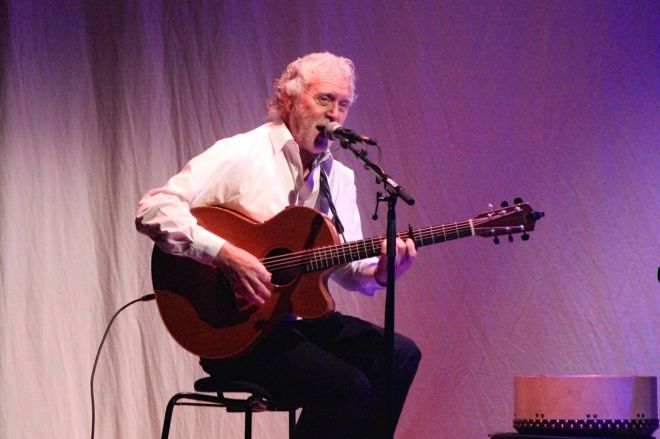
From Burtonport to Bucharest: a restless heart keeps creative juices flowing

“Some people write poems, some write novels, I write songs…”

Such is how Donegal-based Ian Smith sums up the special craft he has practiced for more than half a century.

I first met the friendly, fair-haired Scotsman when he kindly introduced himself to my wife, Columbia, and I at a gig some years ago in the hauntingly beautiful Poisoned Glen in the shadow of Errigal where he was both musician and an organising team member at the annual Frankie Kennedy Winter Music School.

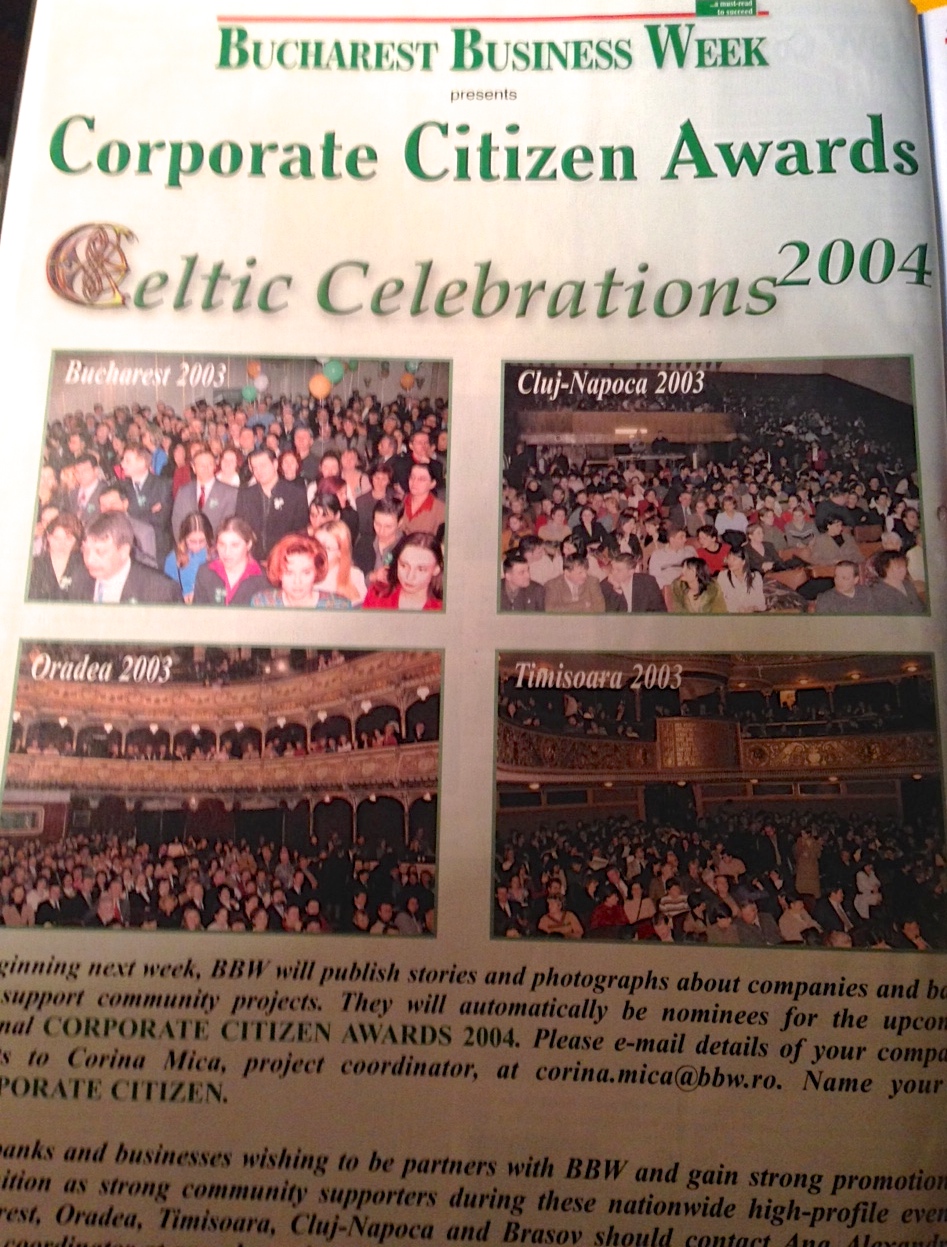
Our friendship strengthened after we asked him if he could arrange a group of Irish musicians to play concerts throughout Romania where we were then living as part of our combined inaugural St. Patrick’s Day celebrations and national Corporate Citizen Awards in that struggling post-Communist country.

Ian Smith musician, folk music Donegal

After his arrival in Bucharest, I remember distinctly his shock upon seeing a huge multicolored banner stretching several floors of a city centre building featuring him strumming guitar. Only then perhaps did the full significance of playing before audiences of thousands including the nation’s President, Prime Minister, Mayors and international Ambassadors truly dawn on him.

St. Patrick's Day celebrations Eastern Europe, Irish music Romania

Through snatches of conversation in airports and on winding roads between Romanian cities such as Cluj-Napoca, Oradea, Brasov and Constanta and in Donegal’s very own Hiudái Beag’s, Teac Jack and Leo’s Tavern I managed to patch together a tapestry of the life of the talented musician-cum-songwriter.

Smith recalls being seduced initially as a young 14-year-old “by the dark and complex lyrics of Lennon and the more upbeat and happy ones of McCartney” before his musical interests expanded quickly until they encompassed Carol King, James Taylor, Steely Dan, and Joni Mitchell. “I could have listened to Joni’s ‘Blue’ album 25 hours a day,” he says.

singer songwriter Ian Smith, Donegal musicians, St Patrick's Day musicians

A moment of pure concentration.

Living in Ayrshire, with such local talent as Gerry Rafferty, Billy Connolly and Barbara Dixon, the air around him was filled with artistic creativity. Smith must have inhaled it deeply as now, many years later, the 65-year-old has three albums under his belt – the wonderful ‘Restless Heart,’ ‘Keadue Bar’ and ‘A Celtic Connection,’ the latter labeled by ‘Irish Music Magazine’ as the recommended album of the year in 2011. He has also produced a two-track mini CD featuring the lovely songs ‘When it Snows In New York City’ and ‘On Keadue Strand’ – all reflecting the diversity of his song-writing abilities and the beauty of his guitar-playing.

As if that wasn’t enough, he has also hosted gigs both in the US, including one at the legendary Woodstock, and across Europe and Scandinavia, touring and playing alongside many international stars such as Nanci Griffith, Benny Gallagher, Christy Moore, Paul Brady, Mary Black, Altan, Dolores Keane, Maura O’Connell and Liam O’Maonlai. He also recently hosted a group of international writers at Teac Jack during the annual Ireland Writing Retreat, granting them insights into the art of songwriting.

Interestingly, the man from Kilmarnock didn’t begin adult life as a musician, instead working in the textile industry before his true passion took him on whirlwind adventures across England and Scotland either performing solo or with bands such as ‘Nessie.’

On one of these tours he met Donegal woman, Breda Ward, and love being the irresistible force that it is, the young, long-haired lead guitarist gave up the fast-moving world of rock music for donkeys, carts, whitewashed cottages and west Donegal rural tranquility where they reared two sons, Daniel and Mathew.
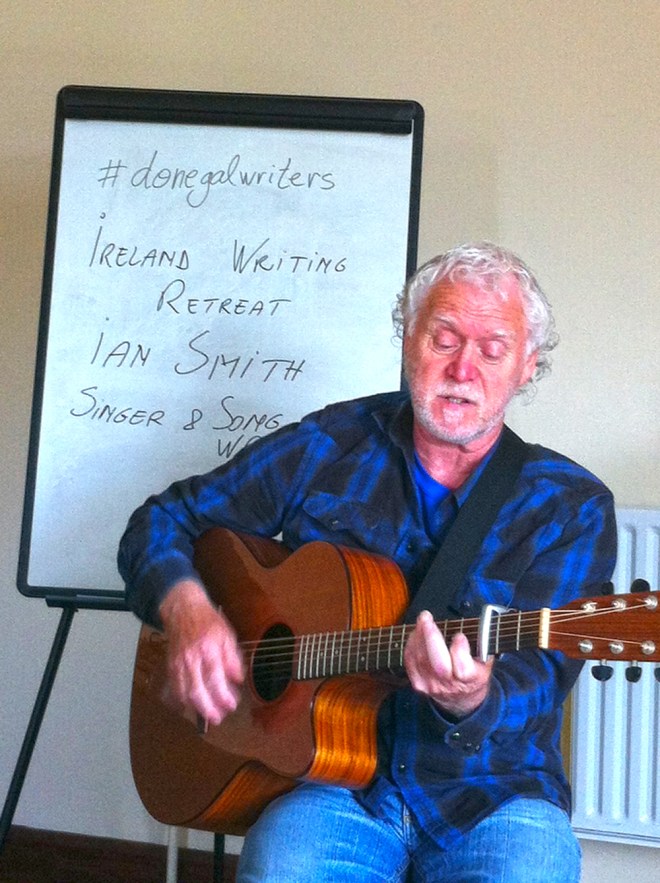
That was 34 years ago but rather than marking the end of his music career, Smith’s move to Ireland’s ‘Forgotten County’ simply signified his entering onto new stages – in the literal sense.

After renovating their home, word went out there was a new musician in the area. Soon there was a knock on the door. ‘Can you play a few songs for us at our Dungloe festival?’

writing songs, Donegal musicians, Ian Smith songwriter

Ian enjoys a moment of post-concert relaxation with international participants and teachers at this year’s Ireland Writing Retreat at Teac Jack, Glassagh, including Gortahork’s Rose Sweeney (centre front) and bearded former CNN editor, John DeDakis from Washington.

That was the beginning of Smith’s baptism into the local melody scene. His skills were in high demand at clubs and pubs throughout the county, and beyond. Smith tours Germany each year with the dynamic dance show  ‘Danceperados’ for which he wrote the song, ‘True Travellers,’ has a music residency in Clare and plays at a number of other venues.

He has also been deeply involved in key community projects – the annual summer ‘Trad Trathnóna’ hosted by the organization Tionscnamh Lugh, at Ionad Cois Locha in Dunlewey, that promotes Irish music and the Frankie Kennedy School, where my wife and I first met him.

Such is his love of music he also hosts intimate concerts in his own home, with creative US-based singer-guitarist, Buddy Mondlock and Benny Gallagher (of Gallagher & Lyle fame), among those playing in his cozy living room.

Buddy Mondlock, Benny Gallagher, Gallagher & Lyle, Ian Smith

A memorable concert at Ian’s home featuring (l to r) Ian, Benny Gallagher and Buddy Mondlock.

You’ll also hear Smith playing with local band, ‘Vintage,’ featuring Letterkenny musician, Ted Ponsonby, on slide guitar, Englishman, Dave Wintour and Gary Porter from Lifford.

Smith sums up his approach to songwriting in the phrase, ‘One and one equals three.’

“It’s all about sharing,” he says. “Working with others – even up to four people together – can make a song so much better. Lyrics should create word images. Songs are really four-minute novels, with beginnings, middles and ends.” No surprise then that he is a regular participant at festivals such as Songcraft, enjoying the camaraderie of artists just like himself.

In Smith’s view, time matters little in songwriting. “In Nashville, a place filled with great talent, songs are churned out like clockwork, but that’s not my thing, I don’t set a specific time to complete one,” he says. “One song, ‘James,’ about my father, took nine years, it was a tough emotional journey. Yet ‘Restless Heart,’ the title album of my first CD, took twenty minutes in my kitchen. As I get older, I write less songs but, hopefully, better ones.”

Looking back over the years, Smith says, “I consider myself lucky in life. I have a passion for melody and the guitar has helped give me a voice of my own.”

Singing lobsters and boxer shorts

A gentleman if ever there was one, Dore man Sabba Curran wore an undisguised look of contentment seated comfortably in the captain’s quarters of ‘The Cricket’ gazing out beyond a sleepy sea to the quaint houses lining the crust of Gola Island.

The Cricket boat to Gola Island, ferry to Gola Island, Donegal islands

Full steam ahead, Captain!

Behind him, a lively group – young and old, locals and tourists – stood on the open deck breathing in deep draughts of fresh warm air under a clear, azure-blue summer sky (no, I’m not color blind, though with the torrential rain we’ve had since it’s hard to believe).

Though barely mid-afternoon, the Gola Ferry Service was already completing its fourth return trip from Maghergallon Pier, having started early Saturday before any of us had even finished our scrambled eggs and scones (okay, okay, maybe just me).

painting classes, painting on the island, Gola painting

Maureen Ferry (l) and colleague prepare for the island painting class.

Meanwhile, the ‘island crew’ of Maureen Ferry, Sheila Gallagher, His Majesty, Eddie Joe Mac Aoidh, the Uncrowned Island King and family and friends, all members of the Gola Island Development Co-op, had finished their stuff.

Gola Island festival, Celtic traditions, pagan traditions in Ireland

Some lead a life of leisure and some gotta work – guess which is which!

A crowd of over a hundred was expected for the annual Gola Island Festival and things had all been put in order. Colorful buntings fluttered in the light breeze, the kettle was on the boil in the wee café (it really should have a name – any suggestions?) and assorted materials for an outdoor painting class were well in hand.

Der Spiegel, New York photographer, Pól Ó Muireasáin, sea-forager

(l to r) Photographer and reporter from New York and Cologne on Gola Island ready to capture the ‘Pól’ moment.

Even the day’s star guest, bearded philosopher, polyglot and sea-forager, Derry-man-cum-transplanted Bunbegian, Pól Ó Muireasáin, was ready and eager to rock ‘n roll. He’d powdered his nose, coiffured his hair and got his bits and bobs together, ready to lead a merry band of Marine Apostles, including Der Spiegel’s correspondent from Cologne and a photographer all the way from the Big Apple, on a hazardous two-hour, search-and find expedition for monsters of the deep among the sand and rocks of the coastal inlets.

And what a delightful day it turned out to be.

visit Gola Island, ferry to Gola Island, Donegal islands

(l to r) His Majesty Gola Island’s King Eddie and cousin Thomas from Aberdeen take a break from playing family catch-up.

King Eddie had a good ole chin-wag with his distant cousin, James Sharkey, now plying his trade in far-off Aberdeen;

Gola island caffee, scones and tea on the island, walking on Gola island

A pretty picture!

a smiling Marie Moloney-Pearson did her thing behind the café counter beside the island’s photo exhibition;

TG4, Irish islands, Irish television,

The Long and Winding Road…..Niall McCaffrey decides to takes a walk.

and boatman-cum-scriptwriter, Niall McCaffrey of TG4 ‘C. U. Burn’ fame, enjoyed a leisurely wander along winding paths (by the way, did you know his family name as Gaeilge is ‘MacEachmharcaigh,’ meaning basically, ‘son of a jockey’).

celebrate your engagement, Hollywood couple, visit the Irish islands

35 years may seem a long time, but it really ain’t, so treasure every moment.

There was also George and Yvonne Adams, a lovely couple from Hollywood (not the Tinseltown variety), who’d first landed on the island 35 years ago to celebrate their engagement and now had returned for a heartwarming taste of nostalgia.

Gola Island Donegal, lobster catching Ireland,

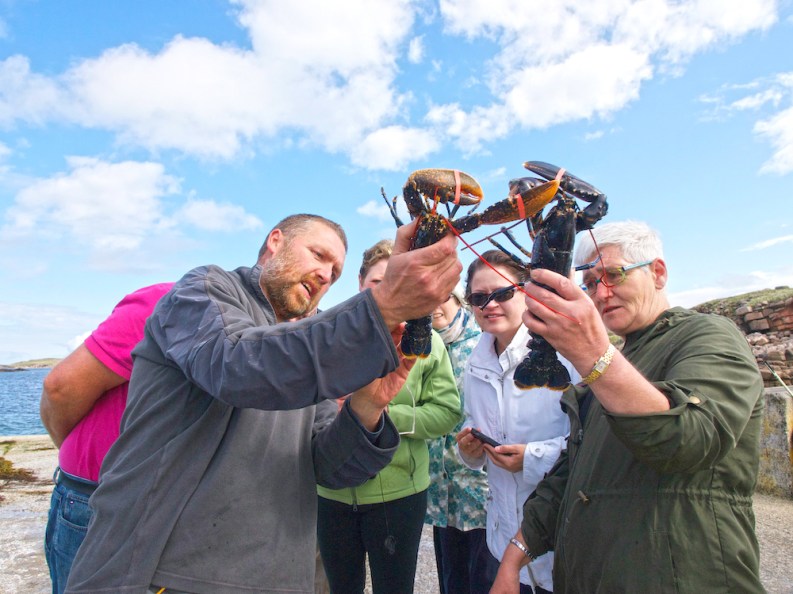
Pól Ó Muireasáin explains to visitors the intricacies of the skeletal-muscular make-up of lobsters.

And to top it all off, there was the rare (the rarer the better) sighting of a shy and reserved Pól the Peacock perched on a stone wall stripping to his nifty boxer shorts singing a German ditty at the top of his voice having just splashed through hell and high water to ensure the life of a young and wayward lobster.

Yes, a most memorable day had by all.

Celtic traditions highlight dynamic Cnoc Fola festival

Every community needs a ‘connector’ – even more so in a small rural area.

Someone who initiates, encourages, coaxes and cajoles to tease a fine idea along the often difficult passageway to reality.

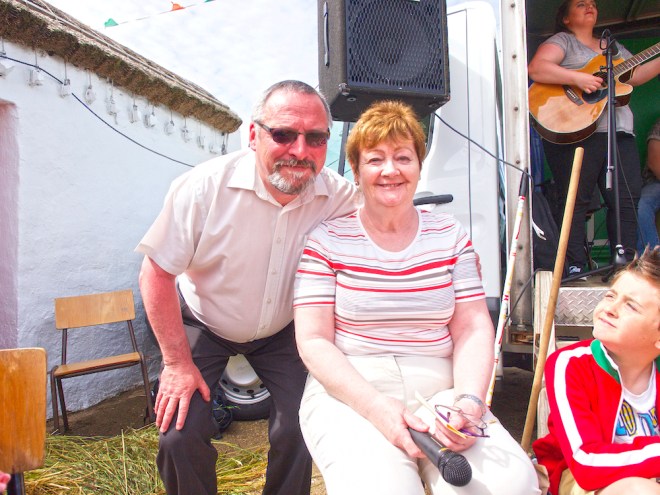
Mary Nic Phaidin (Teac Jack) and Sinn Fein councillor John Sheamais ó Fearraigh share a moment of fun at the Cnoc Fola festival Saturday (All photos by Columbia Hillen)

Mary Nic Phaidin is such a person.

Ask anyone in the west Donegal Gaeltacht – and far beyond for that matter – and there’s nary a person who doesn’t know Mary from Teac Jack.

Cnoc Fola festival Donegal, celtic traditions

Crows gather Saturday at Teach Mhuiris for the start of the Cnoc Fola Festival.

Personally speaking, the former school principal is one of the prime reasons my wife, Columbia, and I have been happily ensconced on Cnoc Fola (Bloody Foreland) for the last few years. It was my good fortune to meet Mary by chance on a house reconnaissance expedition from Bucharest via Belfast one fine day quite a few summers back, and the rest is history.

Sean Hillen writer, Donegal wild atlantic way

Who’s that woman taking photographs?

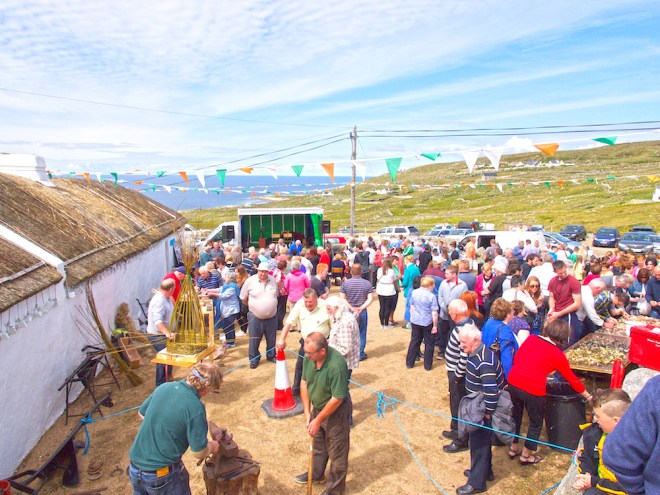
I saw her yesterday afternoon (Saturday) performing her accustomed leadership role at the delightful annual Féile Thraidisiúnta Chnoc Fola (Cnoc Fola Festival) at the thatched Teach Mhuiris (circa 1860) perched high on a bend in the road offering panoramic vistas over the wide Atlantic.

broom dance Donegal, Donegal Celtic traditions

Proinsias and Eibhlin and Mhic Suibhne display their fine dancing skills.

Joviality and good-naturedness were in generous abundance among the lively crowd gathered there – neighbors, family, friends and national and international visitors, all enjoying a lively community gathering under clear blue skies and bright sunshine.

Irish dancing, Donegal traditions, music in Donegal

Now it’s your turn! A fine dancing display by Eibhlin Mhic Suibhne before volunteers are called for.

One minute, Mary was introducing the singers and dancers and asking for volunteers to attempt the high-kicking ‘damsha na scuaibe’ (broom dance) on the makeshift wooden stage and the next, happily regaling the arrival of such and such persons to the proceedings – all done with sheer aplomb and warm sincerity.

Interestingly, the popular brush or broom traditional dance has its origins in ancient Celtic Pagan Ireland linked to the deeply-rooted mythology of free roaming spirits and separation of body and soul. The broom also symbolizes fertility – the higher and more graceful the leap presumably the greater and more creative one’s love-making ability (and agility). So, dear readers, no better time than right now to grab those brooms from your cupboards and start practicing.

Not that Mary was the only one involved in what was a most successful July festival. As she herself readily acknowledges, “it was a true community effort with many people working extremely hard together to thread all the various strings together.”

There was the bearded, bespectacled Sinn Fein local councilor, John Sheamais ó Fearraigh, who officially opened the festival on Friday evening; there was Tony McHugh who has spent many, many hours over the years compiling a comprehensive archive displayed on local history for all to access freely in the Crann Og community center in Bunbeg; and there was Cathal ó Gallchoir, the center’s manager, preparing Teac Mhuiris from early morning for the day’s rush of visitors.

John Sheamais ó Fearraigh, Sinn Fein councelor Donegal, Toni McHugh Crann Og, Cathal ó Gallchoir

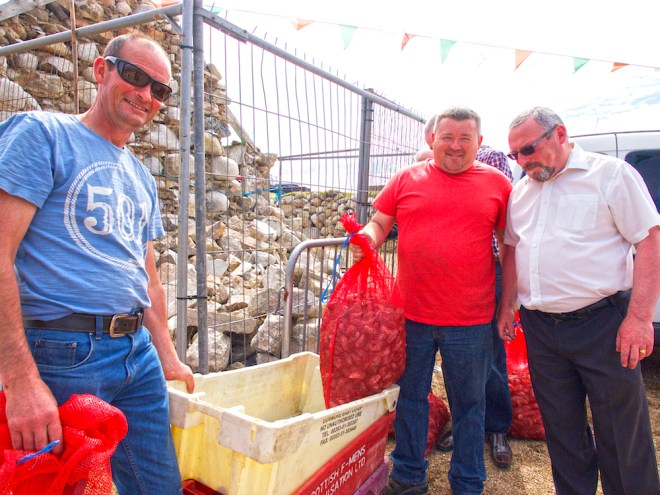
Mussels galore to feed the hungry.

Even our neighbors, the helpful Ferry brothers up the road from us in Bun na Leaca who supply us with turf to keep biting winter winds and rains at bay, were there, hauling sacks of mussels around on their shoulders trying to keep hungry mouths occupied.

farming in Donegal, fresh farm produce,

Farmer Pat McFadden proudly shows his healthy produce.

And there was friendly farmer Pat McFadden with a table-full of produce including potatoes, organic eggs and rhubarb jam, as well as hand-picked carrageenan; and Rose Sweeney, who taught international participants at the ‘Ireland Writing Retreat’ how to dance the ‘sevens,’ with her sister, Marie Ferry, and her Welsh friend, Maureen O’Sullivan.

Rose Sweeney, Marie Ferry, Sean Hillen,

Sisters Rose Sweeney and Marie Ferry caught having a good time.

The Cnoc Fola festival, which has been an annual event for the past 30 years, reflected the rich traditions of the area, with the craft of horse-shoeing and basket weaving being amply demonstrated outside beside tables laden with fish, crab-legs, lobster and cockles, not to mention delicious-smelling scones and wheaten bread being served under the rafters inside.

Rose Sweeney, Maureen O’Sullivan, Cnoc Fola Festival Donegal

(l to r) Long-time friends, Welsh-born weaver Maureen O’Sullivan and Rose Sweeney, enjoy some time together (All photos by Columbia Hillen).

And with the sad reality of Ireland’s youth forced to seek new lives abroad due to an inept and greedy Fianna Fail government, it was heartening to see so many young people involved – the pupils of Pobalscoil Ghaoth Dobhair, directed by Suzanne Ui Ghallchóir in association with Campa Drámaíochta Tuismitheoirí, performing the drama ‘Peire Speacloidi;’ and the excellent music of An Crann Óg group, tutored by Caitlín Joe Jack and her brother PJ, accompanying the dancers.

Pobalscoil Ghaoth Dobhair, Suzanne Ui Ghallchóir , Campa Drámaíochta Tuismitheoirí, An Crann Óg

An Chrann Og entertain the crowd with lively rousing music.

On behalf of all those who reveled in the day’s activities, none less than Columbia and myself, heartiest congratulations to Mary and the entire community team. A project well accomplished.

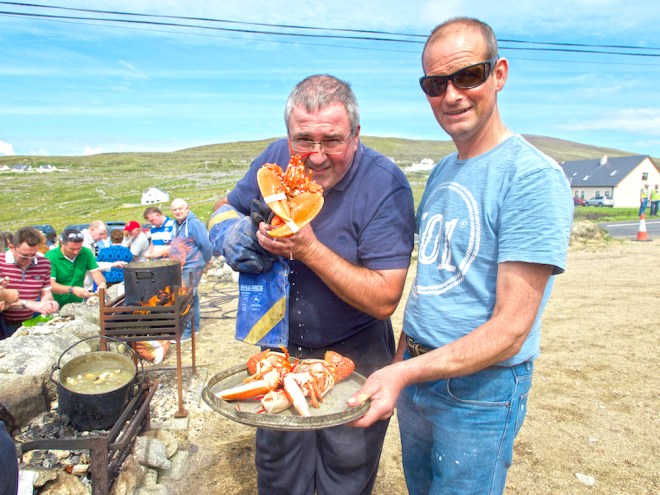
lobster in Donegal, Bloody Foreland Donegal

Fresh lobster for a tasty dinner (All photos by Columbia Hillen).

seafood wild atlantic way, Donegal seafood

Free seafood table attracted no shortage of takers.

local crafts Donegal, Cnoc Fola festival

Cnoc Fola festival highlighted traditional skills such as rope making.

horse-shoeing Donegal, Cnoc Fola festival

The art of making horse shoes.

fishing in Donegal, fresh fish Donegal

Fresh fish of all kinds straight from the sea (All photos by Columbia Hillen).

Toni McHugh, Sean Hillen, Donegal archives

(l to r) Tony McHugh talks about census documents and the comprehensive historical archive that has been collated.

baking Donegal, scones and bread

Freshly-baked breads were a big hit at the Cnoc Fola festival (All photos by Columbia Hillen).

basket weaving Donegal, creel making Donegal

Creel making demonstrations at the festival.

Brigid cross, crafts in Donegal

Crosses in honor of Brigid, an ancient Celtic Goddess who was symbol of fertility, healing and new beginnings.

Sea lettuce, sugar kelp and snakelocks anemone: exotic foods of the Gaeltacht islands

Pól Ó Muireasáin’s the kind of guy who’s hard to miss – especially in a quiet, rural place such as Gaoth Dobhair sweeping down to the islands of west Donegal.
He’ll talk to anyone – no-one being above or below his broad radar of interest.
guide tour of Donegal islands

Sea voyaging is filled with danger – Pól explains to participants at the Wild Atlantic Way ‘Ireland Writing Retreat’ during an expedition on Gola Island, as he recites the names of those islanders who died engraved on the pier wall. Photo by Sean Hillen

Walking with him from A to B means inevitably stopping off at G, H, K and Z as he meanders this way and that to chat with most men or women who happen to come within his quite well-developed range of vision.

Not that you’d want to miss him anyway cos that’d mean you’d suffer the loss of hearing his colorful, homespun tales about wildlife and ghostly sightings; his abiding interest in the intricacies of the Irish language; his poetic lyricism on the beauty of the local landscape; and his whimsical descriptions about esoteric delicacies he manages to find hidden along nearby shorelines.  
Sea lettuce, sugar kelp and snakelocks anemone – these are just some of the lesser-known foods uncovered on the solo ‘search-and-find’ missions that Pól Ó, a committed, skilful ‘sea forager,’ conducts around the islands of the west Donegal Gaeltacht.
Sea lettuce, sugar kelp, snakelocks

Sea lettuce and snakelocks anemone make for tasty snacks (Photo by Pól Ó Muireasáin)

Wearing waders, a waterproof vest and carrying an aquascope, an underwater viewing device, the exploits of the Derry native now living in Bunbeg and a guest speaker at this weekend’s annual Gola Island Festival (Féile Ghabhla), have now attracted national and international attention, with Der Spiegel, the German national newspaper, despatching a photo-writer team this week to profile him and Raidió na Gaeltachta’s ‘Mo Ghrá Thú’ featuring him in a special.
“There is as much nutritional food underwater than there is above and we haven’t even really begun to understand it,” claims Ó Muireasáin, a youthful-looking 49, who worked for two years as the first Irish language proof-reader in Legal Services at the European Commission when it was granted official status in 2007, before moving to Gaoth Dobhair. “It’s sad when one reads about world food shortages and the lack of a nutritional diet, especially when so much healthy ‘cuisine’ exists in our seas and oceans.”
Sea lettuce, sugar kelp, sea forager, snakelocks anemone

Sea urchins – yummy, yummy! (Photo by Pól Ó Muireasáin)

An island lover, Ó Muireasáin, whose local nickname is  Pól a’Bhicycle, spends much of his time on Gola. In fact, he was the official island guide during the recent Wild Atlantic Way, ‘Ireland Writing Retreat,’ at Teac Jack, which featured former CNN news editor, John DeDakis.
Needing to take time out to contemplate what was important in my life, I went seeking solitude,” he explains. “I wild-camped and developed an avid interest in sea-foraging, enjoying a calm convalescence, observing and listening to nature at close quarters. Doing so helped me appreciate the important things in life – mental and physical health, giving help to others and receiving help in return, smiling and making others smile and having a deep gratitude for simply being alive.”
writing in Donegal, Ireland Writing Retreat, lobster

On the pier at Magheraghallon, Pól explains the difference between male and female lobsters – “See, one is hard and erect,” he says, much to the ladies’ rising curiosity.

As for the obscure foods he finds on his foraging trips, Ó Muireasáin refers to the Atlantic Ocean as “freesupermarket.com,” adding, “All you need to know is which aisles to wander down for whatever type of seafood you want. The Japanese convert sugar kelp into crispy snacks, the Spanish deep-fry snakelocks anemone which they call ‘ortiguillas de mar’ (little sea nettles) in olive oil for a tasty dinner. You can also boil shrimps or prawns with sea lettuce for a nutritious meal or make a fine stew from limpets, not to mention using both types of duileasc – dillisk or creathnach – in a whole range of culinary ways.”
Ireland Writing Retreat, writing courses Donegal, Gola Island

His Excellency King Eddie of Gola (in blue T-shirt) listens attentively as Pól talks about some of his island adventures.

During his sojourns on Gola, near the dilapidated Teach Charlie Uí Fhrighil, the polyglot, fluent in five languages, has undergone a number of intriguing experiences, including ghostly apparitions in the dead of night that sent him scurrying like a madman out of his tent (though where he could scurry to on an isolated island, alone, without a boat or a paddle is beyond me), as well as his sighting of a six-foot conger eel sunbathing off Portacrin Pier. “Experiences I’d hardly get in Brussels,” he said, smiling, recollecting some of his adventures on the ‘high seas.’
Gareth Doherty, Selkie Sailing, Pól Ó Muireasáin’s, Pól Ó Muireasáin

Two seafaring environmentalists (l to r) Pól and Gareth Doherty share a joke on an island pier. (Photo by Sean Hillen)

Ó Muireasáin voices admiration for many local people who’ve befriended him since his arrival in west Donegal, including Gareth Doherty with Selkie Sailing, who organises training in water-sports and eco-tourism trips and has lobbied for greater protection for stranded sea mammals. Ó Muireasáin describes him as a “a committed and deeply knowledgeable environmentalist.”
Both men passionately believe environmental tourism coupled with the rich cultural history of the Gaeltacht can bring strong economic benefits to the marginalized rural area, describing the Donegal islands as a “a paradise of wildlife.”
“There’s dolphins, both bottlenose and Risso’s; otters, porpoises, whales, especially Minke; you’ve even got eels that travel around seven thousand miles from the Sargasso Sea,” said Doherty. “Not to mention diverse birdlife – sandwich and arctic terns, the largest migratory birds in the world; puffins, around two thousand on Tory Island alone, the most westerly of colonies; sand martins, skua, corncrake, as well as manx and sooty shearwaters, which fly about a million miles during their lifetimes.”
fishing in Donegal, Gola Island Ferry, sea foreger

Dinner is served! (Photo by Sean Hillen)

Adds Ó Muireasáin, “There is tremendous potential here for attracting international visitors, especially from landlocked areas of countries such as Germany and the US, but local people need to pull together. They can’t act like islands.”
Ó Muireasáin, who studied Celtic languages and literature at Queens University before completing his Masters in Irish translation studies, teaching at the University of Ulster and working for the Department of the Gaeltacht, also admires Eddie Joe Mac Aoidh, the ‘Uncrowned King’ of Gola (Rí Ghabhla). Eddie, born on the island, has set up a café there to cater for visitors, many of whom travel over on ‘The Cricket,’ a ferry service organised by Captains Sabba Curran and his son, Daniel, of Gola Ferry Service.
Ireland Writing Retreat, John DeDakis, writers in Donegal

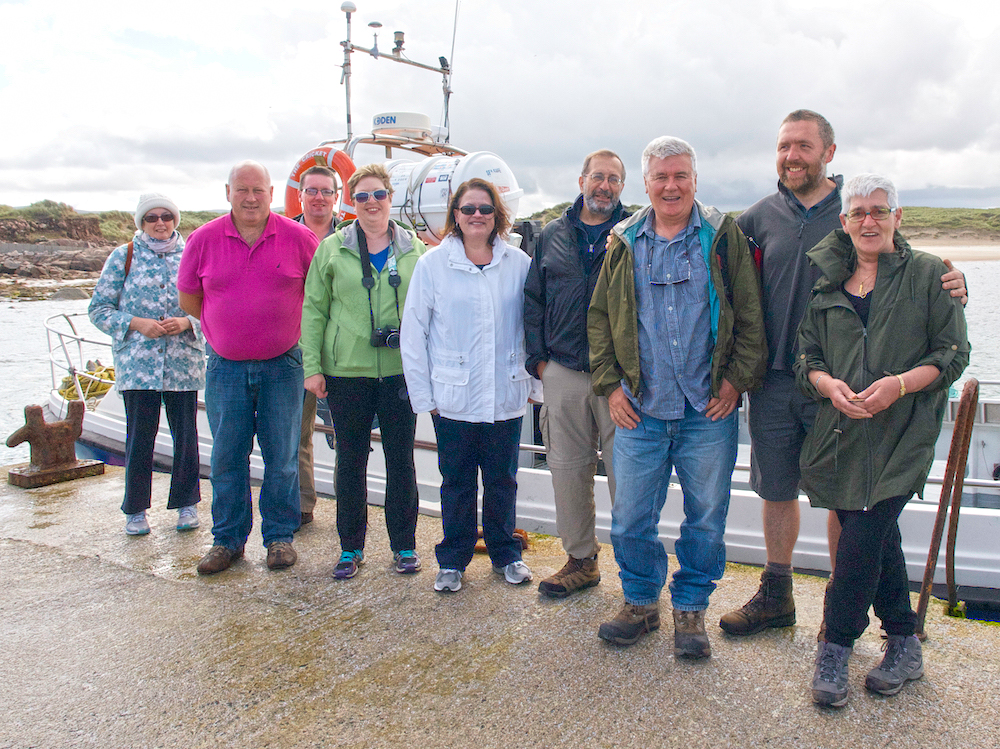
Participants at the Wild Atlantic Way ‘Ireland Writing Retreat’ with Pól and Captain Sabba Curran (in T-shirt) before embarking on ‘The Cricket’ courtesy of Gola Ferry Service for Gola Island.

They’re all hoping this weekend’s island festival and the promotion in Der Spiegel, RnG and other media outlets will provide a welcome tourism boost and bring greater focus on the traditional Donegal island way of life.
See feature article on page 28 of today’s Donegal News.
Sean Hillen writer Donegal