Are yoga, thai chai and reiki dreaded Druidic distractions? Is the anti-cervical cancer vaccine, HPV, the Devil’s poison?

Glancing through last Friday’s edition of the ‘Donegal News,’ I was dazzled by the sheer creativity of people from Ireland, (see a particularly interesting article on page 47 focusing on a man who lasted 70 days in prison without food and is now a Doctor in Sociology and a well-known Irish playwright and film and documentary script writer).

It’s as if the artists of every shade throughout Ireland and particularly in my resident county, Donegal – musicians, actors, painters, dancers et al – feel they have a deep, abiding, age-old responsibility to uphold our ancient rich Gael culture, and in doing so, prevent its dilution.

And I don’t mean – wonderful though it is – simply the native folk music and song of the lauded, award-winning Frosses-native Rita Gallagher and Gaoth Dobhair’s Mairead Ni Mhaonaigh (who play this Thursday at the Balor Arts Centre as part of the Bluestacks Festival).
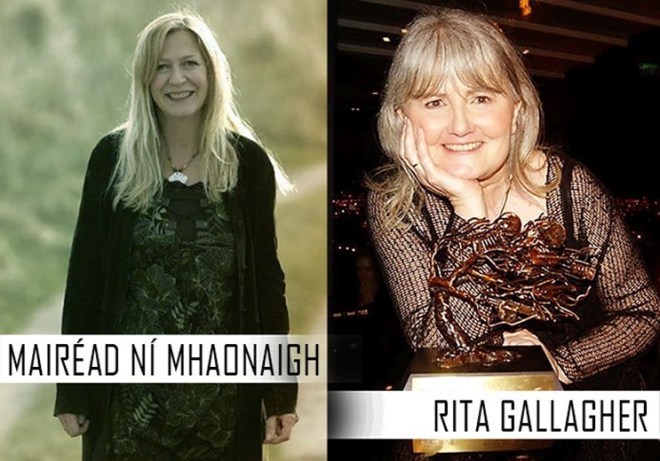
rita Gallagher, Mairead Ni Mhaonaigh

Winners of TG4 Gradam Ceoil Awards.

I mean our vast spread of artistic talent, first brought here to these shores when definitive Celtic traditions arrived from places such as Romania and Gaul (Gallia) in the fourth century B.C.

Then, unlike all other islands, Alice Stopford Green tells us in her work ‘Irish Nationality,’ Ireland, “was circled round with mountains, whose precipitous cliffs rose sheer above the water standing as bulwarks against the immeasurable sea, providing a bulwark – though sadly not an invincible one – against invaders of all kinds. And certainly, helping far-flung places such as Donegal escape foreign domination.” (unlike the Pale of Dublin which followed a completely different tract).

Irish chroniclers tell of a vast Celtic antiquity, with a shadowy line of monarchs reaching back some two thousand years before Christ: legends of lakes springing forth; of lowlands cleared of wood; the appearance of rivers, the making of roads and causeways, the first digging of wells: the making of forts; invasions and battles and plagues.

The Celts or Gaels exalted and encouraged learning in national life. Professors of every school roamed freely here and the warrior’s duty was to protect them. There were periodical exhibitions of everything the people esteemed—democracy, literature, tradition, art, commerce, law, sport, the Druid religion, even rustic buffoonery. The years between one festival and another were spent in serious preparation for the next.

Innovative arts programme at the Balor Arts Center, Ballybofey, Donegal.

The law of the Celts was the law of the people. They never lost their trust in it. They never followed a central authority, for their law needed no such sanction. A multitude of maxims were drawn up to direct the conduct of the people.

While the code was one for the whole race, the administration on the other hand was divided into the widest possible range of self-governing communities, which were bound together in a willing federation. The forces of union were not material but spiritual, and the life of the people consisted not in its military cohesion but in its joint spiritual inheritance—in the union of those who shared the same tradition, the same glorious memory of heroes, the same unquestioned law, and the same pride of literature.

So deeply was their importance felt, the Irish have kept these tradition diligently, and even in the darkest times of our history, down to the 17th century, still gathered to ‘meetings on hills’ to exercise their law and hear their learned men.

Not-to-be-missed performer.

So please think of this rich vein of cultural tradition that we’ve inherited when you read this week about the wealth of artistic talent on display here in Donegal and throughout Ireland – the multi-talented Pat Kinevane from Temple Bar-based Fishamble enacting not one but three separate one-man plays beginning this Friday with ‘Forgotten,’ at An Grianan in Letterkenny, a fine venue under the organization of Patricia McBride, Helene McMenamin, Daithi Ramsay and other staff members; Fishamble’s literary officer, Gavin Kostick, hosting playwriting masterclasses this Saturday there; the Regional Cultural Centre in Letterkenny, under the direction of Shaun Hannigan, presenting a feast of autumn concerts, kicking-off with the duet of Eliza Carty and Tim Eriksen this Friday evening; and ‘The Ghostlight Sessions’ at the Balor Arts Centre in Ballybofey tonight, an evening of original music curated by Nikki Pollock (Mojo Gogo) and Dean Maywood and featuring ‘In Their Thousands’ and ‘Without Willow.’

Not to mention ‘The Donegal Voices’ this Friday in Ballyshannon performing Handel’s magnificent ‘Coronation Anthems’ and the ‘Hallelujah Chorus.’ Many of the performances are funded by the Donegal County Council/An Comhairle Ealaion.

First Lady of Celtic music – Donegal-born Moya Brennan.

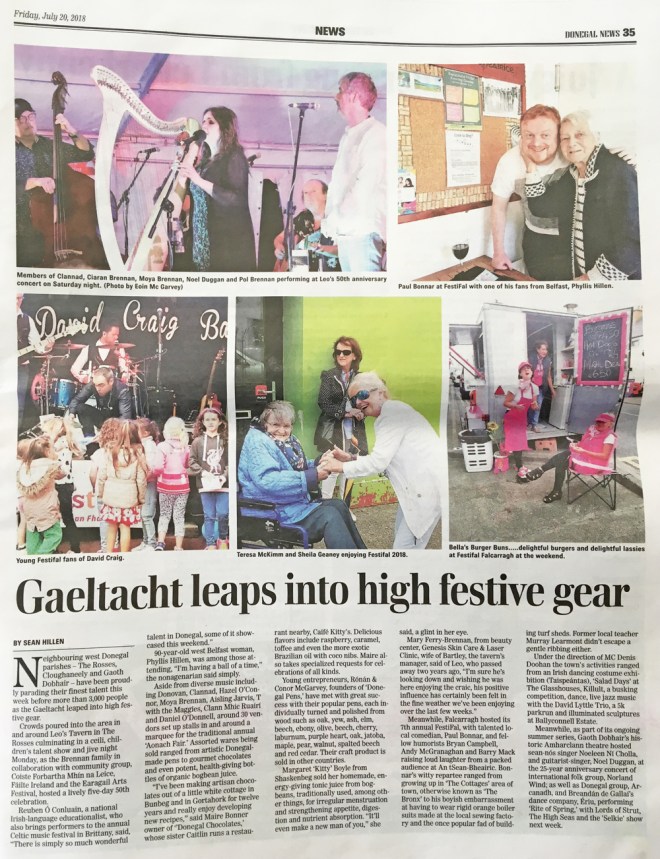
And if you missed Moya Brennan of Clannad performing a few days ago with her husband, Tim, daughter Aisling and son Paul, in Teac Leo in Crolly, in support of the Inishowen Floods Fund, you’ll surely get the chance again to hear this brilliantly talented family in the future. The same goes for ‘Shoot The Gear,’ a fine piece of theater with a fishing-community based theme facilitated by the Killybegs Fishermen’s Organization, written by An Grianan Theatre artist-in-residence, Guy Le Jeune, and performed by a cast of local actors, singers and musicians including Fionn Robinson, Louise Conaghan, Orlaith Gilchreest and Ronan Carr.

Speaking of music, what a terrific accomplishment by Donegal Music Education Partnership (DMEP) manager, Martin McGinley, and his team, including tutor and pianist, Ellen Quinn, Maureen Fryer-Kelsey and James Sarsteiner , with help from Marianne Lynch of Donegal County Council Library Services in putting together a new online library of more than 1,500 musical items that the public can easily access.

Martin McGinley (left) – Journalist, editor, fiddle player par excellence, now manager of Donegal Music Education Partnership.

However, as we rightly attempt to emulate our rich, multi-layered Celtic past, I would issue a sharp warning. While the keystone of our proud ancestors’ beliefs was based on the premise of democracy, each individual having a fair say, let us beware.

The Catholic Church – so long dominant in Irish society after vanquishing Druidic life, more so in rural Irish society – must now learn to accept – in turn – its rapidly changing place. And that place is no longer its own self-styled, unquestioning right to direct all community groups, especially on sensitive matters of finance. Too often have I heard complaints here in the Donegal Gaeltacht and elsewhere in Ireland about frocked priests and bishops sitting at the heads of tables, making vital decisions, often cunningly in an underhand way ahead of the formal committee meetings, on where vital monies should go. And not always to the benefit of the community as a whole – but to the church in particular.

My own area, Cnoc Fola, has just received a grant of 40,000 euro from Fine Gael Minister Joe McHugh. Considering the rather incestuous relationship between the Catholic Church and successive ruling political parties in Ireland – Fianna Fail and Fine Gael – is it reasonable for me to expect there is no payback expected, from both church and state, for this money, in terms of votes and support?

Is it also reasonable for me to trust the word of men in long black coats who describe yoga, thai chai and reiki as activities that ‘endanger our souls’ and who also discourage women from taking the HPV vaccine against cervical cancer, saying it simply encourages widespread promiscuity and immorality? And who move child abusing clergy from parish to parish?

Some months ago in a previous blog, I invited a well-known, rather affable west Donegal Gaeltacht priest, Brian O’Fearraigh, to join community members in our weekly yoga sessions at An Crann Og in Gaoth Dobhair. He hasn’t made an appearance yet. My offer is still open. He’d receive a warm ‘Cead Mile Failte’ from very friendly people there.

What do these seemingly unrelated issues – yoga, thai chai, reiki and the HPV vaccine – have in common, anyway? Freedom of mind and body, of course. And such displays of individual identity are perceived as hot, red-light dangers by most major corporation and institutions, especially the more conservative ones.
Wait for it, it’ll be swimming, cycling, swing dancing and jazz next. Oh, I forgot, the latter was already forbidden by the Church to all God-fearing people some years ago.

Does that mean God-loving people can enjoy such relaxing music? Even if they are Druids, Pagans, atheists, agnostics or pantheists and their God is Mother Nature herself?

Notes 

Hope you like my latest published novel, the suspense Pretty Ugly, linking Donegal and other parts of Ireland, including Belfast, with the US cities of Boston, New York, Kansas City and Washington DC.

Interested in creative writing? A novel? Biographical memoir? Play or movie script? See Ireland Writing Retreat
Lion-tamers, nude concert-goers, the Rolling Stones, one-clawed lobsters and terrific Irish music

How can small boxes of air that fit neatly between one’s hands create the haunting rhythm of a heartbeat, the roar of an angry sea and the chanting of cloistered monks at prayer?

Ask the talented, five-member ‘Irish Concertina Ensemble’ who captivated a packed audience earlier this week at Teach Hiudái Beag, a popular traditional music venue on the main street of Bunbeg in the Donegal Gaeltacht (a region that features prominently in new suspense novel ‘Pretty Ugly’ (Easons, Gallaghers/Matt Bonners Bunbeg, Amazon) and where the Irish Writing Retreat takes place every year).

Such wondrous music left me bemused about how such a rich diversity of melodies can emerge from such a tiny bellows-buttons-reed instrument. The ensemble, with members from different Irish counties, was one of many performances at this week’s ongoing annual ‘Scoil Gheimhridh’ (Winter School) in Gaoth Dobhair (the festival continues right through Sunday, so buy your show tickets now).

Composed of Tim Collins, Padraig Rynne, Micheal O’Raghallaigh, Caitlin Nic Gabhann and Edel Fox – the musicians brought this popular, cozy pub to a hushed and appreciative silence. So exhilarated were affable pub manger and owner, also himself a fine musician, Hugh Gallagher, my wife, Columbia, myself and others, we gave them a hearty and well-deserved standing ovation.

Irish Concertina Ensemble, Scoil Gheimhridh

Boxes of air that produce mellifluous music.

Drawing on a wealth of melodies, some old, some new, some composed for other instruments such as the fiddle, flute and uilleann pipe, the group displayed the surprising and immense versatility of the concertina.

Not only were there versions of tunes by such iconic instrumentalists as Turlough O’Carolan, (1670–1738), a blind Irish harper and composer, but also their own compositions. Highlights among the latter were a series of mellifluous waltzes in honor of Kathy, a friend and admired social activist who died from cancer, and also a dreamy melody inspired by watching the sunrise with Oisin, the young child of one of the group members.

The opening night of the festival was a veritable cabaret of myriad talents at Ionad Cois Locha in memory of well-respected community and media leader, Seamus Mac Géidigh, broadcaster and manager of RTÉ Raidió na Gaeltachta‘s northwest service in Donegal, who recently passed away.

Such is the interest in preserving local Irish heritage, fiddle player and teacher Róisín McGrory who is also co-founder of the Inishowen Traditional Music Project established in 1999 to preserve the music of the region, also performed at the festival.

Another highlight of this week’s festival and music school so far has been the double-bill of Carlow-based brothers Diarmuid and Brian Mac Gloinn who perform as ‘Ye Vagabonds’ and star fiddle-player and ‘Hobbit-lookalike’ Frankie Gavin, who played alongside bouzouki-mandolin player, Brendan O’Regan. The former, resembling young, bearded troubadours, moved effortlessly from ballad to toe-tapping melodies, from the ‘Lowlands of Holland,’ a soft air about a man lost at sea, which they learned from Donegal-native Paddy Tunney, the same county their mother hails from – Arranmore Island – to a lively finale that included ‘The Lark In The Morning.’ They sang songs in both English and Irish.

While he strikes a remarkable resemblance to one of my heroes, the hobbit, Bilbo Baggins, the affable Gavin’s blinding bursts of speed reminded me more of ‘The Fiddler of Dooney,’ the character in the W.B. Yeats poem of the same name whose fiddle playing ‘made folks dance like a wave of the sea.’

Frankie Gavin, Brendan O’Regan, Donegal Irish music

(l to r) Frankie ‘Bilbo Baggins’ Gavin and Brendan ‘Speedy Fingers’ O’Regan display their ample talents at Teac Jack.

To say Gavin’s bow tripped lightly over the strings would be a severe understatement. Skipping, dancing, somersaulting even, would be much more appropriate descriptions – from hornpipes and reels to jigs and highlands; from Donegal composition, ‘Strike the Gay Harp’ to ‘The Old Grey Goose;’ from tunes by well-known Irish musical ambassadors such as fiddler Tommy Peoples and music collector and uilleann pipe player, Séamus Ennis; to others learned from fellow musician, Dermot Byrne; and still others he performed previously with French violinist Stéphane Grappelli in a ‘Jigs and Jazz’ show.

Gavin’s ludicrously fast fiddle-playing may have seemed eye-to brain-to-fingers neurologically impossible but when he picked up the flute he really put the emotional brakes on his packed audience at Teac Jack in Glassagh (which also features prominently in ‘Pretty Ugly‘), leaving them glassy-eyed with his version of the classic slow air, ‘Boolavogue,’ about Father John Murphy and the Wexford uprising during the Irish rebellion of 1798.

Not only, but the founder of the well-known group, DeDannan, is also a natural raconteur and effortlessly entertained his listeners with an assortment of jokes, ranging from lion-tamers to one-clawed lobsters. Alongside him, ‘Speedy Fingers’ O’Regan displayed his musical virtuosity with a simply brilliant solo of his own competition on mandolin.

The festival’s energetic and committed organizers deserve great praise.

They include Conor Byrne, accomplished flute player who was mentored by west Belfast musician Frankie Kennedy (who tragically died from cancer at a young age and for whom the festival was originally named after); Cathal Ó Gallchóir, who is also manager of local community center, An Crannog in nearby Derrybeg, where varied activities ranging from yoga to Irish language and music classes take place; their excellent, friendly support team; and special guests such as fiddle player, music teacher and journalist, Martin McGinley, who opened the festival this year and who conducted a most interesting, light-hearted and insightful  afternoon interview with Gavin at PobalScoil Gaoth Dobhair (more on that, including naked Danish concert-goers and sessions with Jagger and Co. of The Rolling Stones in an enlarged festival review on World Itineraries later this weekend).

Scoil Gheimridh, Irish music festivals, live Irish music

Cathal Ó Gallchóir introduces festival musical performers.

‘Scoil Gheimridh’ has now rightly become a prominent feature of national Irish cultural life. Students and teachers, men and women, schoolchildren and retirees, both national and international, lovers of instruments ranging from the bodhrán, an Irish hand drum, to fiddle, flute, uilleann pipes, accordion, concertina and even traditional sean-nós singing and dancing, gather every year in this beautiful north-western region known as the ‘Forgotten County’ to attend classes taught by leading musicians and to enjoy the many concerts and seisún.

Here, in this most northerly region of Ireland, interest and pride in the native Irish language, Gaeilge, and the rich cultural heritage of their forebearers remains impressively strong, especially in the face of the fickleness and superficiality of modern-day life.

The festival ends this weekend with a concert tonight (Friday, 8.30pm) by Dublin four-piece band, Lynched, at Teac Jack; an exhuberant New Year’s Eve celebration at Club CLG Gaoth Dobhair with Kerry-based Polca4 and local band, An Crann Óg; and two seisiún mór (big informal music/dance sessions) at Teach Hiúdaí Beag Saturday and Sunday, plus the classes.

Sponsors of the annual winter school include The Arts Council of Ireland.

A sad, rather pathetic, Christmas story

Twas the night before Christmas, when all through the house
Not a creature was stirring, not even a mouse.
The stockings were hung by the chimney with care,
In hopes that St Nicholas soon would be there.’ (Clement Clarke Moore)

As winds howl around me and rain rattles my window panes like the chattering of false teeth, I recall this sad, rather pathetic, Christmas story…

Prominent politician-on-the-cusp-of-greatness on the Irish national stage gets stuck on a knife-edge. Someone with access to key information can prove he falsified expenses on the back of the average Seamus/Sean/Patrick ‘Joe O’Blow’ citizen, both as a board member of Irish-language body, Údarás na Gaeltachta, and Donegal County Council.

Concerned about the effects on its chances of returning to Power if things get sour, spin doctors at his political party’s Dublin head office get involved. Politician-on-the-cusp-of-greatness also calls in his own local cronies, most from the west Donegal Gaeltacht area – well-paid fellows in silk suits, some of whom made financial hay on the back of his and his party’s long-term, some say overly-long, stay in power.

Christmas story Donegal, politicians in Donegal

Money, money – who says I’m interested in money?

They say ‘deny, deny,’ which said politician-on-the-cusp-of-greatness does. He’s hoping the custodians of the county council and the national Irish-language body – many of whose top brass owe their own cushy, well-paid admin jobs, expenses and pensions to his own political party – will sit on it like dementia-suffering chickens, and do nothing.

But the evidence is much too solid, and from a respected and knowledgeable insider too, comprising definitive documents that prove beyond a shadow of a doubt the culpability of said politician-on-the-cusp-of-greatness.

Also, hushed voices are alleged to whisper in the Corridors of Power, ‘there’s so much more that could easily come to light and make donkeys of us all.

Aforesaid local top brass know they must do what’s unavoidable. Otherwise their own jobs, generous expenses and pensions could be on the line. So, faced with no alternative, they bring the allegations – rather reluctantly – to the attention of the relevant authorities, hoping it will all go away and they can return undisturbed to their comfy desks, genteel lifestyles and holiday homes on the Spanish coast.

But that doesn’t happen.

An investigation begins by the six-member, national Standards in Public Office (SIPO) chaired by an experienced, former High Court Judge.

corruption in Donegal, what's on in Donegal

Now let me think: two places at the same time. Mmmmm, surely it must be possible. Anyway, who’s lookin’?

Re-enter stage left the local and national spin-doctors-cum-advisors to said politician-on-the-cusp-of-greatness. Okay, not ‘deny, deny,’ but ‘delay, delay.’ Until it all blows over and our All-Consuming Party climbs back on to its Rightful Throne. ‘Knowing the fickleness of the average dumb, thick-as-shite, Irish voter, that’s inevitable,’ they say, ‘quicker than you can slip a brown envelope into a pocket.’ Then we can blow this under the carpet as we have done with much more serious stuff in the past.’

But national elections come around. And, lo and behold, the hoped-for Dramatic Return to Power, which they feel is theirs by Right, they being the ‘Soldiers of Destiny,’ doesn’t happen.

The battle cry, as per the silk-suited, well-heeled advisers and cronies, then becomes not ‘deny, deny’ or even ‘delay, delay’ but that bastion of Irish patriotism. The one, they feel, will blind the thick-as-shite voters to the insignificant wrongs of falsifying expenses and screwing the average Seamus/Sean/Patrick Joe O’Blow.

The sacred language. The language of Pearse, Plunkett and Wolfe Tone.

Let’s tell them, by George: ‘We want any investigation to be conducted in our native language, as Gaeilge, le do thoil. If not, we’ll not recognize this court.’ Quite ironic, as the comprehensive falsifying of expenses, by all accounts, was done in the dignified language of the Royal British Crown.

And so it’s done.

And so the cost continues to rise…and rise…and rise even more.

Finally, the rather inevitable conclusion was reached, just last week after around two years of delay: politician-on-the-cusp-of-greatness has indeed screwed over the average thick-as-shite Seamus/Sean/Patrick ‘Joe O’Blow.’ Regardless of our rapid technological development, it seems it’s still impossible for a homo sapien to be in two separate physical places at the very same time.

But guess what?

poverty in Donegal, Senator O'Donnel Donegal

Hey Mister, Merry Christmas, can ye spare a penny cos the politician-on-the-cusp-of-greatness stole all our parents’ money?

Instead of costing the average Seamus/Sean/Patrick thick-as-shite ‘Joe O’Blow’ a couple of thousand euro, it costs, wait for it – with lawyers’ fees, documents, photocopying, translation costs, administrators and secretarial overtime etc – a whopping 350,000 euro.

To put this sum in perspective, this is the equivalent of around 12,000 (that’s twelve thousand) round-trip airfares on flybe for cancer patients from Donegal’s Carrickfinn Airport for specialist treatment in Dublin.

Yet, even sadder, so unimportant and insignificant is scarce public money, both Donegal county council and Údarás na Gaeltachta have just announced they’re not going to ask for the money back from said politician-on-the-cusp-of-greatness.

Now isn’t that a sad and pathetic Christmas story?

But know what the even sadder thing is?

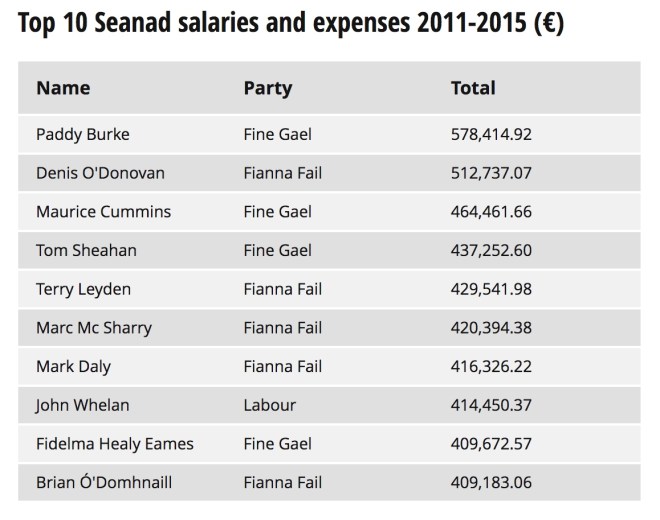
Said politician-on-the-cusp-of-greatness continues to be paid out of Seamus/Sean/Patrick ‘Joe O’Blow’s’ thick-as-shite’ pocket. In fact, between 2011 and 2015, said politician was among the top ten most expensive Senators in the entire Irish nation – 409,183.06 euro to be exact in salaries and expenses. That’s about a 100,000 euro a year. Did you ever earn that figure?

As for the party of our politician-on-the-cusp-of-greatness. Fianna Fail by name. Beset by ever-increasing, power-hungry pains and after spending a great deal of time, effort and money defending ‘Their Man’ and spinning the truth, they – in their instantaneous wisdom – cut him loose. Snip. You can always come back another day, they say, the Seamus/Sean/Patrick thick-as-shite-Irish-voter suffers genetically from short-term memory problems, so we’re all okay, in it together, if you know what I mean.

Now, you tell me. Who’s the real loser in this sad, rather pathetic, Christmas story?

Donegal politicians, Fiana Foil Donegal

Yeah, it’s pretty bad. We ain’t got no shoes or socks. Where did the money for them go anyway, you ask? Well, it’s a sad, rather pathetic, Christmas story…


If you’re interested in political and corporate corruption in a suspense novel linking Donegal to the US, read newly-published ‘Pretty Ugly.’ Can be purchased direct from Amazon, in eBook or print form, or in Donegal from Gallaghers or Matt Bonners Bunbeg, or Easons Letterkenny.


First suspense novel links Donegal ‘Wild Atlantic Way’ with America 

Readers have asked me in reference to my recently-published suspense novel ‘Pretty Ugly’ focusing on deadly cosmetics and political and corporate corruption, linking Ireland with America, how I describe Donegal in the book.

Of course, as an author, I should respond “well, might I suggest you go out and buy the book and the mystery will be revealed.” (‘Pretty Ugly’ can be purchased at Easons Letterkenny, Gallaghers Bunbeg, or direct from Amazon).

But as this is the season of goodwill and the ‘Forgotten County’ plays such a key location role in the unfolding drama of the novel, I’m including two videos of readings from the novel that focus on Donegal that I made recently at a Berlin bookstore .

The context is that Colm Heaney, an investigative reporter, is on a plane over the Atlantic en route to Ireland, chasing after a world exclusive. He’s hoping to find a beauty queen, a former Miss USA, who is hiding from the paparazzi – in, of all places – the hills of the west Donegal Gaeltacht, in the shadow of Cnoc Fola (Bloody Foreland) in Gaoth Dobhair.

Dare I be immodest and say it? Okay, okay, if you think I really should: ‘Pretty Ugly’ makes for a pretty good Christmas gift, with a pretty stunning cover and at a pretty decent price.

Looking forward to your comments and feedback on Facebook, directly on the book’s website or on Amazon.

I wish you and your family and friends a most contented and relaxed holiday season. The perfect time to settle yourself in a comfy armchair with a glass of something strong and an interesting book to delve into.

Grassroots initiative promotes men’s health and well-being

Few things deserve greater praise than a community-led initiative that helps increase the quality of life of its members – thus the Men’s Sheds concept.

Started only five years ago, the idea has enjoyed phenomenal growth with more than 350 such sheds throughout Ireland already with an amazing 10,000 people attending activities every week, and a growth rate of 1.5 sheds per week. Donegal alone has 10 sheds.

What’s the aim? A simple, yet admirable one – improving members’ mental and physical health through diverse activities.

See article below I wrote for this week’s edition of the ‘Donegal News.’ It contains a couple of Donegal contacts for those interested in finding out more.

Making Lives Better in the Shed

Many men throughout Donegal travelled to Belfast this past weekend for the biggest international gathering of ‘Men’s Shed’ members with the goal of developing diverse activities and closer links with each other to help improve members’ physical and mental health.

Embracing the traditional concept that the garden shed has long served as a sanctuary for men, a place where they ease the everyday stresses of life, ‘Men’s Sheds’ are spaces where men meet and work together on diverse projects. Community-based and non-profit, they are open to all men who want to enjoy a safe, friendly and inclusive environment.

Sheds without Borders, Gaobh Dobhair Men’s Shed

Members of Gaobh Dobhair Men’s Shed (Scioból na bFhear), Liam Ó Gógáin, Paul Treacy, Michael Coll, Dónal Clancy and Austin O’Donnell, at Belfast international ‘Sheds without Borders’ conference.

Founded just five years ago, the Irish Men’s Sheds Association (IMSA) organized the Belfast event, entitled ‘Sheds without Borders,’ which was attended by several hundred people from countries such as Scotland, Wales, Australia and Ireland. The association has experienced phenomenal growth and now represents sheds both here and across the border with a rapidly-increasing membership of 350, with around 10,000 ‘shedders’ attending weekly. It is growing at a rate of 1.5 sheds per week. Membership is also expanding in Northern Ireland, with 44 sheds and around 1,000 attending weekly. Donegal now has about 10 sheds county-wide.

Reflecting on their growing popularity, Liam O’Gogain, a member of Gaobh Dobhair shed (Scioból na bFhear) in the local industrial estate who went to Belfast with several colleagues, said, “Worldwide, sheds have a proven positive mental health dividend for members countering feelings of isolation with a relaxed, community spirit and an opportunity to share your skills and learn new ones.” He said “increasing public awareness” about them was key, with the shed he attends meeting every Monday and Thursday evening 7-10 pm. Anyone interested can contact sciobolgaothdobhair@gmail.com or call Liam on Mobile 087 254 3997 for details.

Liam Ó Gógáin Donegal, Men's Sheds

Shedders enjoy a joke while converting a disused room into a tea-room using bits and pieces.

Enthused by the Belfast conference, O’Gogain said he heard, “endless stories from men of all ages about how their shed has transformed their lives, through friendship, conversation and simply having fun with projects,” which, he added, “creates effusive, natural companionship.”

Asked why Men’s Sheds’ are particularly important in Donegal, he added, “With the loss of the manufacturing jobs base here, Scioból na Bfhear, like other such sheds, provides a welcoming environment for men from every background from their mid-30s to their 80s, any age, to gather and work together through craic and collaboration.” As to the benefits of last weekend’s international event at Belfast City Hall, he said, “We made friends and contacts with other sheds in Donegal and throughout the country who offered information, ideas and support to fledgling sheds. Interesting talks ranged from mental health to adult learning.”

Back from Belfast and speaking about inclusiveness and easing social isolation, Gerry Connolly, chairperson of the Ballybofey-Stranorlar shed established last year, now with 30 members, said, “We started, in part, because may men here in the area suddenly became unemployed either out of illness or redundancy when the crash happened but we also have many retirees.” Members completely renovated and rewired a Portacabin for meetings, which is also used by other community groups, and will make ‘buddy benches’ for schools with the help of a skilled woodturner. Those wishing to know more can contact Gerry at Mobile 086 825 0550.

Shed activities nationwide range from boat-building to making ornamental crafts from wood such as candle-holders and toolboxes to simply playing pool or table-tennis and creating choral groups.

Unique chance to meet Washington-based author and former CNN editor in west Donegal

Wandering through a dappled glade in Glenveigh National Park a short while back, Lugh and Siog, our two loving, lively, not-so-shy Irish collies – as is their habit – found some new friends. A bearded man, his wife and his daughter.
That man turned out to be Washington-based former CNN senior editor and triple-book author, John DeDakis, a friendly fellow over on this side of the Pond on a short holiday – his first foray into Donegal.
He must have liked what he saw, for that same man I am delighted to say, will now speak at a special public event hosted by ‘Ireland Writing Retreat’ at Teac Jack in Gaoth Dobhair this Monday evening, June 29, at 8pm, sharing his decades-long experiences in American TV and radio broadcasting – including interviewing Alfred Hitchcock – as well as writing three crime suspense novels.
Interestingly, the protagonist in John’s three crime novels is a young woman, so – having honed his writing skills from a female perspective – he will talk about what he learned about the mistakes men make in trying to forge meaningful relationships with women.
In his fourth novel, which he is working on now, John deals with the death of his 22-year-old son. During his talk, he will explain why he wanted to tackle such a personal and painful topic.
John will also offer advice to those who feel they have an interesting story to tell, but are confused about how to get started writing it.
 
Staffed 24 hours, seven days a week at CNN‘s world headquarters in Atlanta, Georgia, and in bureaus worldwide, the television and online news network has a global team of almost 4,000 news professionals. Its news and information services are available in five different languages across all major TV, internet and mobile platforms reaching more than 380 million households worldwide.
“It is a delight to be a part of the Ireland Writing Retreat in Donegal,” said John earlier this week, several days before he departed from the US capital. “It is wonderful that such an international event as this takes place amid such a beautiful landscape, a perfect backdrop for artists of all kinds, including creative writers.” 
His exciting and informative multi-media presentation is entitled ‘From Journalist to Novelist Or How I Learned to Start Making it Up.’ If you’re interested in news, journalism, current events or creative writing – don’t miss it.
Among the many roles, John played at CNN was as senior script editor of the popular Emmy and Peabody-Award winning programme, ‘The Situation Room,’ hosted by Wolf Blitzer, which offered expert analysis of the world’s top news and current affairs stories, both national and international.
John is travelling direct to west Donegal from Washington this weekend to join a line-up of top-notch published authors in diverse genres, including crime, magic realism and science fiction, for the week-long ‘Ireland Writing Retreat’ where they will help retreat participants improve their creative writing skills.
His interest in the crime suspense genre began long before he finished the first of his three published novels, ‘Fast Track,’ ‘Bluff’ and ‘Troubled Water.’ He enjoyed the rare privilege of conducting a 40-minute, one-on-one interview with the man who has been nicknamed the ‘Master of Suspense,’ Alfred Hitchcock. The career of this British director, who pioneered many techniques in psychological thriller movie genres, spanned half a century and included such film successes as ‘The Birds,’ ‘Dial M for Murder’ and ‘Psycho.’
John was also White House correspondent for CBN News during the last three years of Ronald Reagan’s presidency. He is an adjunct journalism faculty member at the University of Maryland-College Park and has been a lecturer at the American University, Washington, D.C. and Writer-in-Residence at the Callanwolde Fine Arts Center in Atlanta, teaching fiction writing classes and holding one-on-one writing tutorials.
For details on how to book your place see Ireland Writing Retreat

‘Whatever you say, say nothing!’ – motto of Údarás na Gaeltachta

‘People have no right to ask how we spend their money.’

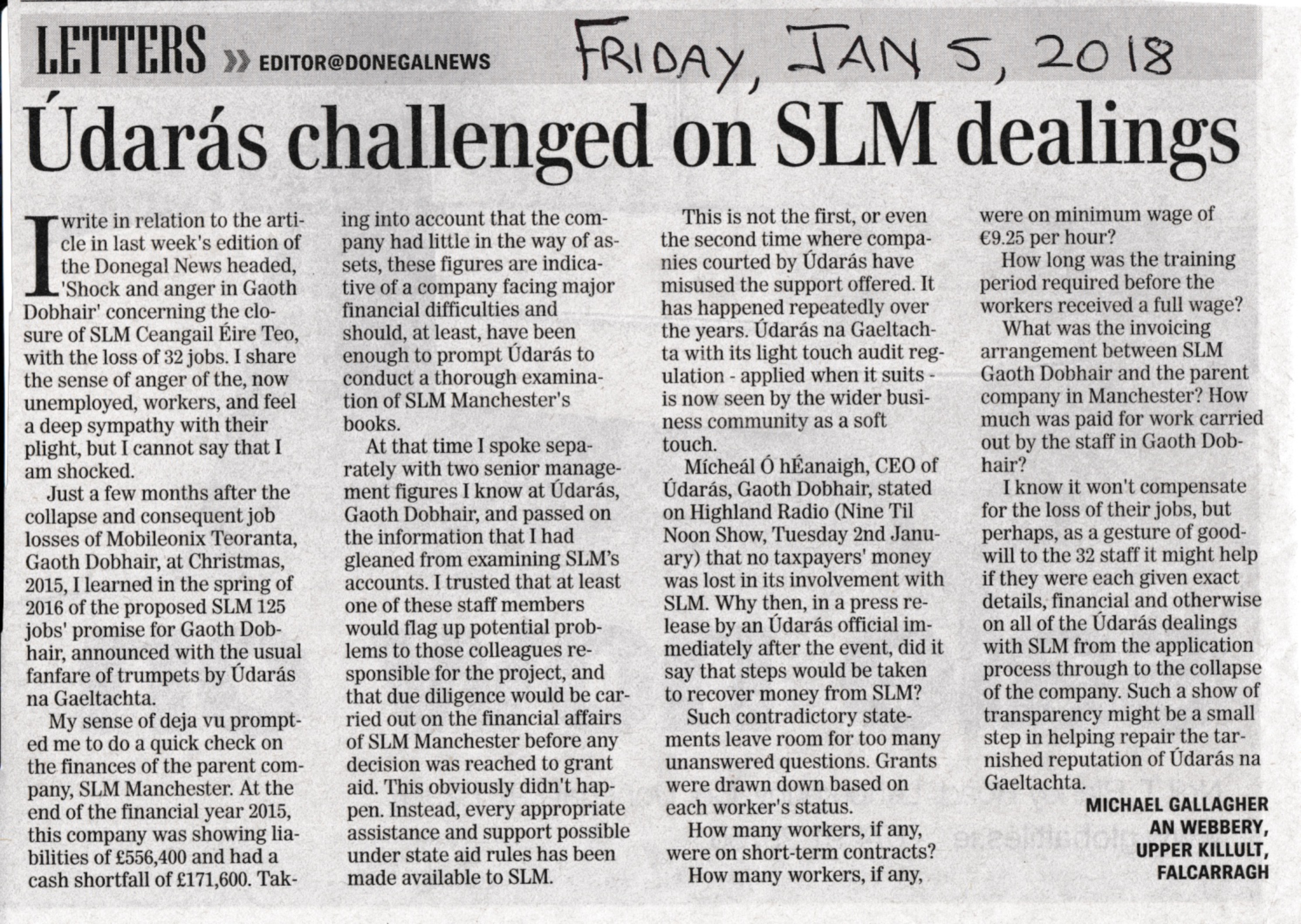
That’s the attitude of Údarás na Gaeltachta, which has once again refused to release key information about how it spends public funds.

Udaras

A Senate committee revealed that Údarás pays millions of euro every year in pensions to former executives, some of whom were local Donegal employees including Cathal MacSuibhne, former regional manager based in Gaoth Dobhair.

cathal

Sinn Fein’s Trevor Ó Clochartaigh, a member of that Senate committee, exclaimed, “I nearly fell off the chair when I heard that almost half the current expenditure goes on pension payments to 136 people who are no longer employed by the organisation. Small wonder Údarás is not able to function more effectively.

He added, “This raises serious concerns regarding the levels of monies being paid and who is receiving them.”

Under transparency rules, other public bodies have made a breakdown of such pension figures available for examination, but in response to a Freedom of Information (FOI) request I made, Údarás refused to do so, citing gobbledegook about data protection.

As a result, having brought the matter to the attention of a number of TDs, the Údarás pension issue has risen to the highest levels of national government, to the office of Brendan Howlin, Minister for Public Expenditure.

I can reveal in this blog that on my behalf various leading politicians including Public Accounts Committee (PAC) member, Mary Lou McDonald, have attempted to find out the individual pension figures but Údarás has stonewalled every request, preventing their release.

MaryLou

How it happened

Údarás responded to my initial FOI request last year seeking details on pension and lump sum payments to former executives in a letter signed by Padraic O’Conghaile – a ‘cinnteoir’ at the organisation’s headquarters in Galway.

In the letter, he wrote, “I am refusing these records as they relate to the pension of an individual under Section 28.1 (Personal Information). The FOI Act defines personal information as information about an identifiable individual that: ‘would, in the ordinary course of events, be known only to individuals or members of the family or friends, of the individual.’ I believe that the right to privacy of these persons with regard to such information far outweighs any public interest there may be in this matter.

The fact, that all the pensions and payments are publicly-funded and thus not “known only to individuals or members of the family or friends, of the individual” as he asserts – did not seem to enter Mr. O’Conghaile’s thinking. Or, perhaps, did, but he refused to acknowledge it.

Following this response, I requested several TD’s to present formal written parliamentary questions in the Dail on the same issue.

For example, Mary Lou McDonald, a member of the Public Accounts Committee (PAC), submitted her parliamentary question to the Minister for Arts, Heritage and the Gaeltacht asking the Minister to “reference the specific provisions of the Data Protection Acts 1988 and 2003 to which he referred (supporting Údarás’ denial of information); the basis on which he believes Údarás na Gaeltachta does not, unlike in the case of all other senior managers across the civil and public sector, have to make public the details of public service pension arrangements on retirement for senior management.

Dinny McGinley, then junior minister, wrote back in a vague response saying simply that Údarás had informed him it was “a data controller, defined under the Acts as a person who either alone or with others controls the contents and use of personal data.

dinny

Put in simple words, it means Údarás, while deriving all its funding from public money, considers ‘People have no right to ask how we spend their money.’ McGinley’s response also has no logical meaning whatsoever under present Irish law. Instead it is a classic delaying tactic. The former Minister did not bother to question it or seek elaboration.

That response led McDonald to submit a follow-up question, this time to Minister Howlin, reading, “given the Minister’s stated commitment to transparency and accountability in the spending of public monies, whether in his view it is acceptable for a public body fully funded by the exchequer to withhold from the public record details of public service pension arrangements on retirement for senior managers; and if he is prepared to legislate to require all publicly funded bodies to make such information public in the interests of open government.

HOWLINBRENDAN

It is most disappointing that a simple request to a fully publicly funded body about its spending has led to such a reactionary response from an organisation such as Údarás, which is responsible for the economic, social and cultural development of the Gaeltacht.

Such utter lack of transparency and disregard for public concerns has already led to such widespread corruptive practices as those at FAS when it was discovered hundreds of thousands of euro went on lavish holidays including first-class travel and expensive rounds of golf for executives and their wives. Údarás itself has yet to account for trips paid out of public funds for board members, executives and wives to visit attractive international destinations, including Las Vegas.

Public money is a precious thing and every penny of it ought to be properly accounted for and judiciously spent.

I will reprint Minister Howlin’s response on this blog when it is received. It should provide a most interesting read.

Bunbeg, once pretty, now disfigured

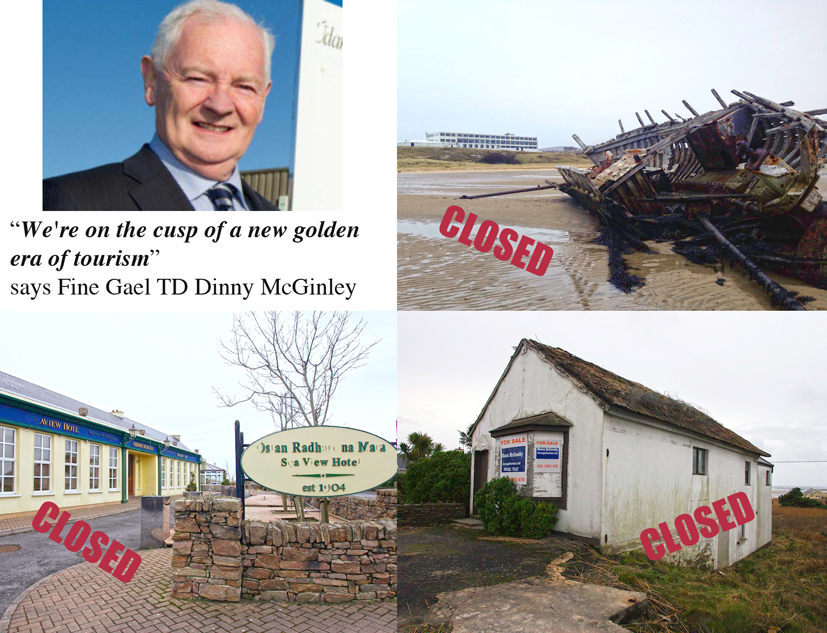
Once pretty, Bunbeg is looking more and more like a toothless old hag.

Derelict spaces, decrepit ‘For Sale’ signs and boarded up, empty and run-down buildings have pockmarked its once thriving main street.

OLYMPUS DIGITAL CAMERA

The iconic, century-old Seaview Hotel, which employed over 108 people seven years ago (talk of Cayman Islands and meat debts has no place in this blog), stands empty and forlorn this week , joining a heap of other ‘deadwoods’ on the street  – a once popular restaurant opposite and three other nearby hotels, The Errigal View, the Ostan Gaoth Dobhair and The Brookvale, as well as a mix of shops, bars and cafes, all now closed and crumbling.

Ironically, one of the few buildings to be renovated and opened on the main street is the constituency office of Fine Gael TD and former Gaeltacht, Arts and Tourism Junior Minister Dinny McGinley, the man who proudly pronounced this week, “We’re on the cusp of a new golden era of tourism.”

colaj good

Talk about poor timing.

Not to mention poor positioning. McGinley’s office lies a mere 50 yards from the deserted Seaview Hotel, first established in 1904.

News this week of the Seaview’s demise is a stark reminder of the abnegation by Udaras, the area’s main economic regeneration group, of its prime responsibility for creating  jobs, including those in the hospitality sector, with Gearoid O’Smaolain its main tourism development officer.

Eamon McBride, former President of the Gaoth Dobhair Chamber of Commerce, put it simply: “the area is crying out for more attractions.”

Job losses, lack of transparency

Aside from the 35 jobs, both full and part-time, lost at the Seaview this week, hundreds have been lost at other Udaras-sponsored businesses such as Largo Foods, Nuance and Sioen Apparel over the last few years. In fact, the Udaras Donegal office has performed consistently worse than any other Gaeltacht region in Ireland in terms of its job-creation record.

Sinn Fein TD Pearse Doherty this week called on the Government to immediately publish the findings of a delayed report by a working group tasked with examining job creation in the Gaoth Dobhair area. One hopes he will demand the same of the local Udaras office. Only then, can the organisation be properly analyzed to ascertain if the public is getting ‘bang for its buck,’ or if drastic changes need to be made internally if it is found that employees lack the skills-set necessary for the important task at hand.

photo and chart good

Gaeltacht disintegration

The intriguing part of the sad saga surrounding what is, in effect, economic mismanagement of the Irish-speaking area, is that while towns within it, such as Gortahork, Falcarragh and Bunbeg, are literally peeling apart, both economically and physically, Dunfanaghy, just outside the borders of the Gaeltacht, is riding a wave, with bars and cafes enjoying a boost in trade, especially at weekends – without the benefit of public funding of any kind.

While Udaras Donegal announced this week it will release proposals for economic development, observers say this is more a cosmetic exercise aimed at organisational survival than a serious attempt at strategic innovation and staff revision – that it has not even hosted a single open public meeting to ascertain the views of ordinary people, the very people who pay for its running costs. Interestingly though, while widespread job losses have occurred in Udaras-sponsored companies in Donegal, no such losses have occurred within the local Udaras office itself.

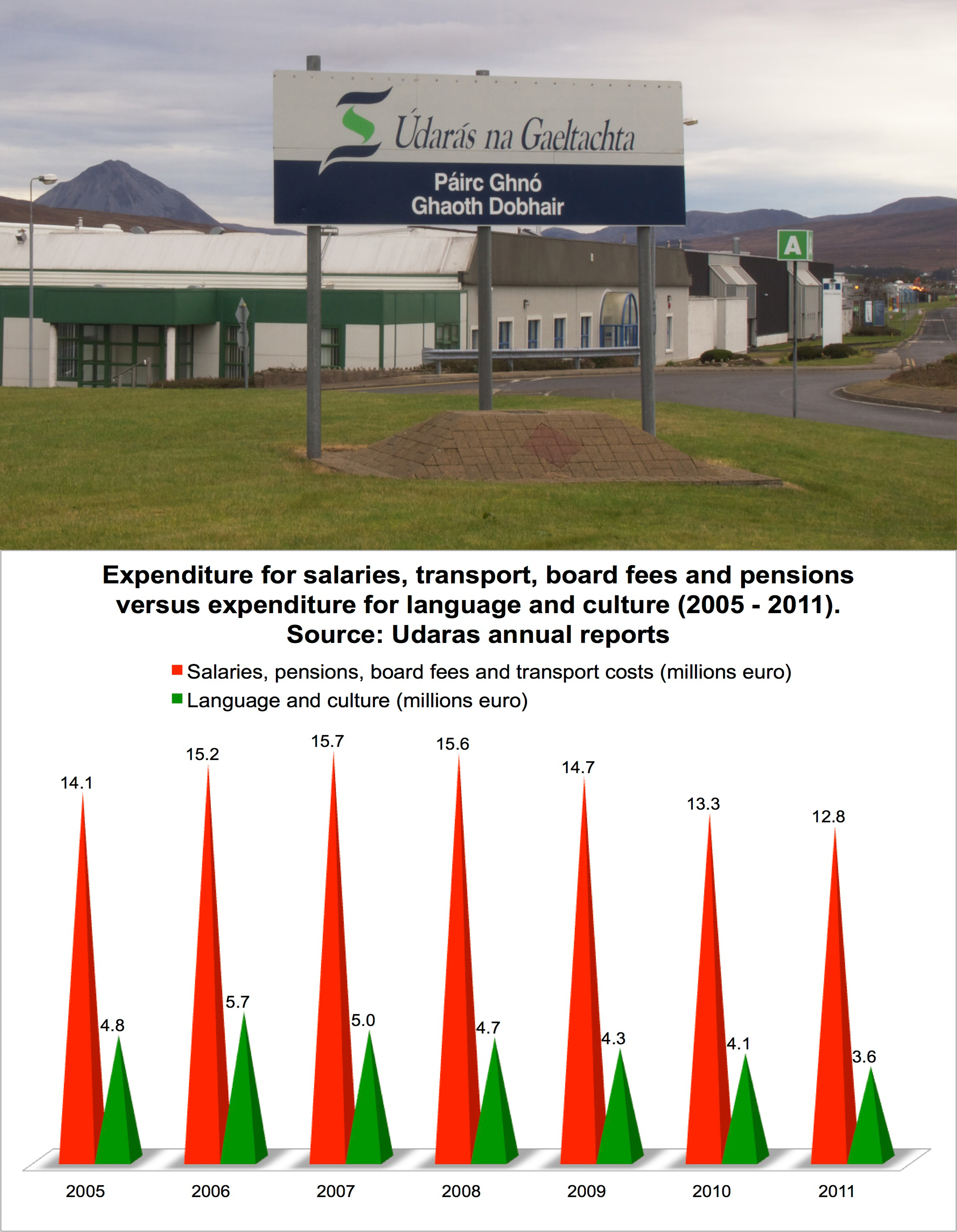
Based on its operational history (see above graph), should we accept as normal that out of its seven million euro budget for this year as announced by Udaras officials, two-thirds go towards salaries, pensions and expenses, and the remaining one-third only to economic and language development?

Is it not long past time this organisation came under closer public scrutiny and thus be made more accountable?

Whale sightings off Donegal coast encourage educational and tourism efforts

Approaching within 30 feet of a minky whale out on the Atlantic takes courage – but such is his concern for the welfare of local marine life that’s exactly what Gareth Doherty did recently.

With the sighting of so many such baleen whales off the northwest Donegal coast over the last few weeks, Doherty, a skilled seaman (he manages Selkie Sailing in Gaoth Dobhair) and knowledgeable environmentalist, realized it would be a prime opportunity to try to identify them and monitor their movements and thus understand better the thriving whale population off Irish coastal waters.

whales 1

“It is only by recording the twenty-four cetacean species recorded thus far in Irish waters that we can protect them,” he said. “The fact that so many are now visiting us is wonderful news.”

whales 6

Doherty also believes that greater numbers of such healthy marine animals locally means greater opportunities to both educate people about this vital segment of sea-life and strengthen environmental tourism efforts throughout Donegal.

Here is yet another local cultural tourism-cum-educational project worthy of financial support. Udaras na Gaeltachta, the state-sponsored economic support group in the area, has refused to pay for much-needed equipment for Selkie Sailing.

Readers of this blog and of a series of articles I penned for the Donegal News will remember Gareth for the sterling work he and others did to bring important publicity about the plight of a pod of stranded whales at Ballyness beach in Falcarragh earlier this year.

whales 2

Not only did Gareth and colleagues highlight the stark inadequacies, both in equipment and training, of the National Parks and Wildlife Service to deal with such incidents (it has since become known that Donegal wildlife officials didn’t even take sample tissue from any of the dead whales to ascertain what may have stranded them and led to their slow suffocation) but they also banded together to organize marine lifesaving training programs for people that continue even now.

Visiting my Bun na Leaca home recently, Gareth said his intention was also to launch a series of educational visits to local schools to make presentations about the importance of marine life around our shores. It is an excellent idea and there seems no more qualified and enthusiastic a person to host such a program than Gareth.

whales 3

Minke whales grow to about nine meters in length, weigh around 10 tons and can live about 50 years. Their bodies are dark grey to black on the back and lightening to white on the belly and undersides of the flippers. There are often areas of light grey on the flanks, one just above and behind the flippers and the other behind the head. Those in the northern hemisphere usually have a diagonal white band on the upper surface of each flipper. Smallest of the seven great whales, minkes often enter estuaries, bays and inlets and feed around headlands and small islands.

Updates can be checked on Selkie Sailing.

The Irish Whale and Dolphin Group assisted with local training programs.

Brewing up a storm

A wheelbarrow and a pair of boots painted proudly in Donegal GAA colors perched atop a house roof in Falcarragh.

IMG_2148

A sexy, full-size female mannequin dressed in nifty sporting gear posing roadside in Glassagh, Gaoth Dobhair.

IMG_2181

And goodness knows how many rusted carcasses of cars suddenly transformed into brightly-colored, eye-catching street decorations.

photo

Sporting success has brought out the best in Donegal creativity – both on and off the field.

With less than seven days to go before ‘the Grande Finale’ at Croke Park, the county is awash with an artistic spirit that Jimmy, Declan and their respective teams have inspired.

Wouldn’t it be wonderful if such genuine outpouring of community solidarity could be harnessed into sustained cultural tourism projects that would provide much needed long-term employment and economic benefits?

If some of the recently erected ‘altars’ to the success of Donegal GAA are anything to go by, there is no shortage of ideas, but funding is sadly missing. Not because the money isn’t there, it is. But because those holding the purse strings don’t have the confidence that proposed projects are anything more than short-term hobbies. Consequently, those with excellent cultural tourism ideas continue to live a hand-to-mouth existence, spending much of their brilliant creativity, not on artistic endeavor, but on scrounging for pennies, with long-term sustainability a mere pipe-dream.

An earlier post cited Udaras’ rejection of funding this year for the excellent ‘Evil Eye’ festival in Falcarragh. Now, a recent report shows a paltry 48,250 euro has been shoe-horned for 17 festivals throughout the county by Failte Ireland. Work out the math. It doesn’t amount to a hill of beans.

Meanwhile, there is a peculiar notion out there that beer will be consumed in considerable quantities in the county if Donegal ride victorious over the Holy Ground this weekend.

The bad news is that beverage choice for such a celebration in the county is among the most limited in the nation. Seemingly, more publicans in Donegal have kowtowed to multinationals such as the British-owned company, Guinness, and Heineken because they offer their products wholesale for as little as 50 cents a pint rather than offer their customers a wider choice of beers and ales to imbibe as is happening in other parts of Ireland.

Attending the Irish Craft Beer and Cider Festival a week ago at the RDS in Dublin, I was delighted to see how many micro-breweries had been launched nationwide – Galway Bay Brewery, The White Hag in Sligo and 9 White Deer in Cork to name but a few. While Ireland is still well behind England and the US in terms of micro-beer choice, mainly due to consumer acquiescence, Donegal is well behind other counties.

OLYMPUS DIGITAL CAMERA

Only Kinnegar Brewing and Muckish Mountain Brewery keep Donegal from being bottom of the national micro-brewery league table. The latter is named after nearby Kinnegar Beach 
just north of Rathmullan and produces around 4,000 liters per week with funky brands such as Limeburner, Scraggy Bay, Rustbucket, Devil’s Backbone and Yannaroddy. The latter, based in Creeslough, produces Miner’s Red Ale made with dark crystal malt.

OLYMPUS DIGITAL CAMERA

It is the same narrative when it comes to cider. Check any pub in Donegal and the likelihood is the label says ‘Bulmers.’ For the record, most of what goes into this particular drink is concentrate, usually brought in from Poland by the truckload. Every day they’re lined up at the plant waiting to unload. ‘Tree slurry,’ as as one cider aficionado quipped less than affectionately. In contrast, Irish apples represent a tiny percentage, less than five percent of content, insiders say. That’s why information on bottles and cans is so vague and limited. Yet, there’s choice aplenty – if we push publicans to provide it – with scores of other Irish cider producers that use freshly-squeezed apples, such as ‘Tempted? outside Lisburn, the ‘Armagh Cider Company’ and ‘Craigies Irish Cider’ in Wicklow. But most Donegal pubs ignore them – for the sake of greater profit.

Good news is that a crop with a long tradition in Donegal but one long forgotten is again being planted – something that gives a faint glimmer of hope to real beer drinkers. Hops are now growing in Conwal outside Letterkenny near the site of an old monastic settlement, whose caped inhabitants once prided themselves on their beer-making skills (those monks had their priorities right).

So when you rush to the bar this Sunday evening celebrating the latest Ryan McHugh goal, forgo the usual sulphite-laden, chemical-ridden liquids and ask for a local brew. Then watch closely the bemused expression on the barman’s face (as per below).

OLYMPUS DIGITAL CAMERA