Amharclann Donegal kicks-off innovative drama project linking five Irish theatres

by Sean Hillen

An innovative drama project linking five different Irish theatres kicked-off this week with two performances at Amharclann in Donegal.

Supported by the International Fund for Ireland’s Communities in Partnerships Programme (CIPP), the project is a co-production between Amharclann in Bunbeg in the heart of the Donegal Gaeltacht and the Waterside Theatre and Arts Centre in Derry of the play ‘‘Observe The Sons Of Ulster Marching Towards The Somme’ by Donegal-born playwright Frank McGuinness.

This thought-provoking play, coincidentally hosted at the Amharclann on the same day as the United Nations International Day Of Peace, focuses on the experiences of a group of Ulstermen in the trenches of World War One who take part in the battle of the Somme. While a military setting, the play raises many themes including homosexuality, homophobia, the inner conflict of self-respect, bravery, patriotism, friendship and sacrifice. 
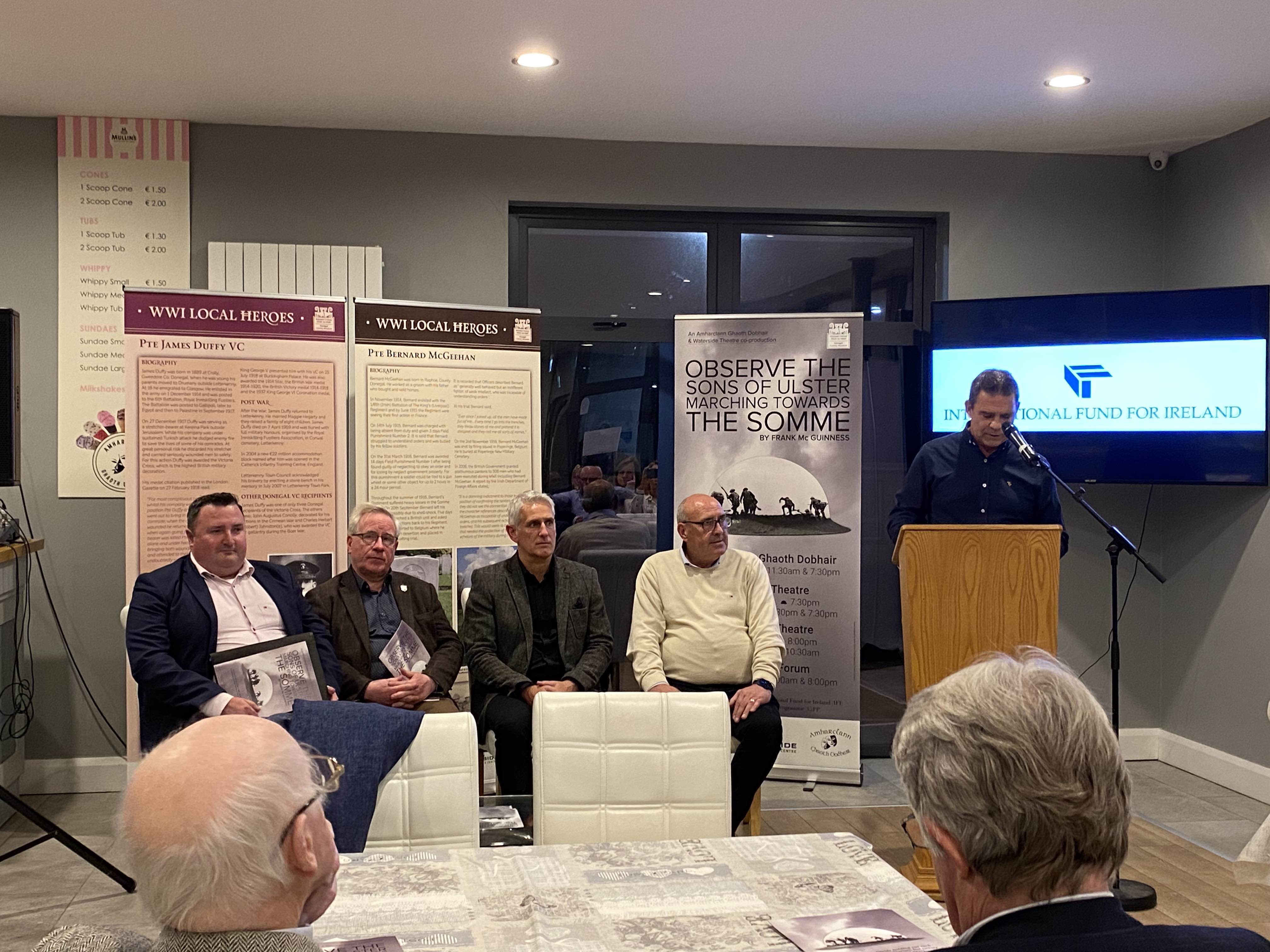
Panel of speakers at an interesting post-performance Q&A event at the Amharclann.

Enjoying the play, one is left with a vexing question: Is the play about the futility of war? The nature of loyalty, friendship and heroism? Or an examination of the protracted Protestant-Catholic northern Irish conflict from a completely different perspective? Or all of the above?

Whichever it is, this production is a two-hour, richly-rewarding theatrical experience that offers a balanced mix of black humour and poignancy with credible characters well developed through very fine acting.

Director David Grant together with production and stage manger, Fiona Harkin, assistant director, Ronan Hamill, lightning designer JP Conaghan and composer, Rebecca Doherty and the rest of the team have re-created the moving story of ordinary men – among them a blacksmith, a weaver and a baker – who set off patriotically to fight ‘the Hun’ but become disillusioned with the myth about war they’ve been sold.  

The play opens with a crippled man, Old Pyper, played by Shaun Byrne, who steps on stage alone, war medals pinned to his chest, and calls forth the ghosts of his former comrades who were all killed. Mystified as to how he survived the terrible battle, he is haunted by the images of those who died in the trenches, who then slowly, phantom-like, emerge from the shadows at the edges of the stage and stand motionless.

Theatre-goers mingle together for friendly discussions at the play’s intermission.

This sets the scene as to what follows, nostalgic flashbacks to the barracks where the men from places such as Derry, Armagh, Coleraine, Enniskillen and Belfast, gather for their first day of training and on to the sand-bagged first world war trenches where they face death together. Kudos go to Harkin and Conaghan who create a well-designed set, in which the barracks with wooden slats for beds is later transformed brilliantly into World War One trenches. Murals along the stage also add intriguing ambience, one of which depicts the ancient Celtic legendary hero, Cú Chulainn.

I particularly liked how a series of intense interlocking vignettes between couplets of men were enhanced by lighting and space, as well as by the thunderous roar of a Lambeg drum, a triumphalist symbol of the Protestant Orange Order in Northern Ireland. The military uniforms and equipment were also striking in their sheer authenticity. 

The tone of the play is bittersweet and philosophic, with elements of both black humor and solemnity. Patrick Quinn plays the younger version of Pyper wonderfully. An openly-gay man of aristocratic background who volunteered for army service, Quinn grants him a carefree, reckless air behind which lurks a man of deep sentiment and a troubled mind. A multi-faceted person – cynical, seemingly on the brink of madness, brash, supercilious, bold to the point of foolhardy, wickedly direct, yet at the same time, a vulnerable and lost individual. 

His anecdote about his three-legged French wife is highly amusing and a love scene involving him is touching in its quiet, side-stage minimalism. One character saying the ‘Huns’ speak Gaelic also creates a light-hearted moment. In contrast, depiction of one man’s despair and breakdown in the face of danger is touching, even more so as his friend tries to help.

While all the characters, except Pyper, are Northern Irish Protestant Unionists, one of the men admits something mid-way through the play which creates added intrigue and requires the attention of a military minister. 

Pyper is the exception to the anti-Fenian rants of the other men, being unwilling to indulge in such narrow-minded northern Irish tribalism and more keenly aware of the ‘sandbag’ nature of their being sent ‘over the top’ and into battle. He even demands of his fellow soldiers to answer the question as to why they are there.

Some Irish Republicans may be upset by the anecdotal joke told about rebel leader, Padraig Pearse, executed after the 1916 revolution, as someone who told his enemies he was only posting a letter when he took over Dublin’s main post office to launch the revolution, but this reflects the wit Frank McGuinness is renown for.   

Bulgarian visitors to Gaoth Dobhair – (l to r) Peter Petkov and Vanya Kovacheva – were among an enthusiastic audience at Amharclann theatre in Bunbeg, Donegal earlier this week

One of my favorite lines from the play, for reasons I’m not quite sure of, is ‘To hell with the truth as long as it rhymes.’

Ultimately, the play is about the fragility of life and the futility of war. In the end, one is left with the belief that the soldiers are united in one thing – fear of death – and that real heroes are ordinary people and unfortunately ordinary people remain ordinary because they don’t get recognised as much as they deserve. 

Local Donegal ladies enjoy a wee bit of craic and an evening’s entertainment at the Amharclann.

The play will be hosted today (Saturday) at the Lyric Theatre in Belfast, tomorrow at An Grianan Theatre in Letterkenny and next week at the Millennium Forum in Derry. 

In a post-event Q&A, Pol McCool, board chairperson of Amharclann theatre in Bunbeg, spoke about the need to build bridges between communities to help break down barriers and to appreciate shared history and values. 

Director David Grant (l) enjoys the company of friends during intermission at the Amharclann.

Stephen Barrett, manager for Donegal of the International Fund for Ireland, talked about the role of community leaders in peace-building projects and described the evolution of this co-produced project. He also spoke eloquently about his own reaction upon seeing the graves of those who died in the trenches in Belgium and France during the First World War. The IFI was established in 1986 with financing from many countries including the US, Australia and Canada and the play was supported by the organisation’s. 

Director David Grant talked about the challenges involved in creating the production and the overriding need for people to challenge mythology about wars.

Aine Ni Churrain, former presenter at RTE Raidió na Gaeltachta and a board member of Amharclann, thanked the audience for attending the two performances at the theatre, as well as everyone involved in developing and hosting the project and wished actors, director, producer and all the technical staff every success in the other theatres where it will be held.

Waterside Theatre CEO, Iain Barr, also thanked everyone for their concerted efforts in creating a memorable theatrical event with such an important social and moral message that contributes to greater peace and understanding among communities.

Video links to some of the speakers are on my Facebook – https://www.facebook.com/hillensean and https://www.facebook.com/worlditinerariespage

Kill the messenger?

There’s an old saying – ‘if you can’t deal with the message, deal with the messenger.

Usually it’s a strategy by people who are guilty of something, or who are inadequate or who have made a mistake and need to hide it somehow. 

Sadly, as a messenger, I was the brunt of such a ‘deal’ this weekend. 

My sin  – I dared speak out.

If I was wrong to do so, then I’ve only myself to blame.  Even though I do feel – if one cares enough about something – one should always speak out, even when your gut tells you you’ll be crucified for it. Otherwise, nothing in life changes.

In attempting to help Amharclann, my local theatre in Donegal and the work being done there, I suggested more than eight weeks ago that the theatre should organise a fund-raiser for the unfortunate families of people tragically killed in an explosion in the nearby town of Creeslough. That was October 9, two days after the tragedy occurred. 

As you can see, I also offered to help bring top national performers to the Amharclann from different parts of Ireland who would not normally have come to Donegal. Here is my message –

Two board members thanked me by return email for my idea, informing me a decision would be made by the board and someone would get back to me.

More than eight weeks later and still not a word from anyone on the board. 

This weekend in a Facebook post I said I was disappointed with the delay in responding and also suggested some simple marketing improvements based on my experience owning a multi-national publishing and events company that I thought might help attract more people to shows at the Amharclann. 

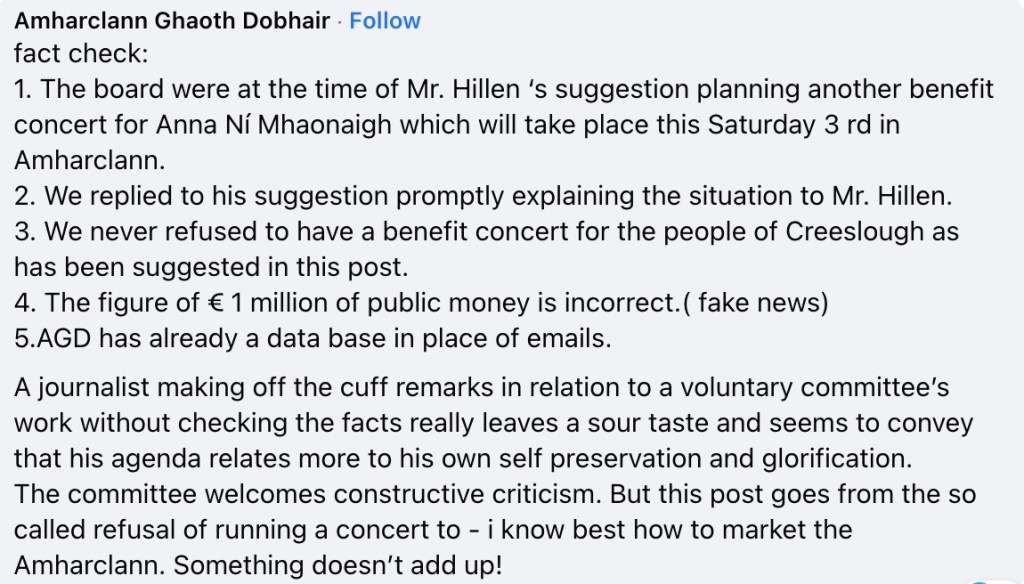
For this, I was accused by the powers that be at the theatre, the spokesperson and chairperson of the board I presume, of ‘self preservation and glorification,’ creating ‘Fake News’ and making ‘off the cuff’ remarks.’ See below.

I must admit, I was taken aback by the severity of the backlash, especially as I praised the hardworking of theatre staff in my Facebook post. As I have done for previous events, I also urged people to attend this evening’s special event (Saturday) in aid of a cancer victim. 

But those positive comments were conveniently overlooked by the person who wrote the response above on behalf of the theatre. 

I also received an aggressive text from the board chairperson saying my comments reminded him of ’hurlers on the ditch ….bellowing.’ Of course, he’s entitled to his opinion, but he’s conveniently forgetting that I have attended many events and written many articles supporting the theatre and have even helped organise a fund-raising event there. That’s hardly being in the ditch.

Here are just a couple of my articles – 

I simply couldn’t understand the furore that necessitated an urgent board brainstorming session within a few hours of my Facebook message being posted to compile such a negative response to me. 

In terms of timing, comparing a few hours to more than eight weeks, there seems to be what I’d call a ‘major time discrepancy ’ between the two. So why?

Last night, I happened to be reading my local newspaper and saw a full-page of photos and text in the Donegal News praising a successful event organised by Ionad Naomh Fionnan, a small community centre in the nearby town of Falcarragh, which raised more than 5,000 euro for the Creeslough Community Support Fund. 

That’s when the penny dropped. 

Did my Facebook post make a certain person at Amharclann, the largest theatre in northwestern Donegal, embarrassed at failing to organise themselves properly in more than two months to host a fund-raising event for the families of victims? And sadly, instead of taking what amounts to delayed action on the idea, not for my sake but for those in need in Creeslough, they decided to use their energies to deflect blame from themselves and attack the messenger – me – instead. 

It’s a tried and true trick, used since the days of Ancient Rome. And if it worked then, it could well work now, more than a millennium later. 

As for the moral of the story, I’m still not sure. 

It’s difficult for me to accept the obvious – ‘simply, keep your mouth shut.’ If we all did that, owners of homes destroyed by mica would not receive any compensation and be homeless over Christmas.

Some things are simply worth speaking out about.

Accepting praise is easy, it’s accepting constructive criticism that’s a true sign of character. I, like everyone else, want the Amharclann to succeed. It is my local theatre, after all, and I wouldn’t have written so many articles about it otherwise and praised those who worked so hard to attract the investment necessary to renovate it years after it closed.

But as my taxes and those of others helped pay for this renovation, shouldn’t we all have the right to voice our opinions and make sure the investment of so much public money is the very best it can be for all concerned?

I’m still waiting for the answers to my questions:

Intriguing to see how Amharclann can make a decision to respond within a few hours to my Facebook post. Yet still not make a decision on my suggestion for a fund-raiser for families of victims of the Creeslough tragedy made two months ago (October 9). While it’s disappointing to see Amharclann attacking me personally rather than dealing with the issue, let’s together try to make things clearer, point by point. These are my questions to the Amharclann representative who made the comment on behalf of the board.

  1. I still do not see how planning tonight’s event, which I fully support and which was due to take place in October, prevented the board making a decision about my suggestion for a fund-raiser for families of the Creeslough tragedy. Please explain.
  2. I have received no notification of a decision by you on the Creeslough fund-raising idea. 
  3. I never said the theatre refused to host a Creeslough fund-raiser. Not making a decision is a decision as there is no such event on the theatre’s future program.

4. Amharclann says costs for the theatre are not one million euro as my inside source informed me, which you label ‘Fake News.’ For transparency sake, please give a brief breakdown here of the real figure to justify your accusations.

5. Myself, my wife Columbia, friends and guests, have attended more than 25 events at Amharclann and I have written a series of articles promoting the theater. Never on any occasion has any of us been asked to leave our email/phone contact for marketing purposes. And we have never received any direct notification of events. Please explain how this database you mention was compiled and how is it used. Do only certain people receive notifications?

And lastly, for clarification purposes, please explain how a fund-raising concert for families of the Creeslough tragedy would benefit me personally, for my ‘self-preservation and glorification’ as you describe it. 

I simply don’t understand.

And for the record, I fully support the aims and mission of the Amharclann, as evidenced by my many articles and attendances at shows.

In the meantime, I wish Ann Mooney success with the medical treatment she is undergoing in Spain. This is the link if you, like me, would like to make a donation.

Help Ann Receive Vital Cancer Treatment

Half million euro missing in Donegal, 250 euro returned

Half a million euro would be considered a miraculous life-saver by Mary, the tireless community worker struggling on behalf of cancer patients from Donegal who can barely afford the hefty cost of travel to Galway for specialised treatments.

If the hardworking managers of local community centres in the Donegal Gaeltacht received half a million euro, they could hire additional full-time Irish, and English-language, staff for several years and expand exponentially their range of services and activities in support of local people. 

If Amharclann, the Irish-language theatre in Bunbeg, received half a million euro, it could run an exciting cultural programme of dance, music, cinematic and theatrical performances for the next five years.

Not to mention how hard-pressed individual artists and musicians bereft of gigs due to Covid could use that money. Or indeed the Donegal office of Irish-language organisation, Foras na Gaeilge, whose local members help keep our native language alive here. And as for those unfortunate people whose homes and businesses have been destroyed by mica ….

But none of these groups have the luxury of half a million euro. 

Such a notion would be considered pure and utter fantasy, especially in the hard financial times in which we now live. 

Yet that is about the sum of money former Donegal Fianna Fail Senator, Brian O’Donnell, from Falcarragh in the heart of the Donegal Gaeltacht, has just wasted. ‘Snatched brutally, selfishly and greedily’ some are saying, from the public purse. Others use the term ‘stolen,’ but in this article I wish to be diplomatic.

How did he do this?

Ironically, over the Irish language.

O’Donnell was caught taking money from the public purse by duplicating travel and subsistence expenses as both board member of Irish-language economic group, Údarás na Gaeltachta, and Donegal County Council. 

The accusations – and this beggars belief – investigated by the Standards in Public Office Commission (SIPO) – was that it would have been impossible for him to have been in two different parts of the country at exactly the same time, at two different conferences. 

And there I thought teleportation – where matter is de-materialised at one place and recreated instantly at another – happened only in science-fiction movies and fantasy comics.

If that wasn’t enough, the former Fianna Fail Senator then cowardly left the scene of an accident while driving his car in a drunken state.

But that’s only the beginning of the saga.

O’Donnell, with the aid of well-paid lawyers, fought the accusations against him, not on the basis of whether they were right or wrong, true or false, but on the simple basis that the cases should be heard as Gaeilge (in Irish) not English. The fact that both languages are official languages of the Republic of Ireland didn’t matter a damn to him, nor them. Nor the eventual cost to ordinary Irish citizens, including those unfortunate people suffering from cancer.

The rest of the story is spread across years of newsprint.

After deploying numerous tactics to delay the ‘claims investigation’ many times, he then decided to do the same to the ‘leaving the scene of an accident’ investigation, not once but a total of 20 times.

As a result, the total bill to the ordinary Irishman, woman and child has been estimated at around – yes, you’ve guessed it – half a million euro, the amount the board of trustees of Amharclann, Donegal’s proud Irish-language theatre, the hardworking staff of the county’s community centres and the many severely sick people – all dream of having to help them.

In the meantime, craftily devising his delaying tactics, which eventually spanned a massive eight years, did O’Donnell quietly planned his ‘get-out-of-jail card’ – his emigration to Canada? In fact, O’Donnell being found guilty could perhaps have led to a short prison sentence and would have prevented him emigrating to Canada. And certainly would have prevented him getting a Canadian driving license.

Was his delaying tactics also related to avoidance of his share of the legal costs? For example, I’ve been trying to find out if he ever paid a legal bill placed upon him by three judges who threw out of court his claim that the SIPO was not entitled to investigate his duplicitous behaviour because, he claimed, the allegations arose from ‘an anonymous complaint by a member of the public.’ 

I’d like to know not only if Mr. O’Donnell has paid his full legal bill but how much it was. If Mr O’Donnell is reading this, please get in touch. It’s only fair to hear his side of the story. And transparency is something we all should strive for.

Mysteriously the court hearing that finally put an end to one of the most ludicrous and wasteful cases in Irish legal history, almost went under the radar earlier this month, slipped quietly and quickly onto the docket of a mundane court sitting.

How did this happen? Donegal media said simply that, “according to court papers.. O’Donnell’s case was not due to be heard until the Wednesday after during a sitting  of Falcarragh District Court.” That’s when his (O’Donnell’s) solicitor, Sean Cannon, “brought the matter up with Judge Paul Kelly …during a family law sitting of Letterkenny District Court.” And the judge conveniently and quickly moved the case forward.

‘Brought the matter matter up?’ What the hell does that mean? And does such a serious case merit being in a sitting on family law? The mind boggles.

And this Judge Paul Kelly? Who is he? Was he appointed under a previous Fianna Fail government? Does it look like it from this article? But then again, that doesn’t matter, surely. After all, the Irish legal system is separate from the political one, isn’t it?

Though, as we well know, it is not unknown in Ireland for political favours and indeed, brown envelopes, or both, to pass hands.

The result of the long-delayed case: a ridiculously low fine, in my opinion, of 250 euro for charges of drunken driving leaving the scene of an accident and providing misinformation the police. I dare you to find any court case where such a laughable decision has been made in such a serious case. 

As for the short ban from driving, does it really matter? O’Donnell is sitting pretty in another country. Did an infamous Irish ‘brown envelope’ pass hands to facilitate this convenient legal accommodation in Letterkenny? No-one knows, and unfortunately no-one will probably ever know. Is this just an example of the old adage, ‘there’s a law for the ordinary working citizen but a very different one for the elite, well-connected in Irish society?’ 

So, while O’Donnell enjoys his new life in Quebec, Irish men, women and children in his very own constituency in the heart of the Donegal Gaeltacht continue to struggle to make ends meet, people continue to suffer pain and hardship, some desperately trying to raise enough money to help them avail of specialised life-saving cancer treatments. And young, talented teachers from the Donegal Gaeltacht, and other parts of the county, are forced to go abroad, to places like Quatar in the Middle East, because there’s no money to employ them here at home.

Is this called ‘fairness’ in Ireland today? 

Among all this misconduct (there are stronger words to describe O’Donnell’s behaviour), there are two other guilty parties that should not escape blame and require stronger scrutiny by the public at large and by themselves. 

At the very least, both Údarás na Gaeltachta and Donegal Council obviously urgently require a proper Code of Practice for Good Governance. And, more importantly, to enforce it. Want to know more about the failings of Údarás na Gaeltachta, an organisation that receives tens of millions of euro from the public purse every year? Read more here. Has it cleaned up its act since then? Time will tell.

There’s little anyone can do now about the regrettable situation surrounding the O’Donnell controversy, except two things.

Firstly, as a citizen you have the right to appeal to the relevant authorities about a court decision you consider overly-lenient and unfair and to have the case reviewed. One place to start is writing to the Complaints Department of the Law Society of Ireland at complaints@lsra.iethe

Then the Judicial Conduct Committee established by The Judicial Council recently. You can write a short email to: info@judicialcouncil.ie You can ask to remain anonymous in both instances. It’s time to stand up and speak out, don’t you think?

I have already sent a complaint about Judge Paul Kelly’s decision as I consider a 250 euro fine to be utterly ridiculous and a 3-year driving ban to be insignificant, considering that Mr. O’Donnell can simply come to Ireland in the intervening years and drive with no problems using a Canadian driving license I presume he will obtain quite easily, thus posing a danger yet again to ordinary people on our roads. On both sides of the Atlantic.  

Secondly, when election time comes round, and it will come quicker than you think, consider carefully which political party and candidates you vote for. Is it not better to avoid the Brian O’Donnells of this world and choose others with a much greater sense of decency and honesty? 

Festive tribute to the creative, artistic people of Donegal

Getting kissing techniques just right for on-stage credibility, takes practice.

Ask director-cum-teacher Máire Ioannidis.

She’s taught loads of people how to do it, her latest challenge being in the recent production of the musical ‘Hairspray’ by students at Pobalscoil Chloich Cheann Fhaola at Amharclann theatre in Bunbeg recently.

“Where do you put your hands, your arms,” she explained to me during a conversation after the Donegal Gaeltacht’s school’s triumphant, four-show run attended by more than a thousand people. “What side do turn your head to kiss, if you both turn the same way heads, noses may bump together, hardly an authentic and romantic sight to behold.”

That was only one of many challenges facing Máire and her team in the ambitious production. Capacity crowds and standing ovations are testament to the fact that they got them all right, including directing sixty-six teenagers.

Tickets for all productions were like gold-dust, with friendly Amharclann general manager, Manus O’Domhnaill, saying the shows provided a record attendance for the historic theatre, which was established in 1961 and reopened after major renovation more than a year ago.

Speaking about ‘Hairspray,’ Máire said proudly, “This particular musical holds a special place in my heart, a story about an amazing opportunity that turns a vision into reality. And I thoroughly enjoyed working with our talented students who showed commitment, energy and enthusiasm throughout. Unlocking their confidence, seeing them grow and perform on stage each night along with watching their joyous celebrations and a shared team attitude of ‘we did it!’ at the end of each show made this whole experience very worthwhile.”

‘Hairspray’ is an American musical with score by Marc Shaiman and lyrics by Scott Wittman based on John Waters’ 1988 film. Winner of eight Tony Awards, including best musical, it focuses on efforts by a dance-loving teenager to bring racial integration to a popular TV show in 1960s Baltimore.

Having gone to watch several productions of ‘Hairspray,’ in other theaters, Máire and her team then created several unique extras to their production. These included performers surprising audiences by entering from different doorways at Amharclann and a scene in which a chorus of singers walk through the aisles holding candles singing, then sitting on the floor among the audience.

Set changes were accomplished professionally with the aid of lighting, for example, from an ordinary living-room scene complete with ironing-board and TV to that of a prison cell, in which the lead performer, Róisín Doogan, playing Tracy Turnblad, has been incarcerated.

From the get-go, the opening song and dance routine ‘Good Morning Baltimore,’ this production leaped along in vibrant bounds with other complex choreography and songs including a powerful renditions of ‘Big, Blond and Beautiful,’ ‘Mama, I’m A Big Girl Now’ and ‘It Takes Two’ spiced with comedy and sentiment.

“PCC’s production of ‘Hairspray’ was full of energy from beginning to end,” said Eoghan Mac Giolla Bhrighde, a well-known actor who was in charge of lighting for this show. “Their singing was lively and it was excellently choreographed. It was well cast and they all portrayed their character effortlessly. Their drive and enthusiasm was palpable, students and teachers alike. “

Máire herself is no stranger to the arts, being a member of local acting group, Aisteori Ghaoth Dobhair, and an accomplished flute player. She also directed a school production of ‘Grease’ for two consecutive years. Of Gweedorean-Greek parentage, Máire has worked at Pobalscoil Chloich Cheann Fhaola for the last four years teaching a mix of Irish language, IT and business.

Aside from the versatile student actors and singers, full credit goes to crew, some of whom were also students, and senior production members including producer Donna Coll; choral director, Siún McDermott-Lyng; choreographer, Maureen Byrne; audio Noel Boylan; set construction, Joe Coll, Christopher Symth and Manus Gallagher; costumes, Mairead Harkin McGee and Siobhan Doogan. School principal, Maeve Sweeney and her deputy, Donna McFadden, said they were “over the moon about the show’s success.” Profits went towards various school expenses.

Coming up soon at Amharclann is its annual pantomime, this one entitled, ‘Leipreachán an Phota Mhóir.’ With Eoghan Mac Giolla Bhrighde involved, both on and off-stage, it’s bound to be a beauty. Don’t miss it! January 24-26 and January 30 to February 1.

The Amharclann and student actors and production crew at Pobalscoil Chloich Cheann Fhaola are only the tip of the iceberg of creativity throughout the Donegal Gaeltacht. Throw a stone and you’re likely to hit a painter, a musician, a sculptor, a yoga teacher, a hypnotherapist, a novelist, a poet, a psychotherapist on the head.

Consider the wondrous wealth of talent coming up beginning tomorrow at the Scoil Gheimhridh Ghaoth Dobhair, the Gweedore Winter School beginning tomorrow (Friday) –  http://scoilgheimhridh.com/

Also, please read previous blog on this site on an issue vitally important for everyone living in Donegal.

And check out ‘Ireland Writing Retreat’ https://www.irelandwritingretreat.com/ and my novel, ‘Pretty Ugly,’ linking Donegal and the United States https://www.amazon.co.uk/Pretty-Ugly-Sean-Hillen/dp/1523361158

Journalism: a funny thing, sometimes

Sometimes it’s not writing about political showmanship and skullduggery or economic booms and busts that create good journalism.

Sometimes, it’s the simple quirks of everyday life that make for a good story.

You can imagine my delight in unearthing these two tales of near disaster in Donegal that end happily.

They give new meaning to the term ‘missing people.’

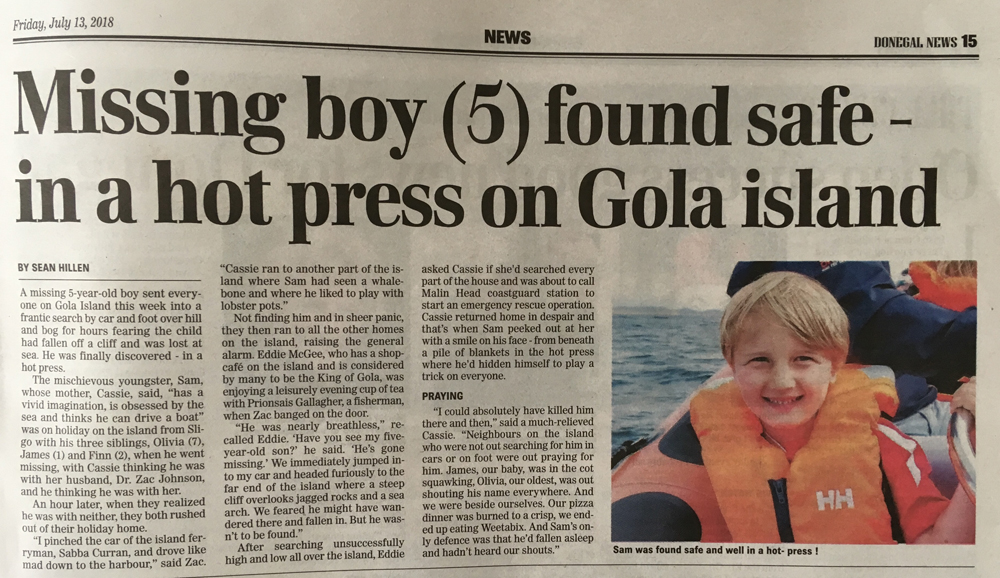
Missing boy (5) found safe – in a hot press on Gola Island

gola island donegal, donegal tourism, gaeltacht tourism,

He almost ‘missed the boat’ 

gaeltacht tourism, gola island, donegal tourism


Donegal Gaeltacht community spirit rides high

I was delighted to write this feature piece for the ‘Donegal News’ recently supporting the hard-work, communal spirit and creativity of people in Gaoth Dobhair, Falcarragh and the Rosses in hosting their respective festivals.

For such a small rural area, often there are more diverse cultural activities – dance, theatre, sporting events, concerts, to be name but a few – than in major urban areas.

Delightfully, making choices as to which to attend can be the biggest challenge.

Sean Hillen Donegal gaeltacht, donegal gaeltacht,

Traditional Irish group Arcanadh woos and wins hearts of audience

Traditional Irish group Arcanadh woos and wins hearts of audience

Another cultural entertainment success for Amharclann

What a terrific cultural contribution this historic theatre provides not just for Bunbeg, not just for the Gaeltacht, not just for Donegal but for all-Ireland, north and south.

World Itineraries's avatarworld itineraries

by Sean Hillen

Six musicians-singers-songwriters with such a wealth of talent it seems blatantly unfair to the rest of us mere mortals – that sums up Irish-group, Arcanadh, which played to an enthusiastic audience at historic Amharclann theater, Bunbeg, northwest Donegal, Ireland this week.

Here I must admit my bias.

In a rare moment of wisdom, I invited this terrific group to tour Romania when I launched the first-ever Saint Patrick’s Day celebrations in that former-Communist country. It was a decision I’ve never regretted.

The result more than 10 years ago was the same as that at Amharclann 72-hours ago – a boisterous appeal for more at the end and an appreciative standing ovation after their final encore.

Members of Arcanadh have known each other for more than twenty years and this is reflected in their smooth light-hearted banter off-song and their seamless harmonies on-song. Their passion for their…

View original post 805 more words

Who’s the mystery whistle-blower inside the corridors of Údarás na Gaeltachta?

Seems as if Donegal’s leading newspaper and Údarás na Gaeltachta are on a head-on collision over truth following publication by the ‘Donegal News’ recently of sensitive, confidential correspondence indicating the Irish language group has been planning wind-farms on many sites throughout the county and an immediate rebuttal of the article in a press release issued by the Irish language group.

Údarás na Gaeltachta has wind turbine plans for six sites

An tÚdarás dismisses wind turbine talks

If not for strong protest meetings by Stad An Tuirbín Gaoithe, a community-based Donegal group opposing Galway company, Lir Energy Ltd’s plans to construct 123- meter turbines on publicly-owned land in Gweedore and a flood of more than 100 objection letters to the county council, a forest of turbines could have gone up ‘under the radar’ – some in scenic sites and some close to homes.

According to the confidential correspondence obtained by the newspaper, these could include Ardara, Kilcar, Fintown, Cloghan, Termon and Glencolmcille.

A string of shady dealings have left many people disturbed by the clandestine way in which Údarás now seems to operate, both locally in Donegal and out of its Galway headquarters.

Following the secrecy of the sale by Údarás of Irish seaweed rights to Canadian multinational Acadian Seaplants, with an unprecedented ten-year confidentiality clause attached to the contract, by which no documents can be accessed, some observers say the Irish language economic group has lost public confidence.

An Oireachtas Public Accounts Committee (PAC) investigation queried why 30,000 euro was spent by Údarás on seven different trips by senior officials to look at “seaweed projects” in Halifax, Canada, according to a report in The Irish Times.

These suspicious situations plus behind-the-scenes talks with a Catholic Church group to construct what some say was to be an alcohol, sex-addiction and drugs rehabilitation clinic in Falcarragh in a landscaped green area now used for community walks and jogging, has left some wondering if the publicly-funded group has reneged on its responsibilities in terms of transparency and fairness.

Landscaped area in Falcarragh that was being earmarked for an addiction center to be funded by Udaras.

“This organization is funded out of the public pocket so at the very least it should be open about how exactly it’s spending that money,” said one irate Gaoth Dobhair resident at the recent ‘Scoil Gheimridh’ (Winter School) music festival. “People are also questioning the ownership of this Galway company, Lir, and what its connections might be to top executives of Údarás. It could be a re-run of the seaweed scandal.”

It has also become known that the Údarás office in Donegal is to be paid a whopping 600,000 euro for managing a 2.3 million euro EU LEADER scheme in the county, almost a quarter of the total funding, aside from several million euro it receives annually out of the national public coffers.

“Is the wind-farms’ project simply another way for Údarás executives to make money?” said a resident of Bunbeg earlier this week. “There’s no proof at all they’ll help reduce energy costs as we’ve had wide turbines for years in the area and there’s been no obvious public benefit at all. It’s long past time people were told just how much money is being used by Údarás for projects that create jobs and how much is simply being used to top up executive salaries and expenses. For God’s sake, Údarás staff have the highest salaries of any group under the Department of Arts, Heritage, Regional, Rural and Gaeltacht Affairs.”

While many criticize Údarás for its poor record in job creation in Donegal, it must be acknowledged that it is not easy to attract companies to Ireland’s most northwesterly region, but few would disagree that greater transparency is necessary to calm rising fears that scarce public money is being misspent.


If you’re interested in political and corporate corruption in a suspense novel linking Donegal to the US, read newly-published ‘Pretty Ugly,’ to be launched also in Dublin this month.  Can be purchased direct from Amazon, in eBook or print form and locally, in Donegal from Gallaghers or Matt Bonners Bunbeg, or Easons Letterkenny.


‘Whatever you say, say nothing!’ – motto of Údarás na Gaeltachta

‘People have no right to ask how we spend their money.’

That’s the attitude of Údarás na Gaeltachta, which has once again refused to release key information about how it spends public funds.

Udaras

A Senate committee revealed that Údarás pays millions of euro every year in pensions to former executives, some of whom were local Donegal employees including Cathal MacSuibhne, former regional manager based in Gaoth Dobhair.

cathal

Sinn Fein’s Trevor Ó Clochartaigh, a member of that Senate committee, exclaimed, “I nearly fell off the chair when I heard that almost half the current expenditure goes on pension payments to 136 people who are no longer employed by the organisation. Small wonder Údarás is not able to function more effectively.

He added, “This raises serious concerns regarding the levels of monies being paid and who is receiving them.”

Under transparency rules, other public bodies have made a breakdown of such pension figures available for examination, but in response to a Freedom of Information (FOI) request I made, Údarás refused to do so, citing gobbledegook about data protection.

As a result, having brought the matter to the attention of a number of TDs, the Údarás pension issue has risen to the highest levels of national government, to the office of Brendan Howlin, Minister for Public Expenditure.

I can reveal in this blog that on my behalf various leading politicians including Public Accounts Committee (PAC) member, Mary Lou McDonald, have attempted to find out the individual pension figures but Údarás has stonewalled every request, preventing their release.

MaryLou

How it happened

Údarás responded to my initial FOI request last year seeking details on pension and lump sum payments to former executives in a letter signed by Padraic O’Conghaile – a ‘cinnteoir’ at the organisation’s headquarters in Galway.

In the letter, he wrote, “I am refusing these records as they relate to the pension of an individual under Section 28.1 (Personal Information). The FOI Act defines personal information as information about an identifiable individual that: ‘would, in the ordinary course of events, be known only to individuals or members of the family or friends, of the individual.’ I believe that the right to privacy of these persons with regard to such information far outweighs any public interest there may be in this matter.

The fact, that all the pensions and payments are publicly-funded and thus not “known only to individuals or members of the family or friends, of the individual” as he asserts – did not seem to enter Mr. O’Conghaile’s thinking. Or, perhaps, did, but he refused to acknowledge it.

Following this response, I requested several TD’s to present formal written parliamentary questions in the Dail on the same issue.

For example, Mary Lou McDonald, a member of the Public Accounts Committee (PAC), submitted her parliamentary question to the Minister for Arts, Heritage and the Gaeltacht asking the Minister to “reference the specific provisions of the Data Protection Acts 1988 and 2003 to which he referred (supporting Údarás’ denial of information); the basis on which he believes Údarás na Gaeltachta does not, unlike in the case of all other senior managers across the civil and public sector, have to make public the details of public service pension arrangements on retirement for senior management.

Dinny McGinley, then junior minister, wrote back in a vague response saying simply that Údarás had informed him it was “a data controller, defined under the Acts as a person who either alone or with others controls the contents and use of personal data.

dinny

Put in simple words, it means Údarás, while deriving all its funding from public money, considers ‘People have no right to ask how we spend their money.’ McGinley’s response also has no logical meaning whatsoever under present Irish law. Instead it is a classic delaying tactic. The former Minister did not bother to question it or seek elaboration.

That response led McDonald to submit a follow-up question, this time to Minister Howlin, reading, “given the Minister’s stated commitment to transparency and accountability in the spending of public monies, whether in his view it is acceptable for a public body fully funded by the exchequer to withhold from the public record details of public service pension arrangements on retirement for senior managers; and if he is prepared to legislate to require all publicly funded bodies to make such information public in the interests of open government.

HOWLINBRENDAN

It is most disappointing that a simple request to a fully publicly funded body about its spending has led to such a reactionary response from an organisation such as Údarás, which is responsible for the economic, social and cultural development of the Gaeltacht.

Such utter lack of transparency and disregard for public concerns has already led to such widespread corruptive practices as those at FAS when it was discovered hundreds of thousands of euro went on lavish holidays including first-class travel and expensive rounds of golf for executives and their wives. Údarás itself has yet to account for trips paid out of public funds for board members, executives and wives to visit attractive international destinations, including Las Vegas.

Public money is a precious thing and every penny of it ought to be properly accounted for and judiciously spent.

I will reprint Minister Howlin’s response on this blog when it is received. It should provide a most interesting read.

Bunbeg, once pretty, now disfigured

Once pretty, Bunbeg is looking more and more like a toothless old hag.

Derelict spaces, decrepit ‘For Sale’ signs and boarded up, empty and run-down buildings have pockmarked its once thriving main street.

OLYMPUS DIGITAL CAMERA

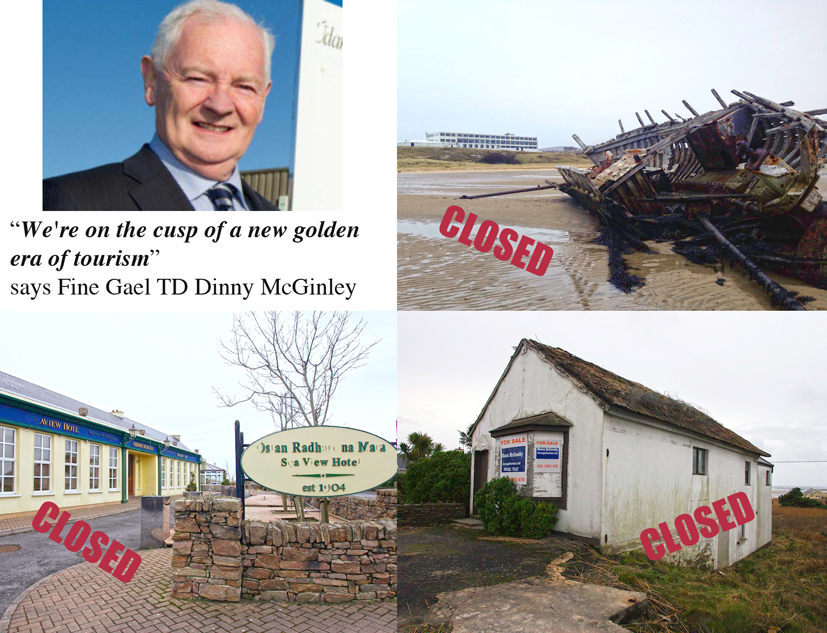
The iconic, century-old Seaview Hotel, which employed over 108 people seven years ago (talk of Cayman Islands and meat debts has no place in this blog), stands empty and forlorn this week , joining a heap of other ‘deadwoods’ on the street  – a once popular restaurant opposite and three other nearby hotels, The Errigal View, the Ostan Gaoth Dobhair and The Brookvale, as well as a mix of shops, bars and cafes, all now closed and crumbling.

Ironically, one of the few buildings to be renovated and opened on the main street is the constituency office of Fine Gael TD and former Gaeltacht, Arts and Tourism Junior Minister Dinny McGinley, the man who proudly pronounced this week, “We’re on the cusp of a new golden era of tourism.”

colaj good

Talk about poor timing.

Not to mention poor positioning. McGinley’s office lies a mere 50 yards from the deserted Seaview Hotel, first established in 1904.

News this week of the Seaview’s demise is a stark reminder of the abnegation by Udaras, the area’s main economic regeneration group, of its prime responsibility for creating  jobs, including those in the hospitality sector, with Gearoid O’Smaolain its main tourism development officer.

Eamon McBride, former President of the Gaoth Dobhair Chamber of Commerce, put it simply: “the area is crying out for more attractions.”

Job losses, lack of transparency

Aside from the 35 jobs, both full and part-time, lost at the Seaview this week, hundreds have been lost at other Udaras-sponsored businesses such as Largo Foods, Nuance and Sioen Apparel over the last few years. In fact, the Udaras Donegal office has performed consistently worse than any other Gaeltacht region in Ireland in terms of its job-creation record.

Sinn Fein TD Pearse Doherty this week called on the Government to immediately publish the findings of a delayed report by a working group tasked with examining job creation in the Gaoth Dobhair area. One hopes he will demand the same of the local Udaras office. Only then, can the organisation be properly analyzed to ascertain if the public is getting ‘bang for its buck,’ or if drastic changes need to be made internally if it is found that employees lack the skills-set necessary for the important task at hand.

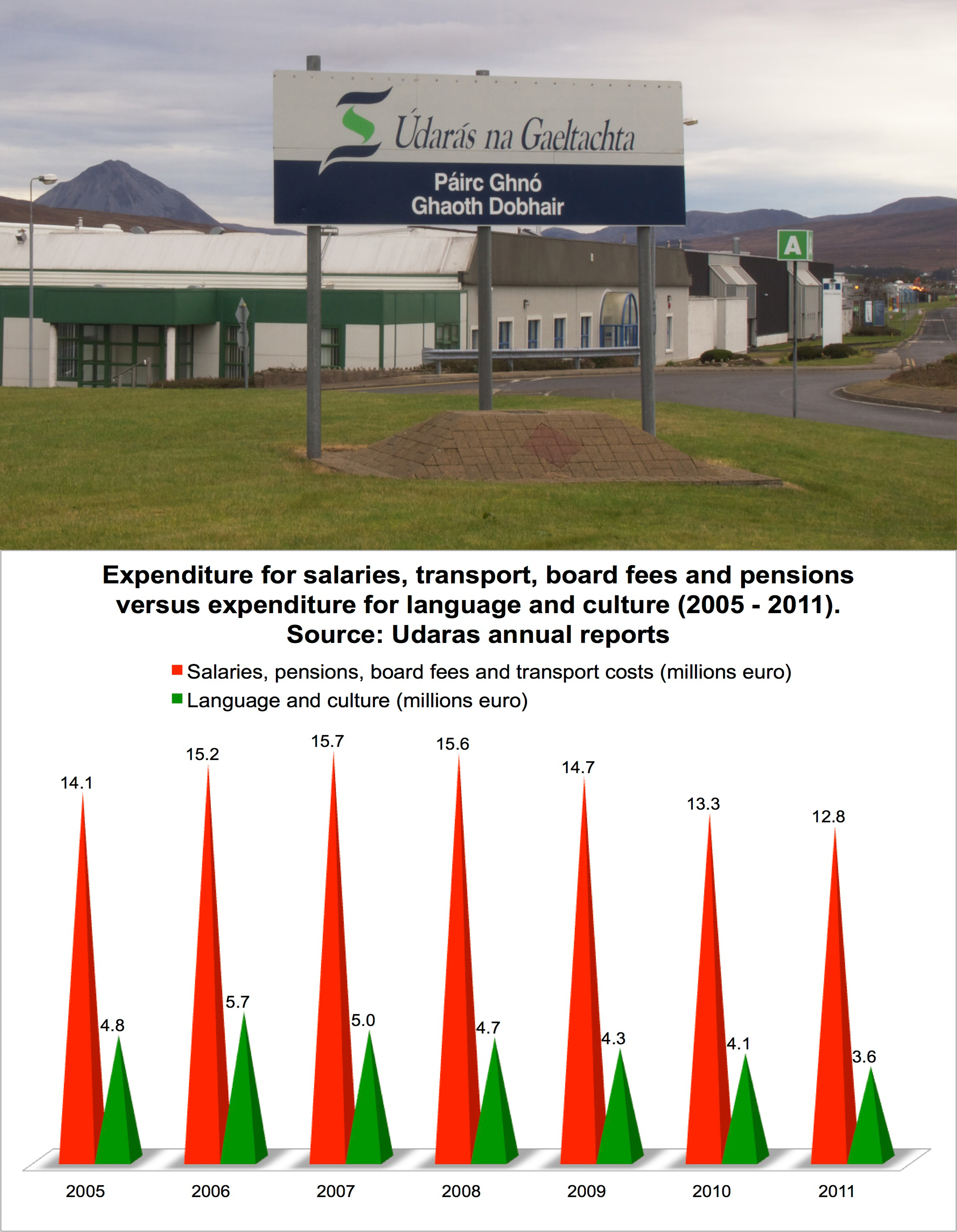
photo and chart good

Gaeltacht disintegration

The intriguing part of the sad saga surrounding what is, in effect, economic mismanagement of the Irish-speaking area, is that while towns within it, such as Gortahork, Falcarragh and Bunbeg, are literally peeling apart, both economically and physically, Dunfanaghy, just outside the borders of the Gaeltacht, is riding a wave, with bars and cafes enjoying a boost in trade, especially at weekends – without the benefit of public funding of any kind.

While Udaras Donegal announced this week it will release proposals for economic development, observers say this is more a cosmetic exercise aimed at organisational survival than a serious attempt at strategic innovation and staff revision – that it has not even hosted a single open public meeting to ascertain the views of ordinary people, the very people who pay for its running costs. Interestingly though, while widespread job losses have occurred in Udaras-sponsored companies in Donegal, no such losses have occurred within the local Udaras office itself.

Based on its operational history (see above graph), should we accept as normal that out of its seven million euro budget for this year as announced by Udaras officials, two-thirds go towards salaries, pensions and expenses, and the remaining one-third only to economic and language development?

Is it not long past time this organisation came under closer public scrutiny and thus be made more accountable?