Author, playwright and civil rights activist, Danny Morrison, to attend ‘Ireland Writing Retreat’

Interesting experiences fire the imagination, so it’s little wonder Danny Morrison has become master of both the written and the spoken word as author of numerous books, including fiction and non-fiction, short stories and plays, as well as being a newspaper editor, insightful radio and television commentator, community arts festival chairperson and elected public official.

Ireland Writing Retreat‘ is proud to welcome Danny as one of the guest trainers at this year’s event which begins at Teac Jack in Gaoth Dobhair at the end of June. Participants from places as diverse as Minnesota, Cork, New Hampshire, Dublin and Missouri are to attend this year’s international gathering.

I have met Danny on many occasions over the years, often at political, media and writing events (the most recent being at the Sinn Fein Ard Fheis in Dublin) and was honored when he invited me to speak at the West Belfast Festival that he chaired a few years ago. Interestingly, before knowing Danny, I knew his lovely younger sister, Susan, as she and her friends and myself and mine would strut our stuff, teenage-style at the weekly Clonard dances on the Falls Road to the sounds of Sweet, T. Rex, Mott the Hoople, Queen and David Bowie. Susan, now sadly departed, married a close friend of mine, John Patterson, who came with their daughter to my 50th birthday party at the Gaoth Dobhair golf club where we wandered down nostalgia road together. Danny and I have much in common, both being from Andersonstown and having attended some of the same schools, including St. Theresa’s Primary and St. Mary’s Grammar in Belfast. I admire greatly what he has suffered in his lifetime, what he has achieved and what he has become. It’s  wonderful he has agreed to come to the Donegal Gaeltacht to be a trainer at this year’s writing retreat but also to take part in a special Q&A public event at Teac Jack about his life.

Danny Morrison author

Unique life experiences make for interesting stories as illustrated by published author and creative writing trainer, Danny Morrison.

Born in Andersonstown, west Belfast, the friendly, down-to-earth Irishman has led such an intriguing and eventful life, including internment without trial and imprisonment for eight years while barely in his 20s, that it has imbued him with multi-faceted views on both the world of politics and the world of literature.
Morrison grew up in a solid, working-class family, reaching teenage years just as the so-called ‘Troubles’ in northern Ireland erupted, with civil rights protests becoming widespread, then civil strife and finally a peace agreement based upon a fairer and more just society for everyone.

As a young man, influenced by what was happening around him and the anti-Vietnam protests in the US, Morrison developed a yearning to write and a need to confront injustice. When his sister loaned him the money in 1971 to buy a typewriter, his fate was sealed.

'Rudi - In the Shadow of Knulp, Danny Morrison

Later, both before and after becoming editor of An Phoblacht/Republican News, he wrote many articles, political pamphlets and even scripts for documentary films on Irish history until, in the 1980s, he became national director of publicity for the Sinn Féin political party.

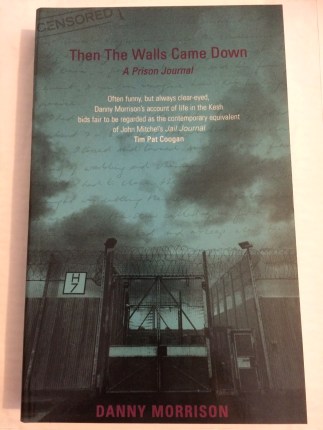
His love of creative writing flourished even in jail and led to Morrison’s first novel, ‘West Belfast,’ being published in 1989 but never formally launched. In 2015 a revised edition was re-issued to celebrate the 25th anniversary of the first publication. ‘On the Back of the Swallow,’ his second novel, was written in prison and published nine months before his release, in May 1995. ‘The Wrong Man,’ his third novel, also begun in prison, was completed after his release and published in 1997. Morrison’s three works of non-fiction are: ‘Then The Walls Came Down,’ based on his prison letters, published in 1999; ‘All The Dead Voices,’ a part-memoir, published in 2002; and ‘Rebel Columns,’ a collection of his political writings, published in 2004. He edited a book of essays, ‘Hunger Strike,’ which was published in 2006 by Brandon. His fourth novel, ‘Rudi – In the Shadow of Knulp,’ inspired by ‘Knulp,’ the 1915 novel by Hermann Hesse, was published in 2013.

Then the Walls Came Down book, Danny Morrison author


His writing also spans the short story format leading to published work in various magazines and broadcasts on BBC, RTE and Lyric FM radio. Interestingly, ‘We’ve Got Tonite’, a love story he penned, was banned by the BBC in 1992 despite having already been recorded. He also adapted ‘The Wrong Man’ for the stage. The play was hosted in London, Edinburgh, Belfast and Dublin and was nominated by ‘Fest’ magazine as one of the top three dramas of the 2005 Edinburgh Fringe Festival.

Morrison has also written articles for such prestigious newspapers as ‘The Irish Times,’ ‘The Observer,’ ‘The Guardian,’ “The Washington Post’ and ‘The Boston Globe’ and is currently working on a fifth novel, ‘Band on the Run’ and a play, ‘The Mental.’

For a number of years, Morrison has been in strong demand as a trainer of creativity writing and recently completed a writer-in-residence program in Berlin.

Sinn Fein Ard Fheis features multi-faceted personalities

It’s interesting, the people – some expected, some unexpected – one meets at a political Ard Fheis – in this case, Sinn Féin’s in Dublin’s ultra-modern glass and steel, Liffey-fronting Convention Centre recently.

The former included loyal, hardworking party stalwarts – both at local and national level. People like Donegal Councillor and youth worker, John Sheamais Ó’Fearraigh, from the Gaeltacht hamlet of Bun na Leaca, Gaoth Dobhair, who voiced his concerned “about the closure of rural post offices and banks and lack of broadband coverage and tourism development, as well how European legislation on planning and wild life is preventing rural development – all leading to the export of our youth and loss of our Teanga Dúchas.”

John Sheamais Ó'Fearraigh, Sinn Fein Donegal

(l to r) Donegal Councillor, John Sheamais Ó’Fearraigh, discusses issues with Pearse Doherty TD, outside Dublin Convention Centre at the Sinn Fein Ard Fheis.

And Inishowen Councillor Albert Doherty from Carndonagh who spoke passionately to the 2,500 party members about “unfortunate Donegal residents who are having to watch their homes disintegrate before their very eyes” because of Muscovite mica, a mineral that weakens concrete. He called for the government’s much-delayed experts report to be concluded by August 31.

Then there’s Pearse Doherty, TD. Though only six years since his victorious High Court case against Fianna Fail for delaying the Donegal South-West by-election, Doherty has risen in the party ranks astronomically since, culminating in national kudos recently when he found a gaping two billion euro hole in Fine Gael’s ‘fiscal space,’ (the amount of money available to the government above what is already being spent on public services). His value to Sinn Fein was more than obvious last weekend when I entered the so-called ‘green room’ to find him engaged in whispered conversation with party president Gerry Adams and vice-president Mary Lou McDonald. Even though a photograph was required of him for this article, a subliminal ‘not-to-be-disturbed’ sign hung clearly in the air.

Easter Rising Celebrations Dublin,

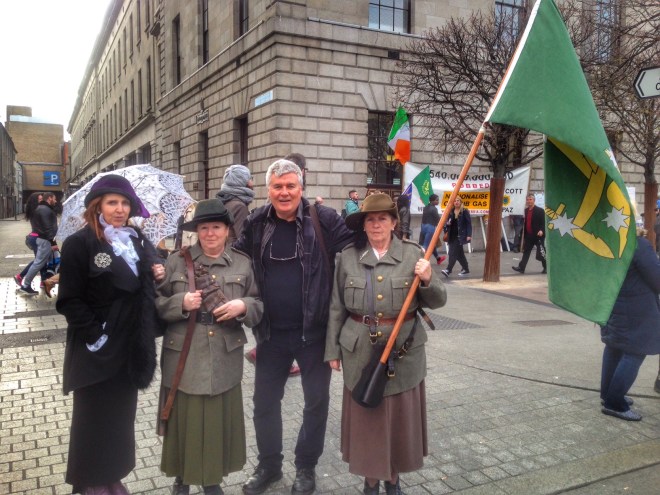
Celebrating women’s role in the 1916 Rising. Over 300 women participated, some of whom were sentenced to death, later commuted.

All three Donegal politicians supported calls made by delegates under the party banner “Saoirse Ceart Aontacht’ for the rejuvenation of rural Ireland, on behalf of people the official Ard Fheis programme declared, “are tired of being treated as second-class citizens, fed up with under-investment and angry at the lack of jobs and opportunities.” Among the motions to strengthen rural areas under the document, ‘A New Deal for the West,’ were “the introduction of rural equality legislation; a spatial enterprise and infrastructure strategy backed up with financial stimulus; a commitment to significant investment to protect and enhance public services; support for traditional industries, particularly co-operatives; and measures to assist emigrants wishing to return.”

Sinn Fein Ard Fheis Dublin

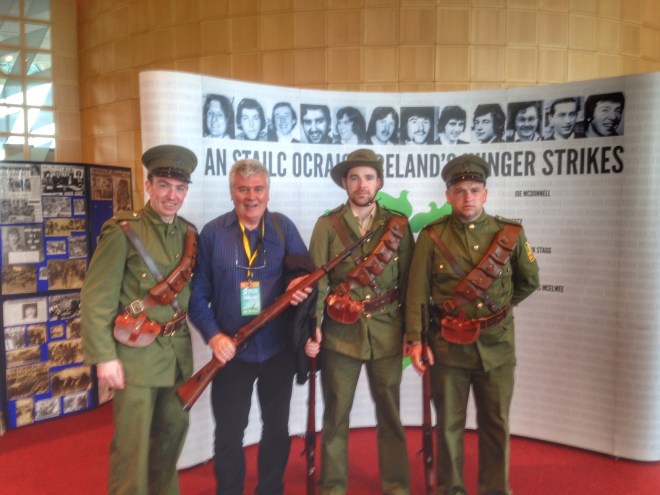
Honoring those who died during the Hunger Strikes and the Easter Rising.

Such were the expected.

Among the unexpected was meeting author and former ‘Sunday Times’ managing editor and ‘Daily Mirror’ editor, Roy Greenslade, now journalism professor at City University London, my alma mater, who now pens an insightful media blog for ‘The Guardian.’ From sturdy working-class roots in east London and a fellow West Ham fan, Greenslade has been a long-time supporter of Sinn Fein. We met way back in the mid-80’s ago when he and his wife, Noreen, a former national feature writer, visited me in Kansas City and later at Mirror HQ before I headed off to the Romanian revolution, former Yugoslavia and the Iraq war. Greenslade bought Ballyarr House in Ramelton and two years ago stood surety for Creeslough-based former IRA member John Downey after his arrest at Gatwick Airport.

Roy Greenslade journalist

Roy Greenslade, author, editor and journalism professor: unafraid to speak out on sensitive social issues.

Last, but not least, was Danny Morrison, Sinn Fein’s former national publicity director, now successful fiction and non-fiction author and international creative writing trainer. Dressed stylishly in black hat and long leather coat, the affable man reminded me of Toulouse-Lautrec’s portrait of Aristide Bruant, famous on so many posters. Both Greenslade and Morrison have been invited as special guest speakers at this year’s ‘Ireland Writing Retreat’ held at Teac Jack’s in Glassagh from June 27 to July 3.

Danny Morrison author

Belfast-based Danny Morrison: a life well lived. Former editor of An Phoblacht-Republic News, Sinn Fein publicity director, author and creative writing guide.

For those interested in writing a novel, poetry or a memoir, or simply want to hear some fascinating speakers, this is the place to head for. It should be a most stimulating week. You can stay for the whole week, or sign up for several of the days. Your choice.

Irish band, Goats Don’t Shave, raise the rafters at album launch concert

Musical lovers know such Irish groups as U2, The Cranberries and The Pogues – now make way for Donegal-based ‘Goats Don’t Shave.’

Whether it’s about the perils of drinking, the Irish Revolution, the loss of island life or indeed love itself – multi-talented singer-songwriter Pat Gallagher and his dynamic band move you to laughter or to tears. Never neither, as more than evident in a hair-raising, hand-clapping, foot-tapping, time-stopping, standing-ovation performance at The Balor Theatre recently in Ballybofey, Donegal, northwestern Ireland.

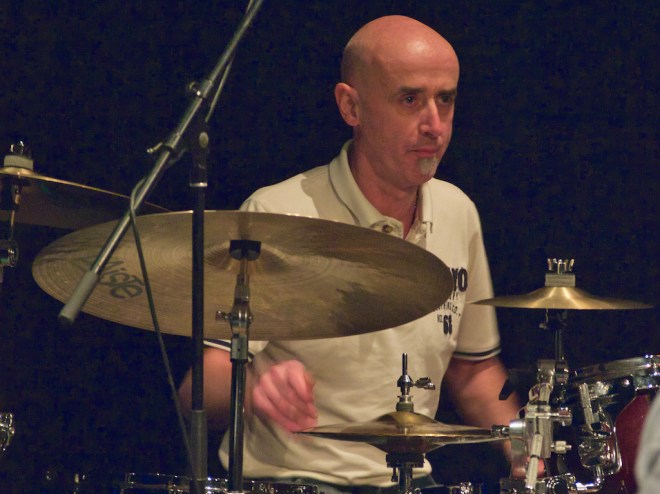
Master of many instruments including guitar, mandolin, banjo, harmonica and drum, not to mention the fine art of lyric writing, Gallagher and his musical colleagues more than please an audience – with humorous anecdotes, brilliant musicianship and strong voices whether in soft, poignant, tear-jerking ballads or fast, let-it-all-hang-out rhythms.

More than that, Gallagher’s songs tell vivid stories, rough-cut slices of life, some with serrated edges. And diverse they are too, whether about a washed-up Scottish boxer and his winning the world championship, digging turf for the fire (down and dirty blues-style), the tale of an Irish gigolo known as ‘Crooked Jack,’ or simply about Irish navvies taking the bus from Donegal to Glasgow in search of work.

Pat Gallagher musician, Goats don't Shave

Living in rural west Donegal – considered by many to be the most naturally beautiful part of all Ireland – Gallagher and his band have just released their fourth album, entitled ‘Turf Man Blues,’ an impressive output of musical creativity by any standard. Equally impressive, the friendly performers work spans many genres, from country and rock to folk, blues, even gospel. So versatile is Gallagher, musical aficionados say they await his debut as a classical composer and conductor for the Irish National Orchestra.

Shaun Doherty Goats don't Shave

While light-hearted banter is an integral element of Gallagher’s performances, so too sometimes is biting satire, as in ‘God Takes Visa’ about how some religions have gotten so greedy about taking peoples’ money for the saving of souls, as exemplified in the line, ‘the dollar is a Kingdom but the poor must stay outside.’

Mickey Gallagher Goats don't Shave

Gallagher’s verses and musical notes also have an enduring effect on listeners as in his, at times poignant, at times angry rendition, of ‘The Evictions,’ about the merciless evictions of Irish peasants from their small farms in Derryveagh in Donegal by a powerful English landlord, John George Adair, and his ‘crowbar brigades’ in the mid-1800s, thus forcing them to sail away from family, friends and their native homeland to Australia and other far-off places.

Odhran Cummings Goats don't Shave

Just as Gallagher’s new song, ‘The Volunteer,’ is a tribute to those men, women and children who gave up their lives during the 1916 Easter Irish Revolution, with the centennial being commemorated this year, so ‘Let The World Keep On Turning’ is devoted to diversity, whether that be religion, skin color or language.

Patsy Gallagher Goats don't Shave

A tribute to the loyalty Pat Gallagher and ‘Goats Don’t Shave’ have created down through the years, especially since their chart-topping hit ‘Las Vegas in the Hills of Donegal’ in 1992, is that on Saturday night a woman made a request for her two friends who got engaged at a Goats concert almost 20 years ago.

Stephen Campbell Goats don't Shave

Devoted fans Malachy McLaughlin from Dungloe and Michael Gallagher (Ireland’s famous weather forecaster) and daughter Marian, a Special Olympics Summer Games silver medal winner, left the concert-hall in ecstasy, with the former saying, “Brilliant. Fantastic music from my favorite band. I loved it.”

Michael Gallagher weather man, The Turf Man Blues

Even when Gallagher, singer-songwriter-musician par excellence, asked the audience to stay behind for a moment after the last song to pose for a group photo, he brought a smile to everyone’s face, saying he wanted it for the band’s ‘Instabook’ page.

So, a big hurrah for band members Pat Gallagher (vocal, guitar and banjo), Mickey Gallagher (drums), Patsy Gallagher (lead guitar, mandolin and vocal), Odhran Cummings (bass), Shaun Doherty (guitar and vocal) and Stephen Campbell (fiddle), as well as guest musicians, Connor Malone (saxophone) and Dermot Donohue (harmonica), for a terrific evening of entertainment launching the band’s newest CD. Interestingly, for part of Saturday’s concert, Pat Gallagher and fellow musician, Patsy Gallagher, played instruments made by Donegal-based company, Emerald Guitars – Pat on an X20 Artisan Woody, featuring a Bubinga veneer, and Patsy on an X7 Artisan.

Goats don't shave, Turf Man Blues

Following the Balor Theatre gig, ‘Goats Don’t Shave’ will perform three dates in Scotland next month: The Ceilidh House, Oban (May 27); Ramsay Hall, Port Ellen, Islay (May 28) and The Shed, Glasgow (May 29).

1916 celebrations: a mixed basket of Easter eggs

Easter Monday 1916 Revolutionary celebrations in Dublin had its up and downs, its successes and its disasters.

And I was fortunate to have experienced many of them.

First prize goes to Mother Nature. Realising the heroic efforts of the men, women and children of the Rising had been pretty well ignored by the average JoeMacBlow in Ireland back then – it decided to put on a special show for the centennial.

And what a show it turned out to be, perhaps the brightest, prettiest, sunniest day this year. One that brought out thousands of Irish people to walk the sacred walkways tread by Connolly, Pearse, Plunkett and co., with many of the people wearing turn-of-the-20th century clothing, including tweed waistcoats, flat-caps, bonnets and brogues.

Being from West Belfast, I was also delighted to learn that security for Easter Monday’s 1916 commemorations in Dublin was organised by MICAB, the company owned by Andersonstown-based, former Republican prisoner, John Trainer. I guess all that experience in ‘security operations’ we got over the last few decades up North helps.

1916 commemorations Dublin

Meeting friendly security guards from Ardoyne at the Dublin 1916 Easter Monday celebrations was an utter delight.

Last prize on the sacred day goes to highly-paid, long-time RTE Loyalist, Miriam O’Callaghan. Behaving like a Russian doll with seemingly nothing inside but herself, she got smaller and smaller as an event she hosted entitled “Reflections on Exile – How we are viewed by our American cousins” at The Gaiety Theatre near Stephens Green wore on.

Miriam O'Callaghan, RTE presenter, 1916 Rising events, John Lee historian

Oops! Overpaid RTE presenter, Miriam O’Callaghan, made a few screw-ups on Easter Monday- none more woeful than to eminent historian John Lee at a packed event at The Gaiety Theatre during Dublin’s 1916 Rising tribute events.

Dear Miriam, salary in excess of 300,000 euro, plus expenses, made so many gaffes, she became comical entertainment embodied.

First of all, she had the talented musician-cum-singer Mick Moloney perform his lovely rendition of the ballad, ‘James Connolly,’ twice as RTE’s ineptness meant it had failed to record him properly.

Then, speaking to eminent New York University Irish history professor John Lee, she said, “Is that the proclamation of independence you have there on your knee? Do you know how important that is?” The solemn professor looked aghast.

Later, in a pathetic transplanted D4 attempt to redeem herself, the misguided O’Callaghan asked the same unfortunate, “Let’s talk some more about 1916? How important was it?” adding for assertive emphasis, “Spell it out for me.”

Mairead Mooney of Donegal-based Altan fame deserves strong credit for her words and her singing, though dressed as she was in an All-Black outfit, one might have thought she was a cheerleader for the New Zealand rugby team. But with that sulky-blonde-hair-all-down-my-back look lending her that unique sexy-sensual-come-get-me-wide-eyed-innocence combo, she sang a beautiful, unaccompanied version of ‘Roisin Dubh.’

Mairead Mooney, Donegal-based Altan, 1916 Rising events

Entering the political arena, Mairead Mooney, lead singer and fiddle-player with Donegal-based Altan, said at an event at The Gaiety Theatre on Easter Monday that the 1916 Irish rebels would “turn over in their graves” if they saw what Ireland had become.

Then, sitting on the ‘intellectual’ couches with Lee and Armagh-born Pulitzer-prize-winning poet, Paul Muldoon, for the Q&A session (probably under her PR minder’s guidance to raise her profile for a future Senator’s spot on the Arts and Culture panel when Sinn Fein rises to Government status), she said, bravely enough, “the rebel leaders of 1916 would probably turn over in their graves to see what Ireland has become today,” adding, as a matter of course, “more money should be given for the arts. After all, that’s what Ireland is known for throughout the world.” (And there I thought it was for widespread nepotism, corruption and political and financial incompetence).

Joseph Hillen Ashbourne, Irish Citizen Army parade,

My younger brother Joseph practices his routines as a member of the Irish Citizens Army, encouraged by his Brasov-born partner, Angela.

Then there was my brother Joseph. So proud of him, I am. Selected to march up O’Connell Street on Easter Sunday, he was also chosen to be a member of the Irish Citizens Army and promptly dressed up in suitable 1916 attire the very next day to re-enact the Battle of Ashbourne, the only victory in the entire revolution. And that was just a few of his duties over the Easter celebrations.

Dublin Easter Rising events

Two against one isn’t fair, but having commandeered my brother’s Lee Enfield, I obviously have the upper hand against Joseph and our nephew. Dara.

When I left Dublin this morning, he was headed to Liberty Hall for yet another event he had been asked to participate in at which President Michael Higgins spoke.

And last, but not least, my Transylvanian-born wife, Columbia, now an Irish citizen, who duly took up with a Republican group and marched proudly (with me alongside as dutiful husband) past the GPO, Dublin Castle and the Four Courts to Kilmainham Jail where rebel leaders were executed.

Columbia Hillen, Sinn Fein, Easter Rising Commemorations

My Transylvanian-born wife, Columbia (in blue, with scarf, and the only person with such a name among 21 million Romanians) displays her Republican spirit on O’Connell Street on Easter Monday.

So let’s wait to see what the next 100 years brings. Considering her birthplace, Columbia may be the only one of us alive then.

‘Justice(s) in Ireland’ – a cozy cartel

Believe it or not, I’m not going to write about the national election, either the one here or the one across the Atlantic.

(except to say…Fianna Fail will support a minority Fine Gael government and acrobatically pretend to be ‘in’ Government and ‘out’ of Government and Hilary will win the White House but will be run close by Bernie Sanders whom she’ll choose as her vice-president in an effort to get him to stay quiet, though I’d prefer Bernie to win outright).

Rather than elections – we all need a break – I’m going to write about a poor, unfortunate woman who was shafted by what is loosely – very loosely – called ‘the justice system in Ireland.’

justice in Ireland, Concillor O'Donnell

The lady in question is an emigrant, the luckless Petra Kucklick of Creeslough and she was run over by reckless driver, John O’Donnell, a long-time Fianna Fail member, who in order to get elected to Donegal County Council at a time when that particular political party was rightly blamed for bankrupting Ireland became what I call a ‘pseudo Independent.’ He showed his true colors last week openly supporting Fianna Fail’s Pat the Cope Gallagher, a friend of the family, who, in turn, let down those who voted for him by saying he wanted to be Ceann Comhairle, where he won’t have any voting rights on any issues whatsoever – a fine, upstanding way to represent one’s constituents on the national stage.

But back to Petra.

Run over and injured by Chauffeur O’Donnell in the year 2000, she has been waiting for fair compensation for 16 long years. Does this seem like justice to you?

Not only, but even now, after the public tax payer has doled out tens of thousands of euro on repeated court hearings on this particular case – not on whether O’Donnell is guilty or not, that has been clear from the very beginning – but on why an obviously guilty party has not paid out proper compensation.

Even now, this week, at the latest episode in what has become a legal circus, an utter mockery of any justice system, Mr. O’Donnell comes to court, after being told last month to bring all documents showing he has no money – a claim he makes to avoid paying compensation – and raises two fingers high to all those present – document-less.

Donegal justice, legal system Ireland

As for the expensive clothes said Mr. O’Donnell has been buying and the fine dinners with the best of wines for himself and his friends, well……what’s a man to do, one has to live in the style to which one has become accustomed. A full year of payments he was finally asked to make to Ms. Kucklick amounted to less than the suit he chose at the local menswear shop.

But there’s one element to this whole story that has escaped attention thus far. Why would a judge of any kind, never mind the one in this particular case, Paul Kelly, let a man screw around like Mr. O’Donnell has done? After all, every time this case is adjourned – and O’Donnell has demanded that regularly – it costs the ordinary citizen a lot of money.

judges in Ireland, Irish corruption

A glimpse into the expenses of judges in Ireland may provide part of the answer. Judges claimed a total of 1.65 million euro last year, excluding salaries. All expenses for judges in Ireland, including mileage, are tax-free. Judge Kevin Kilraine, who presides in Donegal, for example, claimed 65,392 euro in 2014 and featured in the top five claims nationally last year also.

And what about Judge Kelly…. could money have something to do with why he seems so easily to allow Mr. O’Donnell to nonchalantly ignore repeated requests from the court for details on his personal financial worth, in a case that has lasted 16 years? After all, the more the cases are adjourned, the more judges get in expenses.

How much do you think Judge Kelly’s expenses amount to? Hazard a guess….

In journalism, the golden rule is: ‘Follow the money … or the politics.’ In the case of Councillor O’Donnell, it seems both elements play a role.

Time for change. Real, lasting change. Time to grow up, we Irish have prevaricated enough

Today, you and I – along with several million other Irish people – will enter a voting booth, pick up a pencil and start X’ing.

In doing so, we’ll help seal the Fate of the Republic of Ireland for the next five years, and probably far beyond.

That is a daunting responsibility for all of us and we need to be clear and confident in what we do – for it is not only for whom we give our X but the very action in doing so that could have momentous repercussions. As has been proven scientifically, actions and words have a multiple energy far beyond the effect on the person taking the action or saying a word or phrase.

Without going into further details here, my advice is to be aware of the incredible power you possess that is yours and yours only.

Back to the national elections and one particular influence playing you.

Irish elections 2016, voting in Ireland

It’s time for us to grow up as a Nation. We’ve tried Fianna Fail, Fine Gael and Labour – and they’ve all failed us. Let’s change the game right now.

Established media

‘Established media,’ no matter the country, holds a certain view about social development. Having been in turn, reporter, editor, publisher and journalism professor for over 30 years, I suppose I could easily be lumped in under this heading. I hope not, for the term refers to those media, usually right of left to varying degrees in their political thinking, which support the status quo, regardless of whom is in power nor the far-reaching consequences of that entity staying in power.

Why?

Inevitability it’s because members of the ‘established media’ have well-paying jobs they want to protect at all costs, ones that provide them with hefty salaries, thick expenses and a handsome pension at the end of it all. Change, they feel, means uncertainty. Perhaps, their jobs lost. After all, they are elites and the fall could be a mighty one.

That’s why it is key for us voters to be aware of these factors when we read newspapers, watch TV or listen to radio – especially media supported directly or indirectly by big business (Denis O’Brien at Independent Newspapers) or government (RTE). Health warning: don’t be unduly influenced.

I have been fortunate not only to have spent my media career in both broadcast and print (newspapers and magazines) but also in different countries including Ireland, north and south, the US and mainland Europe, so have gained a broader perspective than if I had stayed in my native Belfast.

As such, while abroad, I was shocked to learn that the entire body of ‘established Irish media’ failed utterly to warn ordinary folk of the economic bubble that burst upon them, a bubble as we know, created by crooked bankers, crooked developers, inept regulators, all caricatured by Fianna Fail’s infamous ‘Galway tent.’

From my standpoint, removed for so many years from journalism in Ireland, the cozy relationship between big Irish media and big Irish business was, and is, so obvious, with some few exceptions, sometimes (such The Irish Times columnists, Fintan O’Toole and Diarmaid Ferriter).

RTE’s Leaders Debate – an exercise in maintaining Right power

leaders debate Ireland, national elections Ireland

Sinn Fein President, Gerry Adams (left), capturing Fine Gael Taoiseach Enda Kenny (second left) in pretty much a straight lie was the highlight of the entire set of nationalized ‘Leader Debates’ – but ask the ‘Established Media’ and you’ll get a very different answer.

Take, for example, the ‘Leaders Debate’ on RTE earlier this week. My view: Miriam O’Callaghan’s performance was biased and amateurish, certainly compared to Claire Byrne in the previous debate. O’Callaghan read at times so automaton-like from her prepared script while attempting to stamp her ‘established media’ credentials on the final outcome.

Did you notice how, having mentioned the widespread cronyism that has gone on under the tutelages of Fine Gael, Fianna Fail and Labour (hard to avoid), she then turned to Gerry Adams – who, not having ever been Taoiseach or a Government Minister here, couldn’t be accused of cronyism. But that didn’t stop O’Callaghan, citing, unfairly, two particular persons, Bobby Storey and Danny Morrison. Her inaccurate accusation of Morrison being a felon was so reckless and willful an attack that it could well lead to a major lawsuit for which, rightly, RTE should pay generous compensation. Morrison was long ago cleared of all charges in the case the British state brought against him and RTE’s researchers should have been well aware of that.

Not only but in the televised debate, there was one dramatic and defining moment, one captured by Gerry Adams on camera before millions: that, for the first time after multiple denials and prevarications, Taoiseach Enda Kenny admitted – caught unawares – that HE had appointed Donegal’s John McNulty, a Fine Gael Seanad by-election candidate, to the board of the Irish Museum of Modern Art, even though McNulty had no prior interest whatsoever in art throughout his entire life (unless you include the art of deception).

Gerry Adams Sinn Fein, Enda Kenny Fine Gael

Moment of triumph for Sinn Fein President, Gerry Adams (left). Caught in a lie, Taoiseach Enda Kenny (right) fumbles to keep him at arm’s length.

Hypocrisy of RTE’s Miriam O’Callaghan

I also find rather despicable the hypocrisy of Miriam O’Callaghan in bringing up the issue of cronyism. I met her in the Belfast studios of the BBC in recent years having been invited to attend an event celebrating the investigative program, ‘Panorama.’ I had learned that not only did Miriam use her role as a presenter to help get lucrative contracts with her employer, RTE, for some of her eight children, but also for her private production company, Mint Productions, one she established with her second husband, Steve Carson. Then helped him get a job at the Beeb in Belfast (my belief is that Carson left RTE, in great part, because the conflicts of interest he and his wife were involved in by gaining outside contracts with RTE for his children and Mint Productions was encroaching more into the public arena and the RTE elite were becoming uncomfortable that their lucrative jobs could be at stake for allowing it, but also because of some silly broadcasting mistakes Carson made).

Miriam O’Callaghan elections,

Expensive looking dress. Miriam O’Callaghan and husband, Steve Carson, have done pretty well financially as full-time RTE employers, while also obtaining RTE contracts for their own production company, as well as for their children. But there’s nothing wrong with that, is there?

At the public debate that was part of the ‘Panorama’ event, hosted by Miriam, I asked her about these things as the first question from the floor. Her answer shocked me, “I don’t know anything about those things. My husband and I don’t discuss professional matters.”

This is the very same lady who tried to hammer Mr. Adams, Danny Morrison and Bobby Storey so unfairly on national television earlier this week – about cronyism.

Analysis or simply spin?

Immediately after RTE’s 90-minute ‘Leaders Debate,’ the station hosted ‘The Spin Room,’ with so-called experts analyzing the debate. Even though Gerry Adams catching Taoiseach Kenny out on the McNulty issue was by far the most dramatic new development in the whole debate – literally a ‘journalistic scoop’ – the station did not even re-broadcast that short exchange between Adams and Kenny – even though they did replay other videos from the debate, labeling several of them as moments of what they called ‘Adams’ substandard performance.’

RTE’s ‘Leaders Debate’ was peppered with examples of ‘Established Media’ bias. There were plenty more elsewhere:

Noel Whelan, in his column for The Irish Times, wrote that, “The only sustainable outcome (of the election) is a Fine Gael and Fianna Fail Government.”

Sarah McInerney, a political reporter for The Sunday Times, who lives high on the hog in a spacious home in one of the most elite areas of Dublin, said during ‘The Spin Room:’ “The next Government will be Fine Gael-Fianna Fail. If they can’t do business, no-one can.”

Pat Leahy, deputy editor and political editor of The Sunday Post, in his very first column  days before the election was even called, wrote: “For Sinn Fein, the big breakthrough – participation in government – won’t come this time. The party doesn’t really want it to – that’s what its strategy to rule out anything but a left-led coalition means.”

Sinn Fein and Independents: a viable alternative to the same old…

What such ‘Established media’ commentators are saying is that with Labour in free-fall, there is no other choice – but there is, though they don’t dare mention it: a winning combination of Sinn Fein and Independents.

Through sheer hard-work and diligent application, Sinn Fein has increased its popularity, both in votes and seats at both national level (in the election five years ago) and in the local elections (two years ago). Not only but Martin McGuinness – who has acknowledged that, like the 1916 heroes, Padraig Pearse and James Connolly before him, he is an Irish Republican, and was a member of the IRA – did well in the Presidential Election. In fact, his penetrating dramatic contribution on the final televised Presidential debate in 2011, in effect, won Áras an Uachtaráin (the Irish ‘White House’) for Michael D. Higgins.

As for the Independents, their rise up the political ladder over the last five years is just as impressive as Sinn Fein’s, but the ‘established media’ again do not want you or I to consider that duet option. So they’ve tried to pour cold water on it, saying Independents in government is unworkable, especially when they’re Lefty Liberals.

History, however, proves them wrong, repeatedly.

Steve Farnsworth, political journalism

US professor, journalist, author and political commentator, Stephen Farnsworth, says Liberal and Left-wing coalitions can and do govern well.

A long-time friend, Stephen Farnsworth, veteran American journalist with whom I was a colleague in the US, author or co-author of five books and now a tenured Professor of Political Science and International Affairs and Director of the Center for Leadership and Media Studies at the University of Mary Washington, told me over the last few days, “Not so.” Pointing to the Liberal minority governments of Lester Pearson of Canada in the 1960s, he informed me, “Pearson was Prime Minister during the 1960s and his amazing record, with the Liberals and the NDP, Canada’s left party, working together, included  universal health care, student loans, the Canada Pension Plan, the new Flag of Canada, a unified armed forces, a Royal Commission on Bilingualism and Biculturalism, and he fought to keep Canada out of the Vietnam War. His government also abolished capital punishment de facto.”

Now, wouldn’t it be nice if a coalition of Sinn Fein and the Independents could achieve even half this? Why not? Fianna Fail, Fine Gael and Labour have already failed miserably.

Here in Donegal, there is no shortage of quality Sinn Fein and Independent candidates (and I’m not speaking about pseudo-Independents such as cash-for-favors local councilor, John O’Donnell, who, interestingly, is urging people to vote for Fianna Fail’s Pat the Cope). A TD combination in Donegal of Sinn Fein’s Gary Doherty, Padraig MacLochlann and Pearse Doherty, Independent Thomas Pringle and one of the other candidates, now local councilors, such as Niamh Kennedy, Dessie Shiels, Frank McBrearty or one of the other ‘real’ Independents, seems to me like a good choice.

After all, haven’t we given the Fine Gael-Labour coalition five years to put things right, and what have they done? The former used this precious time to ignore the needs of the vast majority of Irish people and instead strengthened elitism, with economic research showing the most affluent 20 per cent of people in Ireland own 73 per cent of the country’s wealth and the poorest 20 per cent own just 0.2 per cent. Alas, Labour simply sold out its long-held principles for a whiff of power. As for Fianna Fail. Wasn’t that the political party that slept with crooked bankers and developers, bankrupted Ireland, closed hospitals and schools, lost our Sovereignty and sent the country groveling to Brussels for handouts?

Don’t let Big Media misuse and abuse you. This is your time in that voting booth, alone, your time only, a time when no-one has the right to tell you what to do.

As the French might say if they were here – ‘Bon voting‘!

In addition to voting today, there is one other place to which perhaps you would kindly attach your name, for a cause that is both noble and just, virtues hard to find in today’s questionable political world.

Public apology and re-affirmation of support for a true Irish Republic

or

President of Ireland Michael Higgins, apologize & publicly support heroes, families & ideals of 1916 Irish Revolution

Are Fine Gael, Fianna Fail, Labour and pseudo-Independents set on destroying power-sharing in Donegal?

Early last Monday morning as most of us woke up groggily and struggled out of bed to face the week, a dramatic closed-door meeting of the Independent Grouping within Donegal Council was taking place in Lifford at which the very future of politics in the county was being decided.

Or at least that’s one interpretation: that pseudo-Independents (my sobriquet for them) backed by the Coalition Government partners of Fine Gael and Labour together with Fianna Fail were aiming for.

But the political cat might be out of the bag, so to speak.

Could it be that someone poured (or was it self-administered?) poisonous elixir into the ears of certain councillors that the life of an independent within traditionally conservative Irish political circles is a short one, so they’d better rejoin the party fold again – before it is too late? “Being in a party makes for an easier life,” may have been the song on the hymn sheet. “You’ve got the company of like-minded people. Talk up the party you formerly belonged to until we win the Dail, then we – together with you – will control Lifford as well.” If it was, perhaps instead, without knowing, they’ve been listening to the Song of the Sirens.

Donegal councillors, county council meeting

(l to r) Let’s decide on a plan of action. Councillors Frank McBrearty and Michael McBride confer discreetly at Monday morning’s meeting of Donegal County council.

Intriguing backstory

As Councillor Michael McBride told me last week, a motion by John Campbell at Monday morning’s private Independent Grouping meeting to have John O’Donnell expelled from the group supported, by Michael Cholm MacGiolla Easbuig and himself, was defeated by five other councillors, a strange situation to say the least as only last month, they had all voted to make him resign.

But that wasn’t the biggest surprise of that morning.

That came just a few minutes later, immediately Campbell and Easbuig left the Independent Grouping in protest.

“Much to my amazement, someone suddenly called for the dissolution of the entire Grouping,” recalls McBride, who chaired the meeting but said he cannot remember who made what he considered a bizarre call (strange loss of concentration as chairperson at so vital a time). “And it was agreed upon so quickly I can’t but believe they had all discussed this much earlier, in private.”

The five councillors in the Independent Group who voted against O’Donnell’s expulsion were Nicholas Crossan, Tom Conaghan, Niamh Kennedy, Ian McGarvey, and John O’Donnell himself, most former party members.

Later that same evening McBride sent me an e-mail purportedly written by Kennedy stating that, “a decision has been taken to suspend the independent grouping and that no positions would be removed from any member as an investigation is currently underway by the ethics registrar of Donegal county council.”

She added, “None of us are involved in the 25/30 councillors referred to by Cllr.  O Donnell (on the RTE programme). This decision has been taken in the interest of the people of Donegal and in order to accommodate the smooth running of the business of Donegal county council following this past two months of turmoil.” But one is still left wondering why the Grouping was suddenly dissolved? Could it be, as McBride said, that they were fed up working with the fiery Frank McBrearty, who first proposed O’Donnell’s expulsion. Or with the intellectually able Campbell and passionate Easbuig? Or is something more sinister going down?
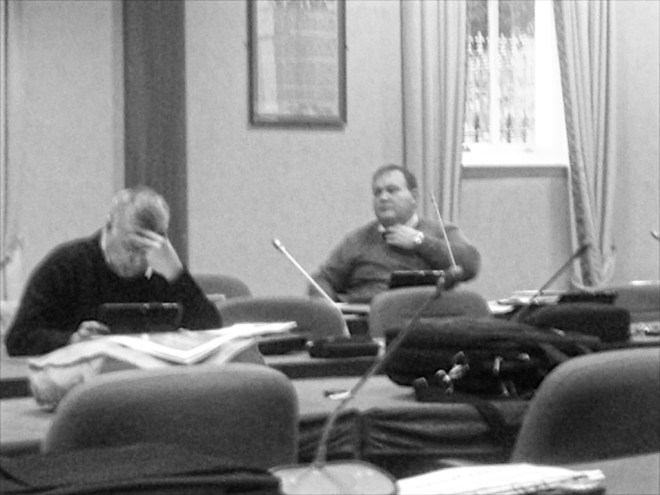
Franc McBrearty, Donegal councillors

Loosening his tie. But then again, Councillor McBride wasn’t wearing one, was he, at the council meeting? Just a bout of nervousness then? Or indecision?

Asked about his feelings on the dissolution of the Independent Grouping, McBride said, “I didn’t want that. It’s good for the council to have the four-group all-inclusive set-up that it has. To my understanding, that kind of power-sharing is unique in the whole country, something Donegal should be proud of.”

I asked McBride several questions

“Would you like O’Donnell – your former business partner in Dúncrua Teoranta, which was granted 120,000 euro from Udaras na Gaeltachta – expelled from all council committees.”

“I would have no problem with him being removed from all committees.”

“Why then did you abstain in the full council vote on the matter this Monday?”

“Because of the way I was treated fairly when I was co-opted on to the council for former Senator Jimmy Harte’s seat.”

“So, you would have been okay with a council decision to expel him, but not for you to vote on it?”

“Yes, it would have been democracy in action.”

Conversation ends.

Shakespeare: Is there something rotten in the state of …. Donegal?

Why would the trio of Fianna Fail, Fine Gael and Labour want the Independent Grouping at Donegal County Council dissolved? Here is a possible answer.

We’ll have a national elections very soon – we’ll know this week just when – and if the situation demands it, these three parties, regardless of what they say now, will try to ‘intermingle’ to form the next Government. But according to latest polls, their Donegal TD candidates desperately need all the help they can get even to shuffle lamely past the finish line – thus the pseudo-Independents. Fifteen years ago, the electoral breakdown was Fianna Fail a massive 70 per cent, Fine Gael 30 per cent, Sinn Fein 0.2 per cent and the rest Independents and Pseudos. Within the last five to six years, the Donegal political pendulum has swung dramatically and is now around 25 per cent Fianna Fail, Fine Gael 18 per cent, Sinn Fein a mighty 40 per cent, and rising, and the rest Independents and Pseudos.

And, let’s be quite clear about this: the main reason some pseudo-Independents are ‘Independents’ is that either their parties didn’t choose them to run last time out or that they’d never have won if they’d gone under that party’s ticket, especially if they’d gone under the Fianna Fail banner. In politics, however, such slights and inconveniences are often forgotten in the greedy grab for the prize piñata.

Concillor O'Donnell, Donegal politics

(r to l) Fianna Fail Donegal County Council chairperson, Ciaran Brogan, prepares for the meeting with council chief executive, Seamus Neely.

What happened behind closed doors Monday morning one week ago after Campbell and Easbuig stood on principle and left could be a classic political quid pro quo situation. ‘Talk up the party in the nationals in a few weeks time and you can run under our ticket for a council spot next time round, and, believe me, you’ll feel more secure for doing so,” could have been the way it was put.

Then again, my hunch might just be the workings of an over-active imagination. The truth might be that the Independent Grouping is a motley group, a raggle-taggle band with perhaps their hearts in the right places, but no cohesion. And so inexperienced and pulled apart by differences that they don’t even realize what their full potential could be if they created unity from diversity and voted for the right things.

This, however, is the perfect time – with national elections six weeks away – to find out which of the above-mentioned theories is the right one. True colors will begin to seep through. Threads will start to unravel.

If something more sinister is afoot, perpetrators of the cloak-and-dagger plotting have sadly overlooked one vital element – common decency. The overriding public mood is one of disillusionment, bordering on despair. If the three main political parties have indeed won the pseudo-Independents over – backed by business elites with much to gain by keeping O’Donnell on the council and on the ever-important ‘Roads’ committee which oversees tens of millions of euro in construction projects – trouble lies ahead. Keep in mind, the council’s annual budget is 133 million, 127 fixed and 6 to 7 discretionary. Construction of the Dungloe-Glenties road is in five-stages, the second, for example, cost around four million euro and the tender for the next stage is end of this month.

The ‘plotters’ may, however, have made the fatal mistake of ignoring the simple, unadorned hopes of ordinary folk, throughout Donegal and throughout the country, hopes for a sliver of common decency among politicians after all the putrid corruption they’ve been forced to roll in over the last five years or so.
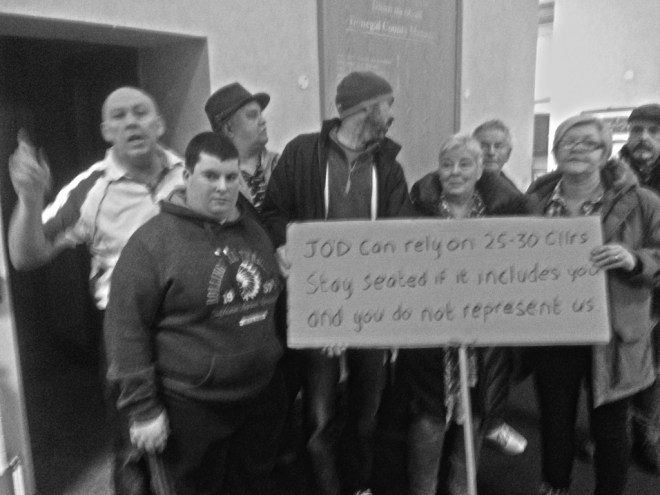
Donegal people demonstrating, Donegal county council

Protestors inside the County Chamber voice their sentiments about Councillor John O’Donnell, corruption and cronyism within and outside Donegal County Council.

Another key question is now being asked in the corridors of power in Lifford: not if, but how many, high-level executives within Donegal Council – many of which were employed both within the county and imported from outside the county, with generous salaries and pensions under the previous, long-running Fianna Fail government – are involved in this purge of True Independents and the break-up of power-sharing? After all, they have to reward their paymasters.

What a shame if such a deceitful game is being played, in this of all years – the centennial anniversary of our national independence.

But in a very short time, you, dear Reader, will have the chance to put things right – by availing of your unalienable right to walk behind a curtain and put your ‘X’ exactly where you want it to be.

Perhaps, this blog will help you choose well. I certainly hope so. It’s a rare chance to truly show that we are indeed ‘different up here.’

As for Councillor O’Donnell….

Epitome of nonchalance

I was quite astounded watching the councillor last Monday morning nonchalantly reading that morning’s edition of the ‘Donegal News’ as the political maelstrom swirled all around him in the council chamber. Either this young man has nerves of steel, I thought, or he is so utterly sure of what will happen that there is absolutely no need for him to be concerned in any way, about anything or anyone. Wish I could wake up feeling that way, as I’m sure do thousands of unemployed, elderly, sick, disabled and struggling mothers trying desperately to feed their children on paltry, insufficient income coming into homes across this county, across the country.

John O'Donnell, Sinn Fein Donegal

Nonchalance or absolute certainty? John O’Donnell displays his lack of concern about the possibility he might be expelled from Donegal County Council on Monday morning. That very evening, he released a press statement thanking his fellow councillors for supporting him.

During a short adjournment, I approached O’Donnell and introduced myself as Gaeilge, thinking – as he had attracted so much Údarás funding – he would be fluent. Perhaps it was due to my poor pronunciation or stumbling vocal ways, but he didn’t seem to understand, so I changed my questioning to as Bearla.

“Can you speak? I’ve a few questions I’d like to ask.”

I’ve been told by my legal advisers not to say anything,” he responded. “They’ve told me to let the ethics investigation takes it course. I’ve nothing to answer for anyway. People are just out to get me and use me as a platform for their own political gains.”

“What would you say to your fellow councilors here if they ask you any questions about your various business interests and debts owed through them?”

“I’d say, ‘That’s none of anyone’s business. It’s my private affair, mine only.”

“What about the 120,000 euro granted to your company, Dúncrua Teoranta, by Údarás na Gaeltachta just before it went bust, can you explain that?

“My legal advisers have told me to say nothing and that’s what I’m going to do.”

“Will you pay the money back?

“No comment.”

Then he went back to reading his newspaper.

O’Donnell, a long-time family member of Fianna Fail, also declined to comment on the court case he faces this Wednesday, Feb. 3 for failing to pay 33,000 euro in compensation to a Creeslough woman whose foot he drove over in a car accident. If O’Donnell does not show up for that case, District Court Judge Paul Kelly has said he will have him arrested.

Next week’s court case should be just as entertaining as the county council meeting last  week – with potentially very serious consequences for all concerned. If, having said he has no money, he pays up, you have to ask yourself: where did the spondulix come from? If his solicitor delays the proceedings, you’ve got to ask yourself: why? Could it be waiting for the results of the upcoming elections? If, however, he is convicted, I am ainformed O’Donnell automatically loses his council seat. There’s a lot at stake.

Go along if you can. It should be as good as an episode of ‘Judge Judy,’ hopefully better – unless some shadowy person(s) gets to the judge before then.
Protestors angry at Donegal County Council’s ‘dog’s dinner’ response to corruption and cronyism

As protestors from across Donegal vented their feelings inside Lifford’s County Council offices yesterday about corruption and cronyism in Ireland – the specific one lighting the fuse relating to controversial Donegal Councillor John O’Donnell – archaic rules, procedural confusion and tribalism prevented members expelling the Kilmacrennan-Fianna Fail linked man from all committees and the full council.

Anachronistic rules meant a counter proposal for what could well be a very long and drawn out ethics investigation by council executives superseded an initial proposal to expel O’Donnell immediately.

At times, the meeting, which was hosted by chairperson, Fianna Fail’s Ciaran Brogan, with the assistance of council executive Liam Ward and Seamus Neely, council chief executive, took on a farcical nature, with some describing it as a ‘dogs-dinner.’ During a discussion in which some councillors were attempting to expel O’Donnell – one of the most controversial decisions the council has faced in its entire history – confusion reigned, some members being unsure which proposal they were actually being asked to vote on. This caused Sinn Fein councillor, Marie Therese Gallagher, to ask the chair for immediate clarification.

Saying O’Donnell’s alleged ‘cash for favors’ actions caught last month on RTE national Irish TV camera were ‘disgraceful’, former Mayor Frank McBrearty (Independent) proposed removing O’Donnell from all committees, a motion seconded by fellow independent John Campbell.

“Due to the serious allegations against Councillor O’Donnell, we have the power to stand together and take action against him,” McBrearty said. “The public demands transparency and responsibility. There is a need to highlight corruption wherever it shows itself. As all politics is local, what we do here affects the nation so we have the chance to give a clear signal to the people of this county that we will not tolerate unethical behavior. The mushroom is getting bigger for Irish society. We must stop the rot now.”

However, a second, counter motion, by former Fianna Fail member, now long-time Independent councillor, Ian McGarvey, requested an ethics investigation be continued by council staff was also forwarded. Afterwards, during a conversation with me, McGarvey said he did not know how long such a process could take.

Confusion also reigned as Ward and Neely said legal advisers had told them O’Donnell could not be expelled from the council or its committees, but when asked for the legal documents proving this the two officials did not produce them. Neither did they bring into the chamber the legal adviser responsible for the advice when asked to do so by McBrearty.

According to Ward’s own instructions, there is “no specific provision within Local Government Legislation to provide for the removal of a member from committees to which he/she was appointed.” He added, “the position being taken is that the Motion as proposed (by McBrearty) is not permissable and, as a consequence, any resolution passed on foot of it would have no legal effect. The current process under the ethical framework should be allowed to continue until conclusion when the matter may come back before the members in one form or another.”

Some local government procedural analysts deem “illogical,” the situation whereby Chamber rules meant councillors were asked by Brogan to vote on the counter motion ahead of the original one put forward by McBrearty. That counter motion was ultimately accepted by 20 of the 36 councillors present, the votes representing Fine Gael, Fianna Fail, Labor and several Independents, mostly former members of Fianna Fail. All Sinn Fein members supported McBrearty’s motion. Independent Councillor Dessie Shiels was absent, having refused on principle to be in the same room as O’Donnell. Councillors McBride and Brogan abstained. Campbell and fellow Independent Councillor Michael Cholm Mac Giolla Easbuig promptly walked out of the meeting in protest saying, “this council has let down the people of Donegal and should be deeply ashamed.”

Added Councillor Gallagher, “I feel debased by O’Donnell and the opinions of some people about what he has done. He has brought disgrace to this chamber. My view is that as he was voted on to committees by council members, they have the right to vote him off them. It is a shame Frank McBrearty’s motion did not pass. This council had the opportunity to expel him and did not take it and now we have to wait until March to discuss it again.”

Protestors, men and women both inside and outside the chamber, said they were “disgusted by the council’s behaviour” adding, “our elected officials have failed to take proper action to stem an ugly, pervasive growing tide of corruption and cronyism sweeping across both this county and this country detrimentally affecting families, the elderly and children.”

Full story with photos and extended quotes coming up later today.

D-Day approaches inside the Donegal County Council Chambers

As D-Day (O’Donnell Day) approaches within the chambers of Donegal County Council this morning perhaps it’s not beyond the realms of possibility that beleaguered Councilor John O’Donnell has simply been misunderstood over the last few weeks and that this occasion, the first full council meeting since airing of the RTE ‘cash for favors’ controversy, gives him the opportunity to clarify matters.

As the debate gets underway, the eyes and ears of many of the nation’s political and financial elite will be on little ole Donegal, that ‘wee beautiful place on the edge of the Atlantic’ in the very far corner of the country, that is and isn’t an integral part of the island of Ireland, depending which perspective from which you look.

Councillors John O’Donnell, Michael McBride, Ciaran Brogan and all their fellows in the chamber will have the chance to show that, in the right and proper way, “we are different up here.”

Now what that ‘difference’ means is the key question we all hope will be answered truthfully and forthrightly today, hopefully before lunch-time comes around – though that is as likely as seeing a polar bear wearing suntan lotion eating brussels sprouts with a spoon at the side of a heated swimming pool.

Will this morning’s open public event echo the catchphrase that became so popular in the 1970s after the Oscar-winning movie ‘Network’ was first screened? Then lead character, Howard Beale, (played wonderfully by actor Peter Finch), on the brink between brilliance and madness, says passionately, “I don’t have to tell you things are bad. Everybody knows things are bad,” then screams, “I’M AS MAD AS HELL, AND I’M NOT GOING TO TAKE THIS ANYMORE!” his words being carried swiftly from person to person, young and old, man and woman, boy and girl, city to city across the whole of the nation.

If these words are echoed in the council chamber today in Lifford, who’s going to say them first? And will they mean them?

Could they be the battle-cry for a new, rejuvenated Donegal?

Could this be the historical moment we begin to shrug off the cloak of cronyism and corruption that has draped this county for far too long, with the collusion of various governments, and stymied our cultural, social and economic development?

To achieve this not small feat, a comprehensive, collective community effort is required and for that we, in turn, require the strength of the media, broadcast, print and digital  – not the way the print media acted over the last few days, publishing what was in effect a joint press release from  Údarás na Gaeltachta and John O’Donnell on the front and inside pages, nor Highland Radio, avoiding the controversial, not-so transparent payments made from one entity to the other.

If efforts to rid this county of counterproductive ‘goings-on,’ we need local media to be brave, enterprising and outspoken. It is their future as much as it is ours that is at stake.

While this article in yesterday’s ‘The Sunday Business Post’ gives most of the facts surrounding Mr. O’Donnell and Údarás, there is still much more to be said.

Sean Hillen Sunday Business Post, Councillor O'Donnell Donegal

For the sake of fairness and democracy, let Cllrs. O’Donnell and McBride have their say. Give them the chance to explain how and why they were granted the 120,000 euro from Údarás and about how much exactly, and O’Donnell to clarify to whom one of his other companies, Kilmac Form Work Limited, owes millions of euro in debt, and where indeed those millions are now. And why he has still not paid 33,000 euro in injury compensation to an unfortunate Creeslough woman who’s foot he drove over in a car accident.

John O'Donnell Donegal, Donegal councillors

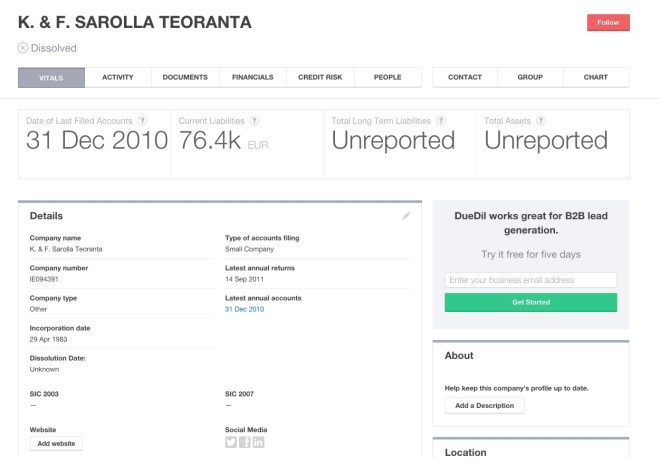
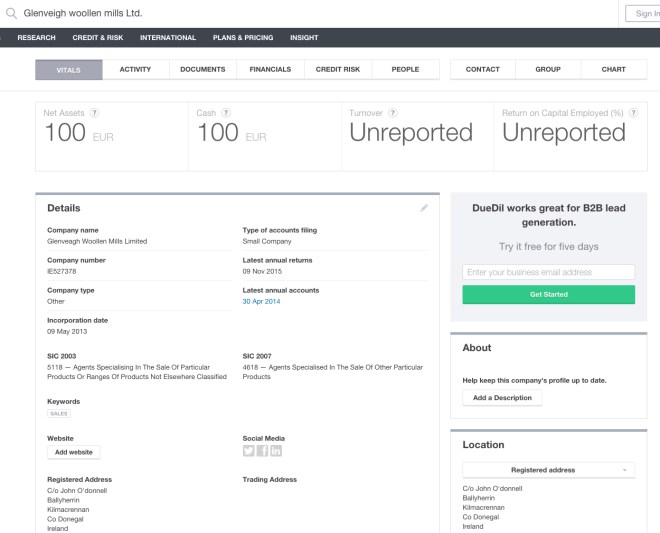
Oh, and let there be an explanation by O’Donnell about how his former company K&F Sarolla Teo (‘wool’ in English) went bust owing over 76,000 euro in 2013, which intriguingly led him to set up Glenveigh Woollen Mills Ltd in May of the same year .

Glenveigh Woolen Mills Ltd, councillor John O'Donnell

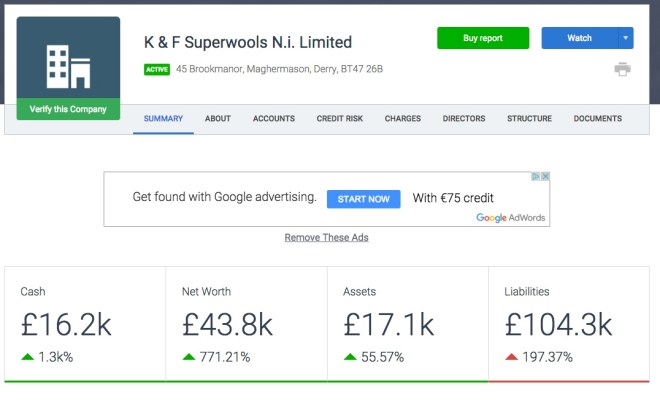
Strangely – perhaps merely a coincidence – K&F Sarolla Teo looks very much like K&F Superwools in Northern Ireland, with – and again it may just be a coincidence – the same director, namely John O’Donnell.

Would it be too much of a coincidence if it was discovered there were grants– those chunky cross-border kind of ones – involved in these companies also?

K&F Superwools, Donegal counicllors

For goodness sake, while we’re at it, as anyone who’s anyone will be there in the council chamber this morning, let Councillor Ciarán Brogan, Donegal County Council Chairperson, explain how his company, Sark Construction, perhaps now renamed Kasmor, managed to obtain an estimated 10 million euro in Donegal council construction contracts.

Gosh, it all sounds as if the craic will be mighty at the Donegal Council meeting this morning (kick-off 11am). For what it’s worth, alternative entertainment options on the box at exactly the same time are (and I kid you not) – ‘Wanted Down Under’ on BBC1; ‘The High Chaparral’ (or is that ‘Hang ‘Em High’) on TG4; ‘Judge Judy’ on TV3; ‘Conspiracy Theory’ on TCM; and ‘Four in a Bed’ on Channel 4.

Funny how all of them – including the local council option – have a similar ring to them.

I know which one I’m choosing.

Exclusive: Donegal councillors John O’Donnell and Michael McBride funded by Údarás na Gaeltachta

At a time when controversial ‘cash for favors’ Donegal councillor John O’Donnell was refusing to pay more than 33,000 euro compensation to a Creeslough woman he injured in a car accident 16 years ago, Údarás na Gaeltachta granted him and fellow councillor Michael McBride more than 122,000 euro in public money (see document here Udaras grant), I can reveal exclusively in this blog.

John O Donnell Donegal, independent councilor Donegal

O’Donnell was founder, director and secretary of Dúncrua Teoranta, the company receiving the money. Interestingly, a second director of the company was fellow councillor, Michael McBride, who also acted as company secretary. Both men – now declaring themselves independent councillors – were then members of Fianna Fail. A third director named was Sarah Doherty.

Documents show McBride and O’Donnell became directors of Dúncrua Teoranta on the same day, 14 Sep 2006, when it was set up to sell metal ore. They are also listed as company secretaries. McBride was director for a year and four months, until February 2008 when he resigned. The company’s address was listed as just inside the Gaeltacht, at Cuirin, Termon.

Dúncrua Teoranta

Údarás approved funding for Dúncrua Teoranta of 122,300 euro in 2008, paying out 66,850 euro in that year alone. The owners put the company into bankruptcy within months of the money being given. Aidan Garcia of Collins Garcia Corporate Recovery, 28 Fitzwilliam Place, Dublin was appointed as liquidator.

“As the money was given at a time when the company was close to bankruptcy, it seems it’s yet another case of cronyism, money given to two Fianna Fail politicians by a Fianna Fail dominated organization,” commented one observer with inside knowledge of Údarás operations.

Interestingly, O’Donnell was granted the money by Údarás at a time when he owned another company, Kilmac Form Work Limited, which later went into receivership with documents showing it had liabilities of 4.8 million Euro. Much of that debt, as declared during a High Court hearing in 2012, was owed to AIB Finance, thus to ordinary Irish people as the bank was bailed out by the State through injections of billions of euro of public money.

Kilmac Form Work Limited

O’Donnell registered Kilmac Form Work Limited on 6 April, 2005 in Ballyherrin, Kilmacrennan, several kilometers from Duncrua Teo, described as being involved in the manufacture of metal structures. It is currently listed as ‘Receivership’ with two directors, O’Donnell and his brother. The ‘Irish Independent’ reported recently that O’Donnell was forced to make back settlements to the taxman totaling over 330,000 euro. I have contacted both Councillors McBride and O’Donnell for comment but neither has responded. Údarás finally released a statement confirming it did grant O’Donnell the money. Where were Údarás officials when the RTE ‘cash for favors’ investigation was aired to such national furore weeks ago? Cowering in a corner hoping no-one would notice it had given scarce public money away so recklessly?

Urgent questions require immediate answers

The documents unearthed for this blog call into question the actions of both O’Donnell and Údarás na Gaeltachta.

O’Donnell is already firmly in the public spotlight due to his being caught on RTE camera allegedly offering ‘favors for cash’ on Donegal council business, as well as being under threat of arrest for failing to pay compensation due to Ms. Petra Kucklick of Creeslough whom he injured when he drove his car over her foot in 2000. District Court Judge Paul Kelly was quoted in the local media saying he will have the councillor arrested if he does not appear in person at the Letterkenny court on February 3rd to explain why he has failed to pay any of the compensation to the injured woman. O’Donnell seemed to have had lots of money at one time and could have easily paid the compensation, why did he decide not to do so?

Almost all of the main political party representatives in Donegal have called directly for O’Donnell’s resignation, as did Independent councillors, Micheal Cholm Mac Giolla Easpuig, who has called for a boycott of next week’s full council meeting due to take place on Monday, January 25, Dessie Shiels, who left a meeting Letterkenny Municipal District Council last week in protest, and Frank McBrearty, former Mayor, who resigned last week from the Independent Grouping on Donegal County Council in protest as O’Donnell not being expelled.

Donegal Now‘ news service said Cllr. McBrearty explained that Cllr Michael McBride’s casting vote as party whip means he has the power to expel Cllr John O’Donnell from the group and the committees given to him under the all inclusive deal. The news service quoted McBrearty saying: “I will perform my duties as an Independent councillor and do my very best for the people that elected me. I will not be associated with Cllr John O Donnell when he clearly said he could get the backing of 25 to 30 other councillors. I am not one of these councillors and am making my position clear by taking this stand. I do not understand the reluctance of some councillors to support my decision but that’s for them to decide.”

The information these documents reveal also come as councilor Shiels, who will contest the next national elections, recently left a meeting of the 10-member Letterkenny Municipal District Council in protest at O’Donnell’s attendance. “In the aftermath of the RTE investigates programme which aired on RTE in November past, I personally cannot involve myself in county council meetings, whether at Municipal District Level or at full plenary council level in the presence of councillor O’Donnell,” Shiels said. “To do so would, to my mind, compromise everything that I have tried to do to date since being elected to Donegal County Council to restore public confidence in politics in Donegal.”

Added another observer, who prefers his identification to remain confidential at this times, said, “I wondered why Michael McBride was so quiet in his condemnation of O’Donnell.”

Is John O’Donnell the kind of political leader the people of Donegal want? Is this what we mean when we say proudly, “we’re different up here?”

Does Údarás na Gaeltachta lack good governance?

Key questions also remain about the operations of Údarás na Gaeltachta, particularly in Donegal.

Did anyone at the organization check into the financial health of O’Donnell and his companies before granting him 122,000 euro of public money? If so, why did it go ahead and approve the grant? If it did not check, then it is guilty of ignoring its duties to the public whose money supports the organisation’s entire operation.

Perhaps, in addition to the controversial wind farm development issue that was the focus of the RTE program, perhaps O’Donnell can clarify how he got the money from Údarás for Dúncrua Teoranta. It is not believed either O’Donnell or McBride have paid any of the money back.

Also, as the Office of the Director of Corporate Enforcement (ODCE) identified the requirement for a ‘Section 56’ on O’Donnell’s company – which allows interested parties to bring concerns before the liquidator and thus try to recuperate their money – has Údarás done so in relation to the loss of public money (the grant)? If, not, why not? Is this yet again willful disrespect of public interest?

Or in the light of the allegations arising from the RTE program – did some people at Údarás get kick-backs for pushing the money through for O’Donnell? Considering Fianna Fail’s long-time dominance of Údarás and that party’s record of skullduggery in bankrupting Ireland, such allegations cannot be ignored. In addition, this blog revealed that Údarás hired Finbarr Boyle as business training manager for local entrepreneurs through the EU funded CeanaglG project in Donegal even though Boyle was already under investigation, had already pleaded guilty as part of a plea bargain and was later proven guilty of stealing more than 200,000 euro from a village school, including money earmarked for children’s food. Does the organization suffer from a severe lack of good governance?

Oh, and by the way, where did the 122,000 euro go? As Cuba Gooding Jr. said in that wonderful film, ‘Jerry Maguire’ – “Show us the money!”

Changes required at Údarás?

With frequent revelations about the operations of Údarás – including free trips for executives, board members and their wives to Las Vegas (to meet officials of Enterprise Ireland) and ‘insider trading’ schemes whereby former Údarás board members and top executives received money for their own organizations and projects – economic experts are questioning whether the group is fit for purpose. These concerns are especially sensitive locally as well as in Brussels as the Government decided recently it will operate the multi-million euro EU LEADER programme in the Donegal Gaeltacht where decisions on money allocation will take place over the coming months.

Some sector analysts as well as ordinary people in the Gaeltacht community say that after several decades of failure and with unemployment in the Gaeltacht at an all-time high, the economic regeneration model for the regions is simply not working and that Údarás na Gaeltachta should simply be dismantled and replaced with a new and more efficient organization, one featuring well-trained technocrats, not politically-appointed personnel.

Others say that much-needed changes are already underway, an example being the recent appointment of Letterkenny-based, former county council director of services for community, culture and planning, Micheál Ó hÉanaigh, as director of enterprise and employment, marine and natural resources at Údarás. Ó hÉanaigh, credited with launching the Donegal Diaspora project.

However, one must also note the recent reaction by Joe McHugh, Fine Gael Minister for the Gaeltacht, to the questionable activities at Údarás – he said the organization would receive an extra one million euro in public funding this year.