Expenses For Irish Presidency Cost 13,000 Euro Every Single Day

Thankfully, mercy of mercies, the Irish Presidential election is almost over. 

In a few hours, people throughout the Emerald Isle can breathe a sigh of relief. And get on with everyday things, knowing full well that the winning candidate will have barely a whisper of an effect on their day-to-day lives.

They may, however, be a wee bit miffed that election of a person in office for the next seven years with no power to affect their lives will cost them over 35 million euro, over five million a year in salaries and expenses. 

That’s over 13,000 euro for every single day. 

Put another way, it’s over 1,600 euro per hour based on an 8-hour working day.

That could pay salaries for a helluva lot of nurses and doctors to help strengthen Ireland’s woeful health system. Not to mention what it could do for struggling schools and community centres.

It begs the question – Is it worth it?

Sadly, this presidential contest, if one can dignify it with this word, is also probably the most boring in living memory, aside from a single mini-drama when one of only three candidates dropped out, no doubt realising being so far behind in the opinion polls, he’d probably come in fourth. 

It’s also sad that as the two candidates in the race have been well-established party supported national political figures for many years, real refreshing innovative change is obviously not on the Irish agenda for the foreseeable future. Something that’s probably welcome to some of Ireland’s politicians as their salaries and expenses are quite lucrative. Certainly compared to other countries.

This Presidential election has turned out to be the predictable cliche, Left Versus Right scenario, a pretty straightforward political party battle, with Catherine Connolly, who simply left the Labour Party because she wasn’t picked as an election candidate, head and shoulders intellectually above her rival, Heather Humphreys, former Minister for the Fine Gael coalition government partner. A lady who started her campaign with a fixed butter-wouldn’t melt-in-my-mouth regal smile until, seeing herself well behind her rival, suddenly grew fangs. Much too late.

What’s most depressing about this whole Presidential affair is that the leading parties in Ireland turned this election into ‘them-versus-us’ party political battle, thus making sure the next President of Ireland, the only position based on a national vote, would not be handed to a truly Independent candidate with experience on both the left and right of centre, someone from a working-class background but successful in business, someone with fresh new ideas, vision and comprehensive international experience, something sadly neither candidate possesses.

Welcome to Ireland. Land of the Status Quo!

Sinn Fein’s Presidential decision – a case of the tail wagging the dog

Is Sinn Fein’s decision this weekend to support Independent candidate, Catherine Connolly, in November’s Irish Presidential elections a case of the tail wagging the dog?

It certainly seems so.

After much dithering and delay, Ireland’s third ranked political party – which not so long ago could have topped the polls nationwide and emerged as the nation’s leading party if they’d only put forward more candidates – could not even decide on its own Presidential candidate, party member or not.

Instead, it meekly followed in the wake of other smaller Left-leaning parties who have been supporting Connolly for many months.

Catherine Connolly – established Irish politician.

If that’s not the tail wagging the dog, what is? 

No matter how well the story is spun – and sadly Sinn Fein party leader Mary Lou MacDonald offered an ‘over-the-top’ act to do so a few days ago, uttering the superlative cliché ‘game-changer’ – this non-decision decision may come back to bite her and her colleagues. 

While they won’t say it publicly, the other Left wing parties in Ireland are now frothing at the mouth at the possibility of stealing parliament seats from Sinn Fein at the next election.

Unfortunately, Mary Lou made the situation even worse this weekend when she tried vainly to justify choosing Connolly by saying recent Irish presidents had been elected “from outside the political establishment” and that Connolly was following in that tradition.

What a load of nonsense.

Catherine Connolly has been an ‘established’ politician for the last quarter of a century, beginning as local councillor in Galway, then rising to Mayor five years later, then becoming a TD ten years ago. For goodness sake, she was even chairperson of Ireland’s national parliament for a full four years.

If that’s not ‘established’, what is?

Even the present President of Ireland Michael D. Higgins, elected not once but twice over the last 14 years, was a ‘classic established politician.’ For almost half a century including stints as Labour Party president, Senator, TD (Member of Parliament) and even as a Minister. 

One has to ask oneself ‘Who the hell is writing Mary Lou’s scripts. And who’s conducting her research?”

I’ve always been Left of center in my political outlook, and would like Sinn Fein to be in Government and shake up the meagre mediocrity of Irish politics. But with poor decisions like this one over the Presidency, I fear that’s not going to happen any time soon.  

Sinn Fein has shown itself in many instances to be a no-risk party, including its electoral management strategy in Donegal where I now live. In order for it to justify its claim as a leading party, it needs to take risks. But time and time again, it has shown itself to be very much risk averse.  

My humble view is that Irish people are desperate for a fresh face in Áras an Uachtaráin, the official residence of the President of Ireland, someone truly not involved in Irish politics. Someone with the international experience necessary to conduct the role of Presidency in a strong diplomatic manner. They simply don’t want the Presidential race to be based along worn, age-old political party lines.

That’s why someone like Gareth Sheridan – a man whose US-based company has accumulated losses of 40 million dollars and who has himself already been fined for misleading people about his business and whose main business partner is said to have links with Russian oligarchs – has managed to get two county councils in Ireland to nominate him as a Presidential candidate. 

That’s how desperate Irish people are to find someone new. 

Mary Lou went half way by talking about the need for someone new. 

But then she went right ahead and selected someone straight from the old political establishment. And to make matters worse, someone other parties had already selected a long time ago.

It seems Sinn Fein may have just bought the ruling coalition of Fianna Fail and Fine Gael an early Christmas present.  

GAME-CHANGER OR GAME-OVER IN IRELAND?

Sinn Fein’s President Mary Lou McDonald today described on national airwaves that her political party’s long-awaited, soon-to-be-named Irish Presidential candidate would be a ‘game changer.’

@rtenews

Sinn Féin leader Mary Lou McDonald has said that the party’s participation in the Presidential Election campaign will be a “game-changer”. Sinn Féin has been mulling over its approach to the race for Áras an Úachtaráin, with two options at its disposal – either run its own candidate or back Independent Catherine Connolly’s campaign. Speaking at the National Ploughing Championships in Screggan, Co Offaly, Ms McDonald said she already knew the proposal she would be bringing to the party, but that it would not be made public until Saturday. Go to link in bio for more #rtenews #ireland #presidentialelection #sinnfein

♬ original sound – RTÉ News

Having used this grandiose, hifalutin phrase, that’s exactly what supporters and would-be supporters of Sinn Fein will be expecting that person to be – a unique choice who will shock and surprise everyone. 

The kind of individual a disillusioned electorate are hungry for. Someone whose name and background will light a fire under what has already become – albeit in its early stages – a timid, banal, utterly predictable and lukewarm election campaign.

To use such a superlative phrase as ’game-changer’  and not deliver an individual with the immense passion, innovative vision and creativity the term demands will be considered by most people to be a dismal failure.  And show Sinn Fein to be a ‘has-been, once-was’ party, one whose rise in recent years has incontrovertibly stalled.

To come up with something less – such as merely supporting Independent Catherine Connolly – will help damn the party into endless Opposition. It will signal to a triumphant Fianna Fail-Fine Gael coalition Government that it has nothing to worry about from Ireland’s third-ranked party. That Sinn Fein is all bark and bluster. But no real bite. 

Regardless of the spin about Left wing unity, Sinn Fein supporting Connolly will be seen as nothing less than inherent party weakness. That of a political party seeking to lead the country that cannot even find a suitable candidate for the most universally elected political position in the nation. 

That’s not leadership. That’s impotence. 

Supporting Connolly, Sinn Fein at this stage will also be seen as being led by the other Left wing parties who decided on her months ago. And they risk losing key votes at the next election as a result, probably leading to an inevitable decline in its parliamentary seats. A major, perhaps irrecoverable, blow to the party’s hardworking grassroots members.

Thus it’s all-important, not just for future success but for sheer survival, that Mary Lou and her colleagues in the upper ranks of Sinn Fein deliver what they’ve promise so confidently. Nothing less will do.

In doing so, hopefully, they’ll also make this rather boring Irish Presidential battle a bit more interesting than it is right now, raising it from its low-level drab ordinariness.

If they don’t, Sinn Fein may pay a heavy price at the next election. And possibly never recover from the fall.

For a party that is admirably ethical and honest in its dealings, with a central mission of equality and justice for all, they need to find the courage to take risk, something the party is not particularly known for, as not running a second candidate in the Gweedore-Cloughaneely area in the last election showed, with Pearse Doherty’s massive surplus votes going nowhere instead of towards electing a record third TD in Donegal.  

This Presidential campaign is Sinn Fein’s Rubicon moment. It’ll be intriguing to see if they manage to cross over. Or drown in the effort.

Was Columba gay?

Thousands of euro of public money are pouring into diverse celebrations this year throughout Ireland to celebrate the life of a 6th century Celtic monk called Columba (or Colmcille) – a strange and elusive man we know almost nothing about.

Even though schools, community centres, Christian churches, local councils and other groups celebrate the 1,500th year of the mystical monk’s birth, no-one knows exactly when he was born. Nor do we know exactly where. We think it was Donegal but we don’t know for sure what part. We know he left Ireland for the Scottish island of Iona where he spent a good part of his life. But we don’t know the real reasons why.

Sitting on the Torr an Aba (Hill of the Abbott) in front of Iona Abbey where it is said Columba did most of his meditating.

We don’t even know for sure if Columba had a mistress, a wife, children, or indeed whether he was gay or bisexual like many of the monks of his time. (Celibacy was not compulsory then, monks/priests could marry and have families and homosexuality was not denigrated as it is today by the Catholic Church).

Nor do we know where Columba is buried. It was thought his bones (or at least the smaller ones) were wrapped up inside a wooden casket covered with silver and copper-alloy designs known as a reliquary and carried by Scottish soldiers at the Battle of Bannockburn where they famously defeated the English. But we now learn there was nothing in the box, which now sits behind a glass case wired to a sophisticated security alarm system in the National Museum of Scotland in Edinburgh and labelled as the ‘Monymusk Reliquary.’

Make no bones about it – Columba’s relics are not in the ‘Monymusk Reliquary.’

The reason we know so little about Columba is that while he and his followers attracted a worldwide reputation for penning and illustrating magnificent books of all kinds including the famous Book of Kells, there are no records whatsoever of Columba’s own personal writing, not even a simple diary.

So, how is it then we’re spending so much public money celebrating a man we know nothing about, indeed a man who was never even declared a saint, though most people think he was. Why would the Vatican canonise him anyhow? After all, the Celtic Christian church Columba represented stood firmly against the Roman version, battling tooth and nail for ultimate supremacy, that issue being eventually settled at the Synod of Whitby in 664 with Rome being the victor.

Who knows, perhaps Columba, a lover of herbs, specially St. John’s Wort, followed too many Pagan practices, maybe even believing in faeries, and his writings were wilfully destroyed by the powers that be in Rome.

This brings me to another man, a man of our time.

Dr. Brian Lacey relaxes at his rural west Donegal home in the shadow of Errigal mountain.

Lively septuagenarian, author, archaeologist and historian, Brian Lacey is an exceptional dinner guest. A fine raconteur with quirky views of the world, he’s a man at ease with laughter and story-telling.

And he has just penned his latest book, on a spin-doctor called Adomnán (or Eunan) who single-handedly raised Columba’s name to ‘the High Heavens’ by inventing a series of mostly fictional or at the very least, highly-exaggerated, stories about the founder of Iona Monastery and the ‘miracles’ he supposedly performed.

Rather than it being a selfless literary endeavour, Adomnán’s reasons for writing his book were directly linked to both politics and money. In raising the profile of Columba, he also raised the public profile of the community of monks on Iona that he presided over 100 years after its founder had passed on, thus no doubt encouraging new recruits to sign up and more money donated to the monastery’s coffers.

Meeting the man himself, academic celebrity par excellence.

Some in Ireland might use local slang and call Adomnán ‘a cute hoor,’ loosely translated as ‘a shrewd scoundrel, especially in business or politics.’ Probably he was, but he also achieved much more, as you can see from the article below I wrote for the ‘Donegal News’ recently.

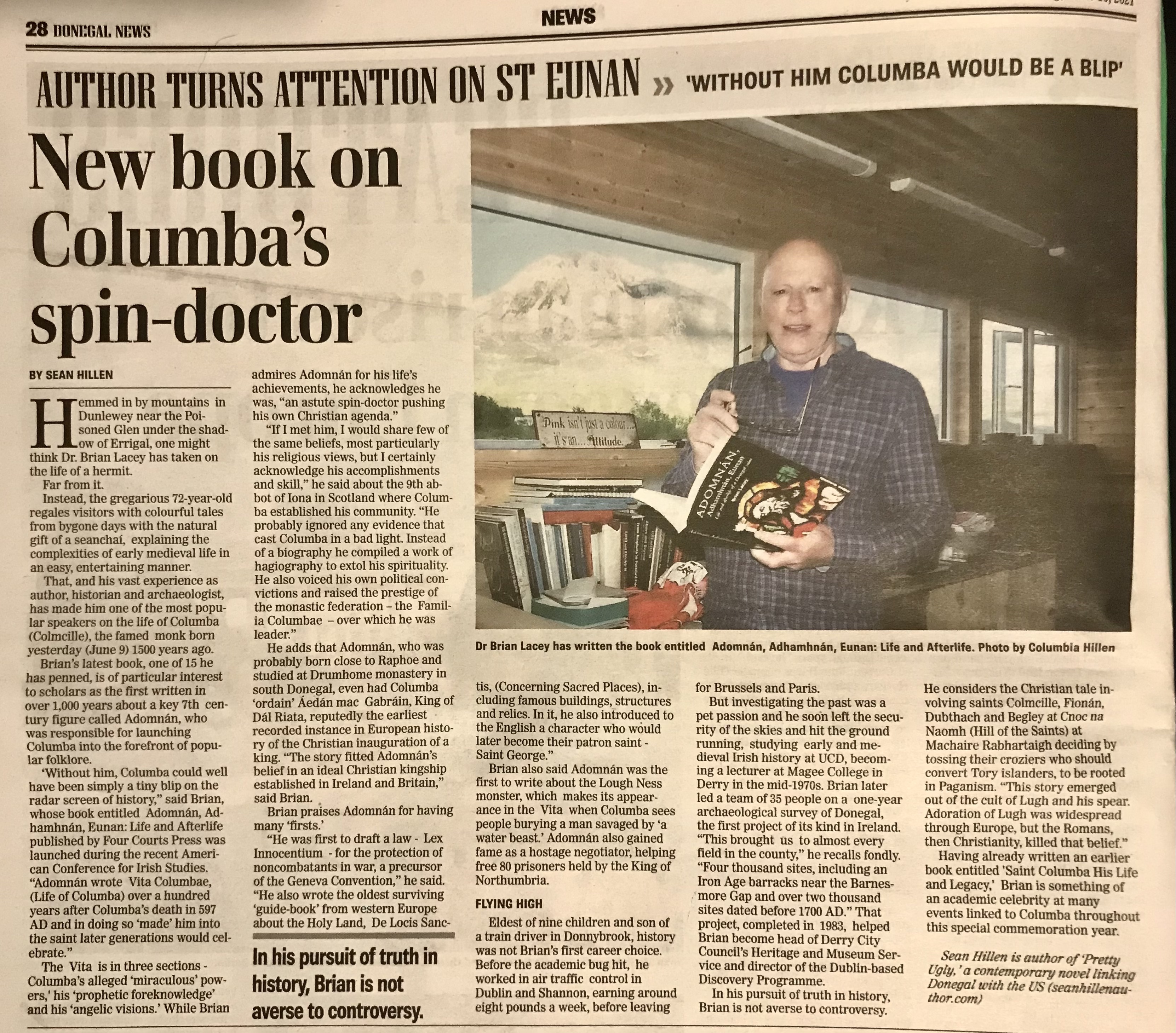
New Book On Columba’s Spin-doctor 

By Sean Hillen

Hemmed in by mountains in Dunlewey near the Poisoned Glen under the shadow of Errigal, one might think Dr. Brian Lacey has taken on the life of a hermit.

Far from it.

Instead, the gregarious 72-year-old regales visitors with colourful tales from bygone days with the natural gift of a seanchaí, explaining the complexities of early medieval life in an easy, entertaining manner.

That, and his vast experience as author, historian and archaeologist, has made him one of the most popular speakers on the life of Columba (Colmcille), the famed monk born yesterday (June 9) 1500 years ago.

Brian’s latest book, one of 15 he has penned, is of particular interest to scholars as the first written in over 1,000 years about a key 7th century figure called Adomnán, who was responsible for launching Columba into the forefront of popular folklore.

‘Without him, Columba could well have been simply a tiny blip on the radar screen of history,” said Brian, whose book entitled Adomnán, Adhamhnán, Eunan: Life and Afterlife published by Four Courts Press was launched during the recent American Conference for Irish Studies. “Adomnán wrote Vita Columbae, (Life of Columba) over a hundred years after Columba’s death in 597 AD and in doing so ‘made’ him into the saint later generations would celebrate.”

The Vita is in three sections – Columba’s alleged ‘miraculous’ powers,’ his ‘prophetic foreknowledge’ and his ‘angelic visions.’ While Brian admires Adomnán for his life’s achievements, he acknowledges he was, “an astute spin-doctor pushing his own Christian agenda.”

“If I met him, I would share few of the same beliefs, most particularly his religious views, but I certainly acknowledge his accomplishments and skill,” he said about the 9th abbot of Iona in Scotland where Columba established his community. “He probably ignored any evidence that cast Columba in a bad light. Instead of a biography he compiled a work of hagiography to extol his spirituality. He also voiced his own political convictions and raised the prestige of the monastic federation – the Familia Columbae – over which he was leader.”

He adds that Adomnán, who was probably born close to Raphoe and studied at Drumhome monastery in south Donegal, even had Columba ‘ordain’ Áedán mac Gabráin, King of Dál Riata, reputedly the earliest recorded instance in European history of the Christian inauguration of a king. “The story fitted Adomnán’s belief in an ideal Christian kingship established in Ireland and Britain,” said Brian.

Brian praises Adomnán for having many ‘firsts.’ 

“He was first to draft a law – Lex Innocentium – for the protection of noncombatants in war, a precursor of the Geneva Convention,” he said. “He also wrote the oldest surviving ‘guide-book’ from western Europe about the Holy Land, De Locis Sanctis, (Concerning Sacred Places), including famous buildings, structures and relics. In it, he also introduced to the English a character who would later become their patron saint – Saint George.”

Brian also said Adomnán was the first to write about the Lough Ness monster, which makes its appearance in the Vita when Columba sees people burying a man savaged by ‘a water beast.’ Adomnán also gained fame as a hostage negotiator, helping free 80 prisoners held by the King of Northumbria.

Flying  high

Eldest of nine children and son of a train driver in Donnybrook, history was not Brian’s first career choice. Before the academic bug hit, he worked in air traffic control in Dublin and Shannon, earning around eight pounds a week, before leaving for Brussels and Paris.

But investigating the past was a pet passion and he soon left the security of the skies and hit the ground running, studying early and medieval Irish history at UCD, becoming a lecturer at Magee College in Derry in the mid-1970s. Brian later led a team of 35 people on a one-year archaeological survey of Donegal, the first project of its kind in Ireland. “This brought us to almost every field in the county,” he recalls fondly. “Four thousand sites, including an Iron Age barracks near the Barnesmore Gap and over two thousand sites dated before 1700 AD.” That project, completed in 1983, helped Brian become head of Derry City Council’s Heritage and Museum Service and director of the Dublin-based Discovery Programme. 

In his pursuit of truth in history, Brian is not averse to controversy. He considers the Christian tale involving saints Colmcille, Fionán, Dubthach and Begley at Cnoc na Naomh (Hill of the Saints) at Machaire Rabhartaigh deciding by tossing their croziers who should convert Tory islanders, to be rooted in Paganism. “This story emerged out of the cult of Lugh and his spear. Adoration of Lugh was widespread through Europe, but the Romans, then Christianity, killed that belief.” 

Having already written an earlier book entitled ‘Saint Columba His Life and Legacy,’ Brian is something of an academic celebrity at many events linked to Columba throughout this special commemoration year.

Published in the ‘Donegal News’

If you want to know more about skulduggery disguised as religion and furious political struggles between Celtic Christians and their Roman counterparts, read the excellent series of Sister Fidelma novels by Peter Tremayne (pseudonym for Peter Berresford Ellis, historian, literary biographer and novelist). 

Fidelma is a ‘dálaigh’ or judge in ancient Ireland, a sexy red-haired female version of Sherlock Holmes in a habit.

Intrigued by the reputation of this early Irish mystic monk known as Columba, I decided as a travel writer to head for Iona, the Scottish island where he established his community of like-minded people. Here’s what I found after landing on a little stony pier after taking the ferry from Mull last autumn, a massive, treacherous sea crossing that took all of five minutes.

Click on the photo to read the story

Colmcille: mysterious monk, mystic and mischief-maker

Though his name has become well known down through the centuries, nobody seems to know much about him – one of the reasons he has become a figure of legend.

But efforts are now underway to unmask the mysterious Irish monk known as Colmcille and in so doing create a special pilgrimage aka the Camino of Santiago de Compostela that could provide a much needed boost to the ailing tourism sector amid the rugged beauty of northwest Ireland.

To this end, a launch event will take place this Friday at 12.30 in An Crann Og in Derrybeg, west Donegal, where all will be revealed.

invitation

Much of the information about the enigmatic fellow was written many years after his death in the middle of the 6th century and as such, as often happens when attempts are made to enhance an individual’s saintly credentials, is either embellished or simply inaccurate. But the result has been even greater intrigue and heightened interest in the fellow – what he did and what he stood for.

One absorbing element is that his name is linked to the ‘illegal’ copying of a secret manuscript – with many observers saying it may have been the first-ever case of copyright infringement. But nobody is certain whether it really happened as described or, if it did, what the sacred document was, belonging to Finian, the monk’s former teacher, that Colmcille felt such a great need to copy, and why.

Following the incident, Diarmuid, High King of Tara, is supposed to have handed down an edict, “To every cow her calf, and to every book its transcript. And therefore to Finian of Moville belongeth the book.” Not surprisingly, this decision was not to the liking of certain interested parties, including the revered monk himself. Records indicate fighting erupted over this bizarre case of intellectual theft with Colmcille facing the High King at the ‘Battle of the Book’ on the slopes of Benbulben in Sligo.

Some also say this – a bloody battle that left several thousand dead – was the reason Colmcille left Ireland for Scotland voluntarily and with great remorse, to establish his own settlement on the island of Iona. Others say he was ordered, or ‘advised,’ to get out of town fast or have assassins forever chasing his tail. After all, a spear to the head or sword to the gut were pretty strong persuaders in the dark days when rival monks were also fighters well trained in the art of swift and agonizing chop-chop.

Colmcille’s story by most accounts began in Gartan, Donegal, where he was born into the northern branch of the O’Neill Clann around 521. His mother, Eithne, was believed to be a princess from Leinster, and his father, Fedelmidh, a prince of Tír Conaill and the great grandson of Niall of the Nine Hostages, the pagan king who brought Patrick, he of shamrock fame, as a slave to Ireland. Christened Criomhthann (meaning ‘fox’), Colmcille certainly lived up to his name, jumping in among the chickens as he did and causing such a furor.

Scholar, warrior, mischief-maker, prince, diplomat – Colmcille seems to have been a man of many parts. If you want to learn more about him, be at Crannog, this Friday where Brian Lacey, renown historian, author and expert in the era, and Moira Ní Ghallachóir, founder of outdoors tourism group, mng.ie which organises ‘Rock agus Roam,’ will speak at the launch of an innovative tourism venture entitled ‘Connecting Colmcille.’

In addition, a special exhibition entitled ‘Amra Cholium Chille’ – a modern translation of a poem composed after the monk’s death with paintings by Brian Ferran and caligraphy by Donald Murray – will be opened at An Gailearai in Aislann Ghaoth Dobhair at 8pm this Friday evening. The event is free and open to the public with wine and refreshments served.

For further reading, see the works of University College Cork’s Máire Herbert (Iona, Kells, and Derry: The History and Hagiography of the Monastic Familia of Columba) and Brian Lacey (Saint Columba: His Life & Legacy).

Connecting Colmcille 1

International guests from three continents are immersed in Irish culture at ‘Forgotten Land, Remembered Words’ Ireland Writing Retreat in Gaoth Dobhair

“These kind of events (Goitse go Gaoth Dobhair festival and ‘Forgotten Land, Remembered Words’ Ireland Writing Retreat) reflect cultural tourism as its best. With a rich tapestry of culture, history and legend in Donegal, the powers that be should be investing heavily in these kinds of activities. Any other place in the world would be delighted to have such a rich background as a platform to promote tourism and the economic benefits it brings.” Jane Gilgun, Professor of Sociology, University of Minnesota and participant at the recent writing retreat

group with Jane

International participants at the ‘Forgotten Land, Remembered Words’ writing retreat enjoy blue skies and sunshine outside Teac Jack.

From creative writing workshops and authors’ talks to ceildhe dancing, from hillwalking to studying the secrets of lyric writing, from performance of Irish seannós singing to learning ‘cúpla focal’ as Gaeilge and insights into Celtic mythology – such were some of the experiences of international participants at the inaugural ‘Ireland Writing Retreat’ held last week in Donegal.

group with Ronan

Raidió na Gaeltachta’s Rónán Mac Aodha Bhuí chats with writing retreat guests at Cabaret Craicailte in Teach Hiúdaí Beag.

A host of local people helped guests from three different continents – Australia, America and Europe – immerse themselves in local Irish tradition. They included Eileen Burgess, Divisional Manager of Donegal County Council Cultural Services; Pat Gallagher singer-songwriter and band leader of ‘Goats Don’t Shave’; Mary Nic Phaidin, former school principal and prime organizer of ceildhes in Teac Jack; Noeleen ni Cholla, seannós performer and Foras na Gaeilge representative; Rónán Mac Aodha Bhuí, RnG broadcaster and founder of the dynamic Cabaret Craicailte; Seamus Doohan, walking guide and local historian; Moya Brennan, singer-songwriter, formerly of Clannad fame; Màirin Ó Fearraigh and Síle ui Ghallchóir, sisters and Gola Island guides; Caitlin Ui Dhuibhir, leader of An Crann Óg music group; Martin Ridge, long-time detective and author with transport provided mainly by Grace Bonner, winner of this year’s ‘Gaelforce’ event (over 40s category).

group with noeleen

Noeleen ni Cholla, sings sean-nós and explains to guests about the activities of Foras na Gaeilge.

While most of the creative writing, language, music and dance classes took place inside Teac Jack’s in Glassagh, participants also enjoyed hiking around the base of Lugh’s Mount (Errigal) where they learned about native flora, local history and Celtic legend. Time spent at Leo’s Tavern in Crolly, Teach Hiúdaí Beag in Bunbeg and a day over on Oileán Ghabhla (Gola Island) during the ‘Goitse go Gaoth Dobhair’ festival added to the depth of their overall experience.

Group with Mary

Retreat speaker, award-winning author and movie expert, Rachael Kelly, enjoys an informal get-together with Mary NicPhaidin, friends and family in the lobby of Teac Jack.

The next ‘Forgotten Land. Remembered Words’ Ireland Writing Retreat takes place this September. Spread the gospel and help attract more international tourists to your area.

For those unable to attend the week-long ‘Forgotten Land, Remembered Words’ Ireland Writing Retreat, here is a reproduction of a feature story published in Monday’s ‘Donegal News’ indicating some of the many highlights from it.

Donegal News after event

Donegal’s largest circulation newspaper, Donegal News, focuses Monday’s edition on the ‘Forgotten Land, Remembered Words’ Ireland Writing Retreat.

Cultural tourism – its time is nigh

There are some among us (either through ignorance or greed) who consider Donegal unfit for cultural tourism – but a quick glance at what’s happening right now in the area proves them wrong.

Take, for example, the Slí Cholmcille (Slighe Chaluim Chille) project.

As I started writing this, many people – tourism and community leaders, teachers, retired air-force pilots, sociologists, photographers, authors, solicitors, doctors and academics – were gathered at Óstán Loch Altan, Gortahork, in the scenic northwest of the county, talking enthusiastically about developing Ireland’s very own ‘Santiago Columba’ into a successful cultural tourism pilgrimage project that could attract thousands to both western Scotland and Ireland.

Speakers at the conference air their views as to how the proposed pilgrimage trail could be developed.

Organized by The Islands Book Trust, led by John Randall and ably assisted by the ever-helpful Mairi NicChoinnich, in association with Colmcille Éirinn is Alba and supported by Bòrd na Gàidhlig and Foras na Gaeilge, this three-day conference which ended today (Sunday) aims to develop a heritage trail based on the travels and travails of the Celtic mystic, Columba. Such a project could not only inform Irish and foreign visitors about local history, archaeology, folklore and heritage but also create employment and business for hotels, B&Bs, cafes, restaurants, museums and bars alike in the two regions.

“We have a wonderful opportunity to expand our learning and to attract visitors on a significant historical route from south-west Donegal to the Isle of Lewis in north-west Scotland,” said Randall, chairman of the Islands Book Trust.

This united effort is supported by renown authors-cum-academics such as University College Cork’s Máire Herbert (Iona, Kells, and Derry: The History and Hagiography of the Monastic Familia of Columba) and Brian Lacey (Saint Columba: His Life & Legacy).

Renown University of Cork researcher and author Máire Herbert beside the old stone cross on Tory Island with her groundbreaking book on the mystic monk Columba (Colmcille).

With additional speakers such as University of Galway’s Mícheál Ó Dónaill, Calum MacGilleain, Tristan ap Rheinallt and Aidan O’Hara from Scotland, Noel O’Gallchoir from Gaoth Dobhair, Noleen Ni Cholla, Moira Ni Ghallchoir, Maolcholaim Scott, Liam O’Cuinneagain and even the King of Tory Island himself, Patsy Dan MacRuaidhri, the conference comprehensively analyzed the tantalizing persona of Columba from the sociological, archaeological, historical, religious and mythological perspectives. And, more importantly, how interest in the fellow can be turned into a dollars and cents/euros and pennies booster for local tourism.

Brian Lacey, medieval historian and author, informs guests at the Sli Cholmcille conference about Pagan and druidic practices in and around Errigal and Muckish mountains.

The only drawback to an otherwise excellent symposium of speakers was the often poor technics, the out-of-focus projection of some otherwise well-researched multi-media presentations.

But the development of Sli Cholmcille is just the tip of the iceberg.

A quick glance at the local newspapers – the Donegal News and the Donegal Democrat – this weekend alone, shows a rich vein of cultural tourism – including the weekly music seisúns and this summer’s ‘Gaelturas’ initiative at Teach Hiudai Beag; the year-long programme of music and dance at Teac Jack and Leo’s Tavern; the ‘Goitse Gaoth Dobhair’ events in Bunbeg this coming weekend, which emerged from the ‘Dearg le Fearg’ language equality campaign, as well as ‘Luinneog Lunasa’ in the same area; the ‘Swell Festival’ on Arranmore; and ‘FestiFál’ and ‘Evil Eye Festival’ in Falcarragh to name but a few. Other local diverse activities with strong potential range from rock-climbing, wind-surfing and kayaking with Rock agus Roam; horse and pony riding at the Dunlewey Trekking Centre and elsewhere; the craft demonstrations at Ionad Cois Locha; and the educational Walking Donegal, the hill, coast and lake hikes with informed guide, Seamus Doohan; as well as specialty walks such as the ‘Tullaghbegley Heritage Walking Weekend.’

The list is endless.

And that’s not to mention the many literary tourism opportunities based on the art of creative writing.

Antonia Leitner from Carinthia in Austria is not shy to show her love of books and learning at Magheroarty Beach.

The idyllic landscapes and seascapes of Donegal have been an inspiration to many best-selling novelists and short story authors who have set their plots within or around the county, in genres ranging from sci-fi to literary fiction and fantasy, as well as plays. These writers include Brian Friel, Edna O’Brien, Sophia Hillan, Kenneth Gregory, Emma Heatherington, Michael Harding and Laurence Donaghy, some of whom will speak at Ireland’s newest writing retreat ‘Forgotten County, Remembered Words’ from June 28th to July 4th in Gaoth Dobhair.

With the national initiative ‘The Wild Atlantic Way’ now well underway and Donegal an integral part of it, there’s only one thing stopping the cultural tourism momentum that’s building up – a continued reluctance by Údarás na Gaeltachta, the primary economic development organisation in the Gaeltacht – to fund the many projects with serious money not just the few pennies it has been doling out until now to stave off a rising tide of protest.
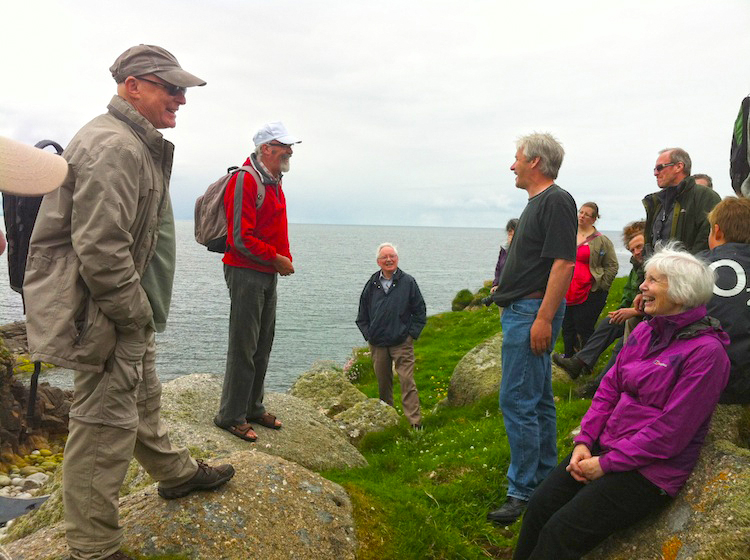
‘Acupuncture of the body, acupuncture of the earth’ – author Brian Lacey describes a theory he learned from a Slovenian artist.

As many people are now saying, this organisation must host regular, open, community meetings and really listen to what local people – the very people they are there to serve – want in terms of more innovative community development; provide much greater transparency in its spending of an estimated 1.2 billion euro in public money, than it has to date; and an end to kow-towing to political parties and their funders (first Fianna Fail and now Fine Gael) which has resulted in far too much money going into the pockets of a rich elite of developers/builders who make easy profits from building simplistic, unneeded, industrial estates.

A new direction is required and a Catholic Church-run sex, drugs and alcohol addiction center in Falcarragh, with no guarantee of decent local jobs – especially as such a centre already exists in Donegal and research indicates this is sufficient for need – is hardly the panacea for high unemployment and emigration from the area. Some say real investment in local cultural tourism means shelving the proposed investment of three million euro by Údarás in the addiction centre and putting those euro millions into local tourism projects, the one sector a beautiful region like Donegal can benefit widely from, now and in the long-term (if that three million euro is spent on the proposed addiction centre, it spells the end for any real investment in anything else – no other board members of Údarás in other Gaeltachts will vote for any further significant monies for Donegal).

In this regard, it is quite sad to see how much Tory Island has fallen below its full potential – far behind many other attractive island retreats dotted around Ireland. The dismissive attitude of relevant funding authorities – and perhaps the disunity and lack of concerted lobbying and effort by local people (full burden cannot rest solely on the shoulders of one man, King Patsy Dan) – has meant its tourism income has suffered greatly, with accompanying lack of promotion (not even a regular newsletter on events or significant signage on the mainland and on the island itself).

“I am tired of trying to persuade Udaras na Gaeltachta officials to properly fund projects here on Tory Island, their ears are deaf, they simply don’t understand,” said King Patsy Dan MacRuaidhri. “The people here deserve such support. Our ancient and colourful history calls out for it.”

Befriending Royalty. Modern version of the horse-drawn carriage?

It’s make-or-break time for northwest Donegal.

Let’s put an end to the notion that cultural tourism is an unimportant, peripheral activity, the kind of mind-think that Údarás officials are stuck on, and have been for decades. This specialized sector has the potential to provide immense, long-term economic benefits for this hard-hit, hard-pressed part of the county and country, but it requires serious commitment and financial support.

In a future post I will give specific examples from my extensive sojourns in other parts of the world as an international travel writer where cultural tourism has transformed and enlivened a local and often paralyzed economy.

Meanwhile the next post will focus on what precisely various speakers at the conference said about Columba, this larger-than-life monk who seems to defy description, someone about whose background we know very little, either because documents were destroyed by marauding, book-burning Vikings, or were deftly confiscated by church abbots on a precise propaganda campaign.

To read more of Sean’s work, check these sites:

Digging for Dracula

World Itineraries

Examiner

JustLuxe

Ireland Writing Retreat

Fios Training and Coaching Organization

IMG_1269

IMG_1381

IMG_1320

IMG_1334IMG_1426

IMG_1342

IMG_1359

IMG_1363

IMG_1374

IMG_1379

IMG_1382

IMG_1390

IMG_1417

IMG_1432

IMG_1472IMG_1478

Flesh-eating plants, soaring eagles, Pagan wishing stones – all in a day’s work

His reputation was spoken of highly by good people – Mary McFadden, former headmistress and organizer of the lively ceilidh dances at Teac Jack’s and John Curran voluntary sector leader and aspiring politician. There seemed no-one better to uncover the anthropological and natural wonders of west Donegal for us than this fellow.

Seamus

So that’s how my wife, Columbia, our two small sheepdogs, Siog (‘fairy’ in Irish) and Lugh (who, according to Celtic legend, slew Balor of the Evil Eye) and myself ended up cowering for dear life under the branches of chubby furze bush as hailstones the size of a rabbit’s droppings – though much, much, much harder – pummeled down on us mercilessly from above.

But the drenching we got was worth the wetting (and sure didn’t the sun break out just a few minutes later as if to reassure us we’d be dry soon). For that’s how we got to know about flesh-eating plants, soaring eagles, Pagan wishing stones and Colmcille’s guide to the joy of sex all along the newly-Christened ‘Wild Atlantic Way.’ And many’s another thing that’s in Seamus Doohan’s head about our wee area tucked away in the far corner of this, the Forgotten County.

An electrical contractor by trade, the jolly, bald-headed 48-year-old became fascinated by the immense diversity of natural and anthropological features around him in his native Gaeltacht area of Cloughaneely after he participated in a sports endurance charity event for cancer victims three years ago. There and then he decided to study the local flora, fauna and history in greater depth and to launch a guided walks and navigation service, Walking Donegal, as an added attraction for visiting tourists and for local people. So far, he has taken several hundred on tours, including visitors from countries as diverse as Italy, the US and Japan, as well as guided walks with the Errigal Arts Festival and for schools.

Seamus 2

“We are spoiled for landscape choice in west Donegal, with such a wealth of intricate and colourful plant species and a fascinating history dating back to the time of primitive man and Pagan worship, not to mention the Christian era that came afterwards,” he said.  “There is something mysterious and magnetic about the mountains around us here, with so many routes for walkers of all ages and aspirations.”
Seamus’s walks, which include forest, island, hill and beach, range in duration from one to five hours and are graded 1 through 5 in terms of difficulty, from flat terrain to challenging gradients. They traverse places such as Horn Head, Ards Forest Park, Sli an Earagail, Dunlewey Glen, Tory, Innisboffin and Arranmore, as well as the Joey Glover Challenge, a walk from Muckish to Errigal “taking in all the mountains in between.”

devil's matchstick

Halting momentarily on the way up rolling fields to Lough Altan near Errigal, Seamus suddenly bends down and parts some blades of grass. Hidden beneath is a tiny plant with a vivid red head. ‘Devil’s matchstick, or cladonia cristatella,” he says, then points to a spot a few feet away. “And over there, some Devil’s chalices.”

devil's chalis

Running his fingers over a spread of soft lime-green moss, he adds, “Sphagnum. During the First World War there was a shortage of bandages and they used this to stem the flow of blood, especially from bayonet wounds. But there are a hundred other varieties.” He swings round on his hunkers to gaze at a small plant with what looks like a set of animal horns on top. “That’s staghorn. And there’s club and fern over there. Beside them, that’s bell and ling heather. You can dry their flowers and make healthy herbal teas out of them.” Turning again, his eyes searching closely, he adds, “There’s some tormentil flowers. They’re yellow in summer, natural antiseptic to ease toothaches. And there, sundew plants. They’re carnivorous, the glands on their leaves emit a sticky gel to traps insects. They then eat them to supplement the poor mineral nutrition of the soil in which they grow.”

Spagnum

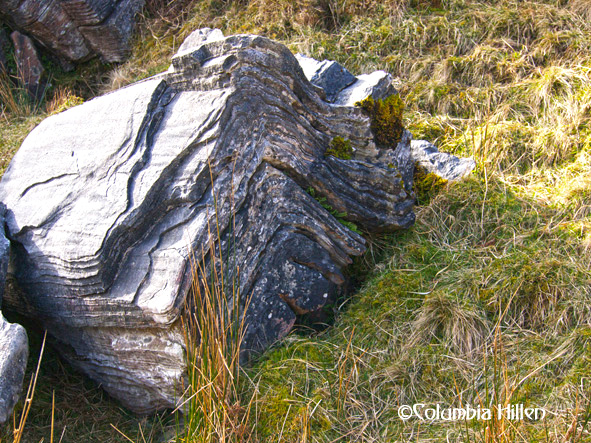
Further along, by the side of an old pony and cart track used more than a hundred years ago to get to Altan Farm, he stops again, this time beside a strange rock formation that resembles the open pages of a book.  “I call this ‘leabhar cloch Cholm Ciolle’ (Colmcille’s book of stone). It’s believed the monk, who would have wandered these hills, secretly copied a mysterious text. Who knows? This could be it – magically petrified.” Somebody nearby says the book in question was probably ‘The Joy Of Sex” – a particularly delightful illustrative book that helped enlighten me greatly in the face of strict Catholic doctrine on the sacrosanct subject. But Seamus rightly ignores my nostalgic ramblings. And rambles on up the hill.

book

Below in the sunshine, the ruins of a once sturdy, castle-like structure stands at the head of the lough, still defying the elements after all these years. To our left a herd of deer dart away on to higher ground while above us two eagles glide effortlessly, on the sharp lookout for unwary prey.

eagles

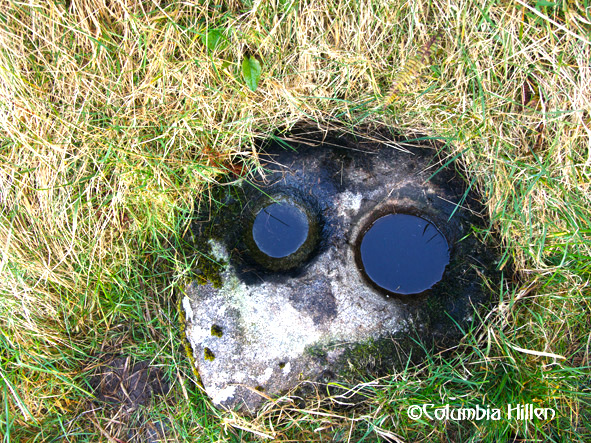
Later, up a steep climb behind Gortahork, Seamus, who is secretary and training officer of the North West Mountaineering Club, points to two round indentations carved out of bare stone, resembling an alien’s head. “Cup or ring marks, prehistoric art,” he says. “Sometimes known as wishing stones in Pagan times. Supposedly the water that gathers in them heals warts, thus the Gaeilge name, Tober na bhFáithní (the Wart Stone). ”

alien

Out at Ray, he stops at a ruined church and flat run of fields beyond, “This is known as ‘Lag na gCnámh,’ the resting place of bones, after a massacre that occurred here in the 17th century,” he ssays. “No-one knows exactly where the bodies are but there’s a lot of them under this soil somewhere.” In a hillside graveyard outside Falcarragh, he stands in the wind and rain, gazing east, “Amazing to think that druids long ago in their big, flowing cloaks stood right here with this amphitheater of hills in front of them and prayed to Nature.”As he spoke and the hailstones started pouring down again, I wondered if he might just take on the role, burst into a chant and invoke the Sun God to smile upon us.

Ray church