Minister of Public Expenditure raps Údarás na Gaeltachta for lack of transparency

Minister of Public Expenditure and Reform, Brendan Howlin, has rapped Údarás na Gaeltachta on the knuckles for failing to release vital information on spending of public money affecting Donegal and other Gaeltacht areas.

Following a refusal by Údarás to provide details on hefty pension payments to former executives that accounts for more than half its annual budget under a Freedom of Information (FOI) request I filed, formal written parliamentary questions were submitted by TDs angry about the lack of transparency by the Gaeltacht economic development group.

FOI

Such questions culminated in one by Mary Lou McDonald, Sinn Fein TD and member of the Public Accounts Committee (PAC) on my behalf, directly to the Minister, “To ask the Minister for Public Expenditure and Reform in view of his stated commitment to transparency and accountability in the spending of public moneys, his views that it is acceptable for a public body fully funded by the Exchequer to withhold from the public record details of public service pension arrangements on retirement for senior managers; and if he will legislate to require all publicly funded bodies to make such information public in the interests of open Government.”

A formal written response has just been received from Minister Howlin, in which he, in effect, tacitly states that Údarás was wrong to turn down my FOI request seeking details of pensions for former executives paid wholly out of public funds, and that it should release the information forthwith.

The Minister writes, “Under the 2014 (Freedom of Information) Act, the terms and conditions of any individual who holds or held any office or other position remunerated from public funds in a public body, rather than just those of a Director or member of staff as provided for under the 1997 Act, are not afforded the protections under the Act in relation to personal information. On that basis, the type of information to which the Deputy’s question refers i.e. public service pension arrangements on retirement for senior managers which would be part of remuneration, would be available from a public body that was subject to FOI, other than where a specific exemption applies against the release of such information.

The Minister elaborates further, “Under the Freedom of Information Act 2014, as was the case in the original Freedom of Information Act in 1997, an exemption from the provisions of Freedom Of Information (FOI) is provided for personal information. The 2014 Act also expanded the definition of what does not constitute personal information in the context of FOI.”

In answer to McDonald’s question as to whether the Minister “will legislate to require all publicly funded bodies to make such information public in the interests of open Government,” the Minister writes, “Given the matter is already provided for by the Freedom of Information Act 2014, I do not consider further legislative action is required.

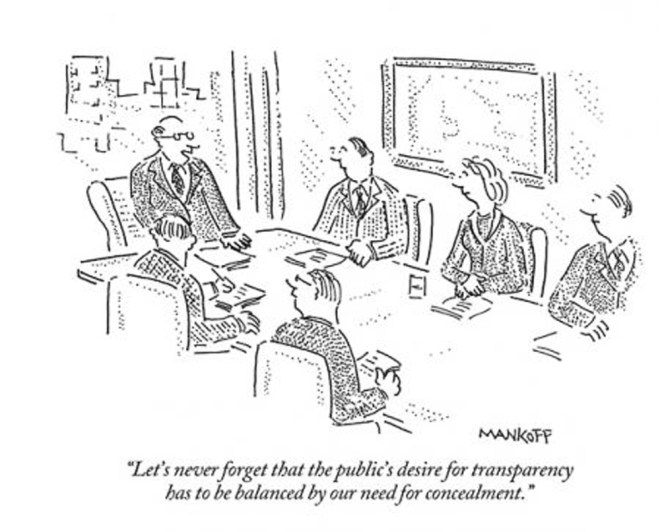
As we have seen with scandal-hit FAS and other Irish state bodies that abused peoples’ trust and misspent public money, the only way to prevent corruption is by creating greater transparency. The government coalition of Fine Gael and Labour made this a central issue in their electoral platform. In the three years since they took office, little progress has been made.
cartoon

Several weeks ago, Ireland was placed 31st position ‘in the league of transparent nations’ following research by the World Wide Web Foundation. It is the worst of any European nation, even behind countries such as Russia, Mexico and Brazil. The group’s categorized Ireland as a country that faces challenges to “mainstreaming open data across government and institutionalizing it as a sustainable practice.” It also said “core data on how the government is spending taxpayers’ money and how public services are performing remains inaccessible or pay-walled even though such information is critical to fight corruption and promote fair competition is even harder to get.”

Tim Berners-Lee, Web, founder of the Web Foundation and the London-based Open Data Institute, said, “Governments continue to shy away from publishing the very data that can be used to enhance accountability and trust” and highlighted the power of open data “to put power in the hands of citizens.”

Údarás is a classic case in point.

lenses

Dinny McGinley, former junior minister for the Gaeltacht, wrote back in a vague response to my FOI request saying simply that Údarás had informed him it was “a data controller, defined under the Acts as a person who either alone or with others controls the contents and use of personal data.

For so many years untouchable hidden behind a veil of Irish-language support, Údarás perhaps is in many ways no different to FAS in terms of greed and individual self-interests. According to Údarás sources, former board members in Donegal remained in boardroom meetings during discussions on lucrative payments to their very own companies and organisations. In addition, not one but at least three Donegal Údarás board members have been up before the Standards in Public Office Commission on corruption charges relating to double dipping on expenses. When one considers the expense claims for board members, particularly under the long-time chairmanship of Liam Cunningham from Glencolmbcille (from 2005 to 2010 he received more than 155,000 euro in fees and expenses, according to Highland Radio), one has an idea of the unchecked, proliferate spending that went on.

Some details as already reported by Highland Radio –

  • Four former Donegal members of the Údarás board each received in excess of 100,000 euro each, over a four-year period, in travel expenses.
  • Fianna Fáil member Daithi Alcorn earned nearly €120,000 between 2005 and 2009;
  • Fianna Fail Senator Brian O Domhnaill received €115,000 while independent Donegal member Padraig O Dochartaigh received €105,000.

Over one billion euro of public money has already gone into supporting Udaras na Gaeltachta yet unemployment rates in Gaetachts are consistently highest in the nation.

Misspending of public money (an issue brought up by the former head of the PAC, see 3-part series article series), includes all-expenses trips to Las Vegas for Udaras board members and their spouses – supposedly to meet a delegation of the IDA;

In truth, Údarás was – and perhaps still is – a cash cow for well-to-do insiders in west Donegal.

It is long past time Údarás prepared proper annual reports instead of the porous documents it now produces that disguise the spending picture and that it holds open public meetings to allow the people of the Gaeltacht to know exactly how their hard-earned money is being spent.
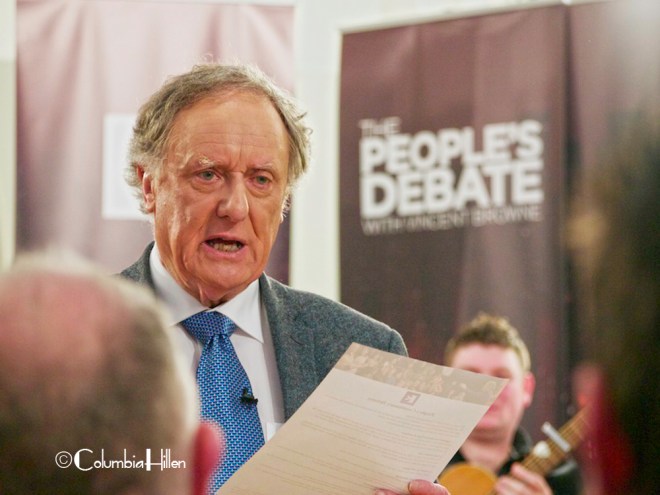
TV3’s Vincent Browne ‘People’s Debate’ in Donegal attracts lively discussion

While Fine Gael and Labour were expected to take a beating at yesterday evening’s Vincent Browne-hosted ‘People’s Debate’ in Letterkenny – in part deserved as the two parties refused to participate – Fianna Fail also took a drubbing.

OLYMPUS DIGITAL CAMERA

At one point, after listening to the party’s TD Charlie McConalogue berate government policies, the veteran TV host exclaimed, “I cannot understand how you can make these criticisms. Fine Gael is simply following Fianna Fail policies. Fianna Fail laid down the strategy for dealing with the banking bailout and Fine Gael and Labour are merely following it.”

McConalogue made another mistake later in the debate saying, “the agreement with the Troika was negotiable,” thus contradicting what the public had been told by Fianna Fail that the deal under former Taoiseach Brian Cowen and Minster of Finance, Brian Lenihan, was non-negotiable. Browne was quick to make the point, “Your party said details of the agreement with the Troika were non-negotiable, yet now you say they were. Make up your mind.”

On the emotive issue of water charges, McConalogue – after much fudging said he would halt Irish Water and suspend water charges. Again, Browne responded, “Your party, Fianna Fail, already had a plan in place in 2010 to impose water charges, but now you’re saying you’re having second thoughts.”

OLYMPUS DIGITAL CAMERA

Browne, at his best as a current affairs host when pushing political guests for a clear-cut answer, didn’t let the lively capacity audience down, especially when badgering the four-member panel for their views on a potential coalition after the next election. Asked whether he would take a ministerial seat under a Fine Gael or Fianna Fail led coalition Sinn Fein’s Pearse Doherty seemed somewhat uncomfortable in his seat.

“That is a hypothetical question and such decisions are made at our party Ard Fheis,” he said finally, as if caught by surprise, but recovering. “What we have agreed is that unless water and property charges are dropped, we will not go into any coalition.” He acknowledged, “Some members have voiced their opinion that they would go into a coalition as a minority party. We are a party hungry for change, we are not hungry for power.”

When asked the same question, his Sinn Fein colleague TD Pádraig MacLochlainn was more direct, unhesitatingly replying, “I will not participate in a government led by either Fianna Fail or Fine Gael.” As if taking strength from this, Doherty later stated categorically, “If asked by a government led by Fianna Fail or Fine Gael to be a minister, I would refuse.”

OLYMPUS DIGITAL CAMERA

After chastising the two Sinn Fein members for not giving a straight ‘yes’ or ‘no’ answer, McConalogue himself began the dance of the slippery eel until, under bombardment from host and audience, he finally said, “I would not like to participate in a Fine Gael-Fianna Fail coalition but if I was outvoted by my party colleagues I’d have to go along.”

In his two-minute intro, Doherty said “four years ago we were promised a democratic revolution yet all we have had is more of the same with cronyism, stealth taxes and high levels of unemployment, no more so than right here in Donegal. There is a fairer and better way of moving forward and Sinn Fein’s job strategy can reshape this county.” He added that it was little wonder Donegal was known as ‘The Forgotten County.’ “I know Vincent you didn’t come here by train because this is one of only five counties in all Ireland without a mainline railway service.” Under an FOI request he said he has asked for a government paper produced on the future of small schools, adding that Donegal has the second largest number of such schools, with four teacher or less.

When corruption and lack of transparency within Údarás na Gaeltachta was brought up, including its refusal to release key information on its public spending such as lucrative pension payments to former executives which amount to half of its entire annual budget, Doherty said his party had tabled formal parliamentary questions on the issue, adding, “there should be full disclosure about people in receipt of high public pensions, it is important to have complete transparency so such payments can be scrutinized by the public.”

McConalogue said in his intro, “the last four years of government have been an attack on Donegal with post office closures, agriculture being hard hit and worsening heath services,” adding, “we have strong potential here but we need better infrastructure including the A5 project up and running and wider broadband.”

Referring to the pre-election catchphrase ‘Frankfurt’s Way or Labour’s Way,’ MacLochlainn said the government’s record has proved very different, “with a reduction in classrooms, budget cuts across the board and Donegal having the lowest allocation of medical staff of any county.” He added, “Donegal people are hard-working and passionate. All we’re asking is a fair chance and for Dublin to meet us halfway.”

Regarding the water charges, he added, “For thirty years, Sinn Fein has opposed these charges and now it has become the straw that broke the camel’s back. There has simply been too much austerity. Irish Water is a white elephant. My message is ‘scrap the water charges and go back to the drawing board.’ ”

While decrying the lack of proper health services and unfair stealth taxes, Independent TD Thomas Pringle said renewable energy had tremendous potential for Donegal as had the biomass wood industry. Speaking of Killybegs, he also said the fishing industry had been “hard-hit.’ He said water conservation should be a top priority because so much is being lost through poor network connectivity. He also said he was proud of challenging the bank bail-out through the courts and being in the forefront of water charge protests (continuing the momentum, a major ‘Right2Water’ protest took place earlier today – Saturday – in Letterkenny, with others elsewhere nationwide).

All four TDs, when asked directly, said they would vote ‘yes’ in the upcoming referendum on same-sex marriage.

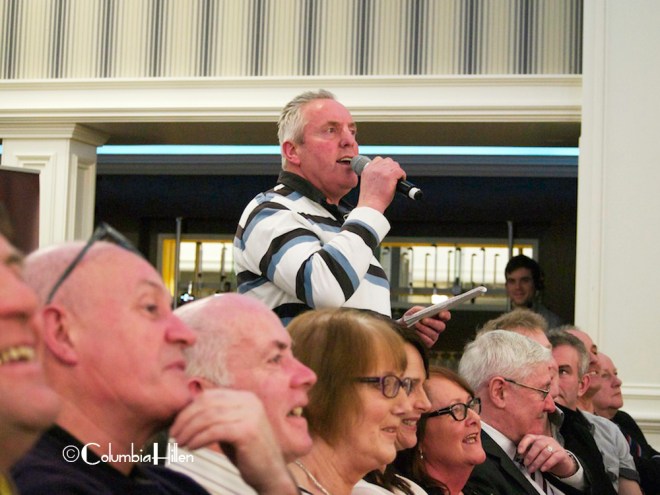
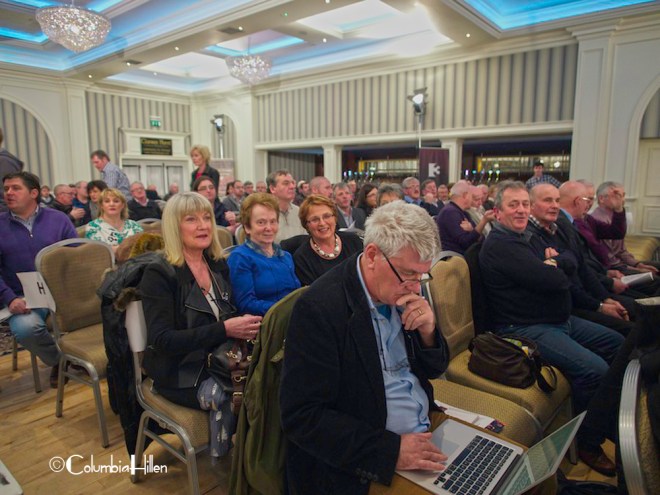
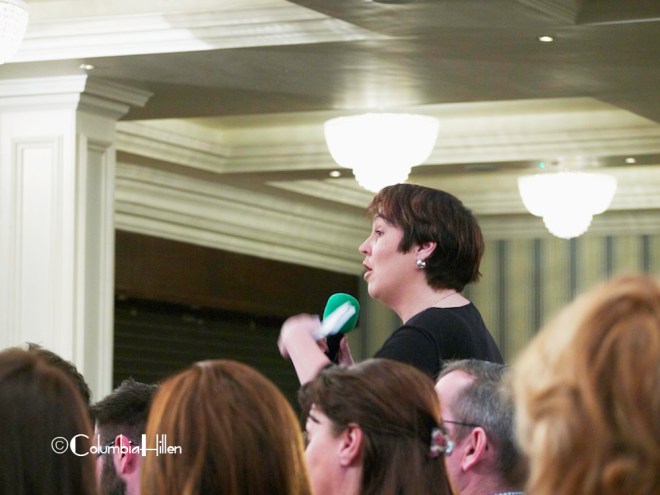
Over the lively, two-hour event at the Clanree Hotel, there was no shortage of questions from the floor with periodic rambunctious catcalls, cheering and booing, which caused short stoppages and words of warning from the presenter.

OLYMPUS DIGITAL CAMERA

True to his word, Browne attempted to cover as many topics as possible such as equality, including the upcoming same-sex marriage referendum; family services, education, employment and health. Speakers ranged from parents of terminally-ill children; school teachers, social workers and community activists working on behalf of people as diverse as lesbians, gay, bisexuals, transgender, cancer sufferers, the disabled, and many others.

Some light-hearted moments and biting comments helped take the edge of emotions as when a thirsty Vincent Browne ran out of water and promised he’d even pay for some and when James Woods from Gortahork commented that with so much emigration, Donegal was turning into a wildlife refuge.

OLYMPUS DIGITAL CAMERA

All in all, ‘People’s Debate’ is an excellent initiative by TV3, no doubt demanding detailed planning to host such shows in all the constituencies of Ireland.

Fine Gael and Labour’s decision to spurn them, indicating fear and a lack of understanding of the difficulties facing ordinary people, could ultimately cost them vital votes in the polling booths.

OLYMPUS DIGITAL CAMERA

OLYMPUS DIGITAL CAMERA

OLYMPUS DIGITAL CAMERA

OLYMPUS DIGITAL CAMERA

OLYMPUS DIGITAL CAMERA

OLYMPUS DIGITAL CAMERA

OLYMPUS DIGITAL CAMERA

OLYMPUS DIGITAL CAMERA

OLYMPUS DIGITAL CAMERA

OLYMPUS DIGITAL CAMERA

‘Whatever you say, say nothing!’ – motto of Údarás na Gaeltachta

‘People have no right to ask how we spend their money.’

That’s the attitude of Údarás na Gaeltachta, which has once again refused to release key information about how it spends public funds.

Udaras

A Senate committee revealed that Údarás pays millions of euro every year in pensions to former executives, some of whom were local Donegal employees including Cathal MacSuibhne, former regional manager based in Gaoth Dobhair.

cathal

Sinn Fein’s Trevor Ó Clochartaigh, a member of that Senate committee, exclaimed, “I nearly fell off the chair when I heard that almost half the current expenditure goes on pension payments to 136 people who are no longer employed by the organisation. Small wonder Údarás is not able to function more effectively.

He added, “This raises serious concerns regarding the levels of monies being paid and who is receiving them.”

Under transparency rules, other public bodies have made a breakdown of such pension figures available for examination, but in response to a Freedom of Information (FOI) request I made, Údarás refused to do so, citing gobbledegook about data protection.

As a result, having brought the matter to the attention of a number of TDs, the Údarás pension issue has risen to the highest levels of national government, to the office of Brendan Howlin, Minister for Public Expenditure.

I can reveal in this blog that on my behalf various leading politicians including Public Accounts Committee (PAC) member, Mary Lou McDonald, have attempted to find out the individual pension figures but Údarás has stonewalled every request, preventing their release.

MaryLou

How it happened

Údarás responded to my initial FOI request last year seeking details on pension and lump sum payments to former executives in a letter signed by Padraic O’Conghaile – a ‘cinnteoir’ at the organisation’s headquarters in Galway.

In the letter, he wrote, “I am refusing these records as they relate to the pension of an individual under Section 28.1 (Personal Information). The FOI Act defines personal information as information about an identifiable individual that: ‘would, in the ordinary course of events, be known only to individuals or members of the family or friends, of the individual.’ I believe that the right to privacy of these persons with regard to such information far outweighs any public interest there may be in this matter.

The fact, that all the pensions and payments are publicly-funded and thus not “known only to individuals or members of the family or friends, of the individual” as he asserts – did not seem to enter Mr. O’Conghaile’s thinking. Or, perhaps, did, but he refused to acknowledge it.

Following this response, I requested several TD’s to present formal written parliamentary questions in the Dail on the same issue.

For example, Mary Lou McDonald, a member of the Public Accounts Committee (PAC), submitted her parliamentary question to the Minister for Arts, Heritage and the Gaeltacht asking the Minister to “reference the specific provisions of the Data Protection Acts 1988 and 2003 to which he referred (supporting Údarás’ denial of information); the basis on which he believes Údarás na Gaeltachta does not, unlike in the case of all other senior managers across the civil and public sector, have to make public the details of public service pension arrangements on retirement for senior management.

Dinny McGinley, then junior minister, wrote back in a vague response saying simply that Údarás had informed him it was “a data controller, defined under the Acts as a person who either alone or with others controls the contents and use of personal data.

dinny

Put in simple words, it means Údarás, while deriving all its funding from public money, considers ‘People have no right to ask how we spend their money.’ McGinley’s response also has no logical meaning whatsoever under present Irish law. Instead it is a classic delaying tactic. The former Minister did not bother to question it or seek elaboration.

That response led McDonald to submit a follow-up question, this time to Minister Howlin, reading, “given the Minister’s stated commitment to transparency and accountability in the spending of public monies, whether in his view it is acceptable for a public body fully funded by the exchequer to withhold from the public record details of public service pension arrangements on retirement for senior managers; and if he is prepared to legislate to require all publicly funded bodies to make such information public in the interests of open government.

HOWLINBRENDAN

It is most disappointing that a simple request to a fully publicly funded body about its spending has led to such a reactionary response from an organisation such as Údarás, which is responsible for the economic, social and cultural development of the Gaeltacht.

Such utter lack of transparency and disregard for public concerns has already led to such widespread corruptive practices as those at FAS when it was discovered hundreds of thousands of euro went on lavish holidays including first-class travel and expensive rounds of golf for executives and their wives. Údarás itself has yet to account for trips paid out of public funds for board members, executives and wives to visit attractive international destinations, including Las Vegas.

Public money is a precious thing and every penny of it ought to be properly accounted for and judiciously spent.

I will reprint Minister Howlin’s response on this blog when it is received. It should provide a most interesting read.

Bunbeg, once pretty, now disfigured

Once pretty, Bunbeg is looking more and more like a toothless old hag.

Derelict spaces, decrepit ‘For Sale’ signs and boarded up, empty and run-down buildings have pockmarked its once thriving main street.

OLYMPUS DIGITAL CAMERA

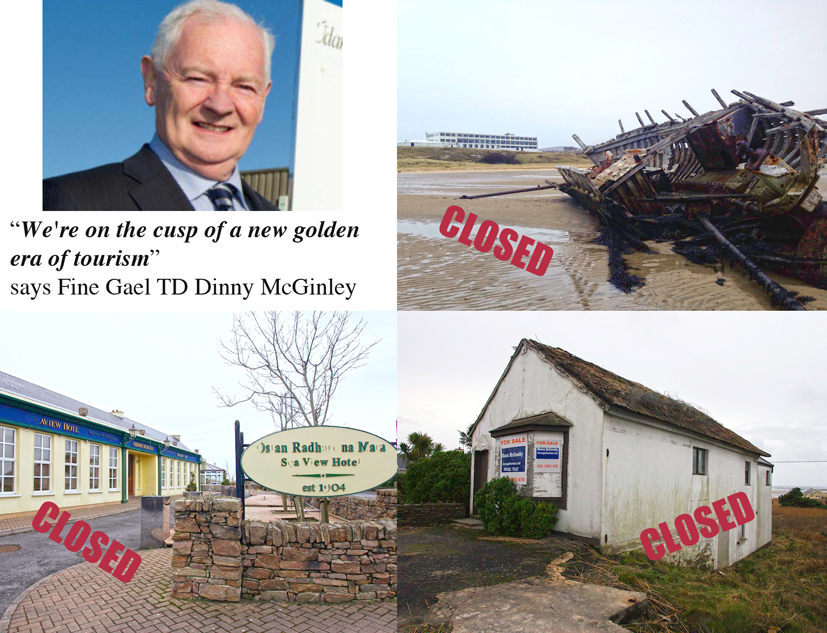
The iconic, century-old Seaview Hotel, which employed over 108 people seven years ago (talk of Cayman Islands and meat debts has no place in this blog), stands empty and forlorn this week , joining a heap of other ‘deadwoods’ on the street  – a once popular restaurant opposite and three other nearby hotels, The Errigal View, the Ostan Gaoth Dobhair and The Brookvale, as well as a mix of shops, bars and cafes, all now closed and crumbling.

Ironically, one of the few buildings to be renovated and opened on the main street is the constituency office of Fine Gael TD and former Gaeltacht, Arts and Tourism Junior Minister Dinny McGinley, the man who proudly pronounced this week, “We’re on the cusp of a new golden era of tourism.”

colaj good

Talk about poor timing.

Not to mention poor positioning. McGinley’s office lies a mere 50 yards from the deserted Seaview Hotel, first established in 1904.

News this week of the Seaview’s demise is a stark reminder of the abnegation by Udaras, the area’s main economic regeneration group, of its prime responsibility for creating  jobs, including those in the hospitality sector, with Gearoid O’Smaolain its main tourism development officer.

Eamon McBride, former President of the Gaoth Dobhair Chamber of Commerce, put it simply: “the area is crying out for more attractions.”

Job losses, lack of transparency

Aside from the 35 jobs, both full and part-time, lost at the Seaview this week, hundreds have been lost at other Udaras-sponsored businesses such as Largo Foods, Nuance and Sioen Apparel over the last few years. In fact, the Udaras Donegal office has performed consistently worse than any other Gaeltacht region in Ireland in terms of its job-creation record.

Sinn Fein TD Pearse Doherty this week called on the Government to immediately publish the findings of a delayed report by a working group tasked with examining job creation in the Gaoth Dobhair area. One hopes he will demand the same of the local Udaras office. Only then, can the organisation be properly analyzed to ascertain if the public is getting ‘bang for its buck,’ or if drastic changes need to be made internally if it is found that employees lack the skills-set necessary for the important task at hand.

photo and chart good

Gaeltacht disintegration

The intriguing part of the sad saga surrounding what is, in effect, economic mismanagement of the Irish-speaking area, is that while towns within it, such as Gortahork, Falcarragh and Bunbeg, are literally peeling apart, both economically and physically, Dunfanaghy, just outside the borders of the Gaeltacht, is riding a wave, with bars and cafes enjoying a boost in trade, especially at weekends – without the benefit of public funding of any kind.

While Udaras Donegal announced this week it will release proposals for economic development, observers say this is more a cosmetic exercise aimed at organisational survival than a serious attempt at strategic innovation and staff revision – that it has not even hosted a single open public meeting to ascertain the views of ordinary people, the very people who pay for its running costs. Interestingly though, while widespread job losses have occurred in Udaras-sponsored companies in Donegal, no such losses have occurred within the local Udaras office itself.

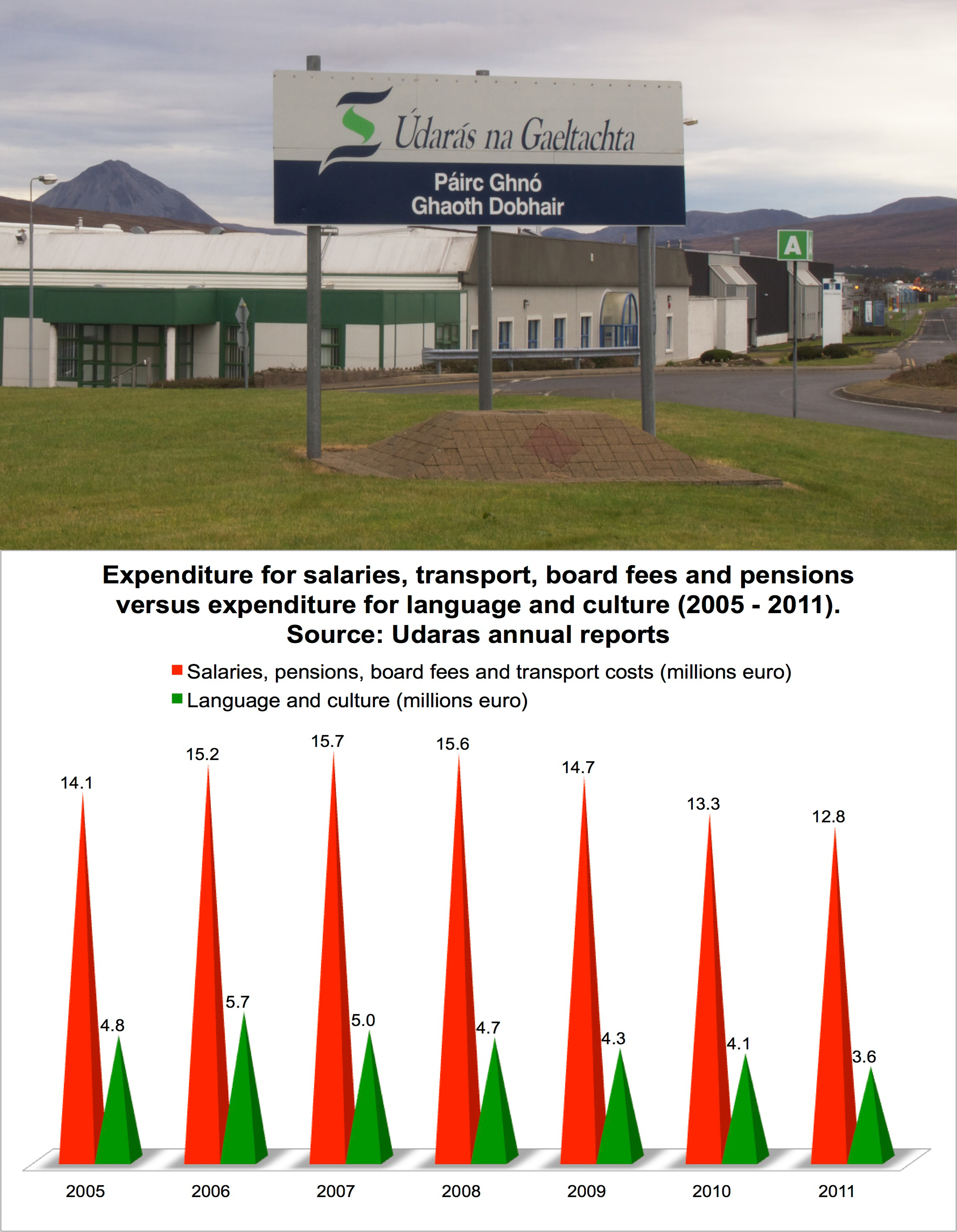
Based on its operational history (see above graph), should we accept as normal that out of its seven million euro budget for this year as announced by Udaras officials, two-thirds go towards salaries, pensions and expenses, and the remaining one-third only to economic and language development?

Is it not long past time this organisation came under closer public scrutiny and thus be made more accountable?

Complaint about Udaras cover-up sent to Ombudsman

Ireland’s biggest fault is lack of accountability – the main reason we’re in the humiliating position of doffing our caps and begging for mercy from the IMF.

Instead of fairness and transparency in public affairs, we get cronyism and cover-ups. The Central Remedial Clinic, The Financial Regulator, FAS, the Rehab Group, the John McNulty scandal …. the list is a depressingly long one.

But what’s even worse is when our supposed independent media collude in supporting this kind of deception.

Damning evidence this week indicates that is exactly what the local office of Udaras na Gaeltachta and the ‘Donegal Daily’ news website have been involved in.

Earlier this year, Udaras’ local tourism officer Gearoid O’Smaolain contacted Stephen Maguire, the news website’s co-owner, complaining that a report on the site contained what he said was “a fabricated quote,” attributed to him when he spoke at the launch of the multi-million euro, EU-funded CeangalG project at An Chuirt hotel.

false accusation

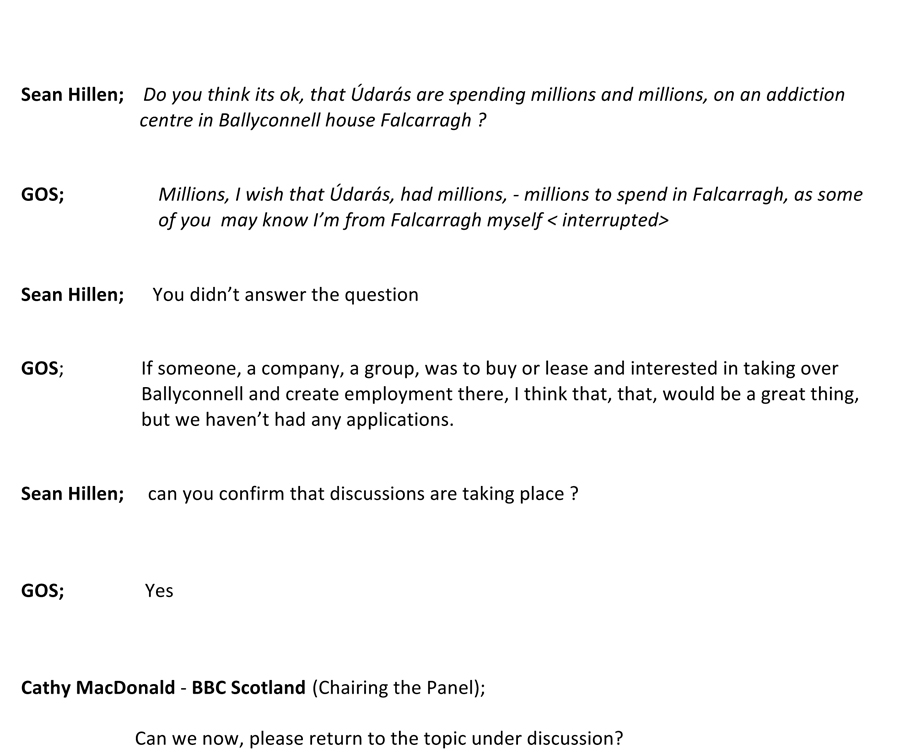
At that conference, I had asked O’Smaolain about a proposed addiction clinic in Falcarragh that was rumored would cost taxpayers several million euro and run by the Catholic church. O’Smaolain said discussions were indeed underway with Udaras, that his organisation didn’t have millions to spend and that no decent projects had been put forward for the site at Ballyconnell House beside the town golf course. Thus the article below:

Angry reaction to setting up addiction clinic in Falcarragh

As it was I who compiled the news report, Maguire promptly called me, saying O’Smaolain told him he had an official transcript of the conference to prove his accusation. I asked if he (Maguire) had read or listened to this transcript. He said he hadn’t but that O’Smaolain had sent him an excerpt. See below –

transcript email

Sean Hillen Q and A

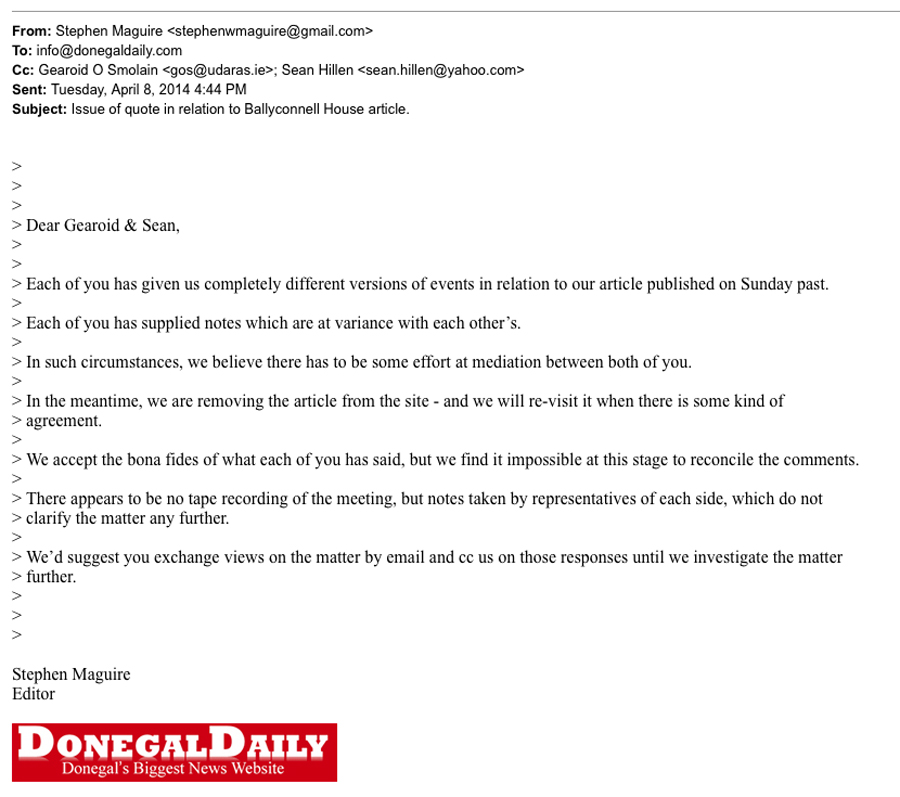
Upon reading this, I offered to give Maguire my notes from the conference so he could make a fair decision. Instead he sent this e-mail to both myself and O’Smaolain.

letter from Maguire

Imagine my shock, therefore when – without further notice – I then read this abject apology on the ‘Donegal Daily’ website the very next day.

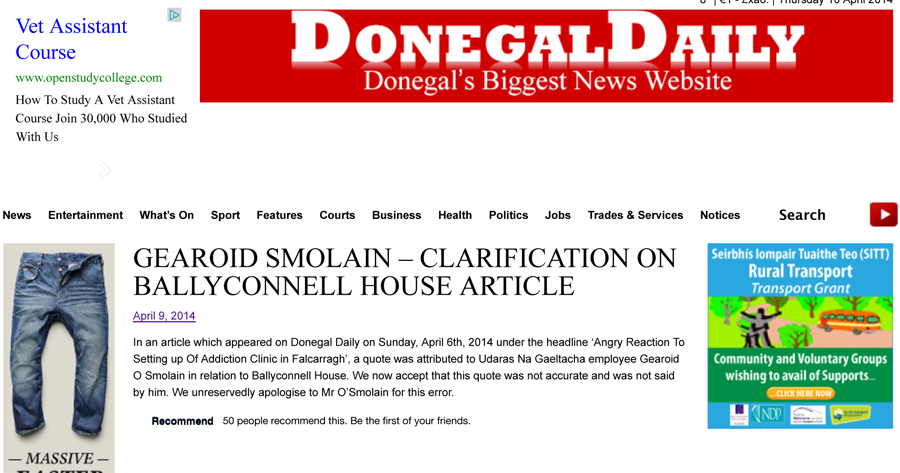
GEAROID SMOLAIN – CLARIFICATION ON BALLYCONNELL HOUSE ARTICLE

I contacted Maguire repeatedly asking for an explanation and a copy of the official transcript of the conference. Months later, still no response.

I then contacted Sabhal Mòr Ostaig in Scotland, the leader of CeangalG, which had also planned and supervised the conference at An Chuirt, asking them for a copy of the transcript.

Claire Nicolson, the organisation’s administrator, was helpful, initially saying she did not think there was such a transcript, and, when I requested a definitive answer, responded this week in the message below that was also c’d to Alasdair Morrison, a former minister in the Government of Scotland, now CeangalG director.

From: Claire Nicolson <claire@connectg.net>

To: Sean Hillen <sean.hillen@yahoo.com>

Cc: Alasdair Morrison <alasdair@connectg.net>

Sent: Friday, December 12, 2014 5:31 PM

Subject: Re: Donegal conference

Seán, a chara, thanks for your email.

That was our cultural tourism conference in February. I recall you asking for this information before. I’m sorry, there was no transcript or recording of the event.

Le gach dea-ghuí

Claire

O’Smaolain therefore, it emerges, not I, was involved in fabrication. Worse, Stephen Maguire and ‘Donegal Daily,’ fully supported him in doing so based on a transcript that never existed.

One might ask: Why was this subject so sensitive that such lies and deceit were used to keep it from the public eye? And why would an editor kowtow so easily to make an unjustified apology and retract a perfectly accurate news story from a website?

As the reasons for Maguire’s actions are obviously not in pursuit of journalistic excellence, are they merely financial? Did Udaras or organisations or individuals associated with Udaras either threaten him or Donegal Daily Ltd. with a lawsuit or through withdrawal of advertising? Or, indeed, did they promise future ad revenue if he simply did as they demanded?

By coincidence, John Curran whom Fine Gael appointed to the board of Udaras and who subsequently failed to win a local council seat recently, had a paid political banner ad in the ‘Donegal Daily’ when my addiction clinic broke. Did Curran threaten to withdraw his ad if the story was not squashed? See the ad at bottom of the same page as the story : Angry reaction to setting up addiction clinic in Falcarragh

If true, this is a most dismaying development, illustrating the reason why there is a falling level of trust by Irish people in today’s government.

Equally, O’Smaolain’s accusation in defense of Udaras – now shown to be false – illustrates why there’s a growing lack of faith in organisations trusted with spending scarce public money.

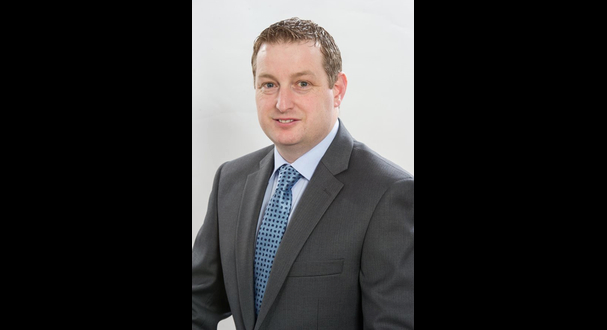
Gearoid O’Smaolain (l) and Stephen Maguire (r)

And most dismaying of all in many respects is the conduct of Stephen Maguire and the ‘Donegal Daily.’ As I pointed out in an earlier post, strong independent media underpins any democracy.

After more than 30 years in journalism both here at home and abroad, I still firmly believe this. As truth is the rudder that steers ethical decisions in journalism, it is most disappointing to see how Maguire and the ‘Donegal Daily abrogated responsibility in such a pathetic way.

Having investigated the situation comprehensively over the last few months, I forwarded a file to the Press Ombudsman and the Press Council of Ireland, only to be informed that it could not investigate further as ‘Donegal Daily’ is not a member of the council.

I find this ironic as only a few days ago the ‘Donegal Daily’ boasted of being among the most popular news websites, yet is not even a member of a nationally-respected organization to which all serious news media outlets belong.

I suppose, more than anything, this indicates how earnestly Mr. Maguire considers the importance of accuracy in news reporting.

My file outlining how Mr. O’Smaolain misused his authority in an effort to damage my reputation, is now with the Office of the Ombudsman. What action is taken, if any, will indicate if our government is serious about creating a more transparent and accountable society, thus preventing what happened to me, happening to others.

Yet another Irish political fiasco

I was shocked to read in a leading Donegal newspaper editorial over the last few days that John McNulty had behaved ‘with dignity’ over his recent Fine Gael botched Senate nomination.

Let’s call a spade a spade.

The last thing Mr. McNulty behaved with was dignity. He condoned the onward march of cronyism and ‘stroke politics’ thus giving his full support to this age-old blight on Irish society.

John McNulty – guilty as charged, complicity to hoodwink. Photo courtesy Independent Newspaper.

Selling Mars bars at a Mace grocery shop in Stranorlar hardly qualifies Mr. McNulty to contribute much, if anything, to the development of the Irish Museum of Modern Art (IMMA) (unless his business is merely a front for a secret network of art collectors storing priceless Van Gogh’s under the petrol pumps). There are many throughout the country with decades of high-level experience in the arts sector and thus much more qualified than he.

Yet when Fine Gael spin-doctors whispered in his ear they’d pull a few strings and shove him on the (already full) board, thus giving him an easier ride into the Senate, he leapt like a deer in heat, omitting to point out the simple fact that he was completely unqualified for such a key position.

In doing so, the 37-year-old Kilcar man is as guilty as those people – mainly under Fianna Fail’s governing stewardship – who greedily grabbed places on other boards such as FAS and the Central Remedial Clinic and proceeded to claim hefty payments and generous expenses on the backs of struggling tax-payers. (Fianna Fail actually rushed 182 of their members on to public boards in the dying days of its last reign).

It must also be remembered that, far from being a credible Senate nominee, Mr. McNulty failed to even get elected to Donegal County Council having won just over 800 votes in May, less than half of the quota required for the six-seat electoral area. In fact, he finished the race at the rear of the pack at a distant 10th place.

Choosing him shows just how desperate Fine Gael are to shore up its political representation in Donegal, especially with the additional failure of John Curran, its choice for the Udaras board, to get elected to the local council (in great part over his willingness to hand over more than a million euro of tax-payers money to the Catholic nuns to run an addiction center in Falcarragh when there’s already one in Donegal, and after the dead babies scandal in Tuam). With Donegal South-West deputy Dinny McGinley due to retire at the next election, Curran’s failure and now McNulty’s means there’s nobody in place as a successor.

John Curran – until recent local elections, was being groomed as potential successor to TD Dinny McGinley?

Public boards or private clubs?

In a bizarre twist to the tale, Fine Gael Arts Minister Heather Humphreys said in the Dail this week that Mr. McNulty was appointed to the board of IMMA “on the balance of talent and experience.” That’s a joke. The minister then added that she and her party were committed “to using the public appointments procedure in line with the guidelines.” That’s an even bigger joke. It recently emerged that at least two of the six appointees to the Board of the Heritage Council last year were made by her colleague Minister Jimmy Deenihan in contravention of that very same formal application process.

Further, a 2012 report by the Institute of Directors In Ireland on state boards showed concern at the lack of transparency around the appointment process and the lack of consideration given to the skills required to fill them. Since then, board positions have featured on Government department websites and advertised via the Public Appointments Service but some describe this as ‘pure window-dressing’. The McNulty situation, and perhaps the Curran one too, are cases in point.

Plain-speaking (maybe too plain) Minister for Health Leo Varadkar said election to the parliament of a candidate who has withdrawn – as McNulty has done to avoid further embarrassment – would not be good thing for the political process. Duh, really?

Obviously, the only way forward is to make the recruitment process entirely transparent, minimise government involvement in choosing appointees, and actively engage individuals with the appropriate skill set to fulfill these positions.

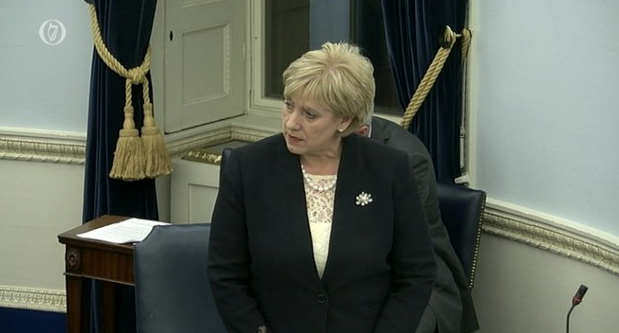
Fine Gael’s Arts Minister Heather Humphreys in the Dail struggling to deflect accusations of cronyism and stroke politics. Photo courtesy RTE News

No crying over spilled milk

Ultimately, however, we have only ourselves to blame.

Most of those who voted for Fine Gael over Fianna Fail three years ago knew deep in their hearts exactly what they were doing. Being conservative, as we Irish are by virtue of our Catholic upbringing, we voted for one party knowing full well deep down it was little different to the other. Then we deigned to pat ourselves on the back for ‘taking a bold stand.’

What baloney! Ours was nothing less than a cowardly act.

To make matters worse, when we had the chance to regain some degree of pride and do away with a Senate that is, and always has been since the foundation of the state, a complete and utter waste of public money, we declined to follow our instincts and put pen to paper. How could any of us vote for such an anachronistic and discriminatory institution highlighted by the fact that with so many worthy universities and colleges throughout Ireland, only two – Trinity College Dublin and the National University of Ireland – are permitted to have Senators? Not to mention that 11 Senators are simply appointed on the whim of the Taoiseach. No elections, no vote.

Padding expenses? Investigations well underway on shenanigans of Fianna Fail’s Brian O’Domhnaill: Handsome salary as Senator not enough?

Today the Irish Senate, unlike the American one, stands as a perfect model of cronyism and stroke politics, with even appointed party members such as Donegal’s very own Fianna Fáil Senator Brian Ó Domhnaill under investigation for milking the system by duplicating expenses.

We tossed away the opportunity to fling the Senate into the bin of history where it firmly belongs. Let’s not now cry over spilled milk. Like McNulty’s reluctance to apologise publicly for his complicity in attempting to hoodwink us ordinary folk, it’s so undignified.


Cultural tourism – its time is nigh

There are some among us (either through ignorance or greed) who consider Donegal unfit for cultural tourism – but a quick glance at what’s happening right now in the area proves them wrong.

Take, for example, the Slí Cholmcille (Slighe Chaluim Chille) project.

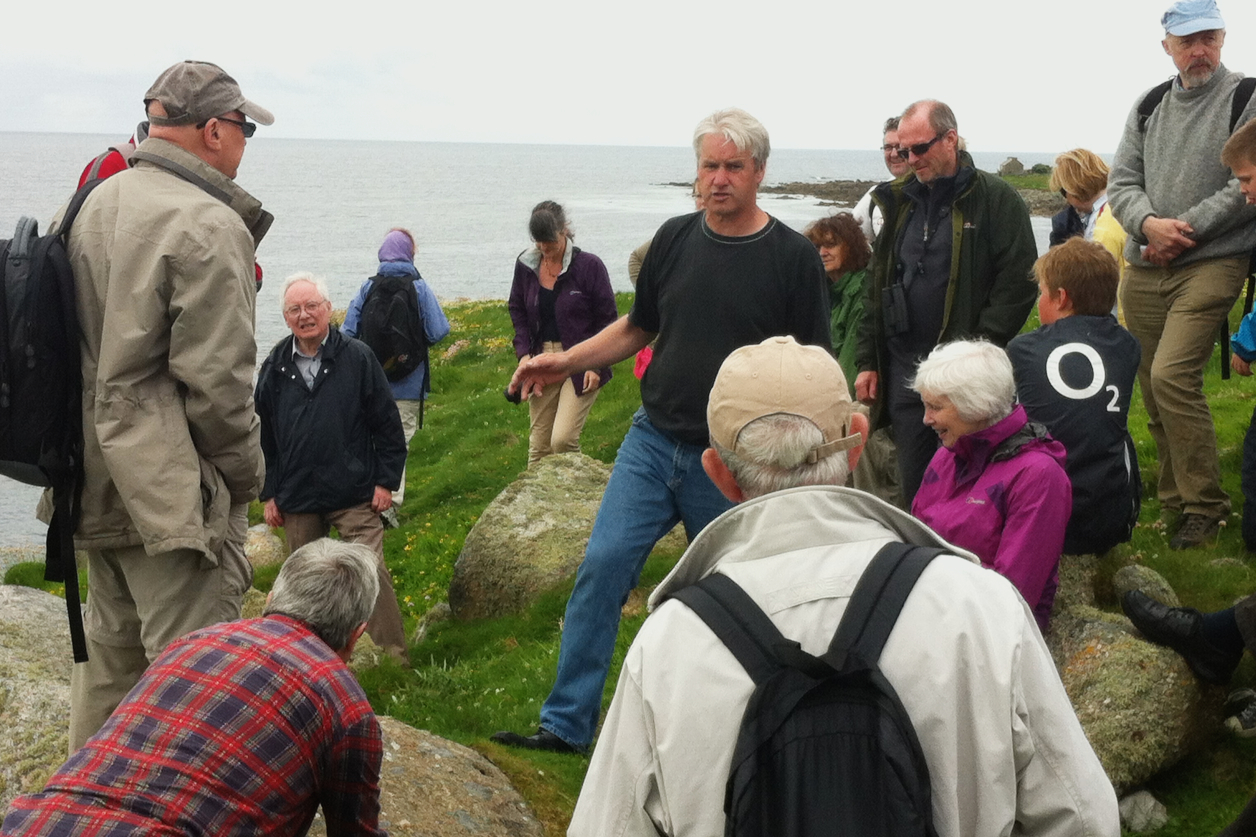
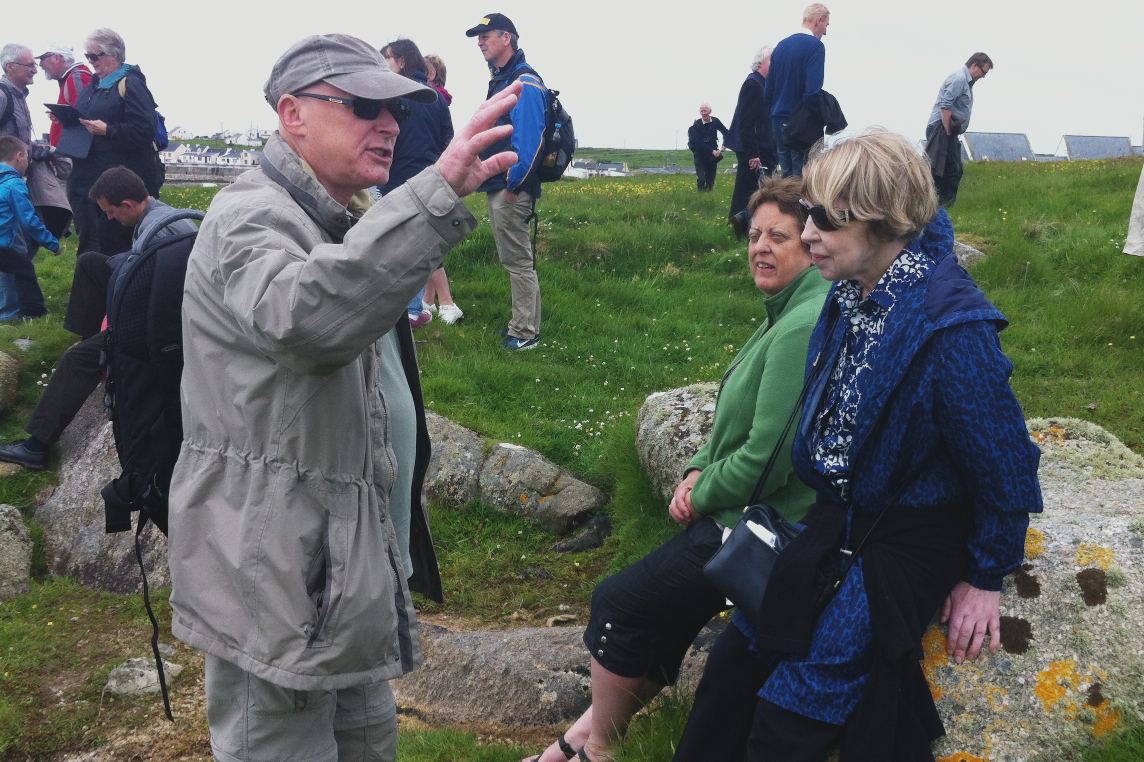
As I started writing this, many people – tourism and community leaders, teachers, retired air-force pilots, sociologists, photographers, authors, solicitors, doctors and academics – were gathered at Óstán Loch Altan, Gortahork, in the scenic northwest of the county, talking enthusiastically about developing Ireland’s very own ‘Santiago Columba’ into a successful cultural tourism pilgrimage project that could attract thousands to both western Scotland and Ireland.

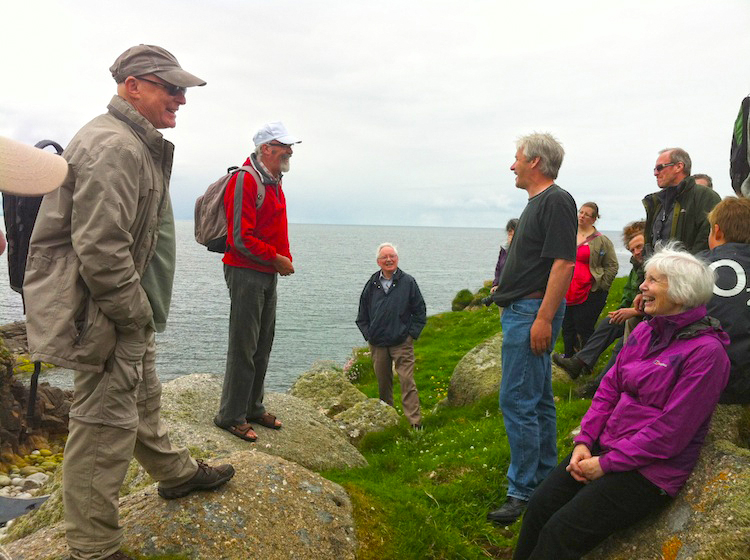
Speakers at the conference air their views as to how the proposed pilgrimage trail could be developed.

Organized by The Islands Book Trust, led by John Randall and ably assisted by the ever-helpful Mairi NicChoinnich, in association with Colmcille Éirinn is Alba and supported by Bòrd na Gàidhlig and Foras na Gaeilge, this three-day conference which ended today (Sunday) aims to develop a heritage trail based on the travels and travails of the Celtic mystic, Columba. Such a project could not only inform Irish and foreign visitors about local history, archaeology, folklore and heritage but also create employment and business for hotels, B&Bs, cafes, restaurants, museums and bars alike in the two regions.

“We have a wonderful opportunity to expand our learning and to attract visitors on a significant historical route from south-west Donegal to the Isle of Lewis in north-west Scotland,” said Randall, chairman of the Islands Book Trust.

This united effort is supported by renown authors-cum-academics such as University College Cork’s Máire Herbert (Iona, Kells, and Derry: The History and Hagiography of the Monastic Familia of Columba) and Brian Lacey (Saint Columba: His Life & Legacy).

Renown University of Cork researcher and author Máire Herbert beside the old stone cross on Tory Island with her groundbreaking book on the mystic monk Columba (Colmcille).

With additional speakers such as University of Galway’s Mícheál Ó Dónaill, Calum MacGilleain, Tristan ap Rheinallt and Aidan O’Hara from Scotland, Noel O’Gallchoir from Gaoth Dobhair, Noleen Ni Cholla, Moira Ni Ghallchoir, Maolcholaim Scott, Liam O’Cuinneagain and even the King of Tory Island himself, Patsy Dan MacRuaidhri, the conference comprehensively analyzed the tantalizing persona of Columba from the sociological, archaeological, historical, religious and mythological perspectives. And, more importantly, how interest in the fellow can be turned into a dollars and cents/euros and pennies booster for local tourism.

Brian Lacey, medieval historian and author, informs guests at the Sli Cholmcille conference about Pagan and druidic practices in and around Errigal and Muckish mountains.

The only drawback to an otherwise excellent symposium of speakers was the often poor technics, the out-of-focus projection of some otherwise well-researched multi-media presentations.

But the development of Sli Cholmcille is just the tip of the iceberg.

A quick glance at the local newspapers – the Donegal News and the Donegal Democrat – this weekend alone, shows a rich vein of cultural tourism – including the weekly music seisúns and this summer’s ‘Gaelturas’ initiative at Teach Hiudai Beag; the year-long programme of music and dance at Teac Jack and Leo’s Tavern; the ‘Goitse Gaoth Dobhair’ events in Bunbeg this coming weekend, which emerged from the ‘Dearg le Fearg’ language equality campaign, as well as ‘Luinneog Lunasa’ in the same area; the ‘Swell Festival’ on Arranmore; and ‘FestiFál’ and ‘Evil Eye Festival’ in Falcarragh to name but a few. Other local diverse activities with strong potential range from rock-climbing, wind-surfing and kayaking with Rock agus Roam; horse and pony riding at the Dunlewey Trekking Centre and elsewhere; the craft demonstrations at Ionad Cois Locha; and the educational Walking Donegal, the hill, coast and lake hikes with informed guide, Seamus Doohan; as well as specialty walks such as the ‘Tullaghbegley Heritage Walking Weekend.’

The list is endless.

And that’s not to mention the many literary tourism opportunities based on the art of creative writing.

Antonia Leitner from Carinthia in Austria is not shy to show her love of books and learning at Magheroarty Beach.

The idyllic landscapes and seascapes of Donegal have been an inspiration to many best-selling novelists and short story authors who have set their plots within or around the county, in genres ranging from sci-fi to literary fiction and fantasy, as well as plays. These writers include Brian Friel, Edna O’Brien, Sophia Hillan, Kenneth Gregory, Emma Heatherington, Michael Harding and Laurence Donaghy, some of whom will speak at Ireland’s newest writing retreat ‘Forgotten County, Remembered Words’ from June 28th to July 4th in Gaoth Dobhair.

With the national initiative ‘The Wild Atlantic Way’ now well underway and Donegal an integral part of it, there’s only one thing stopping the cultural tourism momentum that’s building up – a continued reluctance by Údarás na Gaeltachta, the primary economic development organisation in the Gaeltacht – to fund the many projects with serious money not just the few pennies it has been doling out until now to stave off a rising tide of protest.

‘Acupuncture of the body, acupuncture of the earth’ – author Brian Lacey describes a theory he learned from a Slovenian artist.

As many people are now saying, this organisation must host regular, open, community meetings and really listen to what local people – the very people they are there to serve – want in terms of more innovative community development; provide much greater transparency in its spending of an estimated 1.2 billion euro in public money, than it has to date; and an end to kow-towing to political parties and their funders (first Fianna Fail and now Fine Gael) which has resulted in far too much money going into the pockets of a rich elite of developers/builders who make easy profits from building simplistic, unneeded, industrial estates.

A new direction is required and a Catholic Church-run sex, drugs and alcohol addiction center in Falcarragh, with no guarantee of decent local jobs – especially as such a centre already exists in Donegal and research indicates this is sufficient for need – is hardly the panacea for high unemployment and emigration from the area. Some say real investment in local cultural tourism means shelving the proposed investment of three million euro by Údarás in the addiction centre and putting those euro millions into local tourism projects, the one sector a beautiful region like Donegal can benefit widely from, now and in the long-term (if that three million euro is spent on the proposed addiction centre, it spells the end for any real investment in anything else – no other board members of Údarás in other Gaeltachts will vote for any further significant monies for Donegal).

In this regard, it is quite sad to see how much Tory Island has fallen below its full potential – far behind many other attractive island retreats dotted around Ireland. The dismissive attitude of relevant funding authorities – and perhaps the disunity and lack of concerted lobbying and effort by local people (full burden cannot rest solely on the shoulders of one man, King Patsy Dan) – has meant its tourism income has suffered greatly, with accompanying lack of promotion (not even a regular newsletter on events or significant signage on the mainland and on the island itself).

“I am tired of trying to persuade Udaras na Gaeltachta officials to properly fund projects here on Tory Island, their ears are deaf, they simply don’t understand,” said King Patsy Dan MacRuaidhri. “The people here deserve such support. Our ancient and colourful history calls out for it.”

Befriending Royalty. Modern version of the horse-drawn carriage?

It’s make-or-break time for northwest Donegal.

Let’s put an end to the notion that cultural tourism is an unimportant, peripheral activity, the kind of mind-think that Údarás officials are stuck on, and have been for decades. This specialized sector has the potential to provide immense, long-term economic benefits for this hard-hit, hard-pressed part of the county and country, but it requires serious commitment and financial support.

In a future post I will give specific examples from my extensive sojourns in other parts of the world as an international travel writer where cultural tourism has transformed and enlivened a local and often paralyzed economy.

Meanwhile the next post will focus on what precisely various speakers at the conference said about Columba, this larger-than-life monk who seems to defy description, someone about whose background we know very little, either because documents were destroyed by marauding, book-burning Vikings, or were deftly confiscated by church abbots on a precise propaganda campaign.

To read more of Sean’s work, check these sites:

Digging for Dracula

World Itineraries

Examiner

JustLuxe

Ireland Writing Retreat

Fios Training and Coaching Organization

IMG_1269

IMG_1381

IMG_1320

IMG_1334IMG_1426

IMG_1342

IMG_1359

IMG_1363

IMG_1374

IMG_1379

IMG_1382

IMG_1390

IMG_1417

IMG_1432

IMG_1472IMG_1478

Emperor’s clothes – convenient concealment

John Curran seems to have some of the attributes of an upstanding local county council member – so why is it the Falcarragh man failed to win one of the positions in last months’ elections in Donegal?

Especially as anyone with a snippet of local knowledge knows that at least one other candidate – Terence Slowey – by virtue of being found guilty of ‘double dipping’ on expenses, may be less deserving of a seat.

Could it be that John’s failure reflects the ordinary person’s displeasure with the lack of transparency by public bodies in Ireland and manipulation of public money to benefit the already well-to-do?

John Curran

John is a married man and father, a qualified solicitor and has experience within the county council, as well as in the voluntary sector – indeed he is now director of Donegal Volunteer Centre. More than that – he avows to be deeply interested in community affairs.

Okay, John has deep political ambitions but, hey, what’s wrong with that?  I would hope all of the candidates – the successful and the less so – had this in abundance. Otherwise they’re not worth voting for.

So what went wrong?

How is it others, with – in my view – much less integrity – won out over John? To some readers of this blog, these words may come as a surprise. After all, John lambasted me personally over the last month or so in the print media, on the Highland Radio airwaves (see A Better-Informed Donegal is a Better Donegal) and in his own Facebook, for daring to call for greater transparency on the proposed three million euro spending on an addiction clinic in John’s hometown.

Ironically, that was John’s big mistake.

Did John feel – as a government candidate, with money and party behind him, as well as being a board member of Údarás  na Gaeltachta – that he’d be a shoe-in? Perhaps. I’m not sure. What I am sure about, however, is what he didn’t realize – that people – young and old alike – in this rural area of northwest Ireland are, as one native-born Donegal man put it so poetically, ‘cute hoors.’ In more diplomatic language – they know a maverick when they see one. As Gaeilge, ‘amadáin’ they’re certainly not. Not a one of ‘em.

Running on a Fine Gael ticket probably didn’t help (John could have run as an Independent but, offered a chance to speak at the party’s pre-election Ard Fheis, he decided not to). But his failure to win a council seat amounted to much more than that. After all, Fine Gael candidate, Jimmy Kavanagh, was elected.

By heeding the advice of the golden circle who support him in the Donegal Gaeltacht and who are making big money off the public purse in northwest Donegal, mainly through the goings-on at Údarás, and by attempting to turn a simple call for greater transparency – which in other democratic societies would be considered a normal request (in fact, one that should have been led by John himself) – into a ‘personal’ issue, he – with unfortunate consequences for himself – overstepped the mark.

People in the Donegal Gaeltacht may sometimes be blindsided, but they’re not blind. They may be silent sometimes in face of authority (it’s inherent in our Irish nature, conditioned over generations) but they aren’t voiceless.

And at the recent elections they made their voices heard.

Though only a brave few – among them, Owen Curran, Theresa and Caroline Woods, Mary Bridget Sharkey; Mary Attenborough; Moire McCarry; R.J. McLean; James Woods; Gerard Gallagher and Martin McEhlinny – take to the streets regularly in northwest Donegal to protest injustices – deep down (maybe not so deep), many people are upset. They saw that somebody, some people, some institutions  – including the Catholic Church and Údarás  – were trying to pull the wool over their eyes over the addiction center. They noticed clearly that not enough open discussion was taking place over a major proposal that not only would cost the public around three million euro, but would leave very little, perhaps nothing, for other projects in Falcarragh and other areas of the Donegal Gaeltacht (do you really think other Gaeltachts in Ireland are going to readily vote even more money for Donegal over the three million euro, and from a dwindling public purse?….please).

So what exactly is it that is so sensitive about this proposed addiction centre that it needs be kept so tightly under wraps?

Ballyconnell House

With no answers forthcoming from Údarás na Gaeltachta itself about costs and benefits (see Openness and transparency required: Udaras still has questions to answer), I offered the opportunity directly to Cuan Mhuire – the Catholic Church group of nuns that badly wants this public money for the centre (the second such one in Donegal, a very unusual situation for a county with such a small population). The questions were sent to it before the news broke nationally and internationally about the dumping the bodies of around 800 dead infants in and around a septic tank in Tuam by nuns.

An interpretation of this organisation’s response, or lack thereof, indicates the clinic may focus on sex addiction treatments for convicted clergy, as well as for abusers of drugs and alcohol and that Cuan Mhuire may indeed – as earlier media reports suggest – be guilty of allowing convicted paedophile priests to conduct religious services inside its other addiction clinics in Ireland. And may do so again in Falcarragh if the proposal goes through. And perhaps it’s quite convenient for it to do so – treat convicted clerics, both nuns and priests, for sex addiction and have them conduct religious services inside the centre – in the northwest corner of Donegal. Such nefariousness would thus be far from the glare of the national media.

If Cuan Mhuire were a responsible organization, with nothing to hide, it would have answered, perhaps not every question, perhaps not in the detail that would be reasonably expected, but answer it would. If a responsible organization with the concerns of the local community at heart, it would have realized how sensitive this addiction centre proposal is and deal with the concerns in an open manner.

Instead, Cuan Mhuire, a fully-controlled arm of the Catholic Church, acts as if it’s above the societal norms we others must adhere to – and therein lies a great danger. In the past, and still now – while ordinary people, ordinary community groups, follow rules and regulations that make for a stable, secure world – the church considers itself above the law. That is a frightening path.

In conclusion, if John Curran really wants to be considered a serious candidate for future public office (remember, he was appointed to the board of Údarás by the Government, not elected by the people), he cannot be simply a toadie for a political party or an institution such as the Catholic Church or Údarás. He must do what any decent board member is supposed to do – something, unfortunately, we have NOT seen successive board members at Údarás and most other Irish institutions from FAS to the Central Remedial Clinic do: take his responsibilities seriously and both oversee public spending and the overall health of the community properly.

Cults, sects and mindless mayhem?

Before the elections, in a FRONT page editorial in the Irish Independent (a most unsuited and unprofessional place – see explanation at bottom of article), Fionnan Sheahan, group political editor of Independent Newspapers, described Sinn Fein as a ‘cult’ and a ‘sect’ whose followers were mindless.

Seeing that this particular political party has just won 157 local council seats nationwide in the Republic with 15.2% of the national vote (not to mention 105 council seats in northern Ireland with 24% of the vote), that’s a helluva lot of mindless people.

Will Mr. Sheahan now apologise to such people publicly in the same manner that he attacked them? Or will arrogance and pride prevent him and pave the way for a continued drop in circulation and quality of a once decent newspaper (one I proudly worked for at the start of my career 30 years ago)? Or is Fionnan’s job so dependent on the blatant bias of the media group’s dominant figures – Denis O’Brien (who was shown by the Moriarty Tribunal to have bribed former Fianna Fail Communications Minister, Michael Lowry, to win a mobile phone license), and Tony O’Reilly (who, after recently announcing bankruptcy, owes you and I more than four million euro after buying a luxurious holiday home in Glandore, west Cork with a loan he can’t now pay back) – that he will continue doffing his cap as a D4/ establishment spin-doctor and apologist?

OLYMPUS DIGITAL CAMERA

Can some political commentators not see the forest for the trees?

And not only.

A few weeks ago on Highland Radio’s Friday morning ‘Press Round-up,’ one of the so-called experts – a woman – said Gerry Adams should resign as Sinn Fein party president – and this was after Mr. Adams had just been voted in an ‘Irish Times’ opinion poll as the nation’s most popular party leader. Consider this unwarranted barb in view of the massive gains Sinn Fein has just won across the nation in this weekend’s local, national and European elections under this man’s leadership.

Will that particular woman now apologize? Not simply for a poorly-informed broadside but what is, in effect, blatantly obvious bias. Surely, Highland Radio, a station fighting for license renewal, can find more objective commentators than this person. As both chat-show program host and station managing director, Shaun should pay closer attention to what emerged from the ‘Media Freedom‘ conference I attended at UNESCO headquarters in Paris recently. Can anyone guess the identity of the woman in question?

But back to the recent elections.

IMG_0673

Turning of the tide?

Some commentators would have us believe they were astonishing.

Nothing could be further from the truth. They were quite the opposite – predictable – based on the trend already set three years ago when Sinn Fein went from four TD slots to 14. Of course, Sinn Fein and Independent generous gains in this week’s elections were accelerated this time round by the abject failures and litany of broken promises by Labour and Fine Gael. With the smell of Fianna Fail corruption still rank in our nostrils, and the ‘old guard’ still there in abundance, it hardly provided an alternative, indicated by its abject failure to have anyone elected in the two by-elections and Pat the Cope ‘(the Pope’ as RTE miswrote in a news Twitter) Gallagher’s failure to hold his MEP seat.

A quick glance at some of the specific results indicates the extent of the triumphs of Sinn Fein and the Independents:

  • Four Sinn Fein MEP candidates – four MEPs elected: Liadh Ní Riada; Lynn Boylan; Martina Anderson and Matt Carthy.
  • Independent Luke ‘Ming’ Flanagan topping the poll in the Midlands–North-West constituency;
  • Sinn Fein trebling its local council tally by winning 157 seats nationwide, and in the process becoming the largest single party on the Dublin city council;
  • Independent Marian Harkin defeating sitting MEP Pat the Cope in Midlands–North-West;
  • Sinn Fein securing the single biggest number of first preference votes in northern Ireland’s local government elections while winning 105 council seats;
  • Independents (including the Socialist Party, the Greens, and People Before Profit Alliance) won around 30 per cent of council seats, up from 18 per cent at the last local elections in 2009;

The list just keeps going on, including Sinn Fein winning local council seats it has not held since the foundation of the state, an incredible historic feat. It is something Donegal-based Pearse Doherty, Sinn Fein’s electoral director should be extremely proud of, especially in the run-up to the 1916 centenary commemoration celebrations.

So what happens now? Well-paid Fine Gael, Fianna Fail and Labour spin-doctors – Charlie Flanagan, Pat Rabbitte and Timmy Dooley respectively – have already been out in force on RTE, and other media, this week. They allege – conveniently forgetting that this particular political party has governed alongside its arch-rival, the DUP, for 15 years in northern Ireland – that Sinn Fein cannot govern because it has not learned the art of compromise. In fact, it is one of the very skills Sinn Fein has learned and in the toughest classroom there is – the boiling cauldron of politics across the border. Maybe the faux pas made by Jan O’Sullivan, Labour’s junior minister, on RTE Radio 1 show last Sunday that her party ‘is a mudguard for Sinn Fein’ is more accurate than she cares to believe.

The spin-doctors also say the Independents are a motley group of disparate individuals, again conveniently forgetting that they all, in effect, stood together in unity against harsh austerity and for social justice and fairness – hardly irrelevant issues. Theirs is also a highly pompous and condescending comment to make about ordinary citizens who voted en masse for this so-called ‘motley’ group.

No doubt, Sinn Fein and the Independents will be in the crosshairs of examination over the next two years as the next general election approaches but their strength is that they are bonded by a common purpose. Watch carefully as they come together in unity and forge a partnership to create a more equitable society within Ireland. As they attempt to avoid being the victims of their own success, maintaining organization and structure will be a challenge.

It was also extremely heartening to see so many women win council and MEP seats. Four of Ireland’s 11 elected MEPs being female Sinn Fein candidates while in the two by-elections, Ruth Coppinger won Dublin West for Joe Higgins’ Socialist Party and Gabrielle McFadden of Fine Gael won the Longford/Westmeath seat previously held by her sister, Nicky. Well over 20 per cent of councillors elected are women; 32 per cent of votes cast in Dublin were for female candidates and in some areas 4 out of six councillors are now women. Over 30 per cent of Sinn Fein council candidates were women. Women won 197 out of 943 local seats with campaign group ‘Women for Election’ saying this represented a 33 per cent increase. However, even with this improvement, Ireland remains about 90th in world rankings in terms of women in politics.

However, at last, as this week’s election results show, Ireland is beginning to wake up to reality. We Irish may lack the passion, initiative and courage to go on the streets as did the Greeks and French but we are fortunate to have been given a second chance following our poor voting performance two years ago (echoes – as happened after the 1916 debacle) and have made our voices heard in the polling booths. Rejection of establishment politics and the obvious economic disparities between poor and rich here, has meant Ireland has finally, to a large extent, grown up, matured and begun to shrug off out-dated, horse-blinkered generational politics.

As for Lugh’s choices for my area of the Glenties here in northwest Donegal, I am delighted to say that the little Celtic hero predicted not just the winners, but also the exact order in which they came past the post, viz-a-viz

Marie Therese Gallagher, Sinn Fein

John Sheamuis O’Fearraigh, Sinn Fein

Micheal Cholm MacGiolla Easbuig, Independent

Ireland’s future suddenly seems brighter!

OLYMPUS DIGITAL CAMERA

A new dawn is upon us.

NB: Explanation as promised

In journalism, as a mark of respect to the intelligence of its readers, quality newspapers reserve their opinion columns and editorials for inside pages, designating the front page specifically for informed and – as much as possible considering we have human frailties – objective news upon which readers make up their own minds on key issues. Thus Independent Newspapers broke a golden, nay sacrosanct, rule of journalism, ignoring the fact that only idiots need to be spoon-fed like infants. That may have worked in the past. Not anymore.

Next week’s blog – Remaining on the subject of local elections: how is it a candidate, such as John Curran, failed to get elected in the Glenties to the Donegal council? Was it linked to the severe lack of transparency that has corrupted Irish politics for so long and that still hovers over the workings of Udaras na Gaeltachta of which Mr. Curran is a board member? Or simply that he was the Fine Gael candidate? Next week, I publish the responses from Udaras to questions regarding payments for executive pensions, a breakdown of job creation figures for the Donegal Gaeltacht and total investment in a proposed church-run addiction clinic in Falcarragh. As well as responses from Cuan Mhuire as to whether it shelters convicted clerical child abusers and will provide sex therapy as well as other treatments at the proposed centre.

To be or not to be (a Donegal councillor)

Lugh’s top three choices in the Glenties electoral area

What’s termed in America, ‘mid-term elections’ are coming up tomorrow (Friday) – and the results will indicate the future evolution of political parties and individual candidates, the direction country and counties will take and perhaps even leadership changes.

Living in Gaoth Dobhair, here’s Lugh’s take on his local area (from Dunfanaghy to Dungloe) within the Glenties Electoral area –

VOTE FOR:

Marie Therese Gallagher, Sinn Fein

John Sheamuis O’Fearraigh, Sinn Fein

Micheal Cholm MacGiolla Easbuig, Independent

photo 1

Lugh carefully analyses the candidates

Why?

Marie Therese Gallagher

Setting aside for the moment that there are simply not enough women in Irish politics today, thus a major loss to the political system as whole, Marie Therese has performed very well as a sitting council member (while, at the same time – multi-tasking comes so much easier to women than men – nurturing a delightful family). Reflecting Sinn Fein’s consistent stand on principles of fairness and social justice, she and her party colleagues remained firm against the council budget last year due mainly to Irish Water taking over local water services and people having to pay yet another government stealth tax. Fianna Fail, on the other hand, caved in, with Rena Donaghy, presenting a poor excuse for ducking the vote on the night and Independent, John Campbell, swapping sides to that of Fine Gael and Labour at the last minute.

On the issue of women in politics, Ireland remains in the Dark Ages – even more so with regard to women’s rights. Without Mary Robinson and her successor, Mary McAleese, we’d have been left with Fianna Fail’s Padraig Flynn, Charlie Haughey, Brian Lenihan’s claims that women belong in the kitchen peeling potatoes and in the bathroom changing nappies.  Yet, while some progress has indeed been made, still only 17 per cent of council seats across Ireland are currently filled by women, the worst record in Europe.

John Sheamais O’Fearraigh

John, married to Bernadette and father of three children, is a sincere, decent man, who has contributed much to the local community over the years, through his various roles, especially as a youth worker and on a number of local committees. His message is a simple one, a fine prescription for healing the wounds of society, and particularly here in Ireland: each to his abilities, each to his needs.

John spoke eloquently and passionately on national TV (TG4) a few weeks back about the urgent need for transparency and financial accountability from publicly-funded bodies such as Udaras na Gaeltachta (after the corruptive practices at the higher levels of FAS, the Garda Siochana and Rehab surely we’ve had enough of the particular Irish condition known colloquially as ‘cute whorism’). A vote for him is a vote for progress.

Micheal Cholm MacGiolla Easbuig

Micheal is both vocal and passionate about social justice and deserves credit for the way in which he has put his words into actions, including being a member of the ‘Can’t Pay, Won’t Pay’ campaign. He has organized a number of events, several of which I have attended, some of which I have enjoyed immensely. Local editors inform me he is persistent in pushing stories on diverse social issues, including anti-racism, and greater transparency on public issues, although it was bemusing that he declined to go on the air for TG4 recently to talk about spending of between one and three million euro by Udaras na Gaeltachta on a proposed addiction clinic in Falcarragh without proper benefit-investment information being presented for public analysis. Micheal has been described by some as irascible, but then again so has former Mayor and Councillor Frank McBrearty, a man who has brought up some extremely important issues in the council chamber rather than bow to that most common of Irish characteristics – aversion – a strategy that leaves truth as the ultimate casualty. Irascibility may thus be one of the most important qualities required in the chamber if councillors are to successfully fight for their corner, their supporters and their issues.

photo 2

Lugh seeks trusted advice from his elders

Candidates in the Glenties electoral area who disappointed me

 John Curran, Fine Gael

Running as a Fine Gael candidate instead of an independent (as he informed me he had been considering) has, unfortunately, been a mistake for John, making it harder for him to drum up enough votes to get over the line. Let’s be honest, John had no real choice in the matter as the party put him on the board of Udaras na Gaeltachta with an eye on propelling him forward on a rising political career, perhaps even successor to Minister of State, Dinny McGinley. The decision John took to run on a FG ticket – or was taken for him – has both pros and cons.

The cons are Fine Gael’s wretched record over the last three years and its list of broken electoral promises – ‘not another penny’ and ‘those guilty shall pay’ being its twin, pre-election mantra, which has obviously collapsed in a heap of rubble – is a hard sell. The pros – the party machine behind John’s electoral effort: more ad money; more people out canvassing; more and bigger posters.

To my mind, John had a golden opportunity to prove his individual worth – and blew it – over the proposed spending of millions of euro of public money on a church-run addiction clinic in Falcarragh. Instead of following through on the twin issues he promised as a newly-appointed Udaras board member two years ago – being a watchdog over the organization to create greater transparency and accountability on spending as well as promoting tourism based on our rich, native culture as a top priority – he has put loyalty to the organization ahead of loyalty to the people whose money it spends – some say, too wantonly and irresponsibly.

See his quote in a story published in the Donegal News: Everyone is aware of the lack of transparency in Ireland in the past on certain matters and the unfortunate results for the country as a whole. My commitment is that in future Udaras will be completely open in its dealings so that projects – whether in culture, language or economics – are selected on merit and need, not on who certain people know. Cronyism should play no part in its affairs.

For example, John has made little effort to inform ordinary people how much the proposed addiction clinic will cost or detail the specific community benefits to Falcarragh (as it is proposed to be located where he now lives, he could also be accused of pork barrel politics). John’s initial assertion that the clinic would create a magic 45 jobs is a simple case of political flag-waving. Basic business sense says no jobs are guaranteed until an operation is up and running, (not to mention if any, or many, jobs, will be local), so this number is a figment of the imagination.

John dipped his toe into what he thought was the cool waters of local Irish politics and it came out red and roasting. I like John as a person, so much so I gave him my Croker All-Ireland hurling final tickets last year, with no favors asked and none given (I’ve also offered game tickets to other decent people such as the two local former Gardai, Martin Ridge and Seamus Corbett; Timmy Boyle, friendly Bunbeg restaurateur and boatman, and his brother-in-law, Sabba, one of the kindest men I have met hereabouts). John and I have sat down for dinner and coffees together and held long discussions on various subjects. He had my vote, then let it slip from his grasp. With his background, John would be a help to any local community but not as a political party hack. If he’s not his own man, then he’s nobody’s man.

Seamus O’Domhnaill, Fianna Fail

A win for him in west Donegal means once again developers and bankers will celebrate victory with raised champagne glasses.

Regardless that inappropriate lending and fat bonuses for bankers, as well as developers absconding with much of the loans, has led to national economic collapse and continuing austerity, these two sectors – feeding into each other – remain O’Domhnaill’s twin political platforms.

Considering the amount of money Fianna Fail has reaped from both sectors over the years and the fact that the ‘old guard’ of the party still rules the roost, it should come as no surprise that this strategy will continue to be O’Domhnaill’s remit for years to come. If he wins, and with his brother, Brian as a Senator, his supporters within Fianna Fail hope to dominate future proceedings in their local area of Falcarragh and Gortahork. Then again, some say if Fianna Fail put up a donkey in certain parts of Donegal, it would get elected.

In conclusion, my top three choices of electoral candidates are Marie Therese Gallagher, Sinn Fein; John Sheamais O’Fearraigh, Sinn Fein; and Micheal Cholm MacGiolla Easbuig, Independent. I now cordially invite you to join me in voting for them. We missed out on making the kind of radical political changes we should have made three years ago. Let’s not miss out on it now. If we do, we’d never forgive ourselves.