Michael the modern Messiah

With gray beard, tousled hair and wrinkled coat and pants, writer Michael Harding descended upon Donegal Friday night looking all the world like the modern risen Messiah and promptly mesmerized his disciples.

As one who enjoys a night at the theatre  – pointing my rickety but faithful jalopy weekly out my pebble-stoned driveway enroute to one venue or another – it has been a long while since I last saw An Grianan theatre so packed (a shame really as it hosts so many enjoyable performances).

Photo courtesy of Michael Harding

Photo courtesy of Michael Harding

On this occasion, rightly, theatre director Patricia McBride and her marketing adjutant, Daithi Ramsay, should be marching triumphantly all the way to the bank. Or at least to the office of Traolach O’Fionnan, arts officer at Donegal County Council, with hands outstretched for a somewhat larger annual stipend.

So what magical message did the Messiah from Cavan (via Leitrim) bring northwards to have created such a keen fan base that left nary a seat unoccupied. Notwithstanding the writer-cum-playwright-cum-columnist-cum-actor’s obvious charisma, down-to-earth homeliness and ageless, sage-like physical bearing, I’ve narrowed his popularity in Donegal down to several things –

  • Humanism:  Harding carries a soothing, spiritual message that – in the stress-bedraggled world we inhabit – is manna from heaven. In this respect, he is suitably qualified – as a priest, a calling he abandoned after some years, then as a Buddhist, a calling he continues still. Summing up his lifestyle message Friday night, the author of ‘Staring at Lakes’ and ‘Hanging with the Elephant,’ said, “The ultimate wisdom is that there is no wisdom, so fuck it, just relax,” adding that his secret to contented living was following what he termed “the ancient Gaelic tradition of meditation” – in a word, ‘dozing.’ “I think I’ll start organising workshops training people how to doze properly,” he said tongue-in-cheek.
  • Nostalgia – he recounts homespun, heart-warming tales about life, love and growing old; about mothers and families and childhood, suggestions of innocence reminiscent of our own youth, of those fading bygone years we’ll never experience again but in which we bathe joyously for the remembering and the re-telling. In this respect, Harding is a wistful humourist, the Irish equivalent of Garrison Keillor whose radio programme, ‘A Prairie Home Companion,’ I listened to faithfully on National Public Radio each Saturday evening when I lived across the Atlantic.

OLYMPUS DIGITAL CAMERA

  • Empathy – the performer’s first words after coming on stage Friday evening were, “I’m not well,” said with a downright doleful expression. Immediately he’d captured the audience’s undivided attention. After all, having all been sick at one time or another, hearing someone else who’s sick makes us feel both empathy for that person and better about ourselves, either because, fortunately, we are no longer sick or because we are still sick but as Mephistopheles tells Faustus in Christopher Marlowe’s classic tale “Misery loves company.”
  • Sympathy – one of Harding’s strengths is that he is unafraid to bear his soul, to show his vulnerable side. With a hint of melancholy, he touches – often poignantly – upon self-doubts, mistakes, indecisions, depression and the other suitcases of distress that life tends to carry with it. And we feel for him and support him and want him so dearly to succeed because – aside from altruism – if he emerges okay at the other end, then there’s hope for the rest of us.

OLYMPUS DIGITAL CAMERA

  • Hilarity – Harding can be belly-wobblingly funny – no more so when he is in a self-deprecating mood or on a sudden flight of fancy. The aisles rocked with fits of laughter Friday night as he launched into a story about how – in the muddled midst of a mid-life crisis  – he read that shaving one’s pubic hair helped expand exponentially one’s erotic experiences.  So, fortified by a bottle of wine, he sallied forth, “with a Wilkinson triple blade.” Unfortunately, the mirror he was using was not tall enough so he had to balance himself precariously on a chair to accomplish the feat. The result: “fresh breezes in the nether regions and a boil from an ingrowing hair that had to be pierced by a doctor – a lady.”

OLYMPUS DIGITAL CAMERA

  • Familiarity – Michael has been to Donegal on several occasions, last year at An Earagail Arts Festival with singer Tommy Sands and in late 2013, speaking after the launch of ‘Staring at Lakes.’ He also spent some time previously on holiday in the county and opened the Scoil Gheimhridh Ghaoth Dobhair a few months ago.

OLYMPUS DIGITAL CAMERA

Overall the evening with Michael Harding was a most enjoyable occasion ripe with amusing, philosophical ramblings that left the audience departing the theatre wrapped in added layers of warmth to fend off the cold, biting weather outside.

With but a mysterious suitcase on the floor stage centre, a padded armchair and his lectern as props, Harding took his listeners on a delightful stroll down ‘Nostalgia Avenue,’ his deft turns of phrase encapsulating many-layered meanings in a flurry of simple-seeming words.

His ability to mix ‘n match moods, swinging rapidly from melancholy to bittersweet to outright hilarity was impressive, all part and parcel of personal anecdotes gleaned from the trials and tribulations of his own life. One illustrative example was when he described how his mother would make him wait in the street in front of a draper’s shop while she went in to buy “women’s things” leaving him “to develop childhood neuroses outside,” then in response to the shop-owner asking if he was her son, she’d say yes but that she would have preferred a daughter.

OLYMPUS DIGITAL CAMERA

And how, not having sisters, it took a visit by three Letterkenny girls to his home for him to see “women’s things” first-hand. “Their bras hanging in the bathroom like a line of dead rabbits,” as he amusingly put it.

The writer’s description of rummaging through his mother’s belongs soon after her death was emotive by its sheer simplicity. “I found my dead mother in little boxes and drawers,” he said, before recounting exactly what he found.

Harding’s terse turns of phrase can be poetic as when he talks about his Aunt Molly, as “a woman like a tree with so many shaking bits” or love in Cavan as “not many hugs but a lot of apple tarts and extra portions of potatoes.” Or even a dead chicken hanging on an assembly line in a meat factory as “wrinkled and naked like an old man’s neck.” His sharp observations of everyday life are also impressive as when he describes his uncle sleeping as “heavy on the bed like a hammock” or the danger of men “having ideas” especially in the toilet, leading him to warn women to beware of men emerging saying, “I was just thinking…..”

His insights on Irish rural life are delightfully illuminating whether they about the tradition of “throwing cocks over neighbours walls” to keep a healthy gene pool or the differences between the rural walk (“with chakras open”) and the urban one – both of which were accompanied by amusing on-stage simulations. Or even the annual ‘Blessing of the Graves” which he describes as, “Getting out the deckchairs and sitting on top of the dead to keep them down.”

MICHAEL HARDING  07B

Photo courtesy of Michael Harding

Harding, not surprisingly, has a love for his native Cavan, though he admits, with himself foremost in mind, that, “you’re not going up in the world merely by going from Cavan to Leitrim,” adding that he is more “a refugee seeking asylum.”

An oft-quoted saying is that ‘one can never go back home,’ but Harding achieves the next best thing, resurrecting vivid memories of places and people from his past that help bring an audience on an enjoyable and entertaining journey of nostalgia.

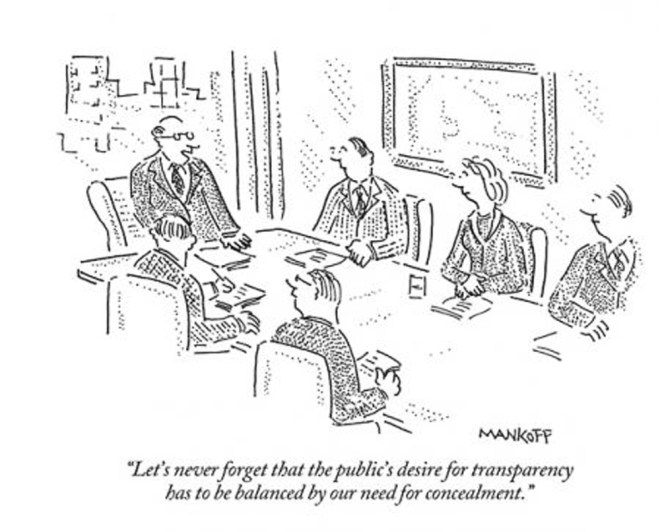
Minister of Public Expenditure raps Údarás na Gaeltachta for lack of transparency

Minister of Public Expenditure and Reform, Brendan Howlin, has rapped Údarás na Gaeltachta on the knuckles for failing to release vital information on spending of public money affecting Donegal and other Gaeltacht areas.

Following a refusal by Údarás to provide details on hefty pension payments to former executives that accounts for more than half its annual budget under a Freedom of Information (FOI) request I filed, formal written parliamentary questions were submitted by TDs angry about the lack of transparency by the Gaeltacht economic development group.

FOI

Such questions culminated in one by Mary Lou McDonald, Sinn Fein TD and member of the Public Accounts Committee (PAC) on my behalf, directly to the Minister, “To ask the Minister for Public Expenditure and Reform in view of his stated commitment to transparency and accountability in the spending of public moneys, his views that it is acceptable for a public body fully funded by the Exchequer to withhold from the public record details of public service pension arrangements on retirement for senior managers; and if he will legislate to require all publicly funded bodies to make such information public in the interests of open Government.”

A formal written response has just been received from Minister Howlin, in which he, in effect, tacitly states that Údarás was wrong to turn down my FOI request seeking details of pensions for former executives paid wholly out of public funds, and that it should release the information forthwith.

The Minister writes, “Under the 2014 (Freedom of Information) Act, the terms and conditions of any individual who holds or held any office or other position remunerated from public funds in a public body, rather than just those of a Director or member of staff as provided for under the 1997 Act, are not afforded the protections under the Act in relation to personal information. On that basis, the type of information to which the Deputy’s question refers i.e. public service pension arrangements on retirement for senior managers which would be part of remuneration, would be available from a public body that was subject to FOI, other than where a specific exemption applies against the release of such information.

The Minister elaborates further, “Under the Freedom of Information Act 2014, as was the case in the original Freedom of Information Act in 1997, an exemption from the provisions of Freedom Of Information (FOI) is provided for personal information. The 2014 Act also expanded the definition of what does not constitute personal information in the context of FOI.”

In answer to McDonald’s question as to whether the Minister “will legislate to require all publicly funded bodies to make such information public in the interests of open Government,” the Minister writes, “Given the matter is already provided for by the Freedom of Information Act 2014, I do not consider further legislative action is required.

As we have seen with scandal-hit FAS and other Irish state bodies that abused peoples’ trust and misspent public money, the only way to prevent corruption is by creating greater transparency. The government coalition of Fine Gael and Labour made this a central issue in their electoral platform. In the three years since they took office, little progress has been made.

cartoon

Several weeks ago, Ireland was placed 31st position ‘in the league of transparent nations’ following research by the World Wide Web Foundation. It is the worst of any European nation, even behind countries such as Russia, Mexico and Brazil. The group’s categorized Ireland as a country that faces challenges to “mainstreaming open data across government and institutionalizing it as a sustainable practice.” It also said “core data on how the government is spending taxpayers’ money and how public services are performing remains inaccessible or pay-walled even though such information is critical to fight corruption and promote fair competition is even harder to get.”

Tim Berners-Lee, Web, founder of the Web Foundation and the London-based Open Data Institute, said, “Governments continue to shy away from publishing the very data that can be used to enhance accountability and trust” and highlighted the power of open data “to put power in the hands of citizens.”

Údarás is a classic case in point.

lenses

Dinny McGinley, former junior minister for the Gaeltacht, wrote back in a vague response to my FOI request saying simply that Údarás had informed him it was “a data controller, defined under the Acts as a person who either alone or with others controls the contents and use of personal data.
For so many years untouchable hidden behind a veil of Irish-language support, Údarás perhaps is in many ways no different to FAS in terms of greed and individual self-interests. According to Údarás sources, former board members in Donegal remained in boardroom meetings during discussions on lucrative payments to their very own companies and organisations. In addition, not one but at least three Donegal Údarás board members have been up before the Standards in Public Office Commission on corruption charges relating to double dipping on expenses. When one considers the expense claims for board members, particularly under the long-time chairmanship of Liam Cunningham from Glencolmbcille (from 2005 to 2010 he received more than 155,000 euro in fees and expenses, according to Highland Radio), one has an idea of the unchecked, proliferate spending that went on.
Some details as already reported by Highland Radio –

  • Four former Donegal members of the Údarás board each received in excess of 100,000 euro each, over a four-year period, in travel expenses.
  • Fianna Fáil member Daithi Alcorn earned nearly €120,000 between 2005 and 2009;
  • Fianna Fail Senator Brian O Domhnaill received €115,000 while independent Donegal member Padraig O Dochartaigh received €105,000.

Over one billion euro of public money has already gone into supporting Udaras na Gaeltachta yet unemployment rates in Gaetachts are consistently highest in the nation.

Misspending of public money (an issue brought up by the former head of the PAC, see 3-part series article series), includes all-expenses trips to Las Vegas for Udaras board members and their spouses – supposedly to meet a delegation of the IDA;

In truth, Údarás was – and perhaps still is – a cash cow for well-to-do insiders in west Donegal.

It is long past time Údarás prepared proper annual reports instead of the porous documents it now produces that disguise the spending picture and that it holds open public meetings to allow the people of the Gaeltacht to know exactly how their hard-earned money is being spent.

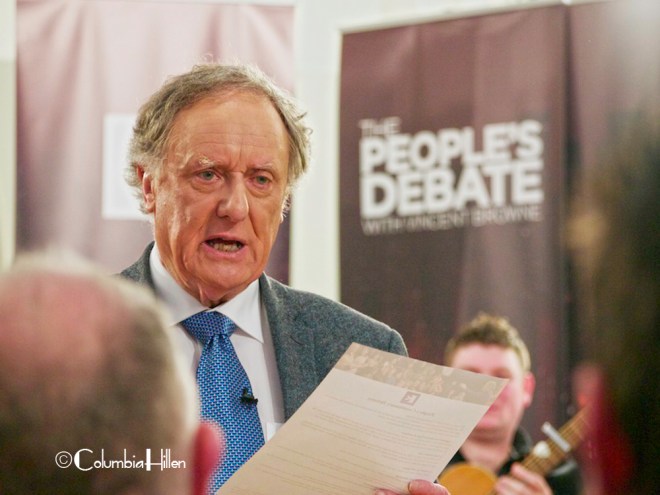
TV3’s Vincent Browne ‘People’s Debate’ in Donegal attracts lively discussion

While Fine Gael and Labour were expected to take a beating at yesterday evening’s Vincent Browne-hosted ‘People’s Debate’ in Letterkenny – in part deserved as the two parties refused to participate – Fianna Fail also took a drubbing.

OLYMPUS DIGITAL CAMERA

At one point, after listening to the party’s TD Charlie McConalogue berate government policies, the veteran TV host exclaimed, “I cannot understand how you can make these criticisms. Fine Gael is simply following Fianna Fail policies. Fianna Fail laid down the strategy for dealing with the banking bailout and Fine Gael and Labour are merely following it.”

McConalogue made another mistake later in the debate saying, “the agreement with the Troika was negotiable,” thus contradicting what the public had been told by Fianna Fail that the deal under former Taoiseach Brian Cowen and Minster of Finance, Brian Lenihan, was non-negotiable. Browne was quick to make the point, “Your party said details of the agreement with the Troika were non-negotiable, yet now you say they were. Make up your mind.”

On the emotive issue of water charges, McConalogue – after much fudging said he would halt Irish Water and suspend water charges. Again, Browne responded, “Your party, Fianna Fail, already had a plan in place in 2010 to impose water charges, but now you’re saying you’re having second thoughts.”

OLYMPUS DIGITAL CAMERA

Browne, at his best as a current affairs host when pushing political guests for a clear-cut answer, didn’t let the lively capacity audience down, especially when badgering the four-member panel for their views on a potential coalition after the next election. Asked whether he would take a ministerial seat under a Fine Gael or Fianna Fail led coalition Sinn Fein’s Pearse Doherty seemed somewhat uncomfortable in his seat.

“That is a hypothetical question and such decisions are made at our party Ard Fheis,” he said finally, as if caught by surprise, but recovering. “What we have agreed is that unless water and property charges are dropped, we will not go into any coalition.” He acknowledged, “Some members have voiced their opinion that they would go into a coalition as a minority party. We are a party hungry for change, we are not hungry for power.”

When asked the same question, his Sinn Fein colleague TD Pádraig MacLochlainn was more direct, unhesitatingly replying, “I will not participate in a government led by either Fianna Fail or Fine Gael.” As if taking strength from this, Doherty later stated categorically, “If asked by a government led by Fianna Fail or Fine Gael to be a minister, I would refuse.”

OLYMPUS DIGITAL CAMERA

After chastising the two Sinn Fein members for not giving a straight ‘yes’ or ‘no’ answer, McConalogue himself began the dance of the slippery eel until, under bombardment from host and audience, he finally said, “I would not like to participate in a Fine Gael-Fianna Fail coalition but if I was outvoted by my party colleagues I’d have to go along.”

In his two-minute intro, Doherty said “four years ago we were promised a democratic revolution yet all we have had is more of the same with cronyism, stealth taxes and high levels of unemployment, no more so than right here in Donegal. There is a fairer and better way of moving forward and Sinn Fein’s job strategy can reshape this county.” He added that it was little wonder Donegal was known as ‘The Forgotten County.’ “I know Vincent you didn’t come here by train because this is one of only five counties in all Ireland without a mainline railway service.” Under an FOI request he said he has asked for a government paper produced on the future of small schools, adding that Donegal has the second largest number of such schools, with four teacher or less.

When corruption and lack of transparency within Údarás na Gaeltachta was brought up, including its refusal to release key information on its public spending such as lucrative pension payments to former executives which amount to half of its entire annual budget, Doherty said his party had tabled formal parliamentary questions on the issue, adding, “there should be full disclosure about people in receipt of high public pensions, it is important to have complete transparency so such payments can be scrutinized by the public.”

McConalogue said in his intro, “the last four years of government have been an attack on Donegal with post office closures, agriculture being hard hit and worsening heath services,” adding, “we have strong potential here but we need better infrastructure including the A5 project up and running and wider broadband.”

Referring to the pre-election catchphrase ‘Frankfurt’s Way or Labour’s Way,’ MacLochlainn said the government’s record has proved very different, “with a reduction in classrooms, budget cuts across the board and Donegal having the lowest allocation of medical staff of any county.” He added, “Donegal people are hard-working and passionate. All we’re asking is a fair chance and for Dublin to meet us halfway.”

Regarding the water charges, he added, “For thirty years, Sinn Fein has opposed these charges and now it has become the straw that broke the camel’s back. There has simply been too much austerity. Irish Water is a white elephant. My message is ‘scrap the water charges and go back to the drawing board.’ ”

While decrying the lack of proper health services and unfair stealth taxes, Independent TD Thomas Pringle said renewable energy had tremendous potential for Donegal as had the biomass wood industry. Speaking of Killybegs, he also said the fishing industry had been “hard-hit.’ He said water conservation should be a top priority because so much is being lost through poor network connectivity. He also said he was proud of challenging the bank bail-out through the courts and being in the forefront of water charge protests (continuing the momentum, a major ‘Right2Water’ protest took place earlier today – Saturday – in Letterkenny, with others elsewhere nationwide).

All four TDs, when asked directly, said they would vote ‘yes’ in the upcoming referendum on same-sex marriage.

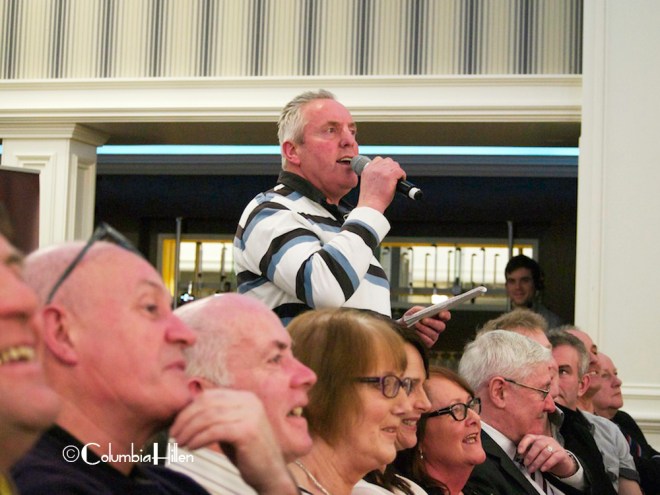
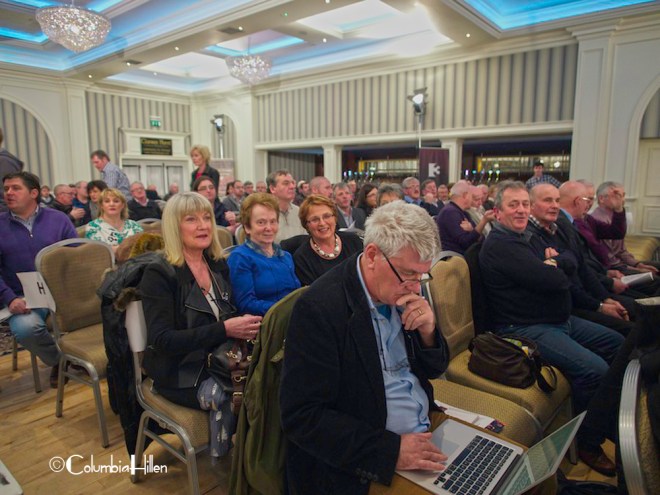
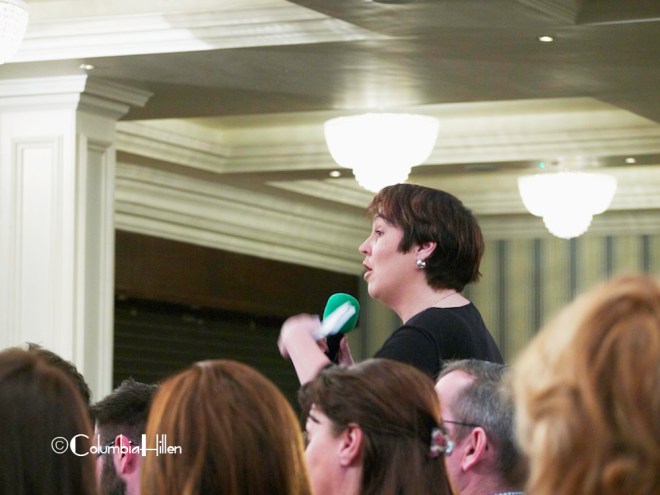
Over the lively, two-hour event at the Clanree Hotel, there was no shortage of questions from the floor with periodic rambunctious catcalls, cheering and booing, which caused short stoppages and words of warning from the presenter.

OLYMPUS DIGITAL CAMERA

True to his word, Browne attempted to cover as many topics as possible such as equality, including the upcoming same-sex marriage referendum; family services, education, employment and health. Speakers ranged from parents of terminally-ill children; school teachers, social workers and community activists working on behalf of people as diverse as lesbians, gay, bisexuals, transgender, cancer sufferers, the disabled, and many others.

Some light-hearted moments and biting comments helped take the edge of emotions as when a thirsty Vincent Browne ran out of water and promised he’d even pay for some and when James Woods from Gortahork commented that with so much emigration, Donegal was turning into a wildlife refuge.

OLYMPUS DIGITAL CAMERA

All in all, ‘People’s Debate’ is an excellent initiative by TV3, no doubt demanding detailed planning to host such shows in all the constituencies of Ireland.

Fine Gael and Labour’s decision to spurn them, indicating fear and a lack of understanding of the difficulties facing ordinary people, could ultimately cost them vital votes in the polling booths.

OLYMPUS DIGITAL CAMERA

OLYMPUS DIGITAL CAMERA

OLYMPUS DIGITAL CAMERA

OLYMPUS DIGITAL CAMERA

OLYMPUS DIGITAL CAMERA

OLYMPUS DIGITAL CAMERA

OLYMPUS DIGITAL CAMERA

OLYMPUS DIGITAL CAMERA

OLYMPUS DIGITAL CAMERA

OLYMPUS DIGITAL CAMERA

‘Whatever you say, say nothing!’ – motto of Údarás na Gaeltachta

‘People have no right to ask how we spend their money.’

That’s the attitude of Údarás na Gaeltachta, which has once again refused to release key information about how it spends public funds.

Udaras

A Senate committee revealed that Údarás pays millions of euro every year in pensions to former executives, some of whom were local Donegal employees including Cathal MacSuibhne, former regional manager based in Gaoth Dobhair.

cathal

Sinn Fein’s Trevor Ó Clochartaigh, a member of that Senate committee, exclaimed, “I nearly fell off the chair when I heard that almost half the current expenditure goes on pension payments to 136 people who are no longer employed by the organisation. Small wonder Údarás is not able to function more effectively.

He added, “This raises serious concerns regarding the levels of monies being paid and who is receiving them.”

Under transparency rules, other public bodies have made a breakdown of such pension figures available for examination, but in response to a Freedom of Information (FOI) request I made, Údarás refused to do so, citing gobbledegook about data protection.

As a result, having brought the matter to the attention of a number of TDs, the Údarás pension issue has risen to the highest levels of national government, to the office of Brendan Howlin, Minister for Public Expenditure.

I can reveal in this blog that on my behalf various leading politicians including Public Accounts Committee (PAC) member, Mary Lou McDonald, have attempted to find out the individual pension figures but Údarás has stonewalled every request, preventing their release.

MaryLou

How it happened

Údarás responded to my initial FOI request last year seeking details on pension and lump sum payments to former executives in a letter signed by Padraic O’Conghaile – a ‘cinnteoir’ at the organisation’s headquarters in Galway.

In the letter, he wrote, “I am refusing these records as they relate to the pension of an individual under Section 28.1 (Personal Information). The FOI Act defines personal information as information about an identifiable individual that: ‘would, in the ordinary course of events, be known only to individuals or members of the family or friends, of the individual.’ I believe that the right to privacy of these persons with regard to such information far outweighs any public interest there may be in this matter.

The fact, that all the pensions and payments are publicly-funded and thus not “known only to individuals or members of the family or friends, of the individual” as he asserts – did not seem to enter Mr. O’Conghaile’s thinking. Or, perhaps, did, but he refused to acknowledge it.

Following this response, I requested several TD’s to present formal written parliamentary questions in the Dail on the same issue.

For example, Mary Lou McDonald, a member of the Public Accounts Committee (PAC), submitted her parliamentary question to the Minister for Arts, Heritage and the Gaeltacht asking the Minister to “reference the specific provisions of the Data Protection Acts 1988 and 2003 to which he referred (supporting Údarás’ denial of information); the basis on which he believes Údarás na Gaeltachta does not, unlike in the case of all other senior managers across the civil and public sector, have to make public the details of public service pension arrangements on retirement for senior management.

Dinny McGinley, then junior minister, wrote back in a vague response saying simply that Údarás had informed him it was “a data controller, defined under the Acts as a person who either alone or with others controls the contents and use of personal data.

dinny

Put in simple words, it means Údarás, while deriving all its funding from public money, considers ‘People have no right to ask how we spend their money.’ McGinley’s response also has no logical meaning whatsoever under present Irish law. Instead it is a classic delaying tactic. The former Minister did not bother to question it or seek elaboration.

That response led McDonald to submit a follow-up question, this time to Minister Howlin, reading, “given the Minister’s stated commitment to transparency and accountability in the spending of public monies, whether in his view it is acceptable for a public body fully funded by the exchequer to withhold from the public record details of public service pension arrangements on retirement for senior managers; and if he is prepared to legislate to require all publicly funded bodies to make such information public in the interests of open government.

HOWLINBRENDAN

It is most disappointing that a simple request to a fully publicly funded body about its spending has led to such a reactionary response from an organisation such as Údarás, which is responsible for the economic, social and cultural development of the Gaeltacht.

Such utter lack of transparency and disregard for public concerns has already led to such widespread corruptive practices as those at FAS when it was discovered hundreds of thousands of euro went on lavish holidays including first-class travel and expensive rounds of golf for executives and their wives. Údarás itself has yet to account for trips paid out of public funds for board members, executives and wives to visit attractive international destinations, including Las Vegas.

Public money is a precious thing and every penny of it ought to be properly accounted for and judiciously spent.

I will reprint Minister Howlin’s response on this blog when it is received. It should provide a most interesting read.

Raiders of the Lost Archives

Finding a killer is no easy matter – more so when government agencies don’t want you to.

That’s why a small team of highly-committed people proudly refer to themselves as ‘raiders of the lost archives’ and this past weekend they arrived in Letterkenny to discuss what they’ve discovered through their painstaking murder investigations.

OLYMPUS DIGITAL CAMERA

Paul O’Connor and Anne Cadwallader are leading members of the Pat Finucane Centre, which, for many years, has been forensically examining sensitive British government documents and interviewing hundreds of people to expose the ruthless collusion between Protestant paramilitary extremists who murdered many Catholics, and the RUC, the former northern Irish police service, and the Ulster Defence Regiment (UDR), once the largest regiment in the British Army.

OLYMPUS DIGITAL CAMERA

Indeed, their investigations have revealed that some of the cold-blooded murderers were actually full-time or part-time members of the above mentioned ‘security forces’ with easy access to rifles, guns, grenades and other weapons used in the killings.

Some of their findings as revealed at the Station House Hotel Friday evening –

  • 120 paramilitary murders, one-third of which took place in the Republic, show RUC and UDR involvement;
  • At least two members of the UDR were involved in the roadside massacre of the Miami Showband music group in July 1975 in County Down;
  • Both members of the RUC and the UDR were involved in the bombing of ‘The Step Inn’ in the town of Keady that killed two people and injured more than twenty;
  • RUC officers and UDR members were part of a gang operating from two farms in south Armagh and Tyrone, responsible for the deaths of 120 people between 1972 and 1976;
  • British government documents acknowledge authorities knew some UDR and RUC members would also join extreme Loyalist paramilitary groups such as the Ulster Defence Association (UDA), the Ulster Volunteer Force (UVF) and the Ulster Freedom Fighters (UFF);
  • Compensation paid out to families of some of those whose loved ones were murdered amounted to a paltry 750 pounds sterling;
  • British government documents listing the amounts of arms that went  ‘missing’ from UDR armories showed a single gun was used to kill 11 people in 11 months;
  • No RUC officer has ever been convicted of any of the murders;
  • Four British soldiers have been convicted of murder in northern Ireland – all were released after serving less than five years of their life sentences. All were allowed to rejoin their regiments;
  • The Special Branch was allowed to operate as “a force within a force” and often decided not to give information to the Criminal Investigation Department;
  • The British government will not allow a review of its secret files on bombings that killed many people in Dublin and Monaghan, not even by an agreed judiciary figure;
  • In explaining the mere suspension of police officers involved in murder, Lord Chief Justice Lowry said, “…. more than ordinary police work was needed and was justified to rid the land of the pestilence which has been in existence.”
  • Scores of cases are now before the Office of the Police Ombudsman for Northern Ireland and civil cases are pending against the Chief Constable and the British government.

In concluding the evening, O’Connor, the centre’s director, and Cadwallader, a former BBC and RTE journalist, posed a number of questions:

  • Was truth covered up systematically by the British government to protect the reputation of the RUC?
  • Did the British government as a former colonial power adopt the technique of using one tribal group against another through counter gangs as it did in Kenya under General Frank Kitson, who also served in northern Ireland?
  • Was there a government policy to kill Catholics in an effort to turn popular opinion within that community against the IRA? In other words ‘if you can’t kill the fish, poison the water.’

Notes

The Pat Finucane Centre, a non-party political, anti-sectarian human rights group supported by the European Union’s PEACE III programme, is named after a Catholic lawyer who was shot dead by Protestant loyalists in front of his wife and children at his north Belfast home in 1989. A review of the case by Sir Desmond de Silva showed RUC officers proposed that Finucane, 39, be killed, passed information to his killers, then obstructed the murder investigation. The findings have been accepted by the Northern Irish Police Service. While describing the level of state collusion as “shocking,” British Prime Minister David Cameron ruled out a full public inquiry.

The event at the Station House Hotel was organized by Abhaile Arís, an EU funded programme supporting the Republican ex-Prisoner community.

A book produced by Anne Cadwallader (Mercier Press) entitled Lethal Allies: British collusion in Ireland, focuses on 120 killings attributed to loyalist groups between 1972 and 1976. It draws on investigations compiled by a specialist group, the Historical Enquiries Team (HET), which is re-examining deaths during the northern Irish conflict.

OLYMPUS DIGITAL CAMERA

OLYMPUS DIGITAL CAMERA

OLYMPUS DIGITAL CAMERA

OLYMPUS DIGITAL CAMERA

OLYMPUS DIGITAL CAMERA

OLYMPUS DIGITAL CAMERA

OLYMPUS DIGITAL CAMERA

Bunbeg, once pretty, now disfigured

Once pretty, Bunbeg is looking more and more like a toothless old hag.

Derelict spaces, decrepit ‘For Sale’ signs and boarded up, empty and run-down buildings have pockmarked its once thriving main street.

OLYMPUS DIGITAL CAMERA

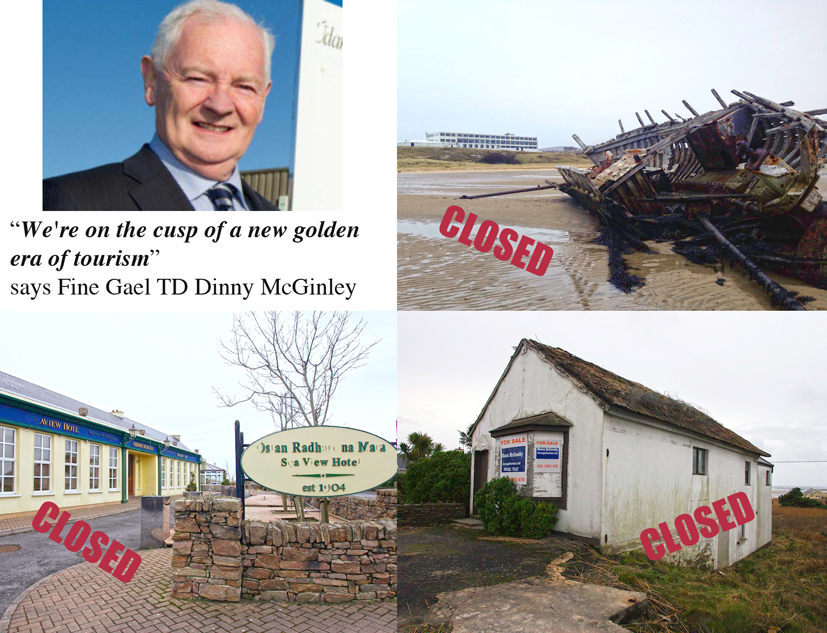
The iconic, century-old Seaview Hotel, which employed over 108 people seven years ago (talk of Cayman Islands and meat debts has no place in this blog), stands empty and forlorn this week , joining a heap of other ‘deadwoods’ on the street  – a once popular restaurant opposite and three other nearby hotels, The Errigal View, the Ostan Gaoth Dobhair and The Brookvale, as well as a mix of shops, bars and cafes, all now closed and crumbling.

Ironically, one of the few buildings to be renovated and opened on the main street is the constituency office of Fine Gael TD and former Gaeltacht, Arts and Tourism Junior Minister Dinny McGinley, the man who proudly pronounced this week, “We’re on the cusp of a new golden era of tourism.”

colaj good

Talk about poor timing.

Not to mention poor positioning. McGinley’s office lies a mere 50 yards from the deserted Seaview Hotel, first established in 1904.

News this week of the Seaview’s demise is a stark reminder of the abnegation by Udaras, the area’s main economic regeneration group, of its prime responsibility for creating  jobs, including those in the hospitality sector, with Gearoid O’Smaolain its main tourism development officer.

Eamon McBride, former President of the Gaoth Dobhair Chamber of Commerce, put it simply: “the area is crying out for more attractions.”

Job losses, lack of transparency

Aside from the 35 jobs, both full and part-time, lost at the Seaview this week, hundreds have been lost at other Udaras-sponsored businesses such as Largo Foods, Nuance and Sioen Apparel over the last few years. In fact, the Udaras Donegal office has performed consistently worse than any other Gaeltacht region in Ireland in terms of its job-creation record.

Sinn Fein TD Pearse Doherty this week called on the Government to immediately publish the findings of a delayed report by a working group tasked with examining job creation in the Gaoth Dobhair area. One hopes he will demand the same of the local Udaras office. Only then, can the organisation be properly analyzed to ascertain if the public is getting ‘bang for its buck,’ or if drastic changes need to be made internally if it is found that employees lack the skills-set necessary for the important task at hand.

photo and chart good

Gaeltacht disintegration

The intriguing part of the sad saga surrounding what is, in effect, economic mismanagement of the Irish-speaking area, is that while towns within it, such as Gortahork, Falcarragh and Bunbeg, are literally peeling apart, both economically and physically, Dunfanaghy, just outside the borders of the Gaeltacht, is riding a wave, with bars and cafes enjoying a boost in trade, especially at weekends – without the benefit of public funding of any kind.

While Udaras Donegal announced this week it will release proposals for economic development, observers say this is more a cosmetic exercise aimed at organisational survival than a serious attempt at strategic innovation and staff revision – that it has not even hosted a single open public meeting to ascertain the views of ordinary people, the very people who pay for its running costs. Interestingly though, while widespread job losses have occurred in Udaras-sponsored companies in Donegal, no such losses have occurred within the local Udaras office itself.

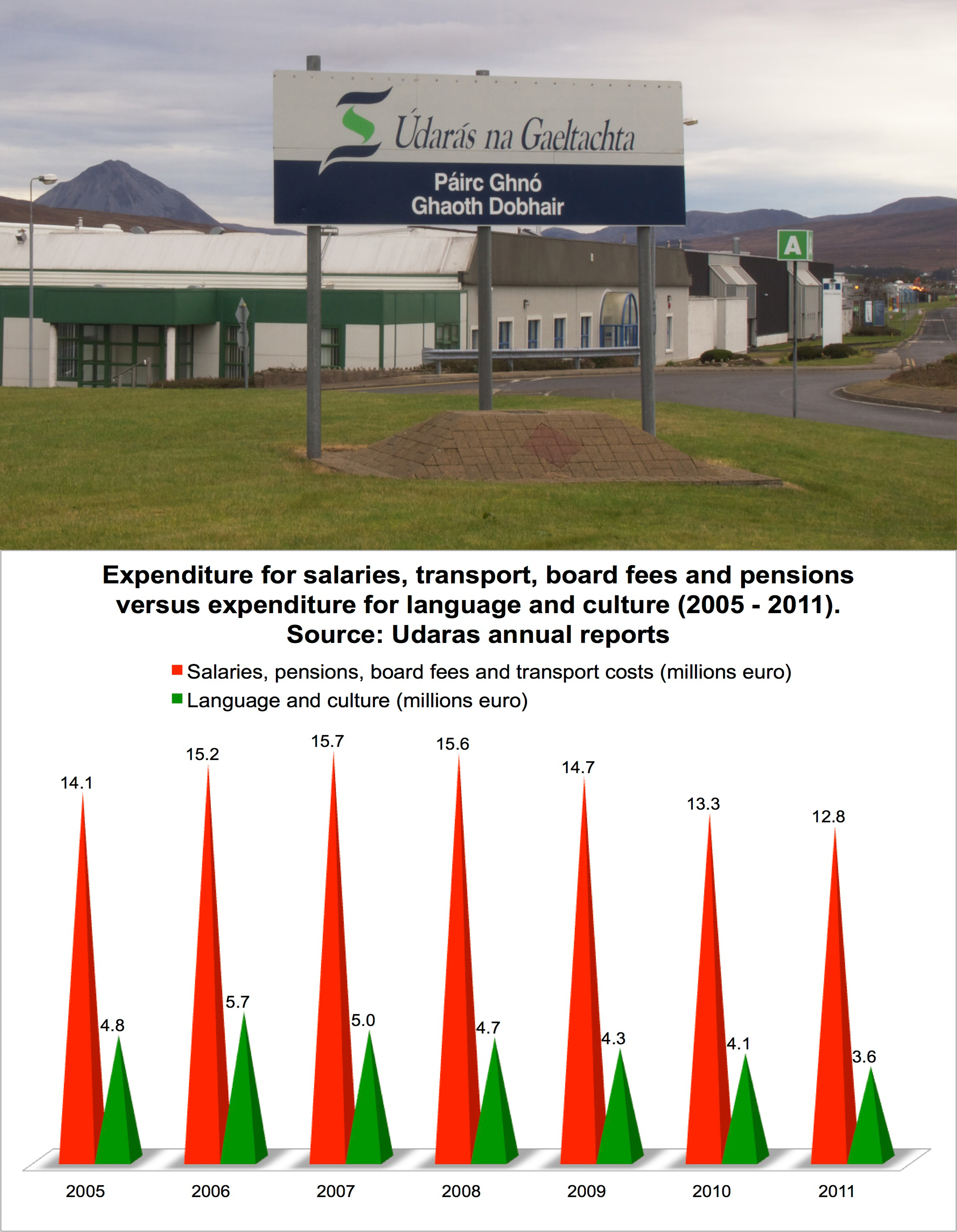
Based on its operational history (see above graph), should we accept as normal that out of its seven million euro budget for this year as announced by Udaras officials, two-thirds go towards salaries, pensions and expenses, and the remaining one-third only to economic and language development?

Is it not long past time this organisation came under closer public scrutiny and thus be made more accountable?

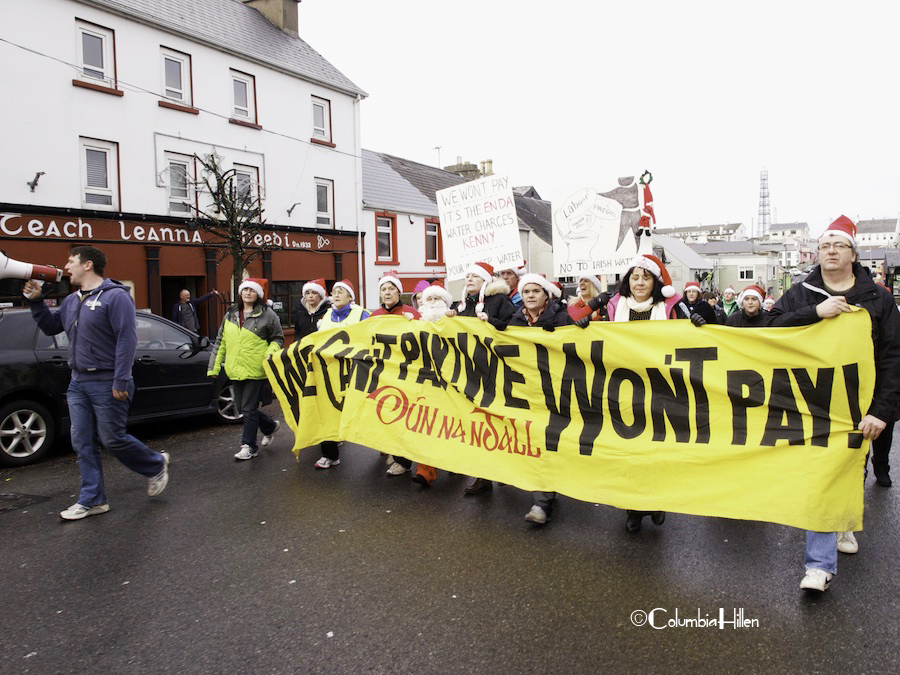
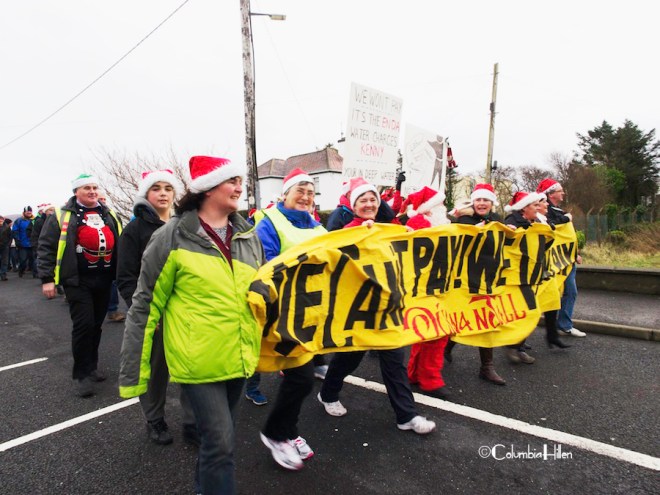
Sea of Santas parade through Dungloe protesting government water charges

Ignoring doomsayers who said very few would turn out for a protest on a damp Saturday afternoon just before Christmas, organisers of an anti-water-charge protest in Dungloe, Donegal placed trust in the will of the people and deservedly enjoyed even greater success than they expected.

OLYMPUS DIGITAL CAMERA

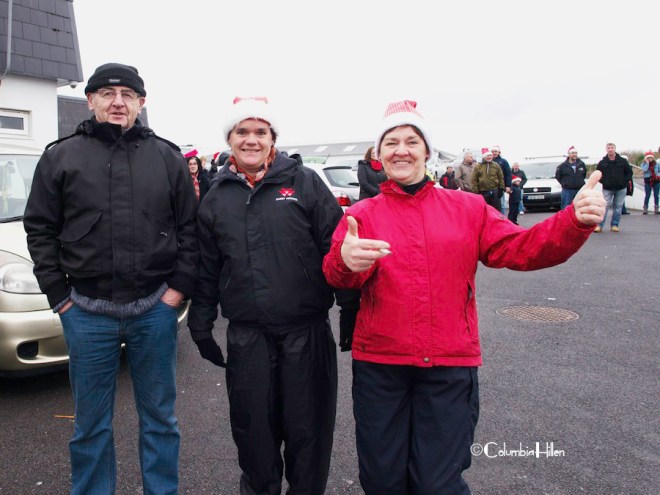
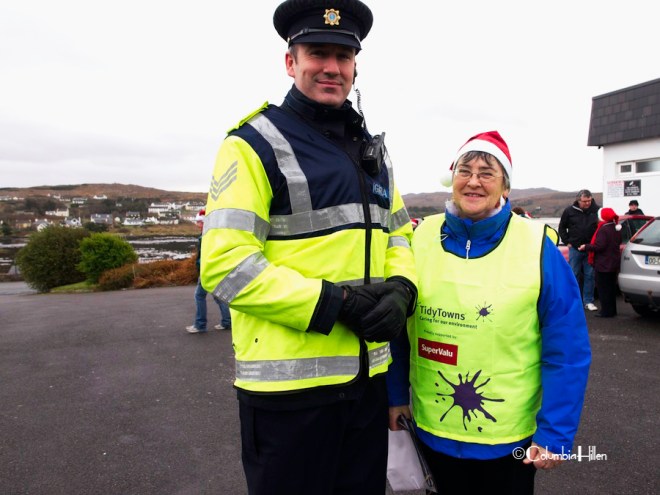
Independent local councilor Michael Cholm Mac Giolla Easbuig, Thomas Pringle Independent TD, social activist Brigid O’Donnell and all those organizing the enduring ‘Can’t Pay, Won’t Pay’ campaign stood on a rise opposite the Garda Station in Dungloe and watched proudly as a lively group of several hundred people marched determinedly through the town centre.

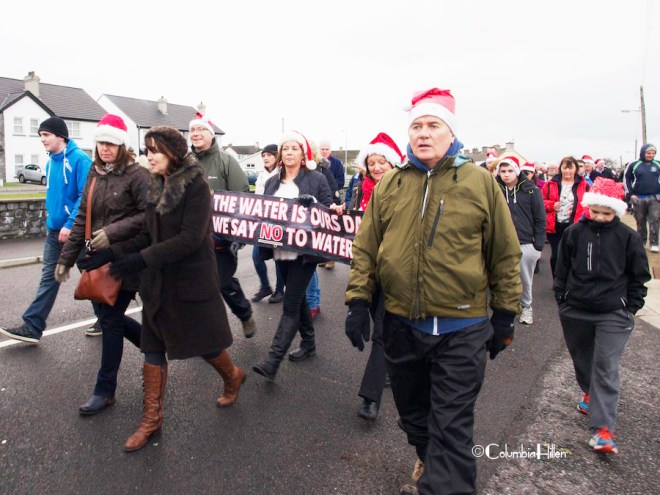
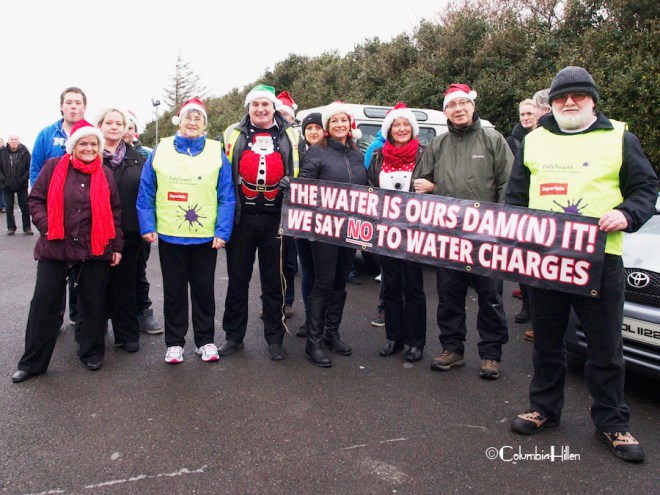
Many wearing decorative Santa hats – some even dressed in the Bearded Fellas’s full bright-red regalia – the marchers called out the names of those TDs who voted in favor of the water charges, including Donegal TDs Joe McHugh and Dinny McGinley, and encouraged everyone to face up to them and not pay.

OLYMPUS DIGITAL CAMERA

Pringle said his home had been metered but added that he would not pay the bills when they arrived next year due to their unfairness.

“It is very gratifying to see so many people here so close to Christmas, it bodes well for the success of this campaign,” he said addressing the crowd. “We will fight this throughout the coming year, and the year after if we have to.”

Mac Giolla Easbuig, who has put himself in the forefront of the protest by blocking workmen trying to install the meters locally, said, “Even if they go ahead and install meters, we all have the choice whether to pay or not. Boycott is a long-held tradition in Ireland and by doing that we can frustrate a government that continues to impose unfair taxes, hitting those who can least afford them.”

OLYMPUS DIGITAL CAMERA

Starting from Ostan na Rosann, the marchers, young and old alike, with children holding parents’ hands, walked to the top of the main street, past the library, then along to Lidl’s supermarket and back again, before stopping to hear a number of speakers, including O’Donnell, who had called for the protest and who’s birthday it was that same day.

For her efforts, she was greeted by warm applause and an impromptu chorus of ‘Happy Birthday’ from all those gathered.

OLYMPUS DIGITAL CAMERA

As we move into a New Year, we all nourish the hope of better things ahead. But sometimes hope is not enough. There has to be real discussion and there has to be real action. That’s why my wife and I showed our solidarity and marched with so many other people who turned out on a cold, damp day this past weekend when they could so easily have stayed snug at home beside a warm fire.

In passing so many stealth taxes since it came into power and failing to raise a wealth tax or deal properly with cronyism and the banker-cum-Irish-Water-bonus mentality, the government relied on people’s apathy.

But they severely underestimated the depth of feeling of the electorate and have paid a hefty price for that failure thus far. If opinion polls are anything to go by, they’ll pay an even bigger price when national elections come round again – unless they start doing what they promised to do – to create a more equitable society in Ireland than there has been in generations.

Let’s hope 2015 proves to be a momentous watershed in this regard, and certainly a big improvement over this past year.

OLYMPUS DIGITAL CAMERA

OLYMPUS DIGITAL CAMERA

OLYMPUS DIGITAL CAMERA

OLYMPUS DIGITAL CAMERA

OLYMPUS DIGITAL CAMERA

OLYMPUS DIGITAL CAMERA

Complaint about Udaras cover-up sent to Ombudsman

Ireland’s biggest fault is lack of accountability – the main reason we’re in the humiliating position of doffing our caps and begging for mercy from the IMF.

Instead of fairness and transparency in public affairs, we get cronyism and cover-ups. The Central Remedial Clinic, The Financial Regulator, FAS, the Rehab Group, the John McNulty scandal …. the list is a depressingly long one.

But what’s even worse is when our supposed independent media collude in supporting this kind of deception.

Damning evidence this week indicates that is exactly what the local office of Udaras na Gaeltachta and the ‘Donegal Daily’ news website have been involved in.

Earlier this year, Udaras’ local tourism officer Gearoid O’Smaolain contacted Stephen Maguire, the news website’s co-owner, complaining that a report on the site contained what he said was “a fabricated quote,” attributed to him when he spoke at the launch of the multi-million euro, EU-funded CeangalG project at An Chuirt hotel.

false accusation

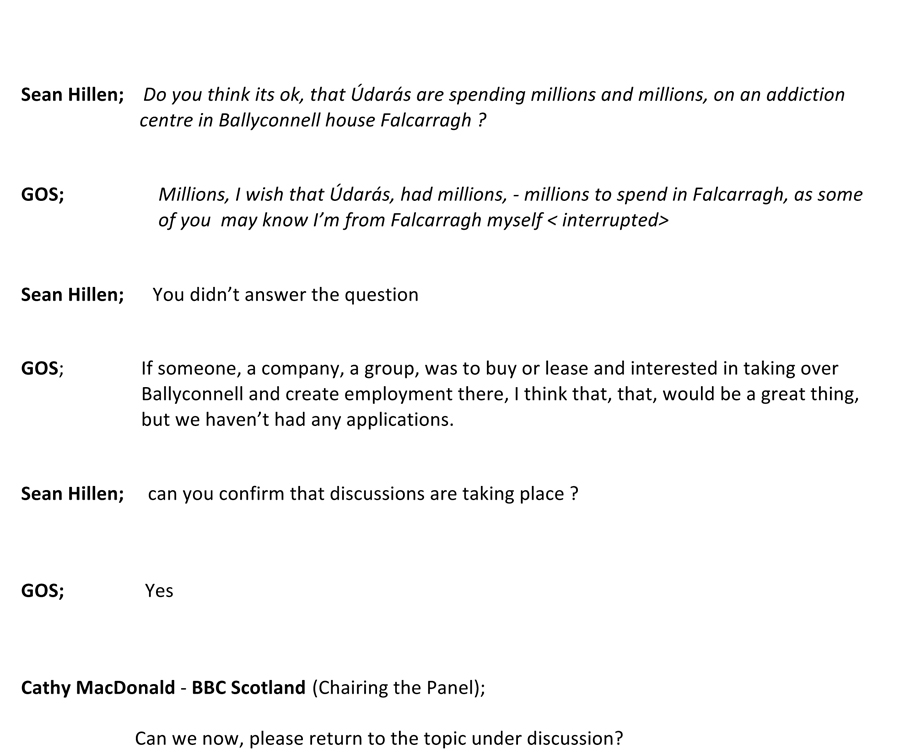
At that conference, I had asked O’Smaolain about a proposed addiction clinic in Falcarragh that was rumored would cost taxpayers several million euro and run by the Catholic church. O’Smaolain said discussions were indeed underway with Udaras, that his organisation didn’t have millions to spend and that no decent projects had been put forward for the site at Ballyconnell House beside the town golf course. Thus the article below:

Angry reaction to setting up addiction clinic in Falcarragh

As it was I who compiled the news report, Maguire promptly called me, saying O’Smaolain told him he had an official transcript of the conference to prove his accusation. I asked if he (Maguire) had read or listened to this transcript. He said he hadn’t but that O’Smaolain had sent him an excerpt. See below –

transcript email

Sean Hillen Q and A

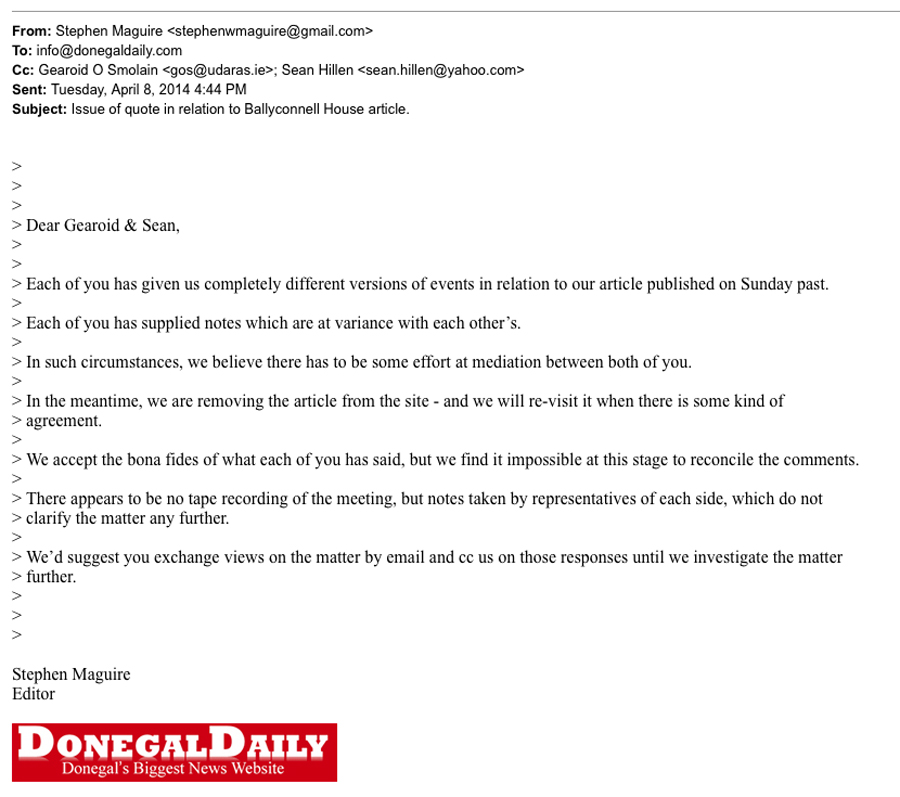
Upon reading this, I offered to give Maguire my notes from the conference so he could make a fair decision. Instead he sent this e-mail to both myself and O’Smaolain.

letter from Maguire

Imagine my shock, therefore when – without further notice – I then read this abject apology on the ‘Donegal Daily’ website the very next day.

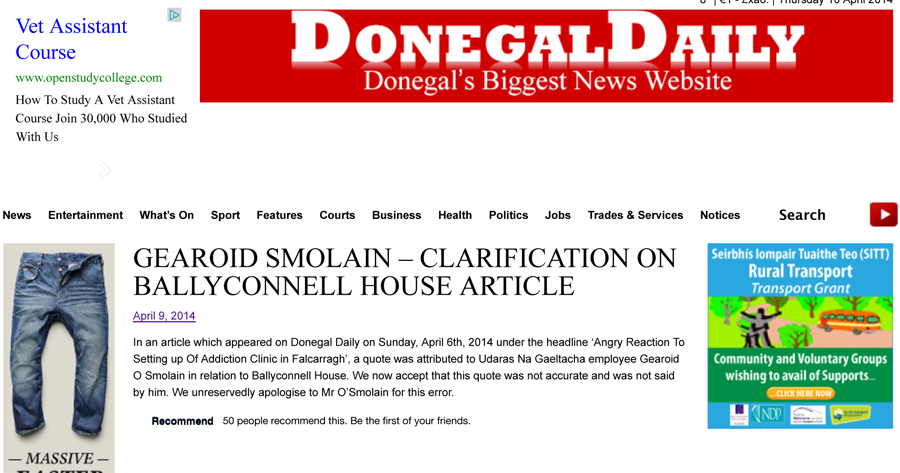
GEAROID SMOLAIN – CLARIFICATION ON BALLYCONNELL HOUSE ARTICLE

I contacted Maguire repeatedly asking for an explanation and a copy of the official transcript of the conference. Months later, still no response.

I then contacted Sabhal Mòr Ostaig in Scotland, the leader of CeangalG, which had also planned and supervised the conference at An Chuirt, asking them for a copy of the transcript.

Claire Nicolson, the organisation’s administrator, was helpful, initially saying she did not think there was such a transcript, and, when I requested a definitive answer, responded this week in the message below that was also c’d to Alasdair Morrison, a former minister in the Government of Scotland, now CeangalG director.

From: Claire Nicolson <claire@connectg.net>

To: Sean Hillen <sean.hillen@yahoo.com>

Cc: Alasdair Morrison <alasdair@connectg.net>

Sent: Friday, December 12, 2014 5:31 PM

Subject: Re: Donegal conference

Seán, a chara, thanks for your email.

That was our cultural tourism conference in February. I recall you asking for this information before. I’m sorry, there was no transcript or recording of the event.

Le gach dea-ghuí

Claire

O’Smaolain therefore, it emerges, not I, was involved in fabrication. Worse, Stephen Maguire and ‘Donegal Daily,’ fully supported him in doing so based on a transcript that never existed.

One might ask: Why was this subject so sensitive that such lies and deceit were used to keep it from the public eye? And why would an editor kowtow so easily to make an unjustified apology and retract a perfectly accurate news story from a website?

As the reasons for Maguire’s actions are obviously not in pursuit of journalistic excellence, are they merely financial? Did Udaras or organisations or individuals associated with Udaras either threaten him or Donegal Daily Ltd. with a lawsuit or through withdrawal of advertising? Or, indeed, did they promise future ad revenue if he simply did as they demanded?

By coincidence, John Curran whom Fine Gael appointed to the board of Udaras and who subsequently failed to win a local council seat recently, had a paid political banner ad in the ‘Donegal Daily’ when my addiction clinic broke. Did Curran threaten to withdraw his ad if the story was not squashed? See the ad at bottom of the same page as the story : Angry reaction to setting up addiction clinic in Falcarragh

If true, this is a most dismaying development, illustrating the reason why there is a falling level of trust by Irish people in today’s government.

Equally, O’Smaolain’s accusation in defense of Udaras – now shown to be false – illustrates why there’s a growing lack of faith in organisations trusted with spending scarce public money.

Gearoid O’Smaolain (l) and Stephen Maguire (r)

And most dismaying of all in many respects is the conduct of Stephen Maguire and the ‘Donegal Daily.’ As I pointed out in an earlier post, strong independent media underpins any democracy.

After more than 30 years in journalism both here at home and abroad, I still firmly believe this. As truth is the rudder that steers ethical decisions in journalism, it is most disappointing to see how Maguire and the ‘Donegal Daily abrogated responsibility in such a pathetic way.

Having investigated the situation comprehensively over the last few months, I forwarded a file to the Press Ombudsman and the Press Council of Ireland, only to be informed that it could not investigate further as ‘Donegal Daily’ is not a member of the council.

I find this ironic as only a few days ago the ‘Donegal Daily’ boasted of being among the most popular news websites, yet is not even a member of a nationally-respected organization to which all serious news media outlets belong.

I suppose, more than anything, this indicates how earnestly Mr. Maguire considers the importance of accuracy in news reporting.

My file outlining how Mr. O’Smaolain misused his authority in an effort to damage my reputation, is now with the Office of the Ombudsman. What action is taken, if any, will indicate if our government is serious about creating a more transparent and accountable society, thus preventing what happened to me, happening to others.

Whale sightings off Donegal coast encourage educational and tourism efforts

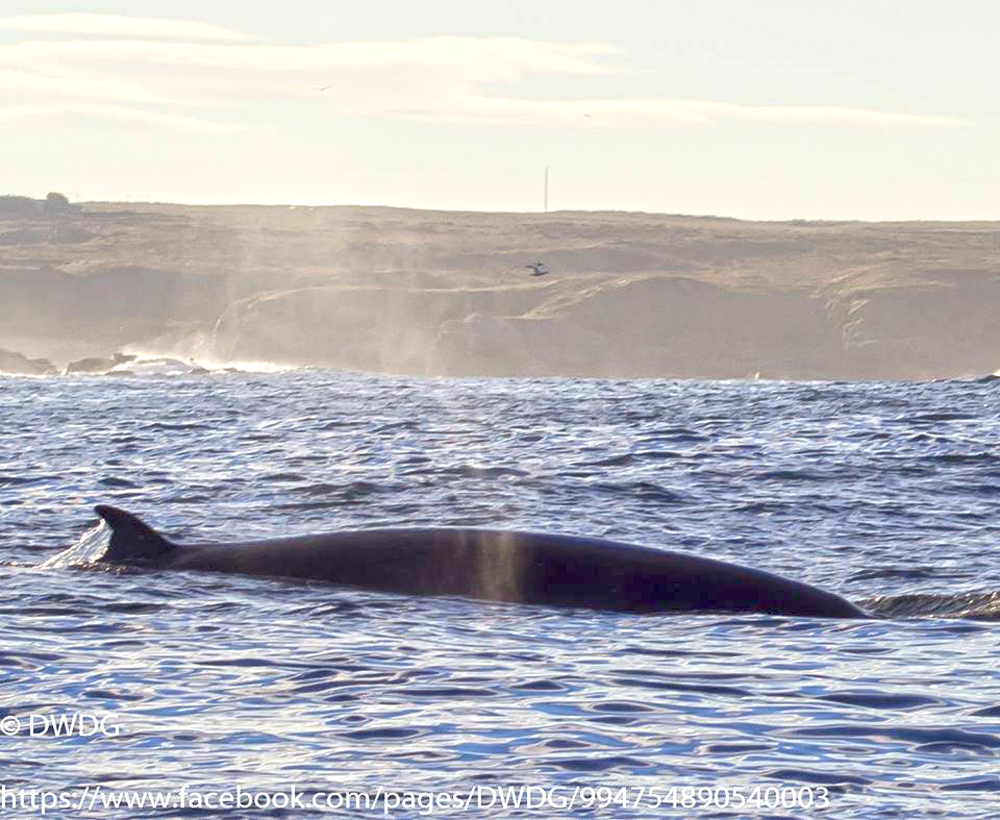
Approaching within 30 feet of a minky whale out on the Atlantic takes courage – but such is his concern for the welfare of local marine life that’s exactly what Gareth Doherty did recently.

With the sighting of so many such baleen whales off the northwest Donegal coast over the last few weeks, Doherty, a skilled seaman (he manages Selkie Sailing in Gaoth Dobhair) and knowledgeable environmentalist, realized it would be a prime opportunity to try to identify them and monitor their movements and thus understand better the thriving whale population off Irish coastal waters.

whales 1

“It is only by recording the twenty-four cetacean species recorded thus far in Irish waters that we can protect them,” he said. “The fact that so many are now visiting us is wonderful news.”

whales 6

Doherty also believes that greater numbers of such healthy marine animals locally means greater opportunities to both educate people about this vital segment of sea-life and strengthen environmental tourism efforts throughout Donegal.

Here is yet another local cultural tourism-cum-educational project worthy of financial support. Udaras na Gaeltachta, the state-sponsored economic support group in the area, has refused to pay for much-needed equipment for Selkie Sailing.

Readers of this blog and of a series of articles I penned for the Donegal News will remember Gareth for the sterling work he and others did to bring important publicity about the plight of a pod of stranded whales at Ballyness beach in Falcarragh earlier this year.

whales 2

Not only did Gareth and colleagues highlight the stark inadequacies, both in equipment and training, of the National Parks and Wildlife Service to deal with such incidents (it has since become known that Donegal wildlife officials didn’t even take sample tissue from any of the dead whales to ascertain what may have stranded them and led to their slow suffocation) but they also banded together to organize marine lifesaving training programs for people that continue even now.

Visiting my Bun na Leaca home recently, Gareth said his intention was also to launch a series of educational visits to local schools to make presentations about the importance of marine life around our shores. It is an excellent idea and there seems no more qualified and enthusiastic a person to host such a program than Gareth.

whales 3

Minke whales grow to about nine meters in length, weigh around 10 tons and can live about 50 years. Their bodies are dark grey to black on the back and lightening to white on the belly and undersides of the flippers. There are often areas of light grey on the flanks, one just above and behind the flippers and the other behind the head. Those in the northern hemisphere usually have a diagonal white band on the upper surface of each flipper. Smallest of the seven great whales, minkes often enter estuaries, bays and inlets and feed around headlands and small islands.

Updates can be checked on Selkie Sailing.

The Irish Whale and Dolphin Group assisted with local training programs.

Celtic or Hibernian: which is rightful heir to the Irish tradition in Scotland?

As a Donegal blow-in, I’ve just completed what some here in Ireland’s ‘Forgotten County’ call a key ‘rite de passage.’

photo copy 5

‘Wee Jimmy’ – a winger with panache and a Celtic footballing hero.

On the invitation of Celtic Football Club management, I made my first-ever visit recently not only to the historic city of Glasgow – where half the people in Donegal seem to have originated, and vice-versa  – but also to the venerable stadium known as Parkhead, home of the Hoops, an illustrious team that has become nothing less than a cultural icon for many generations.

So, on a crisp, dry Saturday afternoon, two hours before kick-off against third-placed Inverness Caley Thistle, I found myself walking along a long inner corridor on the upper tier of the stadium lined with the framed autographed shirts of former players including Ireland’s captain, Robbie Keane, Honduran Emilio Izaguirre, Swede Henrik Larsson, Charlie Mulgrew and Kris Commons.

photo copy 4

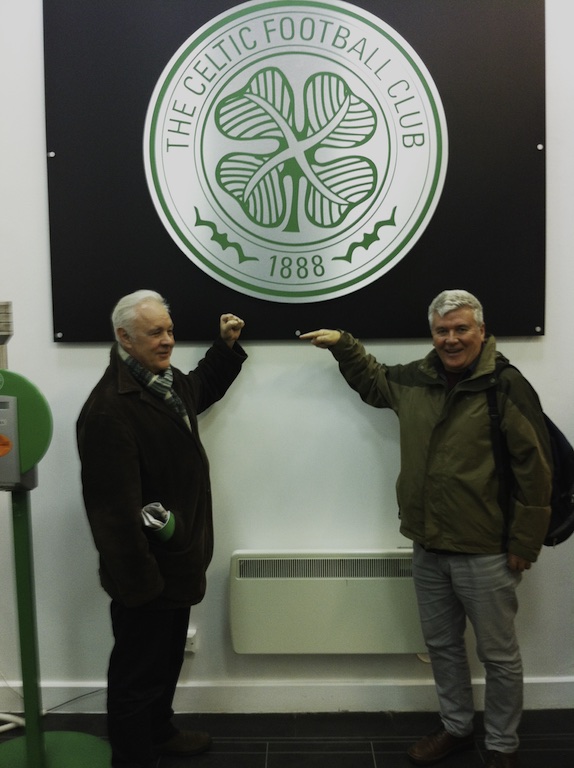
Two gray-haired Celts – Professor Pia (l), footballing expert – ahead of game time.

Within minutes, I was seated in the warm comfort of Café 1888 (the year the club was formed) enjoying a tasty lunch rapidly replenished with alcoholic beverage learning about the trials and tribulations not only of Celtic but of Scottish football in general.

And according to the man sitting opposite me – and no better person to grant illuminating insights than someone who has penned not one but three excellent books on Scottish football (‘The Quiet Man’, ‘Scotland’s For Me’ and ‘Sunshine on Leith’) – footie across the water is not in a healthy state.

Not withstanding that my companion, Simon Pia, long-time journalist and now professor at leading universities in both Edinburgh and Glasgow, has been a ‘Hibbies’ (those persons, who for reasons most bemusing to many Celtic supporters, support Hibernian FC) and that his team now lingers in the shadows of the second division, his insights into the sport in his native land were thoughtful and well considered.

photo copy 7

With Scotland battling Ireland this Friday in the Euro Championships, captain Robbie could be a deciding factor.

With money in short supply – at least compared to the massive amounts enjoyed by teams in the English league – Simon’s view is that Scottish football will remain mediocre and largely uncompetitive for the foreseeable future. And with Celtic’s arch Glaswegian rival, Rangers, declaring bankruptcy and being dumped unceremoniously into the second division more than a year ago, even that spark of zesty competition has been extinguished (though the two teams will face off in the League Cup semi-final soon – the first time they’ve met each other for two years).

Setting patriotism aside, or indeed lauding it, Pia – a product of Italian sperm that migrated to Edinburgh many years ago and who was my close pal at London journalism college a world ago – believes top teams such as Celtic would do better playing in the premier league down south.

photo

Hibbies gracefully acknowledging illustrious history of the Hoops.

“Facing the likes of Manchester United, Chelsea and Arsenal would certainly draw in the big crowds again and probably help other Scottish teams do better in domestic competitions and thus compete on the European stage more often, which would help improve the quality of the game here,” he said.

As for the match itself that day, real excitement was in short supply. The Hoops, under manager Ronnie Deila, struggled to break down a resilient Inverness defense. In the end, a single second-half goal by star forward John Guidetti allowed them to leap over their opposition and into third place, though two late goalmouth scrambles almost sent the visitors home to the banks of Loch Ness in triumph.

Whether good or bad for Scottish football, there are few saying Celtic, the richest team in the league, will not end up winning the premiership for the fourth successive year – especially after leaping to the top with a last-minute winner against Aberdeen on Sunday.

However, after talking to Simon, learning his team was founded by Irish immigrants (thus the nickname ‘Cabbage and Ribs’ and the harp symbol on the shirt) and listening to one of its wonderful musical anthems ‘Sunshine on Leith’ by The Proclaimers, I’m more interested in seeing the Greens promoted than what’s happening in the top division.

But please don’t tell anyone from west Donegal. I’m due to get my residency permit any day.

QUIZ

photo copy 3

Crowds start to gather before kick-off at Parkhead.

Checking your knowledge of Celtic, here are three questions from that day’s match program:

  1. Which two former Celtic captains are this season managing teams in the Championship in England?
  2. Which four clubs did Charlie Mulgrew play for between his two spells at Celtic?
  3. Which two current Celts have in their careers also played in Spanish football?

If you cannot answer these questions, you probably should watch this video Sunshine On leith CIS Final – BBC and listen to the song. I’ll see you at Easter Road.

photo-4 copy

Hoopy the Huddle Hound, Celtic’s lovable mascot (in foreground), supervises the team line-ups.