Yet another Irish political fiasco

I was shocked to read in a leading Donegal newspaper editorial over the last few days that John McNulty had behaved ‘with dignity’ over his recent Fine Gael botched Senate nomination.

Let’s call a spade a spade.

The last thing Mr. McNulty behaved with was dignity. He condoned the onward march of cronyism and ‘stroke politics’ thus giving his full support to this age-old blight on Irish society.
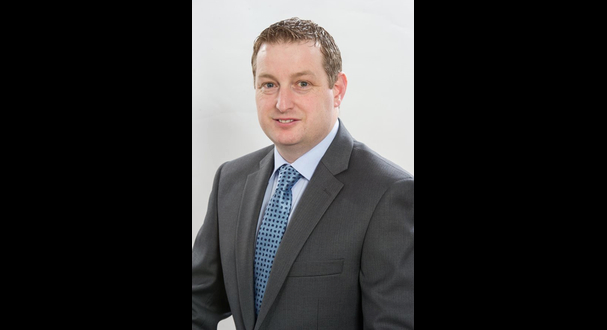
John McNulty – guilty as charged, complicity to hoodwink. Photo courtesy Independent Newspaper.

Selling Mars bars at a Mace grocery shop in Stranorlar hardly qualifies Mr. McNulty to contribute much, if anything, to the development of the Irish Museum of Modern Art (IMMA) (unless his business is merely a front for a secret network of art collectors storing priceless Van Gogh’s under the petrol pumps). There are many throughout the country with decades of high-level experience in the arts sector and thus much more qualified than he.

Yet when Fine Gael spin-doctors whispered in his ear they’d pull a few strings and shove him on the (already full) board, thus giving him an easier ride into the Senate, he leapt like a deer in heat, omitting to point out the simple fact that he was completely unqualified for such a key position.

In doing so, the 37-year-old Kilcar man is as guilty as those people – mainly under Fianna Fail’s governing stewardship – who greedily grabbed places on other boards such as FAS and the Central Remedial Clinic and proceeded to claim hefty payments and generous expenses on the backs of struggling tax-payers. (Fianna Fail actually rushed 182 of their members on to public boards in the dying days of its last reign).

It must also be remembered that, far from being a credible Senate nominee, Mr. McNulty failed to even get elected to Donegal County Council having won just over 800 votes in May, less than half of the quota required for the six-seat electoral area. In fact, he finished the race at the rear of the pack at a distant 10th place.

Choosing him shows just how desperate Fine Gael are to shore up its political representation in Donegal, especially with the additional failure of John Curran, its choice for the Udaras board, to get elected to the local council (in great part over his willingness to hand over more than a million euro of tax-payers money to the Catholic nuns to run an addiction center in Falcarragh when there’s already one in Donegal, and after the dead babies scandal in Tuam). With Donegal South-West deputy Dinny McGinley due to retire at the next election, Curran’s failure and now McNulty’s means there’s nobody in place as a successor.

John Curran – until recent local elections, was being groomed as potential successor to TD Dinny McGinley?

Public boards or private clubs?

In a bizarre twist to the tale, Fine Gael Arts Minister Heather Humphreys said in the Dail this week that Mr. McNulty was appointed to the board of IMMA “on the balance of talent and experience.” That’s a joke. The minister then added that she and her party were committed “to using the public appointments procedure in line with the guidelines.” That’s an even bigger joke. It recently emerged that at least two of the six appointees to the Board of the Heritage Council last year were made by her colleague Minister Jimmy Deenihan in contravention of that very same formal application process.

Further, a 2012 report by the Institute of Directors In Ireland on state boards showed concern at the lack of transparency around the appointment process and the lack of consideration given to the skills required to fill them. Since then, board positions have featured on Government department websites and advertised via the Public Appointments Service but some describe this as ‘pure window-dressing’. The McNulty situation, and perhaps the Curran one too, are cases in point.

Plain-speaking (maybe too plain) Minister for Health Leo Varadkar said election to the parliament of a candidate who has withdrawn – as McNulty has done to avoid further embarrassment – would not be good thing for the political process. Duh, really?

Obviously, the only way forward is to make the recruitment process entirely transparent, minimise government involvement in choosing appointees, and actively engage individuals with the appropriate skill set to fulfill these positions.
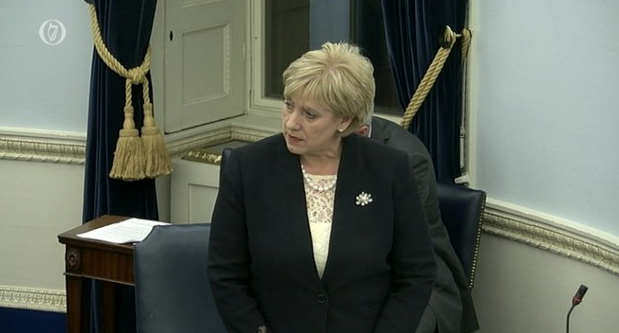
Fine Gael’s Arts Minister Heather Humphreys in the Dail struggling to deflect accusations of cronyism and stroke politics. Photo courtesy RTE News

No crying over spilled milk

Ultimately, however, we have only ourselves to blame.

Most of those who voted for Fine Gael over Fianna Fail three years ago knew deep in their hearts exactly what they were doing. Being conservative, as we Irish are by virtue of our Catholic upbringing, we voted for one party knowing full well deep down it was little different to the other. Then we deigned to pat ourselves on the back for ‘taking a bold stand.’

What baloney! Ours was nothing less than a cowardly act.

To make matters worse, when we had the chance to regain some degree of pride and do away with a Senate that is, and always has been since the foundation of the state, a complete and utter waste of public money, we declined to follow our instincts and put pen to paper. How could any of us vote for such an anachronistic and discriminatory institution highlighted by the fact that with so many worthy universities and colleges throughout Ireland, only two – Trinity College Dublin and the National University of Ireland – are permitted to have Senators? Not to mention that 11 Senators are simply appointed on the whim of the Taoiseach. No elections, no vote.

Padding expenses? Investigations well underway on shenanigans of Fianna Fail’s Brian O’Domhnaill: Handsome salary as Senator not enough?

Today the Irish Senate, unlike the American one, stands as a perfect model of cronyism and stroke politics, with even appointed party members such as Donegal’s very own Fianna Fáil Senator Brian Ó Domhnaill under investigation for milking the system by duplicating expenses.

We tossed away the opportunity to fling the Senate into the bin of history where it firmly belongs. Let’s not now cry over spilled milk. Like McNulty’s reluctance to apologise publicly for his complicity in attempting to hoodwink us ordinary folk, it’s so undignified.


Shipwrecks, puppets and mechanical creatures – opportunities for cultural tourism

An earlier post – Cultural tourism: its time is nigh – highlighted the immense potential for cultural tourism in the Donegal Gaeltacht to help fill the vacuum left by failed government policies, mainly by Údarás na Gaeltachta, to provide jobs and prevent the departure of our dynamic young to foreign shores.

With the pursuit of major manufacturing companies a lost cause mainly due to difficult and expensive transport logistics and call centres being a short-term band-aid, cultural tourism has been an underused weapon in the battle against rising unemployment and severe economic decline in the Gaeltacht.

While some say a minority of people such as language-based entrepreneur Liam Cunningham in Glencolmcille have become tourism millionaires, mainly based on national and international grants with Cunningham perhaps reaping the benefits of his chairmanship of Údarás for over a decade (whether questionable or not, meaning within ethical parameters, is a topic for future discussion), the depth of funding to other local cultural tourism entrepreneurs has been sparse.

The reason, according to Udaras officials, is that cultural tourism doesn’t create long-term jobs. Asked why, officials are at a loss to explain, so what this long-held and somewhat irrational attitude is based on is a matter of pure conjecture, with some critics saying the real reason is unrelated to accepted principles of economic development but rather linked to cronyism, influence peddling and continued support, financial and otherwise, to Fianna Fail, a party that ruled the roost for so long and put certain people in key executive positions.

While the accuracy of this allegation requires further investigation, what is important to note is what other parts of Ireland and beyond have done – and are doing – to reap healthy benefits from committed policies to cultural tourism development and analyze whether the Donegal Gaeltacht has – to put it succinctly – ‘got what it takes.’

At a largely EU-funded conference earlier this year under the auspices of CeangalG and with the catchphrase ‘Selling Our Story,’ speaker after speaker talked about interesting cultural tourism ideas that have produced positive measurable results, including increased job creation. Many of the speakers agreed that key components for such success include ‘identity,’ ‘authenticity’ and ‘memorability.’

In my opinion, the Latin term ‘genius loci’ (spirit of place) best describes what the central element is – the specific nuances of any given place that separate it from the rest of the world.

So, does the Donegal Gaeltacht have what it takes?

In a word, yes!

Cherishing an ancient language that proudly holds its place among the oldest in the known world; with the singing tradition of sean-nós, whose ornamented, rhythmic intimations are an inspirational reminder of the primordial beginnings of Man; and with the area’s unique traditional dance and music, disparate elements of ‘genius loci’ are plentiful. Not to mention the intriguing Celtic legends such as those related to Balor and Lugh, thus the Mount of Lugh (now called Errigal) named after the ancient Sun God.

Having had the privilege over the last 30 years of travelling as a journalist on assignment to many parts of the world, I considered some of the places I’ve visited and successful cultural tourism projects there, projects that have not only strengthened the economic vitality of deprived areas but also uplifted the innate spirit and pride of the local population.

Here are a few, some which might just provide models of excellence for the Donegal Gaeltacht.

elephant

Creative engineering in Nantes, France, has led to economic revival based on cultural tourism.

Nantes, France – Earlier this year, I travelled to this western town in the Pays Loire region to see such a project. Faced with empty industrial estates, local officials had decided to invest in cultural tourism to create jobs using the existing space and infrastructure.

Realizing how watching ships return to this riverside port with exotic cargo from around the world inspired a young Jules Verne to later write science-fiction classics as ‘Twenty Thousand Leagues Under the Sea’ and ‘Journey to the Centre of the Earth,’ the officials embarked on a project that now attracts tens of thousands of visitors annually. Entitled Les Machines de L’Ileand opened in 2007, it is a 21st-century mechanical wonderland consisting of monumental structures including the, ‘Grand Elephant,’ ‘Mantra Ray,’ ‘Sea Snake,’ ‘Heron Tree,’ and ‘World Carousel’ in what is known as the ‘Gallery of Machines’ upon which visitors enjoy adventure rides and experiences. Last year alone, almost 100,000 people rode on the Grand Elephant; 190,000 people visited the gallery and 250,000 the ‘World Carousel.’ Total investment – in various stages – was 17.7 million euro, a sum that was recouped within a few years. In comparison, according to Údarás, Largo Foods received around seven million euro in funding and left the area earlier this year.

Not only did the project increase business revenues, it also created permanent, long-term new jobs in central workshops employing such tradespeople as plumbers, carpenters and engineers. Could a project like this – using local legendary Celtic figures as central subjects – not help deal with the empty industrial spaces throughout west Donegal, while attracting more tourists to the area?

OLYMPUS DIGITAL CAMERA

Puppetry, an age-old tradition in Sicily, attracts tourists and locals alike, providing both entertainment and cultural education.

Palermo, Sicily – Like west Donegal, this rocky island at the toe of Italy has generally been ignored by the central government in Rome. Faced with worsening employment, local officials took matters into their own hands. Seizing on a peculiar and unique vein of cultural heritage dating back hundreds of years to the time of Socrates – puppetry – they created a flourishing tourism attraction that has boosted business and employment.

Opera dei pui’ (puppet theater) has a long tradition in Sicily, reaching its peak around 100 years ago on the island. With support from the Association for Conservation of Popular Traditions, visitors to the downtown Palermo puppet museum can now see hundreds of beautifully designed puppets, their masters’ equipment (mestiere), as well as other memorabilia, and regularly-staged shows involving cultural characters and chivalrous heroes such as Orlando, Rinaldo and Gano di Maganza. So strong has been the resurgence of interest in this long-held tradition, puppet theatre performances – that also play an important educational role in highlighting the island’s history –take place in other parts of Sicily. Again, using local legendary figures and stories, can the Donegal Gaeltacht not avail of a similar cultural tourism initiative? A creative team under the guidance of Kathleen Gallagher has already shown the level of know-how required for such a project.

shipwreck

Donegal flag flies high over one of the area’s most well-known shipwrecks opposite Ostan Gaoth Dobhair. Many others lie offshore, spanning centuries of history.

Key West, Florida – before it became a hotspot for tourism, this area on the tip of the peninsula was a backward, forgotten place in the 1800s where local fishermen and their families led difficult hand-to-mouth existences. Only when the phrase ‘Wreck Ashore!’ rang out did hope for better things arise. ‘Unloading’ the many ships that ran into difficulty was a chore, but a most rewarding one.

Seizing upon this colourful aspect of the area’s history, local officials decided to create an attraction that would be both entertaining, as well as educational. Thus, the ‘Key West Shipwreck Museum,’ where visitors step back in time to discover Key West’s unique maritime heritage. The museum combines actors, video and actual artefacts from the rediscovery of wrecked vessels such as the Isaac Allerton, which sank in 1856 on the treacherous Florida Keys reef.

Narrator and master wrecker, Asa Tift, and his wrecking crew tell the story of how this unusual industry created livelihoods for the early pioneers of Key West. Visitors can even climb a 65-foot lookout tower in search of wrecks.

West Donegal, with its rich maritime heritage and its record of shipwrecks, including the sinking of Spanish Armada galleons off Tory and Gola Islands plus other vessels, both military from the two world wars and commercial, offers a similar historical backdrop to Key West. What’s to prevent officials funding such a project – except, of course, narrow-minded thinking and lack of specialised business acumen?

Columba: saint, soldier or New Age Pagan?

Columba, considered saintly by some, charismatic by others, was a bit of a ‘cute whore,’ a caustic and cantankerous character, a male chauvinist, thrifty to the point of miserliness and perhaps a non-entity who did diddly squat except be a pawn for powerful war lords vying over territory in early Ireland.

Such are the colorful views of some leading historians, archaeologists and writers gathered recently in what is considered the Celtic mystic’s ‘home place’ of west Donegal to deconstruct aspects of the legendary fellow’s life. The three-day conference at Loch Altan Hotel, Gortahork, was organized by The Islands Book Trust, led by John Randall, ably assisted by the ever-helpful Mairi NicChoinnich, in association with Colmcille Éirinn is Alba.

Photo by Alan Sproull

Rural west Donegal – the area is considered the ‘home place’ of the legendary Columba. Photo by Alan Sproull

So who then was responsible for some of the magnanimous stories about this larger-than-life character and his supposedly ‘unEarthly’ powers and their ultimate adoption as mainstream belief? A new, ambitious group hell-bent on making sure it rose to the top of the ‘Champions League of Religions’ table, that’s who. Not an easy task, mind you, for developing Christianity faced well-established teams of equally high calibre, many with loyal fan bases, catchy club anthems, ambient arenas and good-looking kits – all well-suited to the emotional needs and superstitions of Irish people around 2,000 years ago.

To compete with the Red Devils, Gunners, Barças, Reals, Inters and Juves of the religious world, Christianity had to go on the transfer market to strengthen its position. And it didn’t much waste time about doing so either, quickly transferring a bunch of Pagan symbols – wells, crosses, incense, wreaths, bells, chants, ceremonies – even wedding rings – under its spreading angelic wings.

But that wasn’t enough. With solid defensive work and fine attacking play, opposing teams held out well against them.

Then leaders of the new movement put their collective heads together and in an illuminated moment of intellectual brilliance (in lingo religiosa ‘the Holy Spirit came upon them’) realized the one vital ingredient missing from their strategy – the persuasive power of an ancient, as well as modern, condition known commonly as ‘celebratitis.’

picts

Using Pagan symbols such as the cross, Columba may have persuaded tribes-people to a different way of thinking.

So, as one does when one has rising aspirations of political greatness, they created a sub-committee. A subcommittee with the sole purpose of weaving together stories on selected individuals, stories so grandiose and wondrous they’d make celebrities out of any plain Peter, Paul and Mary, alive or dead. In fact, their preferred choice was the latter, for among all the beliefs abounding – then and now – there’s one you can be pretty damn sure of –- it’s difficult to argue with a corpse.

Thus was born the legend of Columba – about whom, conveniently for his ‘handlers,’ conjecture heavily outweighs fact.

Hell-bent on their mission, monks of the newly-fashioned Christian organization created a carefully-crafted chronology of the fellow’s life that they entitled ‘Chronicles of Iona’ but while others mention a library in Kilmacrennan where it might have been housed, no-one has found a single shred of evidence of it (or such evidence, for reasons of strategy, has been craftily shifted to location unknown). A censored part of it is in the ‘Annals of Ulster.’ In it is included details of what they purport to be miracles (seemingly the head gaffer put around a memo to his fellow brethren asking for submissions as they were a bit short on anecdotes) and other material supporting their cause, including their anti-woman crusade (all contributions welcome as to the origin of this particular stance). For example, Columba is supposed to have banished all women from Iona, warning others to be wary of them, not to give them too much power, or – interestingly – too much water, one conference speaker claimed.

As for his alleged saintliness, historians indicate Columba – like many other monks of the time – often believed the secular to be more sacred than the spiritual and were mere ciphers for rival, warring factions, at a time when churches were placed on territorial borders as symbolic deterrents or markers. It is believed Dai Riada, the king of the area associated with Columba, might have wanted to expand his holdings and used our fellow solely for that reason.

Fired up by his missionary zeal, Columba also supposedly skedaddled hither and thither all over Europe. But, just as in the case of saints’ relics, he’d have to have been cloned to be in all the places he is supposed to have been, doing the things he is supposed to have been doing. Some believers, for example, say he was not only involved in discovering the holy wells of Derry but was the actual founder of that particular northern Irish city. There’s little contemporary evidence of this. Due to the gap of years between his death (around 593) and the city’s founding, he’d have to have been a time-travelling vampire to have accomplished the task. Another monk, Augustine, is more central to Derry, having established a church there since the 600s AD. At best, Columba’s favorite Uncle Fiachra was Derry’s founder but again evidence even of this is severely lacking.

According to Christian slant, Columba is also thought to have brought back the so-called Gospel of Martin from Tours in France. Please don’t ask me to accept this on ‘blind faith.’ That’s like the blind leading the blind, and there’s no easier way to go astray than that. More likely, with spelling in those days being less than precise and Tory Island known in documents as Toraigh, Toirinis and Tourensis, it was a case of geographical misplacement (or story enhancement).

iona

Iona – a windswept Scottish island that reflects the heritage of the legendary Celtic mystic.

Even the much talked about Battle of Cúl Dreimne near Ben Bulben in Sligo – allegedly fought over Columba’s illegal copying of a book (‘to every cow its calf and to every book its copy’) and his banishment to Iona – this may simply have been the workings of an over-imaginative scribe in a cloistered scriptorium. Instead, the battle may have been over the killing of man, who was under Columba’s protection, by Diarmait mac Cerbaill, High King of Tara. Some say the leader of a monastic settlement in Inismurray Island, Sligo, then told Columba bluntly it would be‘better’ to high-tail it out of town and across the water (others say he may have left out of guilt at causing so much bloodshed).

Regardless, what seems to be true is that there was no love lost between Columba and Diarmait. Diarmait, the last High King to worship in the Pagan manner and who celebrated the Feast of Tara, the pagan inauguration ceremony, was not keen on this new Christian doctrine, seeing it as an opportunistic usurper. The Irish annals include a reference to him even building druid fences on the battlefield.

As for Columba being caustic and cantankerous, word has it that he’d simply curse people he didn’t like. One man who pretended he was asleep to avoid talking to him ended up snoozing for a year and a day. Poked in the eye by a reed while tying his shoe, Columba cursed all reeds, thus the reason they’re brown and no longer sharp. After slipping on a salmon…… well, I’ll let you conjure up for yourself what curse Columba might have bestowed upon those innocent little creatures.

Amidst all the fact, fiction and propaganda, what emerges is that Pagan leaders and Christian monks and their supportive warring chieftains battled each other for territorial advantage and the spoils of victory that came with it.

Whether you believe Columba was your average Joe Blow or a saint, a term open to so many interpretations (one speaker at the Gortahork conference referred to him as “a bit of a James Bond character”), the cult that grew around him makes for fascinating anthropological and sociological discussion.

That is why the Slí Cholmcille (Slighe Chaluim Chille) project, a partnership between Foras na Gaeilge and Bòrd na Gàidhlig, could be a boon for cultural tourism. After hundreds of years, wouldn’t it be nice for communities, and not only the church, to benefit from such a legendary figure? Developing Ireland’s very own ‘Santiago Columba’ into a successful pilgrimage project could attract thousands to both western Scotland and Ireland.

For further information, see the book by University College Cork’s Máire Herbert (Iona, Kells, and Derry: The History and Hagiography of the Monastic Familia of Columba) and Brian Lacey’s (Saint Columba: His Life & Legacy).

A note of caution: when reading about Columba and his exploits it is probably helpful to keep in mind the old adage – History is written by the victors.

A poem attributed to Columba is also worth musing upon –

“If poet’s verses be but fables

So be food and garments fables

So is all the world a fable

So is man of dust a fable.”

Wailing for the death of majestic whales

Nothing is worse in life than waiting for death.

Especially if that death is an excruciatingly slow and painful one.

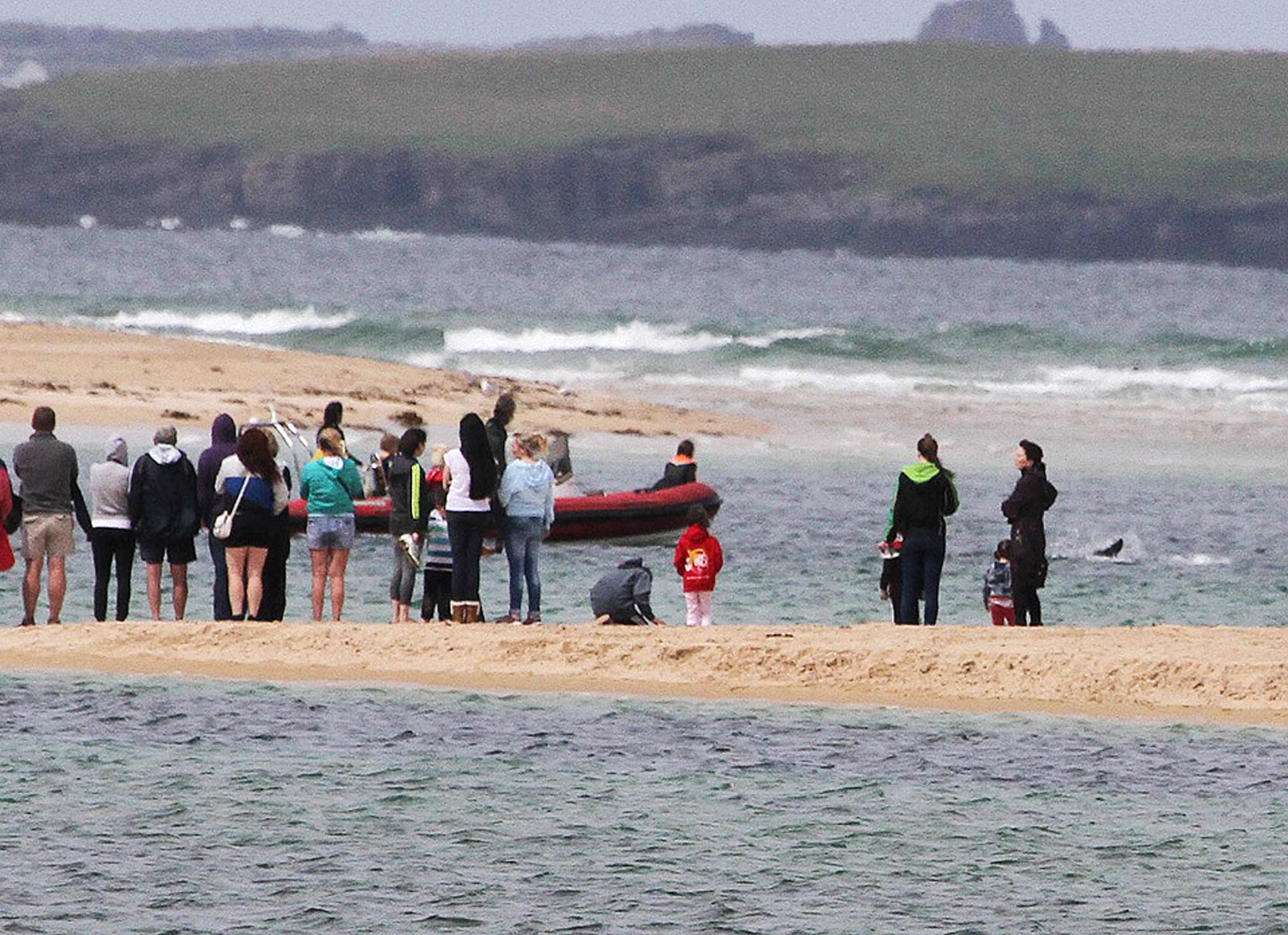
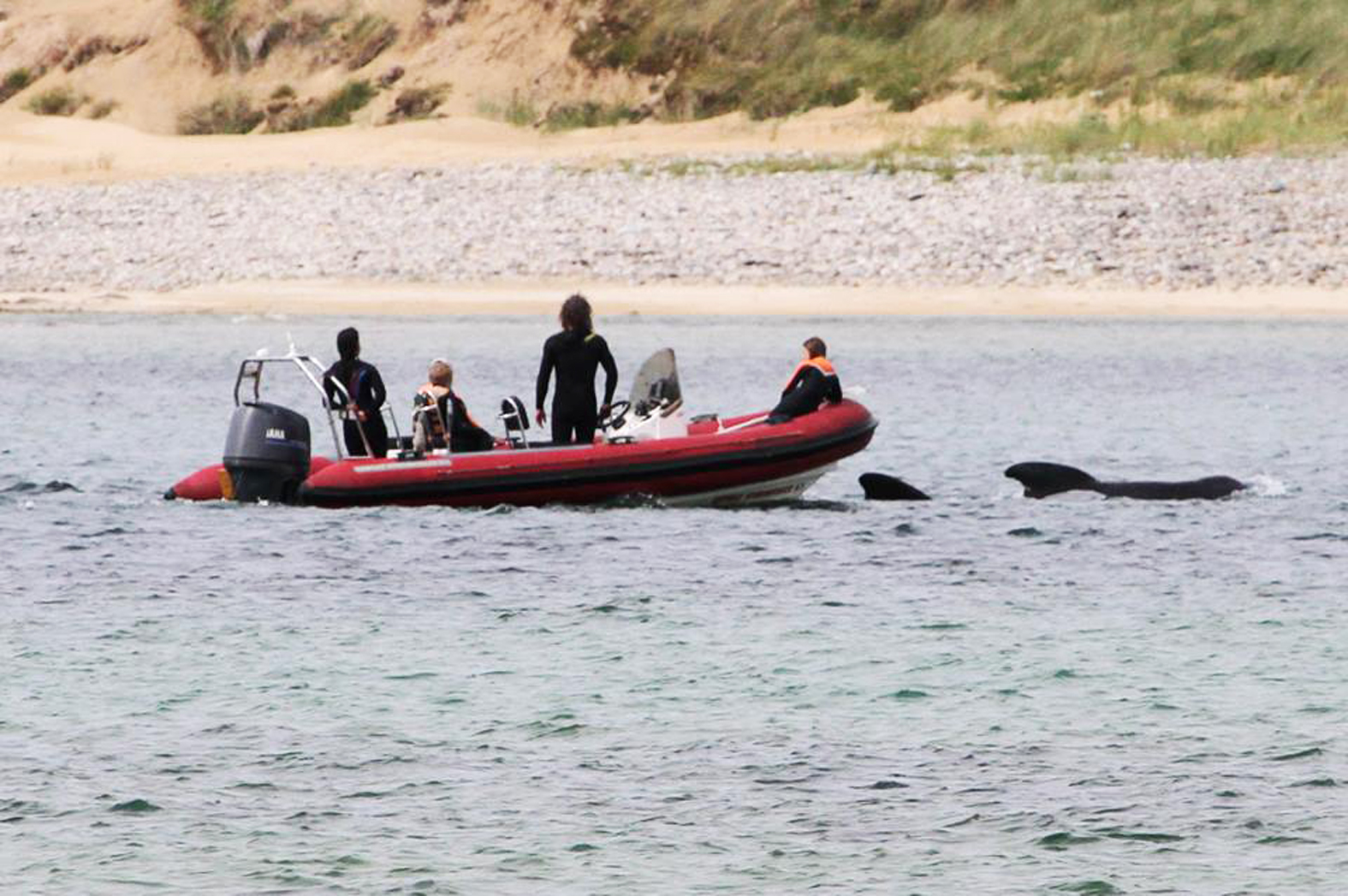
That’s why it was so heart-wrenching to watch a pod of 13 beautiful adult long-finned male and female pilot whales and their children suffocate slowly – over five horrific days – at Ballyness beach near Falcarragh this week.

Photo by Antonia Leitner

One of the stranded pilot whales, a highly-intelligent member of the dolphin family, lies struggling for breath on Ballyness Beach, Falcarragh, west Donegal.

Heart-wrenching because there must be – and is – another, more humane, way to deal, with such a tragic situation. And the Irish authorities, in their usual bumbling, bureaucratic manner, haven’t cottoned on to it.

In other countries, including those in Europe as well as Australia and New Zealand, people are encouraged to come with buckets of water and towels when whales become stranded ashore, to help them survive, to prevent their sensitive skin from being burned up, until efforts can be made to return them to the waters from which they came. At Ballyness, there were reports of the authorities actually turning people back from doing so, including a young woman who was bringing glasses of saltwater to pour over the eye of a dying whale.

Photo by Joe Boland

Local people look on helpless as a pod of pilot whales struggle to re-enter deep waters. Photo by Joe Boland

How ironic. After all, it is usually us, humans, that cause such tragic situations in the first place. Pilot whales, 16 to 20 feet in length and highly-intelligent members of the dolphin family, usually live offshore, following and feeding at a depth of between 2,000 and 10,000 feet along the corridor of the Continental Shelf, which lies around 50 miles off Tory Island, according to local environmentalist, Gareth Doherty. If you see them near shore something is badly wrong. Through the dumping of toxic waste in the ocean and from tolerating – often unauthorized – military submarine activity, both of which interfere with marine animals’ natural sonar systems, we force vulnerable whales, as well as dolphin and other species, into shallow water where they become trapped and struggle for breath. Think of yourself drowning – very, very slowly. Think of a plastic bag being pulled tight over your face and you trying to breathe, realizing the next breath might be your last. That gives you some idea of the torture our close cousin, the whales – mammals just like us – went through this week at Ballyness beach, west Donegal.

That’s tragedy in itself. Worse is that what happened this week could have been prevented. Or at least dealt with in a less cruel fashion.

whales 6

Coastguard Joe Curran (in orange) and Gareth Doherty talk to Austrian Antonia Leitner about whale activity in the area.

Unlike many countries, Ireland doesn’t even have a formal, official SOP (Standard Operating Procedure) in place so that the various organisations – Gardai, health authorities, Dongal County Council, National Parks and Wildlife, the Irish Whale and Dolphin Group – know exactly what to do in a difficult situation like the one this week at Ballyness. Consequently, delays occur, and delays are crucial in such situations, literally the difference between life and death. Some authorities were telling people not to go near the whales, others were letting them do so. When asked about this, the inevitable response from wildlife and parks officials – most of which have a passion for animal safety – was that marine animals are protected in the wild in Ireland. However, stranded whales by the nature of the situation are obviously not ‘in the wild.’ Their response to this: ‘rules are rules, we have to follow protocol.’

In some countries, a task force has been set up and vets specially trained to deal with such large mammals in such distress, even to administer opiates as a mean of ‘mercy killing’ to put the unfortunate animals out of their misery. Not in Ireland, even though such a task force has been ‘under discussion’ for quite some time.

Photo by Joe Boland

Efforts underway by local environmentalists to try to save some of the struggling pilot whales. Photo by Joe Boland

Remember, the stranding and deaths of the 13 whales at Ballyness is not the only example. There have been 13 such whale strandings over the last year in Donegal. Not to mention the 32 whales on Rutland Island two years ago, all left to die, then cut up and transported to Cavan where they were burned in an incinerator. Have you any idea how much that whole operation cost? Tens of thousands of euro in hard-earned public money wasted by Donegal county council – money for the hire of JCB diggers and their drivers simply to be on stand-by – just waiting for the whales to die; costly overtime for Gardai and personnel of the National Parks and Wildlife – just waiting for the whales to die; transport trucks; butchers for the cut-up of the bodies; fees for incineration. That money could have been better used for proper equipment to try to push the whales back into the water – some would survive, others might not, but we’ve got to try. That money could have been used to purchase the opiates; for training of vets; for sending blubber samples to laboratories – as they do in many other countries – to find out what is causing the strandings in the first place.

It’s no wonder we Irish are the laughing stock of Europe, and beyond. It’s long past time Irish authorities faced up to their responsibilities in the proper manner. Whether it’s caring for our precious wildlife; dealing with crooked bankers; or organizing a bloody country-and-western music concert, we just seem to cock things up.

Photo by Joe Boland

Gareth Doherty, environmentalist and wildlife enthusiast with Selkie Sailing, Derrybeg, and colleagues, observe the efforts of pilot whales as they try to make their way back out to sea. Photo by Joe Boland

And we will continue to cock things up – until Irish people wake up, realize they’re being made a fool of and use their voices and their feet to put an end to it.

Instead of letting children bounce up and down on the backs of dying whales, as some parents did at Ballyness this week, or carving their names on their backs, what about people setting up a petition table at Falcarragh crossroads (and/or one online, I can help someone set this up)? Is there a better time to start than today, Friday, market day, and for the next few weeks, calling for changes in regulations to prevent toxic dumping, restrict military submarine activity and allow for more humane care of marine animals dying around our coast?


LATEST NEWS (FRIDAY 2 PM)

Search-and-rescue missions will continue this weekend as further sightings of beached whales and other species reach local coastguard stations. Bunbeg Coastguard Joe Curran and Gareth Doherty, with Selkie Sailing in Derrybeg, spent hours sweeping in and around the inlets of Gola, Owey, Inis Oirthir and Inis Meain islands seeking evidence of whales in difficulty to save them.

“They are wonderful species and deserve whatever help we can provide, like us, they’re of Nature,” said Curran, as he sped from fishing boats to sailing crafts enquiring whether anyone had seen unusual activity (see photo above).

Added Doherty, who managed with others, to push two of the dying whales back into the water for safety, “This tragedy highlights the need for all of us to be extra careful in how we treat the environment around us, whether that be land or sea. Some of the workings of Mother Nature are best left alone, but we can make our environment safer. Keeping our water, our beaches, clean of toxin poisons is key.”

Beached whales associated with sonar show evidence of physical trauma, including bleeding in their brains, ears and internal tissues, often symptoms that in humans seem a severe case of decompression sickness, or ‘the bends.’ Sonar may affect whales’ dive patterns, said Andrew Speer, conservation officer and volunteer with the Irish Whale and Dolphin group. Causes of death can also include weather conditions; diseases (viruses, brain lesions, ear or sinus parasites); underwater seismic activity (seaquakes); magnetic field anomalies; or unfamiliar underwater topography, according to Pat Vaughan, district conservation officer with the National Parks and Wildlife Service.


International guests from three continents are immersed in Irish culture at ‘Forgotten Land, Remembered Words’ Ireland Writing Retreat in Gaoth Dobhair

“These kind of events (Goitse go Gaoth Dobhair festival and ‘Forgotten Land, Remembered Words’ Ireland Writing Retreat) reflect cultural tourism as its best. With a rich tapestry of culture, history and legend in Donegal, the powers that be should be investing heavily in these kinds of activities. Any other place in the world would be delighted to have such a rich background as a platform to promote tourism and the economic benefits it brings.” Jane Gilgun, Professor of Sociology, University of Minnesota and participant at the recent writing retreat

group with Jane

International participants at the ‘Forgotten Land, Remembered Words’ writing retreat enjoy blue skies and sunshine outside Teac Jack.

From creative writing workshops and authors’ talks to ceildhe dancing, from hillwalking to studying the secrets of lyric writing, from performance of Irish seannós singing to learning ‘cúpla focal’ as Gaeilge and insights into Celtic mythology – such were some of the experiences of international participants at the inaugural ‘Ireland Writing Retreat’ held last week in Donegal.

group with Ronan

Raidió na Gaeltachta’s Rónán Mac Aodha Bhuí chats with writing retreat guests at Cabaret Craicailte in Teach Hiúdaí Beag.

A host of local people helped guests from three different continents – Australia, America and Europe – immerse themselves in local Irish tradition. They included Eileen Burgess, Divisional Manager of Donegal County Council Cultural Services; Pat Gallagher singer-songwriter and band leader of ‘Goats Don’t Shave’; Mary Nic Phaidin, former school principal and prime organizer of ceildhes in Teac Jack; Noeleen ni Cholla, seannós performer and Foras na Gaeilge representative; Rónán Mac Aodha Bhuí, RnG broadcaster and founder of the dynamic Cabaret Craicailte; Seamus Doohan, walking guide and local historian; Moya Brennan, singer-songwriter, formerly of Clannad fame; Màirin Ó Fearraigh and Síle ui Ghallchóir, sisters and Gola Island guides; Caitlin Ui Dhuibhir, leader of An Crann Óg music group; Martin Ridge, long-time detective and author with transport provided mainly by Grace Bonner, winner of this year’s ‘Gaelforce’ event (over 40s category).

group with noeleen

Noeleen ni Cholla, sings sean-nós and explains to guests about the activities of Foras na Gaeilge.

While most of the creative writing, language, music and dance classes took place inside Teac Jack’s in Glassagh, participants also enjoyed hiking around the base of Lugh’s Mount (Errigal) where they learned about native flora, local history and Celtic legend. Time spent at Leo’s Tavern in Crolly, Teach Hiúdaí Beag in Bunbeg and a day over on Oileán Ghabhla (Gola Island) during the ‘Goitse go Gaoth Dobhair’ festival added to the depth of their overall experience.

Group with Mary

Retreat speaker, award-winning author and movie expert, Rachael Kelly, enjoys an informal get-together with Mary NicPhaidin, friends and family in the lobby of Teac Jack.

The next ‘Forgotten Land. Remembered Words’ Ireland Writing Retreat takes place this September. Spread the gospel and help attract more international tourists to your area.

For those unable to attend the week-long ‘Forgotten Land, Remembered Words’ Ireland Writing Retreat, here is a reproduction of a feature story published in Monday’s ‘Donegal News’ indicating some of the many highlights from it.

Donegal News after event

Donegal’s largest circulation newspaper, Donegal News, focuses Monday’s edition on the ‘Forgotten Land, Remembered Words’ Ireland Writing Retreat.

From boatman and builder to balladeer extraordinaire 

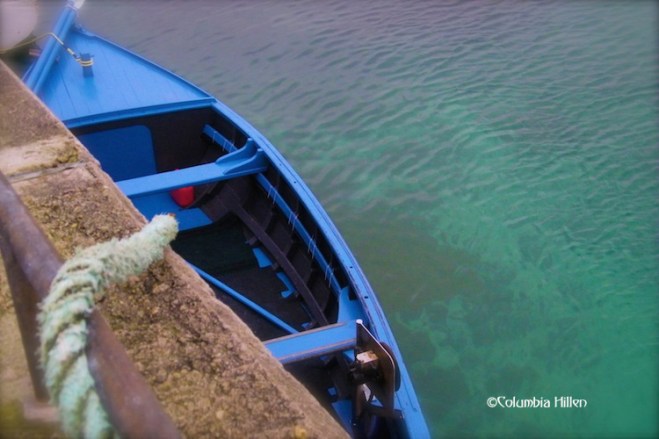
Standing confused on a boat in the tiny west Donegal harbor of Bunbeg is how I first met musician-singer-songwriter extraordinaire Pat Gallagher.

Looking from above and seeing an obvious landlubber flabbergasted as to how to tie a main anchor rope, he kindly doled out guidance and assistance in abundance. That got us to talking, the kind of small talk strangers do to pass the time, with me rambling on about a wonderful concert – featuring ‘Goats Don’t Shave’ – that I’d heard with my wife the evening before.

boat

“So you liked it then?” he asked.

“Liked it? I loved it,” I said enthusiastically. “Great songs, great singing. Whoever wrote them is a musical genius.”

The man smiled, a quiet kind of smile. The kind you’d hardly notice, the kind where the lips barely part. I suppose that should’ve been my first clue. But who was I to know? Hadn’t I just moved to west Donegal and bought a boat soon thereafter? What I knew about either, you could write on the back of a postage stamp and still have plenty of space for a Shakespearian sonnet, or two.

“Do you know who wrote them?” I asked innocently. Then a queer feeling came over me, and in an instant, I knew what that smile meant.

Meet Pat Gallagher – banjo player, guitar player, harmonica player, singer, songwriter. And that’s only what he does for fun. As a Jack-of-all-Trades, he can also lay bricks in a straight line and tell you where the best fishing is among the offshore islands around Gaoth Dobhair in the heart of the Donegal Gaeltacht.

Pat Gallagher

And, of course, as he explained self-effacingly standing on that stony harbor pier, he’d written all the songs in the wonderful concert I’d just been to in Dungloe.

It’s no surprise then that I was delighted to meet him again this past week in the same little town, in a school auditorium between the mountains and the sea, once again with ‘Goats Don’t Shave.’ This time they were starring in a special, community-wide charity concert in aid of two-year-old infant, Lucy Gallagher, from nearby Maghery, who suffers from a rare, potentially life-threatening condition known as ‘harlequin ichthyosis.’

It was a classic sort of Irish evening, the kind I remember well from the days of my youth. The kind where – just like at Sunday Mass – the men all clump close together, too shy to be anywhere near the front of the hall. And the rest of the people are huddled on seats at the very back of the room, which left a very large intimidating space in the middle, right in front of Pat and his band members up on stage.

But where most priests don’t have the power or the charisma to raise the emotions of their listeners, the ‘High Priest of Music’ Mister Gallagher and ‘Goats Don’t Shave’ do, so it wasn’t long before the braver of souls there slipped shyly off their seats and a bit of groovin’ and gyratin’ was soon going on, others joining them, until that middle space began slowly to fill up with moving bodies. It takes some doing to turn a fairly solemn occasion into one of dancing madness but when I saw a young girl in a wheelchair spinning herself round and round to the music like there was no tomorrow – and let’s be perfectly honest, unlike the rest of us able-bodied, its not the same kind of tomorrow that awaits her – I knew the boys on stage had well and truly succeeded.

Dancing

Okay, there were still a lot of burly, muscular men – who could probably turn me into thinly sliced meat with a touch on the arm – still hugging their pints. But there were others who’d started hugging each other, as well as hugging the ladies. Some, lo and behold, unCatholic though the nefarious activity might have been, even hugging their own wives, which got me to thinking. Why is it sometimes we Irish don’t have the strength to be who we really are – emotional and affectionate? There’s a time to be subtle and retiring, and there’s a time to BE. It’s long past time we knew the difference.

But aside from our lingering awkwardness when it comes to overt shows of affection, there was plenty of that other characteristic component of Irish gatherings – rollicking good humor, especially when someone pushed a button by mistake and a giant suspended basketball board almost swiped poor Pat and his colleagues off the stage. Even funnier, as none of the band members noticed the near-catastrophe approaching them from the Heavens above.

lucy and group

As for Pat himself, his musical career has moved in an ever-increasing arc over the years. Having started early in life – he was an UlsterFleadh singing champion when he was 11 – he’s now a master of the art form known as songwriting, with more than 80 under his penmanship – whether it be the lively, foot-thumping ‘Las Vegas (in the Hills of Donegal); the hilarious lyrics and rousing satire of ‘Mary, Mary’ which opened the famous Dungloe festival years ago; the haunting melody of ‘The Evictions’, about the cruel events 0f 1861 in the Glenveigh Estate in Derryveagh under the infamous John George Adair; or the nostalgic journey Pat and thousands of other emigrant workers from Donegal took over the years on the ‘Glasgow Bus.’

He and his band have played many parts of the world, including 14 tours of the US,  taking cities like New York, Philadelphia, Boston, Chicago and Fort Lauderdale. Their debut album ‘The Rusty Razor’ went gold and London’s ‘Time Out’ magazine voted them ‘Best Band’ in 1993. Admirably, Pat is not afraid to face up to many of Ireland’s taboo subjects in his songs – ‘Lock It In,’ a bitter attack on men who physically abuse their partners; or “Let It Go,’ on bigotry against Travellers; or even “Killing Me,’ about his own past addiction to booze and cigarettes. At the same time, his ballads are rich with honest sentiment – ‘Tor,’ about the joys of fatherhood (he is the proud father of three children – Fionnuala, Sarah and Ferdia); ‘Rose Street;’ and one no doubt very close to his heart, ‘She Looked My Way,’ written especially for his wife, Cathy, and given to her as a Christmas present two years ago.

Having released six albums so far (the latest being ‘Songs from Earth’), before the tender age of 55, thankfully there’s still plenty of time left for the friendly musician to regale us with even more such quality work.

And to contribute his myriad talents to such deserving causes as that of unfortunate Lucy.

Údarás na Gaeltachta – a secret society?

Living in Gaoth Dobhair, the heart of the Irish-speaking Gaeltacht area of Donegal in northwest Ireland, I take a strong interest in how this beautiful region – arguably the most scenic part of the entire country – is governed and develops, both economically and socially.

As such, I have vested considerable investigative journalistic experience, gained after 30 years in the media sector, in analyzing the workings of the largest economic development organization here – namely Údarás na Gaeltachta, an organization that has benefited from a spending budget of around one billion euro, mainly for job creation, since it was first established in 1980.

I have penned many news and feature articles on the organization over the last five years, the latest (below) published today (Friday) in the largest circulation newspaper in Donegal, the Donegal News.

For context, it’s probably worth reading the much more comprehensive, three-part series on Údarás that I wrote for the same newspaper. You’ll find it in the earlier posts below.

Pulling the ropes

Údarás na Gaeltachta – a secret society?

Like Br’er Rabbit, west Donegal’s largest economic development group is captive.

Captive to the belief that call centres and large manufacturing companies are the only way to create jobs – and to a golden circle that benefits from such thinking.

As such, Údarás na Gaeltachta is a Tar-baby, ever-more entangled in a sticky situation.

With the recent announcement that Largo Foods in the Gaoth Dobhair industrial estate will now close, with the loss of over 140 jobs, and after spending more than two million euro in the Donegal Gaeltacht over the last year, the Irish-language organisation has suffered a net loss of 78 jobs, according to its own figures, the worst record for many years.

So what has gone wrong? Seemingly, plenty!

Remoteness, poor infrastructure and a narrow skills’ set are the reasons most often given for few companies coming to the rural Gaeltacht of west Donegal. But does this excuse Údarás’ poor performance and lack of transparency as a public body?

After announcing recently it created 220 jobs in Donegal last year, Údarás promptly declined to give a breakdown of the figure. Following a Freedom of Information (FOI) request I made earlier this year seeking a list of funded companies and their job numbers, as well as pension payments, it replied, “For data protection and commercial sensitivity reasons. We do not release specific information collated for the purposes of the Údarás employment survey to the general public,” adding that pensions, while funded by the taxpayer, were private matters.

I asked Sinn Féin Senator Trevor Ó Clochartaigh of the Oireachtas Joint Committee, which revealed Údarás pays half its annual budget in pensions for 136 former executives, to follow-up. His party leader, Gerry Adams TD, submitted Dail question Nr. 127, as well as Questions 416 and 417, asking the Minister for Arts, Heritage and the Gaeltacht to “detail final salaries levels, lump sum or additional payments and the pension payments made to each chief executive officer or regional executive of Údarás who retired in the past three years.” Minister Jimmy Deenihan answered: “I have been advised by Údarás na Gaeltachta it considers the payments referred to are covered under the Data Protection Acts 1988 and 2003. Accordingly, it is not in a position to supply the information requested.”

Mary Lou Nolan, TD, Sinn Féin’s spokesperson on public expenditure and reform, then submitted yet another Parliamentary question, Nr. 148, asking the Minister to “reference the specific provisions of the Data Protection Acts to which he refers; the basis on which he believes Údarás na Gaeltachta does not, unlike all other senior managers across the civil and public sector, have to make public, details of public service pension arrangements.” A full answer is still awaited.

Such lack of co-operation by Údarás is disconcerting and leads inevitably to suspicion, making the words of its Arranmore Island-born chairperson Anna Ní Ghallchóir to me – “utter transparency is a given” – seem pale.

About one billion euro has poured into the Donegal Gaeltacht since Údarás was founded – for a population of 24,000. Result: the highest unemployment rate nationally, ugly, empty, ghost-like industrial estates blighting a rural landscape and a horrendously under-developed tourism sector.

Two years ago, under the Fine Gael-Labour ruling coalition, a new board promised change, with both ni Ghallchoir and fellow board member John Curran saying to me in separate interviews that widespread funding for ‘cultural tourism’ projects would be given to create sustainability by attracting more visitors to west Donegal. Two years later, less than five per cent of Údarás’ budget has gone to such projects, leading people at a recent EU-backed cultural tourism CeangalG (ConnectG) conference at An Chuirt Hotel in Gaoth Dobhair to complain of dwindling support.

In the case of Largo Foods, where is the sustainability that Údarás grants totaling 6.2 million euro to it (over 43,000 euro per job) should have created, and what business-sense does it make for Údarás to allocate half a million euro for two years for this company, which didn’t even bother to draw it down? With call centers and large manufacturing units merely band-aids for local unemployment problems, why has Údarás shown so little trust in small businesses forming the backbone of the local area’s economy? Especially so when a national economist who completed her Doctorate on Údarás operations, concluded, “on supply chain factors alone, a long-term, job creation strategy based on manufacturing was, and will continue to be, insane.” Could the fixation with short-term job numbers be linked to retention of Údarás’ own staff jobs, whose salaries average 80,000 euro annually, excluding expenses?

Instead of cultural tourism being expanded with serious money, Gearóid Ó Smaoláin, the organisation’s tourism officer, said in a recent public forum that “discussions are well-advanced” on building an alcohol and drug addiction clinic in the coastal town of Falcarragh, beside an existing golf course in the Ballyconnell House estate. It is believed Údarás, having already turned down several tourism ideas for the area, will allocate between several hundred thousand and one million euro to the project, which will be run by an arm of the Catholic Church.

Ultimately, decent Donegal people deserve better. How many more millions of euro must be wasted, how many more years lost, before Údarás changes its vision, and for transparency and accountability to be achieved? Perhaps only then will the ceaseless brain-drain halt and our native language escape from withering on the vine.

Published in Donegal News

Many challenges facing Donegal Gaeltacht and Udaras

Fresh from her first meeting recently as board chairperson of a revamped Udaras na Gaeltachta, Anna Ni Ghallchoir faces discouraging news – the number of fluent Irish speakers in Gaeltacht areas is falling and urgent measures are needed to reverse the trend.

“Without doubt, Irish is in decline, we must realise that and put in place a concrete plan to deal with it,” said Ni Ghallachoir, director of the Languages Centre at the NUI in Maynooth.

Meanwhile, a strategy, enshrined in the 2012 Gaeltacht Act and a 20-year strategy plan, is in place, with twin aims of promoting Irish and creating dynamic Gaeltacht communities. Minister of Arts, Heritage and the Gaeltacht, Jimmy Deenihan, told the Donegal News he remains “open and flexible” in his approach. “If the system supporting the Irish-language and economic development in Gaeltacht areas requires streamlining or enhancing for greater efficiency and more effective use of public money, then we are certainly open to doing so.”

Promoting Irish

The proposed plan under the act has several strands, including support for Irish-speaking families and a greater role for community groups such as co-ops, schools, sports and music clubs in each Gaeltacht area, Ni Ghallachoir said, adding, “Local Gaeltachts must take ownership of the plan, be the foundation upon which growth takes place. With different socio-linguistic-economic factors in every Gaeltacht, each must be analysed and area-specific programmes initiated so they become pivotal drivers. ”

Referring to the act, Eoin O’Murchu, former political editor at Raidio na Gaeltachta  and a national commentator on Irish-language affairs, says, “all that reads well, may not be so,” adding, “It comes down to value for money, especially important in the present difficult economic times. Before, there was a lack of purpose from the State, with no clear vision. Co-ordination could have been more efficient with recognition of the specific differences in each Gaeltacht. Now, with a chance to implement a specific strategy, politics unfortunately has entered the fray and that opportunity is being missed.” Added Concubhar O’Liathain, board member of TG4 and former editor of La, the Irish-language newspaper, “Some appointments to important Irish-language boards such as national funding body, Foras na Gaeilge, are being made on party political grounds. People on boards should be challenging officialdom. Those interested in the language but not in party politics are more likely now to be overlooked.” Officials at Foras, who direct a multimillion euro annual budget, said all projects are selected on merit before funding.

Salaries, transport, board fees and pensions

O’Murchu also said what happened in the corporate world recently in Ireland now happens in the Irish-language one. “A small handful of the same people are on boards, each supporting one another’s projects. This prohibits substantive evaluation of Irish-language project proposals. A person is hardly likely to turn down another’s project for funding when they know that person may be voting on theirs at the next meeting. Such meetings are often merely a way to mark time, nothing more.”

Third-level education in Irish in Donegal is also a challenge. Ionad an Acadaimh, established in Gaoth Dobhair in 2004, has received generous funding but cannot recruit enough students. “It is a problem, we need improved marketing, better outreach,” said former Udaras chairperson, Liam O’Cuinneagain, whose language organisation Oideas Gael, which employs four full-time people, received over 350,000 euro from Udaras and more than that from Foras and other sources.

Jobs: tourism or industry

All those involved in Irish-language planning consider job creation key in preserving it, describing it as “an essential element of dynamic Gaeltacht communities.”

“If we don’t succeed in keeping Irish-speaking population in Gaeltachts, how can we possibly expect to maintain the language,” said Dinny McGinley, Minister of State for the Gaeltacht, saying he reduced the Udaras board from 20 to 12 because it was “too large, too expensive and too political.”

But what sort of economic development meets Gaeltachts’ needs? Lacking proper infrastructure especially rapid transport such as motorways, rail-lines and a multi-destination airport that major manufacturers require, the odds are against rapid employment pick-up in this sector in the Donegal one. “On supply chain factors alone, a long-term, job-creation strategy based on manufacturing was, and will be, insane,” said a leading Dublin-based academic whose research has focused on Udaras over several years. “Look at the fate of Fruit of the Loom to see the consequences. Many call centres have also failed, with some still owing Udaras lots of money on outstanding loans.” She added, “Much of what Galway-Connemara – where Udaras is headquartered – got, would help Donegal greatly. Many people there got clean, well-paying, long-term jobs in sectors such as IT, Irish translation services and media, while Donegal, the poor cousin, ended up with lower-paying, short to medium-term, conveyor-belt type jobs in factories.”

The consequences of manufacturing failure dot the Donegal Gaeltacht landscape today, with Sinn Fein TD Pearse Doherty pointing out that almost half of the industrial parks there lie empty, estimated to be around 45,000 square meters. “Manufacturing in the Donegal Gaeltacht is not sustainable,” he said. “We don’t have the necessary transport links and the government’s withdrawal from the Dublin-Donegal A5 project means we are hardly likely to get them any time soon. That means looking for alternative ways to encourage young Irish speakers to stay here and help create dynamic Gaeltacht communities. Broadband offers one solution. It’s like electricity and running water was years ago, ‘must-haves’ in today’s modern world. With it, the Gaeltacht here can chase the jobs the Connemara Gaeltacht got.”

Instead of easy-to-build ‘mortar and metal’ industrial estates, which analysts said made “fabulous profits for builders and developer,” Udaras chairperson, Ni Ghallachoir, board member, Sean O’Cuirean from Falcarragh and TD Doherty point to tourism, particularly the environmental and cultural variety.

For decades, west Donegal tourism relied on northern Irish holiday-makers flooding across the border, local officials said. That ended with the arrival of low-cost airlines. The entire hospitality sector in the Gaeltacht has declined rapidly since.

“Cultural and green tourism offer tremendous opportunities but its potential has not been exploited enough here,” O’Cuirean said. “Udaras has an important role in this, by supporting large and small tourism projects across the Gaeltacht. Compared to places like Galway and Kerry, we lag far behind. We should adopt environmental tourism models, Norway and Scotland, for example. Mayo hosts meditation retreat type holidays. Whether they are participatory projects in re-afforestation or archaeology, we should be offering them.”  Sabba Curran, an angling tourism entrepreneur in Dore, agrees. “We have all we need, the ocean, the islands, the fishing grounds, but we need Udaras help to develop the sector.”  Added Doherty, “West Donegal has so many tourism pearls scattered around – Errigal, Glenveigh, Dunlewey, Glencolmcille, Tory, Gola – but we have failed to make a necklace out of them. They can’t stand alone. With peace in the north and an all-Ireland tourism body established, now’s the time to act.”

Udaras staff in Donegal declined to talk about tourism development nor job-creation statistics here. When contacted, Micheal MacGiolla Easpuic, acting regional manager based in Gaoth Dobhair, told the Donegal News, “We’re a centralised organisation, you’ll have to call Galway.” But Siubhan Nic Grianna, Udaras communications director in Galway, also declined to provide details as did Gerry O’Smaolain, who oversees Udaras tourism projects here.

Budget constraints

Challenges to Irish-language development include a much-reduced Udaras budget, but also that most of its budget goes towards staff salaries, expenses and pensions rather than supporting job creation projects in Gaeltacht areas. Nic Grianna declined to give specific figures on pensions, even though it is public information. A Joint Oireachtas committee, however, learned recently that pensions of 136 people take up half the current Udaras budget. “Pay levels at Udaras are the envy of people in the Irish-language sector and the pension situation needs looking at,” said O’Liathain, “There could be less bureaucracy in terms of funding also. Udaras has its weaknesses, but it’s not so drastic it can’t be fixed.”

Those interviewed for this three-part series on Udaras na Gaeltachta over the last few weeks were agreed on one thing – Gaeltachts require continuing support. “Promoting Irish in the Gaeltachts may seem like selling coal in Newcastle,” O’Liathain said. “You’d think people would have enough of it. But it is very important in preserving our native culture and heritage.”

Published in Donegal News

Udaras na Gaeltachta consider challenges of creating new jobs

Meeting for the first time this morning (Friday), members of the new board of Udaras na Gaeltachta face the challenging tasks of analysing the organisation’s performance and brainstorming on ways to accomplish the goals for which the Irish-language body was established.

One priority is employment in Gaeltacht areas. “Job creation and language promotion go hand-in-hand,” Anna Ni Ghallchoir, 55, the new chairperson, told the Donegal News. “With my new board colleagues, I will be examining very closely if past strategies have been successful and come up with innovative ones to help us move forward.”

Depending on whom you speak to, Udaras has either an acceptable record on job creation, or a very poor one, reflecting the age-old comment that statistics are like sausages – they look good but you’re never quite sure what’s in them.

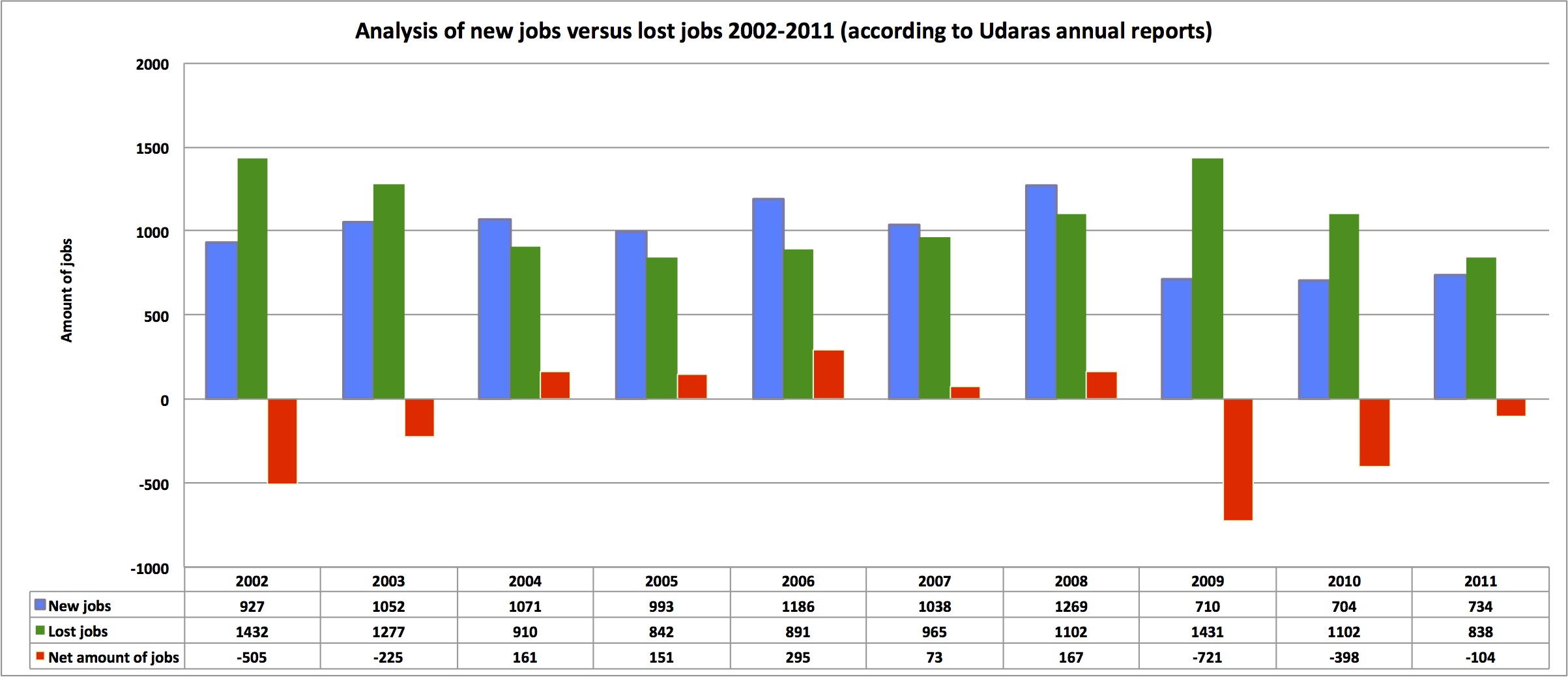
New jobs versus lost jobs

With total funding of around one billion euro so far, Udaras reported it had created 6,970 jobs as of last year in what it terms ‘client companies,’ defined as any company receiving support. When examined in the context of unemployment in Gaeltacht regions, this represents 7.75 per cent of the population there. As of last year, Udaras’ website shows it supported 1,876 jobs in the Donegal Gaeltacht, which represents 7.89 per cent of almost 24,000 people. Donegal Gaeltacht has the second largest number of Irish speakers, but ranks fifth in jobs created among the seven Gaeltacht regions.

Liam O‘Cuinneagain, Udaras chairperson for the last ten years, told the Donegal News he is “satisfied with our job creation performance,” adding, “It’s not easy to get companies to locate to rural Ireland, in part because of its remoteness and lack of transport links and limited skill-sets there.” As evidence in Donegal, he points to sectors Udaras has invested in – seafood processing, call centres (VHI), IT, sea angling, boat repair, even potato-crisp/fast food manufacturing (Largo Foods).

Other business analysts, however, are less satisfied with Udaras’ performance, including Tom Fitzgerald, fluent Irish speaker and business owner employing 50 people at Bard na nGleann, his information-management company in Béal Átha’n Ghaorthaidh in the Cork Gaeltacht. “A strong, well-run economic development organisation is important for the preservation and promotion of the Irish-language and for job creation in marginalized areas such as the Gaeltachts, including Donegal, but there’s no shying away from facts, Udaras is an extraordinarily expensive organisation,” Fitzgerald, whose company has an annual turnover of between one and two million euro, told the Donegal News. “There is little evidence of effectiveness in the statistics. By normal business practice standards, Udaras’ record so far is very poor.”

Expenditure

Fitzgerald points to the fact that the total number of jobs Údarás says it created was lower in 2010 than in 1996. “Furthermore, there’s no indication that the amount of money spent by Údarás in a single year has any impact on job creation in the Gaeltacht.  For example: Údarás spent more than 84 million euro in 2002 according to its own annual report. Yet there is no corresponding spike in jobs either in that year or following years.”

O‘Cuinneagain says during his tenure as chairperson, “cost per job was around eight thousand euro.” However, a simple look at Udaras’s total expenditure for the last ten years (613.5 million euro) relative to the number of jobs it reports creating by the end of last year (6,970) equates to 88,000 euro cost per job. As only around 10 per cent of budget goes to language-cultural activities, the final cost per job figure may be as much as ten times higher than stated. In Donegal, a case study in job costs is Largo Foods, headquartered in Ashbourne, Meath, but with facilities in the Gaoth Dobhair Industrial Estate. According to Udaras, it has received over 6.2 million euro in funding between 1999 and 2011 – with another half-million euro to be paid soon for automated equipment. Udaras said last year the company employed 120 people. Taking those figures, that works out to be over 55,000 euro investment per job created, not considering funding from other bodies for Largo. Ironically, following the installation of the automated equipment earlier this year, media reported 36 jobs were lost at Largo.

As some of Udaras’s ‘client companies’ are also the ‘client companies’ of other organisations, foreign and domestic, from whom they receive additional support, it is difficult to evaluate what specific job numbers Udaras contributions amount to. “The term ‘client companies’ is a loose one, easily manipulated to suit purpose,” said Fitzgerald. “Some organisations that partly support companies in the Gaeltachts often claim all the jobs as their own making, which is quite misleading.”

O’Cuinneagain acknowledges that criticisms of Udaras for not supporting enough micro companies – entrepreneurs wishing to hire a handful of people – are valid. “We’re not getting what we should be getting – smaller businesses,” he said. “We’ve focused too much trying to get big companies that might employ hundreds. Even though the finance and support system is there, Udaras has not been welcoming enough. Staff have not been as pro-active as they should be, have not scoured their Gaeltacht communities to find such entrepreneurs. Unfortunately, we have remained in a culture of factory jobs.”

Asked why, the director of Oideas Gael, a language group in Glencolmcille, lay the blame on factors outside Udaras ranging from lack of business teaching in education “Greek and Latin instead of entrepreneurialism” to lack of bank finance. But he did not rule out the possibility that as funding a small company with thousands of euro amounted to nearly as much paperwork for Udaras staff as funding large companies with millions of euro, there may have be a Udaras propensity for avoiding small business applications. Asked if the push for larger companies could have been simply a strategy to keep employment figures up and for Udaras to retain its all-important job-creation remit, which accounts for most of its annual budget, he said, “That’s ridiculous, sounds more like a conspiracy theory to me.”

Fitzgerald’s opinion differs, “About the only goal that Údarás is measured on is the creation of 800 or so new jobs per year, so they focus on doing just that. The problem is that this strategy doesn’t take into account what kind of jobs they are. In theory, Údarás is better off creating jobs that disappear quickly so they can place the same people again in a year or two.”

Analysts also say the Udaras board members may not have had enough business experience to spearhead a successful jobs-creation strategy. Of the Donegal members on the previous board, none could be identified as having long-time corporate management experience. O’Cuinneagain waved aside concerns that the previous national board was too large, numbering twenty, which some analysts said made it unwieldy to manage and hampered decision-making. “I did not find our board meetings too difficult to manage, but then again my experience as a teacher in inner city Dublin for many years helped a lot,” he said.

Lack of fiscal clarity within Udaras concerns some observers.

“I spent several years studying the organisation and found its finances extremely difficult to understand,” one leading business researcher told the Donegal News. “I also found frequent errors in its calculations. Some figures on spending simply did not add up. There’s really no excuse for that when we have so many accounting software programs such as Excel at our disposal.”

When the Donegal News requested a breakdown of Udaras spending for the seven Gaeltacht regions, particularly Donegal, for the last three years, Siubhán Nic Grianna, national communications and marketing manager, responded, “The distribution of total monies is not segregated on a county by county or Gaeltacht by Gaeltacht basis therefore I cannot provide breakdown for Donegal for this period.”

Bernard Allen, former TD and head of the multi-party Public Accounts Committee (PAC), which oversees the proper spending of public money, told the Donegal News that lack of transparency at Udaras may have hindered job-creation efforts. “We found its expenses system to be incomprehensible and could not understand how it was spending so much money on trips for so-called job creation efforts.”  Referring to the scandal over misspending by another state body, he added, “Udaras’ expenses read like a mini-FAS and it seemed to stymy our efforts to find out the truth and avoid disclosing pertinent facts and figures to us, especially related to board member, staff and associated expenses. With better accounting practices, perhaps its job creation efforts could have been more effective. ”

Some questions concerning expenses, including 30,000 euro over two years on trips to Halifax, Canada, to look at seaweed projects, costly business-class flights, trips to many international cities including Las Vegas, Shanghai, Los Angeles and Chicago, and expenses for spouses – which is counter to existing regulations – have still not been fully answered, Allen said.

Nic Grianna said such concerns lack basis. Describing the first story in this newspaper series as, “a slanted view, full of insinuations,” she added, “There was no reprimand from the Public Accounts Committee (PAC). We are very open and transparent and explained everything. There has been no abuse of public money.” In response, Allen said simply, “We did not get all our questions answered satisfactorily and a national election was called and the PAC disbanded before we could investigate fully.” Even though the information is in the public domain, Nic Grianna declined a request for a breakdown of pensions for 136 Udaras former executives costing around 4.3 million euro this year, half of this year’s current budget. Efforts to contact retired executives Cathal MacSuibhne in Donegal and CEO Padraig O’hAolain through Udaras for comment, were unsuccessful.

With allegations of cronyism and clintelism tainting many public bodies, O’Cuinneagain said he did not experience conflicts of interest while Udaras chairperson. “My organisation, Oideas Gael, did not receive any money from Udaras so I certainly did not feel the need to excuse myself from board discussions on funding, nor did any of the other board members as they did not receive any money either.”

As the Udaras board meeting gets underway this morning, Sean O’Cuirean, a new member from Falcarragh, remains optimistic. “A good thing about this board is that there are a new set of eyes looking at the situation. Such fresh perspectives often result in greater success and money well spent.”

Published in Donegal News