One-Eyed One Irish legend recreated by talented Donegal drama group in Falcarragh

Ever heard about Balor of the Evil Eye?

It’s an ancient Irish legend about the nasty, one-eyed mythical tyrant of a King on Tory Island in Donegal who’s killed by his grandson, Lugh – and there’s no better way to enjoy this suspense-filled story of life and death than when it’s hosted by the Cloughaneely Players, a delightful drama group in the local town of Falcarragh.

As part of its ongoing community service programme, this amiable band of actors and friends put on a wonderful outdoor show recently that had schoolchildren and adults alike both enchanted and enthralled. 

And it took place, most appropriately, beside a 16-foot pedestal, a white limestone boulder with red veining atop a pillar known as the ‘Cloughaneely Stone (Cloich Cheann Fhaola)’, the red veining symbolising the petrified blood of a chieftain called MacKineely (Cian mac Cáinte) beheaded on the stone by Balor after he discovered he planned to kill him after he’d stolen one of MacKineely’s prized cows – Glas Gaibhnenn.

Under the astute direction of Murray Learmont and led by narrator, Joe Kelly, a leading folklorist, the actors had young schoolchildren jumping up and down like excited kangaroos just out of their pouches during the entire production (and a few adults too, though I dare not say who they were less I embarrass them).

Organiser of the event was Mark Boylan, co-manager of the Cloughaneely under 11 Irish GAA football team, with Kevin Scanlon, chairperson of the Cloughaneely Minor Board, giving a short speech to kick-off the evening. 

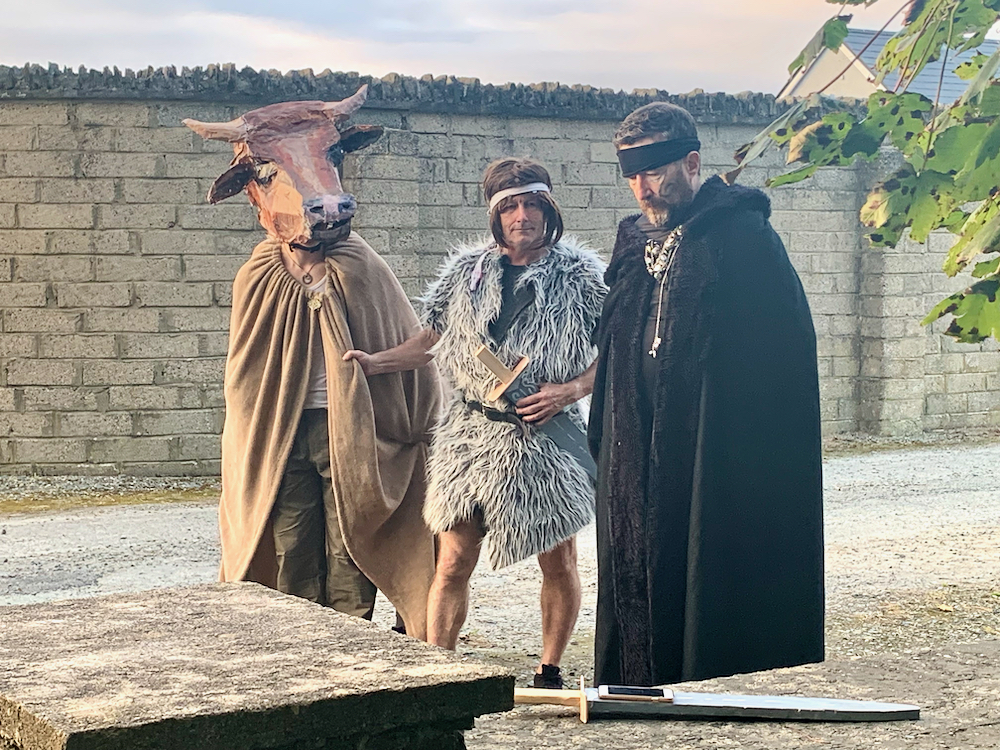
A stellar cast, one with the creative ability to slip off-script and concoct amusing dialogue spontaneously, included Denis Doohan in the lead role of Balor (I particularly liked his joke about Balor having more defenders than Jim McGuinness, the recently-named manager of the Donegal Irish senior GAA football team. 

The intrepid, Mickey McHugh, showing off his dainty, Lionel Messi-like legs and dressed in a costume that looked like it was woven from the hair of a banshee, acted as MacNeely. Insiders say Mister McHugh was specifically chosen for the role due to his lifelong, hard-won, cow-milking abilities which he displayed with tremendous exuberance – by spraying the entire audience with his own brand of the liquid. 

(l to r) Yanto and Rohan as the forever-giving milk cow, Mickey McHugh alias Lionel Messi and Denis Doohan as the face-decorated Balor consider their options.

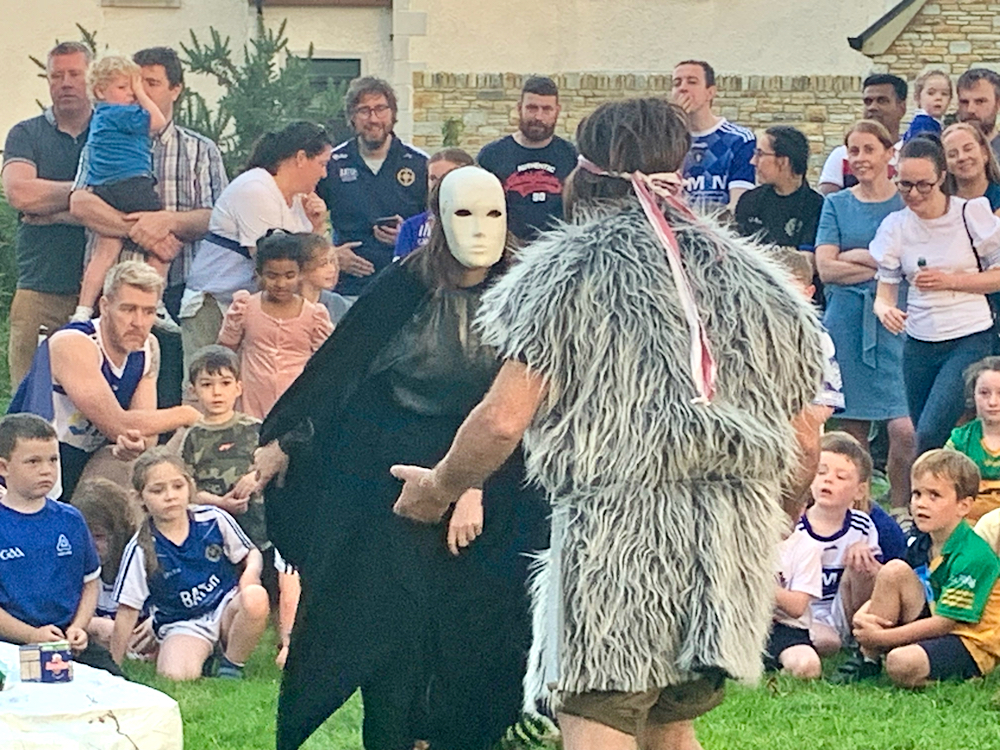
Lugh, Balor’s grandson, was played wonderfully by Pierce Butler, especially impressive with his warlike cries and deadly sword fight with his grandfather, leaving his foe prostrate among a crowd of enthusiastic youngsters.  

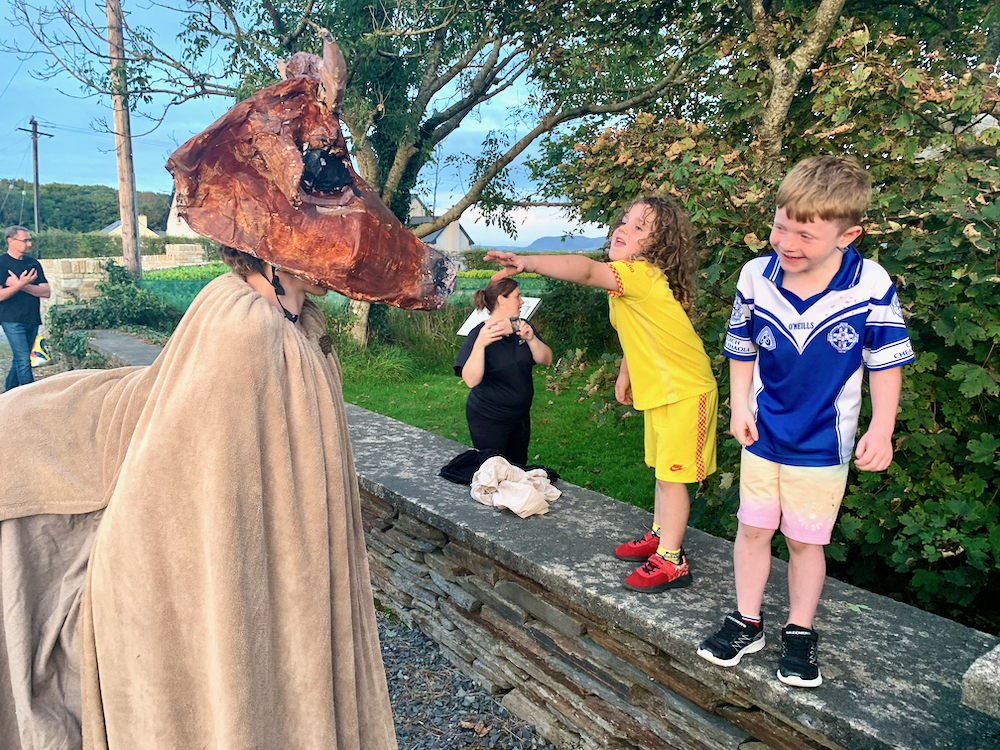
Legendary cow, Glas Gaibhnenn, receives a wee bit of attention off-stage.

Kudos also go to Maggie McKinney, a native of Castlewellan, County Down, who played not one, but two roles – the screeching witch, Biróg, who predicts Balor’s downfall, as well as the bold and brassy, what-are-ye-waiting-for-let’s-have-sex, Eithne, Balor’s daughter, who – in what must be Guinness World Record time – ‘enjoys relations’ with MacNeely and produces not one but three babies, one of which was Lugh. All done and dusted in thirty seconds.

‘Prepare to die’ says Lugh (Pierce Butler) to Balor (Denis Doohan) – but only one will emerge alive.

Mention must also be made of the cow – the beloved animal that was at the center of the entire conflict. As one who has never tried imitating a member of the bovine community, I can only presume that acting the role of a cow is not easy by any means. So many congratulations to Yanto and Rohan, members of Youthreach, for doing so.

Birog the witch (Maggie McKinney) confronts MacNeely (Mickey McHugh).

Next on the dramatic circuit for the talented Cloughaneely Players is a production of the classic story, Casablanca, which I’m reliably informed may be staged sometime in November.

Photographing the entire dramatic proceedings on the evening was Annamarie Coyle, so watch out for her excellent images capturing one of the most tantalising struggles in Irish legendary history.

‘Cute hoorism’ is alive and well in Ireland

Spotlight on corruption inside Irish state institutions

Controversy surrounding Irish public broadcaster RTE involving hidden payments and secret slush funds for music concerts, sports tickets, car loans, expensive hotels and restaurants reminds me of an investigation I conducted into misspending by another state body. 

The two examples underscore the constant need for vigilance over the spending of public money by such bodies.

Misuse of public money – a major problem in Ireland. Here RTE officials prepare to face a grilling.

Having moved to Donegal in the northwestern part of the country – an Irish speaking area known as a Gaeltacht, one of several in Ireland – I was approached as a journalist by many angry local people to investigate the spending of tens of millions of euro by Údarás na Gaeltachta, a national Irish-language organisation responsible for economic, social and cultural development.  

After comprehensive research including a series of interviews and detailed Freedom of Information (FOI) requests, I was stunned to discover the extent of financial waste and utter misuse of public money by Údarás – corruption by any another name, some might say – including all-expenses paid holidays in Florida for some executives and board members and their spouses, which was counter to existing regulations. 

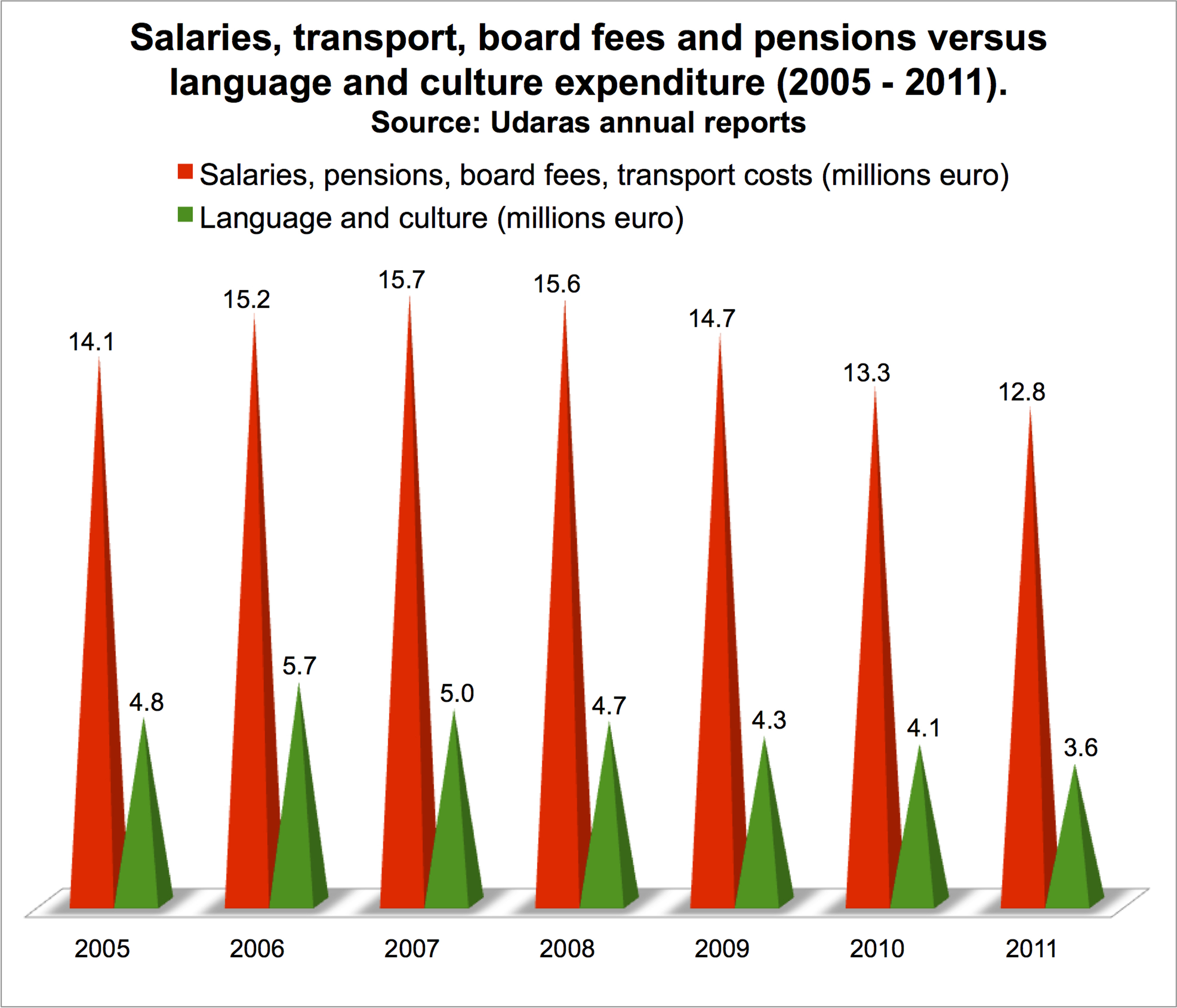
During the year I conducted my investigation, pensions alone for 136 former Údarás employees amounted to 9.8 million euro, half that year’s entire budget, which caused then Public Accounts Committee (PAC) member Sinn Fein Senator Trevor Ó Clochartaigh to declare, “I nearly fell off the chair when I heard that.

Five Donegal board members alone were paid more than half a million euro in fees and expenses over a five-year period between 2004 and 2009.

Shocking statistics I uncovered about spending on Údarás staff compared to project funding.
Key question remains: has the situation changed?

Údarás said each job it helped create back then cost around 8,000 euro, but the actual figure turned out to be 88,000 euro, ten times that number. It also spent more than 30,000 euro on all-expenses paid trips including business-class flights to Halifax, Canada to look at seaweed projects, as well as hefty expenses to other international cities including Las Vegas, Shanghai, Los Angeles and Chicago. Such was the absolute accounting mess, Bernard Allen, former Fine Gael TD and head of the PAC back then told me the expenses system of Údarás was “simply incomprehensible.” 

Údarás had become a free-for-all feeding trough for some board members and executive managers, with blatant conflicts of interest abundant. In short, the situation seemed to have become one of ‘you scratch my back and I’ll scratch yours.’

Liam O’Cuinneagain, chairperson of  Údarás for ten years then and founder of Oideas Gael in in Glencolmcille, Donegal described the investigation into his organisation’s spending as “paranoia” and said he was “satisfied” with its performance. 

After approaching the editor of the ‘Donegal News,’ a leading newspaper in the region, I completed a three-part investigation into the situation but then had to face highly-paid spin doctors for Údarás which did its very worst to prevent the series from being published, including threatening late-night calls to my home.

Padded expenses, lucrative pensions and international trips were only the tip of the ice-berg of misspending. Imagine how a small community centre or school offering classes and activities as Gaeilge or an Irish-language theatre such as Amharclann in Donegal could have used such scarce money. 

You can see some of my stories below.

Údarás na Gaeltachta, like RTE over the last few weeks, came under scrutiny by the Public Accounts Committee (PAC) back then but the government fell in the midst of the investigation, the PAC was disbanded and the investigation was never resumed after the subsequent election.

Some of those leading Údarás na Gaeltachta, both in Donegal and nationally at that time, have retired or resigned, all on very generous pensions, among the highest in Ireland’s civil service. It is hoped the present leaders are honest and transparent in their dealings. Only time will tell. Or another investigation by an enterprising journalist or a concerned citizen.

Shocking revelations at RTE and at Údarás na Gaeltachta should be a stark warning to us all. Sadly, leaders of such state and semi-state organisations with huge budgets at their disposal, if left unexamined, are tempted to misuse public money for personal gain. It is up to each one of us – private individuals and our elected representatives – to keep a close eye on how they spend that money. As both examples clearly demonstrated, we cannot rely on board member oversight alone. 

Both RTE and Údarás na Gaeltachta managed for many years to avoid public examination, the former because it was the all-powerful state broadcaster with political cronyism being a major factor in executive employment there, the latter because it was involved in the Irish language, a sacred cow in Ireland not to be questioned or criticised and it had – and still has – a big bucket of money to hand out in grants which can, in itself, buy silence.

What saddens me most is that both these organisations – RTE and Údarás na Gaeltachta – have vital roles to play in the economic, cultural and social development of Ireland so when they mislead the public, the very people who pay their high salaries and expenses, it is even more unforgivable. 

Suck key institutions should be supported, but not unquestionably so. 

After the RTE shambles, should Údarás na Gaeltachta and other such state bodies not come under extensive examination on a regular basis to make sure public money is being spent properly?

Should Údarás na Gaeltachta, for its own benefit, not be subject to the oversight of the National Treasury Management Agency (NTMA)’s NewEra unit, which provides financial and commercial advice to Government ministers and departments, the primary goal of the NTMA being to deliver long-term value to the Irish people?

Cute hoorism definition

Blind harpist and a lonesome boatman 

From 18th century blind Irish harpist Turlough O’Carolan to songs by contemporary musicians such as James Taylor, Tom Waits, Sting and Richard Thompson – a feast of entertainment was provided by talented Donegal duet, Ian Smith and Martin Crossin Friday evening. 

The two artists – the former from the Rosses and the latter from Milford – received a standing ovation as they opened a packed weekend of activities as part of the annual arts and cultural festival at An tSean Bheairic (The Old Barracks) in the quiet coastal town of Falcarragh. The festival today (Saturday) features a sean-nos singing competition for children, a sean-nós dancing exhibition and workshops and a céilí mór (an Irish traditional dance). On Sunday evening there will be a multi-media presentation on Irish Republican martyr Wolfe Tone hosted by Paddy Cullivan.

Scottish-born Smith a fine guitarist and songwriter with a wide repertoire, has produced a number of CDs including ‘Restless Heart.’ In addition to work by other musicians, he performed some of his own songs Friday evening including ‘Grafton Street,’ about a homeless man on Dublin’s busiest shopping street. Belfast-born Crossin is both a skilful multi-instrumentalist and a master maker of handcrafted uilleann pipes. His rendition on tin whistle of the plaintiff Irish tune, ‘The Lonesome Boatman,’ was superb.

Leading traditional sean-nós dancers Frank and Eileen Sweeney added to the celebratory mood of the evening when they accompanied Smith and Crossin with a rousing performance on the floor. 

Once a disused police barracks originally constructed in 1890, An tSean Bheairic was renovated 25 years ago and transformed into a vibrant community centre with its own library, cafe, gift and craft shop and heritage centre. It also hosts a wide range of conferences, workshops and seminars and is a Fáilte Ireland Visitor Information Point.

The festival was officially launched by manager of An tSean Bheairic, Paddy McHugh; Séamus Mac Aoidh, Secretary and Chairperson, Seosamh Ó Dubhchóin.

Young Donegal performers display their talents

Movie music, Irish fiddle tunes, classic compositions and songs  by Fleetwood Mac and Britney Spears – such was the diversity of entertainment I enjoyed recently at Donegal’s Regional Cultural Centre.

From Ennio Morricone’s captivating score for the movie, ‘The Mission,’ to ‘Finlandia’ by classical composer Jean Sibelius to traditional fiddle tunes, young maestros at Donegal Music Education Partnership (DMEP) served up a feast of entertainment at their summer concert.

Two reels by Caitlin Kennedy on fiddle, accompanied by her brother, Neil, on guitar; Chason Triste by Tchaikovsky played by Deirbhile Flynn on violin; Deux Interludes by Jacques Ibert played by Andrea Mota on oboe and Eve O’Donnell on flute; a concerto by Mozart played by Marina Mercade on flute; an allegro from a sonata by Handel played by Clara Mercade on violin; Ashokan Farewell by Jay Ungar played by Seana McGarry on violin; and Palladio by Karl Jenkins played by Clodagh Doherty on viola were all part of a diverse repertoire by members of the Donegal Youth Orchestra. Percussionist Cathal O’Donnell displayed his vocal skills, singing ‘You’ll Be back’ from the musical, ‘Hamilton.’

The Donegal Youth Choir performed songs ranging from ‘Nothing’s Gonna Harm You’ by Stephen Sondheim from the musical, ‘Sweeney Todd,’ to ‘Songbird’ by Christine McVie of Fleetwood Mac and ‘Everytime’ by Britney Spears.

Audience members at the packed event at the Regional Cultural Centre Sunday evening included Anne McHugh, chief executive of Donegal Education and Training Board, which funds DMEP, and Dr Martin Gormley, ETB’s director of schools.

Martin McGinley, DMEP music development manager, introduced the two-hour event, which ended with presentations to graduates of the educational program which provides vocal training and tuition in a range of instruments.

Orchestra conductor and composer, Vincent Kennedy, who also played a trumpet duet with Niamh O’Donnell, and choir conductor, Evan McGarrigle, and accompanists, including Hannah Gallagher from Falcarragh, all received an enthusiastic standing ovation. The evening also featured Kennedy’s composition, ‘The Letterkenny Waltz.’

Every song has a story, every story has a song

Such is the headline on the inside label of a CD by supremely talented Donegal-based singer-songwriter-multi-instrumentalist Brí Carr and it ’s an extremely appropriate phrase.

For Brí is one of those naturally gifted artists who literally can turn a phrase into song and music as she did quite brilliantly during an evening of excellent entertainment on Culture Night recently that she hosted at Amharclann in Gaoth Dobhair, Donegal where she is that theatre’s first-ever Artist-in-Residence.

Taking a phrase from one of the writers attending international workshops that week hosted by ‘Ireland Writing Retreat,’ she transformed the words of Bernie Doody from Omagh into a spontaneous slice of music that left seated writers from countries as diverse as Germany, Ireland and the US gasping with admiration. You’ll also appreciate Brí’s many talents in doing this by listening to the short music video above taken that very evening.

Though Brí has been writing songs since the tender age of 16,  she never performed publicly until she was in her 40s. That was due to part to derisory laughter she received by a man after she had penned a song to uplift the spirits of a close friend who had just found out she was pregnant. That song is entitled ‘Yesterday’ and, after listening, it is very hard to forgive the ignorance of the man whose only response was critical laughter.

But that is just one song in a wide-ranging portfolio created by Brí over the years and which feature on her CDs, namely ‘Full Circle/Rotha an tsaoil’ and ‘Roots/ Fréamhacha,’ as well as her singles.

Take, for example, ‘Smile Again,’ penned as a young college student in honour of her beloved Uncle John who left his native Arranmore Island in Donegal to work in the London tunnels in the summer of 1988 and sadly died just a few months later.

Extending the island theme, the place of her mother’s childhood, she then wrote ‘ Árainn Mhór,’ her first single, released in early November 2016, which captures the mystery, tradition and history of the island. It reached Nr. 3 in the Irish iTunes Charts in World Music that same week. Other songs in tribute to the island include ‘Ar an Oilean,’ ‘Where We Went To School’ and ‘Home To Shore.’

In late December 2016, her follow-up single, ‘My Father’s Legacy’ topped the charts in Easy Listening Music. It features a beautiful vocal from her then 7-year-old daughter, Caela.

Enjoying close family bonds, Brí dedicated at least three songs to her husband and children, whom she says “never fail to surprise me.” The songs include ‘How I Love Him,’  ‘Tog Mo Lamh Aris’ and ‘Bealach an tSaoil.’

Aside from song-writing, Brí, a teacher, is heavily involved in arts education.

As a job-sharing resource teacher in Lurgybrack NS, I’m extremely fortunate in that I can develop and build upon my facilitation skills in and out of the classroom,” she states on her website. “To date I have enjoyed working with the children and staff of my own school on various school projects, from our LucyBarney School TV, Seachtain Na Gaeilge, Scór, RTE Junior and after-school music and drama. We have recorded albums for ourselves and with the Goats Don’t Shave as part of charity projects.”

Brí’s activities are multi-level. “I enjoy regular interactive workshops with other schools, mainly facilitated by Donegal County Library as part of WainFest, Ireland Reads and Spring into Storytime, which I thoroughly enjoy as it gives me the opportunity to teach and learn from students and teachers from Junior Infants all the way to Leaving Cert, creating and collaborating on new ideas, methodologies and cross-curricular activities,” she said.

As part of Peace IV, Brí was facilitator and director of several inter-school music, art and drama projects from Derry to Dunfanaghy, creating stories, exploring local heritage and cultures, bringing lively performances to the stage in Ozanam Centre, Dunfanaghy, the Workhouse, Dunfanaghy, An Grianan Theatre, Letterkenny and Relay for Life Donegal.

Collaborating with Donegal Education Centre, Donegal Women’s Centre and local schools helps me keep focus on the curriculum, and come up with new ideas for implementation in a fun and educational way,” she said.

Brí is also deeply involved in other organisations and initiatives including Blue Ribbon Arts, the Wider Horizons Project USA and Wild Atlantic Women, to name but a few. A manual by her in both Irish and English will soon be published entitled ‘The Big Blue Ribbon Book of Drama.’

International guests from Germany, the US, Romania and Ireland enjoyed musical performances by Brí and fellow artists, including her daughter, Caela (standing beside her in shorts), at Amharclann on Culture Night recently.

Her book is filled with almost thirty years of Arts in Education games, ideas and inspiration to aid fellow teachers in delivering Drama and SPHE games. She also created the ‘Ready to Rock Music Programme’ for Primary schools with CJ Fallons and is a member of ‘Wild Atlantic Women,’ a group of Donegal’s finest female artists in a wide range of genres from folk to country, traditional to modern who she said, “decided to join their voices in support of all thing Donegal.

As for being Amharclann’s first Artist-in-Residence, pride oozes from her. “It is an honour and a privilege for me as both an artist and as a lover of west Donegal culture, language and heritage,” she said. “I have thoroughly enjoyed the opportunities and challenges coming out of the Covid era, as people are beginning to re-emerge and embrace life in a careful, cautious way. What better way than through the arts, between concerts, exhibitions  theatre, music and drama  all of which are rich and abundant in the Rosses and Gweedore communities. I have been blessed with support of all ideas during the year, and as well as Oíche Chultúr, there has already been a great many stand out moments that I’ll carry with me on to the next phase of my journeys via writing, performance and community involvement.

Brí Carr and Anne Biddie (r) make a terrific musical duet.

Brí is thankful for the opportunities she has been offered.

I can never thank the people of Gweedore, and in particular Coiste Amharclann, for giving me this platform to further explore my work, my art and most of all, my self belief. I’ve had such growth, nurtured many new friendships and been part of countless amazing memories. I’m really excited about all the projects so far and will definitely be rowing in behind the next recipient of Artist-in-Residence, if they’ll have me, to further develop as an artist , engage more with the local community and continue my commitment to Amharclann in the years to come.”

It is certainly no surprise to learn about Brí’s favourite motto: ‘Lots to learn lots to do.’

Donegal man leaves top job at  Údarás na Gaeltachta, remains keen to support key projects

by Sean Hillen

After five years as CEO of Údarás na Gaeltachta – the leading economic development group in lrish-speaking areas – co-ordinating around 300 million euro in publicly funded projects, Donegal-based Mícheál Ó hÉanaigh has completed his contract, leaving some people in the county worried about future local projects.

Having remained in close contact with Mícheál over the last few years, I am one of those somewhat fearful, in the full realisation that Donegal, indeed Ireland, has just lost a loyal servant in a key national position.

Mícheál Ó hÉanaigh held key position at Údarás na Gaeltachta.

Mícheál, 63, took up his position as head of Údarás when the organisation was trying to overcome the worst public relations disaster in its history, when multiple scandals over misspending of public money rocked its foundations. This was highlighted when board members and their partners enjoyed first-class airline tickets and luxury accommodation in various places in the US, including Las Vegas – purportedly to meet officials of the Dublin-based Industrial Development Agency, which also has offices throughout Ireland, including Donegal.

It was believed such situations – including conflicts of interest among top officials – continued unchecked because successive Governments turned a blind eye, not wanting to criticise an organisation working within the Irish language, a politically sensitive sector. And also because few journalists and editors in Dublin knew much Irish and shied away from tackling Údarás’ operations, seeing the language as a challenge to proper investigation. Media in Galway, where Údarás is headquartered and has a major influence, also stayed clear of major controversy.

Donegal having the second largest Irish-speaking population and the largest in geographical size, I myself investigated the organisation and wrote a three-part series for the Donegal News and a series of stories for this blog (Part 1, Part 2, Part 3). For other stories, simply type ‘Udaras’ in the Search engine of this blog. Members of the Dáil’s multi-party Public Action Committee, an important body whose aim is to ensure public money is spent properly, told me they were ’utterly shocked’ by revelations about corruption within Údarás.

It was in the midst of this furore that Letterkenny-based Mícheál bravely took up the gauntlet, and from all accounts, rose to the occasion, sorting out many of the difficulties Údarás faced such as image problems and personnel changes. His responsibilities also included governance and risk management.

Among many tasks, Mícheál also prepared and implemented the Gaeltacht Regional Strategy for Economic, Social and Cultural Development ‘based on sustainability, innovation, entrepreneurship, learning and creativity.’

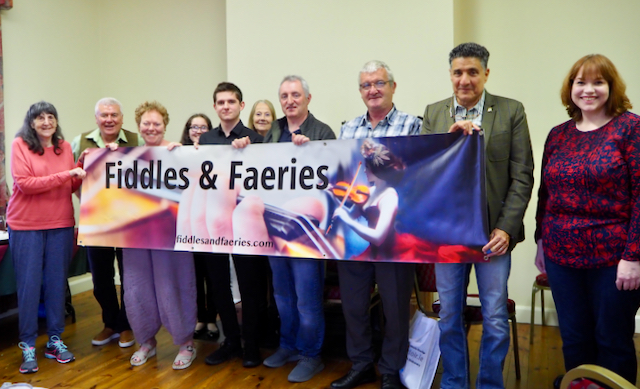
Living in Donegal, Mícheál was enthusiastic to promote his home county and supported initiatives in the cultural, community and business sectors. I collaborated with him on tourism-related proposals for Gaoth Dobhair, one revolving around the Spanish Armada and another entitled ‘Fiddles and Faeries’ to promote traditional music and culture, awards for which were presented at Leon’s Tavern in Crolly this year.

Led by Mícheál, Údarás na Gaeltachta helped fund this cultural initiative of mine.

Mícheál told me proudly this weekend about his accomplishments during his five-year tenure at Údarás. 

“Tourism development in Donegal has been  a major focus of mine, with key projects such as the Fanad Lighthouse, Sliabh Liag, the Errigal Project and Crolly Visitor Centre being advanced, as well as the Blas na Gaeltachta project initiated in Annagaire and the Narosa Marine project in Machaire Rabhartaigh,’’ he said.

He added, “The Gteic Gaeltacht Digital Hub Network was also established and now comprises thirty hubs, with five established in Donegal and three more in development.’’

Mícheál also said, “last year saw record job creation in the overall national Gaeltacht region of Donegal, with employment on the Gaoth Dobhair Business Park growing to over seven hundred and companies such as Randox in Dungloe seeing substantial growth in employment.’’

Mícheál is keen to promote environmentally-friendly tourism and culture projects and renewable energy initiatives.

The ‘Green Economy’ was also among his top priorities. ‘’Plans are advanced for a 5MW community-owned photovoltaic renewable energy project in Gaoth Dobhair and marine resources harnessed, with plans for offshore renewable energy projects and the development of added value projects based on seaweed and fish processing,’’ he said.

In financial terms, Mícheál added, “Last year, a selection of larger Gaeltacht companies had combined sales of over one billion euro, with over 600 million euro in exports, 450 million spend in the Irish economy and 175 million paid in wages.’’

My fervent hope is that Mícheál remains deeply involved in the economic development of the Donegal Gaeltacht with his comprehensive experience not only as the eyes and ears of Údarás for the last five years but also as vice-president of Tourism, Culture and Youth for the Assembly of European Regions (AER) and former director of Services for Community and Enterprise at Donegal County Council.

What’s next for Mícheál – “At this time, I’m examining all my options,” he said simply. ‘I feel I have a lot more still to give.”

Sean Hillen, author and journalist, has worked on a series of Europe-wide projects for major NGOs, including UNICEF, the Rockefeller Foundation and billionaire philanthropist, George Soros

Half million euro missing in Donegal, 250 euro returned

Half a million euro would be considered a miraculous life-saver by Mary, the tireless community worker struggling on behalf of cancer patients from Donegal who can barely afford the hefty cost of travel to Galway for specialised treatments.

If the hardworking managers of local community centres in the Donegal Gaeltacht received half a million euro, they could hire additional full-time Irish, and English-language, staff for several years and expand exponentially their range of services and activities in support of local people. 

If Amharclann, the Irish-language theatre in Bunbeg, received half a million euro, it could run an exciting cultural programme of dance, music, cinematic and theatrical performances for the next five years.

Not to mention how hard-pressed individual artists and musicians bereft of gigs due to Covid could use that money. Or indeed the Donegal office of Irish-language organisation, Foras na Gaeilge, whose local members help keep our native language alive here. And as for those unfortunate people whose homes and businesses have been destroyed by mica ….

But none of these groups have the luxury of half a million euro. 

Such a notion would be considered pure and utter fantasy, especially in the hard financial times in which we now live. 

Yet that is about the sum of money former Donegal Fianna Fail Senator, Brian O’Donnell, from Falcarragh in the heart of the Donegal Gaeltacht, has just wasted. ‘Snatched brutally, selfishly and greedily’ some are saying, from the public purse. Others use the term ‘stolen,’ but in this article I wish to be diplomatic.

How did he do this?

Ironically, over the Irish language.

O’Donnell was caught taking money from the public purse by duplicating travel and subsistence expenses as both board member of Irish-language economic group, Údarás na Gaeltachta, and Donegal County Council. 

The accusations – and this beggars belief – investigated by the Standards in Public Office Commission (SIPO) – was that it would have been impossible for him to have been in two different parts of the country at exactly the same time, at two different conferences. 

And there I thought teleportation – where matter is de-materialised at one place and recreated instantly at another – happened only in science-fiction movies and fantasy comics.

If that wasn’t enough, the former Fianna Fail Senator then cowardly left the scene of an accident while driving his car in a drunken state.

But that’s only the beginning of the saga.

O’Donnell, with the aid of well-paid lawyers, fought the accusations against him, not on the basis of whether they were right or wrong, true or false, but on the simple basis that the cases should be heard as Gaeilge (in Irish) not English. The fact that both languages are official languages of the Republic of Ireland didn’t matter a damn to him, nor them. Nor the eventual cost to ordinary Irish citizens, including those unfortunate people suffering from cancer.

The rest of the story is spread across years of newsprint.

After deploying numerous tactics to delay the ‘claims investigation’ many times, he then decided to do the same to the ‘leaving the scene of an accident’ investigation, not once but a total of 20 times.

As a result, the total bill to the ordinary Irishman, woman and child has been estimated at around – yes, you’ve guessed it – half a million euro, the amount the board of trustees of Amharclann, Donegal’s proud Irish-language theatre, the hardworking staff of the county’s community centres and the many severely sick people – all dream of having to help them.

In the meantime, craftily devising his delaying tactics, which eventually spanned a massive eight years, did O’Donnell quietly planned his ‘get-out-of-jail card’ – his emigration to Canada? In fact, O’Donnell being found guilty could perhaps have led to a short prison sentence and would have prevented him emigrating to Canada. And certainly would have prevented him getting a Canadian driving license.

Was his delaying tactics also related to avoidance of his share of the legal costs? For example, I’ve been trying to find out if he ever paid a legal bill placed upon him by three judges who threw out of court his claim that the SIPO was not entitled to investigate his duplicitous behaviour because, he claimed, the allegations arose from ‘an anonymous complaint by a member of the public.’ 

I’d like to know not only if Mr. O’Donnell has paid his full legal bill but how much it was. If Mr O’Donnell is reading this, please get in touch. It’s only fair to hear his side of the story. And transparency is something we all should strive for.

Mysteriously the court hearing that finally put an end to one of the most ludicrous and wasteful cases in Irish legal history, almost went under the radar earlier this month, slipped quietly and quickly onto the docket of a mundane court sitting.

How did this happen? Donegal media said simply that, “according to court papers.. O’Donnell’s case was not due to be heard until the Wednesday after during a sitting  of Falcarragh District Court.” That’s when his (O’Donnell’s) solicitor, Sean Cannon, “brought the matter up with Judge Paul Kelly …during a family law sitting of Letterkenny District Court.” And the judge conveniently and quickly moved the case forward.

‘Brought the matter matter up?’ What the hell does that mean? And does such a serious case merit being in a sitting on family law? The mind boggles.

And this Judge Paul Kelly? Who is he? Was he appointed under a previous Fianna Fail government? Does it look like it from this article? But then again, that doesn’t matter, surely. After all, the Irish legal system is separate from the political one, isn’t it?

Though, as we well know, it is not unknown in Ireland for political favours and indeed, brown envelopes, or both, to pass hands.

The result of the long-delayed case: a ridiculously low fine, in my opinion, of 250 euro for charges of drunken driving leaving the scene of an accident and providing misinformation the police. I dare you to find any court case where such a laughable decision has been made in such a serious case. 

As for the short ban from driving, does it really matter? O’Donnell is sitting pretty in another country. Did an infamous Irish ‘brown envelope’ pass hands to facilitate this convenient legal accommodation in Letterkenny? No-one knows, and unfortunately no-one will probably ever know. Is this just an example of the old adage, ‘there’s a law for the ordinary working citizen but a very different one for the elite, well-connected in Irish society?’ 

So, while O’Donnell enjoys his new life in Quebec, Irish men, women and children in his very own constituency in the heart of the Donegal Gaeltacht continue to struggle to make ends meet, people continue to suffer pain and hardship, some desperately trying to raise enough money to help them avail of specialised life-saving cancer treatments. And young, talented teachers from the Donegal Gaeltacht, and other parts of the county, are forced to go abroad, to places like Quatar in the Middle East, because there’s no money to employ them here at home.

Is this called ‘fairness’ in Ireland today? 

Among all this misconduct (there are stronger words to describe O’Donnell’s behaviour), there are two other guilty parties that should not escape blame and require stronger scrutiny by the public at large and by themselves. 

At the very least, both Údarás na Gaeltachta and Donegal Council obviously urgently require a proper Code of Practice for Good Governance. And, more importantly, to enforce it. Want to know more about the failings of Údarás na Gaeltachta, an organisation that receives tens of millions of euro from the public purse every year? Read more here. Has it cleaned up its act since then? Time will tell.

There’s little anyone can do now about the regrettable situation surrounding the O’Donnell controversy, except two things.

Firstly, as a citizen you have the right to appeal to the relevant authorities about a court decision you consider overly-lenient and unfair and to have the case reviewed. One place to start is writing to the Complaints Department of the Law Society of Ireland at complaints@lsra.iethe

Then the Judicial Conduct Committee established by The Judicial Council recently. You can write a short email to: info@judicialcouncil.ie You can ask to remain anonymous in both instances. It’s time to stand up and speak out, don’t you think?

I have already sent a complaint about Judge Paul Kelly’s decision as I consider a 250 euro fine to be utterly ridiculous and a 3-year driving ban to be insignificant, considering that Mr. O’Donnell can simply come to Ireland in the intervening years and drive with no problems using a Canadian driving license I presume he will obtain quite easily, thus posing a danger yet again to ordinary people on our roads. On both sides of the Atlantic.  

Secondly, when election time comes round, and it will come quicker than you think, consider carefully which political party and candidates you vote for. Is it not better to avoid the Brian O’Donnells of this world and choose others with a much greater sense of decency and honesty? 

Was Columba gay?

Thousands of euro of public money are pouring into diverse celebrations this year throughout Ireland to celebrate the life of a 6th century Celtic monk called Columba (or Colmcille) – a strange and elusive man we know almost nothing about.

Even though schools, community centres, Christian churches, local councils and other groups celebrate the 1,500th year of the mystical monk’s birth, no-one knows exactly when he was born. Nor do we know exactly where. We think it was Donegal but we don’t know for sure what part. We know he left Ireland for the Scottish island of Iona where he spent a good part of his life. But we don’t know the real reasons why.

Sitting on the Torr an Aba (Hill of the Abbott) in front of Iona Abbey where it is said Columba did most of his meditating.

We don’t even know for sure if Columba had a mistress, a wife, children, or indeed whether he was gay or bisexual like many of the monks of his time. (Celibacy was not compulsory then, monks/priests could marry and have families and homosexuality was not denigrated as it is today by the Catholic Church).

Nor do we know where Columba is buried. It was thought his bones (or at least the smaller ones) were wrapped up inside a wooden casket covered with silver and copper-alloy designs known as a reliquary and carried by Scottish soldiers at the Battle of Bannockburn where they famously defeated the English. But we now learn there was nothing in the box, which now sits behind a glass case wired to a sophisticated security alarm system in the National Museum of Scotland in Edinburgh and labelled as the ‘Monymusk Reliquary.’

Make no bones about it – Columba’s relics are not in the ‘Monymusk Reliquary.’

The reason we know so little about Columba is that while he and his followers attracted a worldwide reputation for penning and illustrating magnificent books of all kinds including the famous Book of Kells, there are no records whatsoever of Columba’s own personal writing, not even a simple diary.

So, how is it then we’re spending so much public money celebrating a man we know nothing about, indeed a man who was never even declared a saint, though most people think he was. Why would the Vatican canonise him anyhow? After all, the Celtic Christian church Columba represented stood firmly against the Roman version, battling tooth and nail for ultimate supremacy, that issue being eventually settled at the Synod of Whitby in 664 with Rome being the victor.

Who knows, perhaps Columba, a lover of herbs, specially St. John’s Wort, followed too many Pagan practices, maybe even believing in faeries, and his writings were wilfully destroyed by the powers that be in Rome.

This brings me to another man, a man of our time.

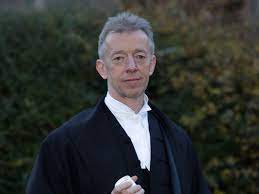
Dr. Brian Lacey relaxes at his rural west Donegal home in the shadow of Errigal mountain.

Lively septuagenarian, author, archaeologist and historian, Brian Lacey is an exceptional dinner guest. A fine raconteur with quirky views of the world, he’s a man at ease with laughter and story-telling.

And he has just penned his latest book, on a spin-doctor called Adomnán (or Eunan) who single-handedly raised Columba’s name to ‘the High Heavens’ by inventing a series of mostly fictional or at the very least, highly-exaggerated, stories about the founder of Iona Monastery and the ‘miracles’ he supposedly performed.

Rather than it being a selfless literary endeavour, Adomnán’s reasons for writing his book were directly linked to both politics and money. In raising the profile of Columba, he also raised the public profile of the community of monks on Iona that he presided over 100 years after its founder had passed on, thus no doubt encouraging new recruits to sign up and more money donated to the monastery’s coffers.

Meeting the man himself, academic celebrity par excellence.

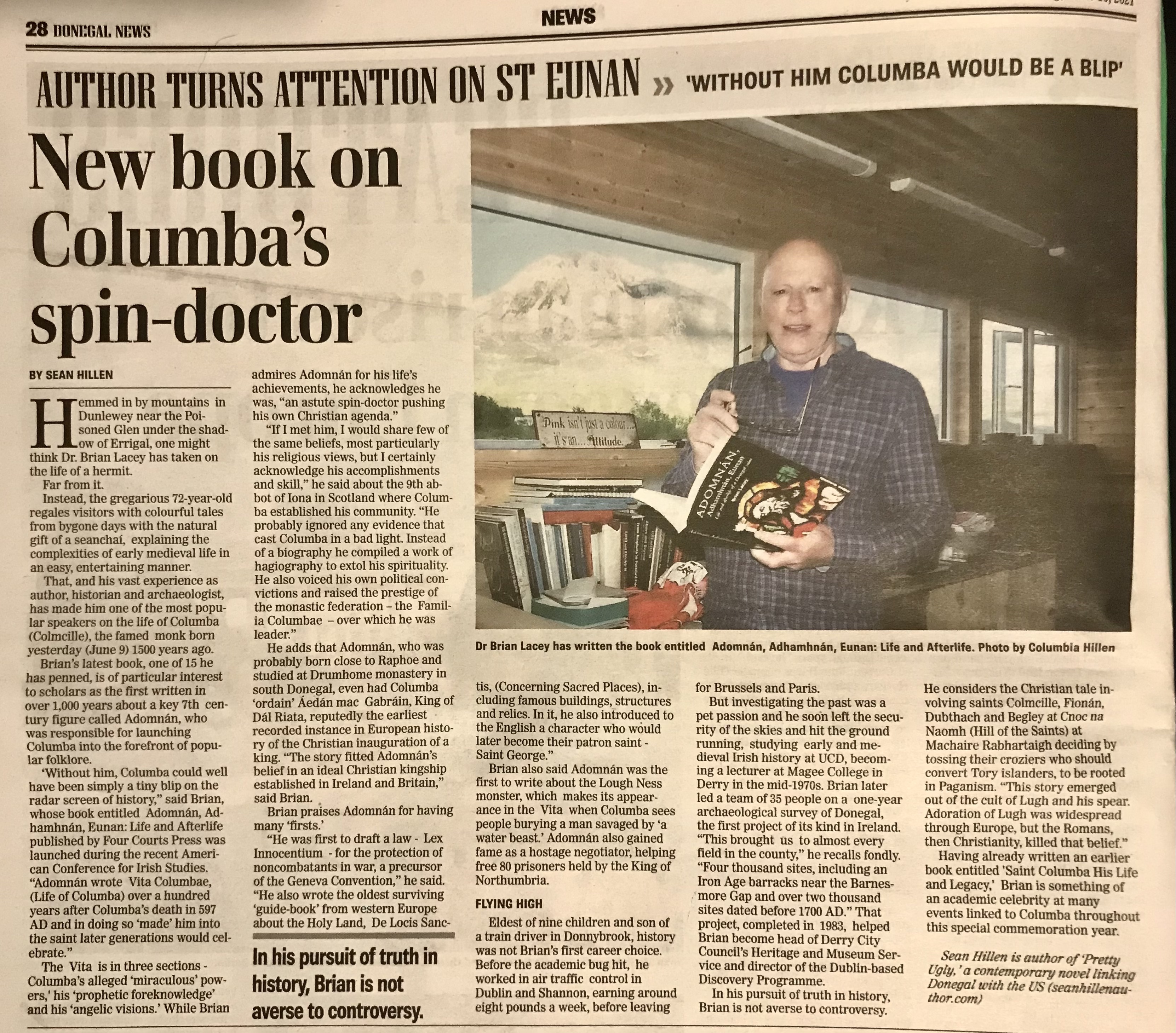
Some in Ireland might use local slang and call Adomnán ‘a cute hoor,’ loosely translated as ‘a shrewd scoundrel, especially in business or politics.’ Probably he was, but he also achieved much more, as you can see from the article below I wrote for the ‘Donegal News’ recently.

New Book On Columba’s Spin-doctor 

By Sean Hillen

Hemmed in by mountains in Dunlewey near the Poisoned Glen under the shadow of Errigal, one might think Dr. Brian Lacey has taken on the life of a hermit.

Far from it.

Instead, the gregarious 72-year-old regales visitors with colourful tales from bygone days with the natural gift of a seanchaí, explaining the complexities of early medieval life in an easy, entertaining manner.

That, and his vast experience as author, historian and archaeologist, has made him one of the most popular speakers on the life of Columba (Colmcille), the famed monk born yesterday (June 9) 1500 years ago.

Brian’s latest book, one of 15 he has penned, is of particular interest to scholars as the first written in over 1,000 years about a key 7th century figure called Adomnán, who was responsible for launching Columba into the forefront of popular folklore.

‘Without him, Columba could well have been simply a tiny blip on the radar screen of history,” said Brian, whose book entitled Adomnán, Adhamhnán, Eunan: Life and Afterlife published by Four Courts Press was launched during the recent American Conference for Irish Studies. “Adomnán wrote Vita Columbae, (Life of Columba) over a hundred years after Columba’s death in 597 AD and in doing so ‘made’ him into the saint later generations would celebrate.”

The Vita is in three sections – Columba’s alleged ‘miraculous’ powers,’ his ‘prophetic foreknowledge’ and his ‘angelic visions.’ While Brian admires Adomnán for his life’s achievements, he acknowledges he was, “an astute spin-doctor pushing his own Christian agenda.”

“If I met him, I would share few of the same beliefs, most particularly his religious views, but I certainly acknowledge his accomplishments and skill,” he said about the 9th abbot of Iona in Scotland where Columba established his community. “He probably ignored any evidence that cast Columba in a bad light. Instead of a biography he compiled a work of hagiography to extol his spirituality. He also voiced his own political convictions and raised the prestige of the monastic federation – the Familia Columbae – over which he was leader.”

He adds that Adomnán, who was probably born close to Raphoe and studied at Drumhome monastery in south Donegal, even had Columba ‘ordain’ Áedán mac Gabráin, King of Dál Riata, reputedly the earliest recorded instance in European history of the Christian inauguration of a king. “The story fitted Adomnán’s belief in an ideal Christian kingship established in Ireland and Britain,” said Brian.

Brian praises Adomnán for having many ‘firsts.’ 

“He was first to draft a law – Lex Innocentium – for the protection of noncombatants in war, a precursor of the Geneva Convention,” he said. “He also wrote the oldest surviving ‘guide-book’ from western Europe about the Holy Land, De Locis Sanctis, (Concerning Sacred Places), including famous buildings, structures and relics. In it, he also introduced to the English a character who would later become their patron saint – Saint George.”

Brian also said Adomnán was the first to write about the Lough Ness monster, which makes its appearance in the Vita when Columba sees people burying a man savaged by ‘a water beast.’ Adomnán also gained fame as a hostage negotiator, helping free 80 prisoners held by the King of Northumbria.

Flying  high

Eldest of nine children and son of a train driver in Donnybrook, history was not Brian’s first career choice. Before the academic bug hit, he worked in air traffic control in Dublin and Shannon, earning around eight pounds a week, before leaving for Brussels and Paris.

But investigating the past was a pet passion and he soon left the security of the skies and hit the ground running, studying early and medieval Irish history at UCD, becoming a lecturer at Magee College in Derry in the mid-1970s. Brian later led a team of 35 people on a one-year archaeological survey of Donegal, the first project of its kind in Ireland. “This brought us to almost every field in the county,” he recalls fondly. “Four thousand sites, including an Iron Age barracks near the Barnesmore Gap and over two thousand sites dated before 1700 AD.” That project, completed in 1983, helped Brian become head of Derry City Council’s Heritage and Museum Service and director of the Dublin-based Discovery Programme. 

In his pursuit of truth in history, Brian is not averse to controversy. He considers the Christian tale involving saints Colmcille, Fionán, Dubthach and Begley at Cnoc na Naomh (Hill of the Saints) at Machaire Rabhartaigh deciding by tossing their croziers who should convert Tory islanders, to be rooted in Paganism. “This story emerged out of the cult of Lugh and his spear. Adoration of Lugh was widespread through Europe, but the Romans, then Christianity, killed that belief.” 

Having already written an earlier book entitled ‘Saint Columba His Life and Legacy,’ Brian is something of an academic celebrity at many events linked to Columba throughout this special commemoration year.

Published in the ‘Donegal News’

If you want to know more about skulduggery disguised as religion and furious political struggles between Celtic Christians and their Roman counterparts, read the excellent series of Sister Fidelma novels by Peter Tremayne (pseudonym for Peter Berresford Ellis, historian, literary biographer and novelist). 

Fidelma is a ‘dálaigh’ or judge in ancient Ireland, a sexy red-haired female version of Sherlock Holmes in a habit.

Intrigued by the reputation of this early Irish mystic monk known as Columba, I decided as a travel writer to head for Iona, the Scottish island where he established his community of like-minded people. Here’s what I found after landing on a little stony pier after taking the ferry from Mull last autumn, a massive, treacherous sea crossing that took all of five minutes.

Click on the photo to read the story

Love boat sets sail again

With its clear water, impressive sea arches, interesting monuments and meandering stone pathways leading to a rustic cafe-cum-information centre, Gola Island is an idyllic, picture-book getaway from the hustle and bustle of modern life.

And if it wasn’t for Captain Sabba Curran and his daily ferry service, few people would be able to enjoy this west Donegal island’s rugged beauty.

C

Many’s the time, stiff from sitting on a chair in front of a computer, I’ve jumped in my car and driven the ten minutes from my home on the slopes of Bloody Foreland towards Magheragallon Pier near the Gweedore Golf Course to catch Sabba’s regular crossings, greeting an old acquaintance on board or meeting a new friend ‘up from the country’ or from another country altogether.

After a short hike and a refreshing seawater swim if the notion takes me, I head to the Uncrowned King of the Island, Eddie McGee, sup an cupán tae and enjoy his lively raconteurship at one of the outside cafe tables overlooking the back pier near the toppled stones of the old schoolhouse. 

So enamoured am I of the island and its quiet, unassuming personality, I included it as a key location in my novel, ‘Pretty Ugly.

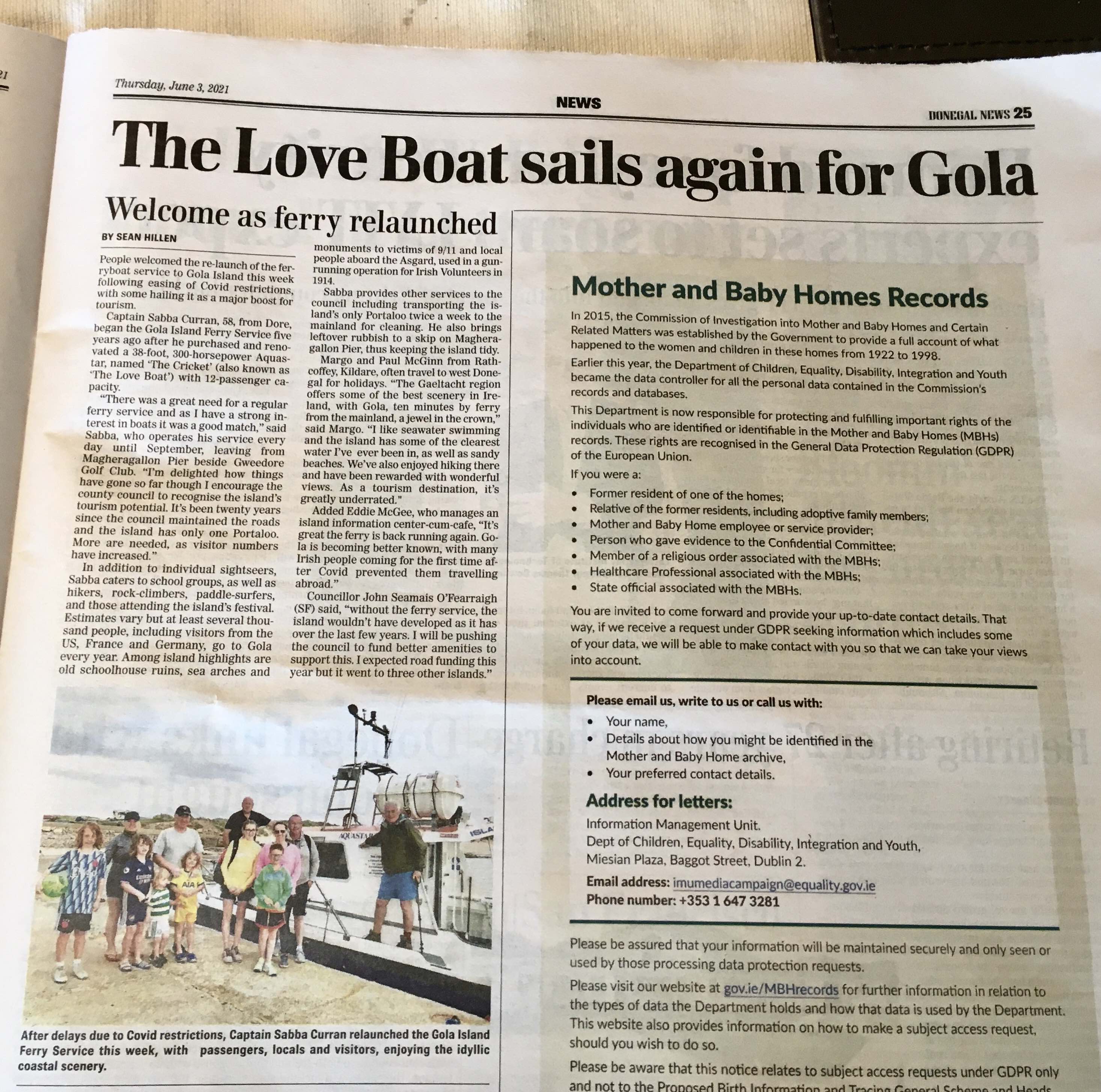
In honor of Sabba, Eddie and the beauty of the island, I penned this short news story for the ‘Donegal News’ this week.   

People welcomed the re-launch of the ferryboat service to Gola Island this week following easing of Covid restrictions, with some hailing it as a major boost for tourism.

Captain Sabba Curran, 58, from Dore, began the Gola Island Ferry Service five years ago after he purchased and renovated a 38-foot, 300-horsepower Aquastar, named ‘The Cricket’ (also known as ‘The Love Boat’) with 12-passenger capacity.

“There was a great need for a regular ferry service and as I have a strong interest in boats it was a good match,” said Sabba, who operates his service every day until September, leaving from Magheragallon Pier beside Gweedore Golf Club. “I’m delighted how things have gone so far though I encourage the county council to recognise the island’s tourism potential. It’s been twenty years since the council maintained the roads and the island has only one Portaloo. More are needed, as visitor numbers have increased.”

In addition to individual sightseers, Sabba caters to school groups, as well as hikers, rock-climbers, paddle-surfers, and those attending the island’s festival. Estimates vary but at least several thousand people, including visitors from the US, France and Germany, go to Gola every year. Among island highlights are old schoolhouse ruins, sea arches and monuments to victims of 9/11 and local people aboard the Asgard, used in a gun-running operation for Irish Volunteers in 1914.

Sabba provides other services to the council including transporting the island’s only Portaloo twice a week to the mainland for cleaning. He also brings leftover rubbish to a skip on Magheragallon Pier, thus keeping the island tidy. 

Margo and Paul McGinn from Rathcoffey, Kildare, often travel to west Donegal for holidays. “The Gaeltacht region offers some of the best scenery in Ireland, with Gola, ten minutes by ferry from the mainland, a jewel in the crown,” said Margo. “I like seawater swimming and the island has some of the clearest water I’ve ever been in, as well as sandy beaches. We’ve also enjoyed hiking there and have been rewarded with wonderful views. As a tourism destination, it’s greatly underrated.”

Added Eddie McGee, who manages an island information center-cum-cafe, “It’s great the ferry is back running again. Gola is becoming better known, with many Irish people coming for the first time after Covid prevented them travelling abroad.”

Local Sinn Fein Councillor John Seamais O’Fearraigh said, “without the ferry service, the island wouldn’t have developed as it has over the last few years. I will be pushing the council to fund better amenities to support this. I expected road funding this year but it went to three other islands.”

New writing competition – almost 3,000 euro worth of awards

If you like writing, please take note – a new competition in northwestern Ireland offers around 3,000 euro worth of awards, for just 500 words.

With the coronavirus outbreak forcing many of us to stay home, Donegal-based ‘Ireland Writing Retreat,’ at which I am co-founder and tutor, decided this was a good time to launch its first-ever competition, with key prizes for winners.

Welcome to the inaugural ‘Wild Atlantic Writing Awards’ (WAWA), a competition that we hope will provide challenge, diversion and enjoyment for you as a wordsmith in the strange times we live in right now.

After much brainstorming, it was decided the competition should reflect the nature of ‘Ireland Writing Retreat’ itself and what it has focused on over the last five years of operation.

The conclusion: not one, but two, separate competitions: fiction and creative nonfiction.

woman in gray sweater sitting on wooden floor typing on portable computer

Photo by bongkarn thanyakij on Pexels.com

Flash Fiction Award

The fiction writing competition is open to all genres – sci-fi, crime, romance, horror, humor, thriller, mystery, whatever tickles you and your Muse’s fancy. And it is in the form of flash fiction, a field growing rapidly in popularity.

To add spice to the idea, there is a single theme.

After many hours of debate, we realised the perfect one was staring us right in the face.

Writing itself.

In other words, upon reading competition entries, judges are left in no doubt that a key element in your story is linked in some way to writing itself. For example, one of the characters, human or non-human, could be a writer. Or a piece of writing could play a key role in the story. Let your imagination be your guide.

All you have to do is pen a flash fiction story in any style or genre focusing on the act of writing, in any way, shape or form, up to a maximum of 500 words.

PRIZE

The winning entry will receive 500 euro in cash.

And more.

An added bonus of 990 euro in value in the form of free participation* – including all excursions, by land and sea, food and drinks tastings, concerts and dance performances, and all writing workshops and author talks – at one of our retreats of your choice, either this autumn in either Paris or Donegal, or one of our retreats next year.

In effect, a total prize equal to almost 1,500 euro.

Plus, with the writer’s permission, the winning entry will be published on the ‘Ireland Writing Retreat’ website, with short bio and photograph. The writer retains all copyright to her or his work.

sad elderly man writing on brown notebook

Photo by Andrea Piacquadio on Pexels.com

Creative Nonfiction Award

As for our creative nonfiction competition, we offer you a similar challenge.

To write a story of not more than 500 words on any subject – whether it be in the form of memoir, profile, literary journalism, personal essay, travel (and remember, award-winning travel articles don’t have to be about exotic destinations, it could be about your own hometown), food, or any creative nonfiction category you prefer.

PRIZE

The winner will receive 500 euro in cash.

And more.

An added bonus of 990 euro in value in the form of free participation* – including all excursions, by land and sea, food and drinks tastings, concerts and dance performances, and all writing workshops and author talks – at one of our retreats of your choice, either this autumn in either Paris or Donegal, or one of our retreats next year.

In effect, a total prize equal to almost 1,500 euro.

Again, with the writer’s permission, the winning entry will be published on the ‘Ireland Writing Retreat’ website, with short bio and photograph. The writer retains all copyrights to her or his work.

Grab this golden opportunity to unleash your creative abilities during this period of restrictive ‘social distancing’ and emerge a happy winner.

Enter now the Wild Atlantic Writing Awards.

*See full terms and conditions.