Sinn Fein’s Presidential decision – a case of the tail wagging the dog

Is Sinn Fein’s decision this weekend to support Independent candidate, Catherine Connolly, in November’s Irish Presidential elections a case of the tail wagging the dog?

It certainly seems so.

After much dithering and delay, Ireland’s third ranked political party – which not so long ago could have topped the polls nationwide and emerged as the nation’s leading party if they’d only put forward more candidates – could not even decide on its own Presidential candidate, party member or not.

Instead, it meekly followed in the wake of other smaller Left-leaning parties who have been supporting Connolly for many months.

Catherine Connolly – established Irish politician.

If that’s not the tail wagging the dog, what is? 

No matter how well the story is spun – and sadly Sinn Fein party leader Mary Lou MacDonald offered an ‘over-the-top’ act to do so a few days ago, uttering the superlative cliché ‘game-changer’ – this non-decision decision may come back to bite her and her colleagues. 

While they won’t say it publicly, the other Left wing parties in Ireland are now frothing at the mouth at the possibility of stealing parliament seats from Sinn Fein at the next election.

Unfortunately, Mary Lou made the situation even worse this weekend when she tried vainly to justify choosing Connolly by saying recent Irish presidents had been elected “from outside the political establishment” and that Connolly was following in that tradition.

What a load of nonsense.

Catherine Connolly has been an ‘established’ politician for the last quarter of a century, beginning as local councillor in Galway, then rising to Mayor five years later, then becoming a TD ten years ago. For goodness sake, she was even chairperson of Ireland’s national parliament for a full four years.

If that’s not ‘established’, what is?

Even the present President of Ireland Michael D. Higgins, elected not once but twice over the last 14 years, was a ‘classic established politician.’ For almost half a century including stints as Labour Party president, Senator, TD (Member of Parliament) and even as a Minister. 

One has to ask oneself ‘Who the hell is writing Mary Lou’s scripts. And who’s conducting her research?”

I’ve always been Left of center in my political outlook, and would like Sinn Fein to be in Government and shake up the meagre mediocrity of Irish politics. But with poor decisions like this one over the Presidency, I fear that’s not going to happen any time soon.  

Sinn Fein has shown itself in many instances to be a no-risk party, including its electoral management strategy in Donegal where I now live. In order for it to justify its claim as a leading party, it needs to take risks. But time and time again, it has shown itself to be very much risk averse.  

My humble view is that Irish people are desperate for a fresh face in Áras an Uachtaráin, the official residence of the President of Ireland, someone truly not involved in Irish politics. Someone with the international experience necessary to conduct the role of Presidency in a strong diplomatic manner. They simply don’t want the Presidential race to be based along worn, age-old political party lines.

That’s why someone like Gareth Sheridan – a man whose US-based company has accumulated losses of 40 million dollars and who has himself already been fined for misleading people about his business and whose main business partner is said to have links with Russian oligarchs – has managed to get two county councils in Ireland to nominate him as a Presidential candidate. 

That’s how desperate Irish people are to find someone new. 

Mary Lou went half way by talking about the need for someone new. 

But then she went right ahead and selected someone straight from the old political establishment. And to make matters worse, someone other parties had already selected a long time ago.

It seems Sinn Fein may have just bought the ruling coalition of Fianna Fail and Fine Gael an early Christmas present.  

Meet The Real Simon Harris – The Dishonourable Duke Of Duping

Is it not reprehensible – the height of hypocrisy in fact – that Simon Harris the leader of the Irish Government  – has the audacity to accuse Sinn Féin in recent weeks of ‘duping’ people when it expelled several party members for substandard social behaviour?

Simon Harris – the Dishonourable Duke of Duping.

The Cambridge dictionary definition of dupe is ‘to deceive’ and if anyone is guilty of deception, it is Harris and his colleagues in the coalition Government of Fine Gael, Fianna Fail and the Green Party.

Over the last four years since being in power – and for many years before that – these parties have been nothing less than ‘repeat offenders,’ constantly deceiving the ordinary hardworking people of Ireland with false promises of a quality lifestyle as befitting a nation that is one of the earliest members of the European Union, then called the European Economic Community, or EEC for short, back in 1973.

Instead, however, we have one of the most disastrous health systems on the continent, with people waiting years for life-saving surgeries, often dying before they receive it; we are awash in homelessness and poverty, with an estimated people 30,000 living on the streets, including thousands of young children and infants; we have a forsaken, forgotten, forlorn State where retirees and newlyweds alike are unable to afford the rent of a simple home, never mind the financial resources to even remotely consider buying one to end or begin their lives together in a modicum of comfort.

Not only does the Dishonourable Duke of Duping continue to deceive people that after all these years he’ll one day consider putting a roof over our heads, but he himself basks in the lap of luxury in one of the most expensive and elitist places in Ireland, the scenic coastal town of Greystones in county Wicklow, where he was born, where he lives and where houses cost up to two million euro, and more.

But is it not somewhat harsh of us to criticise the Dishonourable Duke of Duping for his lack of common decency? Is it not unfair to ask a man of such Royal blood living in such a high falutin’ environment to understand the plight of so many desperate Irish people? Is that not akin to asking King Charles of England to make his own cupán tae once in a while?

Shamefully, while the wealthy in Ireland (many of whom are the Dishonourable Duke of Duping’s closest neighbours) while away their days in decadent lifestyles with fancy homes in fancy places or travel in  environmentally-damaging private jets (which the Dishonourable Duke of Duping does frequently) and indulge their whims in ostentatious holiday homes abroad (which the Dishonourable Duke of Duping often does), modern Ireland suffers the worst housing shortage in its entire 100-year history. 

Studies show less than a third of 30-year-olds own their home. Over half of all newly-built homes in greater Dublin alone were bought or developed by global vulture investor funds, thus locking countless people out of ever attempting to buy one. These ‘vampire funds’ don’t buy homes to sell, they buy them to extract high rents in perpetuity. In other words, they suck the lifeblood out of decent Irish society.

And to make matters worse, the Dishonourable Duke of Duping and his cadre of Government lackeys allowed a temporary no-fault eviction ban in Ireland to lapse last March, thus opening the floodgates for more than 15,000 notices of termination to be issued last year, making the number of evictions higher than it was during the Famine in the mid-1800s. 

For centuries, gutless, greedy, often absentee, landlords, have been the scourge of Ireland, rich, ruthless people who with the click of a finger, a scribbled signature on a sheet of paper, thoughtlessly tossed hungry families out into the ditches. 

Now it seems the same is happening all over again in modern Ireland, this time under the dictatorial rule of the Dishonourable Duke of Duping and his ignoble entourage.

Instead of urgently dealing with these major social and health issues that are making the lives of so many Irish people intolerable, Harris and his well-to-do cohorts, including Government coalition leaders, Micheál Martin of Fianna Fail and Roderic O’Gorman of the Green Party, are pointing their grubby finger at Sinn Féin, an oft-used political ploy to distract popular attention away from the real issues, and their own failings on them. 

In doing so, however, these ‘I’m-better-than-you’ leaders fail to realise something important. While the bitter winds of winter howl at our doors, while Storm Ashley batters the coast this weekend, Irish people are not bears. They are not hibernating. They are wide awake. And fearful. And hungry. And cold. And they remember the empty promises made to them from on high four years ago, and for many years before that.  

Maybe, just maybe, we should ask Sinn Féin leader Mary Lou McDonald to re-tell the story of these empty promises once more, to remind us how easily we were taken for fools. And in doing so, help us make sure the Dishonourable Duke of Duping and his Royal patrons don’t sneak back into power through the back door and make jesters of us for another four years in their Court of Failure.

Maybe, just maybe, we’ve learned our lesson and are wide awake enough to elect Sinn Féin, the ‘Party of Change’ and improve things for the better. For each and everyone of us, our parents, our children and the generations who come after. 

Is Sinn Fein really ready for Government?

by Sean Hillen 

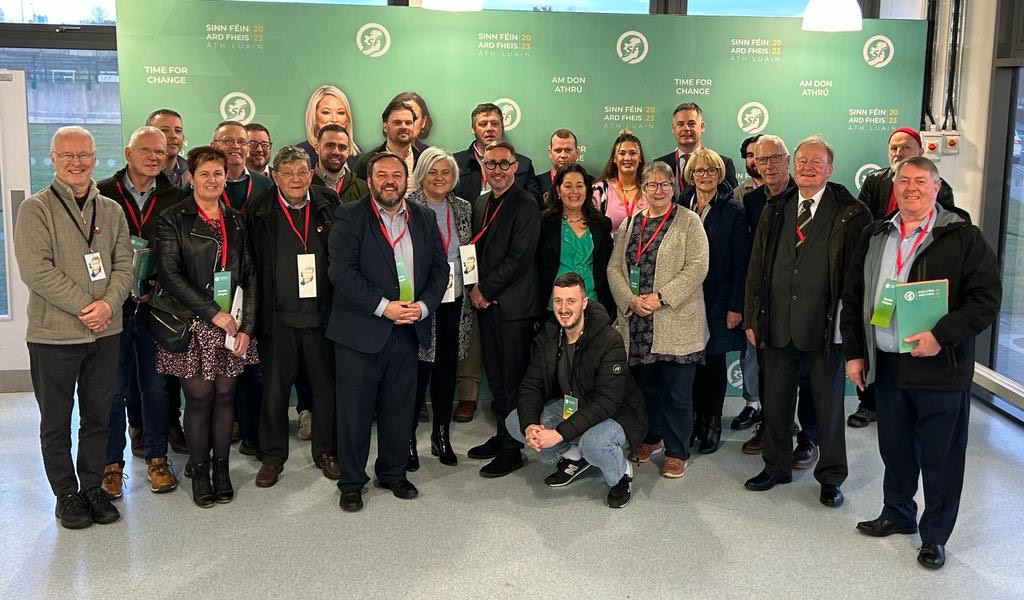
ATHLONE, WESTMEATH – A resounding ‘YES’ was the answer that rang out loud and clear all around me from around 1,500 enthusiastic and committed members, young and old, men and women, some teenagers, some retirees, gathered for the party’s annual Ard Fheis in Athlone, Westmeath several weeks ago.

A large Donegal delegation, the county where I live in northwest Ireland, attended the Ard Fheis.

I know from past experience in both Europe and the US that political party conferences can be full of hype and promise but I sensed something special in the air at this one. Positivity, definitely. Excitement, plenty. Anticipation, yes. Expectation, ditto. Even a little apprehension. Natural, considering it’s been 100 years since Sinn Fein last walked through the corridors of power as the undisputed political leader of Ireland.

Attending this annual meeting, I was extremely impressed with the overwhelming enthusiasm shown by members, their readiness to be in Government and make meaningful changes in Ireland for a better future for all and by the large number of women present, many of whom spoke incisively from the stage as delegates on a range of issues, from education to health, the high cost of living to homelessness. 

With local and EU elections, and perhaps national ones as well, occurring next year, it seemed appropriate that a party that continues to rise in national popularity was holding its annual party meeting in Athlone, a town considered the geographical center of Ireland, with Sinn Féin hoping its influence radiates from there nationwide in all directions.

Led by two women, Mary Lou McDonald, the party’s president and TD for Dublin Central, and Michelle O’Neill, party vice-president and First Minister Elect in Northern Ireland, with TDs nationwide, would-be Ministers-in-waiting, including TDs Pearse Doherty and Pádraig MacLochlainn from Donegal where I now live and with whom I spoke during breaks in the formal proceedings, all aired their views on key issues such as the cost of living crisis, plight of the health system, mounting housing problems, and many more. 

We want to build a new Ireland,” said McDonald in her keynote address after receiving a rousing reception. “A nation home for all. A unified nation of confidence and compassion, talent and ingenuity, claiming our future, our rightful place among the nations of the world. A new Ireland. The Orange and Green reconciled. No place for racism, Islamophobia, Antisemitism, sexism, homophobia, transphobia, or sectarianism.”

O’Neill spoke about the urgent need to kick-start the Stormont Assembly, the national parliament in Belfast, which has been boycotted by the Democratic Unionist Party (DUP), the main Unionist opposition, for the past year. “My message is one of positivity, one about the future, about building a better society for us all to live side by side,” she said. “My message to the DUP is that they need to be in the Executive with the rest of us, making politics work, making this a better place for everybody who lives here.”

Pearse Doherty, the party’s spokesperson on finance, thanked his fellow party members, saying, “You are the engine room of our organisation. Your work, your energy, your ideas, make Sinn Féin what it is – the only viable vehicle for the ordinary people of Ireland to achieve change in our country, and the only viable vehicle to achieve the unity of our country. We are focused on one thing – delivery for workers and family the length and breadth of our island. We are on the countdown to the general election, and we are setting out the type of change that a Sinn Féin government will deliver if the people give us that opportunity. We are setting out our plans to build a better, fairer country for all, for positive change and transformation.”

Pearse Doherty listens closely as Mary Lou McDonald gives her keynote address.

Paul Hayes, from Carrigart, Sinn Féin regional secretary in Donegal, was delighted with the weekend’s success, telling me that the Ard Fheis had brought together over 1,400 people, with more than 200 speakers over 300 issues voted on. “It’s a great success, I’m very happy,” he told me, smiling. Sitting beside me in the auditorium stalwart Pat Doherty, former Sinn Féin vice-president, wore a quiet, thoughtful – one might even say, contented – expression on his face. And no wonder. After many years of personal struggle and hard work towards the goal of a United Ireland Socialist Republic, the idea – once remote – of his party leading Government both in the north and south of of the nation seems rapidly becoming a reality.

(left to right) Paul Hayes, Sinn Féin regional secretary in Donegal, with Pat Doherty, the party’s former vice-president. Both were happy with the strong attendance and content at the Ard Fheis.

Thanking me for exclusive information I provided to Sinn Féin on RTE expenses, MacLochlainn, the party’s chief whip and spokesperson on fisheries and the marine, added, “We are mindful that this Sinn Féin Ard Fheis could be the last one before the next general election and the formation of a new government. We are confident, we are ready.”

Pádraig MacLochlainn, TD, is confident. “Sinn Féin is ready for Government,” he said.

Among the many motions passed was one affecting many people in Donegal. This pertains to an ongoing scandal – houses that are crumbling due to mica and pyrite in concrete. “Sinn Féin are determined to lead the next government so it is important to renew our commitment to one hundred percent redress and to spell out how we would implement that policy, if we get that chance,” said Sinn Féin housing spokesperson, Eoin Ó Broin. “We believe the Enhanced Defective Concrete Block Grant Scheme is another scheme that will deny redress to most affected homeowners.” 

Aside from domestic issues, Sinn Féin also debated foreign policy issues with loud cheers of support and a prolonged standing ovation given to Dr. Jilan Wahba Abdalmajid, Ambassador of Palestine to Ireland, a VIP guest speaker.

Sinn Féin initially abstained at local council and national level from calling for the expulsion of the Israeli Ambassador to Ireland but in face of horrific stories of death and life-threatening injuries, including thousands of young children, and the wholesale destruction of home and hearth in Gaza, changed tack and formally backed those calls, as well as calling for Israel to be referred to the International Criminal Court by Ireland and the Irish government to formally recognise the State of Palestine.

“We call for an immediate ceasefire and stand firmly behind Palestine in its hopes and  aspirations for its own homeland recognised by all international bodies and a long and lasting peace with all its neighbours,” said Matt Carthy, the party’s spokesperson on foreign affairs, who also thanked me for a proposal I made on a possible long-term solution to the Palestine question.

Young members of Sinn Féin show their support for Palestine.

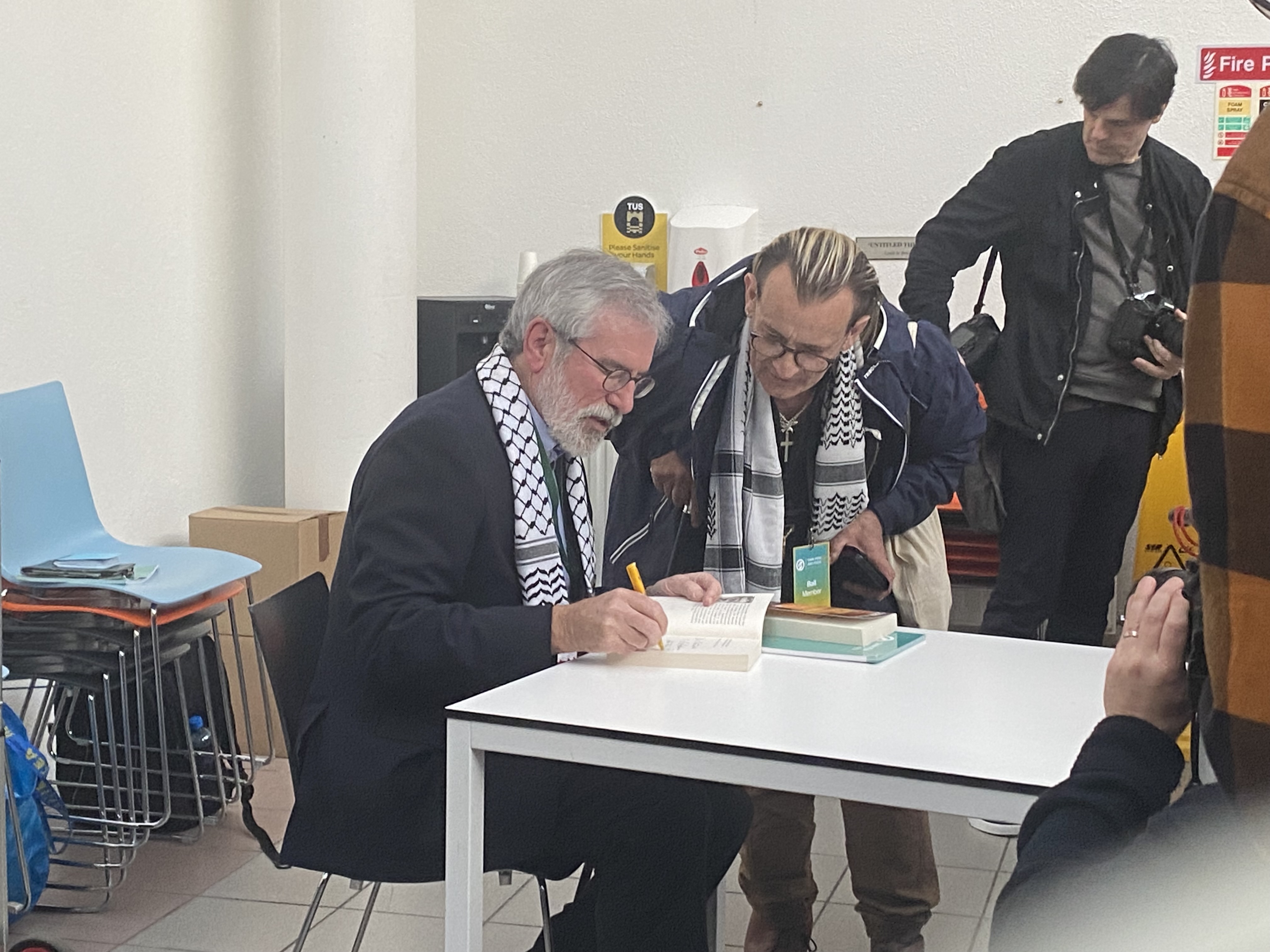
Elsewhere at the Ard Fheis, former Sinn Féin president, Gerry Adams, cheerfully met with a long line of well-wishers as he signed copies of his latest book, Black Mountain and Other Stories. Gerry has authored a number of books including Before the Dawn: An Autobiography; Cage Eleven: Writings From Prison; The Street And Other Stories; Falls Memories; and A Farther Shore: Ireland’s Long Road.

I am proud to say that Gerry’s Donegal holiday house lies less than 10 kilometers from my own home and that his mother and mine were very close friends as teenagers, working side-by-side in west Belfast and stayed together in the Donegal Gaeltacht on several occasions (with their interest in boys vying closely with their interest in the Irish language and culture, I am reliably informed).

Former Sinn Féin president, Gerry Adams, signs copies of his books.

Half million euro missing in Donegal, 250 euro returned

Half a million euro would be considered a miraculous life-saver by Mary, the tireless community worker struggling on behalf of cancer patients from Donegal who can barely afford the hefty cost of travel to Galway for specialised treatments.

If the hardworking managers of local community centres in the Donegal Gaeltacht received half a million euro, they could hire additional full-time Irish, and English-language, staff for several years and expand exponentially their range of services and activities in support of local people. 

If Amharclann, the Irish-language theatre in Bunbeg, received half a million euro, it could run an exciting cultural programme of dance, music, cinematic and theatrical performances for the next five years.

Not to mention how hard-pressed individual artists and musicians bereft of gigs due to Covid could use that money. Or indeed the Donegal office of Irish-language organisation, Foras na Gaeilge, whose local members help keep our native language alive here. And as for those unfortunate people whose homes and businesses have been destroyed by mica ….

But none of these groups have the luxury of half a million euro. 

Such a notion would be considered pure and utter fantasy, especially in the hard financial times in which we now live. 

Yet that is about the sum of money former Donegal Fianna Fail Senator, Brian O’Donnell, from Falcarragh in the heart of the Donegal Gaeltacht, has just wasted. ‘Snatched brutally, selfishly and greedily’ some are saying, from the public purse. Others use the term ‘stolen,’ but in this article I wish to be diplomatic.

How did he do this?

Ironically, over the Irish language.

O’Donnell was caught taking money from the public purse by duplicating travel and subsistence expenses as both board member of Irish-language economic group, Údarás na Gaeltachta, and Donegal County Council. 

The accusations – and this beggars belief – investigated by the Standards in Public Office Commission (SIPO) – was that it would have been impossible for him to have been in two different parts of the country at exactly the same time, at two different conferences. 

And there I thought teleportation – where matter is de-materialised at one place and recreated instantly at another – happened only in science-fiction movies and fantasy comics.

If that wasn’t enough, the former Fianna Fail Senator then cowardly left the scene of an accident while driving his car in a drunken state.

But that’s only the beginning of the saga.

O’Donnell, with the aid of well-paid lawyers, fought the accusations against him, not on the basis of whether they were right or wrong, true or false, but on the simple basis that the cases should be heard as Gaeilge (in Irish) not English. The fact that both languages are official languages of the Republic of Ireland didn’t matter a damn to him, nor them. Nor the eventual cost to ordinary Irish citizens, including those unfortunate people suffering from cancer.

The rest of the story is spread across years of newsprint.

After deploying numerous tactics to delay the ‘claims investigation’ many times, he then decided to do the same to the ‘leaving the scene of an accident’ investigation, not once but a total of 20 times.

As a result, the total bill to the ordinary Irishman, woman and child has been estimated at around – yes, you’ve guessed it – half a million euro, the amount the board of trustees of Amharclann, Donegal’s proud Irish-language theatre, the hardworking staff of the county’s community centres and the many severely sick people – all dream of having to help them.

In the meantime, craftily devising his delaying tactics, which eventually spanned a massive eight years, did O’Donnell quietly planned his ‘get-out-of-jail card’ – his emigration to Canada? In fact, O’Donnell being found guilty could perhaps have led to a short prison sentence and would have prevented him emigrating to Canada. And certainly would have prevented him getting a Canadian driving license.

Was his delaying tactics also related to avoidance of his share of the legal costs? For example, I’ve been trying to find out if he ever paid a legal bill placed upon him by three judges who threw out of court his claim that the SIPO was not entitled to investigate his duplicitous behaviour because, he claimed, the allegations arose from ‘an anonymous complaint by a member of the public.’ 

I’d like to know not only if Mr. O’Donnell has paid his full legal bill but how much it was. If Mr O’Donnell is reading this, please get in touch. It’s only fair to hear his side of the story. And transparency is something we all should strive for.

Mysteriously the court hearing that finally put an end to one of the most ludicrous and wasteful cases in Irish legal history, almost went under the radar earlier this month, slipped quietly and quickly onto the docket of a mundane court sitting.

How did this happen? Donegal media said simply that, “according to court papers.. O’Donnell’s case was not due to be heard until the Wednesday after during a sitting  of Falcarragh District Court.” That’s when his (O’Donnell’s) solicitor, Sean Cannon, “brought the matter up with Judge Paul Kelly …during a family law sitting of Letterkenny District Court.” And the judge conveniently and quickly moved the case forward.

‘Brought the matter matter up?’ What the hell does that mean? And does such a serious case merit being in a sitting on family law? The mind boggles.

And this Judge Paul Kelly? Who is he? Was he appointed under a previous Fianna Fail government? Does it look like it from this article? But then again, that doesn’t matter, surely. After all, the Irish legal system is separate from the political one, isn’t it?

Though, as we well know, it is not unknown in Ireland for political favours and indeed, brown envelopes, or both, to pass hands.

The result of the long-delayed case: a ridiculously low fine, in my opinion, of 250 euro for charges of drunken driving leaving the scene of an accident and providing misinformation the police. I dare you to find any court case where such a laughable decision has been made in such a serious case. 

As for the short ban from driving, does it really matter? O’Donnell is sitting pretty in another country. Did an infamous Irish ‘brown envelope’ pass hands to facilitate this convenient legal accommodation in Letterkenny? No-one knows, and unfortunately no-one will probably ever know. Is this just an example of the old adage, ‘there’s a law for the ordinary working citizen but a very different one for the elite, well-connected in Irish society?’ 

So, while O’Donnell enjoys his new life in Quebec, Irish men, women and children in his very own constituency in the heart of the Donegal Gaeltacht continue to struggle to make ends meet, people continue to suffer pain and hardship, some desperately trying to raise enough money to help them avail of specialised life-saving cancer treatments. And young, talented teachers from the Donegal Gaeltacht, and other parts of the county, are forced to go abroad, to places like Quatar in the Middle East, because there’s no money to employ them here at home.

Is this called ‘fairness’ in Ireland today? 

Among all this misconduct (there are stronger words to describe O’Donnell’s behaviour), there are two other guilty parties that should not escape blame and require stronger scrutiny by the public at large and by themselves. 

At the very least, both Údarás na Gaeltachta and Donegal Council obviously urgently require a proper Code of Practice for Good Governance. And, more importantly, to enforce it. Want to know more about the failings of Údarás na Gaeltachta, an organisation that receives tens of millions of euro from the public purse every year? Read more here. Has it cleaned up its act since then? Time will tell.

There’s little anyone can do now about the regrettable situation surrounding the O’Donnell controversy, except two things.

Firstly, as a citizen you have the right to appeal to the relevant authorities about a court decision you consider overly-lenient and unfair and to have the case reviewed. One place to start is writing to the Complaints Department of the Law Society of Ireland at complaints@lsra.iethe

Then the Judicial Conduct Committee established by The Judicial Council recently. You can write a short email to: info@judicialcouncil.ie You can ask to remain anonymous in both instances. It’s time to stand up and speak out, don’t you think?

I have already sent a complaint about Judge Paul Kelly’s decision as I consider a 250 euro fine to be utterly ridiculous and a 3-year driving ban to be insignificant, considering that Mr. O’Donnell can simply come to Ireland in the intervening years and drive with no problems using a Canadian driving license I presume he will obtain quite easily, thus posing a danger yet again to ordinary people on our roads. On both sides of the Atlantic.  

Secondly, when election time comes round, and it will come quicker than you think, consider carefully which political party and candidates you vote for. Is it not better to avoid the Brian O’Donnells of this world and choose others with a much greater sense of decency and honesty? 

Are yoga, thai chai and reiki dreaded Druidic distractions? Is the anti-cervical cancer vaccine, HPV, the Devil’s poison?

Glancing through last Friday’s edition of the ‘Donegal News,’ I was dazzled by the sheer creativity of people from Ireland, (see a particularly interesting article on page 47 focusing on a man who lasted 70 days in prison without food and is now a Doctor in Sociology and a well-known Irish playwright and film and documentary script writer).

It’s as if the artists of every shade throughout Ireland and particularly in my resident county, Donegal – musicians, actors, painters, dancers et al – feel they have a deep, abiding, age-old responsibility to uphold our ancient rich Gael culture, and in doing so, prevent its dilution.

And I don’t mean – wonderful though it is – simply the native folk music and song of the lauded, award-winning Frosses-native Rita Gallagher and Gaoth Dobhair’s Mairead Ni Mhaonaigh (who play this Thursday at the Balor Arts Centre as part of the Bluestacks Festival).

rita Gallagher, Mairead Ni Mhaonaigh

Winners of TG4 Gradam Ceoil Awards.

I mean our vast spread of artistic talent, first brought here to these shores when definitive Celtic traditions arrived from places such as Romania and Gaul (Gallia) in the fourth century B.C.

Then, unlike all other islands, Alice Stopford Green tells us in her work ‘Irish Nationality,’ Ireland, “was circled round with mountains, whose precipitous cliffs rose sheer above the water standing as bulwarks against the immeasurable sea, providing a bulwark – though sadly not an invincible one – against invaders of all kinds. And certainly, helping far-flung places such as Donegal escape foreign domination.” (unlike the Pale of Dublin which followed a completely different tract).

Irish chroniclers tell of a vast Celtic antiquity, with a shadowy line of monarchs reaching back some two thousand years before Christ: legends of lakes springing forth; of lowlands cleared of wood; the appearance of rivers, the making of roads and causeways, the first digging of wells: the making of forts; invasions and battles and plagues.

The Celts or Gaels exalted and encouraged learning in national life. Professors of every school roamed freely here and the warrior’s duty was to protect them. There were periodical exhibitions of everything the people esteemed—democracy, literature, tradition, art, commerce, law, sport, the Druid religion, even rustic buffoonery. The years between one festival and another were spent in serious preparation for the next.

Innovative arts programme at the Balor Arts Center, Ballybofey, Donegal.

The law of the Celts was the law of the people. They never lost their trust in it. They never followed a central authority, for their law needed no such sanction. A multitude of maxims were drawn up to direct the conduct of the people.

While the code was one for the whole race, the administration on the other hand was divided into the widest possible range of self-governing communities, which were bound together in a willing federation. The forces of union were not material but spiritual, and the life of the people consisted not in its military cohesion but in its joint spiritual inheritance—in the union of those who shared the same tradition, the same glorious memory of heroes, the same unquestioned law, and the same pride of literature.

So deeply was their importance felt, the Irish have kept these tradition diligently, and even in the darkest times of our history, down to the 17th century, still gathered to ‘meetings on hills’ to exercise their law and hear their learned men.

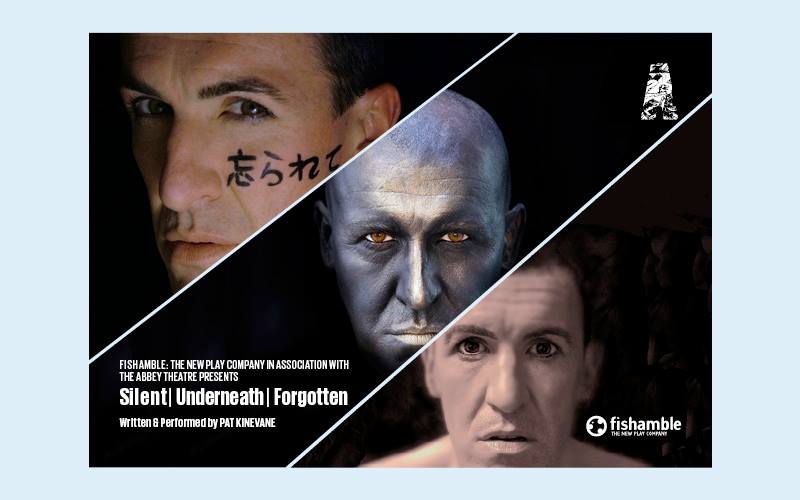
Not-to-be-missed performer.

So please think of this rich vein of cultural tradition that we’ve inherited when you read this week about the wealth of artistic talent on display here in Donegal and throughout Ireland – the multi-talented Pat Kinevane from Temple Bar-based Fishamble enacting not one but three separate one-man plays beginning this Friday with ‘Forgotten,’ at An Grianan in Letterkenny, a fine venue under the organization of Patricia McBride, Helene McMenamin, Daithi Ramsay and other staff members; Fishamble’s literary officer, Gavin Kostick, hosting playwriting masterclasses this Saturday there; the Regional Cultural Centre in Letterkenny, under the direction of Shaun Hannigan, presenting a feast of autumn concerts, kicking-off with the duet of Eliza Carty and Tim Eriksen this Friday evening; and ‘The Ghostlight Sessions’ at the Balor Arts Centre in Ballybofey tonight, an evening of original music curated by Nikki Pollock (Mojo Gogo) and Dean Maywood and featuring ‘In Their Thousands’ and ‘Without Willow.’

Not to mention ‘The Donegal Voices’ this Friday in Ballyshannon performing Handel’s magnificent ‘Coronation Anthems’ and the ‘Hallelujah Chorus.’ Many of the performances are funded by the Donegal County Council/An Comhairle Ealaion.

First Lady of Celtic music – Donegal-born Moya Brennan.

And if you missed Moya Brennan of Clannad performing a few days ago with her husband, Tim, daughter Aisling and son Paul, in Teac Leo in Crolly, in support of the Inishowen Floods Fund, you’ll surely get the chance again to hear this brilliantly talented family in the future. The same goes for ‘Shoot The Gear,’ a fine piece of theater with a fishing-community based theme facilitated by the Killybegs Fishermen’s Organization, written by An Grianan Theatre artist-in-residence, Guy Le Jeune, and performed by a cast of local actors, singers and musicians including Fionn Robinson, Louise Conaghan, Orlaith Gilchreest and Ronan Carr.

Speaking of music, what a terrific accomplishment by Donegal Music Education Partnership (DMEP) manager, Martin McGinley, and his team, including tutor and pianist, Ellen Quinn, Maureen Fryer-Kelsey and James Sarsteiner , with help from Marianne Lynch of Donegal County Council Library Services in putting together a new online library of more than 1,500 musical items that the public can easily access.

Martin McGinley (left) – Journalist, editor, fiddle player par excellence, now manager of Donegal Music Education Partnership.

However, as we rightly attempt to emulate our rich, multi-layered Celtic past, I would issue a sharp warning. While the keystone of our proud ancestors’ beliefs was based on the premise of democracy, each individual having a fair say, let us beware.

The Catholic Church – so long dominant in Irish society after vanquishing Druidic life, more so in rural Irish society – must now learn to accept – in turn – its rapidly changing place. And that place is no longer its own self-styled, unquestioning right to direct all community groups, especially on sensitive matters of finance. Too often have I heard complaints here in the Donegal Gaeltacht and elsewhere in Ireland about frocked priests and bishops sitting at the heads of tables, making vital decisions, often cunningly in an underhand way ahead of the formal committee meetings, on where vital monies should go. And not always to the benefit of the community as a whole – but to the church in particular.

My own area, Cnoc Fola, has just received a grant of 40,000 euro from Fine Gael Minister Joe McHugh. Considering the rather incestuous relationship between the Catholic Church and successive ruling political parties in Ireland – Fianna Fail and Fine Gael – is it reasonable for me to expect there is no payback expected, from both church and state, for this money, in terms of votes and support?

Is it also reasonable for me to trust the word of men in long black coats who describe yoga, thai chai and reiki as activities that ‘endanger our souls’ and who also discourage women from taking the HPV vaccine against cervical cancer, saying it simply encourages widespread promiscuity and immorality? And who move child abusing clergy from parish to parish?

Some months ago in a previous blog, I invited a well-known, rather affable west Donegal Gaeltacht priest, Brian O’Fearraigh, to join community members in our weekly yoga sessions at An Crann Og in Gaoth Dobhair. He hasn’t made an appearance yet. My offer is still open. He’d receive a warm ‘Cead Mile Failte’ from very friendly people there.

What do these seemingly unrelated issues – yoga, thai chai, reiki and the HPV vaccine – have in common, anyway? Freedom of mind and body, of course. And such displays of individual identity are perceived as hot, red-light dangers by most major corporation and institutions, especially the more conservative ones.
Wait for it, it’ll be swimming, cycling, swing dancing and jazz next. Oh, I forgot, the latter was already forbidden by the Church to all God-fearing people some years ago.

Does that mean God-loving people can enjoy such relaxing music? Even if they are Druids, Pagans, atheists, agnostics or pantheists and their God is Mother Nature herself?

Notes 

Hope you like my latest published novel, the suspense Pretty Ugly, linking Donegal and other parts of Ireland, including Belfast, with the US cities of Boston, New York, Kansas City and Washington DC.

Interested in creative writing? A novel? Biographical memoir? Play or movie script? See Ireland Writing Retreat