GAME-CHANGER OR GAME-OVER IN IRELAND?

Sinn Fein’s President Mary Lou McDonald today described on national airwaves that her political party’s long-awaited, soon-to-be-named Irish Presidential candidate would be a ‘game changer.’

@rtenews

Sinn Féin leader Mary Lou McDonald has said that the party’s participation in the Presidential Election campaign will be a “game-changer”. Sinn Féin has been mulling over its approach to the race for Áras an Úachtaráin, with two options at its disposal – either run its own candidate or back Independent Catherine Connolly’s campaign. Speaking at the National Ploughing Championships in Screggan, Co Offaly, Ms McDonald said she already knew the proposal she would be bringing to the party, but that it would not be made public until Saturday. Go to link in bio for more #rtenews #ireland #presidentialelection #sinnfein

♬ original sound – RTÉ News

Having used this grandiose, hifalutin phrase, that’s exactly what supporters and would-be supporters of Sinn Fein will be expecting that person to be – a unique choice who will shock and surprise everyone. 

The kind of individual a disillusioned electorate are hungry for. Someone whose name and background will light a fire under what has already become – albeit in its early stages – a timid, banal, utterly predictable and lukewarm election campaign.

To use such a superlative phrase as ’game-changer’  and not deliver an individual with the immense passion, innovative vision and creativity the term demands will be considered by most people to be a dismal failure.  And show Sinn Fein to be a ‘has-been, once-was’ party, one whose rise in recent years has incontrovertibly stalled.

To come up with something less – such as merely supporting Independent Catherine Connolly – will help damn the party into endless Opposition. It will signal to a triumphant Fianna Fail-Fine Gael coalition Government that it has nothing to worry about from Ireland’s third-ranked party. That Sinn Fein is all bark and bluster. But no real bite. 

Regardless of the spin about Left wing unity, Sinn Fein supporting Connolly will be seen as nothing less than inherent party weakness. That of a political party seeking to lead the country that cannot even find a suitable candidate for the most universally elected political position in the nation. 

That’s not leadership. That’s impotence. 

Supporting Connolly, Sinn Fein at this stage will also be seen as being led by the other Left wing parties who decided on her months ago. And they risk losing key votes at the next election as a result, probably leading to an inevitable decline in its parliamentary seats. A major, perhaps irrecoverable, blow to the party’s hardworking grassroots members.

Thus it’s all-important, not just for future success but for sheer survival, that Mary Lou and her colleagues in the upper ranks of Sinn Fein deliver what they’ve promise so confidently. Nothing less will do.

In doing so, hopefully, they’ll also make this rather boring Irish Presidential battle a bit more interesting than it is right now, raising it from its low-level drab ordinariness.

If they don’t, Sinn Fein may pay a heavy price at the next election. And possibly never recover from the fall.

For a party that is admirably ethical and honest in its dealings, with a central mission of equality and justice for all, they need to find the courage to take risk, something the party is not particularly known for, as not running a second candidate in the Gweedore-Cloughaneely area in the last election showed, with Pearse Doherty’s massive surplus votes going nowhere instead of towards electing a record third TD in Donegal.  

This Presidential campaign is Sinn Fein’s Rubicon moment. It’ll be intriguing to see if they manage to cross over. Or drown in the effort.

Meet The Real Simon Harris – The Dishonourable Duke Of Duping

Is it not reprehensible – the height of hypocrisy in fact – that Simon Harris the leader of the Irish Government  – has the audacity to accuse Sinn Féin in recent weeks of ‘duping’ people when it expelled several party members for substandard social behaviour?

Simon Harris – the Dishonourable Duke of Duping.

The Cambridge dictionary definition of dupe is ‘to deceive’ and if anyone is guilty of deception, it is Harris and his colleagues in the coalition Government of Fine Gael, Fianna Fail and the Green Party.

Over the last four years since being in power – and for many years before that – these parties have been nothing less than ‘repeat offenders,’ constantly deceiving the ordinary hardworking people of Ireland with false promises of a quality lifestyle as befitting a nation that is one of the earliest members of the European Union, then called the European Economic Community, or EEC for short, back in 1973.

Instead, however, we have one of the most disastrous health systems on the continent, with people waiting years for life-saving surgeries, often dying before they receive it; we are awash in homelessness and poverty, with an estimated people 30,000 living on the streets, including thousands of young children and infants; we have a forsaken, forgotten, forlorn State where retirees and newlyweds alike are unable to afford the rent of a simple home, never mind the financial resources to even remotely consider buying one to end or begin their lives together in a modicum of comfort.

Not only does the Dishonourable Duke of Duping continue to deceive people that after all these years he’ll one day consider putting a roof over our heads, but he himself basks in the lap of luxury in one of the most expensive and elitist places in Ireland, the scenic coastal town of Greystones in county Wicklow, where he was born, where he lives and where houses cost up to two million euro, and more.

But is it not somewhat harsh of us to criticise the Dishonourable Duke of Duping for his lack of common decency? Is it not unfair to ask a man of such Royal blood living in such a high falutin’ environment to understand the plight of so many desperate Irish people? Is that not akin to asking King Charles of England to make his own cupán tae once in a while?

Shamefully, while the wealthy in Ireland (many of whom are the Dishonourable Duke of Duping’s closest neighbours) while away their days in decadent lifestyles with fancy homes in fancy places or travel in  environmentally-damaging private jets (which the Dishonourable Duke of Duping does frequently) and indulge their whims in ostentatious holiday homes abroad (which the Dishonourable Duke of Duping often does), modern Ireland suffers the worst housing shortage in its entire 100-year history. 

Studies show less than a third of 30-year-olds own their home. Over half of all newly-built homes in greater Dublin alone were bought or developed by global vulture investor funds, thus locking countless people out of ever attempting to buy one. These ‘vampire funds’ don’t buy homes to sell, they buy them to extract high rents in perpetuity. In other words, they suck the lifeblood out of decent Irish society.

And to make matters worse, the Dishonourable Duke of Duping and his cadre of Government lackeys allowed a temporary no-fault eviction ban in Ireland to lapse last March, thus opening the floodgates for more than 15,000 notices of termination to be issued last year, making the number of evictions higher than it was during the Famine in the mid-1800s. 

For centuries, gutless, greedy, often absentee, landlords, have been the scourge of Ireland, rich, ruthless people who with the click of a finger, a scribbled signature on a sheet of paper, thoughtlessly tossed hungry families out into the ditches. 

Now it seems the same is happening all over again in modern Ireland, this time under the dictatorial rule of the Dishonourable Duke of Duping and his ignoble entourage.

Instead of urgently dealing with these major social and health issues that are making the lives of so many Irish people intolerable, Harris and his well-to-do cohorts, including Government coalition leaders, Micheál Martin of Fianna Fail and Roderic O’Gorman of the Green Party, are pointing their grubby finger at Sinn Féin, an oft-used political ploy to distract popular attention away from the real issues, and their own failings on them. 

In doing so, however, these ‘I’m-better-than-you’ leaders fail to realise something important. While the bitter winds of winter howl at our doors, while Storm Ashley batters the coast this weekend, Irish people are not bears. They are not hibernating. They are wide awake. And fearful. And hungry. And cold. And they remember the empty promises made to them from on high four years ago, and for many years before that.  

Maybe, just maybe, we should ask Sinn Féin leader Mary Lou McDonald to re-tell the story of these empty promises once more, to remind us how easily we were taken for fools. And in doing so, help us make sure the Dishonourable Duke of Duping and his Royal patrons don’t sneak back into power through the back door and make jesters of us for another four years in their Court of Failure.

Maybe, just maybe, we’ve learned our lesson and are wide awake enough to elect Sinn Féin, the ‘Party of Change’ and improve things for the better. For each and everyone of us, our parents, our children and the generations who come after. 

Is Sinn Fein really ready for Government?

by Sean Hillen 

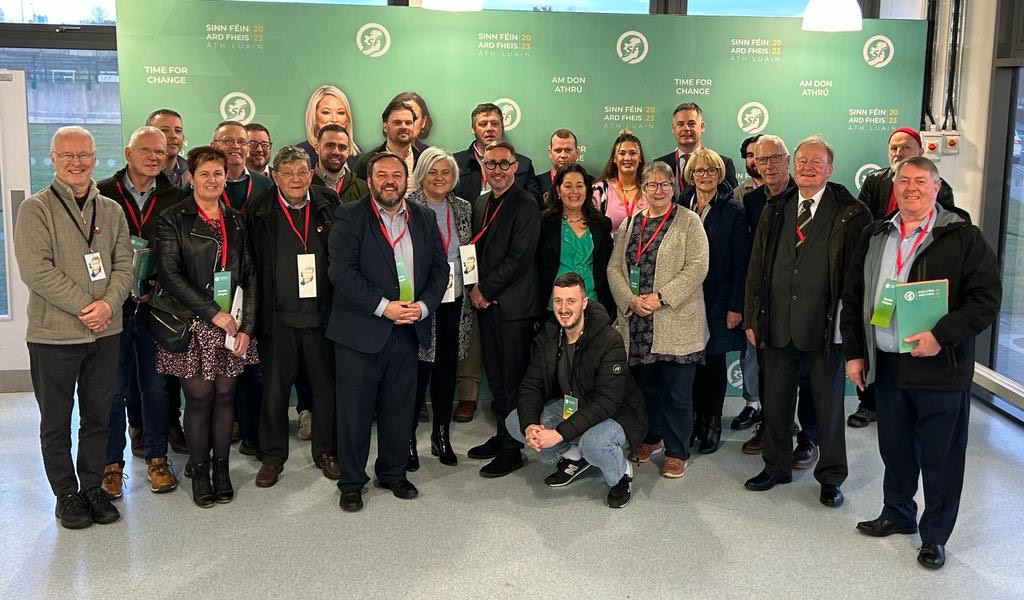
ATHLONE, WESTMEATH – A resounding ‘YES’ was the answer that rang out loud and clear all around me from around 1,500 enthusiastic and committed members, young and old, men and women, some teenagers, some retirees, gathered for the party’s annual Ard Fheis in Athlone, Westmeath several weeks ago.

A large Donegal delegation, the county where I live in northwest Ireland, attended the Ard Fheis.

I know from past experience in both Europe and the US that political party conferences can be full of hype and promise but I sensed something special in the air at this one. Positivity, definitely. Excitement, plenty. Anticipation, yes. Expectation, ditto. Even a little apprehension. Natural, considering it’s been 100 years since Sinn Fein last walked through the corridors of power as the undisputed political leader of Ireland.

Attending this annual meeting, I was extremely impressed with the overwhelming enthusiasm shown by members, their readiness to be in Government and make meaningful changes in Ireland for a better future for all and by the large number of women present, many of whom spoke incisively from the stage as delegates on a range of issues, from education to health, the high cost of living to homelessness. 

With local and EU elections, and perhaps national ones as well, occurring next year, it seemed appropriate that a party that continues to rise in national popularity was holding its annual party meeting in Athlone, a town considered the geographical center of Ireland, with Sinn Féin hoping its influence radiates from there nationwide in all directions.

Led by two women, Mary Lou McDonald, the party’s president and TD for Dublin Central, and Michelle O’Neill, party vice-president and First Minister Elect in Northern Ireland, with TDs nationwide, would-be Ministers-in-waiting, including TDs Pearse Doherty and Pádraig MacLochlainn from Donegal where I now live and with whom I spoke during breaks in the formal proceedings, all aired their views on key issues such as the cost of living crisis, plight of the health system, mounting housing problems, and many more. 

We want to build a new Ireland,” said McDonald in her keynote address after receiving a rousing reception. “A nation home for all. A unified nation of confidence and compassion, talent and ingenuity, claiming our future, our rightful place among the nations of the world. A new Ireland. The Orange and Green reconciled. No place for racism, Islamophobia, Antisemitism, sexism, homophobia, transphobia, or sectarianism.”

O’Neill spoke about the urgent need to kick-start the Stormont Assembly, the national parliament in Belfast, which has been boycotted by the Democratic Unionist Party (DUP), the main Unionist opposition, for the past year. “My message is one of positivity, one about the future, about building a better society for us all to live side by side,” she said. “My message to the DUP is that they need to be in the Executive with the rest of us, making politics work, making this a better place for everybody who lives here.”

Pearse Doherty, the party’s spokesperson on finance, thanked his fellow party members, saying, “You are the engine room of our organisation. Your work, your energy, your ideas, make Sinn Féin what it is – the only viable vehicle for the ordinary people of Ireland to achieve change in our country, and the only viable vehicle to achieve the unity of our country. We are focused on one thing – delivery for workers and family the length and breadth of our island. We are on the countdown to the general election, and we are setting out the type of change that a Sinn Féin government will deliver if the people give us that opportunity. We are setting out our plans to build a better, fairer country for all, for positive change and transformation.”

Pearse Doherty listens closely as Mary Lou McDonald gives her keynote address.

Paul Hayes, from Carrigart, Sinn Féin regional secretary in Donegal, was delighted with the weekend’s success, telling me that the Ard Fheis had brought together over 1,400 people, with more than 200 speakers over 300 issues voted on. “It’s a great success, I’m very happy,” he told me, smiling. Sitting beside me in the auditorium stalwart Pat Doherty, former Sinn Féin vice-president, wore a quiet, thoughtful – one might even say, contented – expression on his face. And no wonder. After many years of personal struggle and hard work towards the goal of a United Ireland Socialist Republic, the idea – once remote – of his party leading Government both in the north and south of of the nation seems rapidly becoming a reality.

(left to right) Paul Hayes, Sinn Féin regional secretary in Donegal, with Pat Doherty, the party’s former vice-president. Both were happy with the strong attendance and content at the Ard Fheis.

Thanking me for exclusive information I provided to Sinn Féin on RTE expenses, MacLochlainn, the party’s chief whip and spokesperson on fisheries and the marine, added, “We are mindful that this Sinn Féin Ard Fheis could be the last one before the next general election and the formation of a new government. We are confident, we are ready.”

Pádraig MacLochlainn, TD, is confident. “Sinn Féin is ready for Government,” he said.

Among the many motions passed was one affecting many people in Donegal. This pertains to an ongoing scandal – houses that are crumbling due to mica and pyrite in concrete. “Sinn Féin are determined to lead the next government so it is important to renew our commitment to one hundred percent redress and to spell out how we would implement that policy, if we get that chance,” said Sinn Féin housing spokesperson, Eoin Ó Broin. “We believe the Enhanced Defective Concrete Block Grant Scheme is another scheme that will deny redress to most affected homeowners.” 

Aside from domestic issues, Sinn Féin also debated foreign policy issues with loud cheers of support and a prolonged standing ovation given to Dr. Jilan Wahba Abdalmajid, Ambassador of Palestine to Ireland, a VIP guest speaker.

Sinn Féin initially abstained at local council and national level from calling for the expulsion of the Israeli Ambassador to Ireland but in face of horrific stories of death and life-threatening injuries, including thousands of young children, and the wholesale destruction of home and hearth in Gaza, changed tack and formally backed those calls, as well as calling for Israel to be referred to the International Criminal Court by Ireland and the Irish government to formally recognise the State of Palestine.

“We call for an immediate ceasefire and stand firmly behind Palestine in its hopes and  aspirations for its own homeland recognised by all international bodies and a long and lasting peace with all its neighbours,” said Matt Carthy, the party’s spokesperson on foreign affairs, who also thanked me for a proposal I made on a possible long-term solution to the Palestine question.

Young members of Sinn Féin show their support for Palestine.

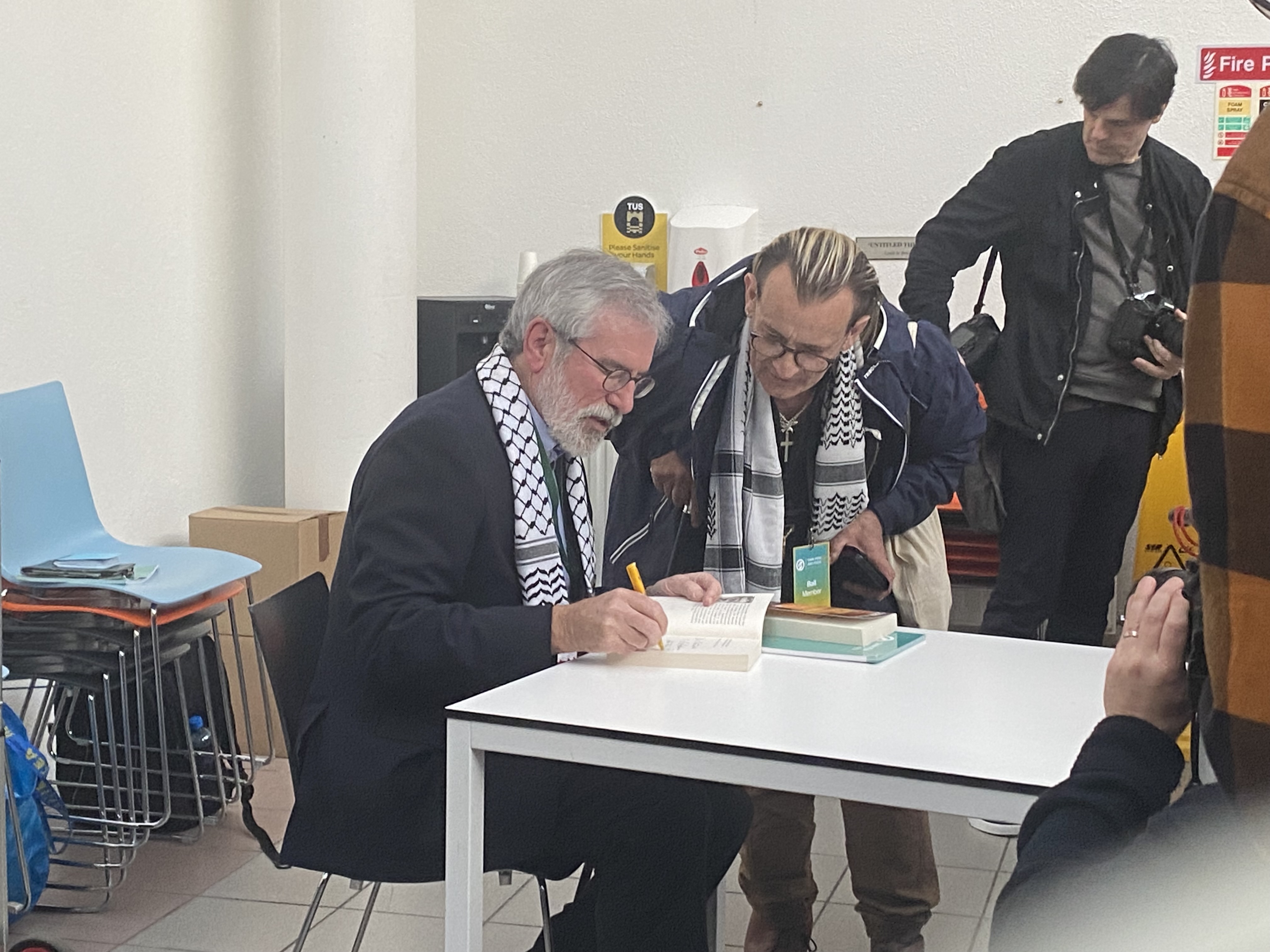
Elsewhere at the Ard Fheis, former Sinn Féin president, Gerry Adams, cheerfully met with a long line of well-wishers as he signed copies of his latest book, Black Mountain and Other Stories. Gerry has authored a number of books including Before the Dawn: An Autobiography; Cage Eleven: Writings From Prison; The Street And Other Stories; Falls Memories; and A Farther Shore: Ireland’s Long Road.

I am proud to say that Gerry’s Donegal holiday house lies less than 10 kilometers from my own home and that his mother and mine were very close friends as teenagers, working side-by-side in west Belfast and stayed together in the Donegal Gaeltacht on several occasions (with their interest in boys vying closely with their interest in the Irish language and culture, I am reliably informed).

Former Sinn Féin president, Gerry Adams, signs copies of his books.

Half million euro missing in Donegal, 250 euro returned

Half a million euro would be considered a miraculous life-saver by Mary, the tireless community worker struggling on behalf of cancer patients from Donegal who can barely afford the hefty cost of travel to Galway for specialised treatments.

If the hardworking managers of local community centres in the Donegal Gaeltacht received half a million euro, they could hire additional full-time Irish, and English-language, staff for several years and expand exponentially their range of services and activities in support of local people. 

If Amharclann, the Irish-language theatre in Bunbeg, received half a million euro, it could run an exciting cultural programme of dance, music, cinematic and theatrical performances for the next five years.

Not to mention how hard-pressed individual artists and musicians bereft of gigs due to Covid could use that money. Or indeed the Donegal office of Irish-language organisation, Foras na Gaeilge, whose local members help keep our native language alive here. And as for those unfortunate people whose homes and businesses have been destroyed by mica ….

But none of these groups have the luxury of half a million euro. 

Such a notion would be considered pure and utter fantasy, especially in the hard financial times in which we now live. 

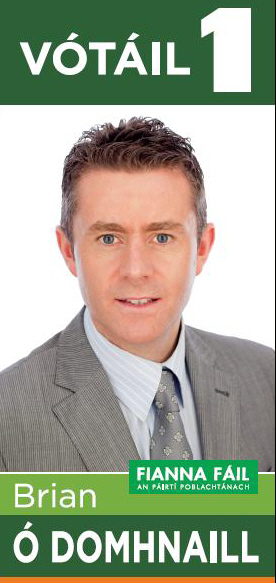
Yet that is about the sum of money former Donegal Fianna Fail Senator, Brian O’Donnell, from Falcarragh in the heart of the Donegal Gaeltacht, has just wasted. ‘Snatched brutally, selfishly and greedily’ some are saying, from the public purse. Others use the term ‘stolen,’ but in this article I wish to be diplomatic.

How did he do this?

Ironically, over the Irish language.

O’Donnell was caught taking money from the public purse by duplicating travel and subsistence expenses as both board member of Irish-language economic group, Údarás na Gaeltachta, and Donegal County Council. 

The accusations – and this beggars belief – investigated by the Standards in Public Office Commission (SIPO) – was that it would have been impossible for him to have been in two different parts of the country at exactly the same time, at two different conferences. 

And there I thought teleportation – where matter is de-materialised at one place and recreated instantly at another – happened only in science-fiction movies and fantasy comics.

If that wasn’t enough, the former Fianna Fail Senator then cowardly left the scene of an accident while driving his car in a drunken state.

But that’s only the beginning of the saga.

O’Donnell, with the aid of well-paid lawyers, fought the accusations against him, not on the basis of whether they were right or wrong, true or false, but on the simple basis that the cases should be heard as Gaeilge (in Irish) not English. The fact that both languages are official languages of the Republic of Ireland didn’t matter a damn to him, nor them. Nor the eventual cost to ordinary Irish citizens, including those unfortunate people suffering from cancer.

The rest of the story is spread across years of newsprint.

After deploying numerous tactics to delay the ‘claims investigation’ many times, he then decided to do the same to the ‘leaving the scene of an accident’ investigation, not once but a total of 20 times.

As a result, the total bill to the ordinary Irishman, woman and child has been estimated at around – yes, you’ve guessed it – half a million euro, the amount the board of trustees of Amharclann, Donegal’s proud Irish-language theatre, the hardworking staff of the county’s community centres and the many severely sick people – all dream of having to help them.

In the meantime, craftily devising his delaying tactics, which eventually spanned a massive eight years, did O’Donnell quietly planned his ‘get-out-of-jail card’ – his emigration to Canada? In fact, O’Donnell being found guilty could perhaps have led to a short prison sentence and would have prevented him emigrating to Canada. And certainly would have prevented him getting a Canadian driving license.

Was his delaying tactics also related to avoidance of his share of the legal costs? For example, I’ve been trying to find out if he ever paid a legal bill placed upon him by three judges who threw out of court his claim that the SIPO was not entitled to investigate his duplicitous behaviour because, he claimed, the allegations arose from ‘an anonymous complaint by a member of the public.’ 

I’d like to know not only if Mr. O’Donnell has paid his full legal bill but how much it was. If Mr O’Donnell is reading this, please get in touch. It’s only fair to hear his side of the story. And transparency is something we all should strive for.

Mysteriously the court hearing that finally put an end to one of the most ludicrous and wasteful cases in Irish legal history, almost went under the radar earlier this month, slipped quietly and quickly onto the docket of a mundane court sitting.

How did this happen? Donegal media said simply that, “according to court papers.. O’Donnell’s case was not due to be heard until the Wednesday after during a sitting  of Falcarragh District Court.” That’s when his (O’Donnell’s) solicitor, Sean Cannon, “brought the matter up with Judge Paul Kelly …during a family law sitting of Letterkenny District Court.” And the judge conveniently and quickly moved the case forward.

‘Brought the matter matter up?’ What the hell does that mean? And does such a serious case merit being in a sitting on family law? The mind boggles.

And this Judge Paul Kelly? Who is he? Was he appointed under a previous Fianna Fail government? Does it look like it from this article? But then again, that doesn’t matter, surely. After all, the Irish legal system is separate from the political one, isn’t it?

Though, as we well know, it is not unknown in Ireland for political favours and indeed, brown envelopes, or both, to pass hands.

The result of the long-delayed case: a ridiculously low fine, in my opinion, of 250 euro for charges of drunken driving leaving the scene of an accident and providing misinformation the police. I dare you to find any court case where such a laughable decision has been made in such a serious case. 

As for the short ban from driving, does it really matter? O’Donnell is sitting pretty in another country. Did an infamous Irish ‘brown envelope’ pass hands to facilitate this convenient legal accommodation in Letterkenny? No-one knows, and unfortunately no-one will probably ever know. Is this just an example of the old adage, ‘there’s a law for the ordinary working citizen but a very different one for the elite, well-connected in Irish society?’ 

So, while O’Donnell enjoys his new life in Quebec, Irish men, women and children in his very own constituency in the heart of the Donegal Gaeltacht continue to struggle to make ends meet, people continue to suffer pain and hardship, some desperately trying to raise enough money to help them avail of specialised life-saving cancer treatments. And young, talented teachers from the Donegal Gaeltacht, and other parts of the county, are forced to go abroad, to places like Quatar in the Middle East, because there’s no money to employ them here at home.

Is this called ‘fairness’ in Ireland today? 

Among all this misconduct (there are stronger words to describe O’Donnell’s behaviour), there are two other guilty parties that should not escape blame and require stronger scrutiny by the public at large and by themselves. 

At the very least, both Údarás na Gaeltachta and Donegal Council obviously urgently require a proper Code of Practice for Good Governance. And, more importantly, to enforce it. Want to know more about the failings of Údarás na Gaeltachta, an organisation that receives tens of millions of euro from the public purse every year? Read more here. Has it cleaned up its act since then? Time will tell.

There’s little anyone can do now about the regrettable situation surrounding the O’Donnell controversy, except two things.

Firstly, as a citizen you have the right to appeal to the relevant authorities about a court decision you consider overly-lenient and unfair and to have the case reviewed. One place to start is writing to the Complaints Department of the Law Society of Ireland at complaints@lsra.iethe

Then the Judicial Conduct Committee established by The Judicial Council recently. You can write a short email to: info@judicialcouncil.ie You can ask to remain anonymous in both instances. It’s time to stand up and speak out, don’t you think?

I have already sent a complaint about Judge Paul Kelly’s decision as I consider a 250 euro fine to be utterly ridiculous and a 3-year driving ban to be insignificant, considering that Mr. O’Donnell can simply come to Ireland in the intervening years and drive with no problems using a Canadian driving license I presume he will obtain quite easily, thus posing a danger yet again to ordinary people on our roads. On both sides of the Atlantic.  

Secondly, when election time comes round, and it will come quicker than you think, consider carefully which political party and candidates you vote for. Is it not better to avoid the Brian O’Donnells of this world and choose others with a much greater sense of decency and honesty? 

New Irish Government was decided BEFORE the elections

Weeks before the recent Irish election was even announced and long before the first votes were cast, representatives of Fianna Fail and Fine Gael met behind closed doors to cut a deal, with one solitary aim in mind – to keep Sinn Fein out of government.

At the same time, generously funded by major corporations, banks and developers, highly-paid public relations specialists in the pockets of these two same political parties were instructed to create what’s known as a ‘news camouflage.’

To avoid any fall-out from someone learning about these secret meetings, they spun a story through a web of overly acquiescent Irish media that these two political parties would instead discuss forming a coalition with other minor parties.

irish elections, elections in ireland

Coalition terms were discussed on behalf of these two men by their representatives BEFORE the Irish election was even announced.

It is a well-planned and co-ordinated charade to create a facade of democratic fairness.

Among those most wanting Sinn Fein side-lined at all costs was Jim O’Callaghan, wealthy Dublin barrister, senior counsel and Fianna Fail’s justice minister, a man who only managed to get elected on the eighth (8th) count, beaten by Sinn Fein candidate, Chris Andrews.

O’Callaghan is brother of millionairess and RTE presenter Miriam O’Callaghan who infamously grilled Sinn Fein leader, Mary Lou McDonald, on a pre-election ‘Leader’s TV Debate’ on – guess what – justice issues.

In doing so, she used an archaic 13-year-old audio report excavated from deep within the archives of the BBC as a weapon. It may come as no surprise to many whom Miriam’s husband, Steve, works for.

Yes, you guessed right. The BBC.

The O’Callaghans, like many wealthy people in Ireland today, would be required to pay a little more in taxes under a Sinn Fein led government, with loose tax avoidance loopholes used by many rich people closed. These taxes would help close the gap between rich and poor and ease the housing, health and education crises mainly affecting working-class people.

Reflecting growing popular interest in the economic inequalities in Ireland, a blog I wrote before the elections on the O’Callaghans attracted a massive 20,348 views from readers in just one week. More than 2,000 readers every single day.

 That being said, here is my prediction.

Within the next two weeks – after demonising Sinn Fein as a ‘cult’ through a slick and expensive media campaign (thus demonising half a million Irish people who voted for that party), Fianna Fail and Fine Gael will announce a new Centre Right government.

The word ‘change’ will be sprinkled liberally throughout their joint manifesto and media interviews and they will announce they ‘have put aside their differences —- in the interests of the country,’ thus positioning themselves as some kind of ‘national saviours.’ 

Sinn Fein President, Mary Lou McDonald, won more votes for Prime Minister than both existing PM Leo Varadkar and Fianna Fail leader, Micheal Martin.

I predict this development with sadness, but with confidence gleaned from 40 years of journalism experience in Ireland, the US and mainland Europe. 

And on this election issue, I’ve got things right so far.

I predicted Sinn Fein would get more than 30 seats.

I predicted the five politicians who would be elected in my own constituency of Donegal

I predicted Pat the Cope Gallagher, a Fianna Fail member of parliament for 40 years, a man with whom I had a public run-in would lose his seat, with many people telling me such a prediction was like Manchester United being relegated from the Premiership.

With the Cheltenham races coming up, perhaps I should make a few big bets for I even predicted the following two weeks ago in my blog –

“… on voting day tomorrow (Saturday), will the final outcome be any different from that over the last 100 years? Sadly, regardless of Sinn Fein receiving a well-deserved boost, hopefully above the 30 mark, I don’t think so.

If past results are anything to go by, we will remain with a Centre Right majority that kowtows to wealthy individuals, major corporations, banks, vulture funds and major land developers offering tax breaks and other incentives. A coalition that steadfastly fails to rectify the growing, severe inequalities in social life here.”

The truth is simple. Fianna Fail’s Micheal Martin wants to be Taoiseach, Fine Gael’s Leo Varadkar still wants to be in Government. And they both need to pay back their rich sponsors, both individuals and corporations.

Such was the huge turnout for this week’s Sinn Fein public meeting at Dublin’s Liberty Hall, site of many famous events hosted by socialist leaders such as 1916 Revolution leader James Connolly, people were addressed both inside and outside the Hall.

As they prepare to announce their Government, it is important to point out the following for context: 

*Sinn Fein elected 37 TD’s, out of 42 candidates;

*10 Sinn Fein candidates topped the polls;

*27 Sinn Fein candidates were elected in the first count.

*Sinn Fein doubled their vote in Dublin;

*Sinn Fein president Mary Lou McDonald won more votes last week for Prime Minister than both the present PM Leo Varadkar and Micheál Martin; 

*Sinn Fein’s Dublin West candidate, Paul Donnelly, elected in the first count, beat Leo Varadkar, who only got elected in the fifth count, the first time in Irish history a Prime Minister has lost his own constituency;

* Sinn Fein candidates in my constituency, Donegal, were both elected on first counts – Pearse Doherty with 21,044 votes, 8,000 over the quota, and Pádraig MacLochlainn, with 13,891 votes, a massive 45% of the total vote;

*Sinn Fein’s candidate in Clare Violet-Anne Wynne who received just 385 in the local elections, won over 10,000 votes in the national ones;

*Sinn Fein candidate Johnny Mythen won in Wexford, the first time in 100 years the party has won a seat there;

*Sinn Fein won 45,614 votes, a mere 2.5% of the total in the 1997 election. In 2020, that transformed into 535,595 or 24.5%;

Is it any wonder the O’Callaghan’s and wealthy people like them are fearful.

And so sadly it seems are the Irish media which, displaying its Right-wing bias, has failed miserably to fulfil its role as the Fourth Estate, to serve and protect the public interest.

It refused to report on the emerging banking crisis under Fianna Fail’s watch that left Ireland bankrupt and at the mercy of the IMF and it is now refusing to report the real reasons Sinn Fein is being excluded from Government.

My predictions: Irish election Saturday

My observations of us Irish since returning to live in my native country 10 years ago is that far from the reputation we have in the eyes of other nationalities as an almost swashbuckling tribe of adventurers, we are in fact the most boring, banal and predictable of people when it comes to voting habits.

We, sheep-like, have voted into government mainly one of only two parties since the nation was founded a century ago, our warped sense of ‘change’ being simply to switch from Fianna Fail to Fine Gael and vice-versa now and then.

In doing so, we fail to realize – or worse, realize but lack the courage to accept – that there is simply no difference between these two parties.

What greater evidence do we need of this, if we needed more, than the last five years of Government: these two parties having been in what is strangely termed a ‘confidence and supply’ relationship. In effect, a coalition government under a different guise.

elections 2020 ireland, vote in 2020 ireland,

My advice: take a chance on change. It’s long past time and no less than what you deserve.

Consequently, shocking ongoing crises in key sectors such as health, housing and social welfare have occurred under the watch of both parties. They are both equally guilty of neglect and disservice to the people of Ireland. And Fianna Fail bankrupted Ireland not so long ago, leaving teachers, nurses and others on the scrap heap, and some of its TDs then are running again, including its leader.

So, on voting day tomorrow (Saturday), will the final outcome be any different from that over the last 100 years?

Sadly, regardless of Sinn Fein receiving a well-deserved boost, hopefully above the 30 mark,  I don’t think so.

If past result are anything to go by, we will remain with a Centre Right majority that kowtows to wealthy individuals, major corporations, banks, vulture funds and major land developers offering tax breaks and other incentives. A coalition that steadfastly fails to rectify the growing, severe inequalities in social life here.

Through the election campaign, I continue to be deeply disillusioned by the media in Ireland and their bias. For example, do many people really believe there was a dead-heat between Fianna Fail and Sinn Fein, 24-24 percent, in the Red C poll for the Business Post? What decent, well-organized poll ends up in a draw? It is not even mathematically possible as you poll an odd number of people, not an even number, to make sure there is an outright winner.

A caveat to this is that my wife, Columbia from Romania, who will, I believe like many emigrants, vote Sinn Fein, received a call from Red C. But when she said she lived in Donegal, they refused to take her details, telling her they had enough people from Donegal.

Surprising to say the least, as Red C had boasted its poll was a ‘random’ one. This simple incident proves it was far, far from that. It is no coincidence that, with Sinn Fein poised through Pearse Doherty and Pádraig Mac Lochlainn to attract more votes than any other party in Donegal, Red C pollsters were told not to take anyone from Donegal in the so-called ‘random’ poll.

I feel Sinn Fein was probably the winner in that poll but a national business newspaper handing this particular party the lead in such a crucial election would have been tantamount to treachery in the eyes of the newspaper’s owners and its well-to-do readers.

vote in 2020 ireland, irish elections 2020

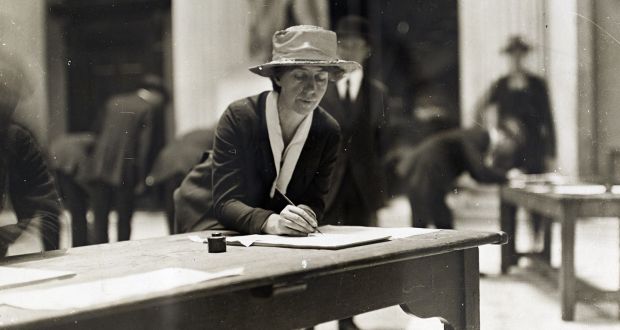
Let a woman take the lead. (image from first-ever Irish elections)

Or take The Irish Times, for whom I worked as a foreign correspondent. At least, they had the decency to portray their poll results honestly. Sinn Fein as outright winners.

But then a strange thing happened, the newspaper started spinning the numbers in an effort to reduce the prestigious victory of Sinn Fein, mixing in other numbers to the point of confusion.

There was even a bizarre moment during its live election debate from Trinity College earlier this week for subscribers when event host, Hugh Linehan, the newspaper’s arts and culture editor, said the poll might have created ‘a self-fulfilling prophecy’ and encouraged other journalistic colleagues on the panel to agree with him, which political correspondent, Pat Leahy (formerly of the Business Post) gleefully did.

How can a poll be ‘a self-fulfilling prophecy’? It’s as if a poll is an unseen power outside in the ether controlling the minds of people. Simply ludicrous. A completely irrational attempt at spin.

Keep in mind also that election podcasts by The Irish Times since the campaign began featured four men in key intro voiceover sound-bites, Fine Gael’s Leo Varadkar and Fianna Fail’s Micheal Martin, another Fine Gaeler and an Independent. No mention of Sinn Fein’s Mary Lou McDonald, who won the newspaper’s own poll as most popular person for Taoiseach and Sinn Fein as most popular party.

Not until I pointed this out to the newspaper in several e-mails did they decide to include Mary Lou’s voice.

Beware of Subliminal Election Messages

PREDICTIONS

My predictions for the five-seater in Donegal where I live: two Sinn Fein, one Fine Gael, one Fianna Fail and one Independent.

Pearse Doherty and Pádraig Mac Lochlainn of Sinn Fein and Joe McHugh of Fine Gael will be the first past the post.

Then there’ll be a battle for the last two seats with Fianna Fail’s Charlie McConalogue sweating it out next to get over the line.

Then the Battle Royale for the final seat – between Fianna Fail’s Pat the Cope Gallagher and hard-working Independent, Thomas Pringle.

vote sinn fein, elections ireland

It’ll be a rainy day for some candidates.

It’s past time multi-pensioned Pat, and his brand of old-style politics, retired from the ring. While once a shoo-in, he’s now panic canvassing door-to-door, but I’m hoping Pringle, younger, more progressive, more passionate, will receive his just reward.

Whether you agree with me or not, don’t waste your right to express your opinion. Call me a dreamer, but I still believe voting has as much meaning as we give it, so use it.

Perhaps this will turn out to be ‘the election of the young,’ the one that changes the usual political landscape of Ireland.

Helluva commotion going on in Donegal over lovable little oysters

Oysters, those soft, jelly-like little creatures that are (to some people) delicious to eat and ingeniously produce glittering pearls, are causing some bother in Ireland, especially in Donegal – or at least the greedy corporations hunting them for profit are.

And it seems the partnership government of Fine Gael-Fianna Fail and its back-up civil service are doing their utmost to prevent concerned local communities from doing anything about it.

Sitting at a public meeting this week at Falcarragh Community Centre focusing on these issues, these were the thoughts that passed through my mind as I listened to speaker after speaker give their views on controversial shellfish farming practices at Ballyness Bay near the town of Falcarragh on the ‘Wild Atlantic Way’ in the Donegal Gaeltacht they consider are polluting and defacing the lovely, pristine scenery.

John Conaghan, spokesperson for the ‘Save Ballyness Bay’ committee, said four jobs would be created through aquaculture while more than 250 would be created via tourism, therefore “we should be protecting our area environmentally.” He also complained his committee had been denied inaccessibility to certain details, sometimes entire documents, pertaining to official comments made by both Donegal County Council and Údarás na Gaeltachta.

“An official comment from Donegal County Council stated that there would be no visual impact, but the document was simply signed by a clerk,” he said. “I’ve spoken to many councillors and nobody seems to know who authorized the comments. No visual impact? Maybe, lads, you should go to Specsavers.”

Politician after politician, both local and national, including TDs, Sinn Fein’s Pearse Doherty and Fianna Fail’s Pat the Cope Gallagher, told around 200 concerned people that they were unable to access key information relevant to the situation.

John Shéamais Ó Fearraigh Sinn Fein local councillor and Údarás na Gaeltachta board member said he would try with whatever powers he had to obtain the information required from the council and the Irish language organization. “I will do whatever I can to help,” he said.

Fine Gael local councillor, Michael McClafferty, said he had submitted questions to the local council but had not received any answers. “It looks as if we are being thrown under the bus,” he added.

The proposed shellfish scheme could cover more than 46 hectares of sea coast in the scenic Gaeltacht region, with bags on steel trestles containing millions of oysters, with sediment accumulation beneath them and large-scale congregation of dead shells, committee members said. Licenses for 20 hectares of oyster beds have already been granted, with one site alone being over 10 hectares.

Committee member, Caitlin Ni Bhroin, said “no cost-benefit analysis has been produced for us to see” and licenses have been granted on “unsound scientific criteria, including the idea that oysters are healthy water filters, but they actually emit waste.”

Conaghan said there were many contradictions in the government’s approach. “While it granted licenses for shellfish farming, Ballyness Bay is not designated a shellfish area, but it is a special area of conservation.” He said Inland Fisheries Ireland declared the bay a valuable fishing asset.

“We are against all oyster harvesting in Ballyness Bay, such activity will damage eco-tourism, which could bring much-needed jobs,” he said. “Gaps, mistakes and assumptions sums up the government’s approach. If community concerns had been addressed properly, we’d not be standing here talking.”

He said the ‘Save Ballyness Bay’ committee was being assisted by Belfast-based Pat Finucane Centre.

Commending the committee on its efforts, Sinn Fein’s Pearse Doherty stated clearly, “My firm belief is that this scheme is anti-community and the application process is not fit for purpose, they are not being given properly and there is a lack of clarity.” He said three years ago he had sent a letter to the relevant ministry and department questioning the decision process, adding “construction cannot begin until all appeals have been heard, which could take several years.”

Being a long time, staunch member of Fianna Fail, part the ‘partnership government,’ Pat the Cope Gallagher, was obviously in a bit of a conundrum. While he offered to find out more information and report back to committee members, he went into a bit of a tantrum when I asked him to say ‘yes or no’ whether he agreed with the ‘Save Ballyness Bay’ committee’s views.

Now, credit being given, Pat is a wily politician, that comes with being forty years and more in politics. Maybe I spoke harshly when I said that his spiel was (to quote myself) “pure politics, filled with generalities and trivialities.” That he took offence was his right. That he tossed the microphone down (as someone said, “like a baby throwing out its dummy-tit”) is also his democratic right.

But he still didn’t answer my question.

Instead, he said previous situations had occurred near his home in Dungloe similar to the one at Ballyness but he “didn’t get involved in them,” but said he did pass on letters he had received from local people to the relevant minister.

At the meeting, two members of Aontú pledged their support, with one young member saying as the shellfish farms were adding to the carbon footprint, people had a right to know more.

Local resident, Mary Attenborough, said while a proper environmental impact study was required, so-called experts were all vetted by the government, and that bias might occur in their reporting.

Committee members were still unsure if licenses already granted were strictly non-transferrable.

One challenge facing the committee is the expense involved in appealing licenses. Each one must be appealed separately at a cost of 200 euro each, with a time limit for appeals being four weeks from date of the government’s decision on December 4.

Columbia Hillen, my wife who is from Romania but concerned about the environment, stood up and asked if those local people who had applied for licenses would show support for the local committee by refusing to accept them even if they were granted. None of those applicants in the hall – and there were some present – said anything. One of the applicants, Seamus O’ Donnell who owns Cluain Na d’Tor (Seaside Nursery Garden) in Falcarragh had gone as far as saying he is “having second thoughts” about his application for over 4.4 hectares of aquaculture if granted. But has he withdrawn his application?

For full information on all applications see HERE.

One speaker said Ballyness Bay was one of the best surfing areas, comparable to Hawaii and western Australia, creating strong tourism income. “Let’s try to keep it that way by not spoiling the scenery.”

Another speaker summed up feelings of many people present, “Governments that treat people with disdain, usually get their comeuppance.”

Sean Hillen is co-founder of Gaoth Dobhair based ‘Ireland Writing Retreat and author of the contemporary novel, ‘Pretty Ugly,’  linking Donegal and the United States.

Traditional Irish group Arcanadh woos and wins hearts of audience

Traditional Irish group Arcanadh woos and wins hearts of audience

Another cultural entertainment success for Amharclann

What a terrific cultural contribution this historic theatre provides not just for Bunbeg, not just for the Gaeltacht, not just for Donegal but for all-Ireland, north and south.

World Itineraries's avatarworld itineraries

by Sean Hillen

Six musicians-singers-songwriters with such a wealth of talent it seems blatantly unfair to the rest of us mere mortals – that sums up Irish-group, Arcanadh, which played to an enthusiastic audience at historic Amharclann theater, Bunbeg, northwest Donegal, Ireland this week.

Here I must admit my bias.

In a rare moment of wisdom, I invited this terrific group to tour Romania when I launched the first-ever Saint Patrick’s Day celebrations in that former-Communist country. It was a decision I’ve never regretted.

The result more than 10 years ago was the same as that at Amharclann 72-hours ago – a boisterous appeal for more at the end and an appreciative standing ovation after their final encore.

Members of Arcanadh have known each other for more than twenty years and this is reflected in their smooth light-hearted banter off-song and their seamless harmonies on-song. Their passion for their…

View original post 805 more words

Sinn Fein Ard Fheis features multi-faceted personalities

It’s interesting, the people – some expected, some unexpected – one meets at a political Ard Fheis – in this case, Sinn Féin’s in Dublin’s ultra-modern glass and steel, Liffey-fronting Convention Centre recently.

The former included loyal, hardworking party stalwarts – both at local and national level. People like Donegal Councillor and youth worker, John Sheamais Ó’Fearraigh, from the Gaeltacht hamlet of Bun na Leaca, Gaoth Dobhair, who voiced his concerned “about the closure of rural post offices and banks and lack of broadband coverage and tourism development, as well how European legislation on planning and wild life is preventing rural development – all leading to the export of our youth and loss of our Teanga Dúchas.”

John Sheamais Ó'Fearraigh, Sinn Fein Donegal

(l to r) Donegal Councillor, John Sheamais Ó’Fearraigh, discusses issues with Pearse Doherty TD, outside Dublin Convention Centre at the Sinn Fein Ard Fheis.

And Inishowen Councillor Albert Doherty from Carndonagh who spoke passionately to the 2,500 party members about “unfortunate Donegal residents who are having to watch their homes disintegrate before their very eyes” because of Muscovite mica, a mineral that weakens concrete. He called for the government’s much-delayed experts report to be concluded by August 31.

Then there’s Pearse Doherty, TD. Though only six years since his victorious High Court case against Fianna Fail for delaying the Donegal South-West by-election, Doherty has risen in the party ranks astronomically since, culminating in national kudos recently when he found a gaping two billion euro hole in Fine Gael’s ‘fiscal space,’ (the amount of money available to the government above what is already being spent on public services). His value to Sinn Fein was more than obvious last weekend when I entered the so-called ‘green room’ to find him engaged in whispered conversation with party president Gerry Adams and vice-president Mary Lou McDonald. Even though a photograph was required of him for this article, a subliminal ‘not-to-be-disturbed’ sign hung clearly in the air.

Easter Rising Celebrations Dublin,

Celebrating women’s role in the 1916 Rising. Over 300 women participated, some of whom were sentenced to death, later commuted.

All three Donegal politicians supported calls made by delegates under the party banner “Saoirse Ceart Aontacht’ for the rejuvenation of rural Ireland, on behalf of people the official Ard Fheis programme declared, “are tired of being treated as second-class citizens, fed up with under-investment and angry at the lack of jobs and opportunities.” Among the motions to strengthen rural areas under the document, ‘A New Deal for the West,’ were “the introduction of rural equality legislation; a spatial enterprise and infrastructure strategy backed up with financial stimulus; a commitment to significant investment to protect and enhance public services; support for traditional industries, particularly co-operatives; and measures to assist emigrants wishing to return.”

Sinn Fein Ard Fheis Dublin

Honoring those who died during the Hunger Strikes and the Easter Rising.

Such were the expected.

Among the unexpected was meeting author and former ‘Sunday Times’ managing editor and ‘Daily Mirror’ editor, Roy Greenslade, now journalism professor at City University London, my alma mater, who now pens an insightful media blog for ‘The Guardian.’ From sturdy working-class roots in east London and a fellow West Ham fan, Greenslade has been a long-time supporter of Sinn Fein. We met way back in the mid-80’s ago when he and his wife, Noreen, a former national feature writer, visited me in Kansas City and later at Mirror HQ before I headed off to the Romanian revolution, former Yugoslavia and the Iraq war. Greenslade bought Ballyarr House in Ramelton and two years ago stood surety for Creeslough-based former IRA member John Downey after his arrest at Gatwick Airport.

Roy Greenslade journalist

Roy Greenslade, author, editor and journalism professor: unafraid to speak out on sensitive social issues.

Last, but not least, was Danny Morrison, Sinn Fein’s former national publicity director, now successful fiction and non-fiction author and international creative writing trainer. Dressed stylishly in black hat and long leather coat, the affable man reminded me of Toulouse-Lautrec’s portrait of Aristide Bruant, famous on so many posters. Both Greenslade and Morrison have been invited as special guest speakers at this year’s ‘Ireland Writing Retreat’ held at Teac Jack’s in Glassagh from June 27 to July 3.

Danny Morrison author

Belfast-based Danny Morrison: a life well lived. Former editor of An Phoblacht-Republic News, Sinn Fein publicity director, author and creative writing guide.

For those interested in writing a novel, poetry or a memoir, or simply want to hear some fascinating speakers, this is the place to head for. It should be a most stimulating week. You can stay for the whole week, or sign up for several of the days. Your choice.