GAME-CHANGER OR GAME-OVER IN IRELAND?

Sinn Fein’s President Mary Lou McDonald today described on national airwaves that her political party’s long-awaited, soon-to-be-named Irish Presidential candidate would be a ‘game changer.’

@rtenews

Sinn Féin leader Mary Lou McDonald has said that the party’s participation in the Presidential Election campaign will be a “game-changer”. Sinn Féin has been mulling over its approach to the race for Áras an Úachtaráin, with two options at its disposal – either run its own candidate or back Independent Catherine Connolly’s campaign. Speaking at the National Ploughing Championships in Screggan, Co Offaly, Ms McDonald said she already knew the proposal she would be bringing to the party, but that it would not be made public until Saturday. Go to link in bio for more #rtenews #ireland #presidentialelection #sinnfein

♬ original sound – RTÉ News

Having used this grandiose, hifalutin phrase, that’s exactly what supporters and would-be supporters of Sinn Fein will be expecting that person to be – a unique choice who will shock and surprise everyone. 

The kind of individual a disillusioned electorate are hungry for. Someone whose name and background will light a fire under what has already become – albeit in its early stages – a timid, banal, utterly predictable and lukewarm election campaign.

To use such a superlative phrase as ’game-changer’  and not deliver an individual with the immense passion, innovative vision and creativity the term demands will be considered by most people to be a dismal failure.  And show Sinn Fein to be a ‘has-been, once-was’ party, one whose rise in recent years has incontrovertibly stalled.

To come up with something less – such as merely supporting Independent Catherine Connolly – will help damn the party into endless Opposition. It will signal to a triumphant Fianna Fail-Fine Gael coalition Government that it has nothing to worry about from Ireland’s third-ranked party. That Sinn Fein is all bark and bluster. But no real bite. 

Regardless of the spin about Left wing unity, Sinn Fein supporting Connolly will be seen as nothing less than inherent party weakness. That of a political party seeking to lead the country that cannot even find a suitable candidate for the most universally elected political position in the nation. 

That’s not leadership. That’s impotence. 

Supporting Connolly, Sinn Fein at this stage will also be seen as being led by the other Left wing parties who decided on her months ago. And they risk losing key votes at the next election as a result, probably leading to an inevitable decline in its parliamentary seats. A major, perhaps irrecoverable, blow to the party’s hardworking grassroots members.

Thus it’s all-important, not just for future success but for sheer survival, that Mary Lou and her colleagues in the upper ranks of Sinn Fein deliver what they’ve promise so confidently. Nothing less will do.

In doing so, hopefully, they’ll also make this rather boring Irish Presidential battle a bit more interesting than it is right now, raising it from its low-level drab ordinariness.

If they don’t, Sinn Fein may pay a heavy price at the next election. And possibly never recover from the fall.

For a party that is admirably ethical and honest in its dealings, with a central mission of equality and justice for all, they need to find the courage to take risk, something the party is not particularly known for, as not running a second candidate in the Gweedore-Cloughaneely area in the last election showed, with Pearse Doherty’s massive surplus votes going nowhere instead of towards electing a record third TD in Donegal.  

This Presidential campaign is Sinn Fein’s Rubicon moment. It’ll be intriguing to see if they manage to cross over. Or drown in the effort.

Amharclann Donegal kicks-off innovative drama project linking five Irish theatres

by Sean Hillen

An innovative drama project linking five different Irish theatres kicked-off this week with two performances at Amharclann in Donegal.

Supported by the International Fund for Ireland’s Communities in Partnerships Programme (CIPP), the project is a co-production between Amharclann in Bunbeg in the heart of the Donegal Gaeltacht and the Waterside Theatre and Arts Centre in Derry of the play ‘‘Observe The Sons Of Ulster Marching Towards The Somme’ by Donegal-born playwright Frank McGuinness.

This thought-provoking play, coincidentally hosted at the Amharclann on the same day as the United Nations International Day Of Peace, focuses on the experiences of a group of Ulstermen in the trenches of World War One who take part in the battle of the Somme. While a military setting, the play raises many themes including homosexuality, homophobia, the inner conflict of self-respect, bravery, patriotism, friendship and sacrifice. 

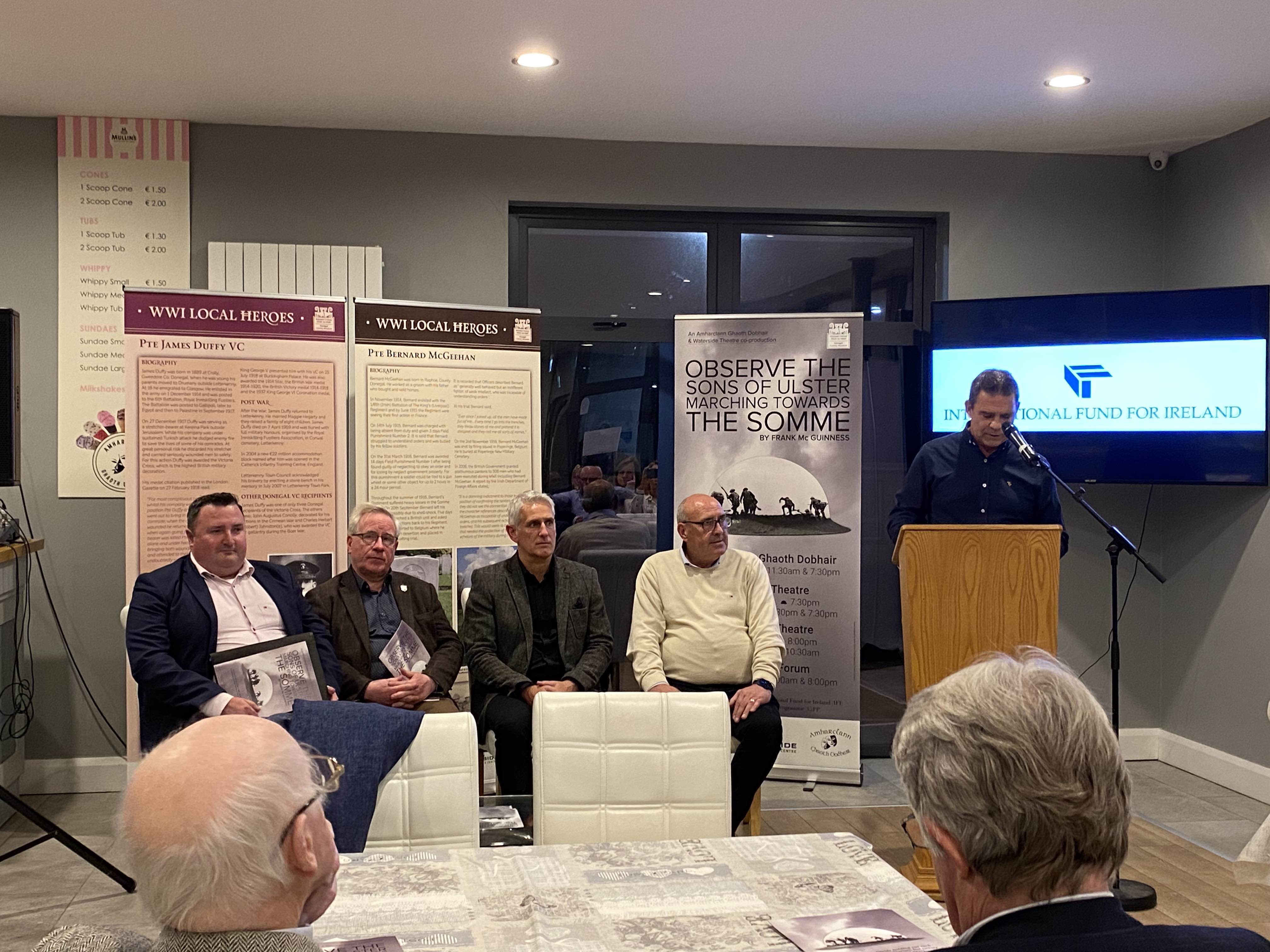
Panel of speakers at an interesting post-performance Q&A event at the Amharclann.

Enjoying the play, one is left with a vexing question: Is the play about the futility of war? The nature of loyalty, friendship and heroism? Or an examination of the protracted Protestant-Catholic northern Irish conflict from a completely different perspective? Or all of the above?

Whichever it is, this production is a two-hour, richly-rewarding theatrical experience that offers a balanced mix of black humour and poignancy with credible characters well developed through very fine acting.

Director David Grant together with production and stage manger, Fiona Harkin, assistant director, Ronan Hamill, lightning designer JP Conaghan and composer, Rebecca Doherty and the rest of the team have re-created the moving story of ordinary men – among them a blacksmith, a weaver and a baker – who set off patriotically to fight ‘the Hun’ but become disillusioned with the myth about war they’ve been sold.  

The play opens with a crippled man, Old Pyper, played by Shaun Byrne, who steps on stage alone, war medals pinned to his chest, and calls forth the ghosts of his former comrades who were all killed. Mystified as to how he survived the terrible battle, he is haunted by the images of those who died in the trenches, who then slowly, phantom-like, emerge from the shadows at the edges of the stage and stand motionless.

Theatre-goers mingle together for friendly discussions at the play’s intermission.

This sets the scene as to what follows, nostalgic flashbacks to the barracks where the men from places such as Derry, Armagh, Coleraine, Enniskillen and Belfast, gather for their first day of training and on to the sand-bagged first world war trenches where they face death together. Kudos go to Harkin and Conaghan who create a well-designed set, in which the barracks with wooden slats for beds is later transformed brilliantly into World War One trenches. Murals along the stage also add intriguing ambience, one of which depicts the ancient Celtic legendary hero, Cú Chulainn.

I particularly liked how a series of intense interlocking vignettes between couplets of men were enhanced by lighting and space, as well as by the thunderous roar of a Lambeg drum, a triumphalist symbol of the Protestant Orange Order in Northern Ireland. The military uniforms and equipment were also striking in their sheer authenticity. 

The tone of the play is bittersweet and philosophic, with elements of both black humor and solemnity. Patrick Quinn plays the younger version of Pyper wonderfully. An openly-gay man of aristocratic background who volunteered for army service, Quinn grants him a carefree, reckless air behind which lurks a man of deep sentiment and a troubled mind. A multi-faceted person – cynical, seemingly on the brink of madness, brash, supercilious, bold to the point of foolhardy, wickedly direct, yet at the same time, a vulnerable and lost individual. 

His anecdote about his three-legged French wife is highly amusing and a love scene involving him is touching in its quiet, side-stage minimalism. One character saying the ‘Huns’ speak Gaelic also creates a light-hearted moment. In contrast, depiction of one man’s despair and breakdown in the face of danger is touching, even more so as his friend tries to help.

While all the characters, except Pyper, are Northern Irish Protestant Unionists, one of the men admits something mid-way through the play which creates added intrigue and requires the attention of a military minister. 

Pyper is the exception to the anti-Fenian rants of the other men, being unwilling to indulge in such narrow-minded northern Irish tribalism and more keenly aware of the ‘sandbag’ nature of their being sent ‘over the top’ and into battle. He even demands of his fellow soldiers to answer the question as to why they are there.

Some Irish Republicans may be upset by the anecdotal joke told about rebel leader, Padraig Pearse, executed after the 1916 revolution, as someone who told his enemies he was only posting a letter when he took over Dublin’s main post office to launch the revolution, but this reflects the wit Frank McGuinness is renown for.   

Bulgarian visitors to Gaoth Dobhair – (l to r) Peter Petkov and Vanya Kovacheva – were among an enthusiastic audience at Amharclann theatre in Bunbeg, Donegal earlier this week

One of my favorite lines from the play, for reasons I’m not quite sure of, is ‘To hell with the truth as long as it rhymes.’

Ultimately, the play is about the fragility of life and the futility of war. In the end, one is left with the belief that the soldiers are united in one thing – fear of death – and that real heroes are ordinary people and unfortunately ordinary people remain ordinary because they don’t get recognised as much as they deserve. 

Local Donegal ladies enjoy a wee bit of craic and an evening’s entertainment at the Amharclann.

The play will be hosted today (Saturday) at the Lyric Theatre in Belfast, tomorrow at An Grianan Theatre in Letterkenny and next week at the Millennium Forum in Derry. 

In a post-event Q&A, Pol McCool, board chairperson of Amharclann theatre in Bunbeg, spoke about the need to build bridges between communities to help break down barriers and to appreciate shared history and values. 

Director David Grant (l) enjoys the company of friends during intermission at the Amharclann.

Stephen Barrett, manager for Donegal of the International Fund for Ireland, talked about the role of community leaders in peace-building projects and described the evolution of this co-produced project. He also spoke eloquently about his own reaction upon seeing the graves of those who died in the trenches in Belgium and France during the First World War. The IFI was established in 1986 with financing from many countries including the US, Australia and Canada and the play was supported by the organisation’s. 

Director David Grant talked about the challenges involved in creating the production and the overriding need for people to challenge mythology about wars.

Aine Ni Churrain, former presenter at RTE Raidió na Gaeltachta and a board member of Amharclann, thanked the audience for attending the two performances at the theatre, as well as everyone involved in developing and hosting the project and wished actors, director, producer and all the technical staff every success in the other theatres where it will be held.

Waterside Theatre CEO, Iain Barr, also thanked everyone for their concerted efforts in creating a memorable theatrical event with such an important social and moral message that contributes to greater peace and understanding among communities.

Video links to some of the speakers are on my Facebook – https://www.facebook.com/hillensean and https://www.facebook.com/worlditinerariespage

Kill the messenger?

There’s an old saying – ‘if you can’t deal with the message, deal with the messenger.

Usually it’s a strategy by people who are guilty of something, or who are inadequate or who have made a mistake and need to hide it somehow. 

Sadly, as a messenger, I was the brunt of such a ‘deal’ this weekend. 

My sin  – I dared speak out.

If I was wrong to do so, then I’ve only myself to blame.  Even though I do feel – if one cares enough about something – one should always speak out, even when your gut tells you you’ll be crucified for it. Otherwise, nothing in life changes.

In attempting to help Amharclann, my local theatre in Donegal and the work being done there, I suggested more than eight weeks ago that the theatre should organise a fund-raiser for the unfortunate families of people tragically killed in an explosion in the nearby town of Creeslough. That was October 9, two days after the tragedy occurred. 

As you can see, I also offered to help bring top national performers to the Amharclann from different parts of Ireland who would not normally have come to Donegal. Here is my message –

Two board members thanked me by return email for my idea, informing me a decision would be made by the board and someone would get back to me.

More than eight weeks later and still not a word from anyone on the board. 

This weekend in a Facebook post I said I was disappointed with the delay in responding and also suggested some simple marketing improvements based on my experience owning a multi-national publishing and events company that I thought might help attract more people to shows at the Amharclann. 

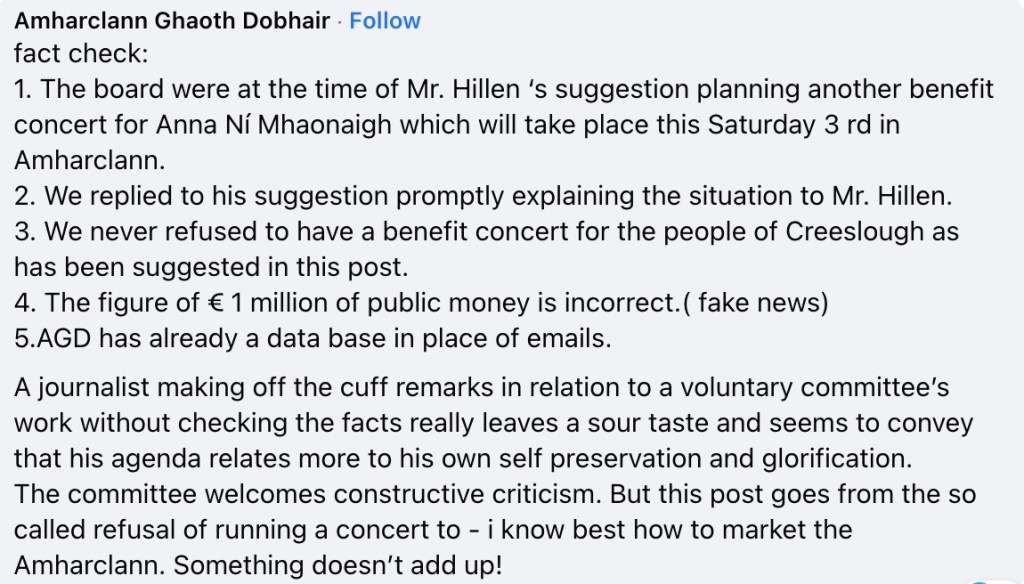
For this, I was accused by the powers that be at the theatre, the spokesperson and chairperson of the board I presume, of ‘self preservation and glorification,’ creating ‘Fake News’ and making ‘off the cuff’ remarks.’ See below.

I must admit, I was taken aback by the severity of the backlash, especially as I praised the hardworking of theatre staff in my Facebook post. As I have done for previous events, I also urged people to attend this evening’s special event (Saturday) in aid of a cancer victim. 

But those positive comments were conveniently overlooked by the person who wrote the response above on behalf of the theatre. 

I also received an aggressive text from the board chairperson saying my comments reminded him of ’hurlers on the ditch ….bellowing.’ Of course, he’s entitled to his opinion, but he’s conveniently forgetting that I have attended many events and written many articles supporting the theatre and have even helped organise a fund-raising event there. That’s hardly being in the ditch.

Here are just a couple of my articles – 

I simply couldn’t understand the furore that necessitated an urgent board brainstorming session within a few hours of my Facebook message being posted to compile such a negative response to me. 

In terms of timing, comparing a few hours to more than eight weeks, there seems to be what I’d call a ‘major time discrepancy ’ between the two. So why?

Last night, I happened to be reading my local newspaper and saw a full-page of photos and text in the Donegal News praising a successful event organised by Ionad Naomh Fionnan, a small community centre in the nearby town of Falcarragh, which raised more than 5,000 euro for the Creeslough Community Support Fund. 

That’s when the penny dropped. 

Did my Facebook post make a certain person at Amharclann, the largest theatre in northwestern Donegal, embarrassed at failing to organise themselves properly in more than two months to host a fund-raising event for the families of victims? And sadly, instead of taking what amounts to delayed action on the idea, not for my sake but for those in need in Creeslough, they decided to use their energies to deflect blame from themselves and attack the messenger – me – instead. 

It’s a tried and true trick, used since the days of Ancient Rome. And if it worked then, it could well work now, more than a millennium later. 

As for the moral of the story, I’m still not sure. 

It’s difficult for me to accept the obvious – ‘simply, keep your mouth shut.’ If we all did that, owners of homes destroyed by mica would not receive any compensation and be homeless over Christmas.

Some things are simply worth speaking out about.

Accepting praise is easy, it’s accepting constructive criticism that’s a true sign of character. I, like everyone else, want the Amharclann to succeed. It is my local theatre, after all, and I wouldn’t have written so many articles about it otherwise and praised those who worked so hard to attract the investment necessary to renovate it years after it closed.

But as my taxes and those of others helped pay for this renovation, shouldn’t we all have the right to voice our opinions and make sure the investment of so much public money is the very best it can be for all concerned?

I’m still waiting for the answers to my questions:

Intriguing to see how Amharclann can make a decision to respond within a few hours to my Facebook post. Yet still not make a decision on my suggestion for a fund-raiser for families of victims of the Creeslough tragedy made two months ago (October 9). While it’s disappointing to see Amharclann attacking me personally rather than dealing with the issue, let’s together try to make things clearer, point by point. These are my questions to the Amharclann representative who made the comment on behalf of the board.

  1. I still do not see how planning tonight’s event, which I fully support and which was due to take place in October, prevented the board making a decision about my suggestion for a fund-raiser for families of the Creeslough tragedy. Please explain.
  2. I have received no notification of a decision by you on the Creeslough fund-raising idea. 
  3. I never said the theatre refused to host a Creeslough fund-raiser. Not making a decision is a decision as there is no such event on the theatre’s future program.

4. Amharclann says costs for the theatre are not one million euro as my inside source informed me, which you label ‘Fake News.’ For transparency sake, please give a brief breakdown here of the real figure to justify your accusations.

5. Myself, my wife Columbia, friends and guests, have attended more than 25 events at Amharclann and I have written a series of articles promoting the theater. Never on any occasion has any of us been asked to leave our email/phone contact for marketing purposes. And we have never received any direct notification of events. Please explain how this database you mention was compiled and how is it used. Do only certain people receive notifications?

And lastly, for clarification purposes, please explain how a fund-raising concert for families of the Creeslough tragedy would benefit me personally, for my ‘self-preservation and glorification’ as you describe it. 

I simply don’t understand.

And for the record, I fully support the aims and mission of the Amharclann, as evidenced by my many articles and attendances at shows.

In the meantime, I wish Ann Mooney success with the medical treatment she is undergoing in Spain. This is the link if you, like me, would like to make a donation.

Help Ann Receive Vital Cancer Treatment

Was Columba gay?

Thousands of euro of public money are pouring into diverse celebrations this year throughout Ireland to celebrate the life of a 6th century Celtic monk called Columba (or Colmcille) – a strange and elusive man we know almost nothing about.

Even though schools, community centres, Christian churches, local councils and other groups celebrate the 1,500th year of the mystical monk’s birth, no-one knows exactly when he was born. Nor do we know exactly where. We think it was Donegal but we don’t know for sure what part. We know he left Ireland for the Scottish island of Iona where he spent a good part of his life. But we don’t know the real reasons why.

Sitting on the Torr an Aba (Hill of the Abbott) in front of Iona Abbey where it is said Columba did most of his meditating.

We don’t even know for sure if Columba had a mistress, a wife, children, or indeed whether he was gay or bisexual like many of the monks of his time. (Celibacy was not compulsory then, monks/priests could marry and have families and homosexuality was not denigrated as it is today by the Catholic Church).

Nor do we know where Columba is buried. It was thought his bones (or at least the smaller ones) were wrapped up inside a wooden casket covered with silver and copper-alloy designs known as a reliquary and carried by Scottish soldiers at the Battle of Bannockburn where they famously defeated the English. But we now learn there was nothing in the box, which now sits behind a glass case wired to a sophisticated security alarm system in the National Museum of Scotland in Edinburgh and labelled as the ‘Monymusk Reliquary.’

Make no bones about it – Columba’s relics are not in the ‘Monymusk Reliquary.’

The reason we know so little about Columba is that while he and his followers attracted a worldwide reputation for penning and illustrating magnificent books of all kinds including the famous Book of Kells, there are no records whatsoever of Columba’s own personal writing, not even a simple diary.

So, how is it then we’re spending so much public money celebrating a man we know nothing about, indeed a man who was never even declared a saint, though most people think he was. Why would the Vatican canonise him anyhow? After all, the Celtic Christian church Columba represented stood firmly against the Roman version, battling tooth and nail for ultimate supremacy, that issue being eventually settled at the Synod of Whitby in 664 with Rome being the victor.

Who knows, perhaps Columba, a lover of herbs, specially St. John’s Wort, followed too many Pagan practices, maybe even believing in faeries, and his writings were wilfully destroyed by the powers that be in Rome.

This brings me to another man, a man of our time.

Dr. Brian Lacey relaxes at his rural west Donegal home in the shadow of Errigal mountain.

Lively septuagenarian, author, archaeologist and historian, Brian Lacey is an exceptional dinner guest. A fine raconteur with quirky views of the world, he’s a man at ease with laughter and story-telling.

And he has just penned his latest book, on a spin-doctor called Adomnán (or Eunan) who single-handedly raised Columba’s name to ‘the High Heavens’ by inventing a series of mostly fictional or at the very least, highly-exaggerated, stories about the founder of Iona Monastery and the ‘miracles’ he supposedly performed.

Rather than it being a selfless literary endeavour, Adomnán’s reasons for writing his book were directly linked to both politics and money. In raising the profile of Columba, he also raised the public profile of the community of monks on Iona that he presided over 100 years after its founder had passed on, thus no doubt encouraging new recruits to sign up and more money donated to the monastery’s coffers.

Meeting the man himself, academic celebrity par excellence.

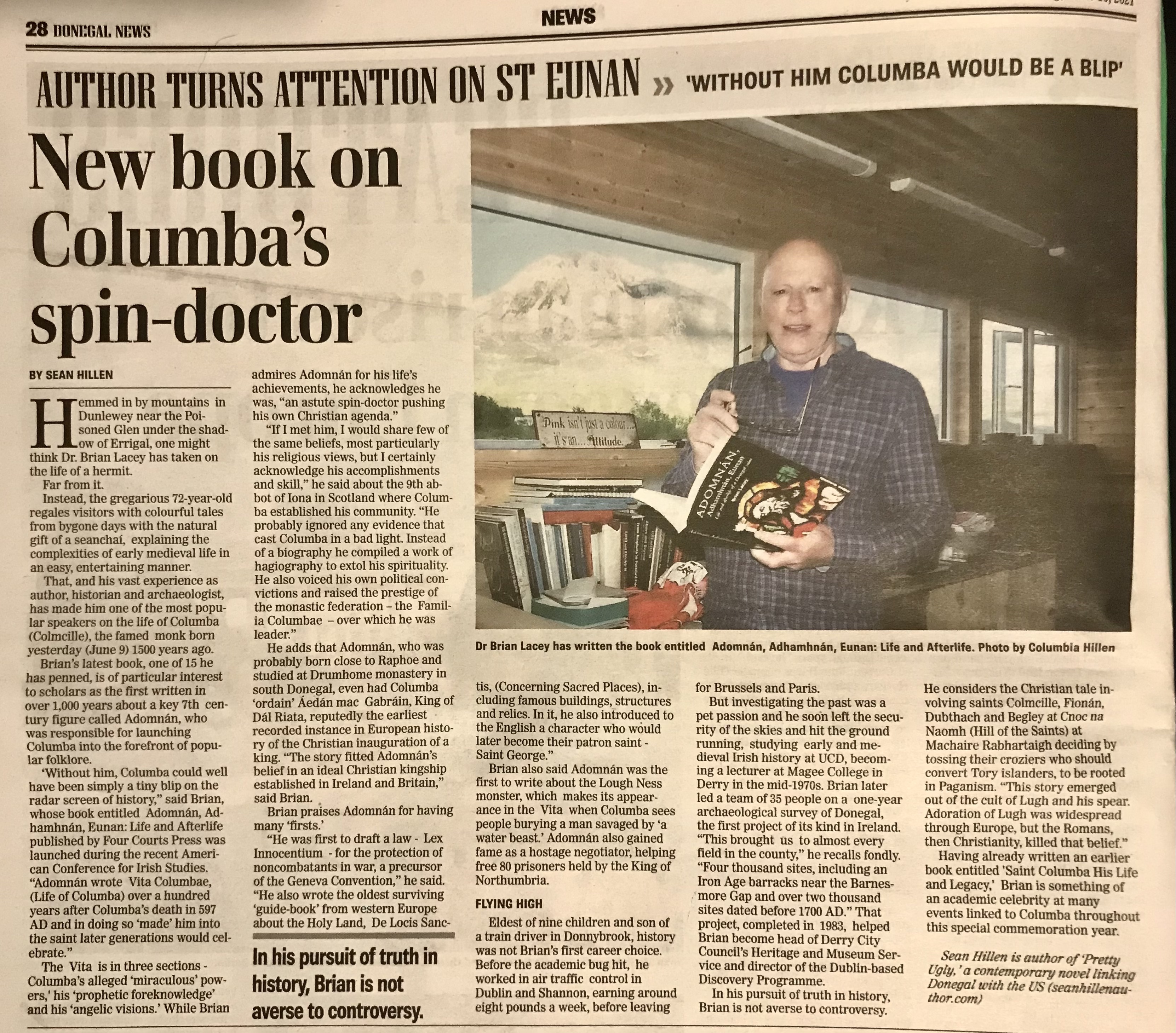
Some in Ireland might use local slang and call Adomnán ‘a cute hoor,’ loosely translated as ‘a shrewd scoundrel, especially in business or politics.’ Probably he was, but he also achieved much more, as you can see from the article below I wrote for the ‘Donegal News’ recently.

New Book On Columba’s Spin-doctor 

By Sean Hillen

Hemmed in by mountains in Dunlewey near the Poisoned Glen under the shadow of Errigal, one might think Dr. Brian Lacey has taken on the life of a hermit.

Far from it.

Instead, the gregarious 72-year-old regales visitors with colourful tales from bygone days with the natural gift of a seanchaí, explaining the complexities of early medieval life in an easy, entertaining manner.

That, and his vast experience as author, historian and archaeologist, has made him one of the most popular speakers on the life of Columba (Colmcille), the famed monk born yesterday (June 9) 1500 years ago.

Brian’s latest book, one of 15 he has penned, is of particular interest to scholars as the first written in over 1,000 years about a key 7th century figure called Adomnán, who was responsible for launching Columba into the forefront of popular folklore.

‘Without him, Columba could well have been simply a tiny blip on the radar screen of history,” said Brian, whose book entitled Adomnán, Adhamhnán, Eunan: Life and Afterlife published by Four Courts Press was launched during the recent American Conference for Irish Studies. “Adomnán wrote Vita Columbae, (Life of Columba) over a hundred years after Columba’s death in 597 AD and in doing so ‘made’ him into the saint later generations would celebrate.”

The Vita is in three sections – Columba’s alleged ‘miraculous’ powers,’ his ‘prophetic foreknowledge’ and his ‘angelic visions.’ While Brian admires Adomnán for his life’s achievements, he acknowledges he was, “an astute spin-doctor pushing his own Christian agenda.”

“If I met him, I would share few of the same beliefs, most particularly his religious views, but I certainly acknowledge his accomplishments and skill,” he said about the 9th abbot of Iona in Scotland where Columba established his community. “He probably ignored any evidence that cast Columba in a bad light. Instead of a biography he compiled a work of hagiography to extol his spirituality. He also voiced his own political convictions and raised the prestige of the monastic federation – the Familia Columbae – over which he was leader.”

He adds that Adomnán, who was probably born close to Raphoe and studied at Drumhome monastery in south Donegal, even had Columba ‘ordain’ Áedán mac Gabráin, King of Dál Riata, reputedly the earliest recorded instance in European history of the Christian inauguration of a king. “The story fitted Adomnán’s belief in an ideal Christian kingship established in Ireland and Britain,” said Brian.

Brian praises Adomnán for having many ‘firsts.’ 

“He was first to draft a law – Lex Innocentium – for the protection of noncombatants in war, a precursor of the Geneva Convention,” he said. “He also wrote the oldest surviving ‘guide-book’ from western Europe about the Holy Land, De Locis Sanctis, (Concerning Sacred Places), including famous buildings, structures and relics. In it, he also introduced to the English a character who would later become their patron saint – Saint George.”

Brian also said Adomnán was the first to write about the Lough Ness monster, which makes its appearance in the Vita when Columba sees people burying a man savaged by ‘a water beast.’ Adomnán also gained fame as a hostage negotiator, helping free 80 prisoners held by the King of Northumbria.

Flying  high

Eldest of nine children and son of a train driver in Donnybrook, history was not Brian’s first career choice. Before the academic bug hit, he worked in air traffic control in Dublin and Shannon, earning around eight pounds a week, before leaving for Brussels and Paris.

But investigating the past was a pet passion and he soon left the security of the skies and hit the ground running, studying early and medieval Irish history at UCD, becoming a lecturer at Magee College in Derry in the mid-1970s. Brian later led a team of 35 people on a one-year archaeological survey of Donegal, the first project of its kind in Ireland. “This brought us to almost every field in the county,” he recalls fondly. “Four thousand sites, including an Iron Age barracks near the Barnesmore Gap and over two thousand sites dated before 1700 AD.” That project, completed in 1983, helped Brian become head of Derry City Council’s Heritage and Museum Service and director of the Dublin-based Discovery Programme. 

In his pursuit of truth in history, Brian is not averse to controversy. He considers the Christian tale involving saints Colmcille, Fionán, Dubthach and Begley at Cnoc na Naomh (Hill of the Saints) at Machaire Rabhartaigh deciding by tossing their croziers who should convert Tory islanders, to be rooted in Paganism. “This story emerged out of the cult of Lugh and his spear. Adoration of Lugh was widespread through Europe, but the Romans, then Christianity, killed that belief.” 

Having already written an earlier book entitled ‘Saint Columba His Life and Legacy,’ Brian is something of an academic celebrity at many events linked to Columba throughout this special commemoration year.

Published in the ‘Donegal News’

If you want to know more about skulduggery disguised as religion and furious political struggles between Celtic Christians and their Roman counterparts, read the excellent series of Sister Fidelma novels by Peter Tremayne (pseudonym for Peter Berresford Ellis, historian, literary biographer and novelist). 

Fidelma is a ‘dálaigh’ or judge in ancient Ireland, a sexy red-haired female version of Sherlock Holmes in a habit.

Intrigued by the reputation of this early Irish mystic monk known as Columba, I decided as a travel writer to head for Iona, the Scottish island where he established his community of like-minded people. Here’s what I found after landing on a little stony pier after taking the ferry from Mull last autumn, a massive, treacherous sea crossing that took all of five minutes.

Click on the photo to read the story

Love boat sets sail again

With its clear water, impressive sea arches, interesting monuments and meandering stone pathways leading to a rustic cafe-cum-information centre, Gola Island is an idyllic, picture-book getaway from the hustle and bustle of modern life.

And if it wasn’t for Captain Sabba Curran and his daily ferry service, few people would be able to enjoy this west Donegal island’s rugged beauty.

C

Many’s the time, stiff from sitting on a chair in front of a computer, I’ve jumped in my car and driven the ten minutes from my home on the slopes of Bloody Foreland towards Magheragallon Pier near the Gweedore Golf Course to catch Sabba’s regular crossings, greeting an old acquaintance on board or meeting a new friend ‘up from the country’ or from another country altogether.

After a short hike and a refreshing seawater swim if the notion takes me, I head to the Uncrowned King of the Island, Eddie McGee, sup an cupán tae and enjoy his lively raconteurship at one of the outside cafe tables overlooking the back pier near the toppled stones of the old schoolhouse. 

So enamoured am I of the island and its quiet, unassuming personality, I included it as a key location in my novel, ‘Pretty Ugly.

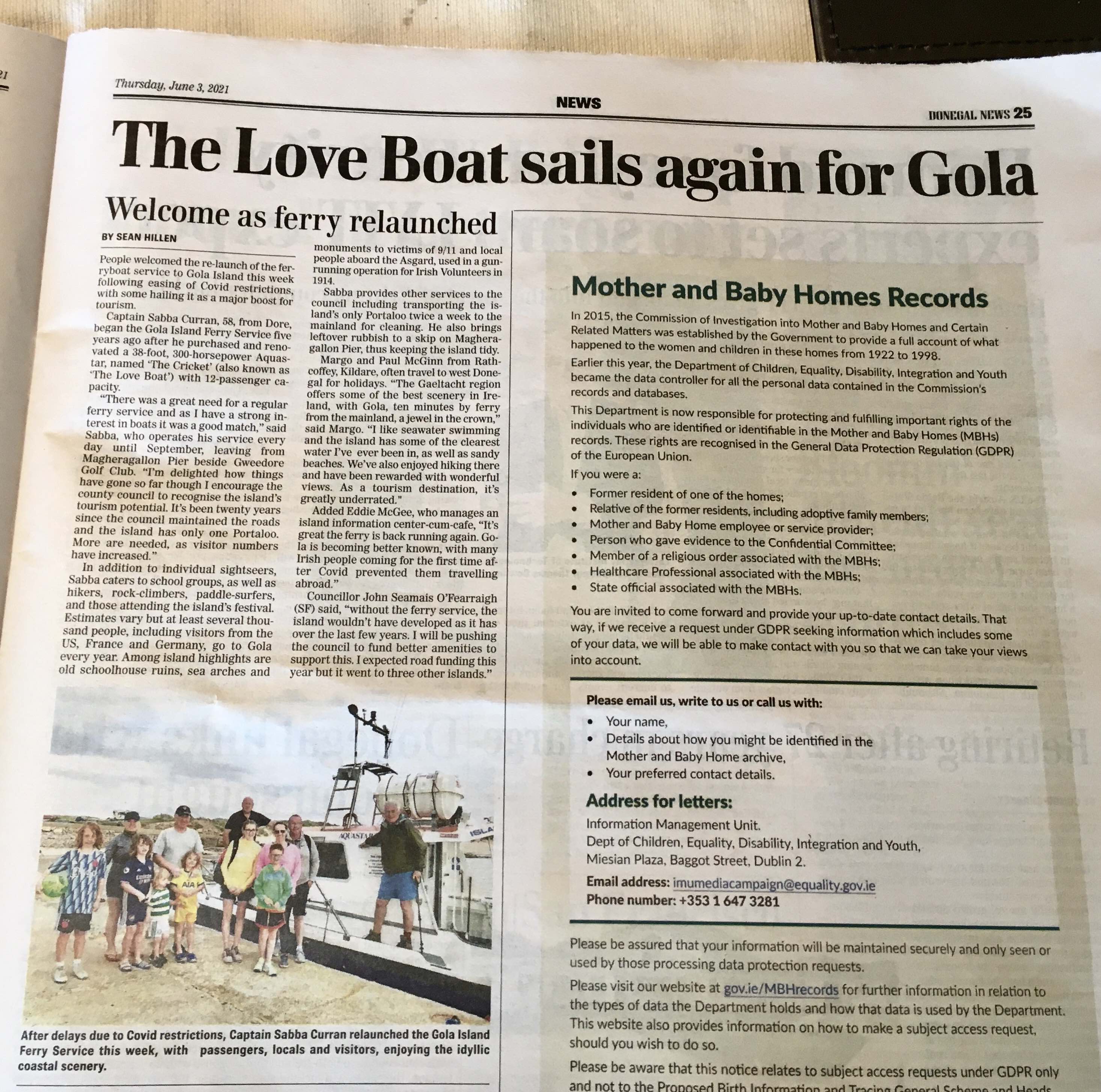
In honor of Sabba, Eddie and the beauty of the island, I penned this short news story for the ‘Donegal News’ this week.   

People welcomed the re-launch of the ferryboat service to Gola Island this week following easing of Covid restrictions, with some hailing it as a major boost for tourism.

Captain Sabba Curran, 58, from Dore, began the Gola Island Ferry Service five years ago after he purchased and renovated a 38-foot, 300-horsepower Aquastar, named ‘The Cricket’ (also known as ‘The Love Boat’) with 12-passenger capacity.

“There was a great need for a regular ferry service and as I have a strong interest in boats it was a good match,” said Sabba, who operates his service every day until September, leaving from Magheragallon Pier beside Gweedore Golf Club. “I’m delighted how things have gone so far though I encourage the county council to recognise the island’s tourism potential. It’s been twenty years since the council maintained the roads and the island has only one Portaloo. More are needed, as visitor numbers have increased.”

In addition to individual sightseers, Sabba caters to school groups, as well as hikers, rock-climbers, paddle-surfers, and those attending the island’s festival. Estimates vary but at least several thousand people, including visitors from the US, France and Germany, go to Gola every year. Among island highlights are old schoolhouse ruins, sea arches and monuments to victims of 9/11 and local people aboard the Asgard, used in a gun-running operation for Irish Volunteers in 1914.

Sabba provides other services to the council including transporting the island’s only Portaloo twice a week to the mainland for cleaning. He also brings leftover rubbish to a skip on Magheragallon Pier, thus keeping the island tidy. 

Margo and Paul McGinn from Rathcoffey, Kildare, often travel to west Donegal for holidays. “The Gaeltacht region offers some of the best scenery in Ireland, with Gola, ten minutes by ferry from the mainland, a jewel in the crown,” said Margo. “I like seawater swimming and the island has some of the clearest water I’ve ever been in, as well as sandy beaches. We’ve also enjoyed hiking there and have been rewarded with wonderful views. As a tourism destination, it’s greatly underrated.”

Added Eddie McGee, who manages an island information center-cum-cafe, “It’s great the ferry is back running again. Gola is becoming better known, with many Irish people coming for the first time after Covid prevented them travelling abroad.”

Local Sinn Fein Councillor John Seamais O’Fearraigh said, “without the ferry service, the island wouldn’t have developed as it has over the last few years. I will be pushing the council to fund better amenities to support this. I expected road funding this year but it went to three other islands.”

Gifted Donegal women host music concert for worthy cause

Death is rarely asked to sing.

But a group of immensely talented women Friday night at Amharclann theatre in the Donegal Gaeltacht invited it to join them – transforming it into a celebration of life, community spirit and artistic triumph.

Devoted to Fiona Carr, popular singer and dancer who fell victim to cancer at the young age of 30 and others like her who bid their last farewells under tender care at the Donegal Hospice, local performers known as the ‘Wild Atlantic Women’ gathered together for a heartfelt musical tribute.

wild atlantic women concert, live music donegal, donegal women singers

And what an uplifting evening it turned out to be.

Regardless of your favorite musical genre, this special concert seemed to have it all – soul and folk, traditional and country, the popular and the newly-penned.

Lead organiser, teacher-multi-instrumentalist-singer-cum-songwriter Brí (Brighdin) Carr with many local female musicians have already raised more than 15,000 euro for Donegal Hospice and the Oncology Department in Letterkenny University Hospital through such events and a double CD.

Few better ways to open such a concert than this admirable group of women together in harmony led by Emma Ní Fhioruisce, Maria McCormack and Bernie Doherty on the haunting folk ballad ‘Caledonia, the unofficial anthem of Scotland written by singer-songwriter Dougie MacLean.

And few better ways to end it than their touching interpretation of ‘Grace,’ written by Frank and Seán O’Meara, telling the tragic story of Grace Gifford who married Irish rebel leader Joseph Mary Plunkett, in Dublin’s notorious Kilmainham Gaol shortly before his execution by firing squad in 1916.

Between these songs, an appreciative audience enjoyed two hours of inspiring entertainment by women, young and old, who displayed remarkable vocal range and musical prowess, drawing a standing ovation for their efforts.

With so many highlights, it’s impossible to describe them all, but here’s a flavour of the evening –

Noeleen Ní Cholla, Gaoth Dobhair-based award-winning sean nos singer-songwriter-instrumentalist, whose angelic voice can be heard on her album ‘An Mhaighdean Mara,’ performed pitch-perfect the Irish-language version of ‘Somewhere Over The Rainbow,’ the ever-popular song written for the 1939 film The Wizard of Oz. How she managed to reach those high notes is beyond me.


Glasgow-born singer, guitarist and lawyer, Jacqui Sharkey, with three albums already to her name, sang ‘Never Be The Sun’ by Donagh Long from Cork. Recorded with her friend and fellow singer Caitlin Murtagh from county Down, and produced by Pat Gallagher of ‘Goats Don’t Shave’ fame who also plays guitar backing. This song will be officially released on February 28 and a video aired on Sky TV this week.

On keyboards, Brí Carr, who founded Blue Ribbon, a performing arts group for children, sang a song she wrote, simply entitled ‘Home,’ as well as a duet with Claire Ward called ‘Second Violin,’ by Irish band, Bagatelle, one Fiona Carr herself recorded aged 14 for Blue Ribbon.

‘H.o.m.e,’ Brí’s next album will be released in May. Her song, ‘Árainn Mhór,’ was the first iTunes chart song as Gaeilge in the Top 200 in Ireland, peaking at number 3. Bubbly Brí, who keeps a ‘big blue book’ of songs she has composed over the past 25 years, also participated in ‘South Of The Border’ festival in Ardara this past weekend. Her first album, ‘Full Circle/Rotha an tSaoil,’ is on iTunes and Spotify. Bernie Doherty sang a beautiful rendition of the wistful ballad, ‘Who Knows Where the Time Goes?’ by English folk-rock singer Sandy Denny. Bernie is now involved in the formation of the ‘Choir of Ages’ its members ranging in age from 5 to 80.

Accomplished pianist and keyboardist, Kelli Nic Ruaidhri,  from Fanad who teaches in Ballinamore and supported many of the songs on the evening, also sang ‘Sanctuary,’ which she translated into ‘Beidh mé Ann.’


Maria Mc Cormack’s contributed to the evening’s success with a song about her own personal experience of lost love. Entitled ‘Stratford to Stansted,’ about someone moving away to London for work, it will feature on her second album, her first being, ‘I Choose To Love.’ Aside from gigs this year in Slane (Purple Sessions), Drogheda (Fireside Festival), and even a St. Patrick’s Day festival in Germany, Maria will also play at the Letterkenny Jazz and Blues Festival on July 4th Maria has set up a fundit page to help support her upcoming recording.

Looking like a sultry Marilyn Monroe in black silk on stage, Rachel Akkoç, actress, singer and member of the Letterkenny Musical Society, transported listeners to a smoky uptown New York nightclub with her soft, seductive interpretation of soul song ‘I Know Where I’ve Been’ from the musical ‘Hairspray.’

Highlighting the difficulty of ‘letting go,’ and having special meaning for me as my mother died last week, Clare Ward sang ‘Reflections’ in remembrance of her friend Manus Kelly, killed tragically last year in the Donegal International Car Rally. Claire’s album is called ‘Bite the Bullet,’ an eclectic mix of folk, Celtic and easy rock music. Recent solo recordings include ‘Eye of the Storm,’ and ‘Remember,’ about a friend’s journey with Alzheimer’s.

Last but certainly not least were what could best be described as ‘the Little (Wild Atlantic) Women’ – girls, aged six and upwards, namely Caela Carr, Siofra Harvey, Clodagh Mooney, Mia Clarke, and Hannah NicPhaidín, all award-winning singers and musicians. They drew enthusiastic applause from the audience with a rousing medley that included ‘I Wish I Had Someone To Love Me,’ ‘Rós na Seirce,’ “Christmas Letter,’ ‘Fear a’Bhata,’ ‘Angels Among Us,’ ‘Liom Féin’ and finally, ‘Home To Donegal.’

Other excellent singers included –

Trish Rodgers, whose albums include ‘This Is My Island,’ ‘Home Sweet Home’ and ‘The Gold Collection’ – singing, ‘Donal Óg.’

Deirdre Bonner, whose albums include ‘Remember When’ and ‘Atlantic Bridges’ – singing, ‘Come All Ye Fair And Tender Ladies.’

Maria McCool, whose albums include ‘Ailleog, ‘Doagh and ‘Shenandoah’ – singing ‘Teddy O’Neill.’

Gearóidín Breathnach, a leading sean-nós singer, whose album is ‘Ar Fhoscadh na gCnoc‘ – singing ‘Anseo I lár an ghleanna.’

and the velvety-voiced Emma Ní fhioruisce from Gaoth Dobhair – singing ‘Ar Ais go Gaoth Dobhair.’


Kudos to Áine Ní Churrain (Barrscéalta Raidio na Gaeltachta) and Karen Gallinagh (Speech and Drama Federation Ireland) who acted as excellent MCs and to Serenity Hair & Beauty Salon Gweedore which donated a 200 euro voucher to a lucky raffle winner.

Appreciation poured in for the artists –

A great night had by all at the Valentine’s night concert by the ‘Wild Atlantic Women.’ We had a fantastic time. Such a talented group of singers and for such a worthy cause as the Donegal Hospice.” Simon Smith, Letterkenny, professor of nursing.

wild atlantic women, live music donegal,

Friends obviously having a good time at Amharclann.

I thoroughly enjoyed the ‘Wild Atlantic Women’ concert in the Amharclann, Gaoth Dobhair. It was an eclectic mix of musical genres, excellent song-writing and inventive reworking of older songs. A great night’s entertainment.” David McNally, librarian and researcher.

A great mix of talents, and all age groups, both languages, and the modern and the traditional. Agus neart craic! I particularly enjoyed the translated songs such as Maria Nic Cumhaill’s ‘Grace’ and Noleen Ní Cholla’s ‘Thar an Tuar Ceatha’(Somewhere Over The Rainbow). Given the night that was in it, we had love-songs and songs of unrequited love such as the haunting and ancient Dónal Óg, Thíos i Lár a’Ghleanna and a new song about love lost to modern day emigration.
Well done ‘Young and Tender Ladies’ of Donegal (one of ballads sung on the night) for sharing St Valentine’s evening and helping an important cause. Having the CD, I can now enjoy it all again.
Reuben Ó Conluain, retired teacher Dún Laoghaire and Machaire Rabhartaigh

Sabba Curran, gola boat ferry, gola island ferry

Sabba and Patricia Curran getting settled for an evening of music and song.

A wonderful night of entertainment, so many talented singers and musicians on stage at one time. Truly memorable.” Sabba Curran, Captain of ‘The Cricket,’ Gola Island ferryboat.

Journalism: a funny thing, sometimes

Sometimes it’s not writing about political showmanship and skullduggery or economic booms and busts that create good journalism.

Sometimes, it’s the simple quirks of everyday life that make for a good story.

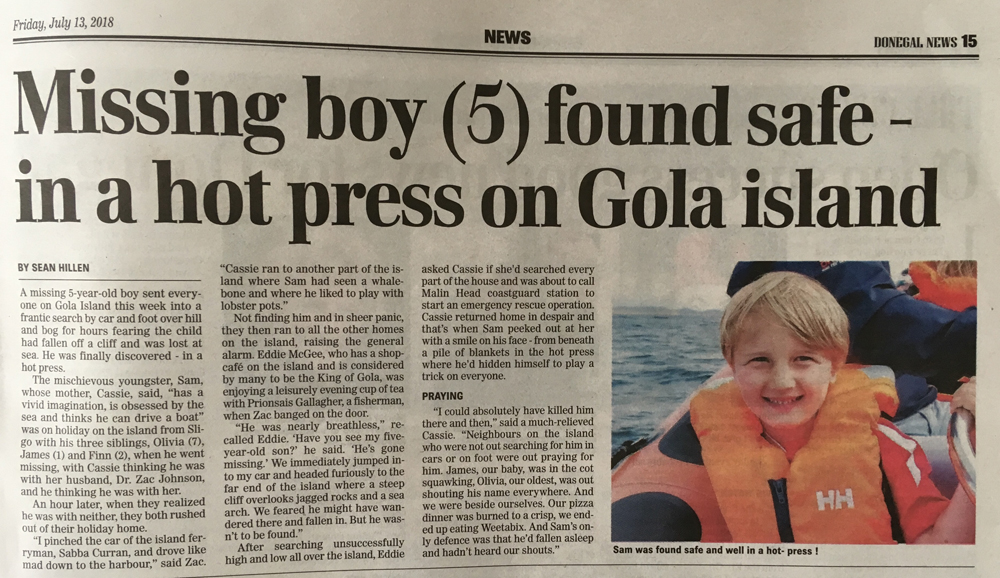
You can imagine my delight in unearthing these two tales of near disaster in Donegal that end happily.

They give new meaning to the term ‘missing people.’

Missing boy (5) found safe – in a hot press on Gola Island

gola island donegal, donegal tourism, gaeltacht tourism,

He almost ‘missed the boat’ 

gaeltacht tourism, gola island, donegal tourism


Donegal Gaeltacht community spirit rides high

I was delighted to write this feature piece for the ‘Donegal News’ recently supporting the hard-work, communal spirit and creativity of people in Gaoth Dobhair, Falcarragh and the Rosses in hosting their respective festivals.

For such a small rural area, often there are more diverse cultural activities – dance, theatre, sporting events, concerts, to be name but a few – than in major urban areas.

Delightfully, making choices as to which to attend can be the biggest challenge.

Sean Hillen Donegal gaeltacht, donegal gaeltacht,

Traditional Irish group Arcanadh woos and wins hearts of audience

Traditional Irish group Arcanadh woos and wins hearts of audience

Another cultural entertainment success for Amharclann

What a terrific cultural contribution this historic theatre provides not just for Bunbeg, not just for the Gaeltacht, not just for Donegal but for all-Ireland, north and south.

World Itineraries's avatarworld itineraries

by Sean Hillen

Six musicians-singers-songwriters with such a wealth of talent it seems blatantly unfair to the rest of us mere mortals – that sums up Irish-group, Arcanadh, which played to an enthusiastic audience at historic Amharclann theater, Bunbeg, northwest Donegal, Ireland this week.

Here I must admit my bias.

In a rare moment of wisdom, I invited this terrific group to tour Romania when I launched the first-ever Saint Patrick’s Day celebrations in that former-Communist country. It was a decision I’ve never regretted.

The result more than 10 years ago was the same as that at Amharclann 72-hours ago – a boisterous appeal for more at the end and an appreciative standing ovation after their final encore.

Members of Arcanadh have known each other for more than twenty years and this is reflected in their smooth light-hearted banter off-song and their seamless harmonies on-song. Their passion for their…

View original post 805 more words

…with a hint of time-travel

In a rather bizarre turn of events with a hint of time-travel, fiction has predicted reality.

In my suspense novel, ‘Pretty Ugly’ released several weeks ago, a key scene depicts a lead character on a plane crossing the Atlantic reading a travel guide about the place to which he is going – the northwestern region of the ‘Forgotten County’ Donegal.

Pretty Ugly novel, Fodor's top experiences

Donegal Fodors guide, Sean Hillen Fodors guide

Fast-forward several weeks and Fodor’s, the world’s largest English-language publisher of tourism and travel information, owned by Penguin Random House, released an article by me on, yes, you’ve guessed it, the very same place – with excerpts from ‘Pretty Ugly’ introducing the article. See the full article below that was published several days ago.

Sean Hillen Fodors, Pretty Ugly novel

As Fodor’s has such a wide reach globally, I’m hoping this article helps bring more international guests – many of whom have never been to Ireland – to enjoy this beautiful and lesser-known part of Ireland’s coastline, strengthen the hospitality sector in the hard-hit Gaeltacht and create more jobs for local cafes, pubs, restaurants, hotels and B&Bs.