Theatrical triumph for the talented Cloughaneely Players in Donegal

What a theatrical triumph this past weekend for local amateur drama company, The Cloughaneely Players, who meet close to my home here in the scenic northwest corner of Donegal.

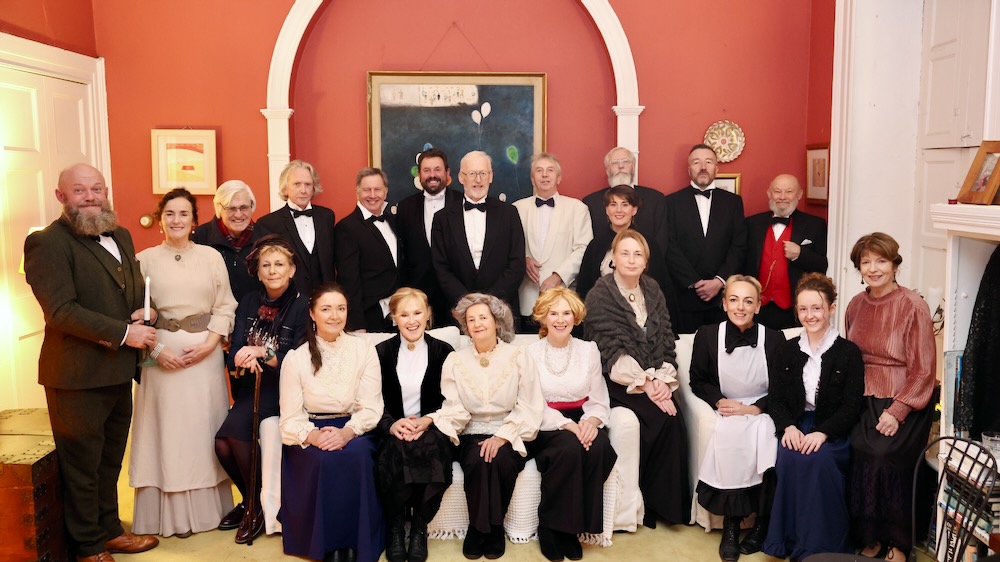
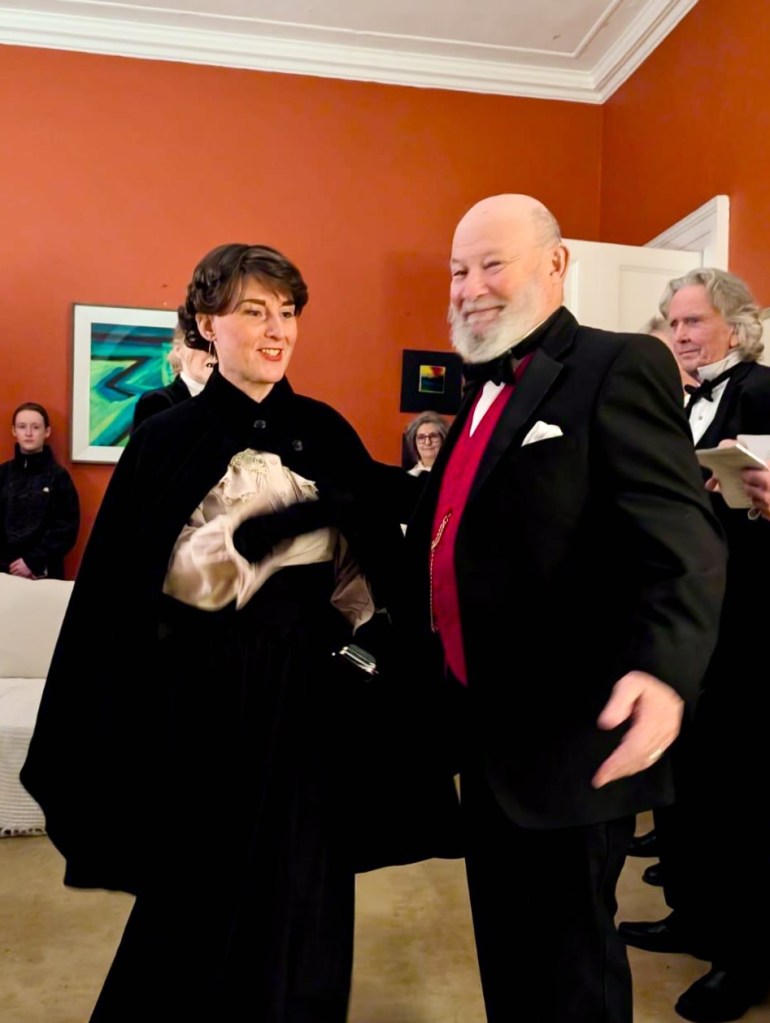
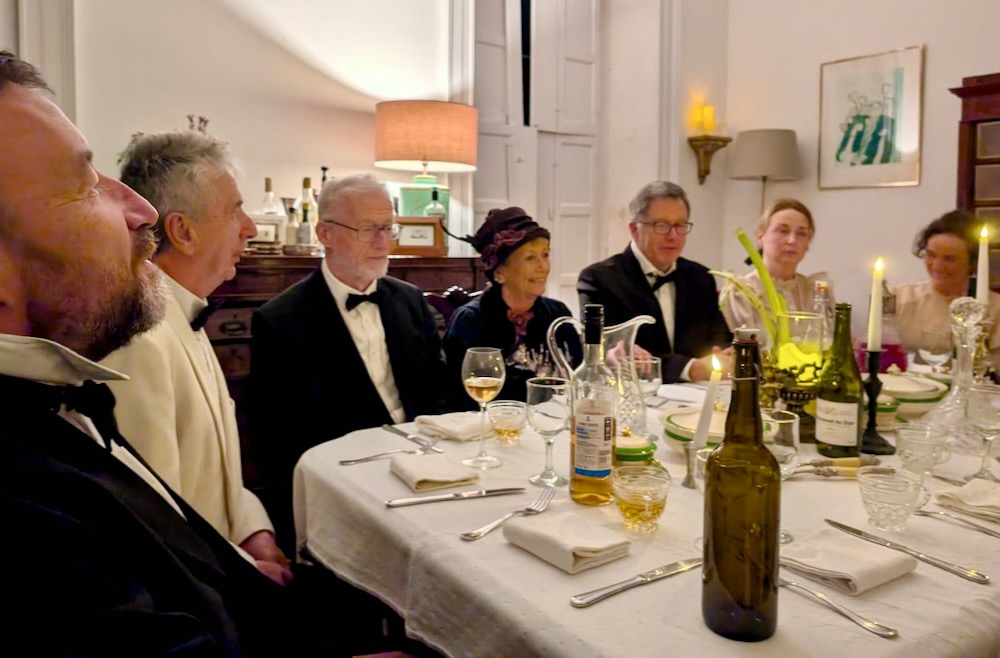
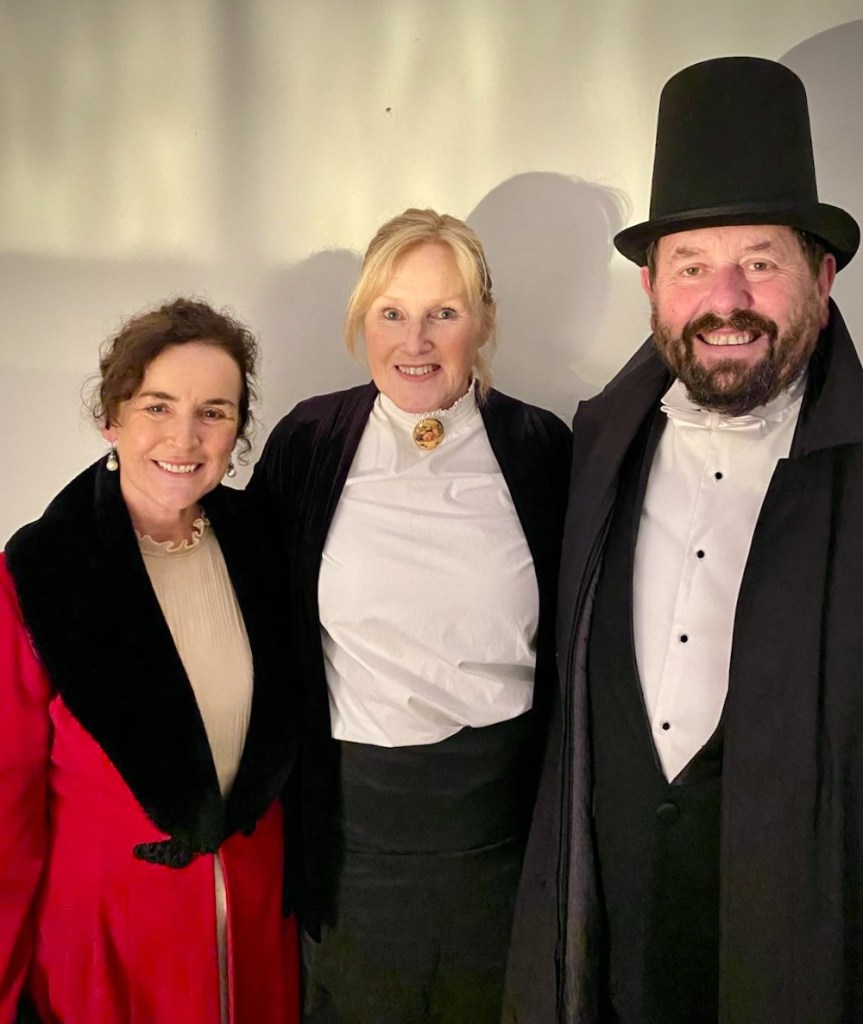
Not only did they host a superb re-enactment, complete with costumes and wigs, of James Joyce’s classic short story ‘The Dead’ set in 1904 in a most enjoyable manner, but they transformed a rural Donegal house into a 19th century multi-stage setting using most of the rooms in the house, both upstairs and downstairs, for various scenes.

Many congratulations to director Carmel MacGill, consultant director Murray Learmont, choreographer Caroline McGee, and more than twenty talented local amateur actors and musicians for a superb show.

And keep in mind, we’re not talking about well-paid West End or Broadway professional performers (though you might be mistaken that they were). We’re talking about a local bartender, a teacher, a nurse, a doctor or two, a real estate broker, a hypno-therapist, even a retired revenue sheriff, and many others, all of whom bring sheer enthusiasm and passion into treading the boards.

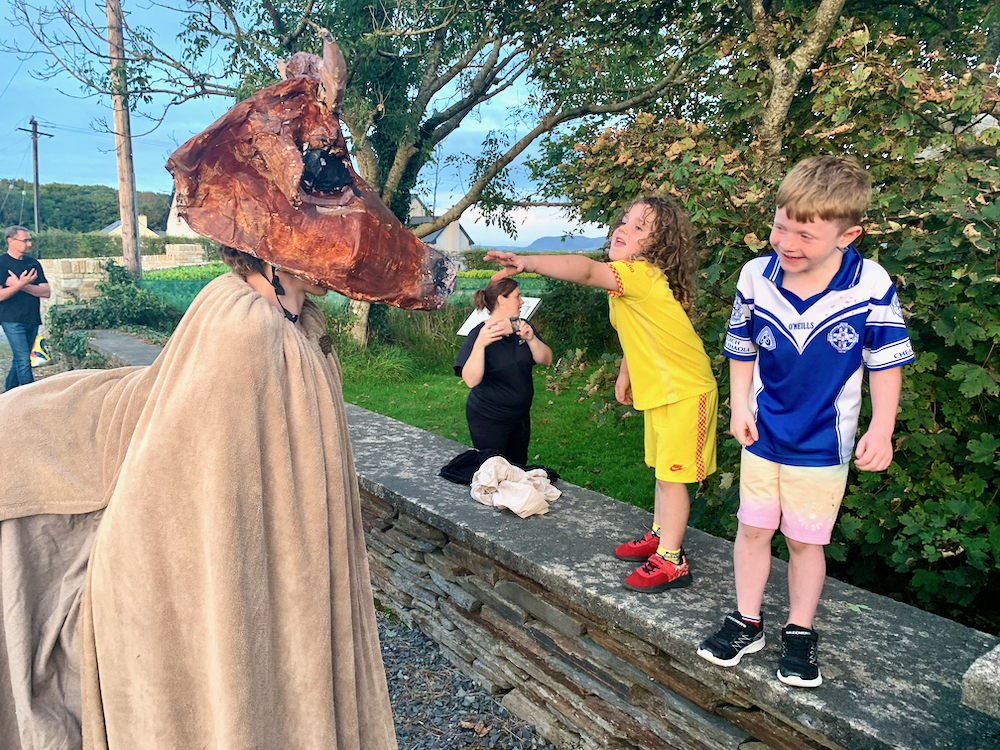
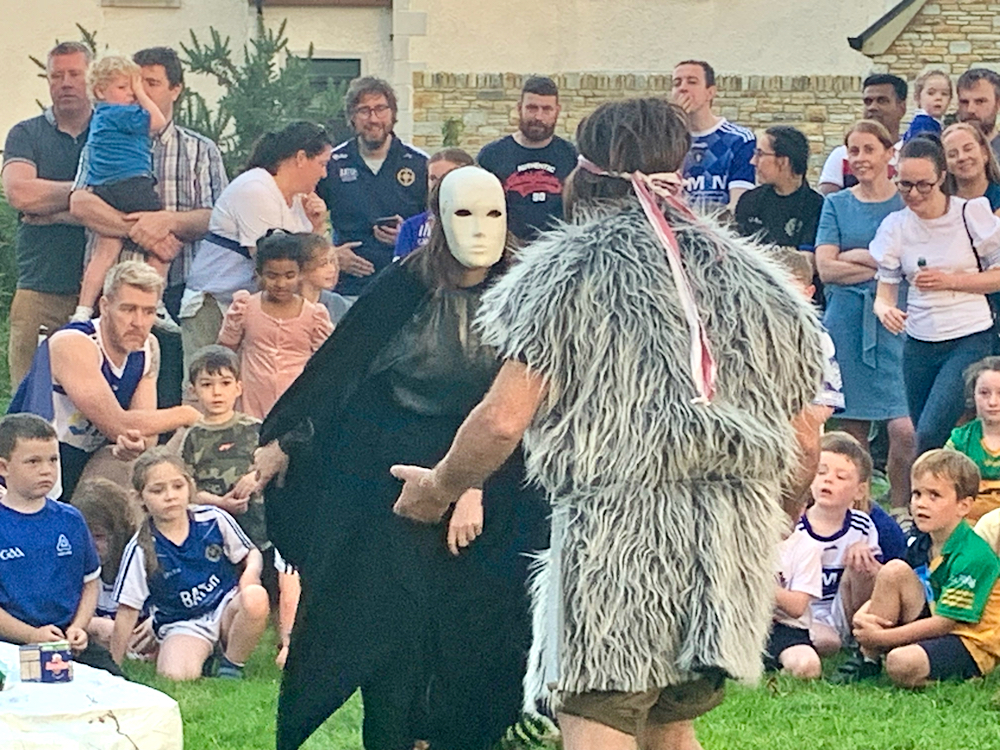
Here’s a few photographs to illustrate the weekend’s entertainment. 

I’ve written a much more comprehensive article in tribute to these delightful women and men for this Thursday’s edition of the Donegal News on the Digest page so pick up a copy and have a read and rejoice we have such talented artists among us.

And don’t miss out on their next production. The tickets will be red hot, so buy early. No doubt they’ll be sold for high prices on the international black market.

Thank you to Catriona Kelly, Jake Campbell McLaughlin and Maggie McKinney for photographs.

Meet The Real Simon Harris – The Dishonourable Duke Of Duping

Is it not reprehensible – the height of hypocrisy in fact – that Simon Harris the leader of the Irish Government  – has the audacity to accuse Sinn Féin in recent weeks of ‘duping’ people when it expelled several party members for substandard social behaviour?

Simon Harris – the Dishonourable Duke of Duping.

The Cambridge dictionary definition of dupe is ‘to deceive’ and if anyone is guilty of deception, it is Harris and his colleagues in the coalition Government of Fine Gael, Fianna Fail and the Green Party.

Over the last four years since being in power – and for many years before that – these parties have been nothing less than ‘repeat offenders,’ constantly deceiving the ordinary hardworking people of Ireland with false promises of a quality lifestyle as befitting a nation that is one of the earliest members of the European Union, then called the European Economic Community, or EEC for short, back in 1973.

Instead, however, we have one of the most disastrous health systems on the continent, with people waiting years for life-saving surgeries, often dying before they receive it; we are awash in homelessness and poverty, with an estimated people 30,000 living on the streets, including thousands of young children and infants; we have a forsaken, forgotten, forlorn State where retirees and newlyweds alike are unable to afford the rent of a simple home, never mind the financial resources to even remotely consider buying one to end or begin their lives together in a modicum of comfort.

Not only does the Dishonourable Duke of Duping continue to deceive people that after all these years he’ll one day consider putting a roof over our heads, but he himself basks in the lap of luxury in one of the most expensive and elitist places in Ireland, the scenic coastal town of Greystones in county Wicklow, where he was born, where he lives and where houses cost up to two million euro, and more.

But is it not somewhat harsh of us to criticise the Dishonourable Duke of Duping for his lack of common decency? Is it not unfair to ask a man of such Royal blood living in such a high falutin’ environment to understand the plight of so many desperate Irish people? Is that not akin to asking King Charles of England to make his own cupán tae once in a while?

Shamefully, while the wealthy in Ireland (many of whom are the Dishonourable Duke of Duping’s closest neighbours) while away their days in decadent lifestyles with fancy homes in fancy places or travel in  environmentally-damaging private jets (which the Dishonourable Duke of Duping does frequently) and indulge their whims in ostentatious holiday homes abroad (which the Dishonourable Duke of Duping often does), modern Ireland suffers the worst housing shortage in its entire 100-year history. 

Studies show less than a third of 30-year-olds own their home. Over half of all newly-built homes in greater Dublin alone were bought or developed by global vulture investor funds, thus locking countless people out of ever attempting to buy one. These ‘vampire funds’ don’t buy homes to sell, they buy them to extract high rents in perpetuity. In other words, they suck the lifeblood out of decent Irish society.

And to make matters worse, the Dishonourable Duke of Duping and his cadre of Government lackeys allowed a temporary no-fault eviction ban in Ireland to lapse last March, thus opening the floodgates for more than 15,000 notices of termination to be issued last year, making the number of evictions higher than it was during the Famine in the mid-1800s. 

For centuries, gutless, greedy, often absentee, landlords, have been the scourge of Ireland, rich, ruthless people who with the click of a finger, a scribbled signature on a sheet of paper, thoughtlessly tossed hungry families out into the ditches. 

Now it seems the same is happening all over again in modern Ireland, this time under the dictatorial rule of the Dishonourable Duke of Duping and his ignoble entourage.

Instead of urgently dealing with these major social and health issues that are making the lives of so many Irish people intolerable, Harris and his well-to-do cohorts, including Government coalition leaders, Micheál Martin of Fianna Fail and Roderic O’Gorman of the Green Party, are pointing their grubby finger at Sinn Féin, an oft-used political ploy to distract popular attention away from the real issues, and their own failings on them. 

In doing so, however, these ‘I’m-better-than-you’ leaders fail to realise something important. While the bitter winds of winter howl at our doors, while Storm Ashley batters the coast this weekend, Irish people are not bears. They are not hibernating. They are wide awake. And fearful. And hungry. And cold. And they remember the empty promises made to them from on high four years ago, and for many years before that.  

Maybe, just maybe, we should ask Sinn Féin leader Mary Lou McDonald to re-tell the story of these empty promises once more, to remind us how easily we were taken for fools. And in doing so, help us make sure the Dishonourable Duke of Duping and his Royal patrons don’t sneak back into power through the back door and make jesters of us for another four years in their Court of Failure.

Maybe, just maybe, we’ve learned our lesson and are wide awake enough to elect Sinn Féin, the ‘Party of Change’ and improve things for the better. For each and everyone of us, our parents, our children and the generations who come after. 

Is Sinn Fein really ready for Government?

by Sean Hillen 

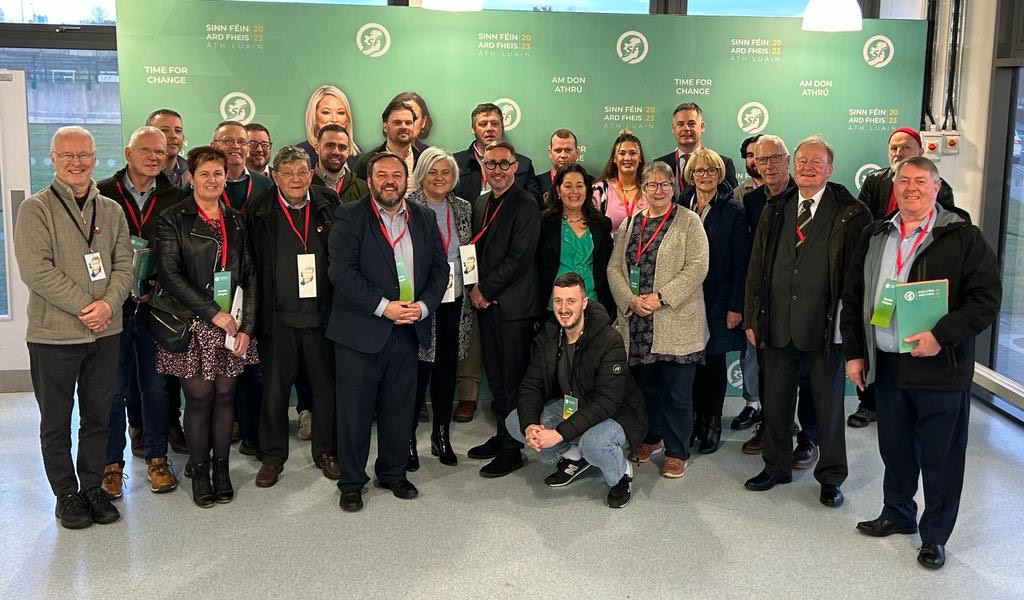
ATHLONE, WESTMEATH – A resounding ‘YES’ was the answer that rang out loud and clear all around me from around 1,500 enthusiastic and committed members, young and old, men and women, some teenagers, some retirees, gathered for the party’s annual Ard Fheis in Athlone, Westmeath several weeks ago.

A large Donegal delegation, the county where I live in northwest Ireland, attended the Ard Fheis.

I know from past experience in both Europe and the US that political party conferences can be full of hype and promise but I sensed something special in the air at this one. Positivity, definitely. Excitement, plenty. Anticipation, yes. Expectation, ditto. Even a little apprehension. Natural, considering it’s been 100 years since Sinn Fein last walked through the corridors of power as the undisputed political leader of Ireland.

Attending this annual meeting, I was extremely impressed with the overwhelming enthusiasm shown by members, their readiness to be in Government and make meaningful changes in Ireland for a better future for all and by the large number of women present, many of whom spoke incisively from the stage as delegates on a range of issues, from education to health, the high cost of living to homelessness. 

With local and EU elections, and perhaps national ones as well, occurring next year, it seemed appropriate that a party that continues to rise in national popularity was holding its annual party meeting in Athlone, a town considered the geographical center of Ireland, with Sinn Féin hoping its influence radiates from there nationwide in all directions.

Led by two women, Mary Lou McDonald, the party’s president and TD for Dublin Central, and Michelle O’Neill, party vice-president and First Minister Elect in Northern Ireland, with TDs nationwide, would-be Ministers-in-waiting, including TDs Pearse Doherty and Pádraig MacLochlainn from Donegal where I now live and with whom I spoke during breaks in the formal proceedings, all aired their views on key issues such as the cost of living crisis, plight of the health system, mounting housing problems, and many more. 

We want to build a new Ireland,” said McDonald in her keynote address after receiving a rousing reception. “A nation home for all. A unified nation of confidence and compassion, talent and ingenuity, claiming our future, our rightful place among the nations of the world. A new Ireland. The Orange and Green reconciled. No place for racism, Islamophobia, Antisemitism, sexism, homophobia, transphobia, or sectarianism.”

O’Neill spoke about the urgent need to kick-start the Stormont Assembly, the national parliament in Belfast, which has been boycotted by the Democratic Unionist Party (DUP), the main Unionist opposition, for the past year. “My message is one of positivity, one about the future, about building a better society for us all to live side by side,” she said. “My message to the DUP is that they need to be in the Executive with the rest of us, making politics work, making this a better place for everybody who lives here.”

Pearse Doherty, the party’s spokesperson on finance, thanked his fellow party members, saying, “You are the engine room of our organisation. Your work, your energy, your ideas, make Sinn Féin what it is – the only viable vehicle for the ordinary people of Ireland to achieve change in our country, and the only viable vehicle to achieve the unity of our country. We are focused on one thing – delivery for workers and family the length and breadth of our island. We are on the countdown to the general election, and we are setting out the type of change that a Sinn Féin government will deliver if the people give us that opportunity. We are setting out our plans to build a better, fairer country for all, for positive change and transformation.”

Pearse Doherty listens closely as Mary Lou McDonald gives her keynote address.

Paul Hayes, from Carrigart, Sinn Féin regional secretary in Donegal, was delighted with the weekend’s success, telling me that the Ard Fheis had brought together over 1,400 people, with more than 200 speakers over 300 issues voted on. “It’s a great success, I’m very happy,” he told me, smiling. Sitting beside me in the auditorium stalwart Pat Doherty, former Sinn Féin vice-president, wore a quiet, thoughtful – one might even say, contented – expression on his face. And no wonder. After many years of personal struggle and hard work towards the goal of a United Ireland Socialist Republic, the idea – once remote – of his party leading Government both in the north and south of of the nation seems rapidly becoming a reality.

(left to right) Paul Hayes, Sinn Féin regional secretary in Donegal, with Pat Doherty, the party’s former vice-president. Both were happy with the strong attendance and content at the Ard Fheis.

Thanking me for exclusive information I provided to Sinn Féin on RTE expenses, MacLochlainn, the party’s chief whip and spokesperson on fisheries and the marine, added, “We are mindful that this Sinn Féin Ard Fheis could be the last one before the next general election and the formation of a new government. We are confident, we are ready.”

Pádraig MacLochlainn, TD, is confident. “Sinn Féin is ready for Government,” he said.

Among the many motions passed was one affecting many people in Donegal. This pertains to an ongoing scandal – houses that are crumbling due to mica and pyrite in concrete. “Sinn Féin are determined to lead the next government so it is important to renew our commitment to one hundred percent redress and to spell out how we would implement that policy, if we get that chance,” said Sinn Féin housing spokesperson, Eoin Ó Broin. “We believe the Enhanced Defective Concrete Block Grant Scheme is another scheme that will deny redress to most affected homeowners.” 

Aside from domestic issues, Sinn Féin also debated foreign policy issues with loud cheers of support and a prolonged standing ovation given to Dr. Jilan Wahba Abdalmajid, Ambassador of Palestine to Ireland, a VIP guest speaker.

Sinn Féin initially abstained at local council and national level from calling for the expulsion of the Israeli Ambassador to Ireland but in face of horrific stories of death and life-threatening injuries, including thousands of young children, and the wholesale destruction of home and hearth in Gaza, changed tack and formally backed those calls, as well as calling for Israel to be referred to the International Criminal Court by Ireland and the Irish government to formally recognise the State of Palestine.

“We call for an immediate ceasefire and stand firmly behind Palestine in its hopes and  aspirations for its own homeland recognised by all international bodies and a long and lasting peace with all its neighbours,” said Matt Carthy, the party’s spokesperson on foreign affairs, who also thanked me for a proposal I made on a possible long-term solution to the Palestine question.

Young members of Sinn Féin show their support for Palestine.

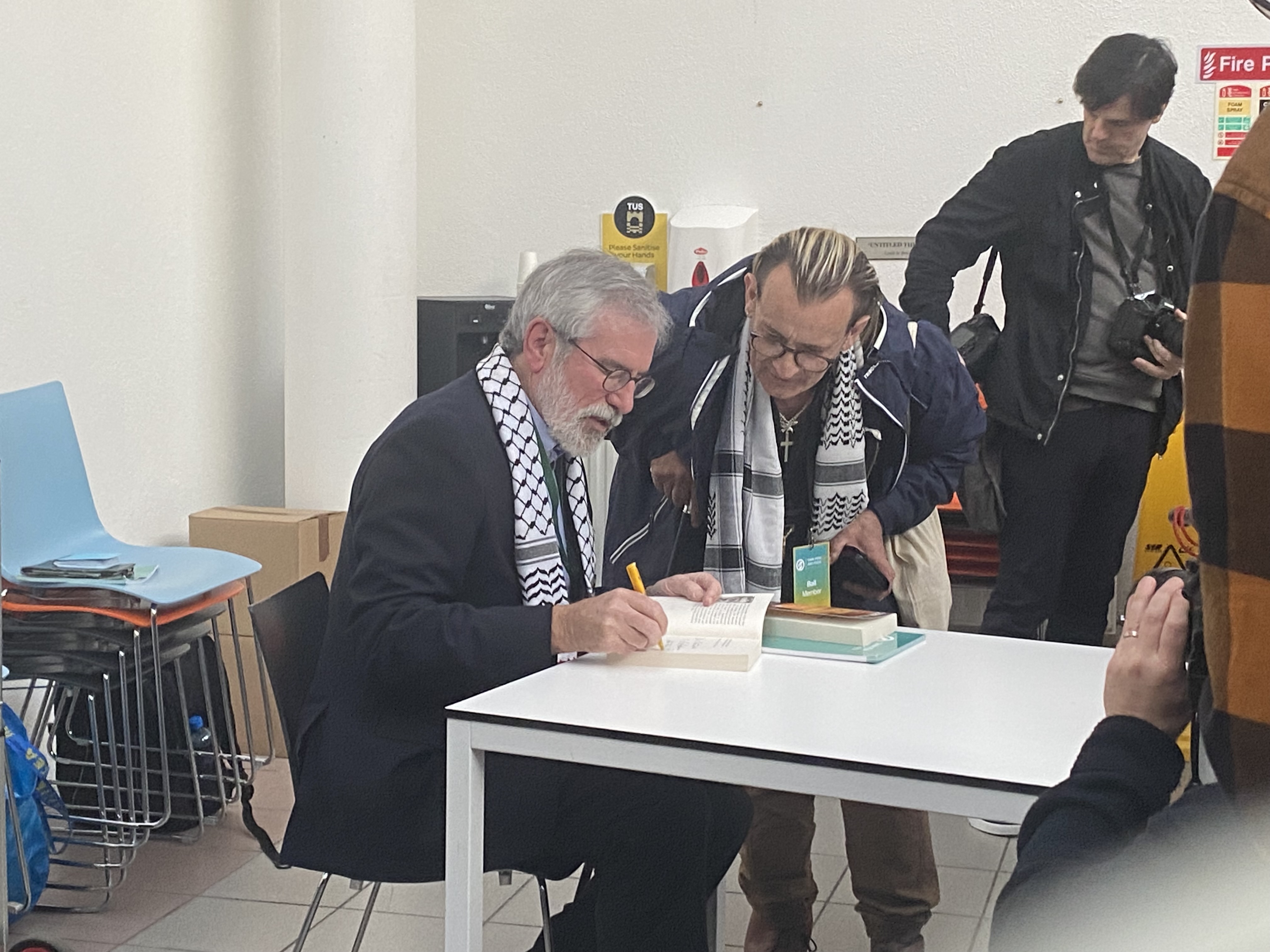
Elsewhere at the Ard Fheis, former Sinn Féin president, Gerry Adams, cheerfully met with a long line of well-wishers as he signed copies of his latest book, Black Mountain and Other Stories. Gerry has authored a number of books including Before the Dawn: An Autobiography; Cage Eleven: Writings From Prison; The Street And Other Stories; Falls Memories; and A Farther Shore: Ireland’s Long Road.

I am proud to say that Gerry’s Donegal holiday house lies less than 10 kilometers from my own home and that his mother and mine were very close friends as teenagers, working side-by-side in west Belfast and stayed together in the Donegal Gaeltacht on several occasions (with their interest in boys vying closely with their interest in the Irish language and culture, I am reliably informed).

Former Sinn Féin president, Gerry Adams, signs copies of his books.

One-Eyed One Irish legend recreated by talented Donegal drama group in Falcarragh

Ever heard about Balor of the Evil Eye?

It’s an ancient Irish legend about the nasty, one-eyed mythical tyrant of a King on Tory Island in Donegal who’s killed by his grandson, Lugh – and there’s no better way to enjoy this suspense-filled story of life and death than when it’s hosted by the Cloughaneely Players, a delightful drama group in the local town of Falcarragh.

As part of its ongoing community service programme, this amiable band of actors and friends put on a wonderful outdoor show recently that had schoolchildren and adults alike both enchanted and enthralled. 
And it took place, most appropriately, beside a 16-foot pedestal, a white limestone boulder with red veining atop a pillar known as the ‘Cloughaneely Stone (Cloich Cheann Fhaola)’, the red veining symbolising the petrified blood of a chieftain called MacKineely (Cian mac Cáinte) beheaded on the stone by Balor after he discovered he planned to kill him after he’d stolen one of MacKineely’s prized cows – Glas Gaibhnenn.

Under the astute direction of Murray Learmont and led by narrator, Joe Kelly, a leading folklorist, the actors had young schoolchildren jumping up and down like excited kangaroos just out of their pouches during the entire production (and a few adults too, though I dare not say who they were less I embarrass them).

Organiser of the event was Mark Boylan, co-manager of the Cloughaneely under 11 Irish GAA football team, with Kevin Scanlon, chairperson of the Cloughaneely Minor Board, giving a short speech to kick-off the evening. 

A stellar cast, one with the creative ability to slip off-script and concoct amusing dialogue spontaneously, included Denis Doohan in the lead role of Balor (I particularly liked his joke about Balor having more defenders than Jim McGuinness, the recently-named manager of the Donegal Irish senior GAA football team. 

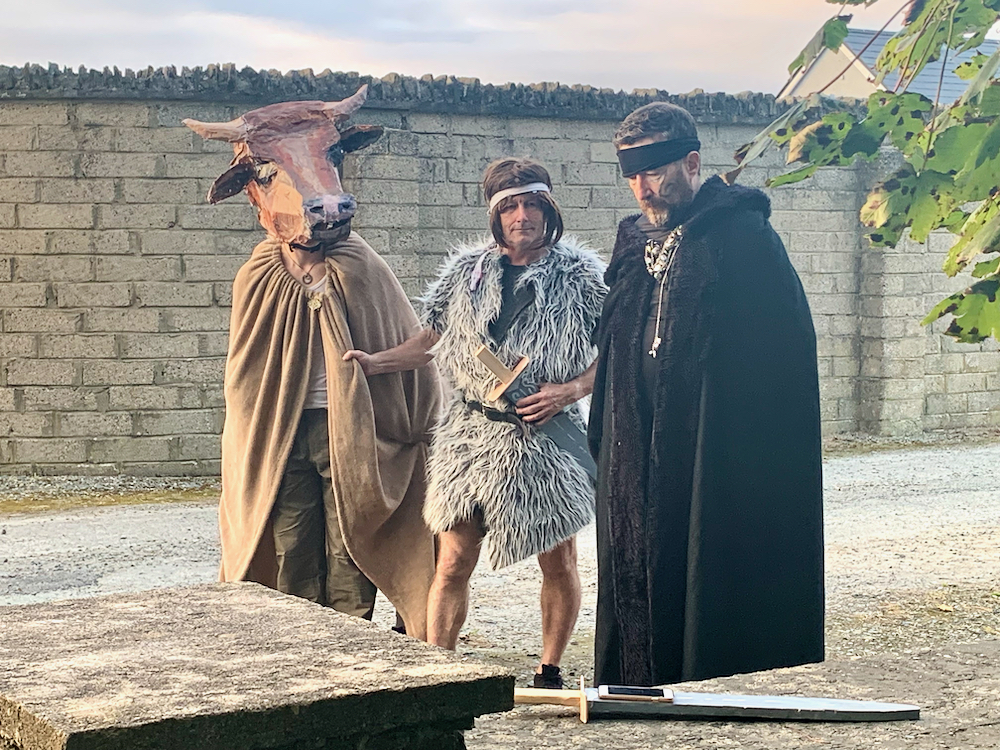
The intrepid, Mickey McHugh, showing off his dainty, Lionel Messi-like legs and dressed in a costume that looked like it was woven from the hair of a banshee, acted as MacNeely. Insiders say Mister McHugh was specifically chosen for the role due to his lifelong, hard-won, cow-milking abilities which he displayed with tremendous exuberance – by spraying the entire audience with his own brand of the liquid. 

(l to r) Yanto and Rohan as the forever-giving milk cow, Mickey McHugh alias Lionel Messi and Denis Doohan as the face-decorated Balor consider their options.

Lugh, Balor’s grandson, was played wonderfully by Pierce Butler, especially impressive with his warlike cries and deadly sword fight with his grandfather, leaving his foe prostrate among a crowd of enthusiastic youngsters.  

Legendary cow, Glas Gaibhnenn, receives a wee bit of attention off-stage.

Kudos also go to Maggie McKinney, a native of Castlewellan, County Down, who played not one, but two roles – the screeching witch, Biróg, who predicts Balor’s downfall, as well as the bold and brassy, what-are-ye-waiting-for-let’s-have-sex, Eithne, Balor’s daughter, who – in what must be Guinness World Record time – ‘enjoys relations’ with MacNeely and produces not one but three babies, one of which was Lugh. All done and dusted in thirty seconds.

‘Prepare to die’ says Lugh (Pierce Butler) to Balor (Denis Doohan) – but only one will emerge alive.

Mention must also be made of the cow – the beloved animal that was at the center of the entire conflict. As one who has never tried imitating a member of the bovine community, I can only presume that acting the role of a cow is not easy by any means. So many congratulations to Yanto and Rohan, members of Youthreach, for doing so.

Birog the witch (Maggie McKinney) confronts MacNeely (Mickey McHugh).

Next on the dramatic circuit for the talented Cloughaneely Players is a production of the classic story, Casablanca, which I’m reliably informed may be staged sometime in November.

Photographing the entire dramatic proceedings on the evening was Annamarie Coyle, so watch out for her excellent images capturing one of the most tantalising struggles in Irish legendary history.

Every song has a story, every story has a song

Such is the headline on the inside label of a CD by supremely talented Donegal-based singer-songwriter-multi-instrumentalist Brí Carr and it ’s an extremely appropriate phrase.

For Brí is one of those naturally gifted artists who literally can turn a phrase into song and music as she did quite brilliantly during an evening of excellent entertainment on Culture Night recently that she hosted at Amharclann in Gaoth Dobhair, Donegal where she is that theatre’s first-ever Artist-in-Residence.

Taking a phrase from one of the writers attending international workshops that week hosted by ‘Ireland Writing Retreat,’ she transformed the words of Bernie Doody from Omagh into a spontaneous slice of music that left seated writers from countries as diverse as Germany, Ireland and the US gasping with admiration. You’ll also appreciate Brí’s many talents in doing this by listening to the short music video above taken that very evening.

Though Brí has been writing songs since the tender age of 16,  she never performed publicly until she was in her 40s. That was due to part to derisory laughter she received by a man after she had penned a song to uplift the spirits of a close friend who had just found out she was pregnant. That song is entitled ‘Yesterday’ and, after listening, it is very hard to forgive the ignorance of the man whose only response was critical laughter.

But that is just one song in a wide-ranging portfolio created by Brí over the years and which feature on her CDs, namely ‘Full Circle/Rotha an tsaoil’ and ‘Roots/ Fréamhacha,’ as well as her singles.

Take, for example, ‘Smile Again,’ penned as a young college student in honour of her beloved Uncle John who left his native Arranmore Island in Donegal to work in the London tunnels in the summer of 1988 and sadly died just a few months later.

Extending the island theme, the place of her mother’s childhood, she then wrote ‘ Árainn Mhór,’ her first single, released in early November 2016, which captures the mystery, tradition and history of the island. It reached Nr. 3 in the Irish iTunes Charts in World Music that same week. Other songs in tribute to the island include ‘Ar an Oilean,’ ‘Where We Went To School’ and ‘Home To Shore.’

In late December 2016, her follow-up single, ‘My Father’s Legacy’ topped the charts in Easy Listening Music. It features a beautiful vocal from her then 7-year-old daughter, Caela.

Enjoying close family bonds, Brí dedicated at least three songs to her husband and children, whom she says “never fail to surprise me.” The songs include ‘How I Love Him,’  ‘Tog Mo Lamh Aris’ and ‘Bealach an tSaoil.’

Aside from song-writing, Brí, a teacher, is heavily involved in arts education.

As a job-sharing resource teacher in Lurgybrack NS, I’m extremely fortunate in that I can develop and build upon my facilitation skills in and out of the classroom,” she states on her website. “To date I have enjoyed working with the children and staff of my own school on various school projects, from our LucyBarney School TV, Seachtain Na Gaeilge, Scór, RTE Junior and after-school music and drama. We have recorded albums for ourselves and with the Goats Don’t Shave as part of charity projects.”

Brí’s activities are multi-level. “I enjoy regular interactive workshops with other schools, mainly facilitated by Donegal County Library as part of WainFest, Ireland Reads and Spring into Storytime, which I thoroughly enjoy as it gives me the opportunity to teach and learn from students and teachers from Junior Infants all the way to Leaving Cert, creating and collaborating on new ideas, methodologies and cross-curricular activities,” she said.

As part of Peace IV, Brí was facilitator and director of several inter-school music, art and drama projects from Derry to Dunfanaghy, creating stories, exploring local heritage and cultures, bringing lively performances to the stage in Ozanam Centre, Dunfanaghy, the Workhouse, Dunfanaghy, An Grianan Theatre, Letterkenny and Relay for Life Donegal.

Collaborating with Donegal Education Centre, Donegal Women’s Centre and local schools helps me keep focus on the curriculum, and come up with new ideas for implementation in a fun and educational way,” she said.

Brí is also deeply involved in other organisations and initiatives including Blue Ribbon Arts, the Wider Horizons Project USA and Wild Atlantic Women, to name but a few. A manual by her in both Irish and English will soon be published entitled ‘The Big Blue Ribbon Book of Drama.’

International guests from Germany, the US, Romania and Ireland enjoyed musical performances by Brí and fellow artists, including her daughter, Caela (standing beside her in shorts), at Amharclann on Culture Night recently.

Her book is filled with almost thirty years of Arts in Education games, ideas and inspiration to aid fellow teachers in delivering Drama and SPHE games. She also created the ‘Ready to Rock Music Programme’ for Primary schools with CJ Fallons and is a member of ‘Wild Atlantic Women,’ a group of Donegal’s finest female artists in a wide range of genres from folk to country, traditional to modern who she said, “decided to join their voices in support of all thing Donegal.

As for being Amharclann’s first Artist-in-Residence, pride oozes from her. “It is an honour and a privilege for me as both an artist and as a lover of west Donegal culture, language and heritage,” she said. “I have thoroughly enjoyed the opportunities and challenges coming out of the Covid era, as people are beginning to re-emerge and embrace life in a careful, cautious way. What better way than through the arts, between concerts, exhibitions  theatre, music and drama  all of which are rich and abundant in the Rosses and Gweedore communities. I have been blessed with support of all ideas during the year, and as well as Oíche Chultúr, there has already been a great many stand out moments that I’ll carry with me on to the next phase of my journeys via writing, performance and community involvement.

Brí Carr and Anne Biddie (r) make a terrific musical duet.

Brí is thankful for the opportunities she has been offered.

I can never thank the people of Gweedore, and in particular Coiste Amharclann, for giving me this platform to further explore my work, my art and most of all, my self belief. I’ve had such growth, nurtured many new friendships and been part of countless amazing memories. I’m really excited about all the projects so far and will definitely be rowing in behind the next recipient of Artist-in-Residence, if they’ll have me, to further develop as an artist , engage more with the local community and continue my commitment to Amharclann in the years to come.”

It is certainly no surprise to learn about Brí’s favourite motto: ‘Lots to learn lots to do.’

Was Columba gay?

Thousands of euro of public money are pouring into diverse celebrations this year throughout Ireland to celebrate the life of a 6th century Celtic monk called Columba (or Colmcille) – a strange and elusive man we know almost nothing about.

Even though schools, community centres, Christian churches, local councils and other groups celebrate the 1,500th year of the mystical monk’s birth, no-one knows exactly when he was born. Nor do we know exactly where. We think it was Donegal but we don’t know for sure what part. We know he left Ireland for the Scottish island of Iona where he spent a good part of his life. But we don’t know the real reasons why.

Sitting on the Torr an Aba (Hill of the Abbott) in front of Iona Abbey where it is said Columba did most of his meditating.

We don’t even know for sure if Columba had a mistress, a wife, children, or indeed whether he was gay or bisexual like many of the monks of his time. (Celibacy was not compulsory then, monks/priests could marry and have families and homosexuality was not denigrated as it is today by the Catholic Church).

Nor do we know where Columba is buried. It was thought his bones (or at least the smaller ones) were wrapped up inside a wooden casket covered with silver and copper-alloy designs known as a reliquary and carried by Scottish soldiers at the Battle of Bannockburn where they famously defeated the English. But we now learn there was nothing in the box, which now sits behind a glass case wired to a sophisticated security alarm system in the National Museum of Scotland in Edinburgh and labelled as the ‘Monymusk Reliquary.’

Make no bones about it – Columba’s relics are not in the ‘Monymusk Reliquary.’

The reason we know so little about Columba is that while he and his followers attracted a worldwide reputation for penning and illustrating magnificent books of all kinds including the famous Book of Kells, there are no records whatsoever of Columba’s own personal writing, not even a simple diary.

So, how is it then we’re spending so much public money celebrating a man we know nothing about, indeed a man who was never even declared a saint, though most people think he was. Why would the Vatican canonise him anyhow? After all, the Celtic Christian church Columba represented stood firmly against the Roman version, battling tooth and nail for ultimate supremacy, that issue being eventually settled at the Synod of Whitby in 664 with Rome being the victor.

Who knows, perhaps Columba, a lover of herbs, specially St. John’s Wort, followed too many Pagan practices, maybe even believing in faeries, and his writings were wilfully destroyed by the powers that be in Rome.

This brings me to another man, a man of our time.

Dr. Brian Lacey relaxes at his rural west Donegal home in the shadow of Errigal mountain.

Lively septuagenarian, author, archaeologist and historian, Brian Lacey is an exceptional dinner guest. A fine raconteur with quirky views of the world, he’s a man at ease with laughter and story-telling.

And he has just penned his latest book, on a spin-doctor called Adomnán (or Eunan) who single-handedly raised Columba’s name to ‘the High Heavens’ by inventing a series of mostly fictional or at the very least, highly-exaggerated, stories about the founder of Iona Monastery and the ‘miracles’ he supposedly performed.

Rather than it being a selfless literary endeavour, Adomnán’s reasons for writing his book were directly linked to both politics and money. In raising the profile of Columba, he also raised the public profile of the community of monks on Iona that he presided over 100 years after its founder had passed on, thus no doubt encouraging new recruits to sign up and more money donated to the monastery’s coffers.

Meeting the man himself, academic celebrity par excellence.

Some in Ireland might use local slang and call Adomnán ‘a cute hoor,’ loosely translated as ‘a shrewd scoundrel, especially in business or politics.’ Probably he was, but he also achieved much more, as you can see from the article below I wrote for the ‘Donegal News’ recently.

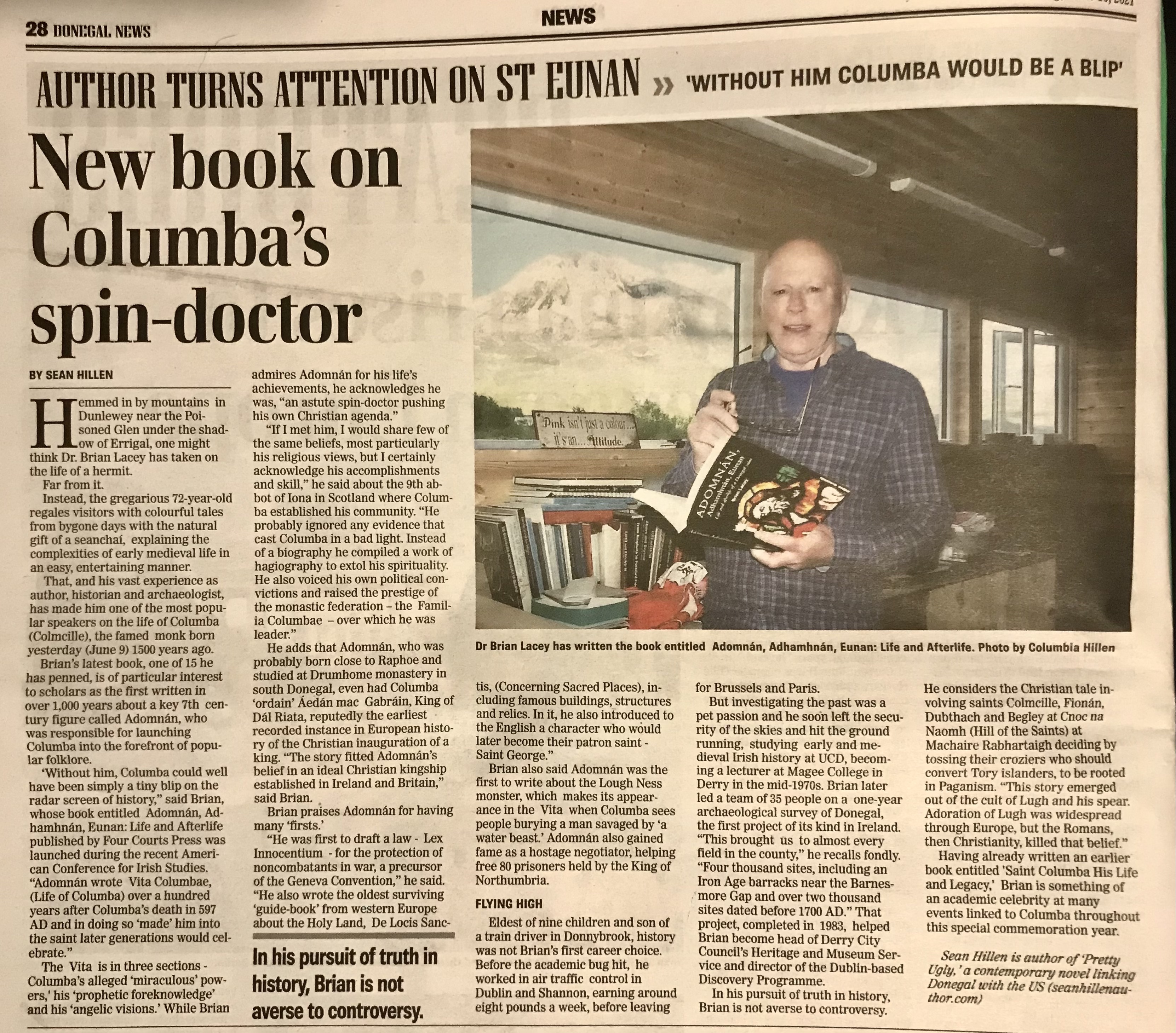
New Book On Columba’s Spin-doctor 

By Sean Hillen

Hemmed in by mountains in Dunlewey near the Poisoned Glen under the shadow of Errigal, one might think Dr. Brian Lacey has taken on the life of a hermit.

Far from it.

Instead, the gregarious 72-year-old regales visitors with colourful tales from bygone days with the natural gift of a seanchaí, explaining the complexities of early medieval life in an easy, entertaining manner.

That, and his vast experience as author, historian and archaeologist, has made him one of the most popular speakers on the life of Columba (Colmcille), the famed monk born yesterday (June 9) 1500 years ago.

Brian’s latest book, one of 15 he has penned, is of particular interest to scholars as the first written in over 1,000 years about a key 7th century figure called Adomnán, who was responsible for launching Columba into the forefront of popular folklore.

‘Without him, Columba could well have been simply a tiny blip on the radar screen of history,” said Brian, whose book entitled Adomnán, Adhamhnán, Eunan: Life and Afterlife published by Four Courts Press was launched during the recent American Conference for Irish Studies. “Adomnán wrote Vita Columbae, (Life of Columba) over a hundred years after Columba’s death in 597 AD and in doing so ‘made’ him into the saint later generations would celebrate.”

The Vita is in three sections – Columba’s alleged ‘miraculous’ powers,’ his ‘prophetic foreknowledge’ and his ‘angelic visions.’ While Brian admires Adomnán for his life’s achievements, he acknowledges he was, “an astute spin-doctor pushing his own Christian agenda.”

“If I met him, I would share few of the same beliefs, most particularly his religious views, but I certainly acknowledge his accomplishments and skill,” he said about the 9th abbot of Iona in Scotland where Columba established his community. “He probably ignored any evidence that cast Columba in a bad light. Instead of a biography he compiled a work of hagiography to extol his spirituality. He also voiced his own political convictions and raised the prestige of the monastic federation – the Familia Columbae – over which he was leader.”

He adds that Adomnán, who was probably born close to Raphoe and studied at Drumhome monastery in south Donegal, even had Columba ‘ordain’ Áedán mac Gabráin, King of Dál Riata, reputedly the earliest recorded instance in European history of the Christian inauguration of a king. “The story fitted Adomnán’s belief in an ideal Christian kingship established in Ireland and Britain,” said Brian.

Brian praises Adomnán for having many ‘firsts.’ 

“He was first to draft a law – Lex Innocentium – for the protection of noncombatants in war, a precursor of the Geneva Convention,” he said. “He also wrote the oldest surviving ‘guide-book’ from western Europe about the Holy Land, De Locis Sanctis, (Concerning Sacred Places), including famous buildings, structures and relics. In it, he also introduced to the English a character who would later become their patron saint – Saint George.”

Brian also said Adomnán was the first to write about the Lough Ness monster, which makes its appearance in the Vita when Columba sees people burying a man savaged by ‘a water beast.’ Adomnán also gained fame as a hostage negotiator, helping free 80 prisoners held by the King of Northumbria.

Flying  high

Eldest of nine children and son of a train driver in Donnybrook, history was not Brian’s first career choice. Before the academic bug hit, he worked in air traffic control in Dublin and Shannon, earning around eight pounds a week, before leaving for Brussels and Paris.

But investigating the past was a pet passion and he soon left the security of the skies and hit the ground running, studying early and medieval Irish history at UCD, becoming a lecturer at Magee College in Derry in the mid-1970s. Brian later led a team of 35 people on a one-year archaeological survey of Donegal, the first project of its kind in Ireland. “This brought us to almost every field in the county,” he recalls fondly. “Four thousand sites, including an Iron Age barracks near the Barnesmore Gap and over two thousand sites dated before 1700 AD.” That project, completed in 1983, helped Brian become head of Derry City Council’s Heritage and Museum Service and director of the Dublin-based Discovery Programme. 

In his pursuit of truth in history, Brian is not averse to controversy. He considers the Christian tale involving saints Colmcille, Fionán, Dubthach and Begley at Cnoc na Naomh (Hill of the Saints) at Machaire Rabhartaigh deciding by tossing their croziers who should convert Tory islanders, to be rooted in Paganism. “This story emerged out of the cult of Lugh and his spear. Adoration of Lugh was widespread through Europe, but the Romans, then Christianity, killed that belief.” 

Having already written an earlier book entitled ‘Saint Columba His Life and Legacy,’ Brian is something of an academic celebrity at many events linked to Columba throughout this special commemoration year.

Published in the ‘Donegal News’

If you want to know more about skulduggery disguised as religion and furious political struggles between Celtic Christians and their Roman counterparts, read the excellent series of Sister Fidelma novels by Peter Tremayne (pseudonym for Peter Berresford Ellis, historian, literary biographer and novelist). 

Fidelma is a ‘dálaigh’ or judge in ancient Ireland, a sexy red-haired female version of Sherlock Holmes in a habit.

Intrigued by the reputation of this early Irish mystic monk known as Columba, I decided as a travel writer to head for Iona, the Scottish island where he established his community of like-minded people. Here’s what I found after landing on a little stony pier after taking the ferry from Mull last autumn, a massive, treacherous sea crossing that took all of five minutes.

Click on the photo to read the story

Gifted Donegal women host music concert for worthy cause

Death is rarely asked to sing.

But a group of immensely talented women Friday night at Amharclann theatre in the Donegal Gaeltacht invited it to join them – transforming it into a celebration of life, community spirit and artistic triumph.

Devoted to Fiona Carr, popular singer and dancer who fell victim to cancer at the young age of 30 and others like her who bid their last farewells under tender care at the Donegal Hospice, local performers known as the ‘Wild Atlantic Women’ gathered together for a heartfelt musical tribute.

wild atlantic women concert, live music donegal, donegal women singers

And what an uplifting evening it turned out to be.

Regardless of your favorite musical genre, this special concert seemed to have it all – soul and folk, traditional and country, the popular and the newly-penned.

Lead organiser, teacher-multi-instrumentalist-singer-cum-songwriter Brí (Brighdin) Carr with many local female musicians have already raised more than 15,000 euro for Donegal Hospice and the Oncology Department in Letterkenny University Hospital through such events and a double CD.

Few better ways to open such a concert than this admirable group of women together in harmony led by Emma Ní Fhioruisce, Maria McCormack and Bernie Doherty on the haunting folk ballad ‘Caledonia, the unofficial anthem of Scotland written by singer-songwriter Dougie MacLean.

And few better ways to end it than their touching interpretation of ‘Grace,’ written by Frank and Seán O’Meara, telling the tragic story of Grace Gifford who married Irish rebel leader Joseph Mary Plunkett, in Dublin’s notorious Kilmainham Gaol shortly before his execution by firing squad in 1916.

Between these songs, an appreciative audience enjoyed two hours of inspiring entertainment by women, young and old, who displayed remarkable vocal range and musical prowess, drawing a standing ovation for their efforts.

With so many highlights, it’s impossible to describe them all, but here’s a flavour of the evening –

Noeleen Ní Cholla, Gaoth Dobhair-based award-winning sean nos singer-songwriter-instrumentalist, whose angelic voice can be heard on her album ‘An Mhaighdean Mara,’ performed pitch-perfect the Irish-language version of ‘Somewhere Over The Rainbow,’ the ever-popular song written for the 1939 film The Wizard of Oz. How she managed to reach those high notes is beyond me.


Glasgow-born singer, guitarist and lawyer, Jacqui Sharkey, with three albums already to her name, sang ‘Never Be The Sun’ by Donagh Long from Cork. Recorded with her friend and fellow singer Caitlin Murtagh from county Down, and produced by Pat Gallagher of ‘Goats Don’t Shave’ fame who also plays guitar backing. This song will be officially released on February 28 and a video aired on Sky TV this week.

On keyboards, Brí Carr, who founded Blue Ribbon, a performing arts group for children, sang a song she wrote, simply entitled ‘Home,’ as well as a duet with Claire Ward called ‘Second Violin,’ by Irish band, Bagatelle, one Fiona Carr herself recorded aged 14 for Blue Ribbon.

‘H.o.m.e,’ Brí’s next album will be released in May. Her song, ‘Árainn Mhór,’ was the first iTunes chart song as Gaeilge in the Top 200 in Ireland, peaking at number 3. Bubbly Brí, who keeps a ‘big blue book’ of songs she has composed over the past 25 years, also participated in ‘South Of The Border’ festival in Ardara this past weekend. Her first album, ‘Full Circle/Rotha an tSaoil,’ is on iTunes and Spotify. Bernie Doherty sang a beautiful rendition of the wistful ballad, ‘Who Knows Where the Time Goes?’ by English folk-rock singer Sandy Denny. Bernie is now involved in the formation of the ‘Choir of Ages’ its members ranging in age from 5 to 80.

Accomplished pianist and keyboardist, Kelli Nic Ruaidhri,  from Fanad who teaches in Ballinamore and supported many of the songs on the evening, also sang ‘Sanctuary,’ which she translated into ‘Beidh mé Ann.’


Maria Mc Cormack’s contributed to the evening’s success with a song about her own personal experience of lost love. Entitled ‘Stratford to Stansted,’ about someone moving away to London for work, it will feature on her second album, her first being, ‘I Choose To Love.’ Aside from gigs this year in Slane (Purple Sessions), Drogheda (Fireside Festival), and even a St. Patrick’s Day festival in Germany, Maria will also play at the Letterkenny Jazz and Blues Festival on July 4th Maria has set up a fundit page to help support her upcoming recording.

Looking like a sultry Marilyn Monroe in black silk on stage, Rachel Akkoç, actress, singer and member of the Letterkenny Musical Society, transported listeners to a smoky uptown New York nightclub with her soft, seductive interpretation of soul song ‘I Know Where I’ve Been’ from the musical ‘Hairspray.’

Highlighting the difficulty of ‘letting go,’ and having special meaning for me as my mother died last week, Clare Ward sang ‘Reflections’ in remembrance of her friend Manus Kelly, killed tragically last year in the Donegal International Car Rally. Claire’s album is called ‘Bite the Bullet,’ an eclectic mix of folk, Celtic and easy rock music. Recent solo recordings include ‘Eye of the Storm,’ and ‘Remember,’ about a friend’s journey with Alzheimer’s.

Last but certainly not least were what could best be described as ‘the Little (Wild Atlantic) Women’ – girls, aged six and upwards, namely Caela Carr, Siofra Harvey, Clodagh Mooney, Mia Clarke, and Hannah NicPhaidín, all award-winning singers and musicians. They drew enthusiastic applause from the audience with a rousing medley that included ‘I Wish I Had Someone To Love Me,’ ‘Rós na Seirce,’ “Christmas Letter,’ ‘Fear a’Bhata,’ ‘Angels Among Us,’ ‘Liom Féin’ and finally, ‘Home To Donegal.’

Other excellent singers included –

Trish Rodgers, whose albums include ‘This Is My Island,’ ‘Home Sweet Home’ and ‘The Gold Collection’ – singing, ‘Donal Óg.’

Deirdre Bonner, whose albums include ‘Remember When’ and ‘Atlantic Bridges’ – singing, ‘Come All Ye Fair And Tender Ladies.’

Maria McCool, whose albums include ‘Ailleog, ‘Doagh and ‘Shenandoah’ – singing ‘Teddy O’Neill.’

Gearóidín Breathnach, a leading sean-nós singer, whose album is ‘Ar Fhoscadh na gCnoc‘ – singing ‘Anseo I lár an ghleanna.’

and the velvety-voiced Emma Ní fhioruisce from Gaoth Dobhair – singing ‘Ar Ais go Gaoth Dobhair.’


Kudos to Áine Ní Churrain (Barrscéalta Raidio na Gaeltachta) and Karen Gallinagh (Speech and Drama Federation Ireland) who acted as excellent MCs and to Serenity Hair & Beauty Salon Gweedore which donated a 200 euro voucher to a lucky raffle winner.

Appreciation poured in for the artists –

A great night had by all at the Valentine’s night concert by the ‘Wild Atlantic Women.’ We had a fantastic time. Such a talented group of singers and for such a worthy cause as the Donegal Hospice.” Simon Smith, Letterkenny, professor of nursing.

wild atlantic women, live music donegal,

Friends obviously having a good time at Amharclann.

I thoroughly enjoyed the ‘Wild Atlantic Women’ concert in the Amharclann, Gaoth Dobhair. It was an eclectic mix of musical genres, excellent song-writing and inventive reworking of older songs. A great night’s entertainment.” David McNally, librarian and researcher.

A great mix of talents, and all age groups, both languages, and the modern and the traditional. Agus neart craic! I particularly enjoyed the translated songs such as Maria Nic Cumhaill’s ‘Grace’ and Noleen Ní Cholla’s ‘Thar an Tuar Ceatha’(Somewhere Over The Rainbow). Given the night that was in it, we had love-songs and songs of unrequited love such as the haunting and ancient Dónal Óg, Thíos i Lár a’Ghleanna and a new song about love lost to modern day emigration.
Well done ‘Young and Tender Ladies’ of Donegal (one of ballads sung on the night) for sharing St Valentine’s evening and helping an important cause. Having the CD, I can now enjoy it all again.
Reuben Ó Conluain, retired teacher Dún Laoghaire and Machaire Rabhartaigh

Sabba Curran, gola boat ferry, gola island ferry

Sabba and Patricia Curran getting settled for an evening of music and song.

A wonderful night of entertainment, so many talented singers and musicians on stage at one time. Truly memorable.” Sabba Curran, Captain of ‘The Cricket,’ Gola Island ferryboat.

Journalism: a funny thing, sometimes

Sometimes it’s not writing about political showmanship and skullduggery or economic booms and busts that create good journalism.

Sometimes, it’s the simple quirks of everyday life that make for a good story.

You can imagine my delight in unearthing these two tales of near disaster in Donegal that end happily.

They give new meaning to the term ‘missing people.’

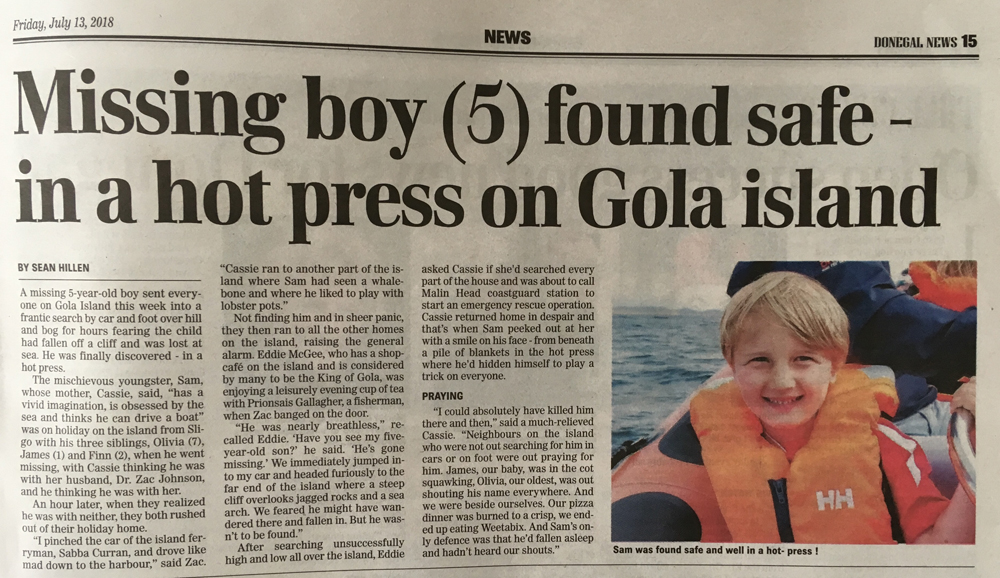
Missing boy (5) found safe – in a hot press on Gola Island

gola island donegal, donegal tourism, gaeltacht tourism,

He almost ‘missed the boat’ 

gaeltacht tourism, gola island, donegal tourism


Donegal Gaeltacht community spirit rides high

I was delighted to write this feature piece for the ‘Donegal News’ recently supporting the hard-work, communal spirit and creativity of people in Gaoth Dobhair, Falcarragh and the Rosses in hosting their respective festivals.

For such a small rural area, often there are more diverse cultural activities – dance, theatre, sporting events, concerts, to be name but a few – than in major urban areas.

Delightfully, making choices as to which to attend can be the biggest challenge.

Sean Hillen Donegal gaeltacht, donegal gaeltacht,

Wizards of Lies, or nightmare accountancy?

Would you approve almost one million euro in public money for a company with liabilities of half a million and a cash shortfall of around 200,000?

Hardly.

Strangely, that’s what seems to have happened in the case of SLM, the English call center that closed several weeks ago without warning in the Donegal Gaeltacht leaving many local people still owed a big chunk of back salaries.

Helluva Christmas gift Mr. Scrooge!

And here’s something even more intriguing…

Michael Gallagher, from the coastal village of Falcarragh, is an intelligent and likeable fellow, a man deeply concerned about social justice.

Sensing something amiss, Michael decided to carry out his civic duty and promptly investigated the financials of the Manchester-based company in the official register. Shocked by what he unearthed, he quickly warned two senior staff members at the economic group, Údarás na Gaeltachta, which intended to hand the company close to a million euro of scarce public money.

Michael Gallagher letter about SLM, Udaras and SLM

Alas, Michael’s timely and crucially important information seemed to have been promptly ignored as Údarás went full-steam ahead with its earlier decision to pour 842,000 euro into the company – strongly supported, maybe even led, by Minister of the Gaeltacht, Joe McHugh.

The award was announced with fancy fanfare, with screaming national and local newspaper headlines. Written by Greg Harkin, now a spin doctor for Minister McHugh, an article in ‘The Irish Independent’ read, ‘125 new jobs announced at SLM Éire Teo in Donegal.’  Not surprisingly, McHugh – who seemingly went to school with SLM manager James Moran and flew to Manchester to seal the deal – was given a pretty quote about being ‘delighted.’

The Údarás website blasted, ‘UK Digital Marketing company to create 125 jobs in Gaoth Dobhair, Co. Donegal,’ with its then CEO  Steve Ó Cúláin saying, “Today’s announcement is the result of Údarás’ enterprise strategy for this vibrant Gaeltacht region. I wish the promoters of SLM Éire every success and wish to thank the Údarás employees whose dedication is helping to make this jobs announcement become a reality.”

Cupán Tae

Meanwhile, quite separately, my interest in SLM began in the most innocent of ways – over a welcome cup of tea shared with a fellow jogger after a challenging morning run. The person worked at the call centre and complained training was lax, pay was the legal minimum, bonus targets were pretty much unreachable and on-the-floor Manchester managers were as scarce as a prickly cactus growing in the turf bogs. Adding that only around 30 people worked there, a far cry from the 125 promised more than a year before.

Two weeks later, on December 3, an article appeared in the ‘Donegal News,’ with the surprising headline ‘SLM Eire Teo Plans To Increase Its Workforce.

Strangely – considering the company closed its doors permanently in Donegal a few short weeks later, barely one year into operations – local SLM manager, James Moran and Paid O’ NeachtainÚdarás public relations director, both said the company would employ more people.

Sheer ignorance? Spin doctoring? Who knows?

Out of the quagmire that has resulted, a key question remains: why did a supposedly experienced, national economic organization such as Údarás award such a formidable grant to a company obviously struggling to make ends meet?

Michael Gallagher discovered SLM Manchester at end financial year 2015 had liabilities of 556,400 pounds sterling and a cash shortfall of 171,600. My Freedom of Information request showed Údarás approved an employment grant for SLM of 614,000 euro, plus a 60,000 employment grant for managers, a training grant of 100,000 and rent subsidy of 68,000.

budget for SLM Donegal, Udaras funding SLM Donegal

Is no-one at Údarás trained in simple analytical accountancy? Did they simply choose to ignore SLM’s shaky financial situation? Or did Minister McHugh – for political kudos through positive media coverage – override concerns that may have been raised by Údarás staff? Or indeed, did everyone involved truly believe this was an employment bonanza for the Donegal Gaeltacht but were duped by SLM owners?

The answer my friend – to use the words of a well-known song ‘…is blowin’ in the wind.’ And, as usual in modern Ireland, no-one’s taking responsibility for failings.

Isn’t this exactly what got Ireland into economic quicksand? Isn’t this why the World Bank and the IMF own us? Isn’t this why health and education are underfunded, why sick people with IVs in their arms are sleeping on chairs in hospital corridors?

If you want to know more about how Údarás spends scarce public money, simply e-mail Cathal O Gallachóir c.ogall (at) udaras.ie and ask for information under FOI. With what you find out, you might even be encouraged to do what Michael Gallagher did, write a letter to the editor Údarás challenged on SLM dealings thus placing important information in the public arena, or notifying concerned councilors such as new Údarás board member, John Sheamais O’Fearraigh.

John Sheamais O’Fearraigh, Udaras Donegal

Curious to know how many SLM jobs that Údarás included in its annual summary, I have requested the much-delayed 2016 report, which 13 months later has still not been published.

It’s still blowin’ in the wind…