Are Fine Gael, Fianna Fail, Labour and pseudo-Independents set on destroying power-sharing in Donegal?

Early last Monday morning as most of us woke up groggily and struggled out of bed to face the week, a dramatic closed-door meeting of the Independent Grouping within Donegal Council was taking place in Lifford at which the very future of politics in the county was being decided.

Or at least that’s one interpretation: that pseudo-Independents (my sobriquet for them) backed by the Coalition Government partners of Fine Gael and Labour together with Fianna Fail were aiming for.

But the political cat might be out of the bag, so to speak.

Could it be that someone poured (or was it self-administered?) poisonous elixir into the ears of certain councillors that the life of an independent within traditionally conservative Irish political circles is a short one, so they’d better rejoin the party fold again – before it is too late? “Being in a party makes for an easier life,” may have been the song on the hymn sheet. “You’ve got the company of like-minded people. Talk up the party you formerly belonged to until we win the Dail, then we – together with you – will control Lifford as well.” If it was, perhaps instead, without knowing, they’ve been listening to the Song of the Sirens.

Donegal councillors, county council meeting

(l to r) Let’s decide on a plan of action. Councillors Frank McBrearty and Michael McBride confer discreetly at Monday morning’s meeting of Donegal County council.

Intriguing backstory

As Councillor Michael McBride told me last week, a motion by John Campbell at Monday morning’s private Independent Grouping meeting to have John O’Donnell expelled from the group supported, by Michael Cholm MacGiolla Easbuig and himself, was defeated by five other councillors, a strange situation to say the least as only last month, they had all voted to make him resign.

But that wasn’t the biggest surprise of that morning.

That came just a few minutes later, immediately Campbell and Easbuig left the Independent Grouping in protest.

“Much to my amazement, someone suddenly called for the dissolution of the entire Grouping,” recalls McBride, who chaired the meeting but said he cannot remember who made what he considered a bizarre call (strange loss of concentration as chairperson at so vital a time). “And it was agreed upon so quickly I can’t but believe they had all discussed this much earlier, in private.”

The five councillors in the Independent Group who voted against O’Donnell’s expulsion were Nicholas Crossan, Tom Conaghan, Niamh Kennedy, Ian McGarvey, and John O’Donnell himself, most former party members.

Later that same evening McBride sent me an e-mail purportedly written by Kennedy stating that, “a decision has been taken to suspend the independent grouping and that no positions would be removed from any member as an investigation is currently underway by the ethics registrar of Donegal county council.”

She added, “None of us are involved in the 25/30 councillors referred to by Cllr.  O Donnell (on the RTE programme). This decision has been taken in the interest of the people of Donegal and in order to accommodate the smooth running of the business of Donegal county council following this past two months of turmoil.” But one is still left wondering why the Grouping was suddenly dissolved? Could it be, as McBride said, that they were fed up working with the fiery Frank McBrearty, who first proposed O’Donnell’s expulsion. Or with the intellectually able Campbell and passionate Easbuig? Or is something more sinister going down?
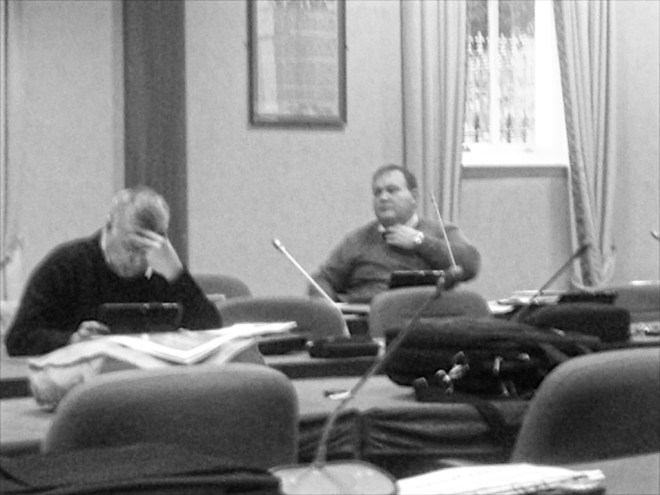
Franc McBrearty, Donegal councillors

Loosening his tie. But then again, Councillor McBride wasn’t wearing one, was he, at the council meeting? Just a bout of nervousness then? Or indecision?

Asked about his feelings on the dissolution of the Independent Grouping, McBride said, “I didn’t want that. It’s good for the council to have the four-group all-inclusive set-up that it has. To my understanding, that kind of power-sharing is unique in the whole country, something Donegal should be proud of.”

I asked McBride several questions

“Would you like O’Donnell – your former business partner in Dúncrua Teoranta, which was granted 120,000 euro from Udaras na Gaeltachta – expelled from all council committees.”

“I would have no problem with him being removed from all committees.”

“Why then did you abstain in the full council vote on the matter this Monday?”

“Because of the way I was treated fairly when I was co-opted on to the council for former Senator Jimmy Harte’s seat.”

“So, you would have been okay with a council decision to expel him, but not for you to vote on it?”

“Yes, it would have been democracy in action.”

Conversation ends.

Shakespeare: Is there something rotten in the state of …. Donegal?

Why would the trio of Fianna Fail, Fine Gael and Labour want the Independent Grouping at Donegal County Council dissolved? Here is a possible answer.

We’ll have a national elections very soon – we’ll know this week just when – and if the situation demands it, these three parties, regardless of what they say now, will try to ‘intermingle’ to form the next Government. But according to latest polls, their Donegal TD candidates desperately need all the help they can get even to shuffle lamely past the finish line – thus the pseudo-Independents. Fifteen years ago, the electoral breakdown was Fianna Fail a massive 70 per cent, Fine Gael 30 per cent, Sinn Fein 0.2 per cent and the rest Independents and Pseudos. Within the last five to six years, the Donegal political pendulum has swung dramatically and is now around 25 per cent Fianna Fail, Fine Gael 18 per cent, Sinn Fein a mighty 40 per cent, and rising, and the rest Independents and Pseudos.

And, let’s be quite clear about this: the main reason some pseudo-Independents are ‘Independents’ is that either their parties didn’t choose them to run last time out or that they’d never have won if they’d gone under that party’s ticket, especially if they’d gone under the Fianna Fail banner. In politics, however, such slights and inconveniences are often forgotten in the greedy grab for the prize piñata.

Concillor O'Donnell, Donegal politics

(r to l) Fianna Fail Donegal County Council chairperson, Ciaran Brogan, prepares for the meeting with council chief executive, Seamus Neely.

What happened behind closed doors Monday morning one week ago after Campbell and Easbuig stood on principle and left could be a classic political quid pro quo situation. ‘Talk up the party in the nationals in a few weeks time and you can run under our ticket for a council spot next time round, and, believe me, you’ll feel more secure for doing so,” could have been the way it was put.

Then again, my hunch might just be the workings of an over-active imagination. The truth might be that the Independent Grouping is a motley group, a raggle-taggle band with perhaps their hearts in the right places, but no cohesion. And so inexperienced and pulled apart by differences that they don’t even realize what their full potential could be if they created unity from diversity and voted for the right things.

This, however, is the perfect time – with national elections six weeks away – to find out which of the above-mentioned theories is the right one. True colors will begin to seep through. Threads will start to unravel.

If something more sinister is afoot, perpetrators of the cloak-and-dagger plotting have sadly overlooked one vital element – common decency. The overriding public mood is one of disillusionment, bordering on despair. If the three main political parties have indeed won the pseudo-Independents over – backed by business elites with much to gain by keeping O’Donnell on the council and on the ever-important ‘Roads’ committee which oversees tens of millions of euro in construction projects – trouble lies ahead. Keep in mind, the council’s annual budget is 133 million, 127 fixed and 6 to 7 discretionary. Construction of the Dungloe-Glenties road is in five-stages, the second, for example, cost around four million euro and the tender for the next stage is end of this month.

The ‘plotters’ may, however, have made the fatal mistake of ignoring the simple, unadorned hopes of ordinary folk, throughout Donegal and throughout the country, hopes for a sliver of common decency among politicians after all the putrid corruption they’ve been forced to roll in over the last five years or so.
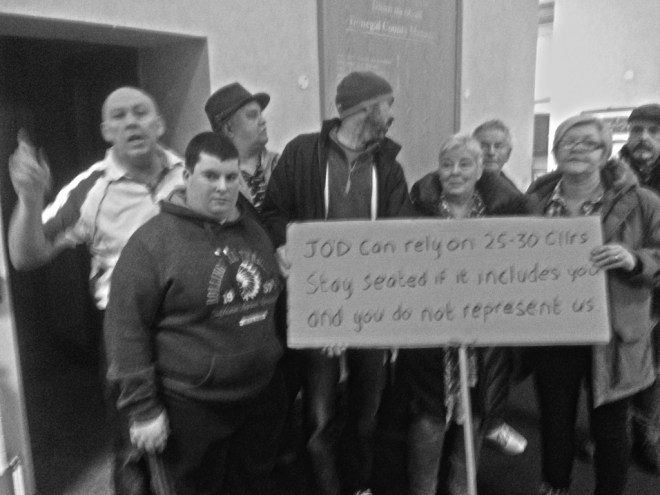
Donegal people demonstrating, Donegal county council

Protestors inside the County Chamber voice their sentiments about Councillor John O’Donnell, corruption and cronyism within and outside Donegal County Council.

Another key question is now being asked in the corridors of power in Lifford: not if, but how many, high-level executives within Donegal Council – many of which were employed both within the county and imported from outside the county, with generous salaries and pensions under the previous, long-running Fianna Fail government – are involved in this purge of True Independents and the break-up of power-sharing? After all, they have to reward their paymasters.

What a shame if such a deceitful game is being played, in this of all years – the centennial anniversary of our national independence.

But in a very short time, you, dear Reader, will have the chance to put things right – by availing of your unalienable right to walk behind a curtain and put your ‘X’ exactly where you want it to be.

Perhaps, this blog will help you choose well. I certainly hope so. It’s a rare chance to truly show that we are indeed ‘different up here.’

As for Councillor O’Donnell….

Epitome of nonchalance

I was quite astounded watching the councillor last Monday morning nonchalantly reading that morning’s edition of the ‘Donegal News’ as the political maelstrom swirled all around him in the council chamber. Either this young man has nerves of steel, I thought, or he is so utterly sure of what will happen that there is absolutely no need for him to be concerned in any way, about anything or anyone. Wish I could wake up feeling that way, as I’m sure do thousands of unemployed, elderly, sick, disabled and struggling mothers trying desperately to feed their children on paltry, insufficient income coming into homes across this county, across the country.

John O'Donnell, Sinn Fein Donegal

Nonchalance or absolute certainty? John O’Donnell displays his lack of concern about the possibility he might be expelled from Donegal County Council on Monday morning. That very evening, he released a press statement thanking his fellow councillors for supporting him.

During a short adjournment, I approached O’Donnell and introduced myself as Gaeilge, thinking – as he had attracted so much Údarás funding – he would be fluent. Perhaps it was due to my poor pronunciation or stumbling vocal ways, but he didn’t seem to understand, so I changed my questioning to as Bearla.

“Can you speak? I’ve a few questions I’d like to ask.”

I’ve been told by my legal advisers not to say anything,” he responded. “They’ve told me to let the ethics investigation takes it course. I’ve nothing to answer for anyway. People are just out to get me and use me as a platform for their own political gains.”

“What would you say to your fellow councilors here if they ask you any questions about your various business interests and debts owed through them?”

“I’d say, ‘That’s none of anyone’s business. It’s my private affair, mine only.”

“What about the 120,000 euro granted to your company, Dúncrua Teoranta, by Údarás na Gaeltachta just before it went bust, can you explain that?

“My legal advisers have told me to say nothing and that’s what I’m going to do.”

“Will you pay the money back?

“No comment.”

Then he went back to reading his newspaper.

O’Donnell, a long-time family member of Fianna Fail, also declined to comment on the court case he faces this Wednesday, Feb. 3 for failing to pay 33,000 euro in compensation to a Creeslough woman whose foot he drove over in a car accident. If O’Donnell does not show up for that case, District Court Judge Paul Kelly has said he will have him arrested.

Next week’s court case should be just as entertaining as the county council meeting last  week – with potentially very serious consequences for all concerned. If, having said he has no money, he pays up, you have to ask yourself: where did the spondulix come from? If his solicitor delays the proceedings, you’ve got to ask yourself: why? Could it be waiting for the results of the upcoming elections? If, however, he is convicted, I am ainformed O’Donnell automatically loses his council seat. There’s a lot at stake.

Go along if you can. It should be as good as an episode of ‘Judge Judy,’ hopefully better – unless some shadowy person(s) gets to the judge before then.

Protestors angry at Donegal County Council’s ‘dog’s dinner’ response to corruption and cronyism

As protestors from across Donegal vented their feelings inside Lifford’s County Council offices yesterday about corruption and cronyism in Ireland – the specific one lighting the fuse relating to controversial Donegal Councillor John O’Donnell – archaic rules, procedural confusion and tribalism prevented members expelling the Kilmacrennan-Fianna Fail linked man from all committees and the full council.

Anachronistic rules meant a counter proposal for what could well be a very long and drawn out ethics investigation by council executives superseded an initial proposal to expel O’Donnell immediately.

At times, the meeting, which was hosted by chairperson, Fianna Fail’s Ciaran Brogan, with the assistance of council executive Liam Ward and Seamus Neely, council chief executive, took on a farcical nature, with some describing it as a ‘dogs-dinner.’ During a discussion in which some councillors were attempting to expel O’Donnell – one of the most controversial decisions the council has faced in its entire history – confusion reigned, some members being unsure which proposal they were actually being asked to vote on. This caused Sinn Fein councillor, Marie Therese Gallagher, to ask the chair for immediate clarification.

Saying O’Donnell’s alleged ‘cash for favors’ actions caught last month on RTE national Irish TV camera were ‘disgraceful’, former Mayor Frank McBrearty (Independent) proposed removing O’Donnell from all committees, a motion seconded by fellow independent John Campbell.

“Due to the serious allegations against Councillor O’Donnell, we have the power to stand together and take action against him,” McBrearty said. “The public demands transparency and responsibility. There is a need to highlight corruption wherever it shows itself. As all politics is local, what we do here affects the nation so we have the chance to give a clear signal to the people of this county that we will not tolerate unethical behavior. The mushroom is getting bigger for Irish society. We must stop the rot now.”

However, a second, counter motion, by former Fianna Fail member, now long-time Independent councillor, Ian McGarvey, requested an ethics investigation be continued by council staff was also forwarded. Afterwards, during a conversation with me, McGarvey said he did not know how long such a process could take.

Confusion also reigned as Ward and Neely said legal advisers had told them O’Donnell could not be expelled from the council or its committees, but when asked for the legal documents proving this the two officials did not produce them. Neither did they bring into the chamber the legal adviser responsible for the advice when asked to do so by McBrearty.

According to Ward’s own instructions, there is “no specific provision within Local Government Legislation to provide for the removal of a member from committees to which he/she was appointed.” He added, “the position being taken is that the Motion as proposed (by McBrearty) is not permissable and, as a consequence, any resolution passed on foot of it would have no legal effect. The current process under the ethical framework should be allowed to continue until conclusion when the matter may come back before the members in one form or another.”

Some local government procedural analysts deem “illogical,” the situation whereby Chamber rules meant councillors were asked by Brogan to vote on the counter motion ahead of the original one put forward by McBrearty. That counter motion was ultimately accepted by 20 of the 36 councillors present, the votes representing Fine Gael, Fianna Fail, Labor and several Independents, mostly former members of Fianna Fail. All Sinn Fein members supported McBrearty’s motion. Independent Councillor Dessie Shiels was absent, having refused on principle to be in the same room as O’Donnell. Councillors McBride and Brogan abstained. Campbell and fellow Independent Councillor Michael Cholm Mac Giolla Easbuig promptly walked out of the meeting in protest saying, “this council has let down the people of Donegal and should be deeply ashamed.”

Added Councillor Gallagher, “I feel debased by O’Donnell and the opinions of some people about what he has done. He has brought disgrace to this chamber. My view is that as he was voted on to committees by council members, they have the right to vote him off them. It is a shame Frank McBrearty’s motion did not pass. This council had the opportunity to expel him and did not take it and now we have to wait until March to discuss it again.”

Protestors, men and women both inside and outside the chamber, said they were “disgusted by the council’s behaviour” adding, “our elected officials have failed to take proper action to stem an ugly, pervasive growing tide of corruption and cronyism sweeping across both this county and this country detrimentally affecting families, the elderly and children.”

Full story with photos and extended quotes coming up later today.

Exclusive: Donegal councillors John O’Donnell and Michael McBride funded by Údarás na Gaeltachta

At a time when controversial ‘cash for favors’ Donegal councillor John O’Donnell was refusing to pay more than 33,000 euro compensation to a Creeslough woman he injured in a car accident 16 years ago, Údarás na Gaeltachta granted him and fellow councillor Michael McBride more than 122,000 euro in public money (see document here Udaras grant), I can reveal exclusively in this blog.

John O Donnell Donegal, independent councilor Donegal

O’Donnell was founder, director and secretary of Dúncrua Teoranta, the company receiving the money. Interestingly, a second director of the company was fellow councillor, Michael McBride, who also acted as company secretary. Both men – now declaring themselves independent councillors – were then members of Fianna Fail. A third director named was Sarah Doherty.

Documents show McBride and O’Donnell became directors of Dúncrua Teoranta on the same day, 14 Sep 2006, when it was set up to sell metal ore. They are also listed as company secretaries. McBride was director for a year and four months, until February 2008 when he resigned. The company’s address was listed as just inside the Gaeltacht, at Cuirin, Termon.

Dúncrua Teoranta

Údarás approved funding for Dúncrua Teoranta of 122,300 euro in 2008, paying out 66,850 euro in that year alone. The owners put the company into bankruptcy within months of the money being given. Aidan Garcia of Collins Garcia Corporate Recovery, 28 Fitzwilliam Place, Dublin was appointed as liquidator.

“As the money was given at a time when the company was close to bankruptcy, it seems it’s yet another case of cronyism, money given to two Fianna Fail politicians by a Fianna Fail dominated organization,” commented one observer with inside knowledge of Údarás operations.

Interestingly, O’Donnell was granted the money by Údarás at a time when he owned another company, Kilmac Form Work Limited, which later went into receivership with documents showing it had liabilities of 4.8 million Euro. Much of that debt, as declared during a High Court hearing in 2012, was owed to AIB Finance, thus to ordinary Irish people as the bank was bailed out by the State through injections of billions of euro of public money.

Kilmac Form Work Limited

O’Donnell registered Kilmac Form Work Limited on 6 April, 2005 in Ballyherrin, Kilmacrennan, several kilometers from Duncrua Teo, described as being involved in the manufacture of metal structures. It is currently listed as ‘Receivership’ with two directors, O’Donnell and his brother. The ‘Irish Independent’ reported recently that O’Donnell was forced to make back settlements to the taxman totaling over 330,000 euro. I have contacted both Councillors McBride and O’Donnell for comment but neither has responded. Údarás finally released a statement confirming it did grant O’Donnell the money. Where were Údarás officials when the RTE ‘cash for favors’ investigation was aired to such national furore weeks ago? Cowering in a corner hoping no-one would notice it had given scarce public money away so recklessly?

Urgent questions require immediate answers

The documents unearthed for this blog call into question the actions of both O’Donnell and Údarás na Gaeltachta.

O’Donnell is already firmly in the public spotlight due to his being caught on RTE camera allegedly offering ‘favors for cash’ on Donegal council business, as well as being under threat of arrest for failing to pay compensation due to Ms. Petra Kucklick of Creeslough whom he injured when he drove his car over her foot in 2000. District Court Judge Paul Kelly was quoted in the local media saying he will have the councillor arrested if he does not appear in person at the Letterkenny court on February 3rd to explain why he has failed to pay any of the compensation to the injured woman. O’Donnell seemed to have had lots of money at one time and could have easily paid the compensation, why did he decide not to do so?
Almost all of the main political party representatives in Donegal have called directly for O’Donnell’s resignation, as did Independent councillors, Micheal Cholm Mac Giolla Easpuig, who has called for a boycott of next week’s full council meeting due to take place on Monday, January 25, Dessie Shiels, who left a meeting Letterkenny Municipal District Council last week in protest, and Frank McBrearty, former Mayor, who resigned last week from the Independent Grouping on Donegal County Council in protest as O’Donnell not being expelled.

Donegal Now‘ news service said Cllr. McBrearty explained that Cllr Michael McBride’s casting vote as party whip means he has the power to expel Cllr John O’Donnell from the group and the committees given to him under the all inclusive deal. The news service quoted McBrearty saying: “I will perform my duties as an Independent councillor and do my very best for the people that elected me. I will not be associated with Cllr John O Donnell when he clearly said he could get the backing of 25 to 30 other councillors. I am not one of these councillors and am making my position clear by taking this stand. I do not understand the reluctance of some councillors to support my decision but that’s for them to decide.”

The information these documents reveal also come as councilor Shiels, who will contest the next national elections, recently left a meeting of the 10-member Letterkenny Municipal District Council in protest at O’Donnell’s attendance. “In the aftermath of the RTE investigates programme which aired on RTE in November past, I personally cannot involve myself in county council meetings, whether at Municipal District Level or at full plenary council level in the presence of councillor O’Donnell,” Shiels said. “To do so would, to my mind, compromise everything that I have tried to do to date since being elected to Donegal County Council to restore public confidence in politics in Donegal.”

Added another observer, who prefers his identification to remain confidential at this times, said, “I wondered why Michael McBride was so quiet in his condemnation of O’Donnell.”

Is John O’Donnell the kind of political leader the people of Donegal want? Is this what we mean when we say proudly, “we’re different up here?”

Does Údarás na Gaeltachta lack good governance?

Key questions also remain about the operations of Údarás na Gaeltachta, particularly in Donegal.

Did anyone at the organization check into the financial health of O’Donnell and his companies before granting him 122,000 euro of public money? If so, why did it go ahead and approve the grant? If it did not check, then it is guilty of ignoring its duties to the public whose money supports the organisation’s entire operation.

Perhaps, in addition to the controversial wind farm development issue that was the focus of the RTE program, perhaps O’Donnell can clarify how he got the money from Údarás for Dúncrua Teoranta. It is not believed either O’Donnell or McBride have paid any of the money back.

Also, as the Office of the Director of Corporate Enforcement (ODCE) identified the requirement for a ‘Section 56’ on O’Donnell’s company – which allows interested parties to bring concerns before the liquidator and thus try to recuperate their money – has Údarás done so in relation to the loss of public money (the grant)? If, not, why not? Is this yet again willful disrespect of public interest?

Or in the light of the allegations arising from the RTE program – did some people at Údarás get kick-backs for pushing the money through for O’Donnell? Considering Fianna Fail’s long-time dominance of Údarás and that party’s record of skullduggery in bankrupting Ireland, such allegations cannot be ignored. In addition, this blog revealed that Údarás hired Finbarr Boyle as business training manager for local entrepreneurs through the EU funded CeanaglG project in Donegal even though Boyle was already under investigation, had already pleaded guilty as part of a plea bargain and was later proven guilty of stealing more than 200,000 euro from a village school, including money earmarked for children’s food. Does the organization suffer from a severe lack of good governance?

Oh, and by the way, where did the 122,000 euro go? As Cuba Gooding Jr. said in that wonderful film, ‘Jerry Maguire’ – “Show us the money!”

Changes required at Údarás?

With frequent revelations about the operations of Údarás – including free trips for executives, board members and their wives to Las Vegas (to meet officials of Enterprise Ireland) and ‘insider trading’ schemes whereby former Údarás board members and top executives received money for their own organizations and projects – economic experts are questioning whether the group is fit for purpose. These concerns are especially sensitive locally as well as in Brussels as the Government decided recently it will operate the multi-million euro EU LEADER programme in the Donegal Gaeltacht where decisions on money allocation will take place over the coming months.

Some sector analysts as well as ordinary people in the Gaeltacht community say that after several decades of failure and with unemployment in the Gaeltacht at an all-time high, the economic regeneration model for the regions is simply not working and that Údarás na Gaeltachta should simply be dismantled and replaced with a new and more efficient organization, one featuring well-trained technocrats, not politically-appointed personnel.

Others say that much-needed changes are already underway, an example being the recent appointment of Letterkenny-based, former county council director of services for community, culture and planning, Micheál Ó hÉanaigh, as director of enterprise and employment, marine and natural resources at Údarás. Ó hÉanaigh, credited with launching the Donegal Diaspora project.

However, one must also note the recent reaction by Joe McHugh, Fine Gael Minister for the Gaeltacht, to the questionable activities at Údarás – he said the organization would receive an extra one million euro in public funding this year.

Minister of Public Expenditure raps Údarás na Gaeltachta for lack of transparency

Minister of Public Expenditure and Reform, Brendan Howlin, has rapped Údarás na Gaeltachta on the knuckles for failing to release vital information on spending of public money affecting Donegal and other Gaeltacht areas.

Following a refusal by Údarás to provide details on hefty pension payments to former executives that accounts for more than half its annual budget under a Freedom of Information (FOI) request I filed, formal written parliamentary questions were submitted by TDs angry about the lack of transparency by the Gaeltacht economic development group.

FOI

Such questions culminated in one by Mary Lou McDonald, Sinn Fein TD and member of the Public Accounts Committee (PAC) on my behalf, directly to the Minister, “To ask the Minister for Public Expenditure and Reform in view of his stated commitment to transparency and accountability in the spending of public moneys, his views that it is acceptable for a public body fully funded by the Exchequer to withhold from the public record details of public service pension arrangements on retirement for senior managers; and if he will legislate to require all publicly funded bodies to make such information public in the interests of open Government.”

A formal written response has just been received from Minister Howlin, in which he, in effect, tacitly states that Údarás was wrong to turn down my FOI request seeking details of pensions for former executives paid wholly out of public funds, and that it should release the information forthwith.

The Minister writes, “Under the 2014 (Freedom of Information) Act, the terms and conditions of any individual who holds or held any office or other position remunerated from public funds in a public body, rather than just those of a Director or member of staff as provided for under the 1997 Act, are not afforded the protections under the Act in relation to personal information. On that basis, the type of information to which the Deputy’s question refers i.e. public service pension arrangements on retirement for senior managers which would be part of remuneration, would be available from a public body that was subject to FOI, other than where a specific exemption applies against the release of such information.

The Minister elaborates further, “Under the Freedom of Information Act 2014, as was the case in the original Freedom of Information Act in 1997, an exemption from the provisions of Freedom Of Information (FOI) is provided for personal information. The 2014 Act also expanded the definition of what does not constitute personal information in the context of FOI.”

In answer to McDonald’s question as to whether the Minister “will legislate to require all publicly funded bodies to make such information public in the interests of open Government,” the Minister writes, “Given the matter is already provided for by the Freedom of Information Act 2014, I do not consider further legislative action is required.

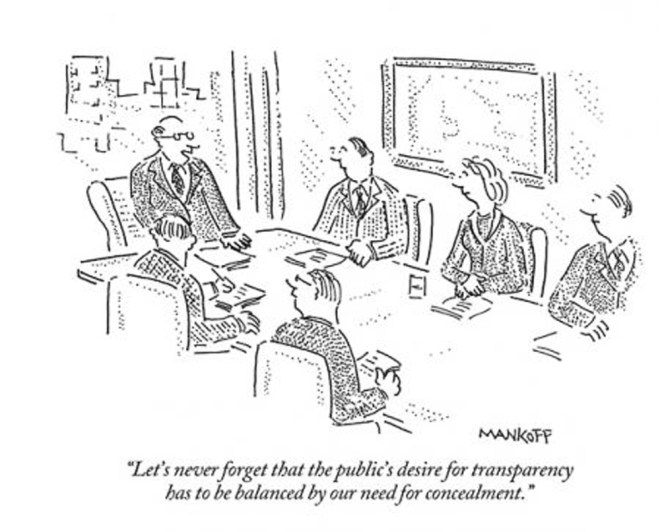
As we have seen with scandal-hit FAS and other Irish state bodies that abused peoples’ trust and misspent public money, the only way to prevent corruption is by creating greater transparency. The government coalition of Fine Gael and Labour made this a central issue in their electoral platform. In the three years since they took office, little progress has been made.

cartoon

Several weeks ago, Ireland was placed 31st position ‘in the league of transparent nations’ following research by the World Wide Web Foundation. It is the worst of any European nation, even behind countries such as Russia, Mexico and Brazil. The group’s categorized Ireland as a country that faces challenges to “mainstreaming open data across government and institutionalizing it as a sustainable practice.” It also said “core data on how the government is spending taxpayers’ money and how public services are performing remains inaccessible or pay-walled even though such information is critical to fight corruption and promote fair competition is even harder to get.”

Tim Berners-Lee, Web, founder of the Web Foundation and the London-based Open Data Institute, said, “Governments continue to shy away from publishing the very data that can be used to enhance accountability and trust” and highlighted the power of open data “to put power in the hands of citizens.”

Údarás is a classic case in point.

lenses

Dinny McGinley, former junior minister for the Gaeltacht, wrote back in a vague response to my FOI request saying simply that Údarás had informed him it was “a data controller, defined under the Acts as a person who either alone or with others controls the contents and use of personal data.

For so many years untouchable hidden behind a veil of Irish-language support, Údarás perhaps is in many ways no different to FAS in terms of greed and individual self-interests. According to Údarás sources, former board members in Donegal remained in boardroom meetings during discussions on lucrative payments to their very own companies and organisations. In addition, not one but at least three Donegal Údarás board members have been up before the Standards in Public Office Commission on corruption charges relating to double dipping on expenses. When one considers the expense claims for board members, particularly under the long-time chairmanship of Liam Cunningham from Glencolmbcille (from 2005 to 2010 he received more than 155,000 euro in fees and expenses, according to Highland Radio), one has an idea of the unchecked, proliferate spending that went on.

Some details as already reported by Highland Radio –

  • Four former Donegal members of the Údarás board each received in excess of 100,000 euro each, over a four-year period, in travel expenses.
  • Fianna Fáil member Daithi Alcorn earned nearly €120,000 between 2005 and 2009;
  • Fianna Fail Senator Brian O Domhnaill received €115,000 while independent Donegal member Padraig O Dochartaigh received €105,000.

Over one billion euro of public money has already gone into supporting Udaras na Gaeltachta yet unemployment rates in Gaetachts are consistently highest in the nation.

Misspending of public money (an issue brought up by the former head of the PAC, see 3-part series article series), includes all-expenses trips to Las Vegas for Udaras board members and their spouses – supposedly to meet a delegation of the IDA;

In truth, Údarás was – and perhaps still is – a cash cow for well-to-do insiders in west Donegal.

It is long past time Údarás prepared proper annual reports instead of the porous documents it now produces that disguise the spending picture and that it holds open public meetings to allow the people of the Gaeltacht to know exactly how their hard-earned money is being spent.

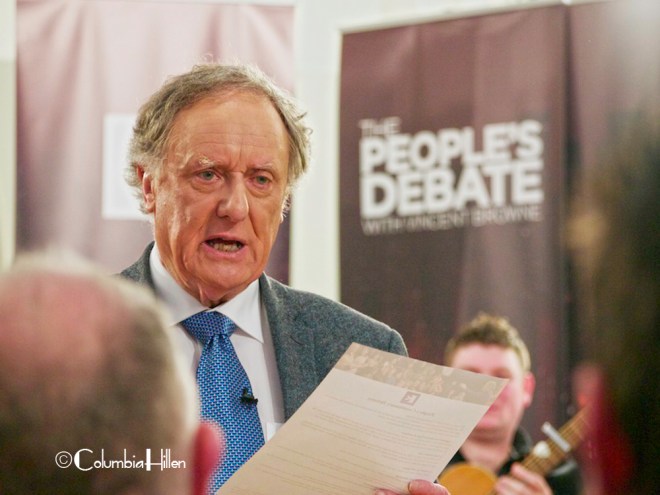
TV3’s Vincent Browne ‘People’s Debate’ in Donegal attracts lively discussion

While Fine Gael and Labour were expected to take a beating at yesterday evening’s Vincent Browne-hosted ‘People’s Debate’ in Letterkenny – in part deserved as the two parties refused to participate – Fianna Fail also took a drubbing.

OLYMPUS DIGITAL CAMERA

At one point, after listening to the party’s TD Charlie McConalogue berate government policies, the veteran TV host exclaimed, “I cannot understand how you can make these criticisms. Fine Gael is simply following Fianna Fail policies. Fianna Fail laid down the strategy for dealing with the banking bailout and Fine Gael and Labour are merely following it.”

McConalogue made another mistake later in the debate saying, “the agreement with the Troika was negotiable,” thus contradicting what the public had been told by Fianna Fail that the deal under former Taoiseach Brian Cowen and Minster of Finance, Brian Lenihan, was non-negotiable. Browne was quick to make the point, “Your party said details of the agreement with the Troika were non-negotiable, yet now you say they were. Make up your mind.”

On the emotive issue of water charges, McConalogue – after much fudging said he would halt Irish Water and suspend water charges. Again, Browne responded, “Your party, Fianna Fail, already had a plan in place in 2010 to impose water charges, but now you’re saying you’re having second thoughts.”

OLYMPUS DIGITAL CAMERA

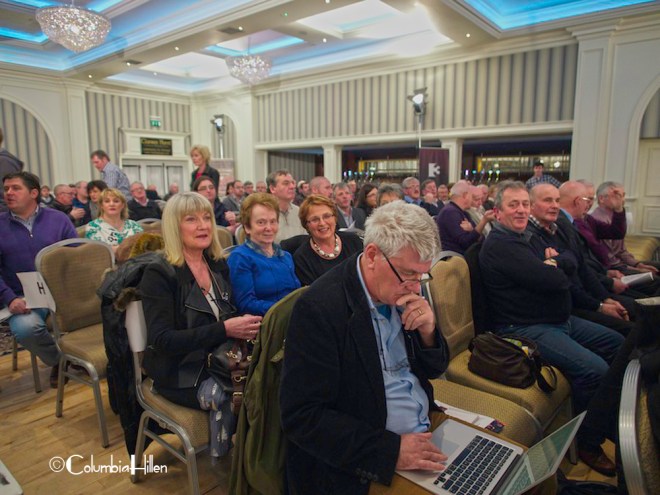
Browne, at his best as a current affairs host when pushing political guests for a clear-cut answer, didn’t let the lively capacity audience down, especially when badgering the four-member panel for their views on a potential coalition after the next election. Asked whether he would take a ministerial seat under a Fine Gael or Fianna Fail led coalition Sinn Fein’s Pearse Doherty seemed somewhat uncomfortable in his seat.

“That is a hypothetical question and such decisions are made at our party Ard Fheis,” he said finally, as if caught by surprise, but recovering. “What we have agreed is that unless water and property charges are dropped, we will not go into any coalition.” He acknowledged, “Some members have voiced their opinion that they would go into a coalition as a minority party. We are a party hungry for change, we are not hungry for power.”

When asked the same question, his Sinn Fein colleague TD Pádraig MacLochlainn was more direct, unhesitatingly replying, “I will not participate in a government led by either Fianna Fail or Fine Gael.” As if taking strength from this, Doherty later stated categorically, “If asked by a government led by Fianna Fail or Fine Gael to be a minister, I would refuse.”

OLYMPUS DIGITAL CAMERA

After chastising the two Sinn Fein members for not giving a straight ‘yes’ or ‘no’ answer, McConalogue himself began the dance of the slippery eel until, under bombardment from host and audience, he finally said, “I would not like to participate in a Fine Gael-Fianna Fail coalition but if I was outvoted by my party colleagues I’d have to go along.”

In his two-minute intro, Doherty said “four years ago we were promised a democratic revolution yet all we have had is more of the same with cronyism, stealth taxes and high levels of unemployment, no more so than right here in Donegal. There is a fairer and better way of moving forward and Sinn Fein’s job strategy can reshape this county.” He added that it was little wonder Donegal was known as ‘The Forgotten County.’ “I know Vincent you didn’t come here by train because this is one of only five counties in all Ireland without a mainline railway service.” Under an FOI request he said he has asked for a government paper produced on the future of small schools, adding that Donegal has the second largest number of such schools, with four teacher or less.

When corruption and lack of transparency within Údarás na Gaeltachta was brought up, including its refusal to release key information on its public spending such as lucrative pension payments to former executives which amount to half of its entire annual budget, Doherty said his party had tabled formal parliamentary questions on the issue, adding, “there should be full disclosure about people in receipt of high public pensions, it is important to have complete transparency so such payments can be scrutinized by the public.”

McConalogue said in his intro, “the last four years of government have been an attack on Donegal with post office closures, agriculture being hard hit and worsening heath services,” adding, “we have strong potential here but we need better infrastructure including the A5 project up and running and wider broadband.”

Referring to the pre-election catchphrase ‘Frankfurt’s Way or Labour’s Way,’ MacLochlainn said the government’s record has proved very different, “with a reduction in classrooms, budget cuts across the board and Donegal having the lowest allocation of medical staff of any county.” He added, “Donegal people are hard-working and passionate. All we’re asking is a fair chance and for Dublin to meet us halfway.”

Regarding the water charges, he added, “For thirty years, Sinn Fein has opposed these charges and now it has become the straw that broke the camel’s back. There has simply been too much austerity. Irish Water is a white elephant. My message is ‘scrap the water charges and go back to the drawing board.’ ”

While decrying the lack of proper health services and unfair stealth taxes, Independent TD Thomas Pringle said renewable energy had tremendous potential for Donegal as had the biomass wood industry. Speaking of Killybegs, he also said the fishing industry had been “hard-hit.’ He said water conservation should be a top priority because so much is being lost through poor network connectivity. He also said he was proud of challenging the bank bail-out through the courts and being in the forefront of water charge protests (continuing the momentum, a major ‘Right2Water’ protest took place earlier today – Saturday – in Letterkenny, with others elsewhere nationwide).

All four TDs, when asked directly, said they would vote ‘yes’ in the upcoming referendum on same-sex marriage.

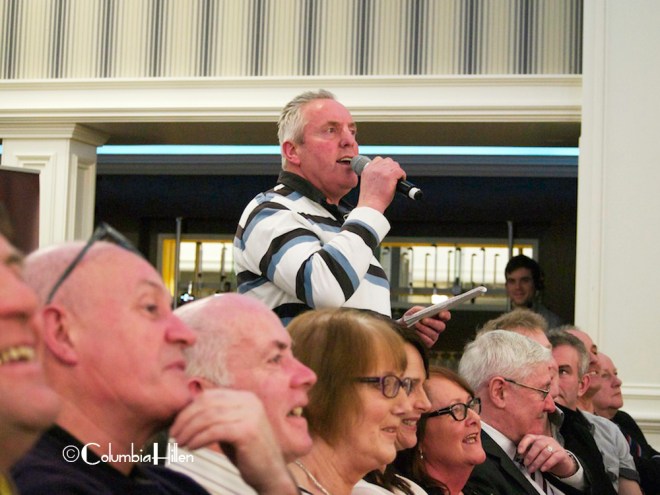
Over the lively, two-hour event at the Clanree Hotel, there was no shortage of questions from the floor with periodic rambunctious catcalls, cheering and booing, which caused short stoppages and words of warning from the presenter.

OLYMPUS DIGITAL CAMERA

True to his word, Browne attempted to cover as many topics as possible such as equality, including the upcoming same-sex marriage referendum; family services, education, employment and health. Speakers ranged from parents of terminally-ill children; school teachers, social workers and community activists working on behalf of people as diverse as lesbians, gay, bisexuals, transgender, cancer sufferers, the disabled, and many others.

Some light-hearted moments and biting comments helped take the edge of emotions as when a thirsty Vincent Browne ran out of water and promised he’d even pay for some and when James Woods from Gortahork commented that with so much emigration, Donegal was turning into a wildlife refuge.

OLYMPUS DIGITAL CAMERA

All in all, ‘People’s Debate’ is an excellent initiative by TV3, no doubt demanding detailed planning to host such shows in all the constituencies of Ireland.

Fine Gael and Labour’s decision to spurn them, indicating fear and a lack of understanding of the difficulties facing ordinary people, could ultimately cost them vital votes in the polling booths.

OLYMPUS DIGITAL CAMERA

OLYMPUS DIGITAL CAMERA

OLYMPUS DIGITAL CAMERA

OLYMPUS DIGITAL CAMERA

OLYMPUS DIGITAL CAMERA

OLYMPUS DIGITAL CAMERA

OLYMPUS DIGITAL CAMERA

OLYMPUS DIGITAL CAMERA

OLYMPUS DIGITAL CAMERA

OLYMPUS DIGITAL CAMERA

Yet another Irish political fiasco

I was shocked to read in a leading Donegal newspaper editorial over the last few days that John McNulty had behaved ‘with dignity’ over his recent Fine Gael botched Senate nomination.

Let’s call a spade a spade.

The last thing Mr. McNulty behaved with was dignity. He condoned the onward march of cronyism and ‘stroke politics’ thus giving his full support to this age-old blight on Irish society.

John McNulty – guilty as charged, complicity to hoodwink. Photo courtesy Independent Newspaper.

Selling Mars bars at a Mace grocery shop in Stranorlar hardly qualifies Mr. McNulty to contribute much, if anything, to the development of the Irish Museum of Modern Art (IMMA) (unless his business is merely a front for a secret network of art collectors storing priceless Van Gogh’s under the petrol pumps). There are many throughout the country with decades of high-level experience in the arts sector and thus much more qualified than he.

Yet when Fine Gael spin-doctors whispered in his ear they’d pull a few strings and shove him on the (already full) board, thus giving him an easier ride into the Senate, he leapt like a deer in heat, omitting to point out the simple fact that he was completely unqualified for such a key position.

In doing so, the 37-year-old Kilcar man is as guilty as those people – mainly under Fianna Fail’s governing stewardship – who greedily grabbed places on other boards such as FAS and the Central Remedial Clinic and proceeded to claim hefty payments and generous expenses on the backs of struggling tax-payers. (Fianna Fail actually rushed 182 of their members on to public boards in the dying days of its last reign).

It must also be remembered that, far from being a credible Senate nominee, Mr. McNulty failed to even get elected to Donegal County Council having won just over 800 votes in May, less than half of the quota required for the six-seat electoral area. In fact, he finished the race at the rear of the pack at a distant 10th place.

Choosing him shows just how desperate Fine Gael are to shore up its political representation in Donegal, especially with the additional failure of John Curran, its choice for the Udaras board, to get elected to the local council (in great part over his willingness to hand over more than a million euro of tax-payers money to the Catholic nuns to run an addiction center in Falcarragh when there’s already one in Donegal, and after the dead babies scandal in Tuam). With Donegal South-West deputy Dinny McGinley due to retire at the next election, Curran’s failure and now McNulty’s means there’s nobody in place as a successor.

John Curran – until recent local elections, was being groomed as potential successor to TD Dinny McGinley?

Public boards or private clubs?

In a bizarre twist to the tale, Fine Gael Arts Minister Heather Humphreys said in the Dail this week that Mr. McNulty was appointed to the board of IMMA “on the balance of talent and experience.” That’s a joke. The minister then added that she and her party were committed “to using the public appointments procedure in line with the guidelines.” That’s an even bigger joke. It recently emerged that at least two of the six appointees to the Board of the Heritage Council last year were made by her colleague Minister Jimmy Deenihan in contravention of that very same formal application process.

Further, a 2012 report by the Institute of Directors In Ireland on state boards showed concern at the lack of transparency around the appointment process and the lack of consideration given to the skills required to fill them. Since then, board positions have featured on Government department websites and advertised via the Public Appointments Service but some describe this as ‘pure window-dressing’. The McNulty situation, and perhaps the Curran one too, are cases in point.

Plain-speaking (maybe too plain) Minister for Health Leo Varadkar said election to the parliament of a candidate who has withdrawn – as McNulty has done to avoid further embarrassment – would not be good thing for the political process. Duh, really?

Obviously, the only way forward is to make the recruitment process entirely transparent, minimise government involvement in choosing appointees, and actively engage individuals with the appropriate skill set to fulfill these positions.

Fine Gael’s Arts Minister Heather Humphreys in the Dail struggling to deflect accusations of cronyism and stroke politics. Photo courtesy RTE News

No crying over spilled milk

Ultimately, however, we have only ourselves to blame.

Most of those who voted for Fine Gael over Fianna Fail three years ago knew deep in their hearts exactly what they were doing. Being conservative, as we Irish are by virtue of our Catholic upbringing, we voted for one party knowing full well deep down it was little different to the other. Then we deigned to pat ourselves on the back for ‘taking a bold stand.’

What baloney! Ours was nothing less than a cowardly act.

To make matters worse, when we had the chance to regain some degree of pride and do away with a Senate that is, and always has been since the foundation of the state, a complete and utter waste of public money, we declined to follow our instincts and put pen to paper. How could any of us vote for such an anachronistic and discriminatory institution highlighted by the fact that with so many worthy universities and colleges throughout Ireland, only two – Trinity College Dublin and the National University of Ireland – are permitted to have Senators? Not to mention that 11 Senators are simply appointed on the whim of the Taoiseach. No elections, no vote.

Padding expenses? Investigations well underway on shenanigans of Fianna Fail’s Brian O’Domhnaill: Handsome salary as Senator not enough?

Today the Irish Senate, unlike the American one, stands as a perfect model of cronyism and stroke politics, with even appointed party members such as Donegal’s very own Fianna Fáil Senator Brian Ó Domhnaill under investigation for milking the system by duplicating expenses.

We tossed away the opportunity to fling the Senate into the bin of history where it firmly belongs. Let’s not now cry over spilled milk. Like McNulty’s reluctance to apologise publicly for his complicity in attempting to hoodwink us ordinary folk, it’s so undignified.


Shipwrecks, puppets and mechanical creatures – opportunities for cultural tourism

An earlier post – Cultural tourism: its time is nigh – highlighted the immense potential for cultural tourism in the Donegal Gaeltacht to help fill the vacuum left by failed government policies, mainly by Údarás na Gaeltachta, to provide jobs and prevent the departure of our dynamic young to foreign shores.

With the pursuit of major manufacturing companies a lost cause mainly due to difficult and expensive transport logistics and call centres being a short-term band-aid, cultural tourism has been an underused weapon in the battle against rising unemployment and severe economic decline in the Gaeltacht.

While some say a minority of people such as language-based entrepreneur Liam Cunningham in Glencolmcille have become tourism millionaires, mainly based on national and international grants with Cunningham perhaps reaping the benefits of his chairmanship of Údarás for over a decade (whether questionable or not, meaning within ethical parameters, is a topic for future discussion), the depth of funding to other local cultural tourism entrepreneurs has been sparse.

The reason, according to Udaras officials, is that cultural tourism doesn’t create long-term jobs. Asked why, officials are at a loss to explain, so what this long-held and somewhat irrational attitude is based on is a matter of pure conjecture, with some critics saying the real reason is unrelated to accepted principles of economic development but rather linked to cronyism, influence peddling and continued support, financial and otherwise, to Fianna Fail, a party that ruled the roost for so long and put certain people in key executive positions.

While the accuracy of this allegation requires further investigation, what is important to note is what other parts of Ireland and beyond have done – and are doing – to reap healthy benefits from committed policies to cultural tourism development and analyze whether the Donegal Gaeltacht has – to put it succinctly – ‘got what it takes.’

At a largely EU-funded conference earlier this year under the auspices of CeangalG and with the catchphrase ‘Selling Our Story,’ speaker after speaker talked about interesting cultural tourism ideas that have produced positive measurable results, including increased job creation. Many of the speakers agreed that key components for such success include ‘identity,’ ‘authenticity’ and ‘memorability.’

In my opinion, the Latin term ‘genius loci’ (spirit of place) best describes what the central element is – the specific nuances of any given place that separate it from the rest of the world.

So, does the Donegal Gaeltacht have what it takes?

In a word, yes!

Cherishing an ancient language that proudly holds its place among the oldest in the known world; with the singing tradition of sean-nós, whose ornamented, rhythmic intimations are an inspirational reminder of the primordial beginnings of Man; and with the area’s unique traditional dance and music, disparate elements of ‘genius loci’ are plentiful. Not to mention the intriguing Celtic legends such as those related to Balor and Lugh, thus the Mount of Lugh (now called Errigal) named after the ancient Sun God.

Having had the privilege over the last 30 years of travelling as a journalist on assignment to many parts of the world, I considered some of the places I’ve visited and successful cultural tourism projects there, projects that have not only strengthened the economic vitality of deprived areas but also uplifted the innate spirit and pride of the local population.

Here are a few, some which might just provide models of excellence for the Donegal Gaeltacht.

elephant

Creative engineering in Nantes, France, has led to economic revival based on cultural tourism.

Nantes, France – Earlier this year, I travelled to this western town in the Pays Loire region to see such a project. Faced with empty industrial estates, local officials had decided to invest in cultural tourism to create jobs using the existing space and infrastructure.

Realizing how watching ships return to this riverside port with exotic cargo from around the world inspired a young Jules Verne to later write science-fiction classics as ‘Twenty Thousand Leagues Under the Sea’ and ‘Journey to the Centre of the Earth,’ the officials embarked on a project that now attracts tens of thousands of visitors annually. Entitled Les Machines de L’Ileand opened in 2007, it is a 21st-century mechanical wonderland consisting of monumental structures including the, ‘Grand Elephant,’ ‘Mantra Ray,’ ‘Sea Snake,’ ‘Heron Tree,’ and ‘World Carousel’ in what is known as the ‘Gallery of Machines’ upon which visitors enjoy adventure rides and experiences. Last year alone, almost 100,000 people rode on the Grand Elephant; 190,000 people visited the gallery and 250,000 the ‘World Carousel.’ Total investment – in various stages – was 17.7 million euro, a sum that was recouped within a few years. In comparison, according to Údarás, Largo Foods received around seven million euro in funding and left the area earlier this year.

Not only did the project increase business revenues, it also created permanent, long-term new jobs in central workshops employing such tradespeople as plumbers, carpenters and engineers. Could a project like this – using local legendary Celtic figures as central subjects – not help deal with the empty industrial spaces throughout west Donegal, while attracting more tourists to the area?

OLYMPUS DIGITAL CAMERA

Puppetry, an age-old tradition in Sicily, attracts tourists and locals alike, providing both entertainment and cultural education.

Palermo, Sicily – Like west Donegal, this rocky island at the toe of Italy has generally been ignored by the central government in Rome. Faced with worsening employment, local officials took matters into their own hands. Seizing on a peculiar and unique vein of cultural heritage dating back hundreds of years to the time of Socrates – puppetry – they created a flourishing tourism attraction that has boosted business and employment.

Opera dei pui’ (puppet theater) has a long tradition in Sicily, reaching its peak around 100 years ago on the island. With support from the Association for Conservation of Popular Traditions, visitors to the downtown Palermo puppet museum can now see hundreds of beautifully designed puppets, their masters’ equipment (mestiere), as well as other memorabilia, and regularly-staged shows involving cultural characters and chivalrous heroes such as Orlando, Rinaldo and Gano di Maganza. So strong has been the resurgence of interest in this long-held tradition, puppet theatre performances – that also play an important educational role in highlighting the island’s history –take place in other parts of Sicily. Again, using local legendary figures and stories, can the Donegal Gaeltacht not avail of a similar cultural tourism initiative? A creative team under the guidance of Kathleen Gallagher has already shown the level of know-how required for such a project.

shipwreck

Donegal flag flies high over one of the area’s most well-known shipwrecks opposite Ostan Gaoth Dobhair. Many others lie offshore, spanning centuries of history.

Key West, Florida – before it became a hotspot for tourism, this area on the tip of the peninsula was a backward, forgotten place in the 1800s where local fishermen and their families led difficult hand-to-mouth existences. Only when the phrase ‘Wreck Ashore!’ rang out did hope for better things arise. ‘Unloading’ the many ships that ran into difficulty was a chore, but a most rewarding one.

Seizing upon this colourful aspect of the area’s history, local officials decided to create an attraction that would be both entertaining, as well as educational. Thus, the ‘Key West Shipwreck Museum,’ where visitors step back in time to discover Key West’s unique maritime heritage. The museum combines actors, video and actual artefacts from the rediscovery of wrecked vessels such as the Isaac Allerton, which sank in 1856 on the treacherous Florida Keys reef.

Narrator and master wrecker, Asa Tift, and his wrecking crew tell the story of how this unusual industry created livelihoods for the early pioneers of Key West. Visitors can even climb a 65-foot lookout tower in search of wrecks.

West Donegal, with its rich maritime heritage and its record of shipwrecks, including the sinking of Spanish Armada galleons off Tory and Gola Islands plus other vessels, both military from the two world wars and commercial, offers a similar historical backdrop to Key West. What’s to prevent officials funding such a project – except, of course, narrow-minded thinking and lack of specialised business acumen?

West Donegal whale protection group formed as threats to human health resurface

Following an often emotional public meeting held at Teac Jack in Glassagh earlier this week, a wildlife protection group has been formed in west Donegal to lobby for government policy changes towards stranded marine animals and to promote specialized training.

The ‘North West Whale & Dolphin Support Group,’ which was established at the Tuesday evening meeting, follows concerns by many local people about the treatment of a pod of 13 pilot whales that were left stranded on Ballyness beach near Falcarragh, which all died of slow suffocation after five days. It is the 13th such stranding this year in Donegal, including a sperm whale stranded off Machaire Rabhartaigh beach. Around 32 other whales died off Rutland Island two years ago and were cut up and transported to Cavan where they were incinerated.

Meanwhile, concerns have arisen as to what caused the mysterious deaths of all the whales amid a recent rise in the numbers of marine animals being stranded off Donegal’s coast.  And that, whatever it is, may also be a hazard to human health.

whale 2

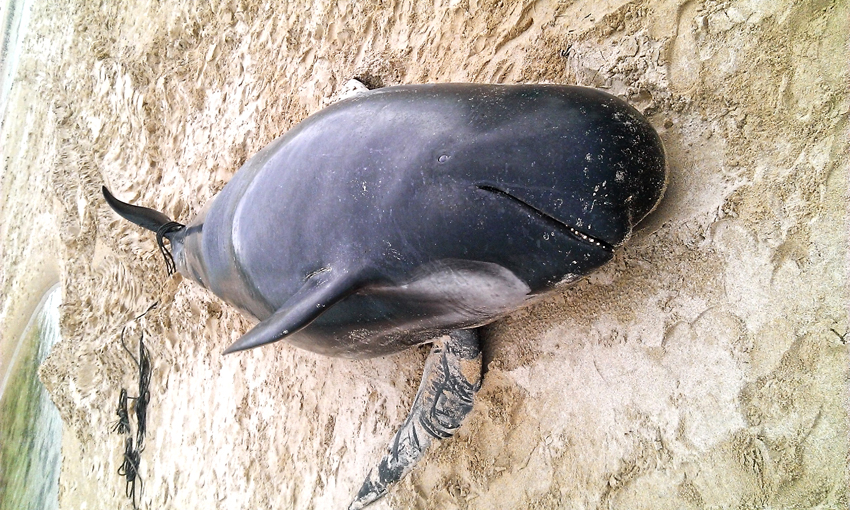
A stranded pilot whale struggles for life at Ballyness beach near Falcarragh, west Donegal. (Photo by Antonia Leitner).

Chairperson of the meeting, Amanda Doherty, with Selkie Sailing, who has also launched a petition that has attracted more than 230 signatures on the issue, said she was pleased by decisions those attending had made together.

“We want to raise community awareness and have the current policy regarding cetacean strandings in the area reviewed,” she said. “It should be a more flexible policy to allow for the particulars of different situations that occur. This is best practice according international standards and Ireland should follow it.”

Some people at the meeting – many of whom tried their best to save the dying whales – became emotional as they described the traumatic situation at Ballyness beach and the agony of the cetaceans as they slowly died of suffocation in shallow water.

Members of the National Parks and Wildlife Service (NPWS), led by Dave Duggan and Pat Vaughan, decided “to let nature takes its course” rather than try to save the whales or apply euthanasia to reduce the whales’ suffering. They also did not ask the coastguard for assistance to bring the whales out to sea, as has happened in other parts of Ireland. The state-funded Donegal county veterinary office under the leadership of Charles Kealey, chief veterinary officer, has also come under criticism for refusing to get involved in any way to help the whales, including making sure the mammals were dead before they were buried. (In contrast, see photo below of a cetacean (dolphin) being treated more humanely in another part of Ireland, with vets and the coastguard involved).

Strandedwm_shay-fennelly_2007

Westport-based Irish Coastguard assist with a stranded Common Dolphin which could not be refloated. A Mayo vet administered an injection to humanely end its suffering. Photo by Shay Fennelly

Pearse Doherty Sinn Fein TD for west Donegal, who has submitted a number of formal questions over the last week in the Dail to Ministers regarding the treatment of stranded whales and other cetaceans, attended the meeting and gave his advice on the best way forward for the group. Doherty said it was important the new group work with current organisations such as the Irish Whale and Dolphin Group (IWDG) and the National Parks and Wildlife Service (NPWS) and suggested a two-pronged approach – making sure policy at the IWDG matched international standards, and the establishment of  ‘first responders’ in the local area, recognized by the NPWS and IWDG – people who could take the lead in developing situations.

The newly-formed ‘North West Whale & Dolphin Support Group’ decided to hold monthly meetings and invite Simon Berrow, founder of the IWDG, to provide specialized training for members on how to best help stranded whales and other cetaceans and to meet with a small working group on the same day to discuss further action. Clare-based Berrow is a full-time lecturer at the Galway-Mayo Institute of Technology teaching on the Applied Freshwater and Marine degree course and project manager of the Shannon Dolphin and Wildlife Foundation.

After being contacted about the meeting, Berrow told the author of this blog, “We are delighted to hear of the formation of a local group. We look forward to working closely with them to prepare a better response to stranded cetaceans in the future and also to encourage local recording.”

Offshore toxic waste dumping? Military submarine activity?

At the same time, concerns regarding the health hazards to human life – as well as marine – from toxic dumping at sea and military submarine activity and experiments that may have caused the strandings have resurfaced locally.

dumping 2

Oceans that become graveyards for poisonous debris that pose dangers to human as well as marine life.

International regulations state that discharges of waste material – often poisonous by nature – should not be made within a certain distance of any landmass, according to the Seas at Risk. But who’s watching? Some major ports have cleaning facilities such as Edinburgh, Belfast and Dublin, but this costs money so some incorrigible corporations say ‘why bother’? As the coast of Donegal is in direct line of most transAtlantic ocean traffic between Europe and the Americas, the amount of waste dumped offshore is probably immense, one respected scientist saying ‘enough to create mountains under the sea.’ Much of this material contains cancer-causing chemicals (carcinogens) such as manganese, benzene, coal-tar, radium, petrolatum, parabens, vinyl chloride lead and zinc. With recent technological developments, many of these chemicals are in the form of deadly nanoparticles (particles less than the size of a human or animal cell) which, airborne, can then penetrate the cells, causing untold damage.

Nanoparticles: Technological and industrial development has outstripped health research into their potential dangers in everyday foods and consumer products.

Nanoparticles: Technological and industrial development has outstripped health research into their potential dangers in everyday foods and consumer products.

Could this be the cause or partial cause of disease in whales and other marine animals? Researchers say they have found large quantities of these chemicals in the whale tissue samples taken and tested. And doctors report larger than normal incidences of human cancer in local people.

In addition, some of the waste is in the form of non-biogradable plastics. Because they don’t dissolve but break up into smaller elements, these plastics have formed what scientists now call ‘plastic islands’ – often the size of countries, one is larger than the US state of Texas, which in itself is 17 times larger than Ireland – that float in our seas, causing disruption to the normal flow of currents. Consequently, the dangers to both human as well as marine animal health is high. For a long time, many people in northwest Donegal have suspected such dumping to have taken place offshore, with menacing results (see further information here).

A special group was established within the last two years at Ionad Naomh Pádraig in Dore by Freddie O’Donnell and Aodán Ó’Gallchoir to examine correlations between high levels of cancer in the Gaeltacht area and dumping of waste in coastal waters nearby. Known as ‘Scaoil Saor ó Ailse’ (Break Free from Cancer’), the group’s public relations officer, Joe Diver, said former local doctor Paddy Delap, said such waste was affecting peoples’ health, particularly cancers of the skin, lung and brain, with an abnormally high level of fatalities. A deep-sea diver then broke his decades-old silence on Raidó na Gaeltachta, describing how he found a large area of the sea bed littered with large black drums with hazardous signage on them in the waters off Tory Island, adding, “We were looking for shipwrecks, went down 40 to 45 metres and came across black drums with green stuff growing on them. There were a few thousand of them. They were heaped in a hill-like structure and had skull and crossbones on them. The diver said the drums would have since disintegrated and their hazardous material dissolved into the ocean off the Gaeltacht coast.”

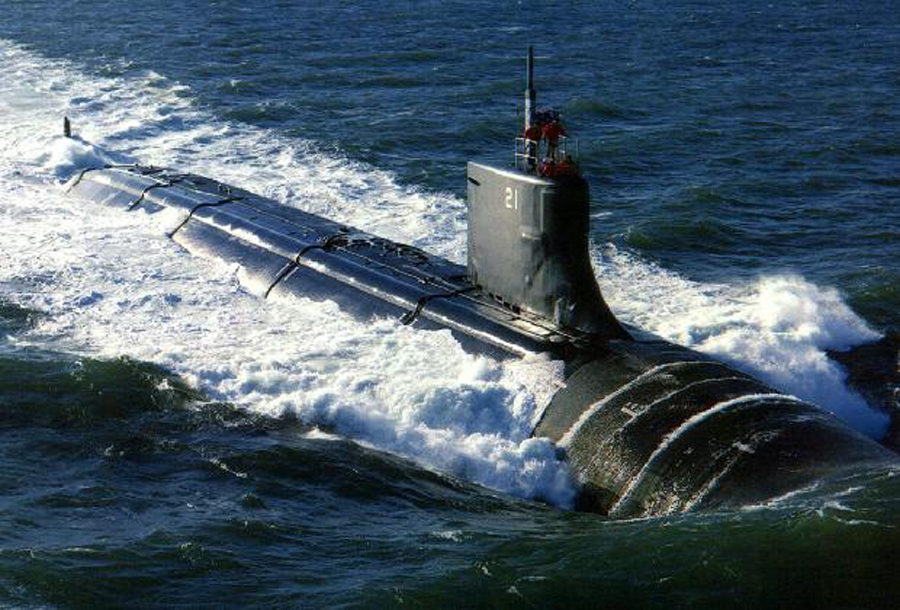
submarine

Military submarine activity and experiments at sea: what are the hazards for Man, Plant and Animal?

Areas affected could include Gaoth Dobhair, Cloughaneely and The Rosses. Calls for greater funding for a more comprehensive analysis were ignored by the relevant authorities, mainly on the instructions of Dublin, some say for economic and political reasons. Further, fearing such research could stir up waves of protest if the result became known, efforts were made by authorities, mainly Fianna Fail, then in power, to trivialize what little had become known. Politics and money trumped peoples’ health and once again the ‘Forgotten County’ was forced to live up to its unfortunate title.

Damage control became main concern for a certain cadre of elite: the party in power in the Dail and its big-business supporters. “This situation has been going on for far too long,” said one medical practitioner who has treated cancer patients in the area. “It is long past time national funding was made available to investigate this situation thoroughly. If it happened in certain other parts of the country, it probably would already have taken place long ago. Surely the deaths of so many marine animals and the high number of cancers affecting people means the issue should be looked at very closely.  To some extent, it’s in the hands of ordinary people. They should be lobbying their government representatives by e-mail, phone and letter. If not, nothing will be done.”

Several of the whales at Ballyness beach were found to have lesions, blemishes and lumps on its skin, but National Parks and Wildlife Service officials declined to say where any disease may have originated. As whales are highly social creatures that travel in communities, some say healthy whales may have refused to abandon sick or injured pod members and followed them into shallow water. “We can’t say for certain,” said Pat Vaughan, district conservation officer for the NPWS. “What we do know is that whales and other marine animals can have high levels of certain toxic elements in their bodies.”

Cultural tourism – its time is nigh

There are some among us (either through ignorance or greed) who consider Donegal unfit for cultural tourism – but a quick glance at what’s happening right now in the area proves them wrong.

Take, for example, the Slí Cholmcille (Slighe Chaluim Chille) project.

As I started writing this, many people – tourism and community leaders, teachers, retired air-force pilots, sociologists, photographers, authors, solicitors, doctors and academics – were gathered at Óstán Loch Altan, Gortahork, in the scenic northwest of the county, talking enthusiastically about developing Ireland’s very own ‘Santiago Columba’ into a successful cultural tourism pilgrimage project that could attract thousands to both western Scotland and Ireland.

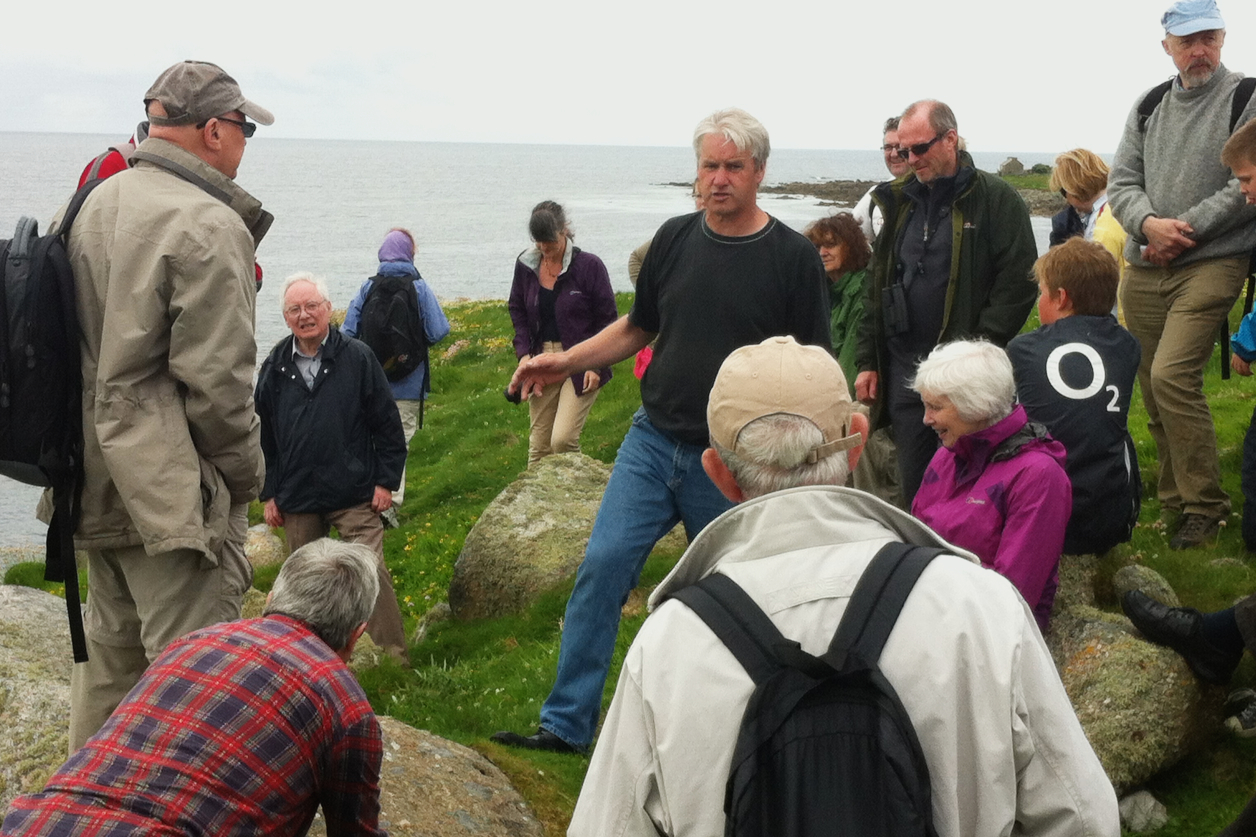
Speakers at the conference air their views as to how the proposed pilgrimage trail could be developed.

Organized by The Islands Book Trust, led by John Randall and ably assisted by the ever-helpful Mairi NicChoinnich, in association with Colmcille Éirinn is Alba and supported by Bòrd na Gàidhlig and Foras na Gaeilge, this three-day conference which ended today (Sunday) aims to develop a heritage trail based on the travels and travails of the Celtic mystic, Columba. Such a project could not only inform Irish and foreign visitors about local history, archaeology, folklore and heritage but also create employment and business for hotels, B&Bs, cafes, restaurants, museums and bars alike in the two regions.

“We have a wonderful opportunity to expand our learning and to attract visitors on a significant historical route from south-west Donegal to the Isle of Lewis in north-west Scotland,” said Randall, chairman of the Islands Book Trust.

This united effort is supported by renown authors-cum-academics such as University College Cork’s Máire Herbert (Iona, Kells, and Derry: The History and Hagiography of the Monastic Familia of Columba) and Brian Lacey (Saint Columba: His Life & Legacy).

Renown University of Cork researcher and author Máire Herbert beside the old stone cross on Tory Island with her groundbreaking book on the mystic monk Columba (Colmcille).

With additional speakers such as University of Galway’s Mícheál Ó Dónaill, Calum MacGilleain, Tristan ap Rheinallt and Aidan O’Hara from Scotland, Noel O’Gallchoir from Gaoth Dobhair, Noleen Ni Cholla, Moira Ni Ghallchoir, Maolcholaim Scott, Liam O’Cuinneagain and even the King of Tory Island himself, Patsy Dan MacRuaidhri, the conference comprehensively analyzed the tantalizing persona of Columba from the sociological, archaeological, historical, religious and mythological perspectives. And, more importantly, how interest in the fellow can be turned into a dollars and cents/euros and pennies booster for local tourism.

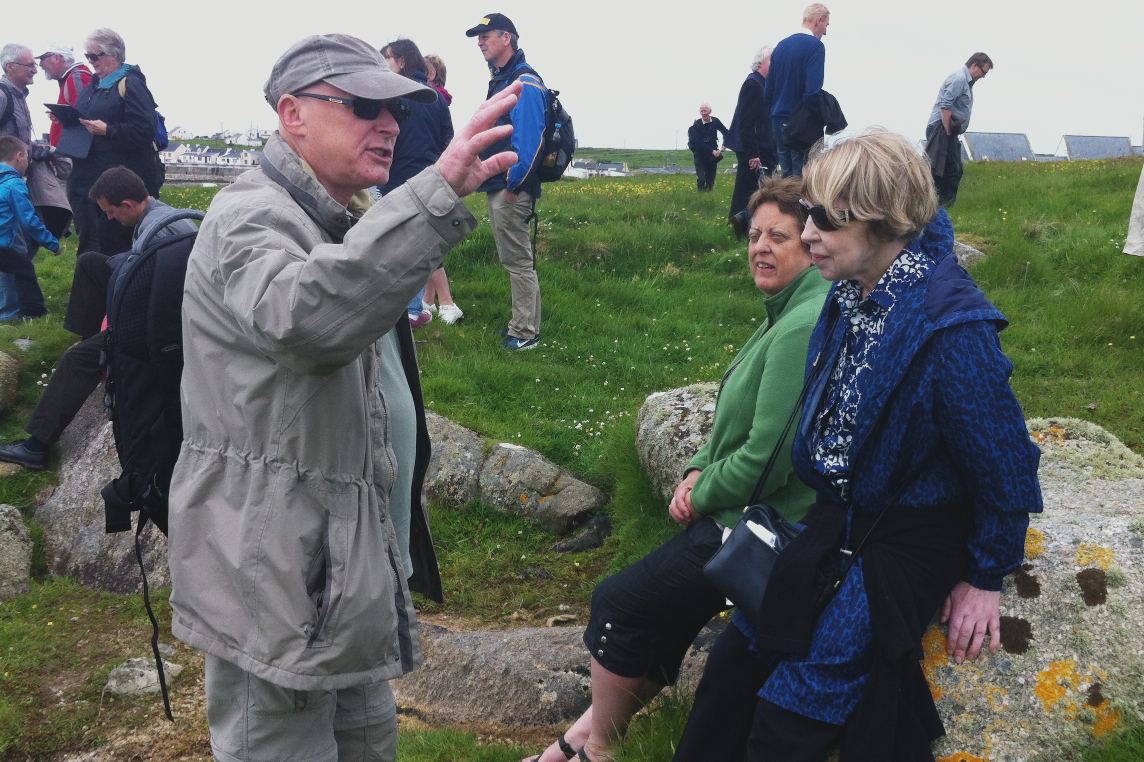
Brian Lacey, medieval historian and author, informs guests at the Sli Cholmcille conference about Pagan and druidic practices in and around Errigal and Muckish mountains.

The only drawback to an otherwise excellent symposium of speakers was the often poor technics, the out-of-focus projection of some otherwise well-researched multi-media presentations.

But the development of Sli Cholmcille is just the tip of the iceberg.

A quick glance at the local newspapers – the Donegal News and the Donegal Democrat – this weekend alone, shows a rich vein of cultural tourism – including the weekly music seisúns and this summer’s ‘Gaelturas’ initiative at Teach Hiudai Beag; the year-long programme of music and dance at Teac Jack and Leo’s Tavern; the ‘Goitse Gaoth Dobhair’ events in Bunbeg this coming weekend, which emerged from the ‘Dearg le Fearg’ language equality campaign, as well as ‘Luinneog Lunasa’ in the same area; the ‘Swell Festival’ on Arranmore; and ‘FestiFál’ and ‘Evil Eye Festival’ in Falcarragh to name but a few. Other local diverse activities with strong potential range from rock-climbing, wind-surfing and kayaking with Rock agus Roam; horse and pony riding at the Dunlewey Trekking Centre and elsewhere; the craft demonstrations at Ionad Cois Locha; and the educational Walking Donegal, the hill, coast and lake hikes with informed guide, Seamus Doohan; as well as specialty walks such as the ‘Tullaghbegley Heritage Walking Weekend.’

The list is endless.

And that’s not to mention the many literary tourism opportunities based on the art of creative writing.

Antonia Leitner from Carinthia in Austria is not shy to show her love of books and learning at Magheroarty Beach.

The idyllic landscapes and seascapes of Donegal have been an inspiration to many best-selling novelists and short story authors who have set their plots within or around the county, in genres ranging from sci-fi to literary fiction and fantasy, as well as plays. These writers include Brian Friel, Edna O’Brien, Sophia Hillan, Kenneth Gregory, Emma Heatherington, Michael Harding and Laurence Donaghy, some of whom will speak at Ireland’s newest writing retreat ‘Forgotten County, Remembered Words’ from June 28th to July 4th in Gaoth Dobhair.

With the national initiative ‘The Wild Atlantic Way’ now well underway and Donegal an integral part of it, there’s only one thing stopping the cultural tourism momentum that’s building up – a continued reluctance by Údarás na Gaeltachta, the primary economic development organisation in the Gaeltacht – to fund the many projects with serious money not just the few pennies it has been doling out until now to stave off a rising tide of protest.

‘Acupuncture of the body, acupuncture of the earth’ – author Brian Lacey describes a theory he learned from a Slovenian artist.

As many people are now saying, this organisation must host regular, open, community meetings and really listen to what local people – the very people they are there to serve – want in terms of more innovative community development; provide much greater transparency in its spending of an estimated 1.2 billion euro in public money, than it has to date; and an end to kow-towing to political parties and their funders (first Fianna Fail and now Fine Gael) which has resulted in far too much money going into the pockets of a rich elite of developers/builders who make easy profits from building simplistic, unneeded, industrial estates.

A new direction is required and a Catholic Church-run sex, drugs and alcohol addiction center in Falcarragh, with no guarantee of decent local jobs – especially as such a centre already exists in Donegal and research indicates this is sufficient for need – is hardly the panacea for high unemployment and emigration from the area. Some say real investment in local cultural tourism means shelving the proposed investment of three million euro by Údarás in the addiction centre and putting those euro millions into local tourism projects, the one sector a beautiful region like Donegal can benefit widely from, now and in the long-term (if that three million euro is spent on the proposed addiction centre, it spells the end for any real investment in anything else – no other board members of Údarás in other Gaeltachts will vote for any further significant monies for Donegal).

In this regard, it is quite sad to see how much Tory Island has fallen below its full potential – far behind many other attractive island retreats dotted around Ireland. The dismissive attitude of relevant funding authorities – and perhaps the disunity and lack of concerted lobbying and effort by local people (full burden cannot rest solely on the shoulders of one man, King Patsy Dan) – has meant its tourism income has suffered greatly, with accompanying lack of promotion (not even a regular newsletter on events or significant signage on the mainland and on the island itself).

“I am tired of trying to persuade Udaras na Gaeltachta officials to properly fund projects here on Tory Island, their ears are deaf, they simply don’t understand,” said King Patsy Dan MacRuaidhri. “The people here deserve such support. Our ancient and colourful history calls out for it.”

Befriending Royalty. Modern version of the horse-drawn carriage?

It’s make-or-break time for northwest Donegal.

Let’s put an end to the notion that cultural tourism is an unimportant, peripheral activity, the kind of mind-think that Údarás officials are stuck on, and have been for decades. This specialized sector has the potential to provide immense, long-term economic benefits for this hard-hit, hard-pressed part of the county and country, but it requires serious commitment and financial support.

In a future post I will give specific examples from my extensive sojourns in other parts of the world as an international travel writer where cultural tourism has transformed and enlivened a local and often paralyzed economy.

Meanwhile the next post will focus on what precisely various speakers at the conference said about Columba, this larger-than-life monk who seems to defy description, someone about whose background we know very little, either because documents were destroyed by marauding, book-burning Vikings, or were deftly confiscated by church abbots on a precise propaganda campaign.

To read more of Sean’s work, check these sites:

Digging for Dracula

World Itineraries

Examiner

JustLuxe

Ireland Writing Retreat

Fios Training and Coaching Organization

IMG_1269

IMG_1381

IMG_1320

IMG_1334IMG_1426

IMG_1342

IMG_1359

IMG_1363

IMG_1374

IMG_1379

IMG_1382

IMG_1390

IMG_1417

IMG_1432

IMG_1472IMG_1478

Cults, sects and mindless mayhem?

Before the elections, in a FRONT page editorial in the Irish Independent (a most unsuited and unprofessional place – see explanation at bottom of article), Fionnan Sheahan, group political editor of Independent Newspapers, described Sinn Fein as a ‘cult’ and a ‘sect’ whose followers were mindless.

Seeing that this particular political party has just won 157 local council seats nationwide in the Republic with 15.2% of the national vote (not to mention 105 council seats in northern Ireland with 24% of the vote), that’s a helluva lot of mindless people.

Will Mr. Sheahan now apologise to such people publicly in the same manner that he attacked them? Or will arrogance and pride prevent him and pave the way for a continued drop in circulation and quality of a once decent newspaper (one I proudly worked for at the start of my career 30 years ago)? Or is Fionnan’s job so dependent on the blatant bias of the media group’s dominant figures – Denis O’Brien (who was shown by the Moriarty Tribunal to have bribed former Fianna Fail Communications Minister, Michael Lowry, to win a mobile phone license), and Tony O’Reilly (who, after recently announcing bankruptcy, owes you and I more than four million euro after buying a luxurious holiday home in Glandore, west Cork with a loan he can’t now pay back) – that he will continue doffing his cap as a D4/ establishment spin-doctor and apologist?

OLYMPUS DIGITAL CAMERA

Can some political commentators not see the forest for the trees?

And not only.

A few weeks ago on Highland Radio’s Friday morning ‘Press Round-up,’ one of the so-called experts – a woman – said Gerry Adams should resign as Sinn Fein party president – and this was after Mr. Adams had just been voted in an ‘Irish Times’ opinion poll as the nation’s most popular party leader. Consider this unwarranted barb in view of the massive gains Sinn Fein has just won across the nation in this weekend’s local, national and European elections under this man’s leadership.

Will that particular woman now apologize? Not simply for a poorly-informed broadside but what is, in effect, blatantly obvious bias. Surely, Highland Radio, a station fighting for license renewal, can find more objective commentators than this person. As both chat-show program host and station managing director, Shaun should pay closer attention to what emerged from the ‘Media Freedom‘ conference I attended at UNESCO headquarters in Paris recently. Can anyone guess the identity of the woman in question?

But back to the recent elections.

IMG_0673

Turning of the tide?

Some commentators would have us believe they were astonishing.

Nothing could be further from the truth. They were quite the opposite – predictable – based on the trend already set three years ago when Sinn Fein went from four TD slots to 14. Of course, Sinn Fein and Independent generous gains in this week’s elections were accelerated this time round by the abject failures and litany of broken promises by Labour and Fine Gael. With the smell of Fianna Fail corruption still rank in our nostrils, and the ‘old guard’ still there in abundance, it hardly provided an alternative, indicated by its abject failure to have anyone elected in the two by-elections and Pat the Cope ‘(the Pope’ as RTE miswrote in a news Twitter) Gallagher’s failure to hold his MEP seat.

A quick glance at some of the specific results indicates the extent of the triumphs of Sinn Fein and the Independents:

  • Four Sinn Fein MEP candidates – four MEPs elected: Liadh Ní Riada; Lynn Boylan; Martina Anderson and Matt Carthy.
  • Independent Luke ‘Ming’ Flanagan topping the poll in the Midlands–North-West constituency;
  • Sinn Fein trebling its local council tally by winning 157 seats nationwide, and in the process becoming the largest single party on the Dublin city council;
  • Independent Marian Harkin defeating sitting MEP Pat the Cope in Midlands–North-West;
  • Sinn Fein securing the single biggest number of first preference votes in northern Ireland’s local government elections while winning 105 council seats;
  • Independents (including the Socialist Party, the Greens, and People Before Profit Alliance) won around 30 per cent of council seats, up from 18 per cent at the last local elections in 2009;

The list just keeps going on, including Sinn Fein winning local council seats it has not held since the foundation of the state, an incredible historic feat. It is something Donegal-based Pearse Doherty, Sinn Fein’s electoral director should be extremely proud of, especially in the run-up to the 1916 centenary commemoration celebrations.

So what happens now? Well-paid Fine Gael, Fianna Fail and Labour spin-doctors – Charlie Flanagan, Pat Rabbitte and Timmy Dooley respectively – have already been out in force on RTE, and other media, this week. They allege – conveniently forgetting that this particular political party has governed alongside its arch-rival, the DUP, for 15 years in northern Ireland – that Sinn Fein cannot govern because it has not learned the art of compromise. In fact, it is one of the very skills Sinn Fein has learned and in the toughest classroom there is – the boiling cauldron of politics across the border. Maybe the faux pas made by Jan O’Sullivan, Labour’s junior minister, on RTE Radio 1 show last Sunday that her party ‘is a mudguard for Sinn Fein’ is more accurate than she cares to believe.

The spin-doctors also say the Independents are a motley group of disparate individuals, again conveniently forgetting that they all, in effect, stood together in unity against harsh austerity and for social justice and fairness – hardly irrelevant issues. Theirs is also a highly pompous and condescending comment to make about ordinary citizens who voted en masse for this so-called ‘motley’ group.

No doubt, Sinn Fein and the Independents will be in the crosshairs of examination over the next two years as the next general election approaches but their strength is that they are bonded by a common purpose. Watch carefully as they come together in unity and forge a partnership to create a more equitable society within Ireland. As they attempt to avoid being the victims of their own success, maintaining organization and structure will be a challenge.

It was also extremely heartening to see so many women win council and MEP seats. Four of Ireland’s 11 elected MEPs being female Sinn Fein candidates while in the two by-elections, Ruth Coppinger won Dublin West for Joe Higgins’ Socialist Party and Gabrielle McFadden of Fine Gael won the Longford/Westmeath seat previously held by her sister, Nicky. Well over 20 per cent of councillors elected are women; 32 per cent of votes cast in Dublin were for female candidates and in some areas 4 out of six councillors are now women. Over 30 per cent of Sinn Fein council candidates were women. Women won 197 out of 943 local seats with campaign group ‘Women for Election’ saying this represented a 33 per cent increase. However, even with this improvement, Ireland remains about 90th in world rankings in terms of women in politics.

However, at last, as this week’s election results show, Ireland is beginning to wake up to reality. We Irish may lack the passion, initiative and courage to go on the streets as did the Greeks and French but we are fortunate to have been given a second chance following our poor voting performance two years ago (echoes – as happened after the 1916 debacle) and have made our voices heard in the polling booths. Rejection of establishment politics and the obvious economic disparities between poor and rich here, has meant Ireland has finally, to a large extent, grown up, matured and begun to shrug off out-dated, horse-blinkered generational politics.

As for Lugh’s choices for my area of the Glenties here in northwest Donegal, I am delighted to say that the little Celtic hero predicted not just the winners, but also the exact order in which they came past the post, viz-a-viz

Marie Therese Gallagher, Sinn Fein

John Sheamuis O’Fearraigh, Sinn Fein

Micheal Cholm MacGiolla Easbuig, Independent

Ireland’s future suddenly seems brighter!

OLYMPUS DIGITAL CAMERA

A new dawn is upon us.

NB: Explanation as promised

In journalism, as a mark of respect to the intelligence of its readers, quality newspapers reserve their opinion columns and editorials for inside pages, designating the front page specifically for informed and – as much as possible considering we have human frailties – objective news upon which readers make up their own minds on key issues. Thus Independent Newspapers broke a golden, nay sacrosanct, rule of journalism, ignoring the fact that only idiots need to be spoon-fed like infants. That may have worked in the past. Not anymore.

Next week’s blog – Remaining on the subject of local elections: how is it a candidate, such as John Curran, failed to get elected in the Glenties to the Donegal council? Was it linked to the severe lack of transparency that has corrupted Irish politics for so long and that still hovers over the workings of Udaras na Gaeltachta of which Mr. Curran is a board member? Or simply that he was the Fine Gael candidate? Next week, I publish the responses from Udaras to questions regarding payments for executive pensions, a breakdown of job creation figures for the Donegal Gaeltacht and total investment in a proposed church-run addiction clinic in Falcarragh. As well as responses from Cuan Mhuire as to whether it shelters convicted clerical child abusers and will provide sex therapy as well as other treatments at the proposed centre.