Dead poet’s society

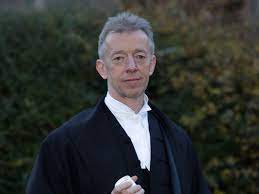
Sometimes a person walks into life or into the fabric of a town  and leaves an indelible mark, a lasting legacy if you will – that seems to sum up Aidan Hayes in Falcarragh.

Taking his last breath last week at the age of 78, Aidan led a fascinating and colorful life, one in which he was by degrees, father, poet, translator, singer, and teacher in schools and prisons in Ireland and France.

“What a lovely man,” said Ger De Róiste (Gerardine Roche), a talented singer, songwriter and multi-instrumental musician who co-hosts a very popular Sunday seisiún in The Shamrock bar in Falcarragh with her friend, Tara, also a talented singer-songwriter-musician. “He spent a joyful time in Falcarragh and we were all lucky to have met him and enjoyed a poetry night in the Shamrock. A father, a poet, a teacher, a singer, a friend to many, Aidan was a joy to spend time with.”
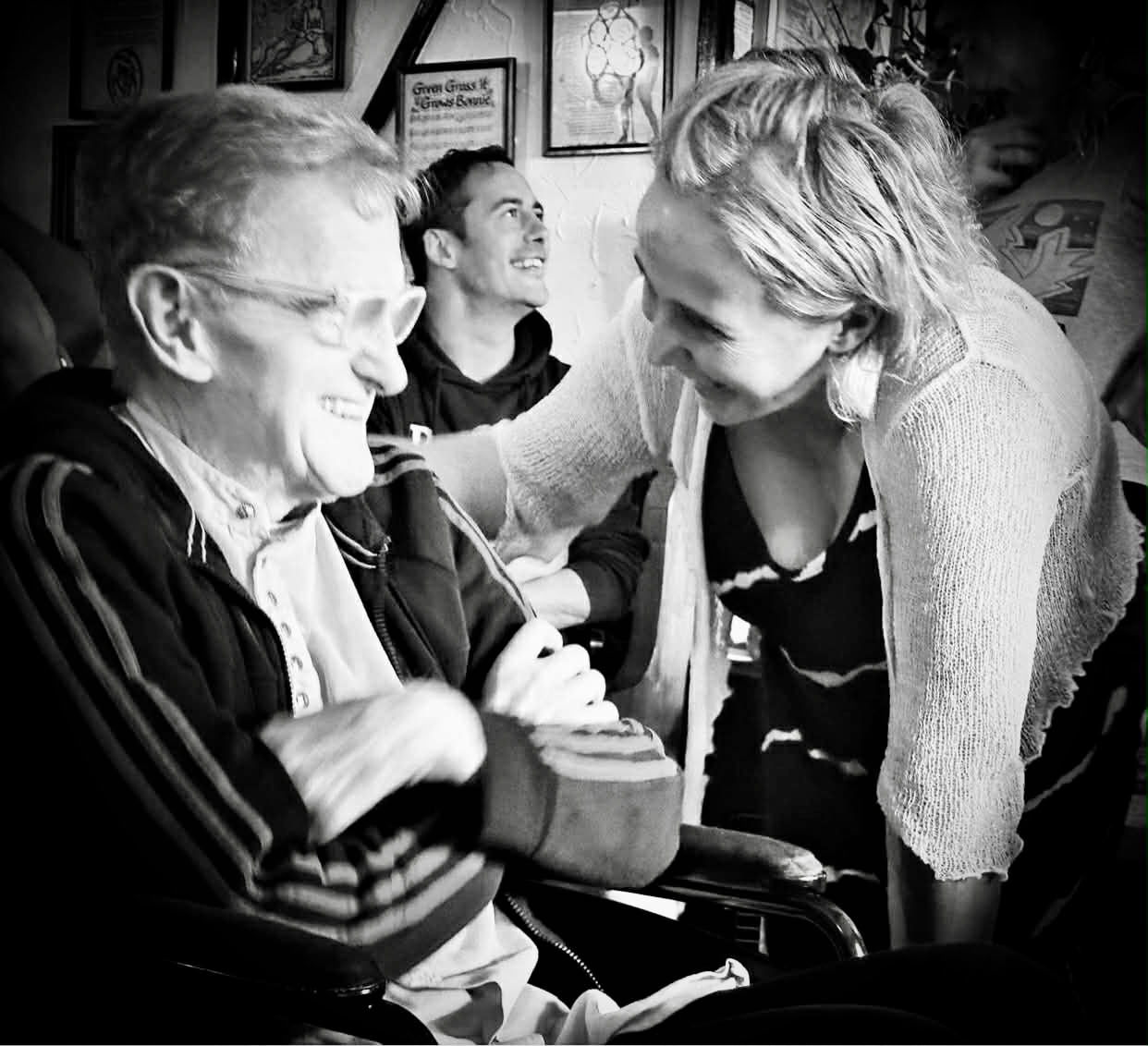
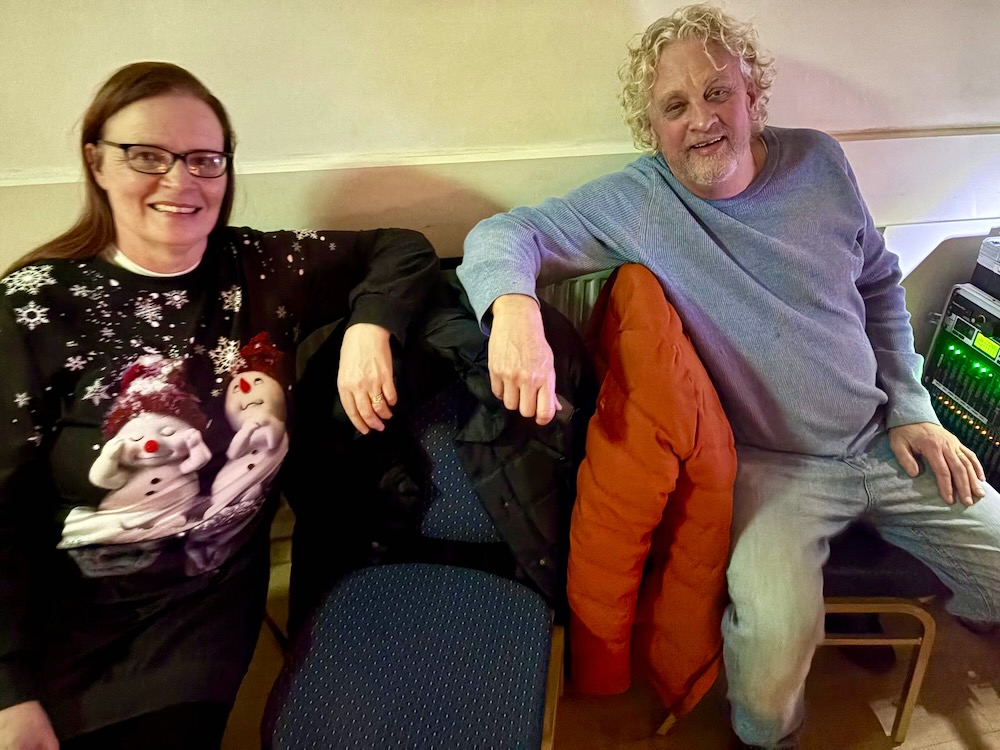
Musician-songwriter, singer Ger De Róiste and Aidan Hayes enjoy a warm moment of joy.

Originally from Cork as was Ger, she met him first in Donegal, “He brought a lot of laughter and could be completely himself without any worry about what others thought of him. He worked with many people helping them with their writing and poetry. He never judged. He was rich in kindness. He completely adored his family, his children and grandchildren he was extremely proud of and spoke fondly of them always. He was fluent in French and had a passion for that language as well as the Irish language. He spoke fondly of the Poets House here in Falcarragh and the wonderful Irish poets he admired.”

Ger was one of many people admiring the quality life Aidan led.  “He was a delightfully lively, flamboyant, creative addition to the Falcarragh community from his arrival at the Poets House in 2001,” said Ian Gordon, an artist from England, who left frantic urban London for the rural idylls of Dunlewey more than four decades ago. “I was fortunate to attend his monthly poetry sessions at the Shamrock for about ten years, where he spread his knowledge and humour copiously. Unfailingly generous with his time he launched two of my art exhibitions with wise and welcoming words.”
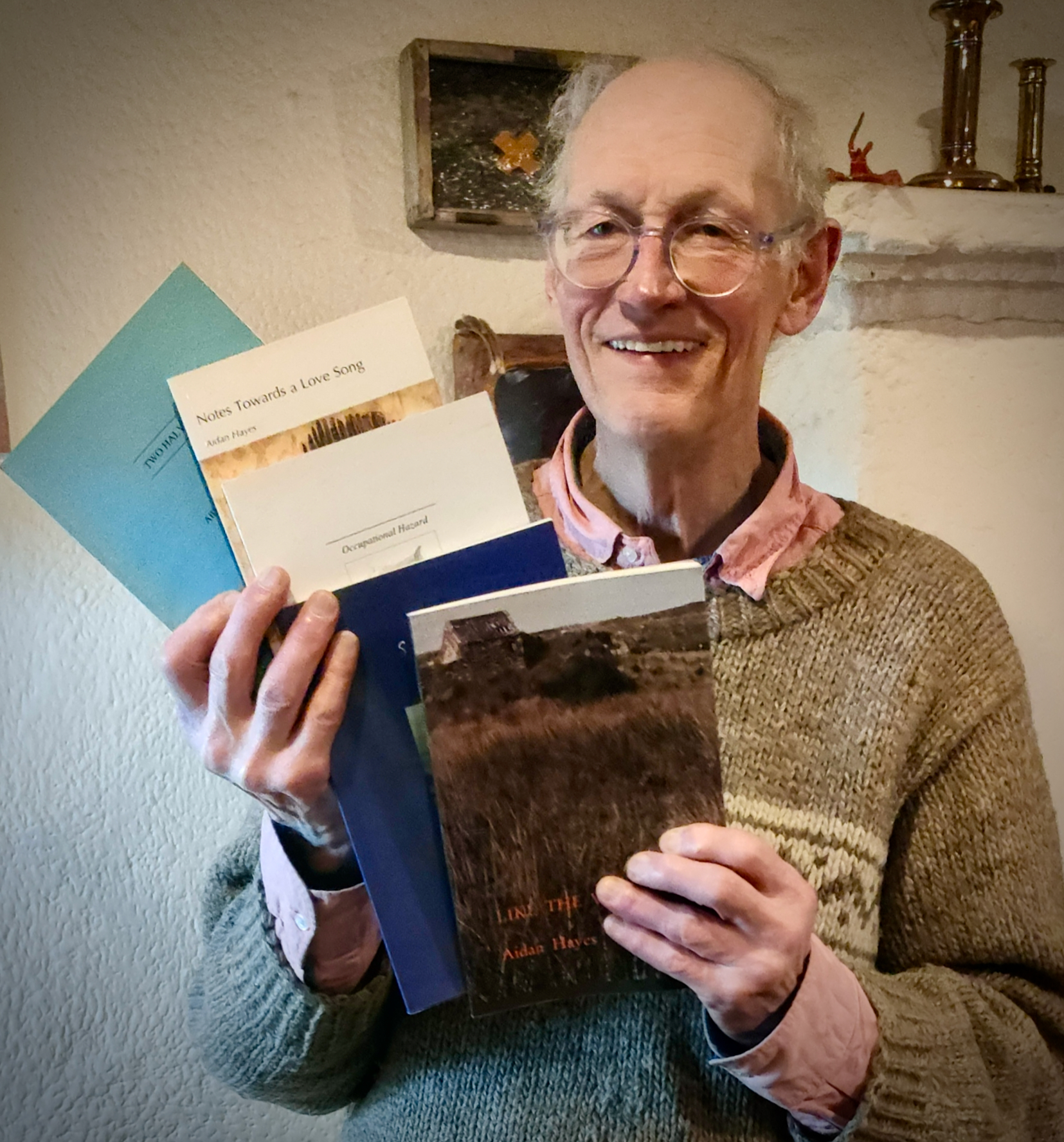
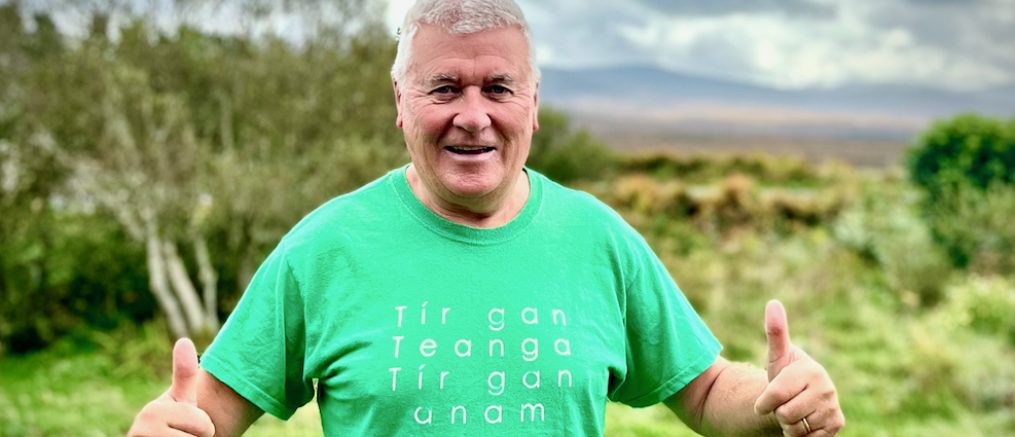
Talented artist Ian Gordan holds aloft books of poetry written by Aidan Hayes.

In 2014 and 2017, Ian published, through Ashlemon Press, volumes of Aidan’s poetry, such as ‘Like the Winter’ and ‘Staccato.’  “I believe poetry is about saying profound and beautiful things using a small number of words,” said Ian. “I said to him at one point, ‘Aidan! Surely it’s sensible, as a poet, to not write a poem every single day? But, happily he completely ignored this. From his shoes to his hat and his non-stop utterances, he was the complete poet. And we all loved him.” 

Andrew Roddy, musician-actor-songwriter and close friend of Aidan’s, said, “My fondest memory of Aidan is when I called in to Brenda Hewitt’s shop, ’The Mermaid’s Purse’ in Falcarragh about fifteen years ago, and I had my dog in the car and my dog was dying, and I had finally got around to realising that I couldn’t just sit and watch the animal suffering, I had to do something about it, and I’d made an arrangement to go to the vet in Ramelton to have him put down, and I was heart-broken, completely heart broken,”  recalled Andrew. “And I don’t know what I was in talking to Brenda about, it was just I was just distressed about the whole situation and as I was chatting to her Aidan came into the shop carrying two bags of shopping and he stood there silently picking up on what I was sharing with Brenda. He didn’t say anything, but when there was a lull in the conversation, he stepped forward and he put the two bags of shopping on the counter and said, ‘Here Brenda, will ye take care of those.’ Then he turned to me, and said, ‘Okay, Andrew, let’s go.’ He then accompanied me and metaphorically held my hand through something that was essentially painful and would have been much lonelier without his company. What really impressed me was the spontaneity of his kindness. I have a very clear memory of our journey together and the drive back.”

Aidan Hayes was laid to rest Sunday in the grounds of the charming St. Anne’s Church in Killult overlooking the Atlantic Ocean not far from his ‘sleeping’ poet friend, Joe Kane. His children, grandchildren, brothers and sister, nieces and nephew, family and friends miss him very much.
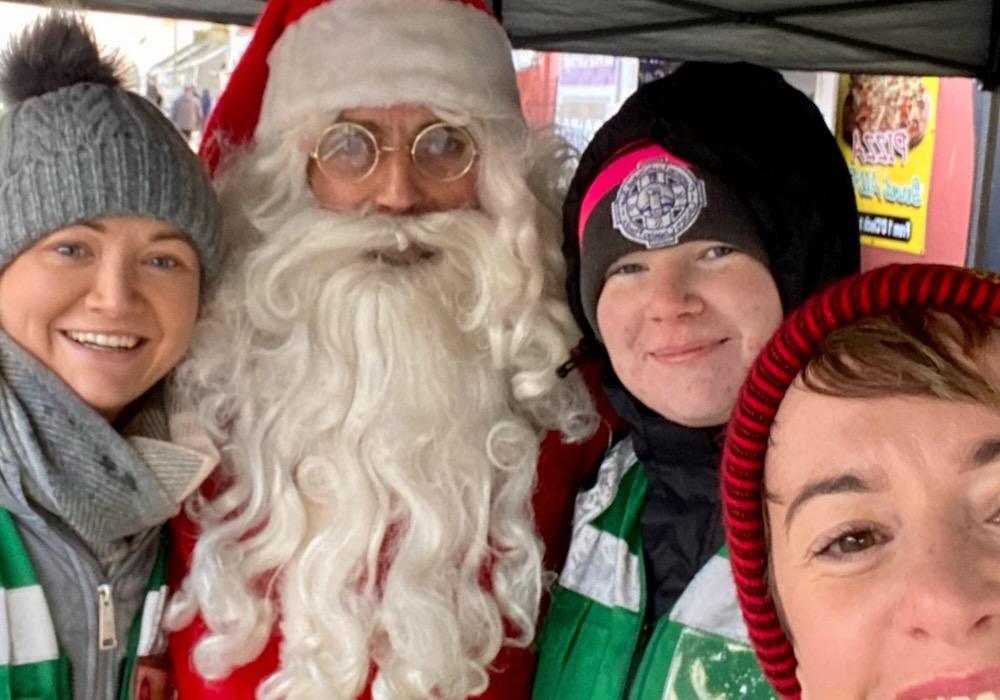
Festive Story – Charlie and The Kindness Factory

It was a wet and stormy night in Gortahork, Donegal when Charlie Cannon died.

For eight minutes.

Before he came to life again.

Shocked and amazed, people around him wondered –  had they just witnessed a miracle?

But before answering that question, let me take a step back in time.

The Loch Altan Hotel on the main street of Gortahork, a charming little town in northwestern, was lively with people on the fateful evening Charlie Cannon died.

It was a holiday weekend and the hotel was packed with revellers enjoying a few leisurely days of freedom. Well-deserved time away from noisy alarm clocks, traffic and work in offices, schools, building sites and other places.

These same revellers included Charlie who was enjoying a friend’s 60th wedding anniversary celebration in the hotel’s main restaurant.

Nearby, in the bar area, members of the Tulleybegley Walking Club including old friends Mickey McHugh and Eddie Curran were also enjoying themselves, having a few well-deserved drinks after finishing a 20 km cross-country trek known as ‘the pilgrimage walk,’ named after a century-old burial tradition whereby eight-men shifts carried coffins up and down hills from surrounding areas to the nearest graveyard that distance away.

Charlie himself wasn’t drinking that night. He had a job to do. He’d volunteered to drive a couple of friends home after the celebration dinner, one of whom had an injured leg and could only walk with the help of a cane.

Being wet and stormy outside, Charlie decided, in his selfless way, to walk to the car park across the road and drive his car to the front entrance of the hotel. Thus saving his friends from getting soaked in the rain.

Having done this, Charlie then went back inside the hotel and brought his two friends to the car. Then opened the passenger door to help his friend with the bad leg get inside.

That’s when it happened. 

“Sudden terrible pain, then I simply dropped to the ground,” he recalled vaguely, not actually remembering anything until two days later in hospital.

Meanwhile elsewhere in the hotel, Mickey and Eddie had moved into the lobby to chat. Hearing a commotion they looked up and saw Charlie‘s body flat on the ground. They rushed over and with the help of others lifted Charlie’s body and brought him further into the lobby, laying him down on the carpeted floor.

Their quick-thinking worked wonders.

Though trained in basic emergency medical skills as members of a local volunteer group known as ‘First Responders,’ they knew a much more experienced person was in the bar area.

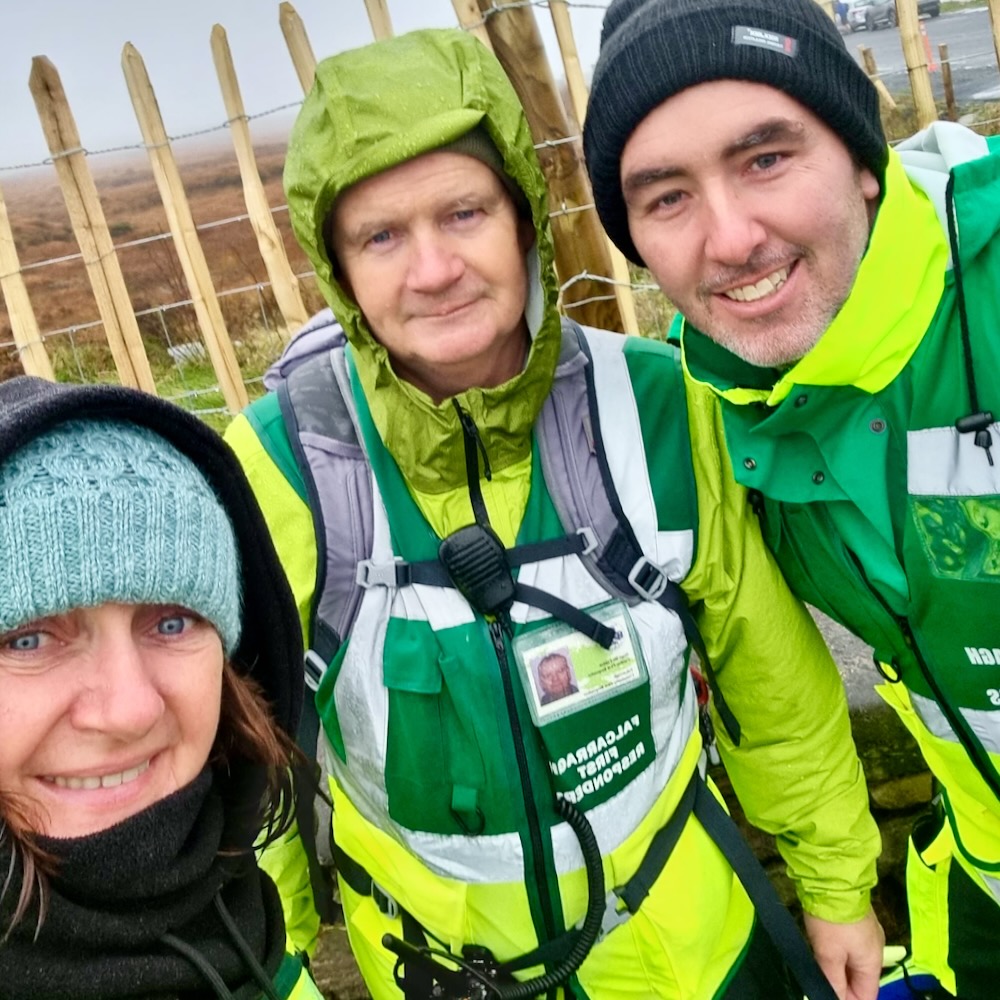
Pushing their way through the doors, they found their fellow hiking colleague Hugo McFadden, 60, an Instructor Safety Diver at Effective Offshore, training officer with Sheephaven Diving Club and one of the founding members of the Falcarragh ‘First Responder’ group ten years ago, with two others, Shaun Boylan and Maureen Gallagher.

Together, Shaun, Mickey and Eddie rushed out of the bar to the hotel lobby where a large crowd had now gathered around Charlie’s inert ‘dead’ body.

I use the term ‘dead’ because when he knelt down beside him, Hugo couldn’t find a pulse. Charlie’s heart had stopped.

In ordinary circumstances, that should have been the end of this story. Charlie’s body would’ve been moved to a morgue somewhere, probably in a hospital. Then later, buried. 

But these weren’t ordinary circumstances.

Well-trained in emergency medicine, Hugo shouted for someone to find him a defibrillator, or Automated External Defibrillator (AED), as they are formally known. Blank stares indicated most people didn’t know if there was one. Or if so, where it might be. Fortunately, Orla the hotel receptionist then, did. Snatched from the wall where it hung, it was rushed to Hugo, still kneeling beside the motionless body of Charlie.

Recalling that frantic scene, some people told me the eight minutes that followed seemed like eight hours.

Hugo started chest compression. No pulse. Moving people around him further away, he placed the paddles on Charlie‘s chest, sending an electric shock through him to kick-start his heart. Still no pulse.

He tried again. Chest compression, electric shock. Still no sign of life. It was then he heard a voice in the crowd around him saying they’d heard a cracking sound, the sound of ribs breaking. 

Luckily, it wasn’t. But even if it were…

“Our motto at ‘First Responders‘ is ‘life over limb,’ said Hugo, telling me what happened. “A cracked rib is worth less than a saved life. I’d crack a few ribs if it saved someone from death. And I wouldn’t have stopped trying for Charlie. No way.”

Unwilling to give up, Hugo tried a third time. Chest compression, electric shock. He felt again for a pulse. This time he found one. Faint, yes, but it was definitely there.

Here, deep in the heart of rural Donegal, northwest Ireland, a region known as the Gaeltacht as the first language spoken here is Irish, emergency ambulances can take around 30 to 45 minutes to get to Gortahork from the more urban areas of Letterkenny and Dungloe. Thus the crucial role played by ‘First Responders’ such as Hugo, Mickey and Eddie in saving lives.

When the ambulance carrying paramedics finally arrived at the Loch Altan Hotel, Hugo had already conducted the most crucial of life-saving interventions. 

Without Hugo‘s help and that of Margarite Meehan who kept feeling for a pulse as Hugo performed chest compressions and administered electric shocks, the 73-year-old former school bus driver and mechanic would be long buried, his loss mourned by family and friends. 

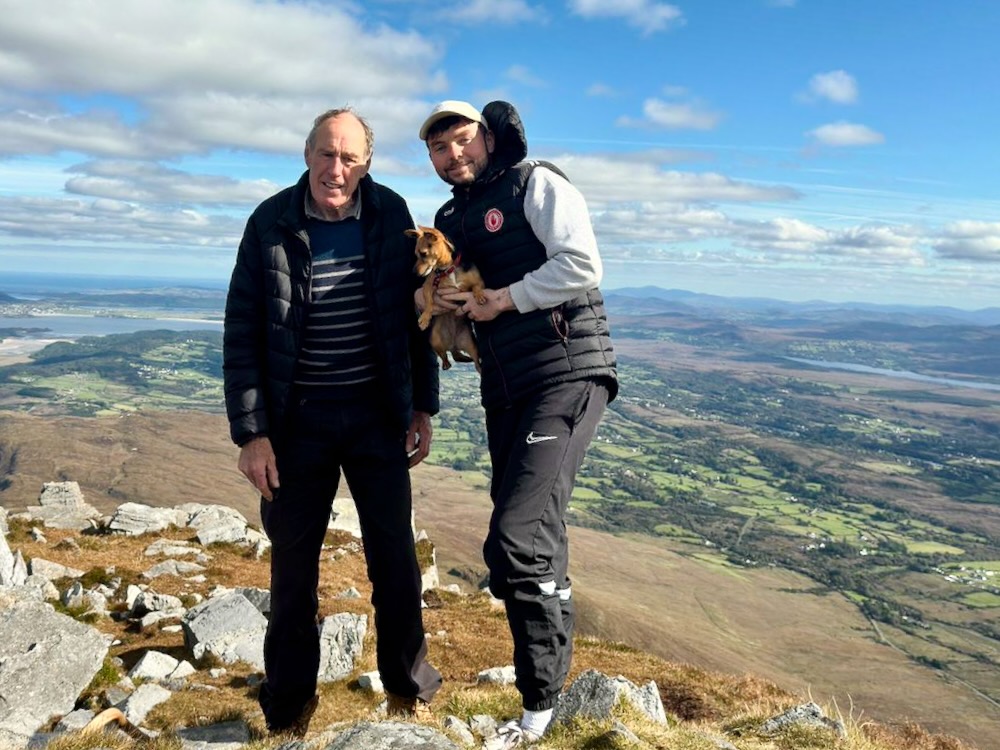
Instead, Charlie is alive and well, spending the festive holidays with his 92-year-old Aunt Una in Mayo, a place he drove to a few days ago. 

“If I was back in Donegal, sure I’d be climbing to the top of Errigal with my son, John Paul,” he hold me in a telephone conversation earlier this week.

A daily walker, usually in the company of his little terrier dog, aptly named Tiny, Charlie, now 73, is also an avid cyclist and an expert restorer of vintage 19th-century bikes nicknamed ‘High Nellies,’ the name referring to its tall riding position with a very large front wheel and a much smaller rear one. More commonly known as ’penny-farthings,’ Charlie sometimes jaunts around on one in the area where he lives in the townland of Stroughan. So fit is he, six weeks ago, with his nephew, Patrick Darcy, he climbed Muckish Mountain. No easy task for anyone, never mind a man who, Lazarus-like, rose from the dead. Sadly, Charlie lost his wife of 47 years, Kathleen, to cancer. But he tries to keep his head up.

“Hugo’s my hero,” he said, a catch in his voice. “And the others too, the ‘First Responders’ who saved my life. If it weren’t  for them, I wouldn’t be talking to you. I wouldn’t have seen another Christmas, another New Year. Instead here I am, enjoying life. There’s not enough words to thank them for what they did for me.”

As I sip my spiced brandy on this frosty winter evening, I ponder…why wait for the festive Christmas and New Year season to celebrate unsung heroes like Hugo, Margarite, Mickey, Shaun, Maureen and Eddie, and all those ‘First Responders.’ Such selfless people are all around us, every single day, especially in close-knit rural communities, quietly helping their fellow Man along the path of Life, without fear or favour. 

‘First Responders’ a purely voluntary group of local people who help fellow citizens in emergency health situations, are seeking new members. Do you want to help your community? Perhaps save someone’s life? If so, then contact falcarraghdefib@gmail.com or Mobile 0861013304. You could make a big difference. And feel tremendous satisfaction doing so.

Community spirit helps save lives in Falcarragh

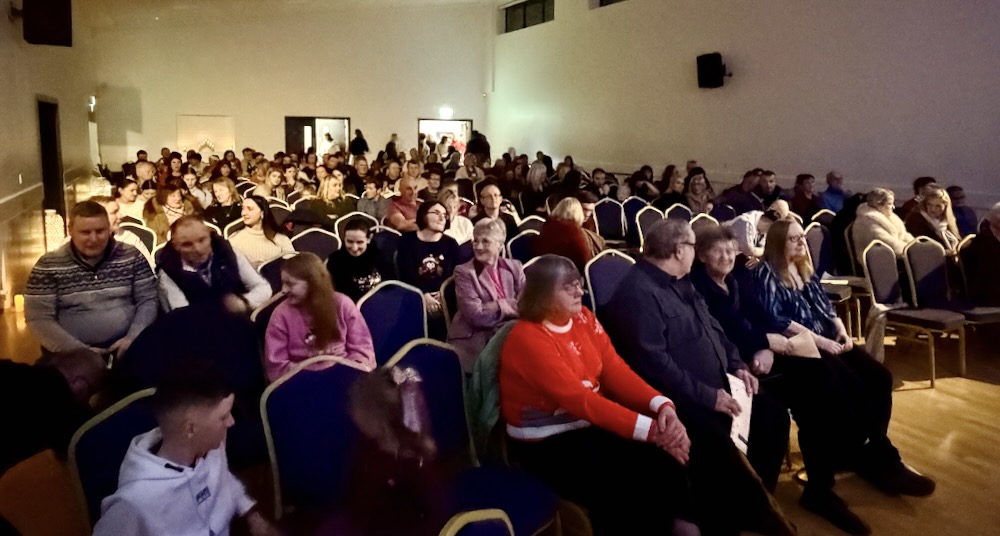
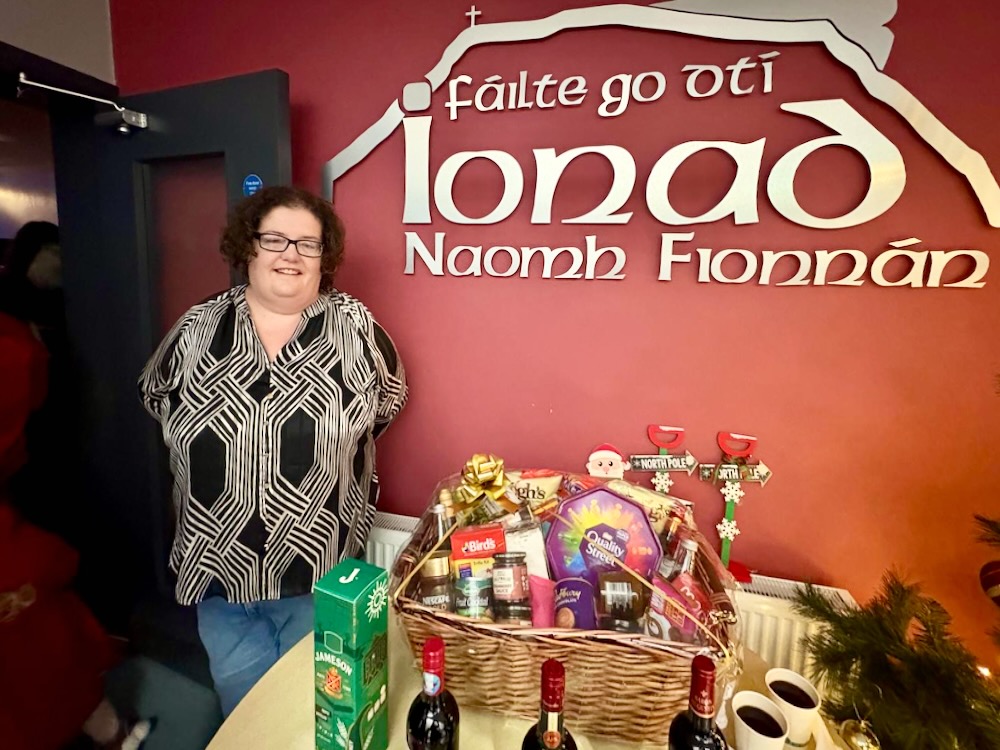
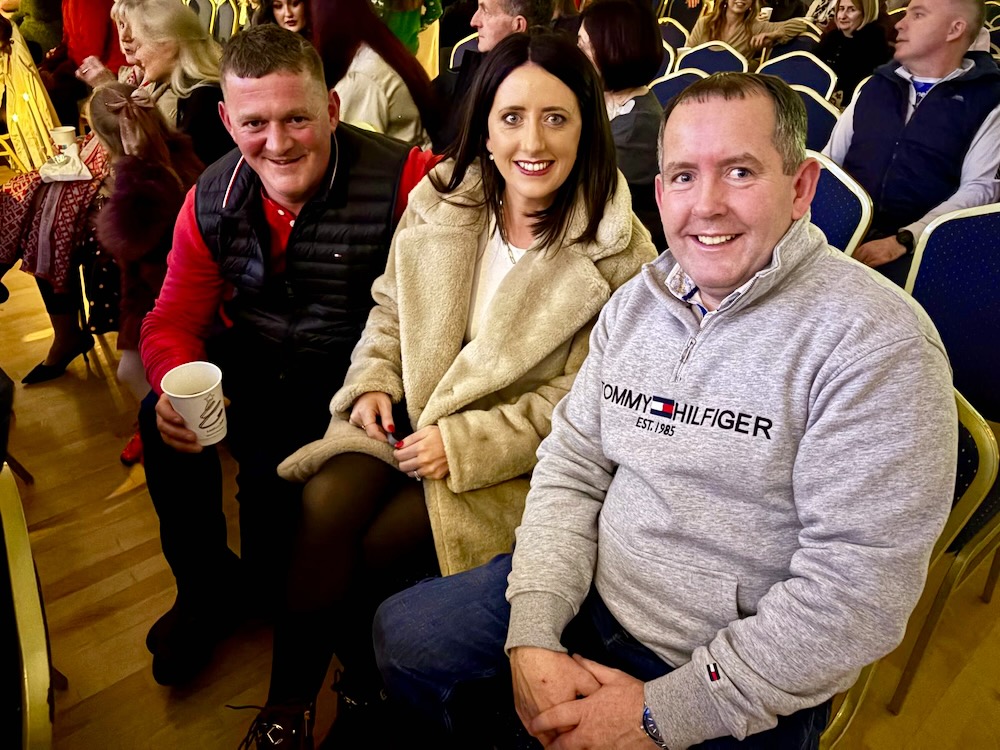
More than 100 people packed into Ionad Naomh Fionnan community centre, Falcarragh, Donegal recently to support selfless volunteers known as ‘First Responders,’ ordinary people who receive basic medical training and help in emergency situations.

Attended by infants and the elderly alike, the ‘Light Up A Star’ event, hosted by Buíon Cheoil Sinsear Chloich Cheann Fhaola, the Senior band, was an evening of high-quality music and singing acts, all from the Cloughaneely area. Emcee was the talented Aoife McNichle, senior band member. 

Ranging from traditional Irish songs and music to contemporary ballads, some composed by performers, the acts included the Cloughaneely Senior and Junior Bands, singers Cora Moore, Clíona Gallagher, Darren O’Halloran, Sarah McGeever, Conor O’Ghallchoir and Hannah McFadden, the local Comhaltas group and Don E Gals, a trio of female ukulele players. Patricia Harley and Annette McPaul read poignant prose passages as Gaeilge and as Bearla from the stage.

“First Responders provide a vital service to the community and we were delighted to show our support,” said Aine Quigg, secretary of the band, who also praised all the volunteers involved in the evening’s fund-raising event, including Patricia Harley, principal of Scoil Náisiúnta Gort an Choirce (Gortahork National School). “Being in a rural area, ambulances from Letterkenny and Dungloe can take quite a while to get here so the work of ‘First Responders’ can be the difference between life and death, where seconds, not just minutes, count.” This was only the second such concert organised by Buíon Cheoil Sinsear Chloich Cheann Fhaola, the firt being last year, which helped raise funds for the band’s tour of New York.

As for Falcarragh ‘First Responders’ group, it was founded ten years ago by Shaun Boylan, who is the group’s co-ordinator, Hugo McFadden, both of whom are Instructor Safety Divers at Effective Offshore, and Maureen Gallagher. It is one of over 350 such groups nationwide, with the local one now having 15 active members, four men and 11 women, who respond to 100-120 call-outs a year in a radius of about seven kilometres around Falcarragh, including the Magheraroarty and Derryconor and all the way to Corcreggan Mill, near near Dunfanaghy.

The emergencies they deal with could range from heart attacks to choking and strokes. There has, unfortunately, been a fall in the number of volunteers as there were around 32 before Covid hit, which is why the group is now seeking new members. 

‘Receiving no government funding, we’re grateful for this generous response from the community we serve, the funds help with training and buying and maintaining life-saving defibrillators, which we’ve expanded from only one when we started to fifteen now, which are placed in various businesses and schools throughout the area,” said Shaun proudly.

“All volunteers are closely vetted and receive training in various aspects of emergency medicine, including the use of defibrillators, how to recognise people suffering strokes, and so on.”

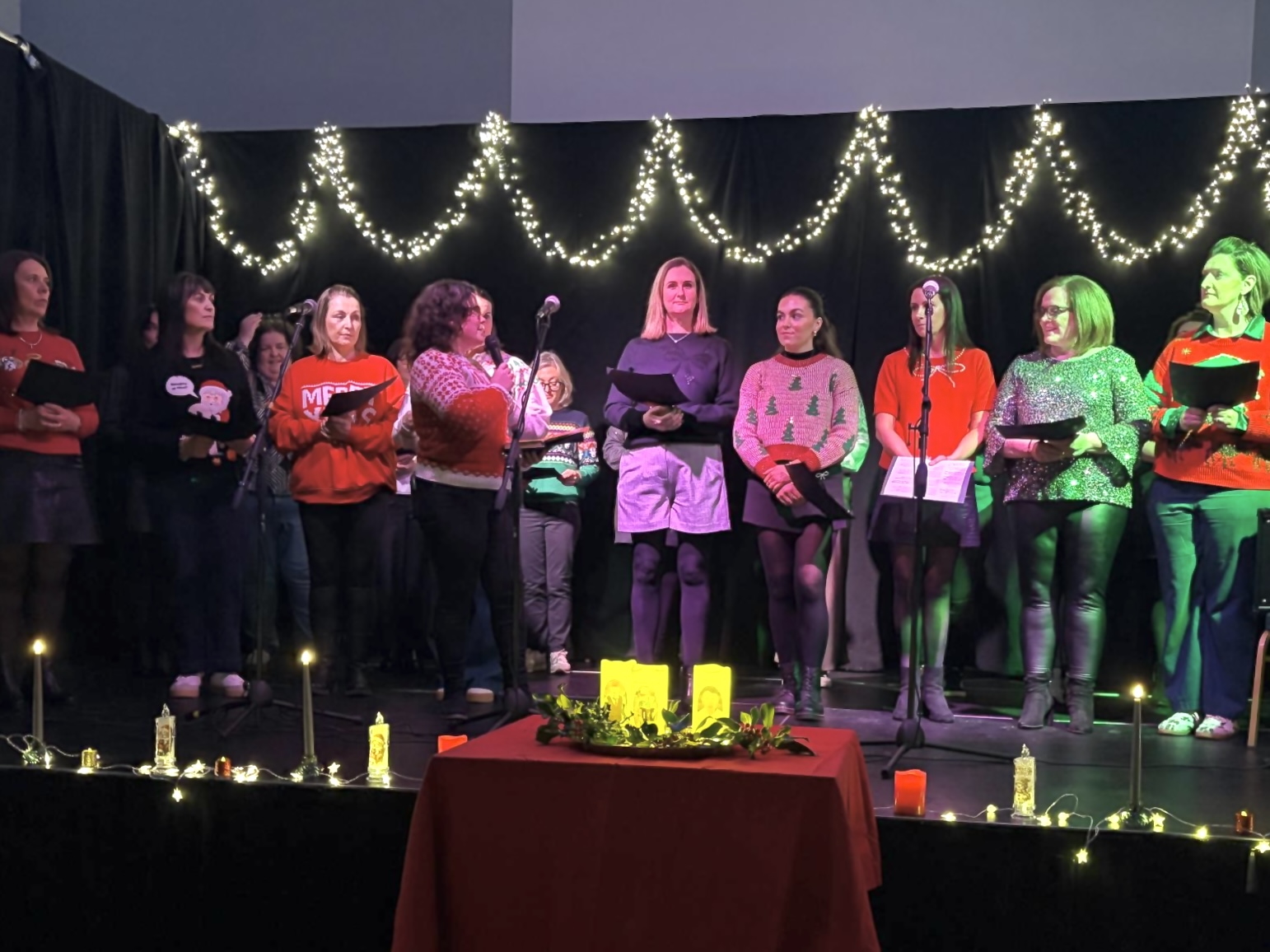
The community event also honoured local people who have died recently. Candles on stage featured the faces of 13-year-old Enya McMurrough from Gortahork who passed suddenly in February and was a member of the junior band and beloved daughter of senior band member, Fionnuala.

And Jamie Diver and Shaun Martin McClafferty, sons of Roise Diver and Sharon McClafferty, who died in a tragic collision. Their deaths occurred within weeks of each other. 

“It was with heavy hearts we organised this fund-raising event,” said Aine Quigg. “In fact, we weren’t even sure if we should go ahead with it due to the tragic deaths. It was a bad year because of this. But after speaking with the bereaved families, we all decided it was best to remember those who had passed.”

The evening’s event also featured a special ‘Remembrance Tree,’ a Christmas tree hung with white stars with the names of deceased loved ones on them which local people purchased to support ‘First Responders.”

Printed on the event programme for the evening were the words, “As we light these stars, we remember those we miss dearly. May these small lights remind us that love shines on.”

‘First Responders’ welcomes new volunteers. If interested, contact falcarraghdefib@gmail.com or Mobile 0861013304.

Music crosses all borders, links people as One

by Sean Hillen 

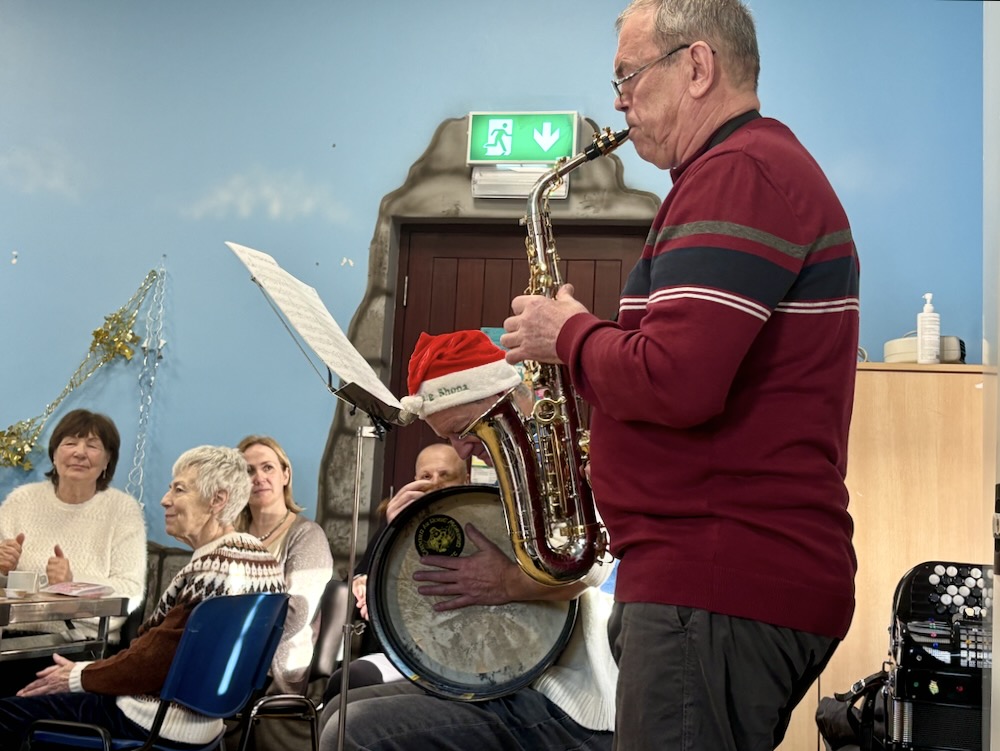
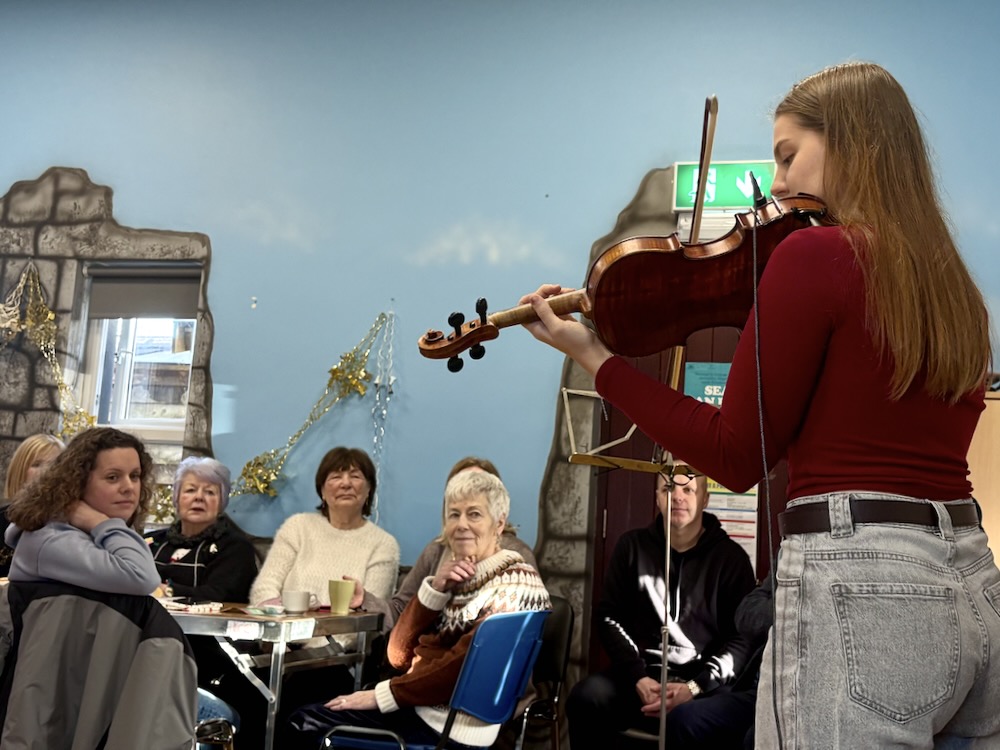
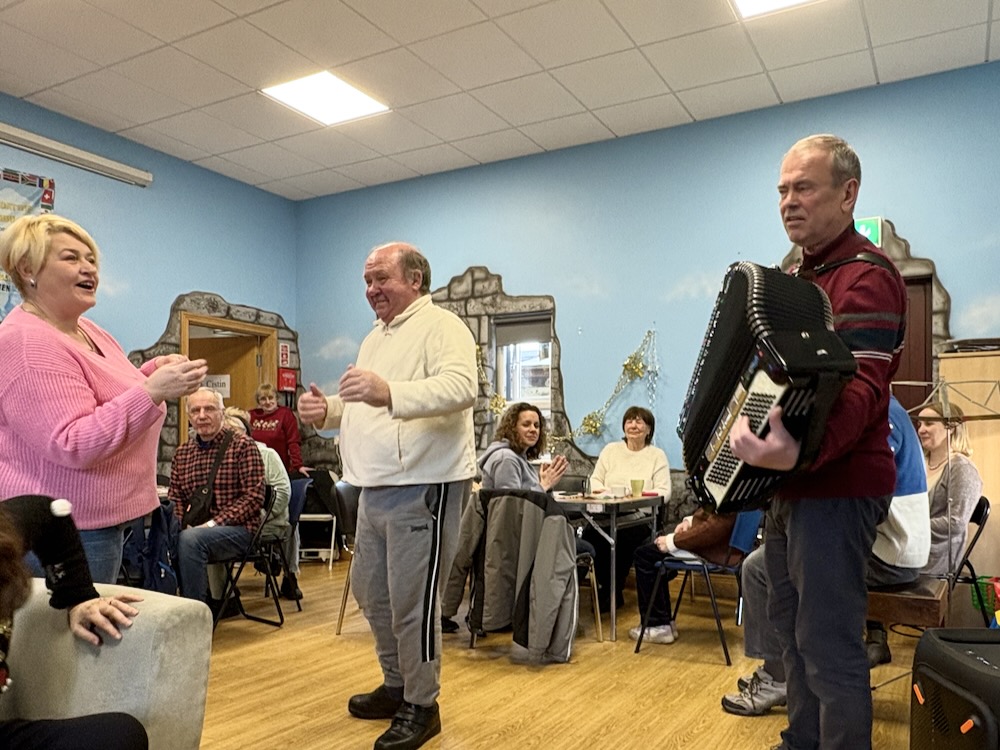
Probably never in the annals of musical history has a Ukrainian saxophonist-cum-accordionist, a classical violinist and an Irish bodhrán player come together as a highly-entertaining trio.

But they did this week at a celebratory Yuletide event at Garradh Colmcille in Falcarragh attended by women, men and children representing diverse nationalities including Canadian, South African, American, Irish, Ukrainian and English.

This unique occasion featured musicians, Reuben O’Conluain, Irish-language professor and cultural enthusiast, multi-instrumentalist Yuriii Hryhoriev and talented Olena Korotka, a classically-trained orchestral violinist from the now militarised region of Kherson in southern Ukraine. 

The proceedings ranged from delightful musical renderings including traditional Irish tunes as well as Ukrainian folk songs such as ‘Chervona Ruta’ and ‘Cheremshyna,’ to contemporary ballads such as Leonard Cohen’s ‘Hallelujah,’ and ‘Until I Found You’ by Stephen Sanchez, with a few festive seasonal songs including ‘Jingle Bell Rock’ and ‘It’s Beginning To Look a Lot Like Christmastossed in for good measure.

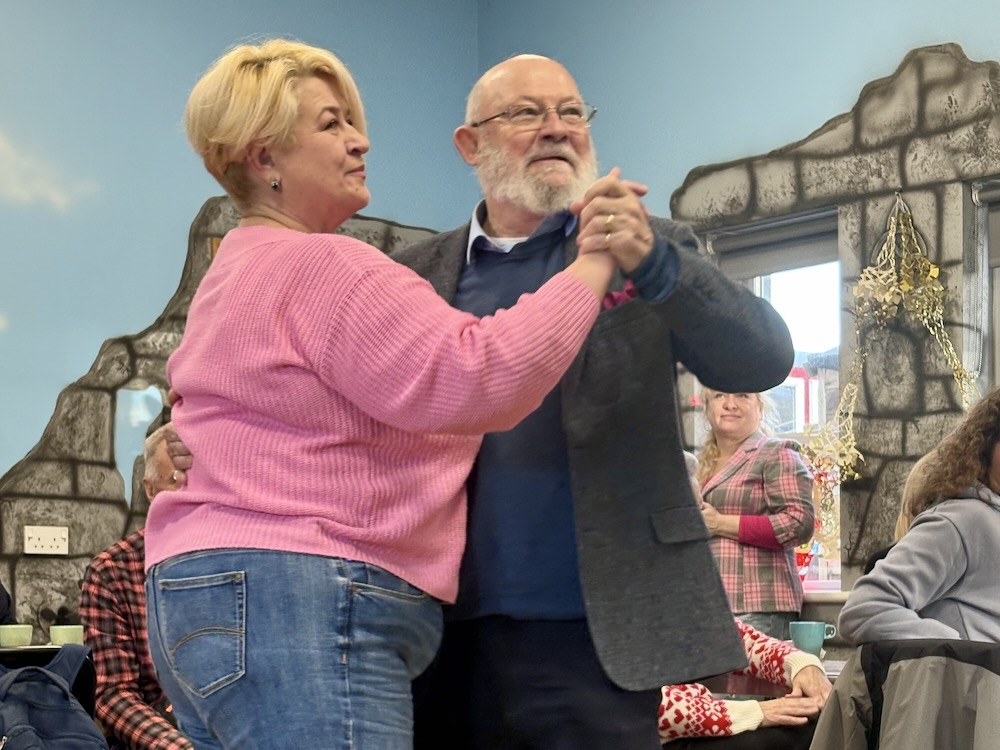
Nimble dancers also took to the floor, shaking their booties in carefree abandon to the lively rhythms of the instruments played so wonderfully.

Many congratulations to Armen Galstyan, a refugee from Odessa, for organising the musicians, and local community activist at Pobal le Chéile, Rosemary Grain, and her enthusiastic support team for hosting the event so well.

For me, and I’m sure for many others attending, the event highlighted the interconnectedness of people across borders illustrating how humanity, regardless of language, skin colour, religion or nationality, is one and the same entity, each element dependent upon the other for peace, progress and prosperity.

Theatrical triumph for the talented Cloughaneely Players in Donegal

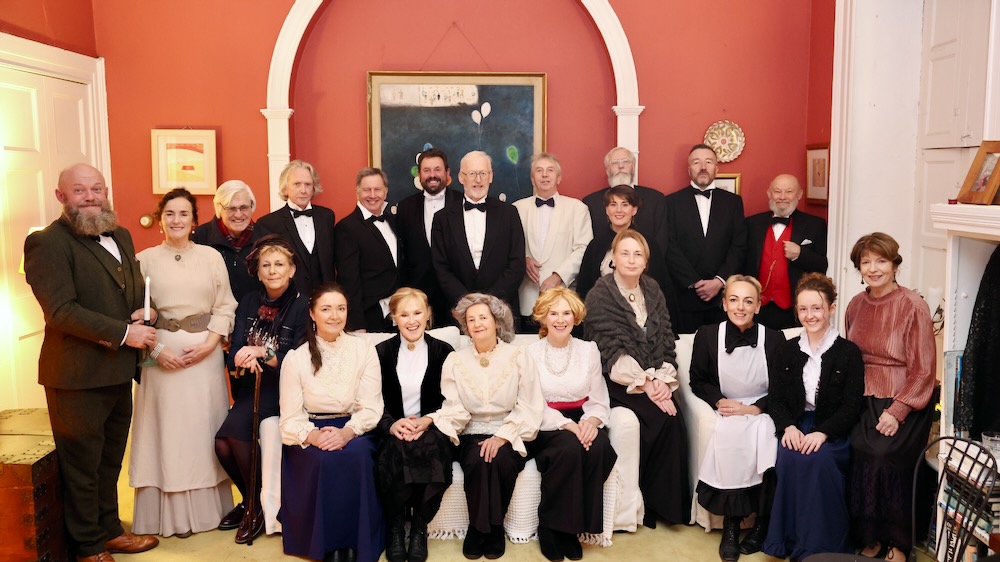
What a theatrical triumph this past weekend for local amateur drama company, The Cloughaneely Players, who meet close to my home here in the scenic northwest corner of Donegal.

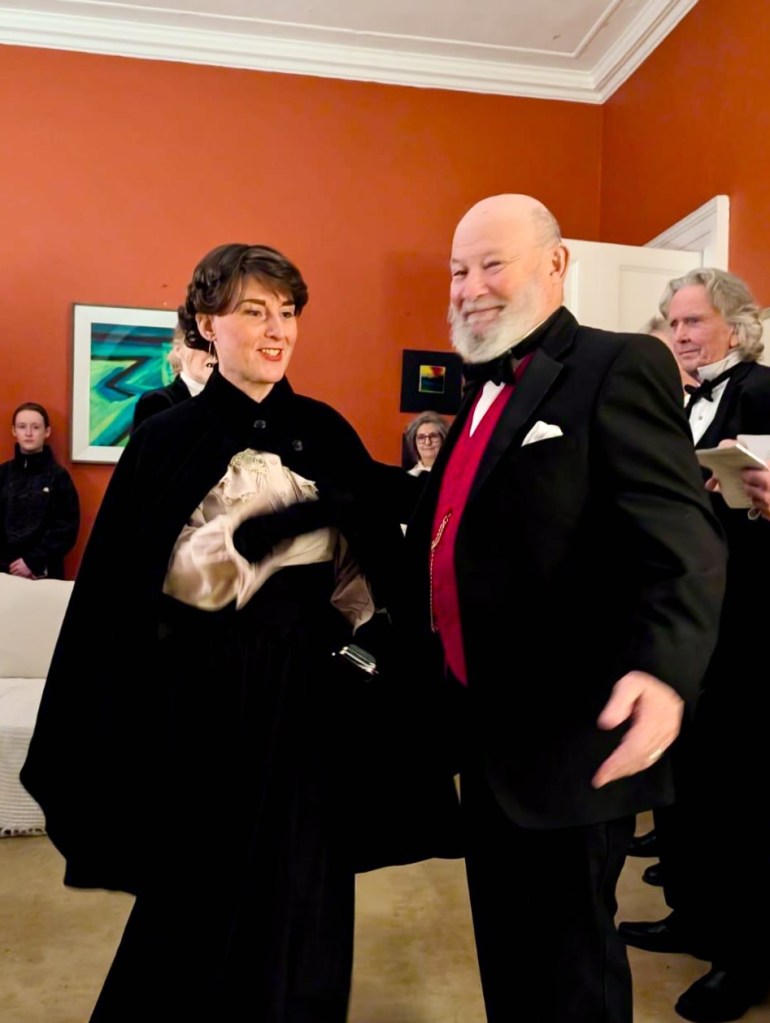
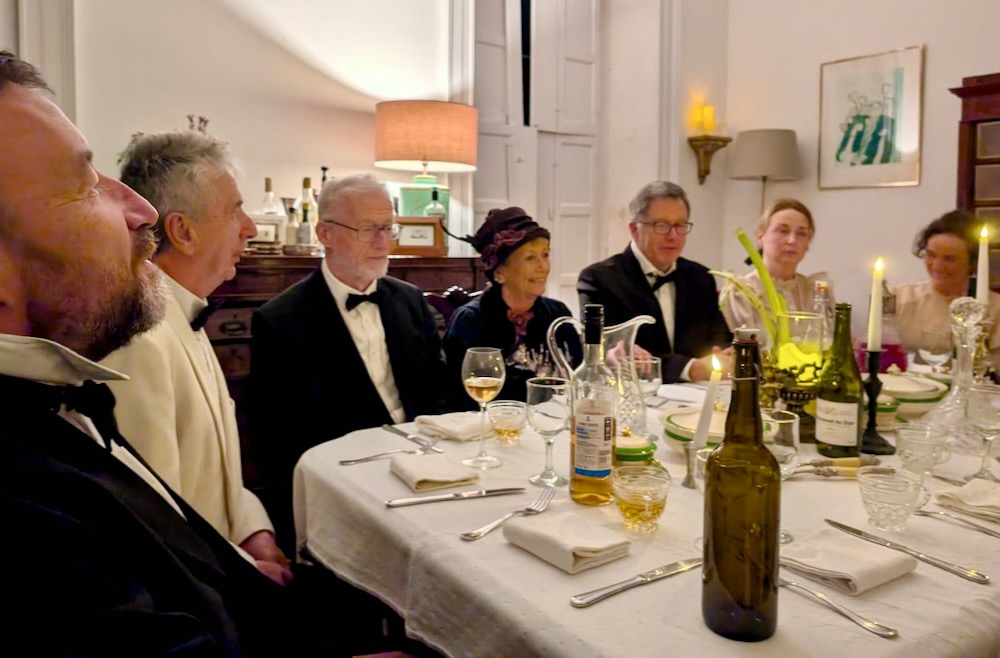
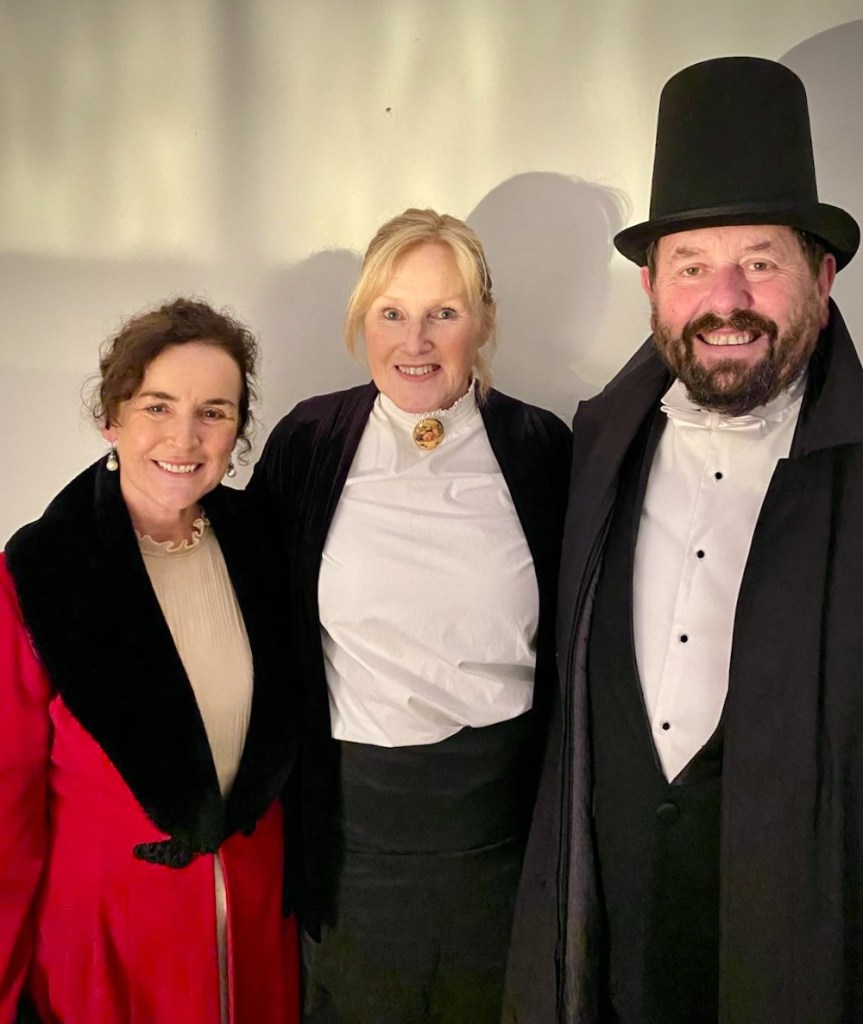
Not only did they host a superb re-enactment, complete with costumes and wigs, of James Joyce’s classic short story ‘The Dead’ set in 1904 in a most enjoyable manner, but they transformed a rural Donegal house into a 19th century multi-stage setting using most of the rooms in the house, both upstairs and downstairs, for various scenes.

Many congratulations to director Carmel MacGill, consultant director Murray Learmont, choreographer Caroline McGee, and more than twenty talented local amateur actors and musicians for a superb show.

And keep in mind, we’re not talking about well-paid West End or Broadway professional performers (though you might be mistaken that they were). We’re talking about a local bartender, a teacher, a nurse, a doctor or two, a real estate broker, a hypno-therapist, even a retired revenue sheriff, and many others, all of whom bring sheer enthusiasm and passion into treading the boards.

Here’s a few photographs to illustrate the weekend’s entertainment. 

I’ve written a much more comprehensive article in tribute to these delightful women and men for this Thursday’s edition of the Donegal News on the Digest page so pick up a copy and have a read and rejoice we have such talented artists among us.

And don’t miss out on their next production. The tickets will be red hot, so buy early. No doubt they’ll be sold for high prices on the international black market.

Thank you to Catriona Kelly, Jake Campbell McLaughlin and Maggie McKinney for photographs.

Meet The Real Simon Harris – The Dishonourable Duke Of Duping

Is it not reprehensible – the height of hypocrisy in fact – that Simon Harris the leader of the Irish Government  – has the audacity to accuse Sinn Féin in recent weeks of ‘duping’ people when it expelled several party members for substandard social behaviour?

Simon Harris – the Dishonourable Duke of Duping.

The Cambridge dictionary definition of dupe is ‘to deceive’ and if anyone is guilty of deception, it is Harris and his colleagues in the coalition Government of Fine Gael, Fianna Fail and the Green Party.

Over the last four years since being in power – and for many years before that – these parties have been nothing less than ‘repeat offenders,’ constantly deceiving the ordinary hardworking people of Ireland with false promises of a quality lifestyle as befitting a nation that is one of the earliest members of the European Union, then called the European Economic Community, or EEC for short, back in 1973.

Instead, however, we have one of the most disastrous health systems on the continent, with people waiting years for life-saving surgeries, often dying before they receive it; we are awash in homelessness and poverty, with an estimated people 30,000 living on the streets, including thousands of young children and infants; we have a forsaken, forgotten, forlorn State where retirees and newlyweds alike are unable to afford the rent of a simple home, never mind the financial resources to even remotely consider buying one to end or begin their lives together in a modicum of comfort.

Not only does the Dishonourable Duke of Duping continue to deceive people that after all these years he’ll one day consider putting a roof over our heads, but he himself basks in the lap of luxury in one of the most expensive and elitist places in Ireland, the scenic coastal town of Greystones in county Wicklow, where he was born, where he lives and where houses cost up to two million euro, and more.

But is it not somewhat harsh of us to criticise the Dishonourable Duke of Duping for his lack of common decency? Is it not unfair to ask a man of such Royal blood living in such a high falutin’ environment to understand the plight of so many desperate Irish people? Is that not akin to asking King Charles of England to make his own cupán tae once in a while?

Shamefully, while the wealthy in Ireland (many of whom are the Dishonourable Duke of Duping’s closest neighbours) while away their days in decadent lifestyles with fancy homes in fancy places or travel in  environmentally-damaging private jets (which the Dishonourable Duke of Duping does frequently) and indulge their whims in ostentatious holiday homes abroad (which the Dishonourable Duke of Duping often does), modern Ireland suffers the worst housing shortage in its entire 100-year history. 

Studies show less than a third of 30-year-olds own their home. Over half of all newly-built homes in greater Dublin alone were bought or developed by global vulture investor funds, thus locking countless people out of ever attempting to buy one. These ‘vampire funds’ don’t buy homes to sell, they buy them to extract high rents in perpetuity. In other words, they suck the lifeblood out of decent Irish society.

And to make matters worse, the Dishonourable Duke of Duping and his cadre of Government lackeys allowed a temporary no-fault eviction ban in Ireland to lapse last March, thus opening the floodgates for more than 15,000 notices of termination to be issued last year, making the number of evictions higher than it was during the Famine in the mid-1800s. 

For centuries, gutless, greedy, often absentee, landlords, have been the scourge of Ireland, rich, ruthless people who with the click of a finger, a scribbled signature on a sheet of paper, thoughtlessly tossed hungry families out into the ditches. 

Now it seems the same is happening all over again in modern Ireland, this time under the dictatorial rule of the Dishonourable Duke of Duping and his ignoble entourage.

Instead of urgently dealing with these major social and health issues that are making the lives of so many Irish people intolerable, Harris and his well-to-do cohorts, including Government coalition leaders, Micheál Martin of Fianna Fail and Roderic O’Gorman of the Green Party, are pointing their grubby finger at Sinn Féin, an oft-used political ploy to distract popular attention away from the real issues, and their own failings on them. 

In doing so, however, these ‘I’m-better-than-you’ leaders fail to realise something important. While the bitter winds of winter howl at our doors, while Storm Ashley batters the coast this weekend, Irish people are not bears. They are not hibernating. They are wide awake. And fearful. And hungry. And cold. And they remember the empty promises made to them from on high four years ago, and for many years before that.  

Maybe, just maybe, we should ask Sinn Féin leader Mary Lou McDonald to re-tell the story of these empty promises once more, to remind us how easily we were taken for fools. And in doing so, help us make sure the Dishonourable Duke of Duping and his Royal patrons don’t sneak back into power through the back door and make jesters of us for another four years in their Court of Failure.

Maybe, just maybe, we’ve learned our lesson and are wide awake enough to elect Sinn Féin, the ‘Party of Change’ and improve things for the better. For each and everyone of us, our parents, our children and the generations who come after. 

One-Eyed One Irish legend recreated by talented Donegal drama group in Falcarragh

Ever heard about Balor of the Evil Eye?

It’s an ancient Irish legend about the nasty, one-eyed mythical tyrant of a King on Tory Island in Donegal who’s killed by his grandson, Lugh – and there’s no better way to enjoy this suspense-filled story of life and death than when it’s hosted by the Cloughaneely Players, a delightful drama group in the local town of Falcarragh.

As part of its ongoing community service programme, this amiable band of actors and friends put on a wonderful outdoor show recently that had schoolchildren and adults alike both enchanted and enthralled. 

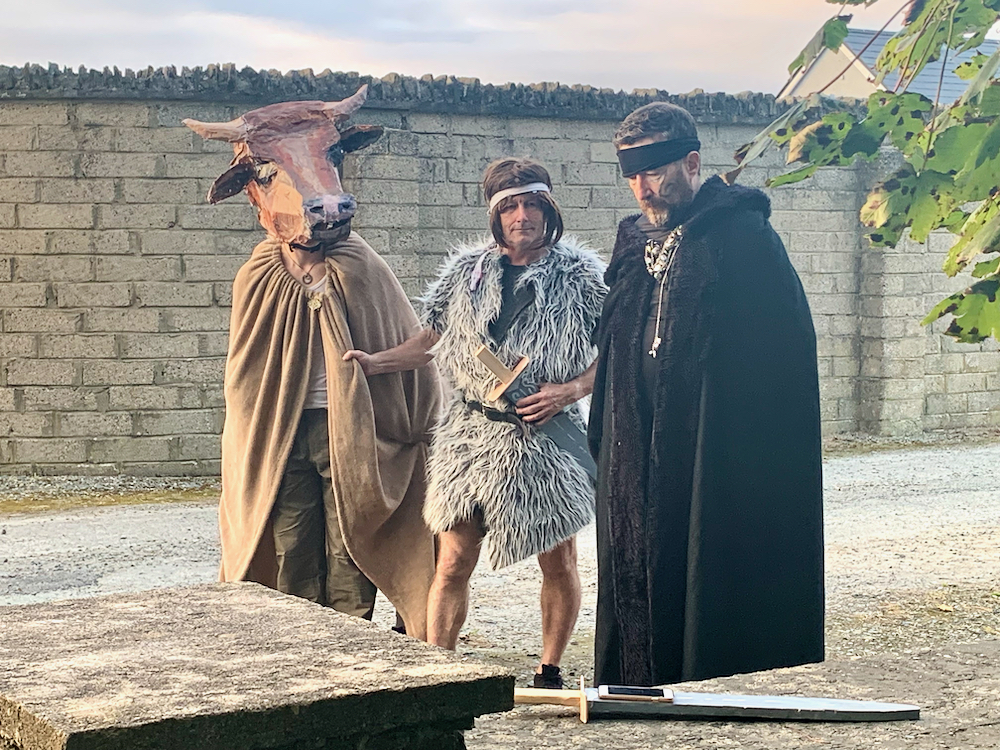
And it took place, most appropriately, beside a 16-foot pedestal, a white limestone boulder with red veining atop a pillar known as the ‘Cloughaneely Stone (Cloich Cheann Fhaola)’, the red veining symbolising the petrified blood of a chieftain called MacKineely (Cian mac Cáinte) beheaded on the stone by Balor after he discovered he planned to kill him after he’d stolen one of MacKineely’s prized cows – Glas Gaibhnenn.

Under the astute direction of Murray Learmont and led by narrator, Joe Kelly, a leading folklorist, the actors had young schoolchildren jumping up and down like excited kangaroos just out of their pouches during the entire production (and a few adults too, though I dare not say who they were less I embarrass them).

Organiser of the event was Mark Boylan, co-manager of the Cloughaneely under 11 Irish GAA football team, with Kevin Scanlon, chairperson of the Cloughaneely Minor Board, giving a short speech to kick-off the evening. 

A stellar cast, one with the creative ability to slip off-script and concoct amusing dialogue spontaneously, included Denis Doohan in the lead role of Balor (I particularly liked his joke about Balor having more defenders than Jim McGuinness, the recently-named manager of the Donegal Irish senior GAA football team. 

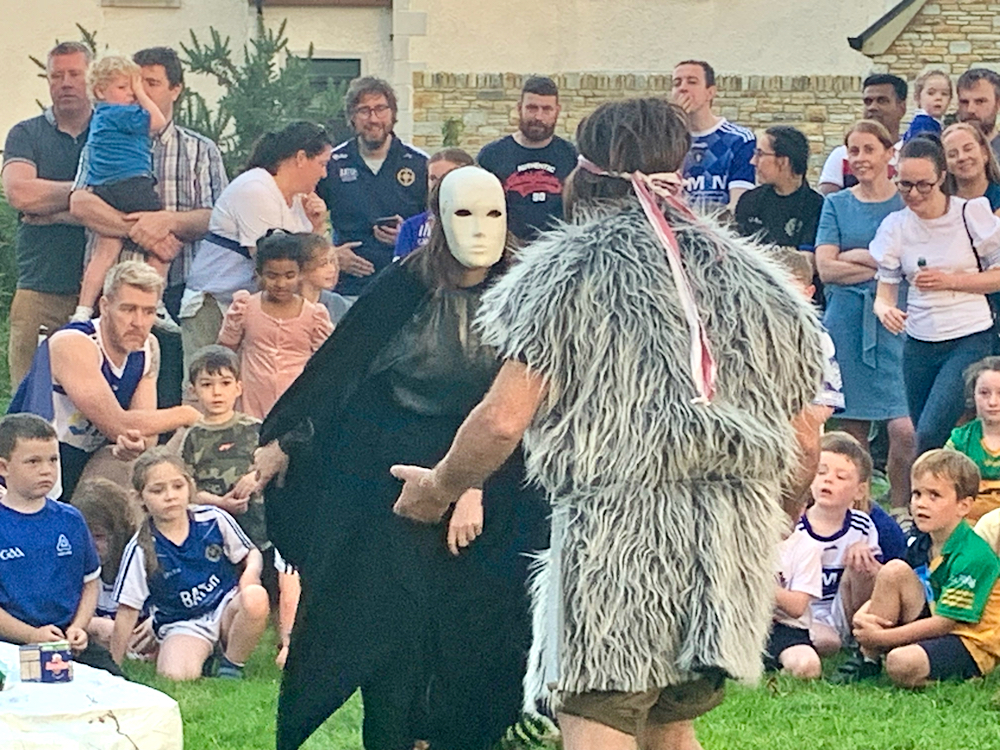
The intrepid, Mickey McHugh, showing off his dainty, Lionel Messi-like legs and dressed in a costume that looked like it was woven from the hair of a banshee, acted as MacNeely. Insiders say Mister McHugh was specifically chosen for the role due to his lifelong, hard-won, cow-milking abilities which he displayed with tremendous exuberance – by spraying the entire audience with his own brand of the liquid. 

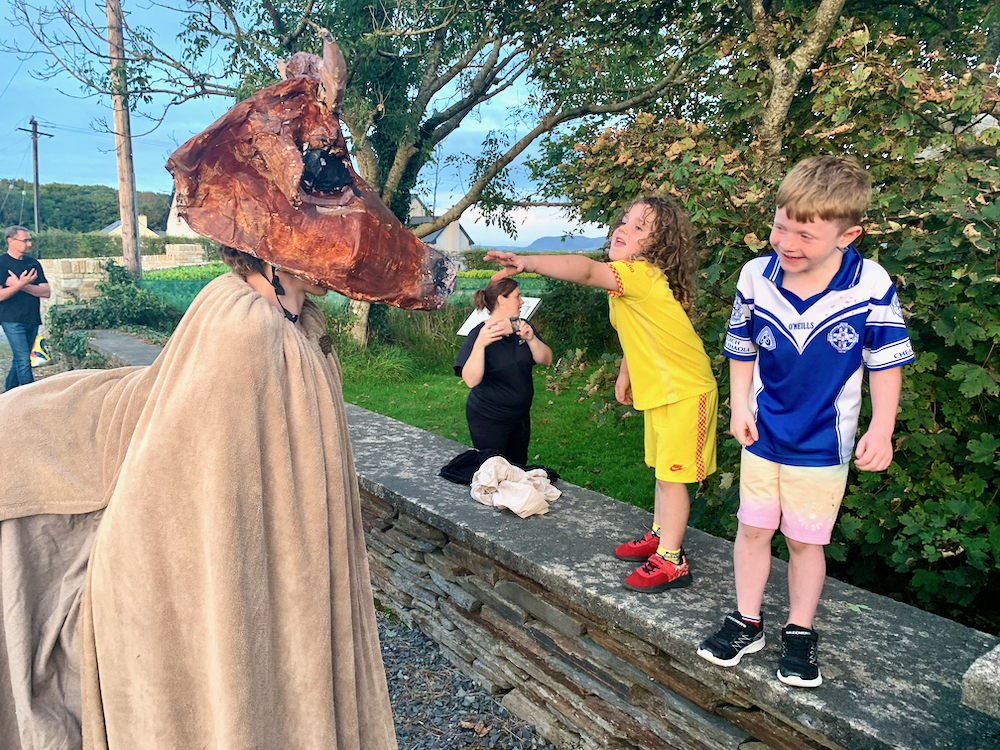
(l to r) Yanto and Rohan as the forever-giving milk cow, Mickey McHugh alias Lionel Messi and Denis Doohan as the face-decorated Balor consider their options.

Lugh, Balor’s grandson, was played wonderfully by Pierce Butler, especially impressive with his warlike cries and deadly sword fight with his grandfather, leaving his foe prostrate among a crowd of enthusiastic youngsters.  

Legendary cow, Glas Gaibhnenn, receives a wee bit of attention off-stage.

Kudos also go to Maggie McKinney, a native of Castlewellan, County Down, who played not one, but two roles – the screeching witch, Biróg, who predicts Balor’s downfall, as well as the bold and brassy, what-are-ye-waiting-for-let’s-have-sex, Eithne, Balor’s daughter, who – in what must be Guinness World Record time – ‘enjoys relations’ with MacNeely and produces not one but three babies, one of which was Lugh. All done and dusted in thirty seconds.

‘Prepare to die’ says Lugh (Pierce Butler) to Balor (Denis Doohan) – but only one will emerge alive.

Mention must also be made of the cow – the beloved animal that was at the center of the entire conflict. As one who has never tried imitating a member of the bovine community, I can only presume that acting the role of a cow is not easy by any means. So many congratulations to Yanto and Rohan, members of Youthreach, for doing so.

Birog the witch (Maggie McKinney) confronts MacNeely (Mickey McHugh).

Next on the dramatic circuit for the talented Cloughaneely Players is a production of the classic story, Casablanca, which I’m reliably informed may be staged sometime in November.

Photographing the entire dramatic proceedings on the evening was Annamarie Coyle, so watch out for her excellent images capturing one of the most tantalising struggles in Irish legendary history.

Young Donegal performers display their talents

Movie music, Irish fiddle tunes, classic compositions and songs  by Fleetwood Mac and Britney Spears – such was the diversity of entertainment I enjoyed recently at Donegal’s Regional Cultural Centre.

From Ennio Morricone’s captivating score for the movie, ‘The Mission,’ to ‘Finlandia’ by classical composer Jean Sibelius to traditional fiddle tunes, young maestros at Donegal Music Education Partnership (DMEP) served up a feast of entertainment at their summer concert.

Two reels by Caitlin Kennedy on fiddle, accompanied by her brother, Neil, on guitar; Chason Triste by Tchaikovsky played by Deirbhile Flynn on violin; Deux Interludes by Jacques Ibert played by Andrea Mota on oboe and Eve O’Donnell on flute; a concerto by Mozart played by Marina Mercade on flute; an allegro from a sonata by Handel played by Clara Mercade on violin; Ashokan Farewell by Jay Ungar played by Seana McGarry on violin; and Palladio by Karl Jenkins played by Clodagh Doherty on viola were all part of a diverse repertoire by members of the Donegal Youth Orchestra. Percussionist Cathal O’Donnell displayed his vocal skills, singing ‘You’ll Be back’ from the musical, ‘Hamilton.’

The Donegal Youth Choir performed songs ranging from ‘Nothing’s Gonna Harm You’ by Stephen Sondheim from the musical, ‘Sweeney Todd,’ to ‘Songbird’ by Christine McVie of Fleetwood Mac and ‘Everytime’ by Britney Spears.

Audience members at the packed event at the Regional Cultural Centre Sunday evening included Anne McHugh, chief executive of Donegal Education and Training Board, which funds DMEP, and Dr Martin Gormley, ETB’s director of schools.

Martin McGinley, DMEP music development manager, introduced the two-hour event, which ended with presentations to graduates of the educational program which provides vocal training and tuition in a range of instruments.

Orchestra conductor and composer, Vincent Kennedy, who also played a trumpet duet with Niamh O’Donnell, and choir conductor, Evan McGarrigle, and accompanists, including Hannah Gallagher from Falcarragh, all received an enthusiastic standing ovation. The evening also featured Kennedy’s composition, ‘The Letterkenny Waltz.’

Half million euro missing in Donegal, 250 euro returned

Half a million euro would be considered a miraculous life-saver by Mary, the tireless community worker struggling on behalf of cancer patients from Donegal who can barely afford the hefty cost of travel to Galway for specialised treatments.

If the hardworking managers of local community centres in the Donegal Gaeltacht received half a million euro, they could hire additional full-time Irish, and English-language, staff for several years and expand exponentially their range of services and activities in support of local people. 

If Amharclann, the Irish-language theatre in Bunbeg, received half a million euro, it could run an exciting cultural programme of dance, music, cinematic and theatrical performances for the next five years.

Not to mention how hard-pressed individual artists and musicians bereft of gigs due to Covid could use that money. Or indeed the Donegal office of Irish-language organisation, Foras na Gaeilge, whose local members help keep our native language alive here. And as for those unfortunate people whose homes and businesses have been destroyed by mica ….

But none of these groups have the luxury of half a million euro. 

Such a notion would be considered pure and utter fantasy, especially in the hard financial times in which we now live. 

Yet that is about the sum of money former Donegal Fianna Fail Senator, Brian O’Donnell, from Falcarragh in the heart of the Donegal Gaeltacht, has just wasted. ‘Snatched brutally, selfishly and greedily’ some are saying, from the public purse. Others use the term ‘stolen,’ but in this article I wish to be diplomatic.

How did he do this?

Ironically, over the Irish language.

O’Donnell was caught taking money from the public purse by duplicating travel and subsistence expenses as both board member of Irish-language economic group, Údarás na Gaeltachta, and Donegal County Council. 

The accusations – and this beggars belief – investigated by the Standards in Public Office Commission (SIPO) – was that it would have been impossible for him to have been in two different parts of the country at exactly the same time, at two different conferences. 

And there I thought teleportation – where matter is de-materialised at one place and recreated instantly at another – happened only in science-fiction movies and fantasy comics.

If that wasn’t enough, the former Fianna Fail Senator then cowardly left the scene of an accident while driving his car in a drunken state.

But that’s only the beginning of the saga.

O’Donnell, with the aid of well-paid lawyers, fought the accusations against him, not on the basis of whether they were right or wrong, true or false, but on the simple basis that the cases should be heard as Gaeilge (in Irish) not English. The fact that both languages are official languages of the Republic of Ireland didn’t matter a damn to him, nor them. Nor the eventual cost to ordinary Irish citizens, including those unfortunate people suffering from cancer.

The rest of the story is spread across years of newsprint.

After deploying numerous tactics to delay the ‘claims investigation’ many times, he then decided to do the same to the ‘leaving the scene of an accident’ investigation, not once but a total of 20 times.

As a result, the total bill to the ordinary Irishman, woman and child has been estimated at around – yes, you’ve guessed it – half a million euro, the amount the board of trustees of Amharclann, Donegal’s proud Irish-language theatre, the hardworking staff of the county’s community centres and the many severely sick people – all dream of having to help them.

In the meantime, craftily devising his delaying tactics, which eventually spanned a massive eight years, did O’Donnell quietly planned his ‘get-out-of-jail card’ – his emigration to Canada? In fact, O’Donnell being found guilty could perhaps have led to a short prison sentence and would have prevented him emigrating to Canada. And certainly would have prevented him getting a Canadian driving license.

Was his delaying tactics also related to avoidance of his share of the legal costs? For example, I’ve been trying to find out if he ever paid a legal bill placed upon him by three judges who threw out of court his claim that the SIPO was not entitled to investigate his duplicitous behaviour because, he claimed, the allegations arose from ‘an anonymous complaint by a member of the public.’ 

I’d like to know not only if Mr. O’Donnell has paid his full legal bill but how much it was. If Mr O’Donnell is reading this, please get in touch. It’s only fair to hear his side of the story. And transparency is something we all should strive for.
Mysteriously the court hearing that finally put an end to one of the most ludicrous and wasteful cases in Irish legal history, almost went under the radar earlier this month, slipped quietly and quickly onto the docket of a mundane court sitting.

How did this happen? Donegal media said simply that, “according to court papers.. O’Donnell’s case was not due to be heard until the Wednesday after during a sitting  of Falcarragh District Court.” That’s when his (O’Donnell’s) solicitor, Sean Cannon, “brought the matter up with Judge Paul Kelly …during a family law sitting of Letterkenny District Court.” And the judge conveniently and quickly moved the case forward.

‘Brought the matter matter up?’ What the hell does that mean? And does such a serious case merit being in a sitting on family law? The mind boggles.

And this Judge Paul Kelly? Who is he? Was he appointed under a previous Fianna Fail government? Does it look like it from this article? But then again, that doesn’t matter, surely. After all, the Irish legal system is separate from the political one, isn’t it?

Though, as we well know, it is not unknown in Ireland for political favours and indeed, brown envelopes, or both, to pass hands.

The result of the long-delayed case: a ridiculously low fine, in my opinion, of 250 euro for charges of drunken driving leaving the scene of an accident and providing misinformation the police. I dare you to find any court case where such a laughable decision has been made in such a serious case. 

As for the short ban from driving, does it really matter? O’Donnell is sitting pretty in another country. Did an infamous Irish ‘brown envelope’ pass hands to facilitate this convenient legal accommodation in Letterkenny? No-one knows, and unfortunately no-one will probably ever know. Is this just an example of the old adage, ‘there’s a law for the ordinary working citizen but a very different one for the elite, well-connected in Irish society?’ 

So, while O’Donnell enjoys his new life in Quebec, Irish men, women and children in his very own constituency in the heart of the Donegal Gaeltacht continue to struggle to make ends meet, people continue to suffer pain and hardship, some desperately trying to raise enough money to help them avail of specialised life-saving cancer treatments. And young, talented teachers from the Donegal Gaeltacht, and other parts of the county, are forced to go abroad, to places like Quatar in the Middle East, because there’s no money to employ them here at home.

Is this called ‘fairness’ in Ireland today? 

Among all this misconduct (there are stronger words to describe O’Donnell’s behaviour), there are two other guilty parties that should not escape blame and require stronger scrutiny by the public at large and by themselves. 

At the very least, both Údarás na Gaeltachta and Donegal Council obviously urgently require a proper Code of Practice for Good Governance. And, more importantly, to enforce it. Want to know more about the failings of Údarás na Gaeltachta, an organisation that receives tens of millions of euro from the public purse every year? Read more here. Has it cleaned up its act since then? Time will tell.

There’s little anyone can do now about the regrettable situation surrounding the O’Donnell controversy, except two things.

Firstly, as a citizen you have the right to appeal to the relevant authorities about a court decision you consider overly-lenient and unfair and to have the case reviewed. One place to start is writing to the Complaints Department of the Law Society of Ireland at complaints@lsra.iethe

Then the Judicial Conduct Committee established by The Judicial Council recently. You can write a short email to: info@judicialcouncil.ie You can ask to remain anonymous in both instances. It’s time to stand up and speak out, don’t you think?

I have already sent a complaint about Judge Paul Kelly’s decision as I consider a 250 euro fine to be utterly ridiculous and a 3-year driving ban to be insignificant, considering that Mr. O’Donnell can simply come to Ireland in the intervening years and drive with no problems using a Canadian driving license I presume he will obtain quite easily, thus posing a danger yet again to ordinary people on our roads. On both sides of the Atlantic.  

Secondly, when election time comes round, and it will come quicker than you think, consider carefully which political party and candidates you vote for. Is it not better to avoid the Brian O’Donnells of this world and choose others with a much greater sense of decency and honesty? 

Helluva commotion going on in Donegal over lovable little oysters

Oysters, those soft, jelly-like little creatures that are (to some people) delicious to eat and ingeniously produce glittering pearls, are causing some bother in Ireland, especially in Donegal – or at least the greedy corporations hunting them for profit are.

And it seems the partnership government of Fine Gael-Fianna Fail and its back-up civil service are doing their utmost to prevent concerned local communities from doing anything about it.

Sitting at a public meeting this week at Falcarragh Community Centre focusing on these issues, these were the thoughts that passed through my mind as I listened to speaker after speaker give their views on controversial shellfish farming practices at Ballyness Bay near the town of Falcarragh on the ‘Wild Atlantic Way’ in the Donegal Gaeltacht they consider are polluting and defacing the lovely, pristine scenery.

John Conaghan, spokesperson for the ‘Save Ballyness Bay’ committee, said four jobs would be created through aquaculture while more than 250 would be created via tourism, therefore “we should be protecting our area environmentally.” He also complained his committee had been denied inaccessibility to certain details, sometimes entire documents, pertaining to official comments made by both Donegal County Council and Údarás na Gaeltachta.

“An official comment from Donegal County Council stated that there would be no visual impact, but the document was simply signed by a clerk,” he said. “I’ve spoken to many councillors and nobody seems to know who authorized the comments. No visual impact? Maybe, lads, you should go to Specsavers.”

Politician after politician, both local and national, including TDs, Sinn Fein’s Pearse Doherty and Fianna Fail’s Pat the Cope Gallagher, told around 200 concerned people that they were unable to access key information relevant to the situation.

John Shéamais Ó Fearraigh Sinn Fein local councillor and Údarás na Gaeltachta board member said he would try with whatever powers he had to obtain the information required from the council and the Irish language organization. “I will do whatever I can to help,” he said.

Fine Gael local councillor, Michael McClafferty, said he had submitted questions to the local council but had not received any answers. “It looks as if we are being thrown under the bus,” he added.

The proposed shellfish scheme could cover more than 46 hectares of sea coast in the scenic Gaeltacht region, with bags on steel trestles containing millions of oysters, with sediment accumulation beneath them and large-scale congregation of dead shells, committee members said. Licenses for 20 hectares of oyster beds have already been granted, with one site alone being over 10 hectares.

Committee member, Caitlin Ni Bhroin, said “no cost-benefit analysis has been produced for us to see” and licenses have been granted on “unsound scientific criteria, including the idea that oysters are healthy water filters, but they actually emit waste.”

Conaghan said there were many contradictions in the government’s approach. “While it granted licenses for shellfish farming, Ballyness Bay is not designated a shellfish area, but it is a special area of conservation.” He said Inland Fisheries Ireland declared the bay a valuable fishing asset.

“We are against all oyster harvesting in Ballyness Bay, such activity will damage eco-tourism, which could bring much-needed jobs,” he said. “Gaps, mistakes and assumptions sums up the government’s approach. If community concerns had been addressed properly, we’d not be standing here talking.”

He said the ‘Save Ballyness Bay’ committee was being assisted by Belfast-based Pat Finucane Centre.
Commending the committee on its efforts, Sinn Fein’s Pearse Doherty stated clearly, “My firm belief is that this scheme is anti-community and the application process is not fit for purpose, they are not being given properly and there is a lack of clarity.” He said three years ago he had sent a letter to the relevant ministry and department questioning the decision process, adding “construction cannot begin until all appeals have been heard, which could take several years.”

Being a long time, staunch member of Fianna Fail, part the ‘partnership government,’ Pat the Cope Gallagher, was obviously in a bit of a conundrum. While he offered to find out more information and report back to committee members, he went into a bit of a tantrum when I asked him to say ‘yes or no’ whether he agreed with the ‘Save Ballyness Bay’ committee’s views.

Now, credit being given, Pat is a wily politician, that comes with being forty years and more in politics. Maybe I spoke harshly when I said that his spiel was (to quote myself) “pure politics, filled with generalities and trivialities.” That he took offence was his right. That he tossed the microphone down (as someone said, “like a baby throwing out its dummy-tit”) is also his democratic right.

But he still didn’t answer my question.

Instead, he said previous situations had occurred near his home in Dungloe similar to the one at Ballyness but he “didn’t get involved in them,” but said he did pass on letters he had received from local people to the relevant minister.

At the meeting, two members of Aontú pledged their support, with one young member saying as the shellfish farms were adding to the carbon footprint, people had a right to know more.

Local resident, Mary Attenborough, said while a proper environmental impact study was required, so-called experts were all vetted by the government, and that bias might occur in their reporting.

Committee members were still unsure if licenses already granted were strictly non-transferrable.

One challenge facing the committee is the expense involved in appealing licenses. Each one must be appealed separately at a cost of 200 euro each, with a time limit for appeals being four weeks from date of the government’s decision on December 4.

Columbia Hillen, my wife who is from Romania but concerned about the environment, stood up and asked if those local people who had applied for licenses would show support for the local committee by refusing to accept them even if they were granted. None of those applicants in the hall – and there were some present – said anything. One of the applicants, Seamus O’ Donnell who owns Cluain Na d’Tor (Seaside Nursery Garden) in Falcarragh had gone as far as saying he is “having second thoughts” about his application for over 4.4 hectares of aquaculture if granted. But has he withdrawn his application?

For full information on all applications see HERE.

One speaker said Ballyness Bay was one of the best surfing areas, comparable to Hawaii and western Australia, creating strong tourism income. “Let’s try to keep it that way by not spoiling the scenery.”

Another speaker summed up feelings of many people present, “Governments that treat people with disdain, usually get their comeuppance.”

Sean Hillen is co-founder of Gaoth Dobhair based ‘Ireland Writing Retreat and author of the contemporary novel, ‘Pretty Ugly,’  linking Donegal and the United States.