Amharclann Donegal kicks-off innovative drama project linking five Irish theatres

by Sean Hillen

An innovative drama project linking five different Irish theatres kicked-off this week with two performances at Amharclann in Donegal.

Supported by the International Fund for Ireland’s Communities in Partnerships Programme (CIPP), the project is a co-production between Amharclann in Bunbeg in the heart of the Donegal Gaeltacht and the Waterside Theatre and Arts Centre in Derry of the play ‘‘Observe The Sons Of Ulster Marching Towards The Somme’ by Donegal-born playwright Frank McGuinness.

This thought-provoking play, coincidentally hosted at the Amharclann on the same day as the United Nations International Day Of Peace, focuses on the experiences of a group of Ulstermen in the trenches of World War One who take part in the battle of the Somme. While a military setting, the play raises many themes including homosexuality, homophobia, the inner conflict of self-respect, bravery, patriotism, friendship and sacrifice. 
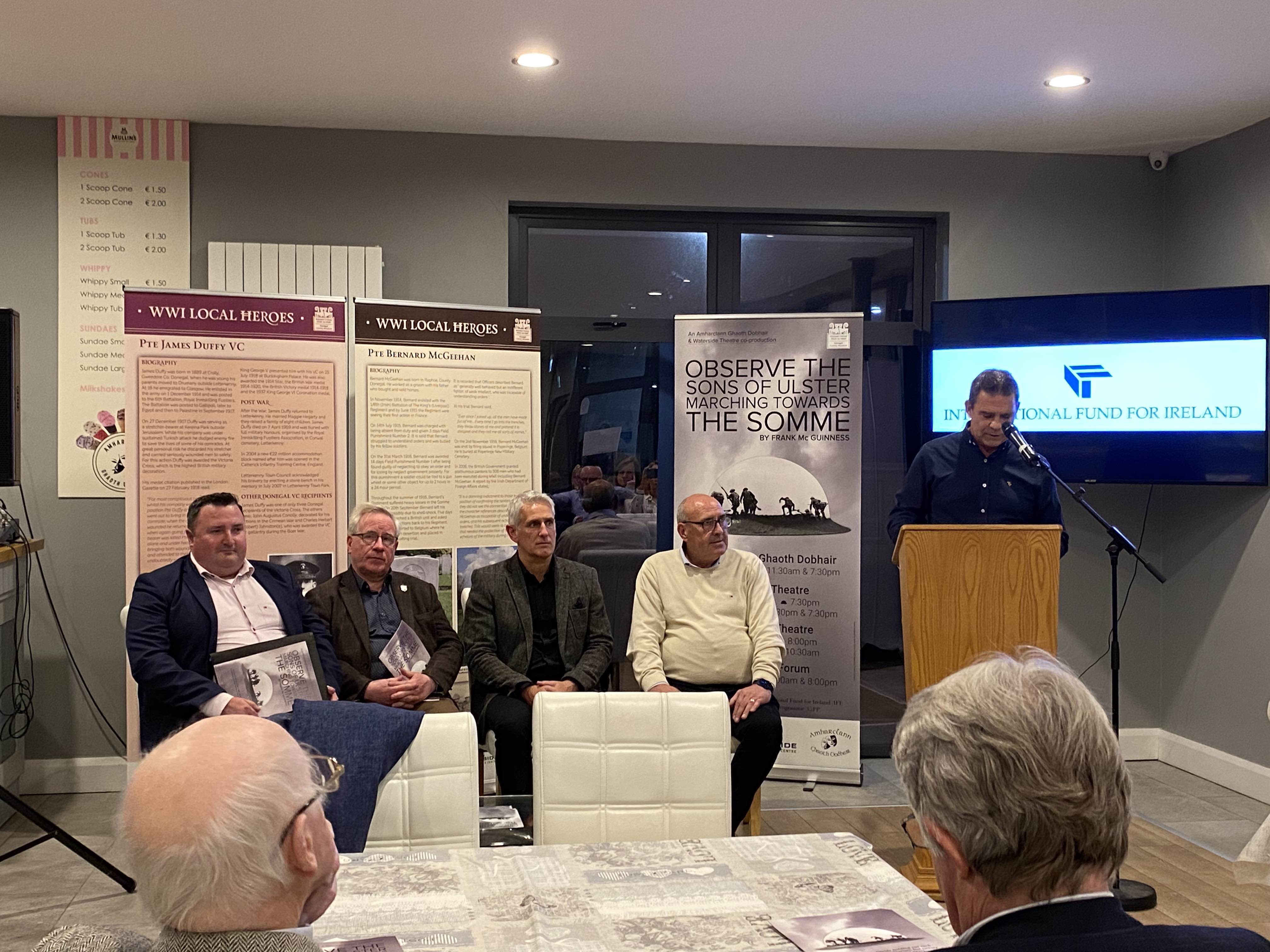
Panel of speakers at an interesting post-performance Q&A event at the Amharclann.

Enjoying the play, one is left with a vexing question: Is the play about the futility of war? The nature of loyalty, friendship and heroism? Or an examination of the protracted Protestant-Catholic northern Irish conflict from a completely different perspective? Or all of the above?

Whichever it is, this production is a two-hour, richly-rewarding theatrical experience that offers a balanced mix of black humour and poignancy with credible characters well developed through very fine acting.

Director David Grant together with production and stage manger, Fiona Harkin, assistant director, Ronan Hamill, lightning designer JP Conaghan and composer, Rebecca Doherty and the rest of the team have re-created the moving story of ordinary men – among them a blacksmith, a weaver and a baker – who set off patriotically to fight ‘the Hun’ but become disillusioned with the myth about war they’ve been sold.  

The play opens with a crippled man, Old Pyper, played by Shaun Byrne, who steps on stage alone, war medals pinned to his chest, and calls forth the ghosts of his former comrades who were all killed. Mystified as to how he survived the terrible battle, he is haunted by the images of those who died in the trenches, who then slowly, phantom-like, emerge from the shadows at the edges of the stage and stand motionless.
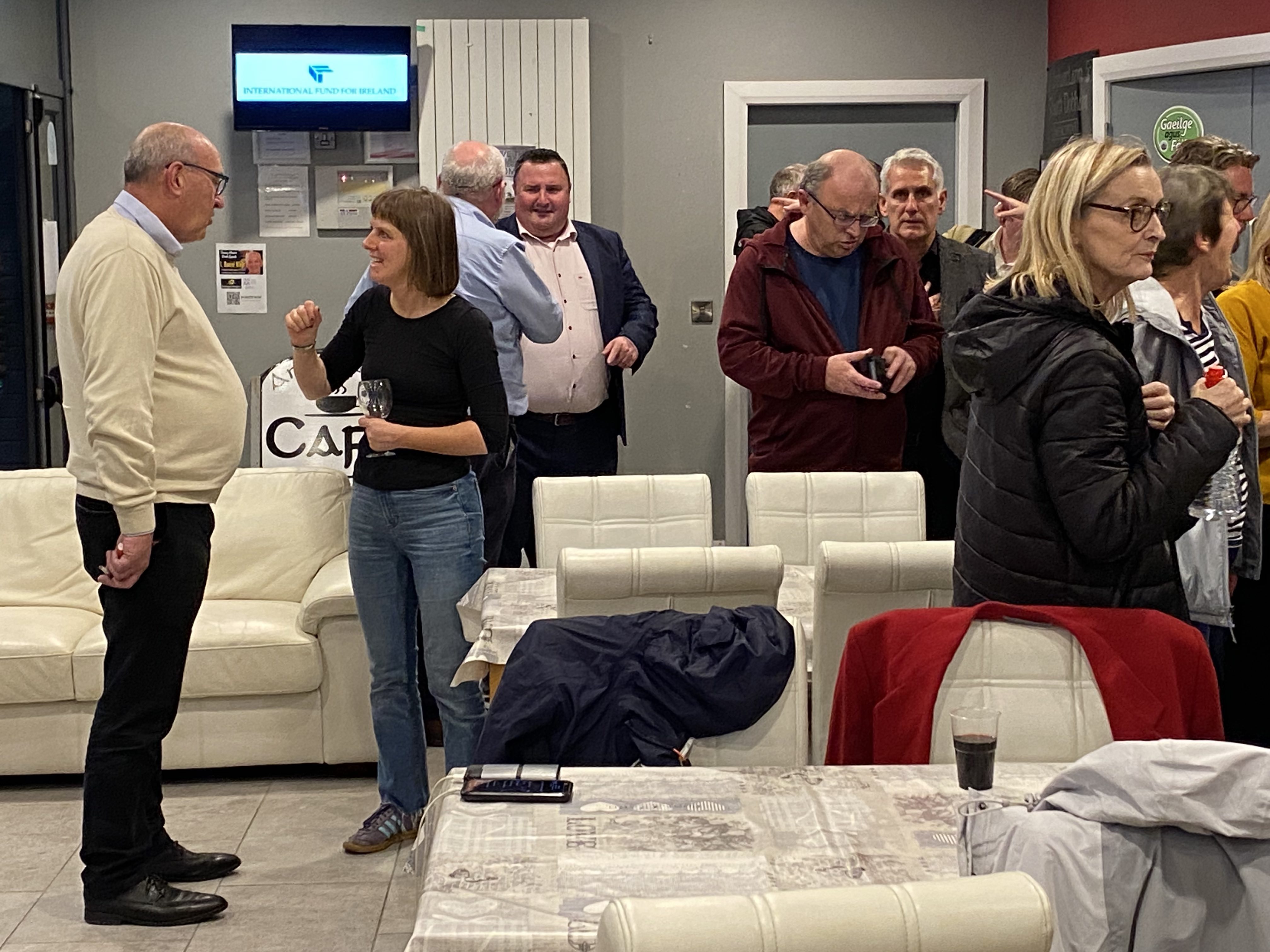
Theatre-goers mingle together for friendly discussions at the play’s intermission.

This sets the scene as to what follows, nostalgic flashbacks to the barracks where the men from places such as Derry, Armagh, Coleraine, Enniskillen and Belfast, gather for their first day of training and on to the sand-bagged first world war trenches where they face death together. Kudos go to Harkin and Conaghan who create a well-designed set, in which the barracks with wooden slats for beds is later transformed brilliantly into World War One trenches. Murals along the stage also add intriguing ambience, one of which depicts the ancient Celtic legendary hero, Cú Chulainn.

I particularly liked how a series of intense interlocking vignettes between couplets of men were enhanced by lighting and space, as well as by the thunderous roar of a Lambeg drum, a triumphalist symbol of the Protestant Orange Order in Northern Ireland. The military uniforms and equipment were also striking in their sheer authenticity. 

The tone of the play is bittersweet and philosophic, with elements of both black humor and solemnity. Patrick Quinn plays the younger version of Pyper wonderfully. An openly-gay man of aristocratic background who volunteered for army service, Quinn grants him a carefree, reckless air behind which lurks a man of deep sentiment and a troubled mind. A multi-faceted person – cynical, seemingly on the brink of madness, brash, supercilious, bold to the point of foolhardy, wickedly direct, yet at the same time, a vulnerable and lost individual. 

His anecdote about his three-legged French wife is highly amusing and a love scene involving him is touching in its quiet, side-stage minimalism. One character saying the ‘Huns’ speak Gaelic also creates a light-hearted moment. In contrast, depiction of one man’s despair and breakdown in the face of danger is touching, even more so as his friend tries to help.

While all the characters, except Pyper, are Northern Irish Protestant Unionists, one of the men admits something mid-way through the play which creates added intrigue and requires the attention of a military minister. 

Pyper is the exception to the anti-Fenian rants of the other men, being unwilling to indulge in such narrow-minded northern Irish tribalism and more keenly aware of the ‘sandbag’ nature of their being sent ‘over the top’ and into battle. He even demands of his fellow soldiers to answer the question as to why they are there.

Some Irish Republicans may be upset by the anecdotal joke told about rebel leader, Padraig Pearse, executed after the 1916 revolution, as someone who told his enemies he was only posting a letter when he took over Dublin’s main post office to launch the revolution, but this reflects the wit Frank McGuinness is renown for.   

Bulgarian visitors to Gaoth Dobhair – (l to r) Peter Petkov and Vanya Kovacheva – were among an enthusiastic audience at Amharclann theatre in Bunbeg, Donegal earlier this week

One of my favorite lines from the play, for reasons I’m not quite sure of, is ‘To hell with the truth as long as it rhymes.’

Ultimately, the play is about the fragility of life and the futility of war. In the end, one is left with the belief that the soldiers are united in one thing – fear of death – and that real heroes are ordinary people and unfortunately ordinary people remain ordinary because they don’t get recognised as much as they deserve. 

Local Donegal ladies enjoy a wee bit of craic and an evening’s entertainment at the Amharclann.

The play will be hosted today (Saturday) at the Lyric Theatre in Belfast, tomorrow at An Grianan Theatre in Letterkenny and next week at the Millennium Forum in Derry. 

In a post-event Q&A, Pol McCool, board chairperson of Amharclann theatre in Bunbeg, spoke about the need to build bridges between communities to help break down barriers and to appreciate shared history and values. 

Director David Grant (l) enjoys the company of friends during intermission at the Amharclann.

Stephen Barrett, manager for Donegal of the International Fund for Ireland, talked about the role of community leaders in peace-building projects and described the evolution of this co-produced project. He also spoke eloquently about his own reaction upon seeing the graves of those who died in the trenches in Belgium and France during the First World War. The IFI was established in 1986 with financing from many countries including the US, Australia and Canada and the play was supported by the organisation’s. 

Director David Grant talked about the challenges involved in creating the production and the overriding need for people to challenge mythology about wars.

Aine Ni Churrain, former presenter at RTE Raidió na Gaeltachta and a board member of Amharclann, thanked the audience for attending the two performances at the theatre, as well as everyone involved in developing and hosting the project and wished actors, director, producer and all the technical staff every success in the other theatres where it will be held.

Waterside Theatre CEO, Iain Barr, also thanked everyone for their concerted efforts in creating a memorable theatrical event with such an important social and moral message that contributes to greater peace and understanding among communities.

Video links to some of the speakers are on my Facebook – https://www.facebook.com/hillensean and https://www.facebook.com/worlditinerariespage

‘Cute hoorism’ is alive and well in Ireland

Spotlight on corruption inside Irish state institutions

Controversy surrounding Irish public broadcaster RTE involving hidden payments and secret slush funds for music concerts, sports tickets, car loans, expensive hotels and restaurants reminds me of an investigation I conducted into misspending by another state body. 

The two examples underscore the constant need for vigilance over the spending of public money by such bodies.

Misuse of public money – a major problem in Ireland. Here RTE officials prepare to face a grilling.

Having moved to Donegal in the northwestern part of the country – an Irish speaking area known as a Gaeltacht, one of several in Ireland – I was approached as a journalist by many angry local people to investigate the spending of tens of millions of euro by Údarás na Gaeltachta, a national Irish-language organisation responsible for economic, social and cultural development.  

After comprehensive research including a series of interviews and detailed Freedom of Information (FOI) requests, I was stunned to discover the extent of financial waste and utter misuse of public money by Údarás – corruption by any another name, some might say – including all-expenses paid holidays in Florida for some executives and board members and their spouses, which was counter to existing regulations. 

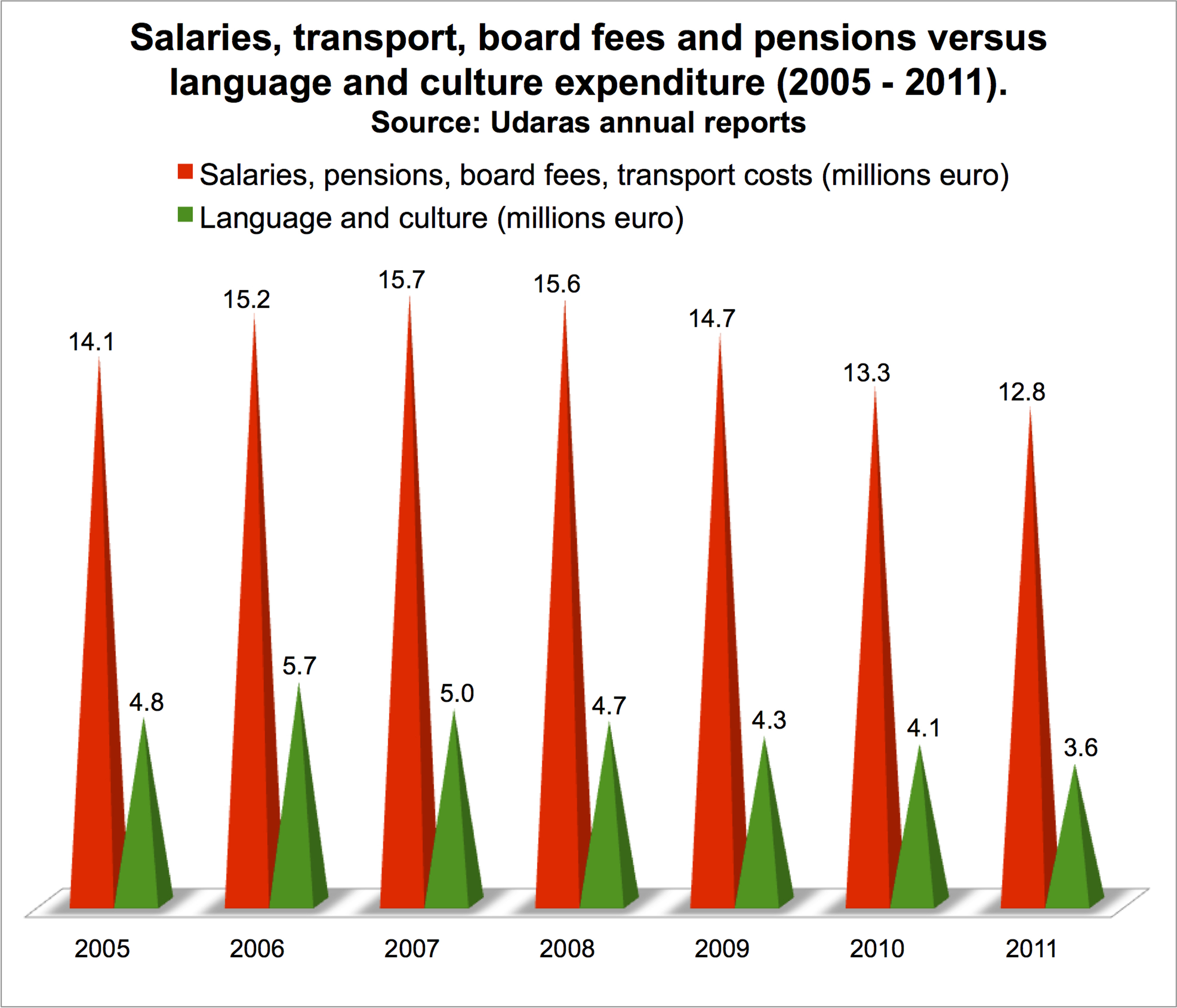
During the year I conducted my investigation, pensions alone for 136 former Údarás employees amounted to 9.8 million euro, half that year’s entire budget, which caused then Public Accounts Committee (PAC) member Sinn Fein Senator Trevor Ó Clochartaigh to declare, “I nearly fell off the chair when I heard that.

Five Donegal board members alone were paid more than half a million euro in fees and expenses over a five-year period between 2004 and 2009.

Shocking statistics I uncovered about spending on Údarás staff compared to project funding.
Key question remains: has the situation changed?

Údarás said each job it helped create back then cost around 8,000 euro, but the actual figure turned out to be 88,000 euro, ten times that number. It also spent more than 30,000 euro on all-expenses paid trips including business-class flights to Halifax, Canada to look at seaweed projects, as well as hefty expenses to other international cities including Las Vegas, Shanghai, Los Angeles and Chicago. Such was the absolute accounting mess, Bernard Allen, former Fine Gael TD and head of the PAC back then told me the expenses system of Údarás was “simply incomprehensible.” 

Údarás had become a free-for-all feeding trough for some board members and executive managers, with blatant conflicts of interest abundant. In short, the situation seemed to have become one of ‘you scratch my back and I’ll scratch yours.’

Liam O’Cuinneagain, chairperson of  Údarás for ten years then and founder of Oideas Gael in in Glencolmcille, Donegal described the investigation into his organisation’s spending as “paranoia” and said he was “satisfied” with its performance. 

After approaching the editor of the ‘Donegal News,’ a leading newspaper in the region, I completed a three-part investigation into the situation but then had to face highly-paid spin doctors for Údarás which did its very worst to prevent the series from being published, including threatening late-night calls to my home.

Padded expenses, lucrative pensions and international trips were only the tip of the ice-berg of misspending. Imagine how a small community centre or school offering classes and activities as Gaeilge or an Irish-language theatre such as Amharclann in Donegal could have used such scarce money. 

You can see some of my stories below.

Údarás na Gaeltachta, like RTE over the last few weeks, came under scrutiny by the Public Accounts Committee (PAC) back then but the government fell in the midst of the investigation, the PAC was disbanded and the investigation was never resumed after the subsequent election.

Some of those leading Údarás na Gaeltachta, both in Donegal and nationally at that time, have retired or resigned, all on very generous pensions, among the highest in Ireland’s civil service. It is hoped the present leaders are honest and transparent in their dealings. Only time will tell. Or another investigation by an enterprising journalist or a concerned citizen.

Shocking revelations at RTE and at Údarás na Gaeltachta should be a stark warning to us all. Sadly, leaders of such state and semi-state organisations with huge budgets at their disposal, if left unexamined, are tempted to misuse public money for personal gain. It is up to each one of us – private individuals and our elected representatives – to keep a close eye on how they spend that money. As both examples clearly demonstrated, we cannot rely on board member oversight alone. 

Both RTE and Údarás na Gaeltachta managed for many years to avoid public examination, the former because it was the all-powerful state broadcaster with political cronyism being a major factor in executive employment there, the latter because it was involved in the Irish language, a sacred cow in Ireland not to be questioned or criticised and it had – and still has – a big bucket of money to hand out in grants which can, in itself, buy silence.

What saddens me most is that both these organisations – RTE and Údarás na Gaeltachta – have vital roles to play in the economic, cultural and social development of Ireland so when they mislead the public, the very people who pay their high salaries and expenses, it is even more unforgivable. 

Suck key institutions should be supported, but not unquestionably so. 

After the RTE shambles, should Údarás na Gaeltachta and other such state bodies not come under extensive examination on a regular basis to make sure public money is being spent properly?

Should Údarás na Gaeltachta, for its own benefit, not be subject to the oversight of the National Treasury Management Agency (NTMA)’s NewEra unit, which provides financial and commercial advice to Government ministers and departments, the primary goal of the NTMA being to deliver long-term value to the Irish people?

Cute hoorism definition

Every song has a story, every story has a song

Such is the headline on the inside label of a CD by supremely talented Donegal-based singer-songwriter-multi-instrumentalist Brí Carr and it ’s an extremely appropriate phrase.

For Brí is one of those naturally gifted artists who literally can turn a phrase into song and music as she did quite brilliantly during an evening of excellent entertainment on Culture Night recently that she hosted at Amharclann in Gaoth Dobhair, Donegal where she is that theatre’s first-ever Artist-in-Residence.

Taking a phrase from one of the writers attending international workshops that week hosted by ‘Ireland Writing Retreat,’ she transformed the words of Bernie Doody from Omagh into a spontaneous slice of music that left seated writers from countries as diverse as Germany, Ireland and the US gasping with admiration. You’ll also appreciate Brí’s many talents in doing this by listening to the short music video above taken that very evening.

Though Brí has been writing songs since the tender age of 16,  she never performed publicly until she was in her 40s. That was due to part to derisory laughter she received by a man after she had penned a song to uplift the spirits of a close friend who had just found out she was pregnant. That song is entitled ‘Yesterday’ and, after listening, it is very hard to forgive the ignorance of the man whose only response was critical laughter.

But that is just one song in a wide-ranging portfolio created by Brí over the years and which feature on her CDs, namely ‘Full Circle/Rotha an tsaoil’ and ‘Roots/ Fréamhacha,’ as well as her singles.

Take, for example, ‘Smile Again,’ penned as a young college student in honour of her beloved Uncle John who left his native Arranmore Island in Donegal to work in the London tunnels in the summer of 1988 and sadly died just a few months later.

Extending the island theme, the place of her mother’s childhood, she then wrote ‘ Árainn Mhór,’ her first single, released in early November 2016, which captures the mystery, tradition and history of the island. It reached Nr. 3 in the Irish iTunes Charts in World Music that same week. Other songs in tribute to the island include ‘Ar an Oilean,’ ‘Where We Went To School’ and ‘Home To Shore.’

In late December 2016, her follow-up single, ‘My Father’s Legacy’ topped the charts in Easy Listening Music. It features a beautiful vocal from her then 7-year-old daughter, Caela.

Enjoying close family bonds, Brí dedicated at least three songs to her husband and children, whom she says “never fail to surprise me.” The songs include ‘How I Love Him,’  ‘Tog Mo Lamh Aris’ and ‘Bealach an tSaoil.’

Aside from song-writing, Brí, a teacher, is heavily involved in arts education.

As a job-sharing resource teacher in Lurgybrack NS, I’m extremely fortunate in that I can develop and build upon my facilitation skills in and out of the classroom,” she states on her website. “To date I have enjoyed working with the children and staff of my own school on various school projects, from our LucyBarney School TV, Seachtain Na Gaeilge, Scór, RTE Junior and after-school music and drama. We have recorded albums for ourselves and with the Goats Don’t Shave as part of charity projects.”

Brí’s activities are multi-level. “I enjoy regular interactive workshops with other schools, mainly facilitated by Donegal County Library as part of WainFest, Ireland Reads and Spring into Storytime, which I thoroughly enjoy as it gives me the opportunity to teach and learn from students and teachers from Junior Infants all the way to Leaving Cert, creating and collaborating on new ideas, methodologies and cross-curricular activities,” she said.

As part of Peace IV, Brí was facilitator and director of several inter-school music, art and drama projects from Derry to Dunfanaghy, creating stories, exploring local heritage and cultures, bringing lively performances to the stage in Ozanam Centre, Dunfanaghy, the Workhouse, Dunfanaghy, An Grianan Theatre, Letterkenny and Relay for Life Donegal.

Collaborating with Donegal Education Centre, Donegal Women’s Centre and local schools helps me keep focus on the curriculum, and come up with new ideas for implementation in a fun and educational way,” she said.

Brí is also deeply involved in other organisations and initiatives including Blue Ribbon Arts, the Wider Horizons Project USA and Wild Atlantic Women, to name but a few. A manual by her in both Irish and English will soon be published entitled ‘The Big Blue Ribbon Book of Drama.’

International guests from Germany, the US, Romania and Ireland enjoyed musical performances by Brí and fellow artists, including her daughter, Caela (standing beside her in shorts), at Amharclann on Culture Night recently.

Her book is filled with almost thirty years of Arts in Education games, ideas and inspiration to aid fellow teachers in delivering Drama and SPHE games. She also created the ‘Ready to Rock Music Programme’ for Primary schools with CJ Fallons and is a member of ‘Wild Atlantic Women,’ a group of Donegal’s finest female artists in a wide range of genres from folk to country, traditional to modern who she said, “decided to join their voices in support of all thing Donegal.

As for being Amharclann’s first Artist-in-Residence, pride oozes from her. “It is an honour and a privilege for me as both an artist and as a lover of west Donegal culture, language and heritage,” she said. “I have thoroughly enjoyed the opportunities and challenges coming out of the Covid era, as people are beginning to re-emerge and embrace life in a careful, cautious way. What better way than through the arts, between concerts, exhibitions  theatre, music and drama  all of which are rich and abundant in the Rosses and Gweedore communities. I have been blessed with support of all ideas during the year, and as well as Oíche Chultúr, there has already been a great many stand out moments that I’ll carry with me on to the next phase of my journeys via writing, performance and community involvement.

Brí Carr and Anne Biddie (r) make a terrific musical duet.

Brí is thankful for the opportunities she has been offered.

I can never thank the people of Gweedore, and in particular Coiste Amharclann, for giving me this platform to further explore my work, my art and most of all, my self belief. I’ve had such growth, nurtured many new friendships and been part of countless amazing memories. I’m really excited about all the projects so far and will definitely be rowing in behind the next recipient of Artist-in-Residence, if they’ll have me, to further develop as an artist , engage more with the local community and continue my commitment to Amharclann in the years to come.”

It is certainly no surprise to learn about Brí’s favourite motto: ‘Lots to learn lots to do.’

Festive tribute to the creative, artistic people of Donegal

Getting kissing techniques just right for on-stage credibility, takes practice.

Ask director-cum-teacher Máire Ioannidis.

She’s taught loads of people how to do it, her latest challenge being in the recent production of the musical ‘Hairspray’ by students at Pobalscoil Chloich Cheann Fhaola at Amharclann theatre in Bunbeg recently.

“Where do you put your hands, your arms,” she explained to me during a conversation after the Donegal Gaeltacht’s school’s triumphant, four-show run attended by more than a thousand people. “What side do turn your head to kiss, if you both turn the same way heads, noses may bump together, hardly an authentic and romantic sight to behold.”

That was only one of many challenges facing Máire and her team in the ambitious production. Capacity crowds and standing ovations are testament to the fact that they got them all right, including directing sixty-six teenagers.

Tickets for all productions were like gold-dust, with friendly Amharclann general manager, Manus O’Domhnaill, saying the shows provided a record attendance for the historic theatre, which was established in 1961 and reopened after major renovation more than a year ago.

Speaking about ‘Hairspray,’ Máire said proudly, “This particular musical holds a special place in my heart, a story about an amazing opportunity that turns a vision into reality. And I thoroughly enjoyed working with our talented students who showed commitment, energy and enthusiasm throughout. Unlocking their confidence, seeing them grow and perform on stage each night along with watching their joyous celebrations and a shared team attitude of ‘we did it!’ at the end of each show made this whole experience very worthwhile.”

‘Hairspray’ is an American musical with score by Marc Shaiman and lyrics by Scott Wittman based on John Waters’ 1988 film. Winner of eight Tony Awards, including best musical, it focuses on efforts by a dance-loving teenager to bring racial integration to a popular TV show in 1960s Baltimore.

Having gone to watch several productions of ‘Hairspray,’ in other theaters, Máire and her team then created several unique extras to their production. These included performers surprising audiences by entering from different doorways at Amharclann and a scene in which a chorus of singers walk through the aisles holding candles singing, then sitting on the floor among the audience.

Set changes were accomplished professionally with the aid of lighting, for example, from an ordinary living-room scene complete with ironing-board and TV to that of a prison cell, in which the lead performer, Róisín Doogan, playing Tracy Turnblad, has been incarcerated.

From the get-go, the opening song and dance routine ‘Good Morning Baltimore,’ this production leaped along in vibrant bounds with other complex choreography and songs including a powerful renditions of ‘Big, Blond and Beautiful,’ ‘Mama, I’m A Big Girl Now’ and ‘It Takes Two’ spiced with comedy and sentiment.

“PCC’s production of ‘Hairspray’ was full of energy from beginning to end,” said Eoghan Mac Giolla Bhrighde, a well-known actor who was in charge of lighting for this show. “Their singing was lively and it was excellently choreographed. It was well cast and they all portrayed their character effortlessly. Their drive and enthusiasm was palpable, students and teachers alike. “

Máire herself is no stranger to the arts, being a member of local acting group, Aisteori Ghaoth Dobhair, and an accomplished flute player. She also directed a school production of ‘Grease’ for two consecutive years. Of Gweedorean-Greek parentage, Máire has worked at Pobalscoil Chloich Cheann Fhaola for the last four years teaching a mix of Irish language, IT and business.

Aside from the versatile student actors and singers, full credit goes to crew, some of whom were also students, and senior production members including producer Donna Coll; choral director, Siún McDermott-Lyng; choreographer, Maureen Byrne; audio Noel Boylan; set construction, Joe Coll, Christopher Symth and Manus Gallagher; costumes, Mairead Harkin McGee and Siobhan Doogan. School principal, Maeve Sweeney and her deputy, Donna McFadden, said they were “over the moon about the show’s success.” Profits went towards various school expenses.

Coming up soon at Amharclann is its annual pantomime, this one entitled, ‘Leipreachán an Phota Mhóir.’ With Eoghan Mac Giolla Bhrighde involved, both on and off-stage, it’s bound to be a beauty. Don’t miss it! January 24-26 and January 30 to February 1.

The Amharclann and student actors and production crew at Pobalscoil Chloich Cheann Fhaola are only the tip of the iceberg of creativity throughout the Donegal Gaeltacht. Throw a stone and you’re likely to hit a painter, a musician, a sculptor, a yoga teacher, a hypnotherapist, a novelist, a poet, a psychotherapist on the head.

Consider the wondrous wealth of talent coming up beginning tomorrow at the Scoil Gheimhridh Ghaoth Dobhair, the Gweedore Winter School beginning tomorrow (Friday) –  http://scoilgheimhridh.com/

Also, please read previous blog on this site on an issue vitally important for everyone living in Donegal.

And check out ‘Ireland Writing Retreat’ https://www.irelandwritingretreat.com/ and my novel, ‘Pretty Ugly,’ linking Donegal and the United States https://www.amazon.co.uk/Pretty-Ugly-Sean-Hillen/dp/1523361158

Donegal Gaeltacht community spirit rides high

I was delighted to write this feature piece for the ‘Donegal News’ recently supporting the hard-work, communal spirit and creativity of people in Gaoth Dobhair, Falcarragh and the Rosses in hosting their respective festivals.

For such a small rural area, often there are more diverse cultural activities – dance, theatre, sporting events, concerts, to be name but a few – than in major urban areas.

Delightfully, making choices as to which to attend can be the biggest challenge.

Sean Hillen Donegal gaeltacht, donegal gaeltacht,