Are Fine Gael, Fianna Fail, Labour and pseudo-Independents set on destroying power-sharing in Donegal?

Early last Monday morning as most of us woke up groggily and struggled out of bed to face the week, a dramatic closed-door meeting of the Independent Grouping within Donegal Council was taking place in Lifford at which the very future of politics in the county was being decided.

Or at least that’s one interpretation: that pseudo-Independents (my sobriquet for them) backed by the Coalition Government partners of Fine Gael and Labour together with Fianna Fail were aiming for.

But the political cat might be out of the bag, so to speak.

Could it be that someone poured (or was it self-administered?) poisonous elixir into the ears of certain councillors that the life of an independent within traditionally conservative Irish political circles is a short one, so they’d better rejoin the party fold again – before it is too late? “Being in a party makes for an easier life,” may have been the song on the hymn sheet. “You’ve got the company of like-minded people. Talk up the party you formerly belonged to until we win the Dail, then we – together with you – will control Lifford as well.” If it was, perhaps instead, without knowing, they’ve been listening to the Song of the Sirens.

Donegal councillors, county council meeting

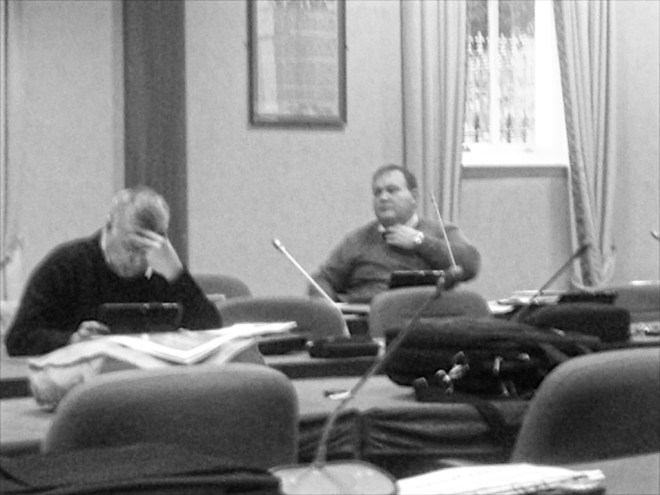
(l to r) Let’s decide on a plan of action. Councillors Frank McBrearty and Michael McBride confer discreetly at Monday morning’s meeting of Donegal County council.

Intriguing backstory

As Councillor Michael McBride told me last week, a motion by John Campbell at Monday morning’s private Independent Grouping meeting to have John O’Donnell expelled from the group supported, by Michael Cholm MacGiolla Easbuig and himself, was defeated by five other councillors, a strange situation to say the least as only last month, they had all voted to make him resign.

But that wasn’t the biggest surprise of that morning.

That came just a few minutes later, immediately Campbell and Easbuig left the Independent Grouping in protest.

“Much to my amazement, someone suddenly called for the dissolution of the entire Grouping,” recalls McBride, who chaired the meeting but said he cannot remember who made what he considered a bizarre call (strange loss of concentration as chairperson at so vital a time). “And it was agreed upon so quickly I can’t but believe they had all discussed this much earlier, in private.”

The five councillors in the Independent Group who voted against O’Donnell’s expulsion were Nicholas Crossan, Tom Conaghan, Niamh Kennedy, Ian McGarvey, and John O’Donnell himself, most former party members.

Later that same evening McBride sent me an e-mail purportedly written by Kennedy stating that, “a decision has been taken to suspend the independent grouping and that no positions would be removed from any member as an investigation is currently underway by the ethics registrar of Donegal county council.”

She added, “None of us are involved in the 25/30 councillors referred to by Cllr.  O Donnell (on the RTE programme). This decision has been taken in the interest of the people of Donegal and in order to accommodate the smooth running of the business of Donegal county council following this past two months of turmoil.” But one is still left wondering why the Grouping was suddenly dissolved? Could it be, as McBride said, that they were fed up working with the fiery Frank McBrearty, who first proposed O’Donnell’s expulsion. Or with the intellectually able Campbell and passionate Easbuig? Or is something more sinister going down?
Franc McBrearty, Donegal councillors

Loosening his tie. But then again, Councillor McBride wasn’t wearing one, was he, at the council meeting? Just a bout of nervousness then? Or indecision?

Asked about his feelings on the dissolution of the Independent Grouping, McBride said, “I didn’t want that. It’s good for the council to have the four-group all-inclusive set-up that it has. To my understanding, that kind of power-sharing is unique in the whole country, something Donegal should be proud of.”

I asked McBride several questions

“Would you like O’Donnell – your former business partner in Dúncrua Teoranta, which was granted 120,000 euro from Udaras na Gaeltachta – expelled from all council committees.”

“I would have no problem with him being removed from all committees.”

“Why then did you abstain in the full council vote on the matter this Monday?”

“Because of the way I was treated fairly when I was co-opted on to the council for former Senator Jimmy Harte’s seat.”

“So, you would have been okay with a council decision to expel him, but not for you to vote on it?”

“Yes, it would have been democracy in action.”

Conversation ends.

Shakespeare: Is there something rotten in the state of …. Donegal?

Why would the trio of Fianna Fail, Fine Gael and Labour want the Independent Grouping at Donegal County Council dissolved? Here is a possible answer.

We’ll have a national elections very soon – we’ll know this week just when – and if the situation demands it, these three parties, regardless of what they say now, will try to ‘intermingle’ to form the next Government. But according to latest polls, their Donegal TD candidates desperately need all the help they can get even to shuffle lamely past the finish line – thus the pseudo-Independents. Fifteen years ago, the electoral breakdown was Fianna Fail a massive 70 per cent, Fine Gael 30 per cent, Sinn Fein 0.2 per cent and the rest Independents and Pseudos. Within the last five to six years, the Donegal political pendulum has swung dramatically and is now around 25 per cent Fianna Fail, Fine Gael 18 per cent, Sinn Fein a mighty 40 per cent, and rising, and the rest Independents and Pseudos.

And, let’s be quite clear about this: the main reason some pseudo-Independents are ‘Independents’ is that either their parties didn’t choose them to run last time out or that they’d never have won if they’d gone under that party’s ticket, especially if they’d gone under the Fianna Fail banner. In politics, however, such slights and inconveniences are often forgotten in the greedy grab for the prize piñata.

Concillor O'Donnell, Donegal politics

(r to l) Fianna Fail Donegal County Council chairperson, Ciaran Brogan, prepares for the meeting with council chief executive, Seamus Neely.

What happened behind closed doors Monday morning one week ago after Campbell and Easbuig stood on principle and left could be a classic political quid pro quo situation. ‘Talk up the party in the nationals in a few weeks time and you can run under our ticket for a council spot next time round, and, believe me, you’ll feel more secure for doing so,” could have been the way it was put.

Then again, my hunch might just be the workings of an over-active imagination. The truth might be that the Independent Grouping is a motley group, a raggle-taggle band with perhaps their hearts in the right places, but no cohesion. And so inexperienced and pulled apart by differences that they don’t even realize what their full potential could be if they created unity from diversity and voted for the right things.

This, however, is the perfect time – with national elections six weeks away – to find out which of the above-mentioned theories is the right one. True colors will begin to seep through. Threads will start to unravel.

If something more sinister is afoot, perpetrators of the cloak-and-dagger plotting have sadly overlooked one vital element – common decency. The overriding public mood is one of disillusionment, bordering on despair. If the three main political parties have indeed won the pseudo-Independents over – backed by business elites with much to gain by keeping O’Donnell on the council and on the ever-important ‘Roads’ committee which oversees tens of millions of euro in construction projects – trouble lies ahead. Keep in mind, the council’s annual budget is 133 million, 127 fixed and 6 to 7 discretionary. Construction of the Dungloe-Glenties road is in five-stages, the second, for example, cost around four million euro and the tender for the next stage is end of this month.

The ‘plotters’ may, however, have made the fatal mistake of ignoring the simple, unadorned hopes of ordinary folk, throughout Donegal and throughout the country, hopes for a sliver of common decency among politicians after all the putrid corruption they’ve been forced to roll in over the last five years or so.
Donegal people demonstrating, Donegal county council

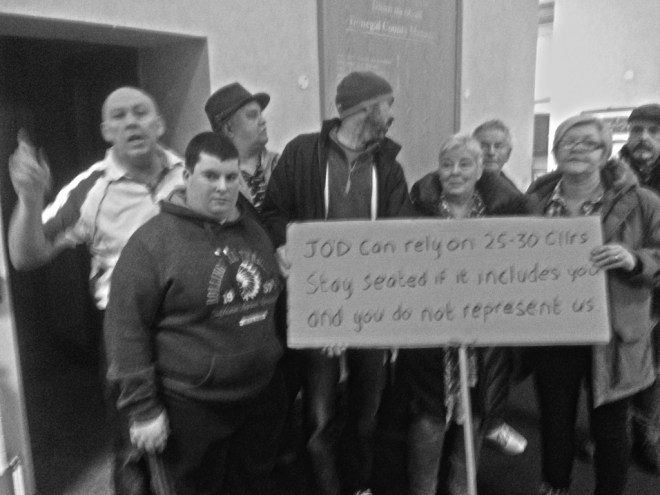
Protestors inside the County Chamber voice their sentiments about Councillor John O’Donnell, corruption and cronyism within and outside Donegal County Council.

Another key question is now being asked in the corridors of power in Lifford: not if, but how many, high-level executives within Donegal Council – many of which were employed both within the county and imported from outside the county, with generous salaries and pensions under the previous, long-running Fianna Fail government – are involved in this purge of True Independents and the break-up of power-sharing? After all, they have to reward their paymasters.

What a shame if such a deceitful game is being played, in this of all years – the centennial anniversary of our national independence.

But in a very short time, you, dear Reader, will have the chance to put things right – by availing of your unalienable right to walk behind a curtain and put your ‘X’ exactly where you want it to be.

Perhaps, this blog will help you choose well. I certainly hope so. It’s a rare chance to truly show that we are indeed ‘different up here.’

As for Councillor O’Donnell….

Epitome of nonchalance

I was quite astounded watching the councillor last Monday morning nonchalantly reading that morning’s edition of the ‘Donegal News’ as the political maelstrom swirled all around him in the council chamber. Either this young man has nerves of steel, I thought, or he is so utterly sure of what will happen that there is absolutely no need for him to be concerned in any way, about anything or anyone. Wish I could wake up feeling that way, as I’m sure do thousands of unemployed, elderly, sick, disabled and struggling mothers trying desperately to feed their children on paltry, insufficient income coming into homes across this county, across the country.

John O'Donnell, Sinn Fein Donegal

Nonchalance or absolute certainty? John O’Donnell displays his lack of concern about the possibility he might be expelled from Donegal County Council on Monday morning. That very evening, he released a press statement thanking his fellow councillors for supporting him.

During a short adjournment, I approached O’Donnell and introduced myself as Gaeilge, thinking – as he had attracted so much Údarás funding – he would be fluent. Perhaps it was due to my poor pronunciation or stumbling vocal ways, but he didn’t seem to understand, so I changed my questioning to as Bearla.

“Can you speak? I’ve a few questions I’d like to ask.”

I’ve been told by my legal advisers not to say anything,” he responded. “They’ve told me to let the ethics investigation takes it course. I’ve nothing to answer for anyway. People are just out to get me and use me as a platform for their own political gains.”

“What would you say to your fellow councilors here if they ask you any questions about your various business interests and debts owed through them?”

“I’d say, ‘That’s none of anyone’s business. It’s my private affair, mine only.”

“What about the 120,000 euro granted to your company, Dúncrua Teoranta, by Údarás na Gaeltachta just before it went bust, can you explain that?

“My legal advisers have told me to say nothing and that’s what I’m going to do.”

“Will you pay the money back?

“No comment.”

Then he went back to reading his newspaper.

O’Donnell, a long-time family member of Fianna Fail, also declined to comment on the court case he faces this Wednesday, Feb. 3 for failing to pay 33,000 euro in compensation to a Creeslough woman whose foot he drove over in a car accident. If O’Donnell does not show up for that case, District Court Judge Paul Kelly has said he will have him arrested.

Next week’s court case should be just as entertaining as the county council meeting last  week – with potentially very serious consequences for all concerned. If, having said he has no money, he pays up, you have to ask yourself: where did the spondulix come from? If his solicitor delays the proceedings, you’ve got to ask yourself: why? Could it be waiting for the results of the upcoming elections? If, however, he is convicted, I am ainformed O’Donnell automatically loses his council seat. There’s a lot at stake.

Go along if you can. It should be as good as an episode of ‘Judge Judy,’ hopefully better – unless some shadowy person(s) gets to the judge before then.

Protestors angry at Donegal County Council’s ‘dog’s dinner’ response to corruption and cronyism

As protestors from across Donegal vented their feelings inside Lifford’s County Council offices yesterday about corruption and cronyism in Ireland – the specific one lighting the fuse relating to controversial Donegal Councillor John O’Donnell – archaic rules, procedural confusion and tribalism prevented members expelling the Kilmacrennan-Fianna Fail linked man from all committees and the full council.

Anachronistic rules meant a counter proposal for what could well be a very long and drawn out ethics investigation by council executives superseded an initial proposal to expel O’Donnell immediately.

At times, the meeting, which was hosted by chairperson, Fianna Fail’s Ciaran Brogan, with the assistance of council executive Liam Ward and Seamus Neely, council chief executive, took on a farcical nature, with some describing it as a ‘dogs-dinner.’ During a discussion in which some councillors were attempting to expel O’Donnell – one of the most controversial decisions the council has faced in its entire history – confusion reigned, some members being unsure which proposal they were actually being asked to vote on. This caused Sinn Fein councillor, Marie Therese Gallagher, to ask the chair for immediate clarification.

Saying O’Donnell’s alleged ‘cash for favors’ actions caught last month on RTE national Irish TV camera were ‘disgraceful’, former Mayor Frank McBrearty (Independent) proposed removing O’Donnell from all committees, a motion seconded by fellow independent John Campbell.

“Due to the serious allegations against Councillor O’Donnell, we have the power to stand together and take action against him,” McBrearty said. “The public demands transparency and responsibility. There is a need to highlight corruption wherever it shows itself. As all politics is local, what we do here affects the nation so we have the chance to give a clear signal to the people of this county that we will not tolerate unethical behavior. The mushroom is getting bigger for Irish society. We must stop the rot now.”

However, a second, counter motion, by former Fianna Fail member, now long-time Independent councillor, Ian McGarvey, requested an ethics investigation be continued by council staff was also forwarded. Afterwards, during a conversation with me, McGarvey said he did not know how long such a process could take.

Confusion also reigned as Ward and Neely said legal advisers had told them O’Donnell could not be expelled from the council or its committees, but when asked for the legal documents proving this the two officials did not produce them. Neither did they bring into the chamber the legal adviser responsible for the advice when asked to do so by McBrearty.

According to Ward’s own instructions, there is “no specific provision within Local Government Legislation to provide for the removal of a member from committees to which he/she was appointed.” He added, “the position being taken is that the Motion as proposed (by McBrearty) is not permissable and, as a consequence, any resolution passed on foot of it would have no legal effect. The current process under the ethical framework should be allowed to continue until conclusion when the matter may come back before the members in one form or another.”

Some local government procedural analysts deem “illogical,” the situation whereby Chamber rules meant councillors were asked by Brogan to vote on the counter motion ahead of the original one put forward by McBrearty. That counter motion was ultimately accepted by 20 of the 36 councillors present, the votes representing Fine Gael, Fianna Fail, Labor and several Independents, mostly former members of Fianna Fail. All Sinn Fein members supported McBrearty’s motion. Independent Councillor Dessie Shiels was absent, having refused on principle to be in the same room as O’Donnell. Councillors McBride and Brogan abstained. Campbell and fellow Independent Councillor Michael Cholm Mac Giolla Easbuig promptly walked out of the meeting in protest saying, “this council has let down the people of Donegal and should be deeply ashamed.”

Added Councillor Gallagher, “I feel debased by O’Donnell and the opinions of some people about what he has done. He has brought disgrace to this chamber. My view is that as he was voted on to committees by council members, they have the right to vote him off them. It is a shame Frank McBrearty’s motion did not pass. This council had the opportunity to expel him and did not take it and now we have to wait until March to discuss it again.”

Protestors, men and women both inside and outside the chamber, said they were “disgusted by the council’s behaviour” adding, “our elected officials have failed to take proper action to stem an ugly, pervasive growing tide of corruption and cronyism sweeping across both this county and this country detrimentally affecting families, the elderly and children.”

Full story with photos and extended quotes coming up later today.

D-Day approaches inside the Donegal County Council Chambers

As D-Day (O’Donnell Day) approaches within the chambers of Donegal County Council this morning perhaps it’s not beyond the realms of possibility that beleaguered Councilor John O’Donnell has simply been misunderstood over the last few weeks and that this occasion, the first full council meeting since airing of the RTE ‘cash for favors’ controversy, gives him the opportunity to clarify matters.

As the debate gets underway, the eyes and ears of many of the nation’s political and financial elite will be on little ole Donegal, that ‘wee beautiful place on the edge of the Atlantic’ in the very far corner of the country, that is and isn’t an integral part of the island of Ireland, depending which perspective from which you look.

Councillors John O’Donnell, Michael McBride, Ciaran Brogan and all their fellows in the chamber will have the chance to show that, in the right and proper way, “we are different up here.”

Now what that ‘difference’ means is the key question we all hope will be answered truthfully and forthrightly today, hopefully before lunch-time comes around – though that is as likely as seeing a polar bear wearing suntan lotion eating brussels sprouts with a spoon at the side of a heated swimming pool.

Will this morning’s open public event echo the catchphrase that became so popular in the 1970s after the Oscar-winning movie ‘Network’ was first screened? Then lead character, Howard Beale, (played wonderfully by actor Peter Finch), on the brink between brilliance and madness, says passionately, “I don’t have to tell you things are bad. Everybody knows things are bad,” then screams, “I’M AS MAD AS HELL, AND I’M NOT GOING TO TAKE THIS ANYMORE!” his words being carried swiftly from person to person, young and old, man and woman, boy and girl, city to city across the whole of the nation.

If these words are echoed in the council chamber today in Lifford, who’s going to say them first? And will they mean them?

Could they be the battle-cry for a new, rejuvenated Donegal?

Could this be the historical moment we begin to shrug off the cloak of cronyism and corruption that has draped this county for far too long, with the collusion of various governments, and stymied our cultural, social and economic development?

To achieve this not small feat, a comprehensive, collective community effort is required and for that we, in turn, require the strength of the media, broadcast, print and digital  – not the way the print media acted over the last few days, publishing what was in effect a joint press release from  Údarás na Gaeltachta and John O’Donnell on the front and inside pages, nor Highland Radio, avoiding the controversial, not-so transparent payments made from one entity to the other.

If efforts to rid this county of counterproductive ‘goings-on,’ we need local media to be brave, enterprising and outspoken. It is their future as much as it is ours that is at stake.

While this article in yesterday’s ‘The Sunday Business Post’ gives most of the facts surrounding Mr. O’Donnell and Údarás, there is still much more to be said.

Sean Hillen Sunday Business Post, Councillor O'Donnell Donegal

For the sake of fairness and democracy, let Cllrs. O’Donnell and McBride have their say. Give them the chance to explain how and why they were granted the 120,000 euro from Údarás and about how much exactly, and O’Donnell to clarify to whom one of his other companies, Kilmac Form Work Limited, owes millions of euro in debt, and where indeed those millions are now. And why he has still not paid 33,000 euro in injury compensation to an unfortunate Creeslough woman who’s foot he drove over in a car accident.

John O'Donnell Donegal, Donegal councillors

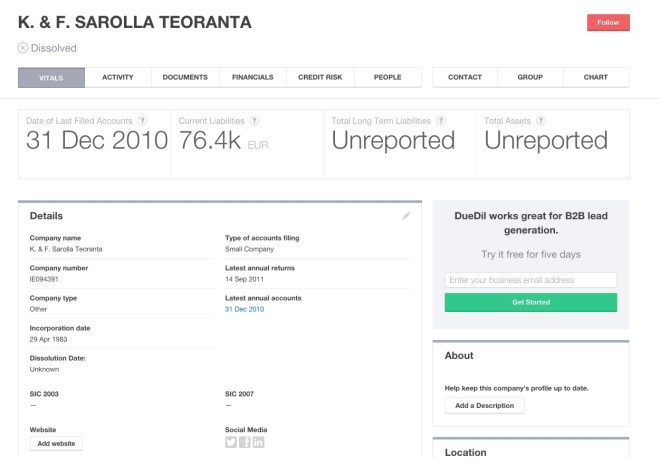
Oh, and let there be an explanation by O’Donnell about how his former company K&F Sarolla Teo (‘wool’ in English) went bust owing over 76,000 euro in 2013, which intriguingly led him to set up Glenveigh Woollen Mills Ltd in May of the same year .

Glenveigh Woolen Mills Ltd, councillor John O'Donnell

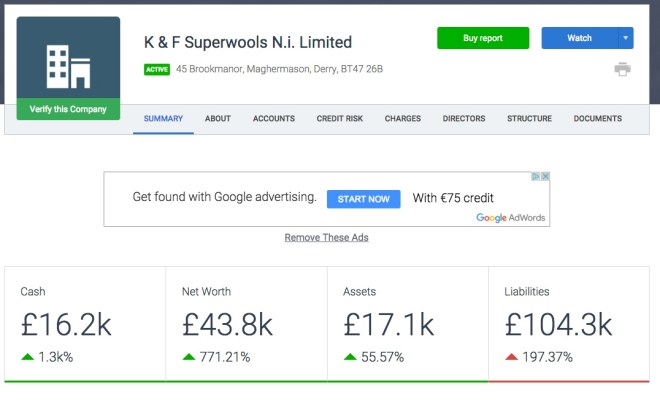
Strangely – perhaps merely a coincidence – K&F Sarolla Teo looks very much like K&F Superwools in Northern Ireland, with – and again it may just be a coincidence – the same director, namely John O’Donnell.

Would it be too much of a coincidence if it was discovered there were grants– those chunky cross-border kind of ones – involved in these companies also?

K&F Superwools, Donegal counicllors

For goodness sake, while we’re at it, as anyone who’s anyone will be there in the council chamber this morning, let Councillor Ciarán Brogan, Donegal County Council Chairperson, explain how his company, Sark Construction, perhaps now renamed Kasmor, managed to obtain an estimated 10 million euro in Donegal council construction contracts.

Gosh, it all sounds as if the craic will be mighty at the Donegal Council meeting this morning (kick-off 11am). For what it’s worth, alternative entertainment options on the box at exactly the same time are (and I kid you not) – ‘Wanted Down Under’ on BBC1; ‘The High Chaparral’ (or is that ‘Hang ‘Em High’) on TG4; ‘Judge Judy’ on TV3; ‘Conspiracy Theory’ on TCM; and ‘Four in a Bed’ on Channel 4.

Funny how all of them – including the local council option – have a similar ring to them.

I know which one I’m choosing.

Exclusive: Donegal councillors John O’Donnell and Michael McBride funded by Údarás na Gaeltachta

At a time when controversial ‘cash for favors’ Donegal councillor John O’Donnell was refusing to pay more than 33,000 euro compensation to a Creeslough woman he injured in a car accident 16 years ago, Údarás na Gaeltachta granted him and fellow councillor Michael McBride more than 122,000 euro in public money (see document here Udaras grant), I can reveal exclusively in this blog.

John O Donnell Donegal, independent councilor Donegal

O’Donnell was founder, director and secretary of Dúncrua Teoranta, the company receiving the money. Interestingly, a second director of the company was fellow councillor, Michael McBride, who also acted as company secretary. Both men – now declaring themselves independent councillors – were then members of Fianna Fail. A third director named was Sarah Doherty.

Documents show McBride and O’Donnell became directors of Dúncrua Teoranta on the same day, 14 Sep 2006, when it was set up to sell metal ore. They are also listed as company secretaries. McBride was director for a year and four months, until February 2008 when he resigned. The company’s address was listed as just inside the Gaeltacht, at Cuirin, Termon.

Dúncrua Teoranta

Údarás approved funding for Dúncrua Teoranta of 122,300 euro in 2008, paying out 66,850 euro in that year alone. The owners put the company into bankruptcy within months of the money being given. Aidan Garcia of Collins Garcia Corporate Recovery, 28 Fitzwilliam Place, Dublin was appointed as liquidator.

“As the money was given at a time when the company was close to bankruptcy, it seems it’s yet another case of cronyism, money given to two Fianna Fail politicians by a Fianna Fail dominated organization,” commented one observer with inside knowledge of Údarás operations.

Interestingly, O’Donnell was granted the money by Údarás at a time when he owned another company, Kilmac Form Work Limited, which later went into receivership with documents showing it had liabilities of 4.8 million Euro. Much of that debt, as declared during a High Court hearing in 2012, was owed to AIB Finance, thus to ordinary Irish people as the bank was bailed out by the State through injections of billions of euro of public money.

Kilmac Form Work Limited

O’Donnell registered Kilmac Form Work Limited on 6 April, 2005 in Ballyherrin, Kilmacrennan, several kilometers from Duncrua Teo, described as being involved in the manufacture of metal structures. It is currently listed as ‘Receivership’ with two directors, O’Donnell and his brother. The ‘Irish Independent’ reported recently that O’Donnell was forced to make back settlements to the taxman totaling over 330,000 euro. I have contacted both Councillors McBride and O’Donnell for comment but neither has responded. Údarás finally released a statement confirming it did grant O’Donnell the money. Where were Údarás officials when the RTE ‘cash for favors’ investigation was aired to such national furore weeks ago? Cowering in a corner hoping no-one would notice it had given scarce public money away so recklessly?

Urgent questions require immediate answers

The documents unearthed for this blog call into question the actions of both O’Donnell and Údarás na Gaeltachta.

O’Donnell is already firmly in the public spotlight due to his being caught on RTE camera allegedly offering ‘favors for cash’ on Donegal council business, as well as being under threat of arrest for failing to pay compensation due to Ms. Petra Kucklick of Creeslough whom he injured when he drove his car over her foot in 2000. District Court Judge Paul Kelly was quoted in the local media saying he will have the councillor arrested if he does not appear in person at the Letterkenny court on February 3rd to explain why he has failed to pay any of the compensation to the injured woman. O’Donnell seemed to have had lots of money at one time and could have easily paid the compensation, why did he decide not to do so?

Almost all of the main political party representatives in Donegal have called directly for O’Donnell’s resignation, as did Independent councillors, Micheal Cholm Mac Giolla Easpuig, who has called for a boycott of next week’s full council meeting due to take place on Monday, January 25, Dessie Shiels, who left a meeting Letterkenny Municipal District Council last week in protest, and Frank McBrearty, former Mayor, who resigned last week from the Independent Grouping on Donegal County Council in protest as O’Donnell not being expelled.

Donegal Now‘ news service said Cllr. McBrearty explained that Cllr Michael McBride’s casting vote as party whip means he has the power to expel Cllr John O’Donnell from the group and the committees given to him under the all inclusive deal. The news service quoted McBrearty saying: “I will perform my duties as an Independent councillor and do my very best for the people that elected me. I will not be associated with Cllr John O Donnell when he clearly said he could get the backing of 25 to 30 other councillors. I am not one of these councillors and am making my position clear by taking this stand. I do not understand the reluctance of some councillors to support my decision but that’s for them to decide.”

The information these documents reveal also come as councilor Shiels, who will contest the next national elections, recently left a meeting of the 10-member Letterkenny Municipal District Council in protest at O’Donnell’s attendance. “In the aftermath of the RTE investigates programme which aired on RTE in November past, I personally cannot involve myself in county council meetings, whether at Municipal District Level or at full plenary council level in the presence of councillor O’Donnell,” Shiels said. “To do so would, to my mind, compromise everything that I have tried to do to date since being elected to Donegal County Council to restore public confidence in politics in Donegal.”

Added another observer, who prefers his identification to remain confidential at this times, said, “I wondered why Michael McBride was so quiet in his condemnation of O’Donnell.”

Is John O’Donnell the kind of political leader the people of Donegal want? Is this what we mean when we say proudly, “we’re different up here?”

Does Údarás na Gaeltachta lack good governance?

Key questions also remain about the operations of Údarás na Gaeltachta, particularly in Donegal.

Did anyone at the organization check into the financial health of O’Donnell and his companies before granting him 122,000 euro of public money? If so, why did it go ahead and approve the grant? If it did not check, then it is guilty of ignoring its duties to the public whose money supports the organisation’s entire operation.

Perhaps, in addition to the controversial wind farm development issue that was the focus of the RTE program, perhaps O’Donnell can clarify how he got the money from Údarás for Dúncrua Teoranta. It is not believed either O’Donnell or McBride have paid any of the money back.

Also, as the Office of the Director of Corporate Enforcement (ODCE) identified the requirement for a ‘Section 56’ on O’Donnell’s company – which allows interested parties to bring concerns before the liquidator and thus try to recuperate their money – has Údarás done so in relation to the loss of public money (the grant)? If, not, why not? Is this yet again willful disrespect of public interest?

Or in the light of the allegations arising from the RTE program – did some people at Údarás get kick-backs for pushing the money through for O’Donnell? Considering Fianna Fail’s long-time dominance of Údarás and that party’s record of skullduggery in bankrupting Ireland, such allegations cannot be ignored. In addition, this blog revealed that Údarás hired Finbarr Boyle as business training manager for local entrepreneurs through the EU funded CeanaglG project in Donegal even though Boyle was already under investigation, had already pleaded guilty as part of a plea bargain and was later proven guilty of stealing more than 200,000 euro from a village school, including money earmarked for children’s food. Does the organization suffer from a severe lack of good governance?

Oh, and by the way, where did the 122,000 euro go? As Cuba Gooding Jr. said in that wonderful film, ‘Jerry Maguire’ – “Show us the money!”

Changes required at Údarás?

With frequent revelations about the operations of Údarás – including free trips for executives, board members and their wives to Las Vegas (to meet officials of Enterprise Ireland) and ‘insider trading’ schemes whereby former Údarás board members and top executives received money for their own organizations and projects – economic experts are questioning whether the group is fit for purpose. These concerns are especially sensitive locally as well as in Brussels as the Government decided recently it will operate the multi-million euro EU LEADER programme in the Donegal Gaeltacht where decisions on money allocation will take place over the coming months.

Some sector analysts as well as ordinary people in the Gaeltacht community say that after several decades of failure and with unemployment in the Gaeltacht at an all-time high, the economic regeneration model for the regions is simply not working and that Údarás na Gaeltachta should simply be dismantled and replaced with a new and more efficient organization, one featuring well-trained technocrats, not politically-appointed personnel.

Others say that much-needed changes are already underway, an example being the recent appointment of Letterkenny-based, former county council director of services for community, culture and planning, Micheál Ó hÉanaigh, as director of enterprise and employment, marine and natural resources at Údarás. Ó hÉanaigh, credited with launching the Donegal Diaspora project.

However, one must also note the recent reaction by Joe McHugh, Fine Gael Minister for the Gaeltacht, to the questionable activities at Údarás – he said the organization would receive an extra one million euro in public funding this year.

Gangsters, journalism and the Pulitzer prize

Kevin Cullen is my kind of journalist – unafraid to lay bare corrupt activities  – especially at public institutions that profess to be paragons of probity and morality such as the Catholic Church – yet also quick to highlight the extraordinary achievements of ordinary people.

When the twice Pulitzer-winning columnist for ‘The Boston Globe’ writes, his words leap off the page and with a resounding thump, smack you full in your emotional center, somewhere between heart and brain.
Such prose power is amply illustrated by his column on the quiet, dignified testimony of Bill Richard during the trial of Boston marathon bomber, Dzhokhar Tsarnaev, whose dastardly work killed the Dorchester father’s 8-year-old son, Martin, ripped the leg of his 6-year-old daughter, Jane, and blinded his wife, Denise, in one eye.
Kevin Cullen Boston Globe, Pullizer Prize winner

Kevin Cullen – one of the most informed American journalists on Irish affairs.

Or on Tim Davis from Taunton, who from the age of six lived in 15 different foster homes, was cruelly treated in some, yet went on to establish the ‘Teddy Bear Foundation for Foster Children,’ which, among other things, delivers gifts to kids every Christmas.
 
Irish culture in America faces challenges
 
As one of the most informed American journalists on Irish affairs, Cullen is also concerned about the dilution of Irish culture in the US due to the dramatic drop in the number of emigrants from here – a subject he’ll address this Friday evening at the ‘TransAtlantic Connections 3‘ conference in Bundoran. A multi-disciplinary event embracing the connections between Ireland and the US, it is organized by Drew University and hosted by the Institute of Study Abroad Ireland and takes place at the Atlantic Aparthotel and Bundoran Cineplex from Wednesday until Saturday.
Event speakers include Christine Kinealy, author of more than 16 books and director of Ireland’s Great Hunger Institute at Quinnipiac University in Connecticut, Mike Nesbitt, leader of the Ulster Unionist Party, authors, Michael MacDonald and Turtle Bunbury, Micheal O’hEanaigh, director of enterprise, employment and property at Údarás na Gaeltachta, Liam Kennedy, director of the Clinton Institute at UCD, Barbara Franz, politics professor at Rider University, New Jersey,  Mary Hickman, Irish Studies professor at St. Mary’s University, London and Tommy Graham, founder and editor of ‘History Ireland’ magazine.  
The institute’s founder, Professor Niamh Hamill, a lecturer in Irish history and culture, completed her Doctorate studies at the New Jersey-based Drew University and established the institute in Bundoran in 1996. “While there, I became aware that the narrative about Ireland in the US was somewhat outdated and that a more contemporary and accurate one was necessary, thus the idea for a multi-disciplinary conference such as this one and the formation of the institute itself,” she told me this week.

But why Donegal?

“I am from the county and my view is that a border location is essential for a comprehensive understanding of Ireland,” she replied. “This is an authentic yet undervalued corner of the country and – being close to cities such as Derry – a greater dimension, both culturally and historically, can be added to an educational endeavor such as this.”

Hamill said Donegal County Council helped fund this week’s conference and Fáilte Ireland helps fund an annual familiarization trip in October for American educators to come to Donegal to help her institute to establish relations with US schools and universities.

As for Cullen, he told me in a telephone interview from Boston this weekend. “Ten years ago, there were around a quarter of a million Irish-born people living in the US. That has now dropped by over one hundred thousand, with major cultural ramifications.” As evidence, he cited the reduction in the number of GAA teams in New York and Boston as well as fewer Irish pubs in what were once considered traditionally Irish neighborhoods such as Dorchester in Boston and Sunnyside in New York. “Fifteen years ago, there would have been Irish music sessions every night. Not now, and in those, very few Irish-born musicians.”
 Cullen is not optimistic this situation will change any time soon.
“Ever since the Famine the Irish diaspora has always been both wide and deep in the US, constantly replenishing itself, with historic deals such as the Donnelly and Morrison visas in the ‘80s and 90s a major benefit,” he said. “But since 9/11, the creation of Homeland Security and the Republican Party’s anti-emigration, anti-amnesty stance, the situation has changed radically and this trend is expected to continue even if the Democrats take over in Washington. This is in stark contrast to Australia and Canada where specific visa strategies for Irish emigrants have been established.”
His words sadden me deeply. I was one of those people lucky enough to emigrate to America in the 1980s, forging a decent career in print and broadcast media there and launching an Irish newspaper and cultural center. I also became an adviser to the Irish Immigration Reform Movement (IIRM) led by the effervescent and charismatic, Cork-born Sean Minihane, that performed such sterling work on behalf of Irish men, women and children, both legal and undocumented. Other IIRM leaders included Mae O’Driscoll and Sean Benson. 
While the developing situation as explained by Cullen is undoubtedly bad news, fortunately he doesn’t consider this dilution of Irishness in the US will affect American investment here. “Such investment has nothing to do with sentimentality. It is finance, pure and simple, in a phrase: low corporate tax rate and other tax shelter options that Ireland offers.”
National policies permitting such shady tax shelters, which companies like Starbucks, Google, Microsoft, Pfizer and Apple have taken full advantage of, are under siege by both EU and US authorities, perhaps rightly so, and may not last. They have cost America more than 500 billion euro in lost tax revenue over the last year alone.
 
Making of a Mafia
 
Cullen is co-author with fellow reporter, Shelley Murphy, of the New York Times best-seller, ‘Whitey Bulger: America’s Most Wanted Gangster and the Manhunt That Brought Him to Justice,’ focusing on one of the most infamous of American gangsters dramatically captured six years ago after eluding the FBI for 16 years. 
Kevin Cullen, Shelley Murphy, Boston Globe journalists

Kevin Cullen and Shelley Murphy, co-authors of a book on gangster, Whitey Bulger, relax on the South Boston waterfront. Photo by Stan Grossfeld

“I wrote the book with Shelley because between the two of us, we broke most of the stories about Bulger over his long criminal career,” Cullen informed me. “I was the one who first figured out he was a protected FBI informant, and Shelley broke everything about his 16 years on the run and the manhunt that finally led to his capture in 2011. The book we wrote was more than a biography of Bulger, it was a biography of South Boston, the Irish-American neighborhood that produced him, and the culture of law enforcement and politics in Boston at that time which allowed him to become the biggest gangster in the city at the same time his brother was the most powerful politician. The book was more about culture than crime.”
 
Brilliant investigative reporting
 
A model for Irish people and journalists in particular is Cullen’s persistence and that of his Globe colleagues which led to their winning the coveted Pulitzer Prize for Public Service in 2003 for revealing, through 600 articles 14 years ago, the horrendous cover-up by the Catholic Church in Boston of priests sexually abusing young children.
That five-month investigation, which is now the subject of a new movie to be released here over the next week or so, entitled ‘Spotlight,’ led to the resignation of Cardinal Bernard Law and a global crisis for the church that continues to this day, with scandals in more than 100 cities across America and at least 100 more around the world.

Cullen informed me, “Regarding the Catholic Church cover-up, as usual, whether you’re talking about Bloody Sunday or Watergate or whatever, it isn’t the crime, it’s the cover-up. The way that bishops, including Cardinal Law, enabled abusive priests by moving them from parish to parish was shocking. The way they treated victims and survivors was worse. As part of the investigative team, I spent much of my time trying to show the deference that was shown the church and the Catholic hierarchy by the leaders of law enforcement, politics and business, most of whom were Irish Catholic in Boston. We tried to explain that beyond the crimes of the priests and enabling bishops, the wider society was somewhat complicit in not challenging them more forcefully over the years. The same thing happened in Ireland.”
Cullen was also a member of ‘The Boston Globe’ reporting team that won another Pulitzer Prize for Breaking News Reporting in 2104 for its marathon bombing coverage. He was one of three finalists for the 2014 Pulitzer for Commentary.  “As it would have been for reporters in Ireland covering The Troubles, the Marathon bombings were very personal for us in the Globe newsroom, because we knew people who were injured,” he told me. “I knew several, and vaguely knew of the Richard family, which suffered so grievously in losing 8-year-old Martin. I was also very friendly with a number of first responders who were traumatized by what they saw. The Globe’s news coverage in that first week after the bombings was recognized for its depth and breadth, from the victims to the medical people who saved them. I was just part of that team, supplying a lot of information about the investigation and the shootout that ended the threat from the bombers.”
 
Lessons to be learned
 
In my discussion with Cullen and in my overall reading of the events mentioned above, one key element stands out – the importance of vigilance in holding powerful institutions and individuals accountable for their actions.
Admirably, the Globe’s ‘Spotlight’ investigation of the church started with four reporters and expanded to eight shortly after the initial stories were published. That group stayed on the story for the rest of the year. In contrast, newspapers today, mainly due to declining circulations and ad revenues, cannot afford to have investigative reporters. But it is vitally important that local, as well as national, newspapers do not shy away from controversial stories. They remain the trusted protectors of the public domain and such stories are the lifeblood of real journalism.
Also, as the US media commentator said, “The Boston Globe’s clergy abuse investigation provided an early lesson in the power of the Internet. Although it may seem all-too-obvious today, its decision to post church documents used in its reporting provided readers with powerful, direct evidence that Law and other church officials had spent decades covering up the abuses. The Internet also helped spread the Spotlight Team’s stories — and the church’s internal records — worldwide, spurring lawsuits, investigations by other news organizations, and complaints from thousands of victims.”
In this regard, a recent blog posted by me, ‘Crooks, citizens or celebrities?– which had key documents attached – attracted more than 1,000 dedicated readers, illustrating the kind of power that technology has provided us with to help right public wrongs.
The same US media commentator continued, “The Globe investigation underscored the importance of old-fashioned, shoe-leather reporting. Though new technologies have provided investigative reporters with an array of shiny tools, it showed there is no substitute for knocking on doors for face-to-face encounters with reluctant sources who needed to be assured of a reporter’s sincerity or determination. Perhaps most important, the investigation highlighted the need for vigilance, or a continuing commitment to cover and advance the story.”
Cullen himself added, “It’s important to write about process, it’s important to write about institutions …but I’m not going to sit and explain to you the ins and outs of our great political system. I will, however, tell you stories about people who got screwed by that same system, because I like writing columns that stick up for those who have no juice, no power, no influence.” 
We here in Donegal – already severely marginalized and ravaged by high unemployment, depression, alcoholism and suicide – cannot afford to stay quiet about greedy people placed in positions of trust who steal scarce money from the public pocket.
All of us – encouraged by passionate local councillors such as Dessie Shiels, Frank McBrearty Jnr. and Micheál Cholm Mac Giolla Easbuig – must constantly be on our guard and speak – nay shout – out, when we see something wrong.
 
In the end, we only get what we accept.
 

Praise and prise

As one year ends and another begins I look back at the privilege I’ve had of writing in this blog about exceptional individuals who – through skill, initiative, invention, passion and sheer persistence – deserve great praise.

They’ve brought added color and a refreshing sense of diversity to Donegal, one of the most remote parts of Ireland straddling its most northwesterly Atlantic seaboard.

Consider Sabba Curran from Dore, who some years ago, without knowing much about boats drove down through England at exactly this time of year and returned with one in tow. Now he owns ‘The Cricket’ one of the largest passenger boats in the area and brings people for enjoyable excursions to Gola Island and much farther out on leisure fishing trips.

The Cricket boat to Gola Island, ferry to Gola Island, Donegal islands

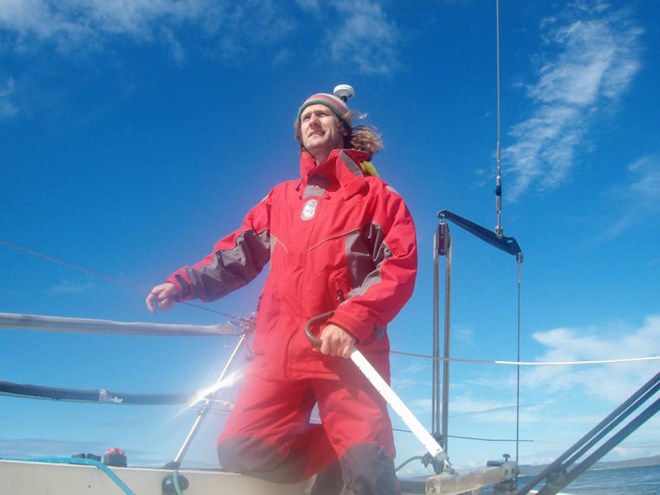
Or Gareth Doherty, whose boat-trips with his grandfather unwittingly launched him on a series of sea-loving escapades. Now, with a plethora of certificates to his name as master of different crafts, Gareth takes visitors, young and old alike, on sailing and canoeing adventures, teaching them the skills he himself has learned over the years and showing them the beauty of the bird and sea-life population all around us.

Selkie Sailing, Gareth Doherty

Then there’s Pól Ó Muireasáin, one of the most refined Irish speakers in the entire Donegal Gaeltacht, or indeed any Gaeltacht for that matter. Having taught as Gaeilge at university and worked as a translator in Brussels on complex European issues, there’s very little Pól doesn’t know about our native language, grammar, linguistic or etymology.

Brimming with civic spirit, there’s few challenges Pól won’t try, including line-dancing as a nun and a cowboy, then imitating that most famous of seasonal characters, Santa, thus bringing untold pleasure to young and old alike.

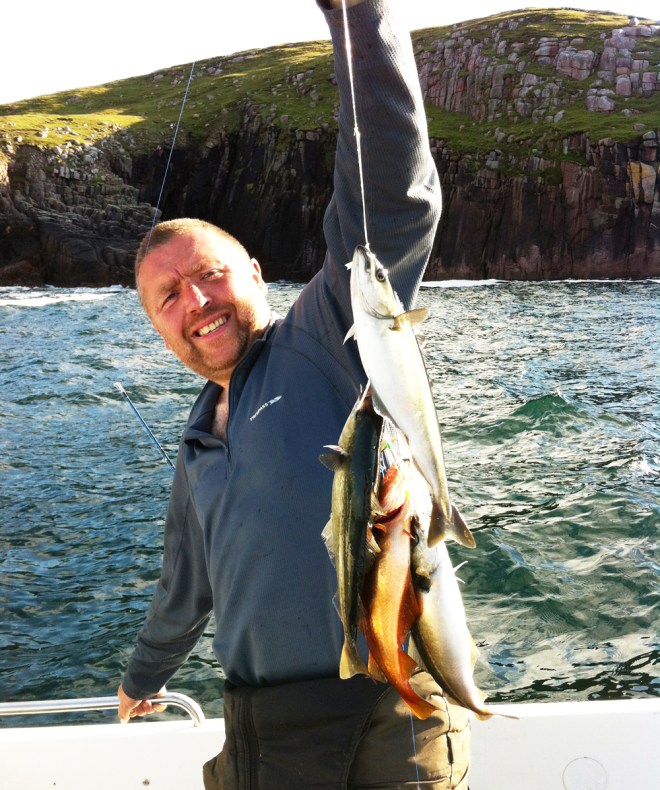
fishing in Donegal, Gola Island Ferry, sea foreger

Photo by Sean Hillen

Trips with these three men over the last few years has filled me with the kind of exhilaration and child-like exuberance one rarely finds in the bland concrete-and-glass urban settings I’ve often lived in.

But it’s not just lovers of the sea that help restore one’s faith in humanity. There’s also lovers of the land. Such people as Seamus Doohan, walking guide and lover of all things Celtic.

Seamus Doohan walking guide, walking Donegal

Having had the pleasure of experiencing his tours for an article in ‘The Irish Times’ as well as for this blog, I can guarantee a right-royal good time in his company, meandering among the hills of Donegal while learning about the colorful history of the area – including flesh-eating plants, soaring eagles and Pagan wishing stones.

Treading a different terrain altogether is Kathleen Gallagher.

Kathleen Gallagher Falcarragh,

Standing at Falcarragh crossroads just before sunset one year, I – like hundreds of others – was astounded to see a dramatic spectacle unfold before our eyes. At the edge of the hazy horizon, slowly coming into view, appeared wave upon wave of grisly, shapeless, blood-spattered zombies, horrible-looking members of the UnDead who, as they drew near, suddenly burst into a frenzy of brilliantly-choreographed dance moves to the pounding music of Michael Jackson’s ‘Thriller.’ Such a mesmerizing event, part of a community festival, is but one example of the sheer creativity of this lively, zesty individual who’s probably the envy of Galway’s ‘Macnas.’

Kathleen’s artistic talent brings me conveniently to another transplant to Donegal, this time from the heart of Scotland – a man who has brought Kings, Queens, medieval murderers and even ‘Cold War’ spies to this small part of the world. From James Joyce’s ‘Ulysses’ to Shakespeare’s ‘Macbeth’ to Graham Greene’s ‘The Third Man,’ Murray Learmont is a stage supremo directing members of the Cloughaneely Players to theatrical success.

Murray Learmont theatre director, theatre in Donegal

‘Toss a stone and you’ll hit a musician on the head.’ Such were the memorable words I recall hearing from someone after first setting up home in Bun na Leaca fifteen years ago. It’s an understatement. ‘Toss a stone and it’ll bounce from the head of one musician to another, to another, to another….’ is a more accurate depiction of the situation.

I’ve had the pleasure of hearing so many performing, it would be impossible to name them all here, but two whose lives I’ve written about deserve mention.

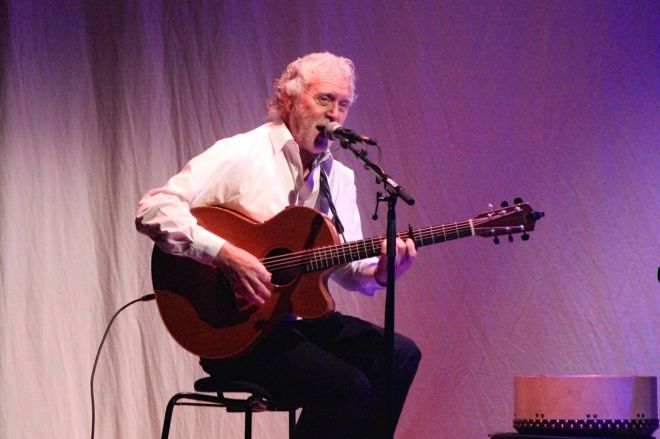
Few around here, nor in places beyond Ireland, don’t remember ‘Goats Don’t Shave’ and its founding member, singer and songwriter extraordinaire, Pat Gallagher, who penned the immortal tribute, ‘Las Vegas in the Hills of Donegal’ that became an instant national hit. Such is his musical prowess Pat can meander effortlessly from one genre to another, from ballads and blues to folk rock and country. Listen to ‘A Returning Islander,’ ‘Turfman’s Blues,’ ‘Children of the Highways,’ and ‘Let the World Keep on Turning’ and you’ll understand just what I mean.

Pat Gallagher musician, Goats don't Shave

Then there’s Ian Smith. Not managing to become a native of west Donegal, he did the next best thing – married beann álainn, Breda, from here. Formerly a guitarist and singer with a rock band in England, Ian left thousands of groupies broken-hearted and settled near Burtonport – and has never looked back, well, hardly ever. During that time he has played with some of the best musicians in the world and has cut not one but three full CDs, one of which ‘Restless Heart’ showcases his immense song-writing talent, with many of the titles his own work.

Ian Smith musician, folk music Donegal

That’s the praise bit of the headline. What about the prising bit?

Such talented people as mentioned have not received the kind of support they deserve from those with their hands on the cash that is meant to enrich the cultural, social and economic soil of west Donegal.

Instead of providing generous funding for touristic and artistic initiatives that help attract welcome visitors to the area and create jobs, the powers-that-be at the Gaeltacht’s leading funder, Údarás na Gaeltachta have either repeatedly fed the billion euro they’ve received to well-known, rich elites; to themselves or acquaintances; to developers to build now derelict, deserted industrial estates; and to companies which have gladly accepted the hand-outs, then promptly left the area, leaving out-of-work unfortunates in their wake.

Perturbed by the stories I’ve been told by local people about such discrimination and the wall of informational silence constructed by Údarás – I began prising apart, bit-by-bit, snippets of information through the Freedom of Information Act about the spending policies of aforesaid economic development organization.

To say I was surprised and disappointed at what I found is a distinct understatement. Astonishment would be a more suitable word. Lack of strategy, absence of clarity, cases of cronyism and nepotism – in fact, all the dubious goings-on that continue to bedevil Ireland and prevent its healthy development.

With the New Year approaching, I’ll continue to praise and prise. Perhaps, in doing so, I’ll help create a bit more transparency as well as highlighting some more of the real heroes of the area and thus contribute something to the area where I live.

I hope so cos’ I’m a terrible singer, can’t play a musical instrument if my life depended on it. As for gardening, what’s the difference between a parsnip and the tail of a donkey? Don’t even mention boating.

In the meantime, have a happy and contented New Year, wherever you are, whatever you do!

Crooks, citizens or celebrities?

Ethics, or lack thereof, has been the raging catchphrase in Donegal recently with county councilor John O’Donnell  caught on RTE camera allegedly offering lobbying services for cash and Bunbeg-based, EU-funded former school principal, Finbarr Boyle, stealing more than 200,000 euro from a village school, including money earmarked for childrens’ food.

But what’s all the commotion about? Hasn’t there been such unsavory goings-on right here in Donegal for years? Why the shock? Or is there any, really?

In last weekend’s edition of ‘The Irish Times,’ columnist Fintan O’Toole, painted a scary scenario, a malaise spreading nationwide.

…other cultures criminalise the things they find unacceptable; we find unacceptable only the things that have been criminalized. If you can get away with it, we reckon, it can’t be all that bad.” He then quoted Central Bank Governor, Patrick Honohan on white-collar crime, saying, “It is remarkable, first of all, how long it takes, how heavy the procedures are and how light the consequences.

Back in Donegal.

Ardara-born Finbarr Boyle’s story is well-publicized “School principal pleads guilty to 7 counts of theft and forgery.”

As a journalist and editor for over thirty years, I thought sharpened instincts had made me a good judge of character – boy, was I ever wrong.

Sitting at a lunch prepared by my wife in my home with Mr. Boyle as guest some time ago, I would never have guessed the man across from me would stoop to such lows as using a village school’s money where he was principal to treat himself royally to holidays in England, Spain and other fine places, car and house payments and expensive golf equipment.

Finbarr Boyle Donegal, CeangalG,

(l to r): Concubhar Ó LIatháin, CeangalG Marketing Manager, Claire Nic Neacail, Alasdair Morrison CeangalG Director, Dinny McGinley Fine Gael TD and Fionbar Ó Baoill – CeangalG Training Manager.

Mr. Boyle was given space inside the headquarters of Údarás na Gaeltachta in the Gweedore Industrial Estate, Bunbeg as a training manager – surprising, as that particular organisation has refused to gave any free space to small, local entrepreneurs in that same estate, a situation local Sinn Fein TD Pearse Doherty, has consistently taken issue with.

I must admit, Mr. Boyle impressed me then, a fast talker, assertive and supremely confident. Yes, I know what you’re probably thinking – ‘Sounds like a conman to me.’ As things turned out, you are absolutely right. But I was left sad and disillusioned after learning of his multiple theft. He struck me then as the kind of person who could be a positive force for change, especially as we discussed the importance of ethics and the need for the Donegal Gaeltacht to rid itself of its historic cronyism and nepotism which have warped normal economic development of the region.

Yet this is the same person found guilty of seven counts of theft over a number of years (he admitted to many more as part of his plea bargain), for whom Judge John Aymler may not impose a custodial sentence because, in part, 25,000 euro of the money taken may be paid back within a year. That’s around a tenth of what was stolen.

Who says crime doesn’t pay?

A key question, however, still remains unanswered: Mr. Boyle was caught red-handed several years ago (the investigation has been ongoing for at least seven (7) years), so how did he obtain a well-paying position as training manager of a lucrative, multi-million euro, tax-payer supported EU funded project – ironically, one aimed at helping economically disadvantaged people? Was this , in itself, a classic case of nepotism and cronyism? Regardless of the multiple thefts, people have asked, “Does a school principal have the business credentials to train entrepreneurs?”

When contacted by me this week on the issue, Dr D. Munro, chair of the CeangalG Steering Group, Sabhal Mor Ostaig in Scotland, e-mailed back, saying, “Mr. Boyle’s actual contract of employment, for the post of Training Officer, with the wider CeangalG Project, was formally and directly managed through our Project Partners, Údarás na Gaeltachta.” He added that Mr. Boyle was “employed by the project between 9th Sept 2013 and 31st March 2015.” The Gardai investigation began as late as 2008 and Mr. Boyle, according to media reports, admitted his thefts almost two years ago (January last year).

Mr. Munro added, “At no stage in either the recruitment process or during his subsequent period of employment, was CeangalG ever made aware of there being any on-going police investigation.” Mr. Munro cc his email to the law company of Wright, Johnston & Mackenzie and to the University of the Highlands. Have I touched a red button?

Entitled CeangalG (ConenctG), this project is funded by the EU’s INTERREG IVA, Bòrd na Gàidhlig, MG ALBA, the Scottish Government, Sabhal Mòr Ostaig and Cultúrlann McAdam Ó Fiaich and focuses on the Gaeltachts of Donegal, Scotland and Belfast. On it’s website, it states:

CeangalG Donegal, INTERREG IVAAs for independent councilor John O’Donnell, the ball is largely in his court. He can do the dignified thing and bow out. If he stays, he places the entire council under a shadow. Independent councillor Frank McBrearty says he should be removed from all committees. But it seems resigning is the last thing O’Donnell will do. Another Independent councillor, Micheál Cholm Mac Giolla Easbuic, is right in asking fellow councilors to walk out of the chamber at the next meeting in protest. Someone has to stand up, otherwise – due to blatant impunity – it will get much worse. Let’s see if that happens. If not, then Fintan O’Toole’s words ring frighteningly true.

John O Donnell Donegal, independent councilor Donegal

Independent councilor John O Donnell: will he do the right thing?

But questionable dealings are nothing new in Donegal, as many local people have told me.

Under the auspices of the former Fianna Fáil government, Liam Cunningham (Liam Ó Cuinneagáin), was paid substantial sums for his services as member and long-time chairperson of Údarás na Gaeltachta – more than a quarter of a million euro. Between 2002 to 2012, his travel expenses alone amounted to 131,730 euro. His fees amounted to 206,962 euro.

More than that, documents requested by me under the Freedom of Information Act also now show that at least one company he established, Oideas Gael, received generous amounts of money – more than 350,000 euro in a series of payments – from the very same organization he chaired for so long. Mr. Cunningham said Oideas Gael was a hobby. With a financial return like that, that’s quite a hobby.

In stock market terms, is this not a case of insider trading, and therefore unethical? After all, no better-placed person to access money from a group than the person who’s on the inside track of that very same group, knowing intimately its budgets, its strategy and its key staff. When called by me about this situation in a phone interview, Liam said, “Sean, things were different then. I don’t see it as a conflict of interest.” Different then? How is it different? The question was never answered.

Oideas Gael, Liam Cunningham Donegal

Liam Cunningham: is it wrong to lobby for money from the very funding organisation that you chair?

Some readers might say, ‘Liam hosts Irish-language classes.’ That’s true, but so do many others and they don’t benefit from the rich financial backing Oideas Gael received so handily. Still others could do so – if they had that kind of money. Is such treatment fair and ethical? Is the playing ground a level one? How many times has Údarás said there’s not enough money for your project?

The particular situation of Mr. Cunningham also raises an inevitable question: was it linked to an ongoing quid pro quo agreement among local Údarás board members then? And has anything changed since? Interested to find out? You have the right to know, and here’s how. (See below).

Mr. Cunningham has since been named, ‘Donegal Person of the Year.’ Considering the dire economic development of the Gaeltacht, where I live, under his watch, the question must be asked, ‘Is this how we want the term ‘model citizen’ to be defined?”

Michael Heaney, formerly a director of services with Donegal County Council, has recently been appointed director of Enterprise & Investment with Údarás. Will his leadership change the way Údarás doles out money, how it selects projects to fund? Or will the same old cadre of elites be the recipients? Time will tell.

As Údarás is helping DLDC select projects for funding under the EU’s upcoming LEADER programme, it will be operating under much tighter European regulations than the rather loose Irish ones it has been working under thus far. It will be interesting to monitor the quality of their project selection process for LEADER.

As O’Toole writes in last Saturday’s column, “If corruption is very low on the list of priorities for criminal justice, it is little higher on the list of political priorities…. So long as impunity reigns, the rare eejit who gets caught will always evoke sympathy… What marks out (Ireland) is the breathtaking degree of impunity for all white-collar crimes.

Isn’t it long past time this situation changed? The upcoming election gives us the chance to affect such change. In  ofthis regard, it is worth noting the words  ‘Donegal News’ columnist Martin McGinley’s in Friday’s edition, “We get what we accept.”

You have the right to know:

You can find out additional information on the dealings of Údarás by e-mailing Judy Ní Dhubháin at judy(at)udaras.ie. Quoting the FOI Act 2014, you can ask for any information you like, financial or otherwise. The service is free.

Anyone wanting answers from CeangalG, can contact Dr D. Munro, chair of the CeangalG Steering Group at dm.smo(at)uhi.ac.uk or +44 (0) 1471 888352. Claire Nicolson is the organisation’s administrator claire(at)ceangalg.net Alasdair Morrison, a former minister in the Government of Scotland, is its director. Or through Údarás na Gaeltachta, Donegal. Tel: 074-9560100. Fax: 074-9560101. Email: dnag(at)udaras.ie

Be sure to tell me what you find out. I’d be curious to know.

Donegal entrepreneur Moira Ní Ghallachóir pushes for local tourism diversity

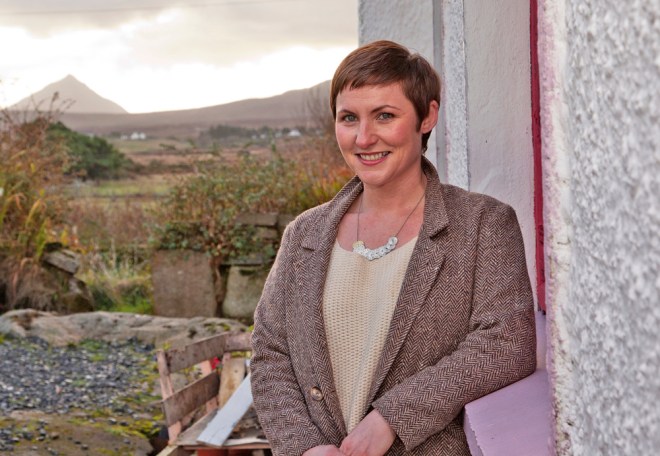
With no particular experience in tourism and no specific agenda, Edinburgh-born Moira Ní Ghallachóir bravely packed up her bags in London four years ago and returned to west Donegal where she grew up, to re-invent herself – and says she has never looked back.

Moira Ní Ghallachóir Donegal,

Back home, and lovin’ it! Photo by Philip Mulligan

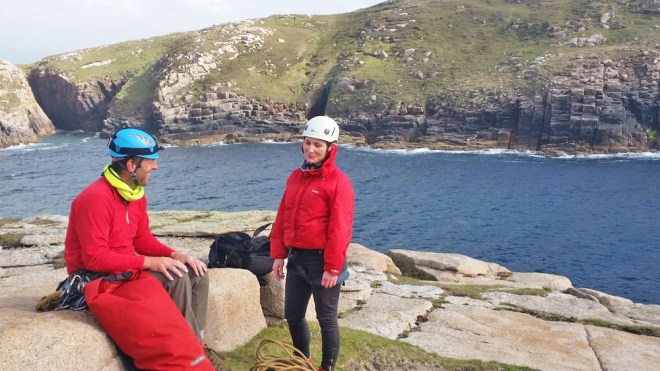
Living in her grandmother’s home in Derryconnor just outside Gortahork in the Gaeltacht, she noticed the large number of local people with outdoors skills such as Iain Miller, an experienced mountaineer, and Gareth Doherty, a sailing instructor, so she launched mng Ventures to organize outdoor adventures linking their skills to clients.

mng Ventures, Donegal outdoor activities

Iain Miller puts Moira ‘through the ropes.’

“I looked at my life in London, the work-week, then partying all weekend, and asked myself, ‘Is this it?’ ” said the petite, short-haired 39-year-old woman sitting in An Crannog, a community-based complex in the coastal town of Bunbeg under the management of Cathal Ó Gallchóir, where she was given free office space for a year to help develop her business. “If someone had told me I’d be earning as little as I have over the last three years, however, I’d have said, ‘You must be joking.’ But, honestly, I feel more fulfilled, happier and healthier than I’ve ever been. With islands, mountains, lakes and the Atlantic Ocean right beside us, this place is truly world class. That’s what inspired me to set up a business.”

While Moira is armed with plenty of enthusiasm and networking links gained from living in Ranafast from age 8 to 18, she is concerned at what some describe as ‘generational grant dependency,’ the over-reliance on public hand-outs for projects rather than sheer entrepreneurial spirit.

mng Ventures, Rock agus Roam

Ready to ‘Rock agus Roam, a project organised by mng Ventures!

“Many people feel they have to be supported by government grants and if there is none, then ‘game over’ it cannot be done,” she said forthrightly. “We need to realize what we have and build on it. Some people say, ‘We need an adventure centre,’ not realizing that the adventure centre is all around them. Many also don’t appreciate what a beautiful landscape they have here. How can they then expect tourists to appreciate it? They’ve got to believe in their business and tell it as it is, get the word out there, with honesty and an authentic voice. Why be quiet about generating jobs or being environmentally-friendly? With today’s technology we can promote ourselves at the click of a button.”

Moira also believes greater co-operation among local people is required for group success. “We need to work together more closely, we’re still not doing enough of that. We need to start clustering.”

activities in Donegal, Donegal people,

Captivating seascapes around the northwest coast of Donegal.

Taking language as a cultural issue, she adds, “There is a lot of fear here in the Gaeltacht around the Irish language issue. Yet it can be our greatest strength, an important part of our cultural landscape. I have never viewed the Irish language as central to the growth of my business, but I embrace it with respect, with ‘meas.’”

In fact, Moira says having a bilingual business is “a challenge, double the effort as it’s often difficult to marry English and Irish,” with even announcements having to be written, edited and designed in both languages.

rock-climbing, sea kayaking, sailing, island hopping, whale watching

Speaker Finbarr Bradley captures his audience on Saturday.

Her statement inadvertently raises an important issue for Gaeltacht areas. Is too much precedence given to Irish-speaking-only entrepreneurs for funding from grant-awarding bodies such as Údarás na Gaeltachta, than local non-Irish speaking applicants or ‘blow-ins’ as they are referred to locally? In terms of larger grants, language doesn’t seem to be a barrier, with English-speaking call centers having received millions of euro over the years from Údarás. With smaller entrepreneurs, however, ‘blow-ins’ report having very little success accessing grants from the organization for projects that they say could create badly needed employment.

While Moira admits to it being, “hard to make a decent living here,” she is optimistic things will get better. “About three hundred are already booked for outdoor pursuits next year,” she says proudly. While she says success so far has been ‘built on my own investment and initiative,” she adds that she has accessed grant funding from Foras na Gaeilge for the Colmcille Trail (Colmcille Eirinn is Alba) project launched recently and from Údarás for a three-month pilot programme, which ends in January.

entrepreneurs Donegal, outdoor activities Donegal

She also says she will probably apply for the upcoming EU-funded LEADER programme aimed at economically regenerating rural areas.

Though mng Ventures organizes a wide variety of activities including rock-climbing, sea kayaking, sailing, island hopping, whale watching and hill walking, Moira believes there is still not enough diversity of tourism offer in west Donegal. “We need more choice and we need to work from the inside out to achieve that.”

where to eat in Gweedore Donegal, Donegal cafes

Caitlin Gallagher, owner of Caife Kitty, and her daughter served up delicious food and drinks to everyone Saturday.

Her words were echoed by Finbarr Bradley, professor and co-author of ‘The Irish Edge’ and a mentor to Moira’s fledgling company. At an event Saturday organized by Moira at Sean Teach Niall O’Domhnaill Loch an Iúir where fine food was prepared by Caitlin Gallagher of Caife Kitty in Bunbeg, he said, “This area of Donegal is rich in landscape and culture and that’s what many people are searching for now, something experiential, something spiritual, something authentic. Building upon all that you already have here so naturally is the best way forward.”

Finbarr Bradley author, University College Dublin

Watched by excellent singer Noeleen Ni Cholla (centre), Finbarr Bradley talks about the importance of ‘cultural authenticity’ in tourism development.

Howls of Halloween are upon us….

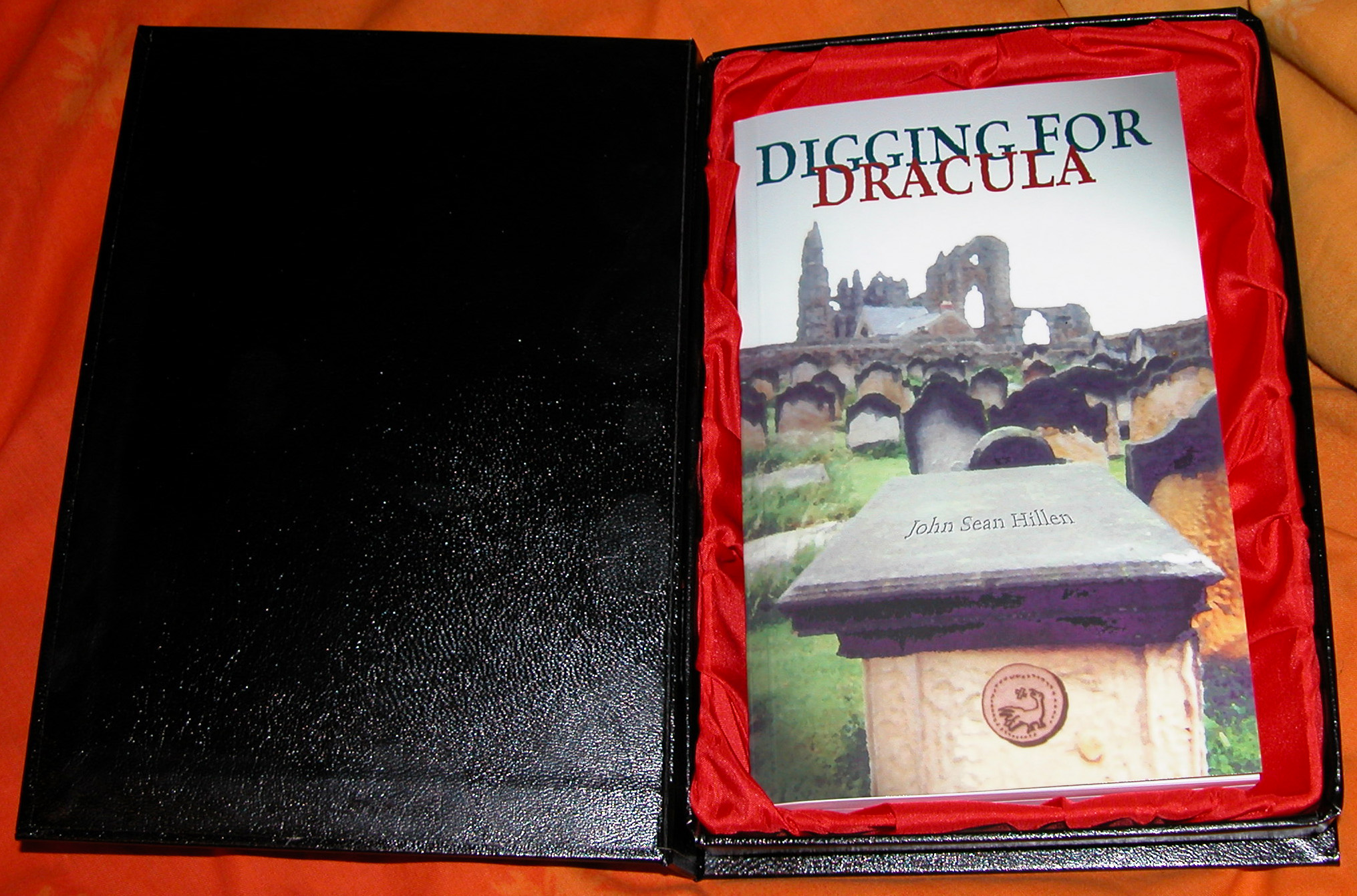
With the spine-chilling howls of Halloween approaching and the door between the living and the dead opening ever so slightly, I’m reminded of midnight hours cutting my teeth on research for a proposed book later published under the title ‘DIGGING FOR DRACULA.

I had been living in Romania for several years, wearing two hats – professor of journalism at the University of Bucharest and foreign correspondent for The Times – when a fax came through from the news desk in London (those were the days before emails).

Halloween gift, book in a coffin

Funky Christmas gift for vampire-lovers! A book-in-a-coffin.

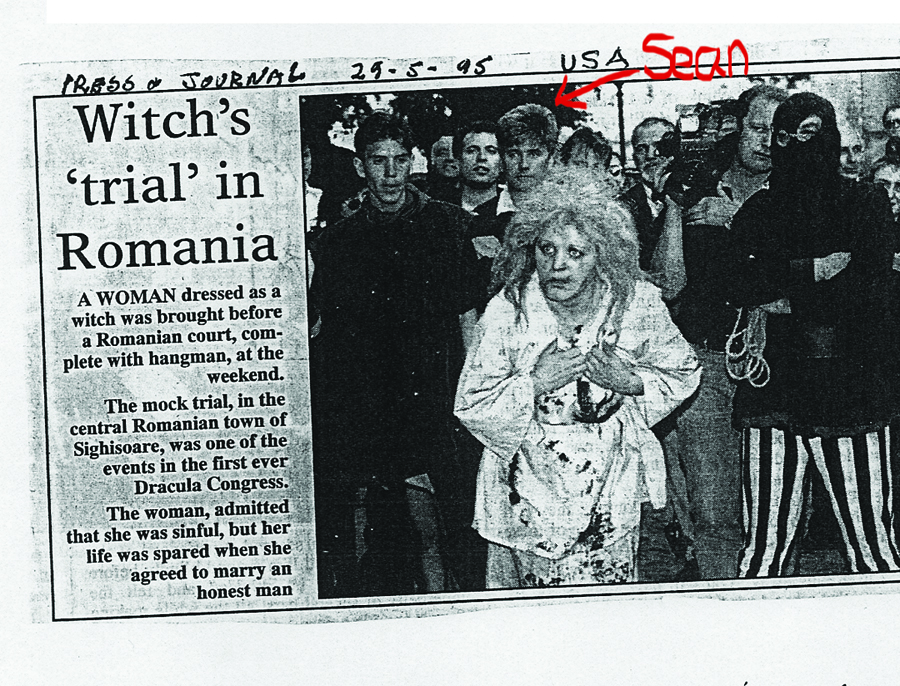
Under the headline ‘First-ever World Congress of Dracula’ were details of an upcoming, week long international event focusing on those strange Long-Toothed creatures that simply refuse to die.

Being from Ireland, the homeland of the famous vampire’s maker, Bram Stoker, I was intrigued, so much so I promptly set off on an adventure – to find out why his classic character created more than a century ago could attract such global fame.

Whitch trial, Transylvania vampires stories

Daily Telegraph, London. I ended up marrying this sexy witch. It was the only way to save her from being burned at the stake. Or worse.

That adventure brought me through the breathtaking landscapes of Transylvania to the princely lair of Vlad the Impaler within the craggy peaks of the Carpathian Mountains; to a seat beside Bram on a cliff-edge in the eastern port of Whitby, England, a place pivotal in the unfolding vampire drama; and to ‘Tinseltown’ Hollywood where Stoker’s creation won immortality on stage and screen.

Along the way, I visited the Mummies of Dublin; the ‘Agony Aunt’ of vampire lovers in New York; voodoo artists in New Orleans; a Los Angeles graveyard filled with larger than life characters; and the world’s largest garlic festival.

On a search for literary truths and the meanings of centuries-old myths, I learned that Celticism might just explain the elusive meaning of the word ‘Dracula’ – ‘droch fhola’ (pronounced ‘druc ula’) meaning ‘bad blood’ in Gaeilge, the native language of Ireland.

Forrest Ackerman science fiction, Los Angeles science fiction museum

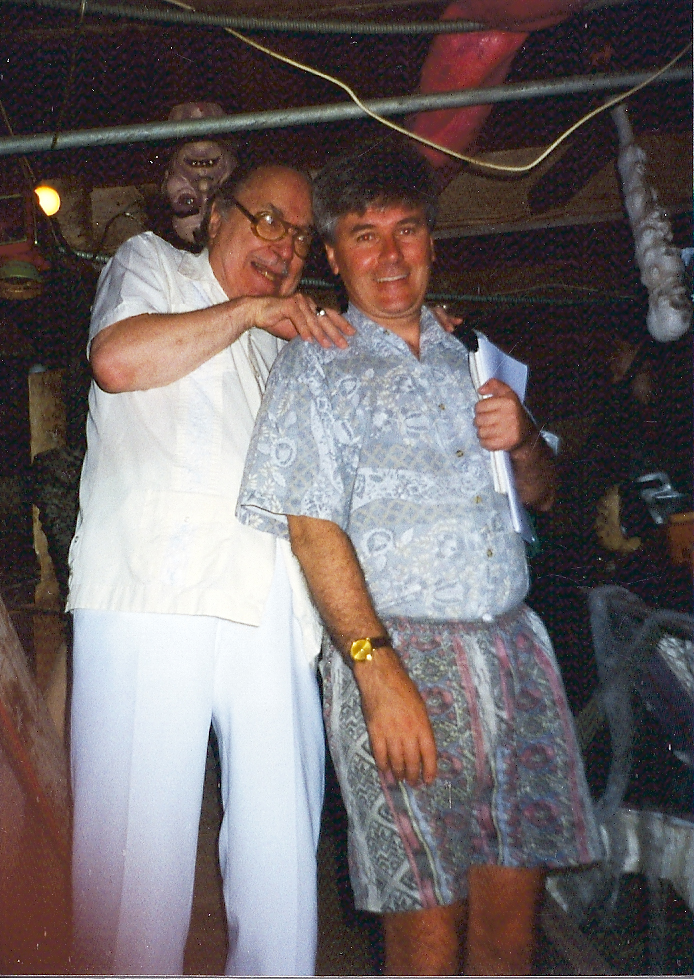
Hollywood, California. Forrest Ackerman (left), known as the ‘Father of Science Fiction,’ famous collector of vampire books and movie memorabilia, shows me how vampires trap their prey.

As for the ‘First–ever World Congress of Dracula,’ it attracted many idiosyncratic people from all walks of life – professors, psychologists, writers, historians and teachers from many countries including Japan, France, Canada, Germany and the USA.

Some had their teeth artificially sharpened. Some slept in coffins. One man offered 10,000 dollars for anyone who could bring him a vampire, having arranged doctors in California to verify the find.

Digging for Dracula book, Vincent Hilliard Los Banos

Vincent Hilliard (left) offered 10,000 dollars to anyone who’d bring him a vampire. He lined up some doctors to verify the find. Here he poses in his home in Los Banos California, with Columbia, a Transylvanian visitor.

Those were just some of my experiences. So grasp your garlic and join me on a journey. Prepare to enter the ‘Lovable House of Horror’ and the ‘Land of the Living Dead.

Scuba-diving plankton make Donegal waters sparkle

Ever seen luminescent plankton sparkle at night like scuba-diving fireflies?
If not, then maybe you should take an island tour with Captain Gareth Doherty of Selkie Sailing as I did several days ago on his 22-foot Drascombe long boat.

Land ahead! Captain ‘Columbus’ Doherty’s first sighting of America, or some such landmark (Photo courtesy Selkie Sailing).

Setting off from what I call ‘Ernie’s Place’ (Bun An Inver harbor, opposite Teac Jack) just as the sun was setting, we headed across tranquil water to Sceard Iompainn (Umfin’s Blowhole) near Béal Scealp Uí Dhúgáin (Duggan’s Sea-Arch), its russet-red rocks sliding smoothly to the sea.
sunset on the wild atlantic way, Donegal boat trips,
Interestingly, as Pól Ó Muireasáin, our Gaelic linguist on board, pointed out, the island of Iompainn may have derived its name from the older spelling, ‘Iompthoinn,’ meaning ‘turning wave.’ Opposite Béal Scealp Uí Dhúgáin is where I normally fish off the side of my boat ‘Radharch na Coco’, catching sizeable pollock, but also losing plenty of lures and weights in the process, tangled in the heavy seaweed there.
Pól Ó Muireasáin, Gareth Doherty, Selkie Sailing

(l to r) Sea-mates Gareth Doherty and Pól Ó Muireasáin enjoy a light-hearted moment. Photo by Sean Hillen

Dare I say it for fear of ridicule, but once I even lost a fine rod there – left unattended in the stern of the boat, a group of conspiratorial avenging fish dragged it down to the murky depths before I could scamper back and rescue it.
From Béal Scealp Uí Dhúgáin, we floated gently on the placid surface for a while indulging in a spot of fishing while marveling at the glittering plankton in the water beside us dancing mightily as if high on ecstasy at a fairy rave party.
Our night tour then took us to Gola (Gabhla – the place of the fork, alluding to the two hills as seen from the mainland); Tororragaun (Tor Uí Arragáin, Harrigan’s Outcrop); Inishmeane (Inis Meáin, Middle Island); and Inishsirrer (Inis Oirthir, East Island).
sailing in Donegal, boats on Wild Atlantic Way

A chat at sea with local coastguard, Joe Curran (in orange) and Antonia Leitner from Austria (front left) helps pass the day away. Photo by Sean Hillen

There’s nothing as peaceful on a lovely evening than to be on a boat on calm seas in good company, chatting idly about this and that. And that’s exactly what we did, with subjects ranging from the fate of the Irish language to the wealth of wildlife off Donegal’s shoreline and Gareth’s peck on the nose from a nervous gannet (And, on a more cultural vein, needless to say Daniel ‘Travolta’ O’Donnell’s chances of capturing the Sam Maguire Cup of classical dance for the glory of Donegal – just joking).
Several things impressed me about Strabane-born Gareth Doherty on this trip.
The slim, bearded sailor loves the sea and all things associated with it, including a heartfelt concern for the environment and the birds and sea creatures that inhabit it.
 As a keen naturalist, the bird and wildlife around the coast here is truly spectacular,” he says. “And there’s so many different ways to enjoy them. Every time I cast off from the shore I have a feeling of anticipation, knowing the rewards that await me. The moment I switch off the engine and hoist sail, this transformation encapsulates for me an ancient tradition.”
Fishing on Wild Atlantic Way, Gareth Doherty

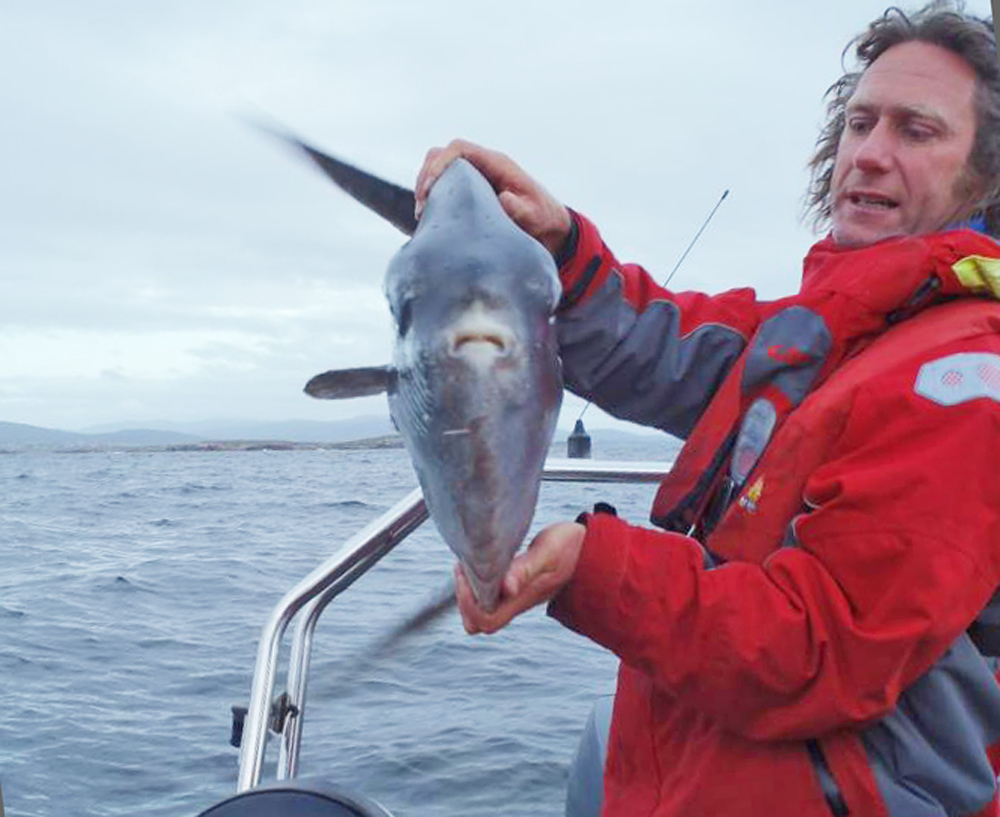
Gareth hand-catches a 15-pound sunfish near Umfin. Photo courtesy of Selkie Sailing

Illustrating his concern for wildlife, Gareth and his wife, Amanda, from Sunderland, helped establish the ‘North West Whale & Dolphin Support Group’ consisting of local like-minded people keen to learn how to save stranded sea mammals. The initiative followed the ill-treatment of a pod of 13 pilot whales left to suffocate after five days on Ballyness beach near Falcarragh. It was the 13th such stranding last year in Donegal.
wild life northwest Donegal, birds and sea life

Gareth’s son, Aran, watches over a young Great Black-backed Gull. The bird’s tongue got tangled in fishing lure, which Gareth skillfully removed. Photo courtesy of Selkie Sailing

Gareth, who lived in Black Isle, near Inverness and Dunoon in Argyll before moving to Donegal seven years ago, (his three children are named after Scottish islands – Skye, Rona and Arran) is a gold mine of marine information.
Well-qualified – he is a dinghy instructor, day-skipper, offshore yachts-master and is trained in advanced power-boating – his deep knowledge ranges from details on wildlife to be found around the Continental Shelf lying 50 miles off the Donegal coast to the characteristics of the waxy oil that dripped from a sperm whale stranded on Magheraroarty (Machaire Rabhartaigh) beach several weeks ago.
The 44-year-old’s passion for the sea originates in great part with his grandfather, Paddy McCauley, who spent much time in Inver, Donegal. “As he was a keen sailor and fisherman, some of my earliest memories are of being on the sea,” he recalls.
Now Gareth has transformed his indefatigable passion into a creative entrepreneurial venture. Aside from the Drascombe long boat, Selkie Sailing, based in Derrybeg, has many other craft – a gaff rig, topper sailboats, a catamaran, kayaks, a rib and a banana boat: more than enough to host guests on adventurous excursions among the many islands, sea arches and caves. Sailing classes take up much of Selkie’s activities.
Gareth Doherty saving sea life, Donegal wild life

Gareth caresses a blue shark, four miles off Inishsirrer near the wreck of the steamship, Boniface, torpedoed during World War One. Photo courtesy of Selkie Sailing

Gareth says different seasons bring different sights. “Spring sees a migration of Arctic Skuas, Sandwich Terns and Gannets with occasional rare visitors like the Short-Eared Owl,” he explains. “Summer days are filled with the song of the Skylark and ground-nesting birds like Oyster Catchers and Ring Plovers, with sea-cliffs harboring colonies of shags, cormorants and fulmars. Chances of seeing an otter, a basking shark, a bottlenose dolphin or a porpoise are higher then. With autumn come Sandlins and Dunlins while seal pups rest on the rocks and the sandy beaches of the islands. Brent and Barnacle Geese rule winter, taking advantage of the sea swells to feed. Sometimes, a long-tailed duck may make an appearance.”
Two proposed projects excite Gareth. One is in education – to teach children in local schools about the marine environment and its sea and air inhabitants. The other focuses on Minke whales. “They’ll start to appear over the next month and I’ve organised two underwater photographers and a cameraman on a drone helicopter to shoot their behaviour,” he says excitedly. “It may be the first time this has ever been done in Ireland.”
whales Donegal, Minke whales

Efforts by Amanda and Gareth Doherty aim to save many stranded whales, dolphins and other sea life such as this.

As to the name ‘Selkie.’ It’s a mythical creature; half man, half seal which comes on to the land and removes its outer layer of skin to reveal itself as a beautiful, dark-eyed human. Like the mermaid, selkies have been both praised and feared. Stories describe how they helped sailors in rough storms but also how they lured people into the sea. Another yarn tells of a man stealing the skin of a female selkie to trick her into being his wife.  
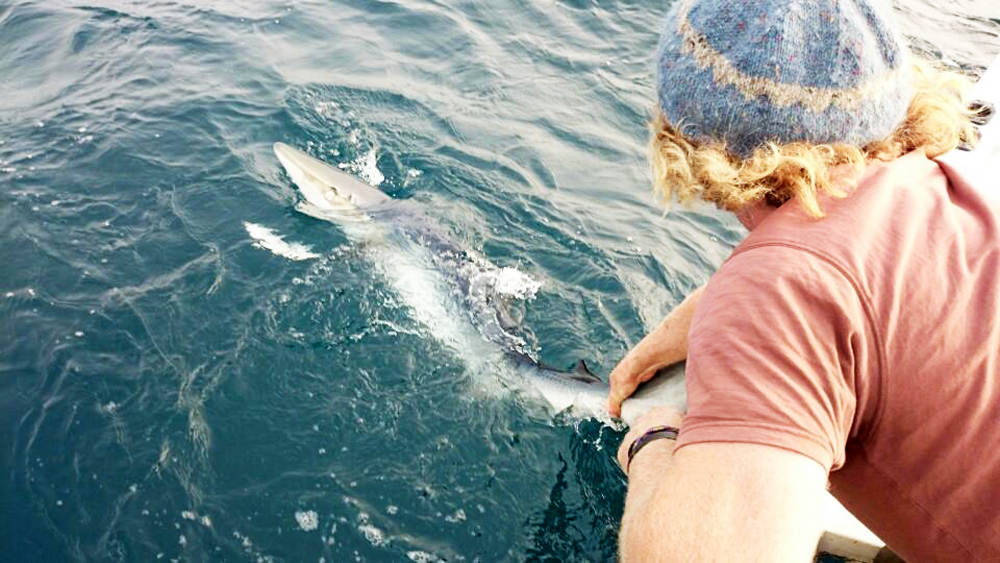
As Selkie Sailing’s motto states – “Where the shore ends, the advenure begins,’ you never know, perhaps a trip with Gareth might end up in a fortuitous meeting with one of these intriguing creatures.