Owen Curran: well-respected Donegal community activist speaks out

Names his choices for local elections in the Glenties

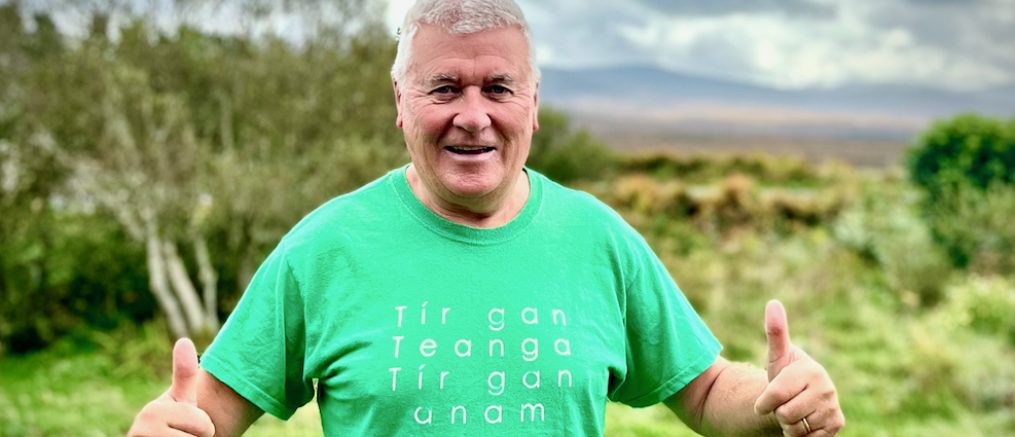
Watching as stone cottages in England were leveled to make way for a nuclear power plant and seeing protestors trying to stop it being mistreated by police was the beginning of Owen Curran’s political awakening.

I was nineteen, living in England, but that planted a seed in me,” the 51-year-old explains simply during a recent two-hour interview at Lough Altan Hotel in Gortahork.

Owen, first from the left, looking at camera, displays his solidarity with protestors seeking greater equality and social justice.

In the intervening thirty-two years, that seed has grown into a sturdy tree, its branches used in the protection of basic civil and community rights and furtherance of a more equitable society. That’s why Curran, who was born in Glasgow but who grew up in Ray, west Donegal, and has lived the last 12 years in nearby Derryconnor, came to be one of the canvassers for a then aspiring Dublin political leader named Joe Higgins in the 1990s. That’s how he also ended up in the vanguard of the Cloughaneely ‘Can’t Pay, Won’t Pay’ campaign against the household and water taxes; among 15,000 people protesting outside the Fine Gael Ard Fheis two years ago in Dublin; and one of a small group of people behind the emergence of ‘May Day’ celebrations earlier this month in Falcarragh.

I suppose you could say I’ve always been involved in fighting for peoples’ rights and social fairness,” says the well-read, quiet-spoken Donegal county council employee. “These rights were hard-fought to get and keeping them is even more difficult, especially in times of economic crisis.

With the local elections but a few weeks away, Owen, who like many Irishmen before him has travelled to many places seeking work, including Neasden, Edinburgh, Bermondsey, Dunbar, Haddington and Port Seton, is eyeing the candidates with that view very much in mind. “I’m looking for people with genuine beliefs about social justice, the kind who get involved and don’t waver when things get tough, people like Pearse Doherty of Sinn Fein, the best politician we’ve ever had in Donegal,” he says, before adding philosophically, “democracy is a living, breathing, thing and should be borne out to its fullest. We’ve been told there is an economic upturn, but we don’t see it. Most of our working people have emigrated or are simply unemployed. How can we talk about rural Ireland if we don’t put people back to work? We need to get back to basics, back to looking at agriculture, tourism, the environment. We need open public forums where people can have the right to their say in how the community in which they live should move forward. We’re not going to come out of this crisis automatically. That requires serious, long-term spending.

So why hasn’t that happened already? Why has there been so little protest from Irish people who have undergone such dire difficulties over the last five years?

There are many reasons,” he explains. “With our colonial past, including landlordism, there has been a ‘do-what-you-have-to’ attitude to survive. Also, the Catholic Church, while it has done much good, has left us over-deferential to authority. Further, emigration has always been Ireland’s safety valve. It lets pressure off. Those who would traditionally stand up are gone away.

Owen also believes history went amiss for the people of Ireland. “After the so-called revolution here, the wrong people grasped power, not the people who did most of the fighting, but larger farmers and those who were better off. Some people like to make a devil out of Éamon de Valera but he wasn’t alone. Some of what he and others beside him did was progressive but there has been an absence of social change. Ireland is a Republic in name only and even though the phrase annoys me, we are a ‘class conscious’ nation. In a country in which we felt we were in it together, resisting the might of the British Empire, we found we were no better, no worse, than them. The green flag is still waiting to be raised. There are still things to do.

That includes, according to Owen, “all people being given choices.” “People are not given their rightful place. Minorities should be able to voice their opinion. That is vitally important. Cutting them off is dangerous and we have to be ever vigilant that does not happen. We also need to relearn a lot of stuff, things we knew in the past, like solidarity and standing up for each other. Irish people like to say they didn’t like Margaret Thatcher yet we’ve taken many of her policies and applied them, thus the Celtic Tiger and the Charlie McCreevy’s of this world. Unions ‘in partnership’ with government? What does that mean? We cannot sit on both sides of the fence. It’s as if we are delighted to be allowed to ‘join the club,’ join the ruling classes. We have become so deferential to authority we let off those clearly guilty of white-collar crime. It has just become too easy for them.

Locally, Owen is passionate about the unfortunate situation at Largo Foods in Gaoth Dobhair. “This is a case where skills were honed over forty years, yet now, it’s all gone. Crocodile tears were shed by many politicians, but it took eleven days for Udaras na Gaeltachta to host a first meeting on the factory’s closure. It should have organized a special task force back in the 1980s when manufacturing was going down. I mean, has there ever been an audit of skills in the Gaeltacht community, not to mention a series of public meetings to find job-creation ideas or special training seminars on how to apply properly for funding? Udaras has spent hundreds of millions of euro of public money over the years and much of it has been wasted. It is long past time for greater transparency and much more public scrutiny of the way this organisation operates.

To whom does Owen owe such thoughtful and mature political thinking? “In Ireland, the lives and writings of people like James Connolly and Jim Larkin, and, of course, Joe Higgins, which is why I canvassed for him all those years ago, but others outside Ireland who were very influential during their time,” he says. Among these, Owen adds, are James Cannon in the United States, whom he sees as “an early stalwart of American socialism in the 1930s and who wrote ‘Socialism on Trial,’ which Owen considers “a masterful explanation of the ‘red scare,’ and even the writer, Jack London, who wrote ‘The Iron Heel,’ about the strength of the individual and the collective. Owen also greatly admires Barack Obama, who, he says, “has made a tremendous difference.”

With local elections up ahead, how does the local activist – with two brothers and two sisters and now married to Sheila – feel about the future?

I remain optimistic. I believe in people, in the human spirit. But we need to build peoples’ confidence, to encourage them to get involved in making their communities better. They will find they are well able but it’s a long process. However, it can work. There is not simply dark and light. There’s rarely an outright victory. The ‘Can’t Pay, Won’t Pay’ campaign, for example, made a number of people active. We all learned how to debate issues. In many ways, it was a model for local democracy within a group. I saw people who were too shy to speak, get up and chair a public meeting.

Regarding the ‘Can’t Pay, Won’t Pay’ campaign, Curran gives great credit to a number of people who he says “have been pioneers in the struggle for greater equality as well as anti-austerity stalwarts, including Theresa and Caroline Woods, founders of the group; Mary Bridget Sharkey; Mary Attenborough; Moire McCarry; R.J. McLean; James Woods;  Gerard Gallagher; and Martin McEhlinny.”

He continues, “Back to the issue of deference – some people on the left wasted an opportunity this economic crisis presented. They disengaged over spurious reasons. The landscape changed but they didn’t take advantage of the opportunity it presented. Forcing Fine Gael and Fianna Fail together would have made way for a stronger Left alliance….. but maybe it’s not too late.

Owen’s choices in the upcoming local elections for the Glenties area are –

  1. Michael McClafferty – “a decent, hardworking person who got involved in this election because he believes change can only come about if people go into politics and fight for it.”
  2. Cllr. Marie Therese Gallagher and John Sheamais O’Fearraigh of Sinn Fein “because that party has shown consistent loyalty to its principles, as well as strong discipline, especially at last year’s council budget meeting.”
  3. Seamus Rogers – “a genuine community activist, and a decent man.”

Openness and transparency required: Udaras still has questions to answer

Fueled by community concerns about lack of transparency and a concerted campaign by Udaras na Gaeltachta to squash attempts to extract information on its spending of public money (see related posts Udaras na Gaeltachta a secret society? and Catholic church-linked addiction clinic in Falcaragh, is this the best use of tax payers job creation money?) and, specifically its proposed spending of between one and three million euro on a church-run addiction clinic in Falcarragh, questions were posed to the four Donegal national board members, including the organisation’s Aranmore-born chairperson, as well as Udaras’ communications and marketing manager, Siubhan Nic Grianna (see: Public accountability? Or continued secrecy?)

In addition, having been invited to speak at a two-day international conference at UNESCO headquarters in Paris this week on access to public information, good governance, protection of journalists and whistle-blowers and media diversity, the overwhelming message was, as UNESCO officials clearly stated, “openness, transparency, access to information and freedom of expression, including press freedom, are essential to good governance.” See short video clip from UNESCO conference here.

Photo 2

Professor Rosental Alves, UNESCO Chair in Communication, and I display media solidarity.

With this in mind, please find below a set of responses received from Ms. Nic Grianna at Udaras HQ in Galway to the specific questions put to her by me on the proposed addiction clinic in Ballyconnell House, Falcarragh.

You will notice frequent use of the term “confidential” to avoid giving pertinent information, and also some vital details missing from her responses (see list below). Her response, for example, to Question Nr. 8 is evasive (to accurately ascertain potential conflicts of interest, one needs to know who is conducting direct negotiations involving public money on the public’s behalf). If you notice other such attempts to avoid answering directly, please inform me. Your identity will remain anonymous if so desired.

  • Who or what group was paid 225,000 Irish Punts by Udaras for Ballyconnell House?
  • What other grants were given in relation to Ballyconnell House since 1988 and to whom – all financial details in questions 1, 2, 3, 4, 6, 7 and 12 are either referred to a FOI request or stated as confidential. If this project is to benefit the community, as stated in Ms. Nic Grianna’s answers, why is Udaras so keen on keeping important information confidential?
  • As I have not been able to find a person who was invited and/or participated at the meeting described in point 9 yet, or find any document related to such a meeting, I hereby issue an open invitation to anyone to help provide such details. It would help shed light on what issues were presumably discussed then. If so desired, the identity of all responders will remain confidential.
  • It is also interesting to note that while Gearoid O’Smaolain, Udaras tourism officer (see post here: Fair or unfair? A nettlesome question of censorship) demanded an apology from Stephen Maguire owner of ‘Donegal Daily’ news service for a article I wrote for the service, saying ‘no proposals’ were ever made for Ballyconnell House, Ms. Nic Grianna states clearly that proposals were indeed received. She doesn’t, however, explain why these proposals were rejected in favor of the proposed clinic. (This contradiction to Mr. O’Smaolain regarding proposals was also made by Udaras board member and Fine Gael local council candidate, John Curran). Their disagreements with each other beg the question: who is being economical with the truth? And for what reason? Or is it that communication is so poor among Udaras executives and board members that they literally don’t know what is happening inside the organisation? If so, then – absolutely and without delay – greater transparency about the spending of millions of euro every year by it, scarce public money, is more than necessary.

Upon reading any of the above outstanding questions, if others come to mind, please send them to me by e-mail. Anonymity will be given if so requested.

Photo 3

Getting ready to speak at the international UNESCO HQ conference in Paris, attended by several hundred journalists, editors, community leaders, diplomats and UN officials.

1. QUESTION: Please provide all documentation related to investment and/or financial payments by Udaras to groups or individuals involved in the operation of Ballyconnell House over the years (from the date of first Udaras involvement in development of this property until present). Please include names and details of the groups and individuals as well as exact amounts.

ANSWER: Background to Eastait Bhaile Chonaill In 1985 Udaras na Gaeltachta was approached by a local community group that were interested in purchasing Eastait Bhaile Chonaill for the purposes of developing the property as a facility/resource for the local community. In 1988 An Udaras purchased Eastait Bhaile Chonaill for 225,000 Irish Punts for community development purposes and with the agreement that the property would be leased to the local community group.  In 1988, a co-op – Comharchumann Eastait Bhaile Chonaill Teo was established by the local community, with 240 shareholders, for the purposes of leasing Eastait Bhaile Chonaill from Udaras and redeveloping the property as a community resource. 120,000 Irish Punts was approved by Udaras to the Comharchumann for restoration and development works. A 35 year lease was agreed.

By 1994 the Comharchumann was in debt due to being unable to sustain the running costs of Baile Chonaill.   The Comharchumann and Udaras agreed to set up a management company – Forbairt Bhaile Chonaill Teo, (with directors nominated by the Comharchumann and Udaras)  in an effort to develop Baile Chonaill as a sustainable cultural tourism business. A manager and administrator were employed. For a number of years Forbairt Bhaile Chonaill Teo managed the property as a tourism business, mainly providing hostel type accommodation and facilities for group bookings. Given the extensive space available, Baile Chonaill also housed tenants during that time, such as Foinn Chonallacha Teo (which ran accredited traditional music courses and boarded the students in Baile Chonaill) , Cumann Staire agus Seanchais Chloich Cheann Fhaola, which ran exhibitions of the local history/culture/heritage, and was open to tourists and the general public alike,  Teleteach Teo which provided IT training facilities/services to the local community and Eagras Failte Thar Chonaill, which operated a tourist information office and managed other tourist offices throughout the county.

During that period, various parts of the building were continuously deteriorating, the extensive size of the building meant that any refurbishment/restoration works were very costly.  The lack of financial resources required to carry out the necessary repair-works became a constant draw on any profits made.

A number of studies were carried out to assess potential development opportunities for Baile Chonaill. All proposals involved substantial investment.

In 2000, arising from an assessment by Peter Quinn & Associates, it was recommended that Forbairt Bhaile Chonaill Teo would cease trading, clear its debts and hand the property back to Udaras na Gaeltachta.  At that time, a number of open days were organised and members of the public were invited to submit applications in relation to possible projects for Baile Chonaill. No submission was received for the overall use of the property.

Also in 2004, and again in 2007 Udaras na Gaeltachta sought tenders from parties interested in acquiring Eastait Bhaile Chonaill for commercial use based on one, or a mix of uses. No proposals were approved by its Board arising from these open invitation processes. Expression of interest and submissions made by the parties are confidential.

In early 2009 An Udaras received enquiries from Cuan Mhuire in relation to Baile Chonaill.

Is it is matter of public record that Cuan Mhuire has expressed an interest in Eastait Bhaile Chonaill, with the aim of developing the property as a rehabilitation and treatment centre.  Please see http://www.cuanmhuire.ie for further information in relation to the charity.

At a meeting in 2012 (see answer to question 9 below), Cuan Mhuire representatives gave information about Cuan Mhuire, described what its general project proposal for Baile Chonaill was, informed that an in-depth feasibility study was underway, and gave an open invitation to any interested party to visit other Cuan Mhuire centres throughout the country and/or give their opinions on the proposal.

Talks are ongoing between Udaras and Cuan Mhuire in relation to their interest in Eastait Bhaile Chonaill. If you require copies of all documentation and other information in relation to this project, you are welcome to request such under the Freedom of Information Acts 1997 and 2003.

2. QUESTION: Please provide all documentation related to grants by Udaras to groups or individuals involved in the operation of Ballyconnell House over the years (from the date of first Udaras involvement in development of this property until present). Please include names and details of the groups and individuals as well as exact amounts.

ANSWER: Please see answers to question 1 above.

3. QUESTION: How much investment is to be made in Ballyconnell House to convert it into a proposed addiction clinic? I consider an absolute accurately figure may not be possible at this stage, but an estimation should be, as such a figure must obviously be an important part of budget discussions taking place now.

ANSWER: Any discussions between Udaras and any of its clients are confidential.  Udaras’ decision to support any project is based on a full analysis and assessment of a detailed business plan/proposal. The decision to support such projects is made by the Board of Udaras na Gaeltachta.

4. QUESTION: To whom is Udaras directly involved with in these negotiations, meaning what named organisations or individuals?

ANSWER: Is it is matter of public record that Cuan Mhuire has expressed an interest in Eastait Bhaile Chonaill. Please see http://www.cuanmhuire.ie for further information in relation to the charity. As stated above, any discussions between Udaras and any of its clients are confidential.

5. QUESTION: I understand from what John Curran said on Highland Radio last week that he has already visited three times, the Cuan Mhuire center in Newry. How many other board or executive members have visited Cuan Mhuire centres with respect to the proposed center in Falcarrgh, Donegal? And what centres have they visited? Has Mr. Curran visited other centres or met representatives, individuals or groups, of organsiations regarding the proposed clinic? Which ones?

ANSWER from Ms. nic Grianna: This is a question directed at the Board members.

(Please note while Ms. nic Grianna gave the above answer, board member Eunan Mac Cuinneagáin – the only one the four board members approached to answer in any way – wrote: In response to an invitation from Cuan Mhuire to Údarás na Gaeltachta, I visited the Cuan Mhuire centre in Newry on one occasion.)

6. QUESTION: What other organisations or individuals will be funding the proposed addiction clinic in Falcarragh? And how much will they be contributing (an estimate is fine)?

ANSWER: As stated above, any discussions between Udaras and any of its clients are confidential.

7. QUESTION: What other organisations or individuals will be involved in the proposed addiction clinic project? And in what capacity?

ANSWER: As stated above, any discussions between Udaras and any of its clients are confidential.

8. QUESTION: Please name the person at the Donegal Udaras office who is spearheading the addiction clinic proposal.

ANSWER: The Regional Manager of the Udaras na Gaeltachta office in Pairc Ghno Ghaoth Dobhair is Micheal Mac Giolla Easbuig.

9. QUESTION: Have any open, public discussion forums been organised by Udaras regarding the proposed addiction clinic where the community can contribute its input? If so, where and when? Please provide evidence of this.

ANSWER: On the 22nd of March 2012 a meeting was held in An tSean Bheairic, An Fal Carrach to which representatives of the local community groups/organisations were invited, including An tSean Bheairic Teo, Cumann Trachtala an Fhal Charraigh,  Pobal Eascarrach, CLG Chloich CheannFhaola, Cumann Gailf Chloich Cheann Fhaola, Pobalscoil Chloich Cheann Fhaola, Scoil Naomh Fionnan, Togra Solas, and Ionad na Seandaoine. The meeting was organised by Cuan Mhuire and Udaras na Gaeltachta and at the meeting the representatives were informed of the plans that Cuan Mhuire have for Eastait Bhaile Chonaill.

12. QUESTION: Has there been any other project proposals put forward to Udaras for the Ballyconnell House estate? If so, please provide details.

ANSWER: In 2000, 2004, and again in 2007 Udaras na Gaeltachta sought submissions from parties interested in redeveloping Baile Chonaill as a sustainable business. No proposals were approved by its Board arising from these open invitation processes. Such submissions are made in confidence.

A Better-Informed Donegal is a Better Donegal

Finally, greater public debate has begun about the financial operations of Udaras na Gaeltachta, an organization rapidly acquiring the sobriquet ‘the secret society,’ and more specifically about spending on a church-run addiction clinic in Falcarragh.

Udaras, having managed to keep the lid on potential spending of between one and three million euro on the centre at Ballyconnell House, had board member and Fine Gael political candidate, John Curran go on the local airwaves over the last few days.

Instead, however, of presenting relevant information on the proposed project’s costing and benefits, he used valuable airtime on Highland Radio to personalize what is a legitimate community issue and attempt to tarnish it as an isolated ‘Sean Hillen‘ one.

Let me make it perfectly clear, if I have not done so already: I am not against or for an addiction clinic in Falcarragh. I have no implication, financial or otherwise in this project (can pro-addiction clinic supporters say this, hand on heart?). Golden axiom in journalism: ‘follow the money.’

ripples

Ripples of democracy begin to spread.

Another axiom for journalists, ‘if they cannot deal with the story, they will try to deal with the story-teller,’ seems more than obvious in this rather unsavory situation. I have heard myself referred to on Highland Radio by Mr. Curran as someone ‘stirring the hornet’s nest’ and as ‘an agitator’ (I have complained formally in writing to the station’s managing director, Shaun Doherty, whose daily news and chat show and Friday morning ‘press round-up’ I have appeared on several occasions, about these personal attacks). In a strange twist to the tale, there was also a reference (a cross between Harry Potter, Star Wars and superhero comic books) on Mr. Curran’s Facebook page to ‘dark forces’ behind me. All in all, it seems spin-doctoring is the unfortunate path Mr. Curran and his political advisers – and those faceless men with most to gain from the addiction clinic – have taken. That’s their prerogative, but it is unprincipled. And utterly untrue.

Owen Curran (no relation to the above), a well-respected community leader in the vanguard of the four-year long Cloughaneely ‘Can’t Pay, Won’t Pay’ campaign against household and water charges, told me this week Udaras na Gaeltachta should release immediately costs and benefits information on the proposed church-run addiction clinic and was in today’s ‘Donegal Democrat’ saying so again (page 17 – by the way, the story headline says 90 people, but I could only count 35 in photo, can’t believe someone would be left out; see also letters page 18, ‘Abused while on the canvas’). “Unfortunately,” he told me. “We live in a time of austerity, a time when there is not a lot of money around, we also live in a time when there has been a severe lack of transparency and accountability in Irish state and semi-state bodies. As such, and with the local Udaras office in Donegal receiving millions of euro every year, it is only fair that ordinary people – whom this proposed project will affect dramatically – be given as much information on the size of the investment and the benefits, including what guarantees there are for what of jobs. Open forums are obvious avenues for discussions to which all members of the community should be able to attend and voice their opinions.

Not only.

Sinn Fein local council candidate, John Sheamais O’Fearraigh, who appeared on national television (TG4 ‘An Nuacht’ last Saturday evening) on the addiction centre issue and is quoted in the ‘Donegal Democrat’ today, also called for greater transparency from Udaras. “I have been reliably informed this project will cost between one and three million euro,” the local Gaoth Dobhair-based youth worker told me. “This is yet another example of a very costly project that has not been fully considered, with a marked absence of open public debate involving local people. A lot of money will be spent on this one, single project. As there is not a lot of funding around nowadays, local people have the right to know how much public money exactly will be involved, if this money is being well spent and how many other projects will suffer funding loss as a result. Also what affect it will have on the image of the community. They also need to know what guarantee, if any, there is for local people and what quality and pay-scale these jobs will be.

spring

Spring at Ballyconnell House

Not only.

Fianna Fail local councillor, Seamus O’Domhnaill, has now also called for Udaras to hold a public meeting to discuss the Cuan Mhuire addiction project. As the Donegal Gaeltacht is much more than just Falcarragh, it is important that ‘meetings’ not ‘meeting’ be held, to give the 16,000 people in other parts of the county’s Irish-speaking region (including its three main areas, Na, Rosa, Gaoth Dobhair and Cloich Cheann Fhaola), a chance to air their views on such a costly venture.

Last Friday afternoon, an open-air petition-signing took place at Falcarragh crossroads calling for more funding for cultural tourism projects in the area and greater public debate over the proposed addiction clinic to be run by Cuan Mhuire, a church-run company, drew open, lively debate. Among concerns voiced were the project’s impact on the safety of local children; future restricted access to the estate’s grounds, the location for a series of annual community events and festivals; and resulting reduced funding for other projects, including those for cultural tourism.

Mary McGarvey, who claimed she owns property on Falcarragh’s Main Street, said at the petition-signing table that the centre would be good for the town’s business while a mother and local festival committee member said while she would “prefer a well-considered leisure facility, especially one for children, something should be done about that derelict house.” Cloughaneely Golf Club members at the petition table complained of reduced funding from Udaras and feared for the club’s survival.

It was, to use an ancient Greek term, ‘agora’ day in Falcarragh and in the classic Greek version of democracy, it was ‘agora’ in terms of open debate and exchange of views.  Why could Udaras not have done this? Why not now in open forums, especially as the seal of secrecy has been prized open?

Sadly also, people on Friday afternoon said they would like to sign the petition but were afraid to do so – including someone (whose identity will remain anonymous for obvious reasons) representing a local arts and cultural project – saying she feared being punished by Udaras and receive no funding in future from it for projects she might put forward. One person even called me after signing the petition (adding that he thought Udaras should “be disbanded”) saying some people had “approached” him and that he feared he might lose business (he asked me for his name not to be mentioned here).

Is this the kind of society we want – one where people are afraid to present their opinions openly, and be listened to; prevented, indirectly or directly, from doing so by a powerful, economic group such as Udaras? I thought, especially since we gained national independence, that the days of humiliating people by making them tug their forelocks was over.

As for Udaras and its spokesperson, Mr. Curran. Instead of presenting specific answers to specific questions on the project’s costings and benefits, all he would say on numerous Highland Radio sound-bites was that he supported the project and that it would not detract from Udaras’s overall budget spend locally (hard to believe when the budget has already been slashed and that other Gaeltachts in Ireland will hardly be so generous as to give Donegal much more money over the addiction centre’s high cost).

Mr. Curran also declined to give investment figures saying, “To date, no contracts have been signed, no budgets have been agreed, so there really isn’t any really figures to be spoken about.” Yet he was adamant forty-five jobs – note the figure is an exact one (for what reason?) – would be created. He also did not know how many of these jobs would be local and what kind of jobs they would be.

spring

Flowers and forest at Ballyconnell House

And finally, to Udaras HQ in Galway, and communications and marketing manager Siubhán Nic Grianna. Some readers may remember I sent 12 formal, written questions a couple of weeks ago, with a set deadline, to her and to all Donegal members of the group’s national board, namely John Curran, Eunan Mac Cuinneagáin and Daithí Alcorn, as well as its Arranmore-born chairperson, Anna Ní Ghallachair (see post here). Of all the board members and chairperson, only Eunan Mac Cuinneagáin had the professional courtesy of responding in person.

As Ms. Nic Grianna’s provision of relevant information on Udaras’ use of public money has been less than co-operative in the past, I am sad to say her responses show that position has remained unaltered, with no details on the investment (estimated or otherwise) or the true benefits, including jobs, of the proposed addiction clinic. Nor other key details on other aspects of Udaras’ financial operations. I will detail each response to the 12 questions in a future blog.

It is worth noting here that prominent leaders in the addiction field say two such clinics in a rural area such as Donegal is most unusual and, as such, detailed market research would be required to justify it (the other center in Donegal is in Muff). Even in Ireland, there is no such situation.

In conclusion, I believe an important step has been made to open discussions about this proposed addiction clinic – but as well respected community leaders have now said –  release of pertinent information is necessary for a more agreeable and equitable outcome for all concerned.

Questions still unanswered –

  • How can Udaras promise so categorically 45 jobs if, as its spokesman, Mr. Curran, says, no budgets have been agreed, no contracts signed?
  • How can Udaras guarantee more funds will be allocated for other projects (as Mr. Curran states on Highland Radio) when the organisation’s budget has already been severely cut?
  • How exactly will this project impact on the Donegal Gaeltacht-Cloughaneely-Falcarragh community at large?
  • What kind of addictions will be treated within the proposed clinic – drug, alcohol or/and sexual addictions?
  • What other proposals have been put forward for Ballyconnell House as stated by an Udaras spokesperson in today’s ‘Donegal Democrat’ (after Udaras tourism officer, Gearoid O’Smaolain, said previously ‘no’ proposals were put forward)?
  • What are the reasons these proposals for Ballyconnell House were rejected in favor of an addiction clinic?
  • Which company conducted the feasibility study?

Happy “May Day’ Weekend to Everyone!

Stark racism rears its ugly head in west Donegal

Sadly, an ugly racist incident took place Friday afternoon that brings the notion of ‘Ireland of the Welcomes’ and the reputation of the Donegal Gaeltacht into severe disrepute.

In trying to encourage more open public debate on what she considers is a serious community issue – Údarás spending of what is believed to be between one and three million euro on a proposed drug addiction clinic in Falcarragh and the need for greater funding for cultural tourism projects in west Donegal – my wife, Columbia – an emigrant to Ireland, now a proud Irish citizen and happy living in the Gaeltacht – was racially abused and told to “Go back where you come from. We don’t want you here.”

The person who shouted the abuse was a man, driver of a car with the registration plate 08DL5251 who stopped as he passed by a petition-signing table my wife was manning as a volunteer at Falcarragh crossroads around 3.30 pm this Friday.

This man’s distressing contribution to what he might well call ‘community development’ is all the worse considering how so many men and women from Ireland down through the generations, including the present one – and unfortunately, many from west Donegal – are emigrants themselves, in search of a new life in other countries, including England, Australia and the US. In this context, isn’t it sad such attitudes of discrimination as this man’s still exist here? Not only were his cutting and insulting remarks an example of stark racism right here in the heart of the Gaeltacht, but also utter hypocrisy.

My wife, Columbia, is a well-educated woman, a former secondary-school language teacher, one of two sisters from an ordinary working-class family in Vișeu de Sus, Maramureş, northern Romania, a small town very similar to Falcarragh itself  – both in terms of population size, pretty, rural location and indeed, economic difficulties it faces. Like many others, Columbia and her family suffered severely under Communism there until dictator Nicolae Ceausescu was ousted from power in December 1989. Such suffering included lack of basic freedoms and constant food shortages – reminders in themselves of what our ancestors right here in west Donegal suffered.

Columbia raised herself from humble beginnings, won a scholarship to university and finished not just one degree but a number of qualifications in journalism, teaching and business, finally becoming for a number of years managing director of a company employing more than 30 full-time people. Not only do I love this lady very much, I am also extremely proud of what she has achieved in her life thus far.

If anyone should know the identity of the person driving car registered 08DL5251 on Friday afternoon through the centre of Falcarragh, please tell him an apology is in order. Doing so is the mark of a real man.

Alternatively, if he happens to pass you on the road, sound your horn – it might just act as reminder to him of the reputational damage he has done to the people around him and the place where he lives.

In defending spending on the Falcarragh addiction clinic, an apparent platform for his political career – and instead of dealing with the issue at hand – Udaras board member and Fine Gael local council candidate, John Curran, labeled myself and my wife on Highland Radio as ‘agitators’ and as people ‘stirring the hornet’s nest,’ rather than as concerned citizens.

Personalizing an issue in this way and using such incendiary terms often lights dangerous fuses in people. Ugly things – such as outright racism and violence – can occur as a result. Whether he meant to or not, Mr. Curran should now take steps to avoid such words for fear they are taken on board by such people as the racist car driver. In fact, perhaps, he should devote his attentions to dealing with such racial outbreaks, isolated though they may be.  And, of course making sure as a government-appointed Udaras board member that there is greater transparency and accountability when it comes to the organisation’s operations, and this addiction clinic specifically.

Sadly Yours,

Concerned Husband and Citizen

Bun na Leaca, Gaoth Dobhair

Support funding of cultural tourism projects in west Donegal

Protest and petition signing at Falcarragh crossroads today (Saturday) at 2pm

With west Donegal’s natural beauty, inspiring landscapes and rich heritage, this area is in an extremely favorable position to create jobs and a strong economy based on cultural tourism.
Such initiatives – of which there are plenty by local people – have the potential to attract tens of thousands of visitors to the area every year, creating a ‘clean’ industry as strong as in other parts of Ireland, including Cork and Galway.
Nowadays many tourists, national and international, are seeking greater ‘authentic’ experiences when they travel for leisure whether those experiences be based on natural scenery, history, archaeology, language, music or dance.
West Donegal offers these elements in abundance including being part of the ‘Wild Atlantic Way.’ What is lacking, however, is a committed long-term strategy incorporating generous funding to get these ideas off the ground and strengthen them.
Until now, funding has amounted in effect to ‘mere pennies’ when considered within the overall size of annual multi-million euro budgets of organizations such as Udaras, the largest economic group in the area (for the last two years, cultural tourism spend has amounted to less than three (3) percent of its budget). It is also interesting to examine the projects funded by the multi-million euro, EU-backed Donegal Local Development Company Ltd (DLDC).
In contrast, most Udaras funding has poured into industrial estates that now lie derelict and almost empty, yet still cost lots of money every year simply to maintain; largely outsider-owned manufacturing units, which simply pack-up and leave when free grants finish (Largo Foods); and call centers, many of which are short-lived before they move off to other cheaper places such as India.
While other areas of Ireland are creating strong environmentally-friendly economies and many jobs for their people within the hospitality industry based on cultural tourism – in cafes, museums, hotels, bars and bed and breakfast operations – west Donegal is lagging far behind.
It’s time we – all of us living here, wanting ourselves and our children to have decent, well-paying long-term ‘non-cabbage’ jobs – stood up and aired our views to the policy makers, including Udaras and DLDC officials as well as those standing for the upcoming County Council elections.
If we don’t speak out, we have less basis for blaming them for making decisions on economic development we disagree with.

Come to Falcarragh today between 2 and 4 pm to hear more about this subject or sign the online petition here.

This petition will be presented to our local political representatives as well as to leaders of key economic organizations such as Udaras and the DLDC.

Fair or unfair? A nettlesome question of censorship

Sitting in the front row at a CeangalG (ConnectG) conference on cultural tourism at An Chuirt Hotel a few weeks back I took the opportunity to ask Udaras representative, Gearoid O’Smaolain, about his organization’s plans for a drug addiction clinic in Falcarragh.

As seems traditional policy with Udaras (a characteristic that has led to its acquiring the sobriquet ‘the Secret Society’), the organization’s local tourism official was reluctant to talk, but I persevered and asked him three separate questions on an issue that I consider is of strong importance to the local community. Ultimately, the response I eased out was that Udaras had received no decent proposals over the years for Ballyconnell House near the crossroads of the west Donegal town and was in advanced negotiations to turn it into a drug addiction clinic. This information was included in one of my stories, “Catholic church linked addiction clinic in Falcarragh – Is this the best use of tax payers job creation money?

Imagine my surprise when I received a phone call from Stephen Maguire, who established the ‘Donegal Daily’ news service with Brenda O’Neill, where my story on the addiction clinic had been published, saying he had received the following email from Mr. O’Smaolain:

email 1

Until Mr. Maguire’s phone call and even though my name was clearly on the article, I had not received any communication from Mr. O’Smaolain about any alleged misquote, not even after I asked Mr. Maguire to have him contact me to discuss the matter (Having once been the beneficiary of my dear wife’s delicious ‘Columbian’ cooking as a guest at my home for lunch, there didn’t seem any valid reason for Mr. O’Smaolain to have been too shy about contacting me).

After many years in journalism, including working for The Irish Times, Time magazine and the Daily Telegraph, the United Nations Media Centre in New York, as well as founder and publisher of a national media and events company in Eastern Europe for ten years, I hope I have developed the right skills to compile an accurate story from an event. However, we are human, mistakes happen, so I asked Mr. Maguire what Mr. O’Smaolain said he had said.

This is where things began to take on a veneer of surrealism.

Mr. Maguire received from Mr. O’Smaolain what was alleged to be a ‘transcript’ of the Q&A we had at the conference and a private conversation I had with Mr. O’Smaolain afterwards. I found this to be surprising as I had been informed by the event organisers that there was no official transcript of the conference. And certainly, nobody tape-recorded the private conversation between us both, immediately afterwards. Also, as I was in the front row not ten yards away, directly facing Mr. O’Smaolain, I doubt very much if I misheard what he said, and I told Mr. Maguire as much (My Teeline shorthand learned at postgraduate journalism school at City University, London, is also pretty darn good. I may even proudly have reached the magic 100 words per minute back then).

When Mr. Maguire called me I was in Sicily (ironically visiting a cultural tourism project) so I asked him to e-mail me the so-called ‘transcript’ and I would respond when I got back to my hotel that evening. The ‘transcript’ is alleged to have been written by Mrs. Cathy MacDonald, the person who chaired the panel meeting Mr. O’Smaolain was on.

email 2

But the so-called ‘transcript’ of the Q&A is quite porous indeed, not surprising, considering the fact that it is never easy to do ‘double duty,’ meaning take comprehensive notes while chairing a four-person, panel discussion (for example, it is truly amazing to read above that while she is speaking at the event, she is writing at the same time). And, as I had learned a week or so earlier from Udaras HQ Galway that  it had spent around 2.2 million euro last year in Donegal, I would hardly have used the term “millions and millions” in relation to one project (it also strikes me as simplistic ‘baby talk’).

Stranger still, while I had quoted Mr. O’Smaolain saying there had been no “decent proposals” for Ballyconnell House since Udaras took it over many years ago, his so-called ‘transcript’ shows him saying there had categorically been “no” applications at all. Coincidently, a week or so before the CeangalG conference, on a bus journey to Letterkenny, a well-respected Gortahork-based businessman, Milo Butler, in the seat beside me, told me he had submitted a comprehensive proposal for a tourism complex including an equestrian centre to Udaras for Ballyconnell House, a statement he reiterated with much anger when we met in Falcarragh later and I told him what Mr. O’Smaolain had said. Anger is a natural, indeed justifiable, response from anyone who has, in effect, being called a liar. Even stranger still, in an e-mail I received yesterday from Siubhan Nic Grianna, national communications and marketing manager for Udaras, she indicates there indeed were some proposals submitted for Ballyconnell House to her organisation. But more on this in a future post.

After e-mailing both myself and Mr. O’Smaolain saying:

maguire's letter

‘Donegal Daily’ then removed the article on the addiction clinic from its news site, as well as more than 240 ‘shares’ from readers.

I was not pleased, of course, as by doing so, Mr. Maguire was leaving himself open to criticisms of infringing on freedom of expression, but as a former publisher, I also could picture the kind of pressure Mr. Maguire might be under from the powers that be.

Imagine my utter anger, however, when I woke next morning, without any further communication from Mr. Maguire, to read the following on the ‘Donegal Daily’ news site:

donegal daily retraction

I, of course, tried to reach Mr. Maguire by phone and e-mail from Sicily seeking a full explanation, asking what, if any, new information had come to light. There was no response. I contacted him again several days later, sending him another e-mail. As of the time of publishing this blog article, more than a full week later, I still have not received any response from him addressing any of my questions regarding the reasons for his actions – be that legal, editorial or simply financial, meaning Udaras or bodies/individuals associated with Udaras either threatening tacitly or overtly him as an individual or Donegal Daily Ltd. as a company to withdraw advertising, or promised future revenue such as grants. (I note that Udaras board member and Fine Gael local council candidate, John Curran, ran an advertising campaign on ‘Donegal Daily’ plus stories but I would be severely disappointed if he had interfered in freedom of the press or freedom of expression issues in any way – two avenues, I notice, he himself availed of when he promptly favorited the ‘Donegal Daily’ clarification on social media outlets).

Confusing matters further is the fact that the ‘Donegal Daily’ statement was headlined ‘clarification’ not ‘correction,’ so in an effort to clarify matters for readers and respond to the retraction published without my consent, I submitted the comment below to ‘Donegal Daily.’

sean's reply

It declined to publish it and even deleted it from its Facebook. Hardly an action supporting freedom of expression.

Note

After more than 30 years in journalism, some spent in the tough world of investigative journalism, I have learned there is one sure-fire rule: if the people/institution you are writing about cannot ‘deal’ with a particular story (due to its veracity and its controversial nature), they will inevitably attempt to ‘deal’ with the storyteller, usually through accusations of bias or/and professional ineptness.

Ultimately it is sad this episode has come to pass. For more than a year, I have tried through the normal accepted means open to citizens to obtain information from Udaras, locally and nationally, and indeed directly from Mr. O’Smaolain, through phone calls, e-mails and FOI requests, without receiving sometimes as much as the professional courtesy of a response, never mind the information I’ve requested. If I had, there would have been no need to ask Mr. O’Smaolain at a CeangalG public forum.

It must be remembered, Udaras is a public body, supported by your money, the national purse. As such, it should share openly – not hide secretively – details about how it is spending what is a very precious commodity these days. As the most recent scandal at Rehab and others before it have shown, ordinary people in Ireland have already suffered enough from lack of transparency and proper accountability in public and semi-public bodies.

I welcome your views, either through comments below or the contact page.

Public accountability? Or continued secrecy?

Recent focus on this blog on Udaras na Gaeltachta and its spending of public monies and particularly funding of a proposed Catholic Church-run addiction clinic near the main Falcarragh crossroads has obviously hit a nerve.

Local media editors have informed me over the last few days that they have been approached by Udaras officials both locally and from the organisation’s headquarters in Galway in an effort to have the tone of coverage changed, by seeking so-called ‘clarifications’ – a rarely used term that in actual fact means nothing, as something is either accurate or inaccurate – and free editorial space for what it termed ‘right of reply’ – which under Council of Europe guidelines is defined as: “offering a possibility to react to any information in the media presenting inaccurate facts … which affect … personal rights.” Ironically, articles published so far are trying to do just that – encourage Udaras to release information that affects key individual rights – ‘the right to know.’

For local media, defying such pressure can be extremely onerous due to present-day financial straits on both print and digital outlets and the less than media-friendly legal system in Ireland now. At the same time, independent journalism is a cornerstone of any democracy.

Unfortunately, Udaras has not – as yet – agreed to provide what is most needed for full, open public discussion – comprehensive information, specific responses to specific questions I – as well as other reporters and even our elected national political representatives – have asked repeatedly by phone, Freedom of Information (FOI) requests and formal, written TD questions in the Dail (see earlier stories in this blog).

If such action in leaning on editors, and inaction in not providing key information, is not obstructing freedom of information, then what is? It echoes the words of Ireland’s Information Commissioner, who said at a conference last week that Ireland’s public service bodies still operate in a veil of secrecy, which changes in our FOI laws have only partially eased. He added, “There is still a long way to go.’ I agree.

Lack of transparency by Udaras sadly brings back memories from 25 years ago while working as a foreign correspondent for The Irish Times and for London-based Daily Telegraph and other publications in eastern Europe. There, in countries emerging from communist regimes, media faced great difficulties obtaining relevant information from civil service bodies that had got so used to acting in secrecy it had become ingrained in their way of thinking.

So, dear reader in continued pursuit of transparency in public matters and in consideration of their stated pledges about greater openness on issues related to Udaras, I have sent the following questions to the Donegal-based members of the national board of Udaras, namely Seán Ó Cuireáin, Eunan Mac Cuinneagáin and Daithí Alcorn, as well as to its Arranmore-born chairperson, Anna Ní Ghallachair.

In terms of fairness, I have allowed a whole week for a considered response (the deadline for their replies is Wednesday, April 16). Their pledges for greater openness should be obvious in the responses, especially as one of the board members is running for local political office on behalf of Fine Gael in the upcoming council elections.

I also include a small sample of feedback I have received from readers of this blog who are concerned about the spending practices and strategy adopted by Udaras in Donegal. Such feedback makes speedy, comprehensive responses by the aforementioned officials all the more important, details of which I will share with readers when – and if – they arrive.

The Questions –

1. Please provide all documentation related to investment and/or financial payments by Udaras to groups or individuals involved in the operation of Ballyconnell House over the years (from the date of first Udaras involvement in development of this property until present). Please include names and details of the groups and individuals as well as exact amounts.

2. Please provide all documentation related to grants by Udaras to groups or individuals involved in the operation of Ballyconnell House over the years (from the date of first Udaras involvement in development of this property until present). Please include names and details of the groups and individuals as well as exact amounts.

3. How much investment is to be made in Ballyconnell House to convert it into a proposed addiction clinic? I consider an absolute accurately figure may not be possible at this stage, but an estimation should be, as such a figure must obviously be an important part of budget discussions taking place now.

4. To whom is Udaras directly involved with in these negotiations, meaning what named organisations or individuals?

5. I understand from what John Curran said on Highland Radio last week that he has already visited three times, the Cuan Mhuire center in Newry. How many other board or executive members have visited Cuan Mhuire centres with respect to the proposed center in Falcarrgh, Donegal? And what centres have they visited? Has Mr. Curran visited other centres or met representatives, individuals or groups, of organsiations regarding the proposed clinic? Which ones?

6. What other organisations or individuals will be funding the proposed addiction clinic in Falcarragh? And how much will they be contributing (an estimate is fine)?

7.  What other organisations or individuals will be involved in the proposed addiction clinic project? And in what capacity?

8. Please name the person at the Donegal Udaras office who is spearheading the addiction clinic proposal.

9. Have any open, public discussion forums been organised by Udaras regarding the proposed addiction clinic where the community can contribute its input? If so, where and when? Please provide evidence of this.

10. What is the company-by-company breakdown of jobs created in Udaras-funded companies in 2013 in the Donegal Gaeltacht comprising the total jobs figure released to the media in January?

11. Please provide financial details on pension payments and any other payments upon retirement to the former CEO of Udaras and the former regional manager of Udaras in Donegal, Cathal MacSuibhne as mentioned in previous e-mails to you.

12. Has there been any other project proposals put forward to Udaras for the Ballyconnell House estate? If so, please provide details.


Reader Feedback:

Reader One: “Found your article on the addiction centre brilliant.  But did you know that if the state funds the centre then state is committing an illegal act?

Reader Two: “Great article on Ballyconnell House. I regularly play golf down there and I think it’s a disgrace the condition that fine property and grounds are in. That area has massive tourism potential. Udaras should be ashamed of themselves.

Catholic Church-linked addiction clinic in Falcarragh: is this the best use of tax payers’ job creation money?

Is an addiction clinic run by the Catholic Church near the main crossroads in Falcarragh, west Donegal, where widespread clerical child abuse has taken place, the best way to spend hard-earned taxpayers’ job-creation money?
As Údarás na Gaeltachta, the area’s leading economic organisation, is expected to pour hundreds of thousands – perhaps even millions – of euro into the project, I posed the question to Gearóid Ó Smaoláin, the group’s tourism officer, at a recent EU-backed CeangalG (ConnectG) conference on the development of cultural tourism in the Gaeltacht at An Chuirt Hotel. His response: “We’ve tried to develop Ballyconnell House for many years without success as no decent projects have been put forward to us about it, so negotiations are well advanced for the clinic.

Ballyconnell House: Crumbling edifice to be turned into Catholic Church-run addiction clinic?

Ballyconnell House: Crumbling edifice to be turned into Catholic Church-run addiction clinic?

This was strange as local businessman Milo Butler, who developed the 200-year-old hostelry in Gortahork ‘Maggie Dan’s’ into a successful eating establishment, told me in an earlier conversation that he and other local entrepreneurs including a fluent, local Irish-language solicitor, put forward a comprehensive business plan to Údarás to turn the estate – on which the Cloughaneely Golf Club stands – into a hotel and tourism venture, including an equestrian centre. “It is utterly ridiculous to say no decent projects have been put forward, especially at a time when this organisation says it wants to support the growth of tourism in the area,” he said angrily. “Even worse, our proposal did not even receive so much as a response from Údarás, a simple professional courtesy in such circumstances. I am left deeply disappointed by what I’ve heard. It is more than obvious that certain influential organisations and individuals can get funding from Údarás, and others cannot. It is tantamount to discrimination. Proper use of taxpayers’ money is very important and as such it has to be properly accounted for and well spent.”

Údarás officials, still recovering from the imminent closure of Largo Foods in Bunbeg with the loss of 142 jobs after it had invested over 6.2 million euro in it, say the proposed drug and alcohol addiction clinic could provide much needed jobs in a town bereft of them.
Ballyconnell House is historically a symbol of oppression, now it will be a symbol of healing, and it could provide as many as forty-five jobs,” explained John Curran, board member of Údarás.

Others, however, are angry that a Catholic Church-controlled institution, Cuan Mhuire (Harbour of Mary), would operate the facility. Their reaction follows the well-publicised cases of paedophilia by priests, teachers and caretakers at church-run schools in this tightly-knit rural area, as well as national media reports that Cuan Mhuire allowed convicted pedophile priests to hold religious services at their other addiction centres in Ireland and gave jobs to both nuns and priests who are up on charges of child molestation. Media reports concerned two priests convicted of child abuse who allegedly stayed at a Cuan Mhuire centre after their release from prison and were allowed to say Mass to recovering alcoholics there, unbeknown to the patients. In addition, media allege that a priest jailed on multiple counts of sexually abusing altar boys, aged 10 and 11, in a church sacristy, allegedly lived at a Cuan Mhuire centre. Officials at the Catholic organisation have denied many of the allegations but have not opened their books yet for verification.

Martin Gallagher, a victim of clerical abuse from the Falcarragh-Gortahork area, who was interviewed in the BBC BAFTA-winning programme, “The Shame of the Catholic Church,” is also deeply concerned. “After the horrific things that have happened in this small area – with paedophiles linked to the Catholic Church, including Father Eugene Greene in Gortahork who abused over a 30-year period and pleaded guilty to 40 charges, as well as convicted Michael Ferry, who studied to be a priest at Maynooth, taught religion and was a caretaker at a church-run school in nearby Derrybeg where he raped several children – there is understandable apprehension about anything the Catholic Church is involved in here,” he said. The BBC-winning documentary was hosted by investigative journalist Darragh MacIntyre, former owner of the Teach Ruairi Pub in Gortahork. Unfortunately, the Gaeltacht has the highest rate of clerical paedophilia per population than any other part of Ireland.

In a phone conversation with me, Gallagher said some of the addiction cases in the Donegal Gaeltacht are “a direct result of Catholic Church-linked paedophilia, such is the trauma to the victims.” “How can that be handled sensitively by an addiction clinic run, in effect, by the Catholic Church?” he asked. Cuan Mhuire is a Catholic group with strong ties to the Vatican and fees to it for its services would be paid either by private insurance or the HSE.

Asked whether he knew about the allegations against Cuan Mhuire and if he considered them important, Curran said simply “I can’t comment on the CM project due to the fact that the project is still at an exec level within the Udaras. I don’t want to hinder this process as I don’t know what stage the discussions are at and feel that the appropriate time for the Board to get involved is when we have a concrete proposal to hand.”

Others question the need for an alcohol and drug addiction clinic in the area when Donegal already has one close by – White Oaks in Muff, adding that the high cost of the clinic to the tax-payer – with no guarantee that local people will be employed in well-paid professional positions – would restrict available funding for cultural tourism projects for the Gaeltacht that was promised by the new Údarás board after taking office two years ago.

While social workers report an increased problem with drug and alcohol addiction in west Donegal for various reasons, research in the field has shown that people who suffer such addictions rarely attend clinics in their own areas, particularly when the areas in question are rural, due to the high level of stigma attached to such treatment. As such, few people in the immediate area of west Donegal would benefit from treatments provided by a proposed new clinic established there.

It terms of cultural tourism, at the CeangalG conference, Ian Joyce, an arts and culture entrepreneur who launched Cló Ceardlann na gCnoc near Gortahork a number of years ago, told me his multi-annual 40,000 euro budget from Údarás/the Arts Council was stopped this year, leaving him desperately searching for ongoing funding. He said his printing, visual arts and design centre, which lies in the heart of the Gaeltacht, is “an artist lead initiative” which, as its website states, “provides a platform for creative exchange between artists worldwide and the Gaeltacht community.” This includes tailored courses, both residential and non-residential. While Cló has received hundreds of thousands of euro in support from various organisations over the years, Gordan says his initiative attracts many international visitors to the Gaeltacht area while also strengthening links with other countries, thus putting as he described, “the Donegal Gaeltacht on the cultural map.” He added, “Many arts and culture organisations and initiatives in west Donegal, and elsewhere in the county, have been hard-hit by cuts.”

Údarás officials declined to say how many local people might be employed at the proposed clinic or whether they would be part-time, low-skilled such as floor cleaners or higher-paid executive positions.

Ironically, one Údarás official told me the organisation had paid the Catholic Church “millions of euro for Ballyconnell House some years ago” and now plans to offer it back at a “negligible or heavily discounted rental rate as part of an overall deal.”

With the perceived need within Údarás to show healthy job creation statistics to retain its multi-million euro annual budget and well-paid staff jobs in face of a rumoured takeover by the IDA or Enterprise Ireland, a fragile position exacerbated by the loss of 142 jobs at Largo Food that left the organisation with a minus 78 tally, the worse jobs record of all the Gaeltachts of Ireland, after spending more than two million euro in Donegal last year, could the addiction clinic be a way of making its job creation statistics respectable before its key annual year-end review?

Údarás na Gaeltachta – a secret society?

Living in Gaoth Dobhair, the heart of the Irish-speaking Gaeltacht area of Donegal in northwest Ireland, I take a strong interest in how this beautiful region – arguably the most scenic part of the entire country – is governed and develops, both economically and socially.

As such, I have vested considerable investigative journalistic experience, gained after 30 years in the media sector, in analyzing the workings of the largest economic development organization here – namely Údarás na Gaeltachta, an organization that has benefited from a spending budget of around one billion euro, mainly for job creation, since it was first established in 1980.

I have penned many news and feature articles on the organization over the last five years, the latest (below) published today (Friday) in the largest circulation newspaper in Donegal, the Donegal News.

For context, it’s probably worth reading the much more comprehensive, three-part series on Údarás that I wrote for the same newspaper. You’ll find it in the earlier posts below.

Pulling the ropes

Údarás na Gaeltachta – a secret society?

Like Br’er Rabbit, west Donegal’s largest economic development group is captive.

Captive to the belief that call centres and large manufacturing companies are the only way to create jobs – and to a golden circle that benefits from such thinking.

As such, Údarás na Gaeltachta is a Tar-baby, ever-more entangled in a sticky situation.

With the recent announcement that Largo Foods in the Gaoth Dobhair industrial estate will now close, with the loss of over 140 jobs, and after spending more than two million euro in the Donegal Gaeltacht over the last year, the Irish-language organisation has suffered a net loss of 78 jobs, according to its own figures, the worst record for many years.

So what has gone wrong? Seemingly, plenty!

Remoteness, poor infrastructure and a narrow skills’ set are the reasons most often given for few companies coming to the rural Gaeltacht of west Donegal. But does this excuse Údarás’ poor performance and lack of transparency as a public body?

After announcing recently it created 220 jobs in Donegal last year, Údarás promptly declined to give a breakdown of the figure. Following a Freedom of Information (FOI) request I made earlier this year seeking a list of funded companies and their job numbers, as well as pension payments, it replied, “For data protection and commercial sensitivity reasons. We do not release specific information collated for the purposes of the Údarás employment survey to the general public,” adding that pensions, while funded by the taxpayer, were private matters.

I asked Sinn Féin Senator Trevor Ó Clochartaigh of the Oireachtas Joint Committee, which revealed Údarás pays half its annual budget in pensions for 136 former executives, to follow-up. His party leader, Gerry Adams TD, submitted Dail question Nr. 127, as well as Questions 416 and 417, asking the Minister for Arts, Heritage and the Gaeltacht to “detail final salaries levels, lump sum or additional payments and the pension payments made to each chief executive officer or regional executive of Údarás who retired in the past three years.” Minister Jimmy Deenihan answered: “I have been advised by Údarás na Gaeltachta it considers the payments referred to are covered under the Data Protection Acts 1988 and 2003. Accordingly, it is not in a position to supply the information requested.”

Mary Lou Nolan, TD, Sinn Féin’s spokesperson on public expenditure and reform, then submitted yet another Parliamentary question, Nr. 148, asking the Minister to “reference the specific provisions of the Data Protection Acts to which he refers; the basis on which he believes Údarás na Gaeltachta does not, unlike all other senior managers across the civil and public sector, have to make public, details of public service pension arrangements.” A full answer is still awaited.

Such lack of co-operation by Údarás is disconcerting and leads inevitably to suspicion, making the words of its Arranmore Island-born chairperson Anna Ní Ghallchóir to me – “utter transparency is a given” – seem pale.

About one billion euro has poured into the Donegal Gaeltacht since Údarás was founded – for a population of 24,000. Result: the highest unemployment rate nationally, ugly, empty, ghost-like industrial estates blighting a rural landscape and a horrendously under-developed tourism sector.

Two years ago, under the Fine Gael-Labour ruling coalition, a new board promised change, with both ni Ghallchoir and fellow board member John Curran saying to me in separate interviews that widespread funding for ‘cultural tourism’ projects would be given to create sustainability by attracting more visitors to west Donegal. Two years later, less than five per cent of Údarás’ budget has gone to such projects, leading people at a recent EU-backed cultural tourism CeangalG (ConnectG) conference at An Chuirt Hotel in Gaoth Dobhair to complain of dwindling support.

In the case of Largo Foods, where is the sustainability that Údarás grants totaling 6.2 million euro to it (over 43,000 euro per job) should have created, and what business-sense does it make for Údarás to allocate half a million euro for two years for this company, which didn’t even bother to draw it down? With call centers and large manufacturing units merely band-aids for local unemployment problems, why has Údarás shown so little trust in small businesses forming the backbone of the local area’s economy? Especially so when a national economist who completed her Doctorate on Údarás operations, concluded, “on supply chain factors alone, a long-term, job creation strategy based on manufacturing was, and will continue to be, insane.” Could the fixation with short-term job numbers be linked to retention of Údarás’ own staff jobs, whose salaries average 80,000 euro annually, excluding expenses?

Instead of cultural tourism being expanded with serious money, Gearóid Ó Smaoláin, the organisation’s tourism officer, said in a recent public forum that “discussions are well-advanced” on building an alcohol and drug addiction clinic in the coastal town of Falcarragh, beside an existing golf course in the Ballyconnell House estate. It is believed Údarás, having already turned down several tourism ideas for the area, will allocate between several hundred thousand and one million euro to the project, which will be run by an arm of the Catholic Church.

Ultimately, decent Donegal people deserve better. How many more millions of euro must be wasted, how many more years lost, before Údarás changes its vision, and for transparency and accountability to be achieved? Perhaps only then will the ceaseless brain-drain halt and our native language escape from withering on the vine.

Published in Donegal News

Many challenges facing Donegal Gaeltacht and Udaras

Fresh from her first meeting recently as board chairperson of a revamped Udaras na Gaeltachta, Anna Ni Ghallchoir faces discouraging news – the number of fluent Irish speakers in Gaeltacht areas is falling and urgent measures are needed to reverse the trend.

“Without doubt, Irish is in decline, we must realise that and put in place a concrete plan to deal with it,” said Ni Ghallachoir, director of the Languages Centre at the NUI in Maynooth.

Meanwhile, a strategy, enshrined in the 2012 Gaeltacht Act and a 20-year strategy plan, is in place, with twin aims of promoting Irish and creating dynamic Gaeltacht communities. Minister of Arts, Heritage and the Gaeltacht, Jimmy Deenihan, told the Donegal News he remains “open and flexible” in his approach. “If the system supporting the Irish-language and economic development in Gaeltacht areas requires streamlining or enhancing for greater efficiency and more effective use of public money, then we are certainly open to doing so.”

Promoting Irish

The proposed plan under the act has several strands, including support for Irish-speaking families and a greater role for community groups such as co-ops, schools, sports and music clubs in each Gaeltacht area, Ni Ghallachoir said, adding, “Local Gaeltachts must take ownership of the plan, be the foundation upon which growth takes place. With different socio-linguistic-economic factors in every Gaeltacht, each must be analysed and area-specific programmes initiated so they become pivotal drivers. ”

Referring to the act, Eoin O’Murchu, former political editor at Raidio na Gaeltachta  and a national commentator on Irish-language affairs, says, “all that reads well, may not be so,” adding, “It comes down to value for money, especially important in the present difficult economic times. Before, there was a lack of purpose from the State, with no clear vision. Co-ordination could have been more efficient with recognition of the specific differences in each Gaeltacht. Now, with a chance to implement a specific strategy, politics unfortunately has entered the fray and that opportunity is being missed.” Added Concubhar O’Liathain, board member of TG4 and former editor of La, the Irish-language newspaper, “Some appointments to important Irish-language boards such as national funding body, Foras na Gaeilge, are being made on party political grounds. People on boards should be challenging officialdom. Those interested in the language but not in party politics are more likely now to be overlooked.” Officials at Foras, who direct a multimillion euro annual budget, said all projects are selected on merit before funding.

Salaries, transport, board fees and pensions

O’Murchu also said what happened in the corporate world recently in Ireland now happens in the Irish-language one. “A small handful of the same people are on boards, each supporting one another’s projects. This prohibits substantive evaluation of Irish-language project proposals. A person is hardly likely to turn down another’s project for funding when they know that person may be voting on theirs at the next meeting. Such meetings are often merely a way to mark time, nothing more.”

Third-level education in Irish in Donegal is also a challenge. Ionad an Acadaimh, established in Gaoth Dobhair in 2004, has received generous funding but cannot recruit enough students. “It is a problem, we need improved marketing, better outreach,” said former Udaras chairperson, Liam O’Cuinneagain, whose language organisation Oideas Gael, which employs four full-time people, received over 350,000 euro from Udaras and more than that from Foras and other sources.

Jobs: tourism or industry

All those involved in Irish-language planning consider job creation key in preserving it, describing it as “an essential element of dynamic Gaeltacht communities.”

“If we don’t succeed in keeping Irish-speaking population in Gaeltachts, how can we possibly expect to maintain the language,” said Dinny McGinley, Minister of State for the Gaeltacht, saying he reduced the Udaras board from 20 to 12 because it was “too large, too expensive and too political.”

But what sort of economic development meets Gaeltachts’ needs? Lacking proper infrastructure especially rapid transport such as motorways, rail-lines and a multi-destination airport that major manufacturers require, the odds are against rapid employment pick-up in this sector in the Donegal one. “On supply chain factors alone, a long-term, job-creation strategy based on manufacturing was, and will be, insane,” said a leading Dublin-based academic whose research has focused on Udaras over several years. “Look at the fate of Fruit of the Loom to see the consequences. Many call centres have also failed, with some still owing Udaras lots of money on outstanding loans.” She added, “Much of what Galway-Connemara – where Udaras is headquartered – got, would help Donegal greatly. Many people there got clean, well-paying, long-term jobs in sectors such as IT, Irish translation services and media, while Donegal, the poor cousin, ended up with lower-paying, short to medium-term, conveyor-belt type jobs in factories.”

The consequences of manufacturing failure dot the Donegal Gaeltacht landscape today, with Sinn Fein TD Pearse Doherty pointing out that almost half of the industrial parks there lie empty, estimated to be around 45,000 square meters. “Manufacturing in the Donegal Gaeltacht is not sustainable,” he said. “We don’t have the necessary transport links and the government’s withdrawal from the Dublin-Donegal A5 project means we are hardly likely to get them any time soon. That means looking for alternative ways to encourage young Irish speakers to stay here and help create dynamic Gaeltacht communities. Broadband offers one solution. It’s like electricity and running water was years ago, ‘must-haves’ in today’s modern world. With it, the Gaeltacht here can chase the jobs the Connemara Gaeltacht got.”

Instead of easy-to-build ‘mortar and metal’ industrial estates, which analysts said made “fabulous profits for builders and developer,” Udaras chairperson, Ni Ghallachoir, board member, Sean O’Cuirean from Falcarragh and TD Doherty point to tourism, particularly the environmental and cultural variety.

For decades, west Donegal tourism relied on northern Irish holiday-makers flooding across the border, local officials said. That ended with the arrival of low-cost airlines. The entire hospitality sector in the Gaeltacht has declined rapidly since.

“Cultural and green tourism offer tremendous opportunities but its potential has not been exploited enough here,” O’Cuirean said. “Udaras has an important role in this, by supporting large and small tourism projects across the Gaeltacht. Compared to places like Galway and Kerry, we lag far behind. We should adopt environmental tourism models, Norway and Scotland, for example. Mayo hosts meditation retreat type holidays. Whether they are participatory projects in re-afforestation or archaeology, we should be offering them.”  Sabba Curran, an angling tourism entrepreneur in Dore, agrees. “We have all we need, the ocean, the islands, the fishing grounds, but we need Udaras help to develop the sector.”  Added Doherty, “West Donegal has so many tourism pearls scattered around – Errigal, Glenveigh, Dunlewey, Glencolmcille, Tory, Gola – but we have failed to make a necklace out of them. They can’t stand alone. With peace in the north and an all-Ireland tourism body established, now’s the time to act.”

Udaras staff in Donegal declined to talk about tourism development nor job-creation statistics here. When contacted, Micheal MacGiolla Easpuic, acting regional manager based in Gaoth Dobhair, told the Donegal News, “We’re a centralised organisation, you’ll have to call Galway.” But Siubhan Nic Grianna, Udaras communications director in Galway, also declined to provide details as did Gerry O’Smaolain, who oversees Udaras tourism projects here.

Budget constraints

Challenges to Irish-language development include a much-reduced Udaras budget, but also that most of its budget goes towards staff salaries, expenses and pensions rather than supporting job creation projects in Gaeltacht areas. Nic Grianna declined to give specific figures on pensions, even though it is public information. A Joint Oireachtas committee, however, learned recently that pensions of 136 people take up half the current Udaras budget. “Pay levels at Udaras are the envy of people in the Irish-language sector and the pension situation needs looking at,” said O’Liathain, “There could be less bureaucracy in terms of funding also. Udaras has its weaknesses, but it’s not so drastic it can’t be fixed.”

Those interviewed for this three-part series on Udaras na Gaeltachta over the last few weeks were agreed on one thing – Gaeltachts require continuing support. “Promoting Irish in the Gaeltachts may seem like selling coal in Newcastle,” O’Liathain said. “You’d think people would have enough of it. But it is very important in preserving our native culture and heritage.”

Published in Donegal News