Amharclann Donegal kicks-off innovative drama project linking five Irish theatres

by Sean Hillen

An innovative drama project linking five different Irish theatres kicked-off this week with two performances at Amharclann in Donegal.

Supported by the International Fund for Ireland’s Communities in Partnerships Programme (CIPP), the project is a co-production between Amharclann in Bunbeg in the heart of the Donegal Gaeltacht and the Waterside Theatre and Arts Centre in Derry of the play ‘‘Observe The Sons Of Ulster Marching Towards The Somme’ by Donegal-born playwright Frank McGuinness.

This thought-provoking play, coincidentally hosted at the Amharclann on the same day as the United Nations International Day Of Peace, focuses on the experiences of a group of Ulstermen in the trenches of World War One who take part in the battle of the Somme. While a military setting, the play raises many themes including homosexuality, homophobia, the inner conflict of self-respect, bravery, patriotism, friendship and sacrifice. 
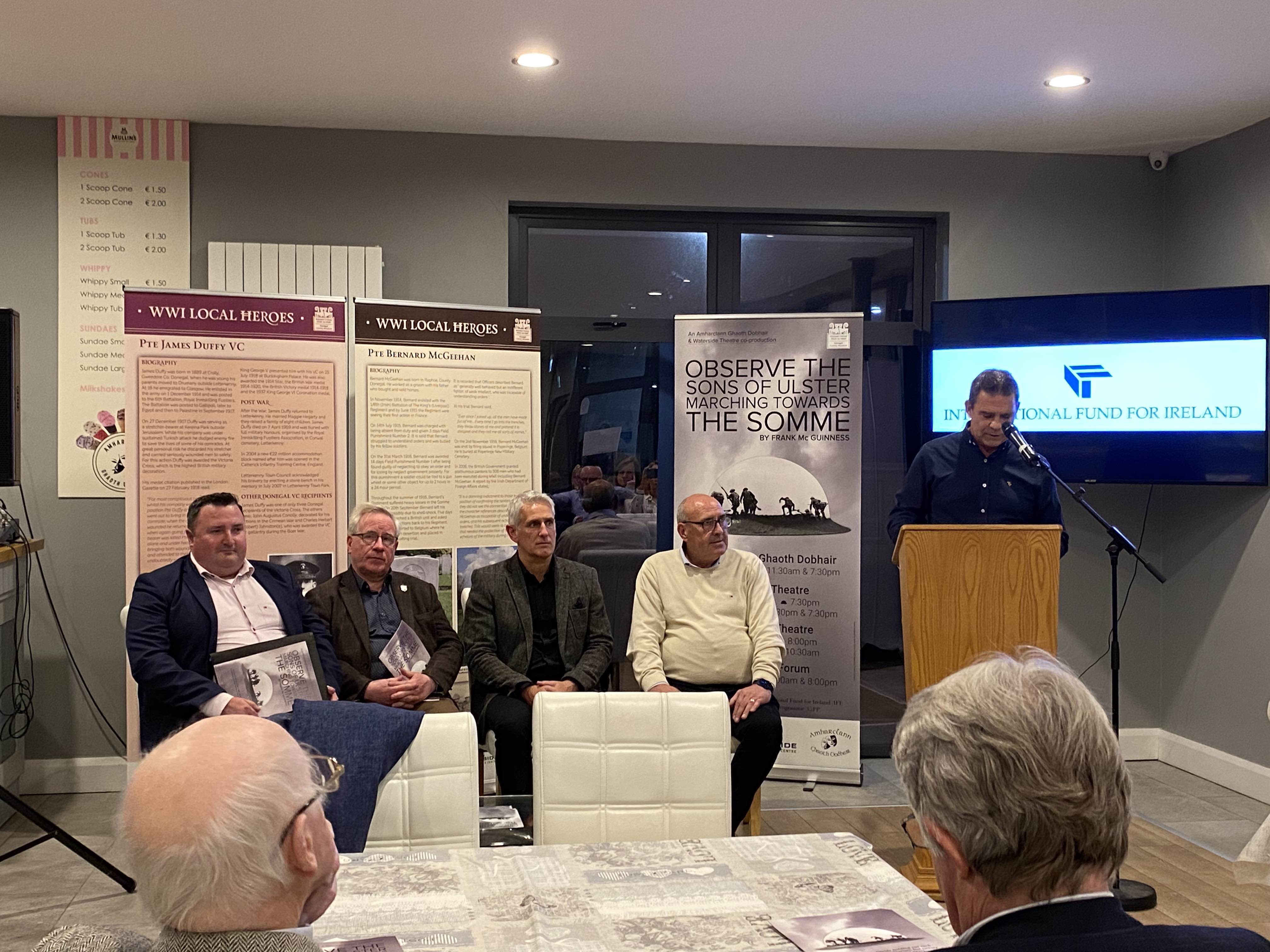
Panel of speakers at an interesting post-performance Q&A event at the Amharclann.

Enjoying the play, one is left with a vexing question: Is the play about the futility of war? The nature of loyalty, friendship and heroism? Or an examination of the protracted Protestant-Catholic northern Irish conflict from a completely different perspective? Or all of the above?

Whichever it is, this production is a two-hour, richly-rewarding theatrical experience that offers a balanced mix of black humour and poignancy with credible characters well developed through very fine acting.

Director David Grant together with production and stage manger, Fiona Harkin, assistant director, Ronan Hamill, lightning designer JP Conaghan and composer, Rebecca Doherty and the rest of the team have re-created the moving story of ordinary men – among them a blacksmith, a weaver and a baker – who set off patriotically to fight ‘the Hun’ but become disillusioned with the myth about war they’ve been sold.  

The play opens with a crippled man, Old Pyper, played by Shaun Byrne, who steps on stage alone, war medals pinned to his chest, and calls forth the ghosts of his former comrades who were all killed. Mystified as to how he survived the terrible battle, he is haunted by the images of those who died in the trenches, who then slowly, phantom-like, emerge from the shadows at the edges of the stage and stand motionless.

Theatre-goers mingle together for friendly discussions at the play’s intermission.

This sets the scene as to what follows, nostalgic flashbacks to the barracks where the men from places such as Derry, Armagh, Coleraine, Enniskillen and Belfast, gather for their first day of training and on to the sand-bagged first world war trenches where they face death together. Kudos go to Harkin and Conaghan who create a well-designed set, in which the barracks with wooden slats for beds is later transformed brilliantly into World War One trenches. Murals along the stage also add intriguing ambience, one of which depicts the ancient Celtic legendary hero, Cú Chulainn.

I particularly liked how a series of intense interlocking vignettes between couplets of men were enhanced by lighting and space, as well as by the thunderous roar of a Lambeg drum, a triumphalist symbol of the Protestant Orange Order in Northern Ireland. The military uniforms and equipment were also striking in their sheer authenticity. 

The tone of the play is bittersweet and philosophic, with elements of both black humor and solemnity. Patrick Quinn plays the younger version of Pyper wonderfully. An openly-gay man of aristocratic background who volunteered for army service, Quinn grants him a carefree, reckless air behind which lurks a man of deep sentiment and a troubled mind. A multi-faceted person – cynical, seemingly on the brink of madness, brash, supercilious, bold to the point of foolhardy, wickedly direct, yet at the same time, a vulnerable and lost individual. 

His anecdote about his three-legged French wife is highly amusing and a love scene involving him is touching in its quiet, side-stage minimalism. One character saying the ‘Huns’ speak Gaelic also creates a light-hearted moment. In contrast, depiction of one man’s despair and breakdown in the face of danger is touching, even more so as his friend tries to help.

While all the characters, except Pyper, are Northern Irish Protestant Unionists, one of the men admits something mid-way through the play which creates added intrigue and requires the attention of a military minister. 

Pyper is the exception to the anti-Fenian rants of the other men, being unwilling to indulge in such narrow-minded northern Irish tribalism and more keenly aware of the ‘sandbag’ nature of their being sent ‘over the top’ and into battle. He even demands of his fellow soldiers to answer the question as to why they are there.

Some Irish Republicans may be upset by the anecdotal joke told about rebel leader, Padraig Pearse, executed after the 1916 revolution, as someone who told his enemies he was only posting a letter when he took over Dublin’s main post office to launch the revolution, but this reflects the wit Frank McGuinness is renown for.   

Bulgarian visitors to Gaoth Dobhair – (l to r) Peter Petkov and Vanya Kovacheva – were among an enthusiastic audience at Amharclann theatre in Bunbeg, Donegal earlier this week

One of my favorite lines from the play, for reasons I’m not quite sure of, is ‘To hell with the truth as long as it rhymes.’

Ultimately, the play is about the fragility of life and the futility of war. In the end, one is left with the belief that the soldiers are united in one thing – fear of death – and that real heroes are ordinary people and unfortunately ordinary people remain ordinary because they don’t get recognised as much as they deserve. 

Local Donegal ladies enjoy a wee bit of craic and an evening’s entertainment at the Amharclann.

The play will be hosted today (Saturday) at the Lyric Theatre in Belfast, tomorrow at An Grianan Theatre in Letterkenny and next week at the Millennium Forum in Derry. 

In a post-event Q&A, Pol McCool, board chairperson of Amharclann theatre in Bunbeg, spoke about the need to build bridges between communities to help break down barriers and to appreciate shared history and values. 

Director David Grant (l) enjoys the company of friends during intermission at the Amharclann.

Stephen Barrett, manager for Donegal of the International Fund for Ireland, talked about the role of community leaders in peace-building projects and described the evolution of this co-produced project. He also spoke eloquently about his own reaction upon seeing the graves of those who died in the trenches in Belgium and France during the First World War. The IFI was established in 1986 with financing from many countries including the US, Australia and Canada and the play was supported by the organisation’s. 

Director David Grant talked about the challenges involved in creating the production and the overriding need for people to challenge mythology about wars.

Aine Ni Churrain, former presenter at RTE Raidió na Gaeltachta and a board member of Amharclann, thanked the audience for attending the two performances at the theatre, as well as everyone involved in developing and hosting the project and wished actors, director, producer and all the technical staff every success in the other theatres where it will be held.

Waterside Theatre CEO, Iain Barr, also thanked everyone for their concerted efforts in creating a memorable theatrical event with such an important social and moral message that contributes to greater peace and understanding among communities.

Video links to some of the speakers are on my Facebook – https://www.facebook.com/hillensean and https://www.facebook.com/worlditinerariespage

Michael the modern Messiah

With gray beard, tousled hair and wrinkled coat and pants, writer Michael Harding descended upon Donegal Friday night looking all the world like the modern risen Messiah and promptly mesmerized his disciples.

As one who enjoys a night at the theatre  – pointing my rickety but faithful jalopy weekly out my pebble-stoned driveway enroute to one venue or another – it has been a long while since I last saw An Grianan theatre so packed (a shame really as it hosts so many enjoyable performances).

Photo courtesy of Michael Harding

Photo courtesy of Michael Harding

On this occasion, rightly, theatre director Patricia McBride and her marketing adjutant, Daithi Ramsay, should be marching triumphantly all the way to the bank. Or at least to the office of Traolach O’Fionnan, arts officer at Donegal County Council, with hands outstretched for a somewhat larger annual stipend.

So what magical message did the Messiah from Cavan (via Leitrim) bring northwards to have created such a keen fan base that left nary a seat unoccupied. Notwithstanding the writer-cum-playwright-cum-columnist-cum-actor’s obvious charisma, down-to-earth homeliness and ageless, sage-like physical bearing, I’ve narrowed his popularity in Donegal down to several things –

  • Humanism:  Harding carries a soothing, spiritual message that – in the stress-bedraggled world we inhabit – is manna from heaven. In this respect, he is suitably qualified – as a priest, a calling he abandoned after some years, then as a Buddhist, a calling he continues still. Summing up his lifestyle message Friday night, the author of ‘Staring at Lakes’ and ‘Hanging with the Elephant,’ said, “The ultimate wisdom is that there is no wisdom, so fuck it, just relax,” adding that his secret to contented living was following what he termed “the ancient Gaelic tradition of meditation” – in a word, ‘dozing.’ “I think I’ll start organising workshops training people how to doze properly,” he said tongue-in-cheek.
  • Nostalgia – he recounts homespun, heart-warming tales about life, love and growing old; about mothers and families and childhood, suggestions of innocence reminiscent of our own youth, of those fading bygone years we’ll never experience again but in which we bathe joyously for the remembering and the re-telling. In this respect, Harding is a wistful humourist, the Irish equivalent of Garrison Keillor whose radio programme, ‘A Prairie Home Companion,’ I listened to faithfully on National Public Radio each Saturday evening when I lived across the Atlantic.

OLYMPUS DIGITAL CAMERA

  • Empathy – the performer’s first words after coming on stage Friday evening were, “I’m not well,” said with a downright doleful expression. Immediately he’d captured the audience’s undivided attention. After all, having all been sick at one time or another, hearing someone else who’s sick makes us feel both empathy for that person and better about ourselves, either because, fortunately, we are no longer sick or because we are still sick but as Mephistopheles tells Faustus in Christopher Marlowe’s classic tale “Misery loves company.”
  • Sympathy – one of Harding’s strengths is that he is unafraid to bear his soul, to show his vulnerable side. With a hint of melancholy, he touches – often poignantly – upon self-doubts, mistakes, indecisions, depression and the other suitcases of distress that life tends to carry with it. And we feel for him and support him and want him so dearly to succeed because – aside from altruism – if he emerges okay at the other end, then there’s hope for the rest of us.

OLYMPUS DIGITAL CAMERA

  • Hilarity – Harding can be belly-wobblingly funny – no more so when he is in a self-deprecating mood or on a sudden flight of fancy. The aisles rocked with fits of laughter Friday night as he launched into a story about how – in the muddled midst of a mid-life crisis  – he read that shaving one’s pubic hair helped expand exponentially one’s erotic experiences.  So, fortified by a bottle of wine, he sallied forth, “with a Wilkinson triple blade.” Unfortunately, the mirror he was using was not tall enough so he had to balance himself precariously on a chair to accomplish the feat. The result: “fresh breezes in the nether regions and a boil from an ingrowing hair that had to be pierced by a doctor – a lady.”

OLYMPUS DIGITAL CAMERA

  • Familiarity – Michael has been to Donegal on several occasions, last year at An Earagail Arts Festival with singer Tommy Sands and in late 2013, speaking after the launch of ‘Staring at Lakes.’ He also spent some time previously on holiday in the county and opened the Scoil Gheimhridh Ghaoth Dobhair a few months ago.

OLYMPUS DIGITAL CAMERA

Overall the evening with Michael Harding was a most enjoyable occasion ripe with amusing, philosophical ramblings that left the audience departing the theatre wrapped in added layers of warmth to fend off the cold, biting weather outside.

With but a mysterious suitcase on the floor stage centre, a padded armchair and his lectern as props, Harding took his listeners on a delightful stroll down ‘Nostalgia Avenue,’ his deft turns of phrase encapsulating many-layered meanings in a flurry of simple-seeming words.

His ability to mix ‘n match moods, swinging rapidly from melancholy to bittersweet to outright hilarity was impressive, all part and parcel of personal anecdotes gleaned from the trials and tribulations of his own life. One illustrative example was when he described how his mother would make him wait in the street in front of a draper’s shop while she went in to buy “women’s things” leaving him “to develop childhood neuroses outside,” then in response to the shop-owner asking if he was her son, she’d say yes but that she would have preferred a daughter.

OLYMPUS DIGITAL CAMERA

And how, not having sisters, it took a visit by three Letterkenny girls to his home for him to see “women’s things” first-hand. “Their bras hanging in the bathroom like a line of dead rabbits,” as he amusingly put it.

The writer’s description of rummaging through his mother’s belongs soon after her death was emotive by its sheer simplicity. “I found my dead mother in little boxes and drawers,” he said, before recounting exactly what he found.

Harding’s terse turns of phrase can be poetic as when he talks about his Aunt Molly, as “a woman like a tree with so many shaking bits” or love in Cavan as “not many hugs but a lot of apple tarts and extra portions of potatoes.” Or even a dead chicken hanging on an assembly line in a meat factory as “wrinkled and naked like an old man’s neck.” His sharp observations of everyday life are also impressive as when he describes his uncle sleeping as “heavy on the bed like a hammock” or the danger of men “having ideas” especially in the toilet, leading him to warn women to beware of men emerging saying, “I was just thinking…..”

His insights on Irish rural life are delightfully illuminating whether they about the tradition of “throwing cocks over neighbours walls” to keep a healthy gene pool or the differences between the rural walk (“with chakras open”) and the urban one – both of which were accompanied by amusing on-stage simulations. Or even the annual ‘Blessing of the Graves” which he describes as, “Getting out the deckchairs and sitting on top of the dead to keep them down.”

MICHAEL HARDING  07B

Photo courtesy of Michael Harding

Harding, not surprisingly, has a love for his native Cavan, though he admits, with himself foremost in mind, that, “you’re not going up in the world merely by going from Cavan to Leitrim,” adding that he is more “a refugee seeking asylum.”

An oft-quoted saying is that ‘one can never go back home,’ but Harding achieves the next best thing, resurrecting vivid memories of places and people from his past that help bring an audience on an enjoyable and entertaining journey of nostalgia.