Amharclann Donegal kicks-off innovative drama project linking five Irish theatres

by Sean Hillen

An innovative drama project linking five different Irish theatres kicked-off this week with two performances at Amharclann in Donegal.

Supported by the International Fund for Ireland’s Communities in Partnerships Programme (CIPP), the project is a co-production between Amharclann in Bunbeg in the heart of the Donegal Gaeltacht and the Waterside Theatre and Arts Centre in Derry of the play ‘‘Observe The Sons Of Ulster Marching Towards The Somme’ by Donegal-born playwright Frank McGuinness.

This thought-provoking play, coincidentally hosted at the Amharclann on the same day as the United Nations International Day Of Peace, focuses on the experiences of a group of Ulstermen in the trenches of World War One who take part in the battle of the Somme. While a military setting, the play raises many themes including homosexuality, homophobia, the inner conflict of self-respect, bravery, patriotism, friendship and sacrifice. 
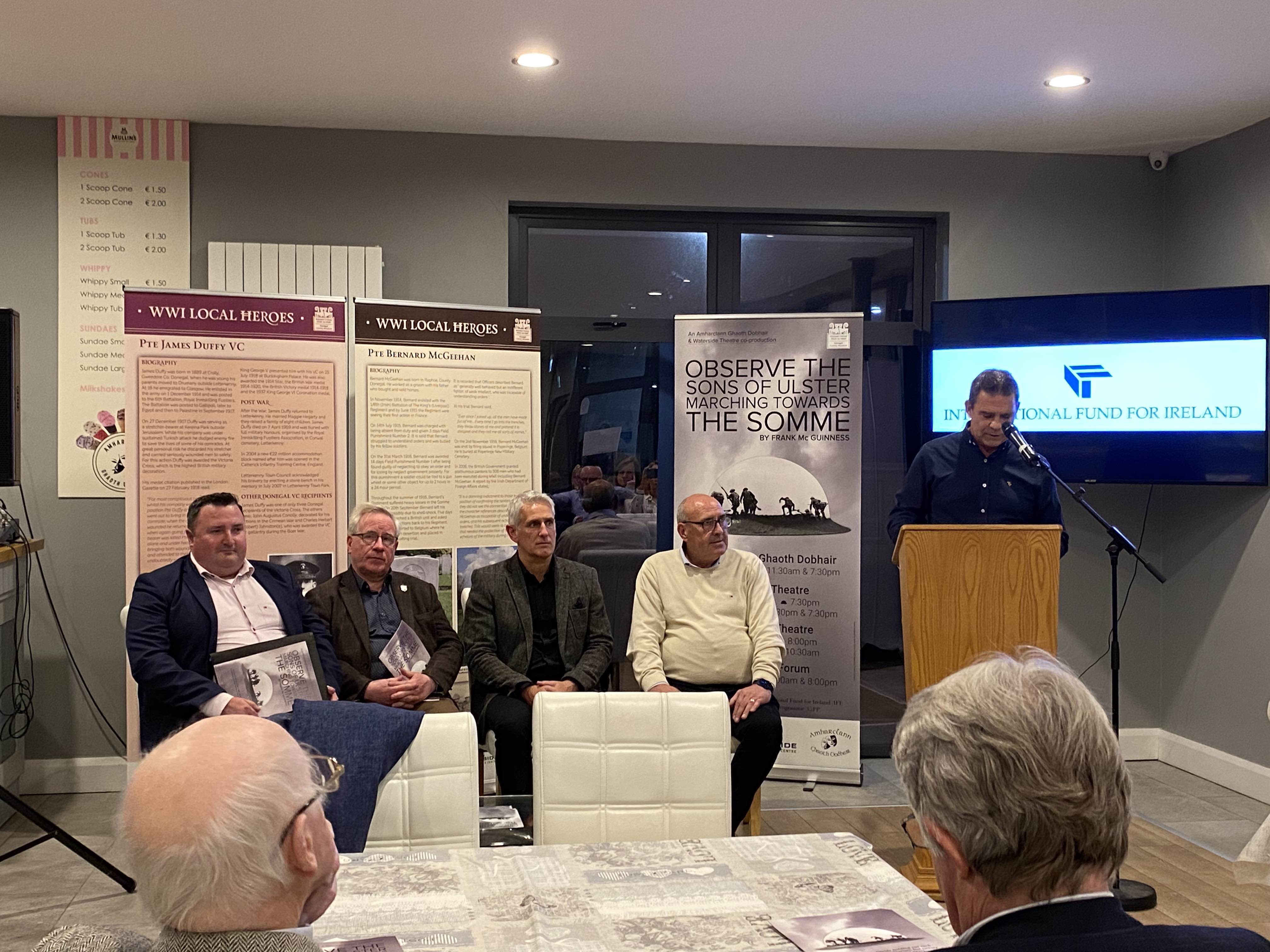
Panel of speakers at an interesting post-performance Q&A event at the Amharclann.

Enjoying the play, one is left with a vexing question: Is the play about the futility of war? The nature of loyalty, friendship and heroism? Or an examination of the protracted Protestant-Catholic northern Irish conflict from a completely different perspective? Or all of the above?

Whichever it is, this production is a two-hour, richly-rewarding theatrical experience that offers a balanced mix of black humour and poignancy with credible characters well developed through very fine acting.

Director David Grant together with production and stage manger, Fiona Harkin, assistant director, Ronan Hamill, lightning designer JP Conaghan and composer, Rebecca Doherty and the rest of the team have re-created the moving story of ordinary men – among them a blacksmith, a weaver and a baker – who set off patriotically to fight ‘the Hun’ but become disillusioned with the myth about war they’ve been sold.  

The play opens with a crippled man, Old Pyper, played by Shaun Byrne, who steps on stage alone, war medals pinned to his chest, and calls forth the ghosts of his former comrades who were all killed. Mystified as to how he survived the terrible battle, he is haunted by the images of those who died in the trenches, who then slowly, phantom-like, emerge from the shadows at the edges of the stage and stand motionless.

Theatre-goers mingle together for friendly discussions at the play’s intermission.

This sets the scene as to what follows, nostalgic flashbacks to the barracks where the men from places such as Derry, Armagh, Coleraine, Enniskillen and Belfast, gather for their first day of training and on to the sand-bagged first world war trenches where they face death together. Kudos go to Harkin and Conaghan who create a well-designed set, in which the barracks with wooden slats for beds is later transformed brilliantly into World War One trenches. Murals along the stage also add intriguing ambience, one of which depicts the ancient Celtic legendary hero, Cú Chulainn.

I particularly liked how a series of intense interlocking vignettes between couplets of men were enhanced by lighting and space, as well as by the thunderous roar of a Lambeg drum, a triumphalist symbol of the Protestant Orange Order in Northern Ireland. The military uniforms and equipment were also striking in their sheer authenticity. 

The tone of the play is bittersweet and philosophic, with elements of both black humor and solemnity. Patrick Quinn plays the younger version of Pyper wonderfully. An openly-gay man of aristocratic background who volunteered for army service, Quinn grants him a carefree, reckless air behind which lurks a man of deep sentiment and a troubled mind. A multi-faceted person – cynical, seemingly on the brink of madness, brash, supercilious, bold to the point of foolhardy, wickedly direct, yet at the same time, a vulnerable and lost individual. 

His anecdote about his three-legged French wife is highly amusing and a love scene involving him is touching in its quiet, side-stage minimalism. One character saying the ‘Huns’ speak Gaelic also creates a light-hearted moment. In contrast, depiction of one man’s despair and breakdown in the face of danger is touching, even more so as his friend tries to help.

While all the characters, except Pyper, are Northern Irish Protestant Unionists, one of the men admits something mid-way through the play which creates added intrigue and requires the attention of a military minister. 

Pyper is the exception to the anti-Fenian rants of the other men, being unwilling to indulge in such narrow-minded northern Irish tribalism and more keenly aware of the ‘sandbag’ nature of their being sent ‘over the top’ and into battle. He even demands of his fellow soldiers to answer the question as to why they are there.

Some Irish Republicans may be upset by the anecdotal joke told about rebel leader, Padraig Pearse, executed after the 1916 revolution, as someone who told his enemies he was only posting a letter when he took over Dublin’s main post office to launch the revolution, but this reflects the wit Frank McGuinness is renown for.   

Bulgarian visitors to Gaoth Dobhair – (l to r) Peter Petkov and Vanya Kovacheva – were among an enthusiastic audience at Amharclann theatre in Bunbeg, Donegal earlier this week

One of my favorite lines from the play, for reasons I’m not quite sure of, is ‘To hell with the truth as long as it rhymes.’

Ultimately, the play is about the fragility of life and the futility of war. In the end, one is left with the belief that the soldiers are united in one thing – fear of death – and that real heroes are ordinary people and unfortunately ordinary people remain ordinary because they don’t get recognised as much as they deserve. 

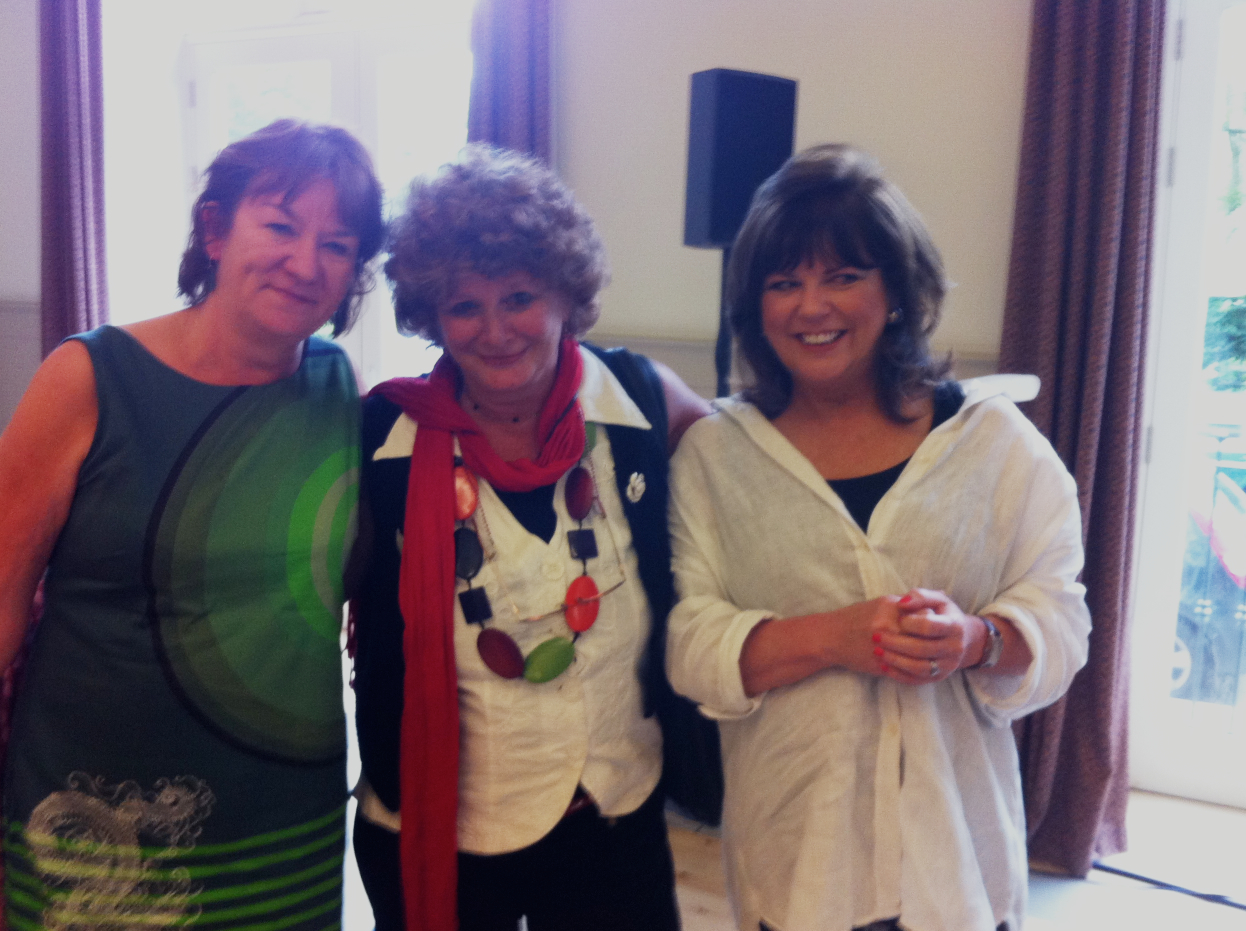
Local Donegal ladies enjoy a wee bit of craic and an evening’s entertainment at the Amharclann.

The play will be hosted today (Saturday) at the Lyric Theatre in Belfast, tomorrow at An Grianan Theatre in Letterkenny and next week at the Millennium Forum in Derry. 

In a post-event Q&A, Pol McCool, board chairperson of Amharclann theatre in Bunbeg, spoke about the need to build bridges between communities to help break down barriers and to appreciate shared history and values. 

Director David Grant (l) enjoys the company of friends during intermission at the Amharclann.

Stephen Barrett, manager for Donegal of the International Fund for Ireland, talked about the role of community leaders in peace-building projects and described the evolution of this co-produced project. He also spoke eloquently about his own reaction upon seeing the graves of those who died in the trenches in Belgium and France during the First World War. The IFI was established in 1986 with financing from many countries including the US, Australia and Canada and the play was supported by the organisation’s. 

Director David Grant talked about the challenges involved in creating the production and the overriding need for people to challenge mythology about wars.

Aine Ni Churrain, former presenter at RTE Raidió na Gaeltachta and a board member of Amharclann, thanked the audience for attending the two performances at the theatre, as well as everyone involved in developing and hosting the project and wished actors, director, producer and all the technical staff every success in the other theatres where it will be held.

Waterside Theatre CEO, Iain Barr, also thanked everyone for their concerted efforts in creating a memorable theatrical event with such an important social and moral message that contributes to greater peace and understanding among communities.

Video links to some of the speakers are on my Facebook – https://www.facebook.com/hillensean and https://www.facebook.com/worlditinerariespage

Donegal Connections – festival of books

For me living in the Gaeltacht region of Gaoth Dobhair in northwestern Ireland, the most surprising thing emerging from the recent, well-organised and stimulating ‘Belfast Book Festival was the number of novels set or inspired by little ol’ Donegal, the so-called ‘Forgotten County.’

Until then, I had been used to reading locally about publication of novels in our native language being funded by the various cultural groups such as Foras na Gaeilge, but hadn’t really thought too much about the diversity of English-language novels set or inspired by the beauty of the county (aside from Brian Friel’s plays), nor the use of phrases ‘as Gaeilge’ in such novels.

I know I’ll be accused of heresy and probably burned under a heather bush on the shadow of Lugh’s Mountain (otherwise known under its Christian name, Errigal) for suggesting this, but with the use of Irish diminishing in everyday conversation, should the various language groups not ease their overly-tight qualification criteria and fund publication of English-language novels that have some Irish phrasing in them?

IMG_1173

Author Emma Heatherington (seated left) and family, with evening event host, broadcaster, Sarah Travers, (seated right) and festival director, Keith Acheson (back right).

To my mind, it seems like not just a very reasonable suggestion, but a most innovative one that delivers many benefits. Books in Irish, by their nature, are for people who already speak and read our native language. Yet what we desperately need is to encourage non-Irish speaking people to become interested in our language and hunger to learn more. As English is one of the world’s leading languages, are not novels in this language not a perfect place for Irish phrases to be included to help achieve this aim? Will that not help expand use of Irish, both domestically and abroad? Such a linguistic/literary initiative would also help support economic development, especially through tourism, by attracting more visitors to Donegal and other such Gaeltachts. Such areas – while on the whole, providing inspiring land and seascapes – tend to be marginalized, unemployment black spots on the map of Ireland.

The landscape of the Outer Hebrides, with its stark cliffs, ghostly mists and lonely beaches, has become a definitive character of Peter May’s Lewis trilogy entitled ‘Hebrides’ and has helped revitalize tourism in that part of Scotland.

Food for thought.

IMG_1162

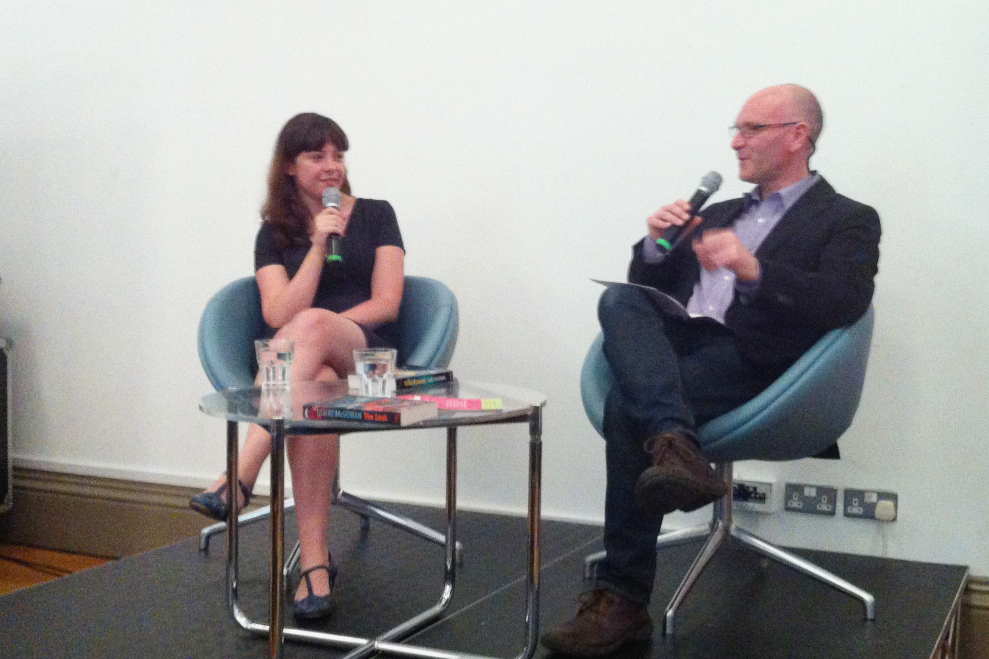
Crime fiction writer, Claire McGowan, with David Torrans of Belfast’s ‘No Alibis’ Bookstore at the Ulster Hall, talking about her genre and her work.

Anyway, back to the most enjoyable ‘Belfast Book Festival’ and novels set in the beautiful countryside of Donegal. Take the delightfully funny writing of Emma Heatherington and her book ‘One Night Only’ about four desperate housewives who take off in a car for an outing to the ‘Forgotten County’ and the hilarious, and poignant, consequences. Emma, who is due to speak next week at Ireland’s newest Writing Retreat in west Donegal is a multi-talented woman whose work ranges from novels to short stories to scripts and screenplays, including ‘Since You’ve Been Gone’ and ‘Playing the Field.’ Her personal ‘growing up’ story of having to become ‘Mum’ to her siblings as a young teenager after her own mother’s untimely death is touching. Aside from her literary output, one can’t help but admire Emma greatly. And she’s a natural, engrossing speaker to boot.

Then there’s Kenneth Gregory, fantasy novelist and mythologist extraordinaire with character names as Gaeilge, perhaps Ireland’s answer to the R.A. Salvatore/ Robert Jordan/ Marion Zimmer Bradley combo. His debut novel ‘The Polaris Whisper,’ the first in a trilogy, was published by Blackstaff Press. He will also speak and teach at Donegal’s ‘Forgotten County, Remembered Wordswriting retreat. Negotiations are now underway for the novel to be turned into a television series with a movie option. His second novel in the series is ‘The Poison of Newgrange.’ ‘Shahryár’s Heir: A Prince among Thieves’ is his first fantasy novel in a re-invention of the Arabian Nights’ stories.

IMG_1188

Blackstaff Press authors Laurence Donaghy and Kenneth Gregory discuss the art of writing, Celtic mythology and fusing fantasy with historical fact with journalist and author, Leona O’Neill at Belfast’s Crescent Arts Centre.

Speaking together, he told me, “It is an honor to speak at such an event as the Ireland Writing Retreat. Northwestern Donegal is an awe-inspiring place, with an intriguing, colorful history packed with legends. So enthralled am I by the area that the third book in my trilogy, a modern-day thriller, has the working title of ‘Brinlack,’ a place beside Bloody Foreland. My best editor, my brother, Mark, lives there and I visit often.”

Then there’s the lady who shares my name, Sophia Hillan, former associate director of Belfast’s Institute of Irish Studies and director of the International Summer School in Irish Studies. During an hour-long interview, Sophia told me about how she came upon a scrap of paper that led her to produce a most fascinating Donegal-based, non-fiction book entitled ‘May, Lou and Cass: Jane Austen’s Nieces in Ireland,’ published by Blackstaff Press in 2011. Her first novel ‘The Friday Tree’ has now just been published by the same publishing group and is set within a stone’s throw of where I grew up and lived for many years in Andersonstown, west Belfast.

IMG_1170

Two intelligent beautiful ladies, leaders in their respective fields – (l to r), author, Emma Heatherington and broadcaster, Sarah Travers.

That’s a lot of Donegal-based writing crossing so many genres, not to mention the many books written about Donegal’s very own mystic monk – Columba – including those by authors Máire Herbert  and Brian Lacey  – more of which will be written about in my next blog.

Of course, not all the authors and books at the ‘Belfast Book Festival’ were linked to Donegal. Head honcho of the Crescent Arts Centre and festival director Keith Acheson and his hardworking team, including marketing director Tracy O’Toole and outreach and education director, Ann Feely, as well as community arts development officer, Jan Carson, (her novel is entitled ‘Malcolm Orange Disappears’) and her colleagues at the Ulster Hall, deserve full praise. They brought together a diverse collection of writers in various genres who spoke on such wide-ranging subjects as ageing and sexual politics (Lynne Segal – ‘Out of Time: The Pleasures and the Perils of Ageing,’ ‘Is the Future Female?,’ ‘Slow Motion: Changing Masculinities, Changing Men,’ and ‘Straight Sex: The Politics of Desire’); murder most foul (Claire McGowan – ‘The Fall,’ ‘The Lost’ and ‘The Dead Ground,’ some of which use phrases ‘as Gaeilge’); matters of the heart and mind (Joseph O’ConnorInishowen,’ ‘Ghost Light,’ ‘The Thrill Of It All’ and ’Star of the Sea’); and guardian angels (Carolyn Jess-Cooke – ‘The Guardian Angel’s Journey’ and ‘The Boy Who Could See Demons’), as well as providing publishing and public speaking advice through guests such as the lovely actress and teacher Rosie Pelan; the inimitable Ian Sansom (Mobile Library Series including ‘The Case of the Missing Books’ and ‘Mr. Dixon Disappears;’ and self-publishing guru, Alison Baverstock (‘Is There A Book in You’ and ‘Marketing Your Book: an author’s guide.’).

IMG_1217

Agents and publishers, including Clare Alexander of Aitken Alexander (r), Patsy Horton (c) and Alice Kate Mullen (l) of Carcanet Press, discuss their roles and responsibilities in the writing field.

In terms of diversity of writer and subjects, the week-long series of events surpassed most such festivals I have attended – and I have been to many, including both the Salon du livre Paris and the London Book Fair. Also – beyond just the world of books – the festival reflects the emergence of Belfast from its enforced dormancy as a dynamic and attractive city with many options for would-be visitors, from cozy, atmospheric cafes, terrific restaurants and avantgarde and traditional theatres such as The MAC and the Lyric.

By the way, other speakers at the Donegal writing retreat which begins formally on Sunday, June 28th between An Bun Beag and Bun an Leaca (on which there are only four places left) include ‘Antony-Cleopatra’ expert Rachael Kelly and award-winning author Anthony Quinn and former detective-cum-writer Martin Ridge who lives near Falcarragh.

IMG_1246

As fiesty and stimulating as ever, author, socialist, feminist and civic leader, Lynne Segal greets her avid admirers.

Rachael, a native of Belfast has become the foremost expert on the age-old romance between Roman leader, Mark Antony, and Egyptian Queen Cleopatra (made famous on-screen by Elizabeth Taylor and Richard Burton) after completing her doctorate in film studies on it. Rachael has also penned the first novel in a trilogy on the two historical figures entitled ‘Queen of the Nile,’ set in 1st-century-BC Alexandria. Rachael’s earlier novel, ‘The Edge of Heaven,’ won the Irish Writers’ Centre Novel Fair Competition 2014, while her short story, Blumelena, was shortlisted for the Bridport Prize 2012. Her ‘Long Anna River’ won the Orange Northern Woman Short Story Award and was later featured in an anthology called ‘The Barefoot Nuns of Barcelona,’ while ‘The Night Sky In November’ was runner-up in the White Tower Publishing Short Story Competition. Her poem, ‘A Five Yard Odyssey,’ won ‘The Battle of the Bards.’

IMG_1227

Alison Baverstock, publisher, trainer and writer, talks about the advantages and pit-falls of self-publishing, accompanied by successful self-publishers at Belfast’s Crescent Arts Centre.

Anthony Quinn was born in 1971 in Tyrone and his short stories have been short-listed twice for a Hennessy/New Irish Writing Award. He was also the runner-up in the Sunday Times New Food Writer competition. ‘Disappeared‘ is the title of his first novel. Published by Otto Penzler’s Mysterious Press in 2012, it was was shortlisted for a Strand Literary Award, as judged by book critics from the LA Times, the Washington Post, the San Francisco Chronicle, CNN and the Guardian. It was also selected by Kirkus Reviews as one of the top ten thrillers of 2012. BORDER ANGELS, the sequel, was published by Mysterious Press last year.

IMG_1233

Actress and teacher, Rosie Pelan, instructs writers how to best speak their words in public.

Martin Ridge, from Galway but living in Donegal for many years, is a retired Garda officer. He almost single-handedly took on the might of the Catholic Church when he investigated rumors – that soon became distressing facts – about the horrific rape and sexual abuse of young boys by members of the clergy in northwest Donegal, in and around the towns of Gortahork and Falcarragh. His brilliantly-written book ‘Breaking the Silence’ tells a tragic story of the carnage such abuse created in the lives of the boys, now men, many still living in the area, and the arrogance of the church towards that abuse in refusing to co-operate with investigations or offer appropriate compensation. This particular rural area now has the ignominy of being the worse area for clerical abuse record in all Ireland. For more information on the Ireland Writing Retreat see http://www.irelandwritingretreat.com/