One-Eyed One Irish legend recreated by talented Donegal drama group in Falcarragh

Ever heard about Balor of the Evil Eye?

It’s an ancient Irish legend about the nasty, one-eyed mythical tyrant of a King on Tory Island in Donegal who’s killed by his grandson, Lugh – and there’s no better way to enjoy this suspense-filled story of life and death than when it’s hosted by the Cloughaneely Players, a delightful drama group in the local town of Falcarragh.

As part of its ongoing community service programme, this amiable band of actors and friends put on a wonderful outdoor show recently that had schoolchildren and adults alike both enchanted and enthralled. 

And it took place, most appropriately, beside a 16-foot pedestal, a white limestone boulder with red veining atop a pillar known as the ‘Cloughaneely Stone (Cloich Cheann Fhaola)’, the red veining symbolising the petrified blood of a chieftain called MacKineely (Cian mac Cáinte) beheaded on the stone by Balor after he discovered he planned to kill him after he’d stolen one of MacKineely’s prized cows – Glas Gaibhnenn.

Under the astute direction of Murray Learmont and led by narrator, Joe Kelly, a leading folklorist, the actors had young schoolchildren jumping up and down like excited kangaroos just out of their pouches during the entire production (and a few adults too, though I dare not say who they were less I embarrass them).

Organiser of the event was Mark Boylan, co-manager of the Cloughaneely under 11 Irish GAA football team, with Kevin Scanlon, chairperson of the Cloughaneely Minor Board, giving a short speech to kick-off the evening. 

A stellar cast, one with the creative ability to slip off-script and concoct amusing dialogue spontaneously, included Denis Doohan in the lead role of Balor (I particularly liked his joke about Balor having more defenders than Jim McGuinness, the recently-named manager of the Donegal Irish senior GAA football team. 

The intrepid, Mickey McHugh, showing off his dainty, Lionel Messi-like legs and dressed in a costume that looked like it was woven from the hair of a banshee, acted as MacNeely. Insiders say Mister McHugh was specifically chosen for the role due to his lifelong, hard-won, cow-milking abilities which he displayed with tremendous exuberance – by spraying the entire audience with his own brand of the liquid. 
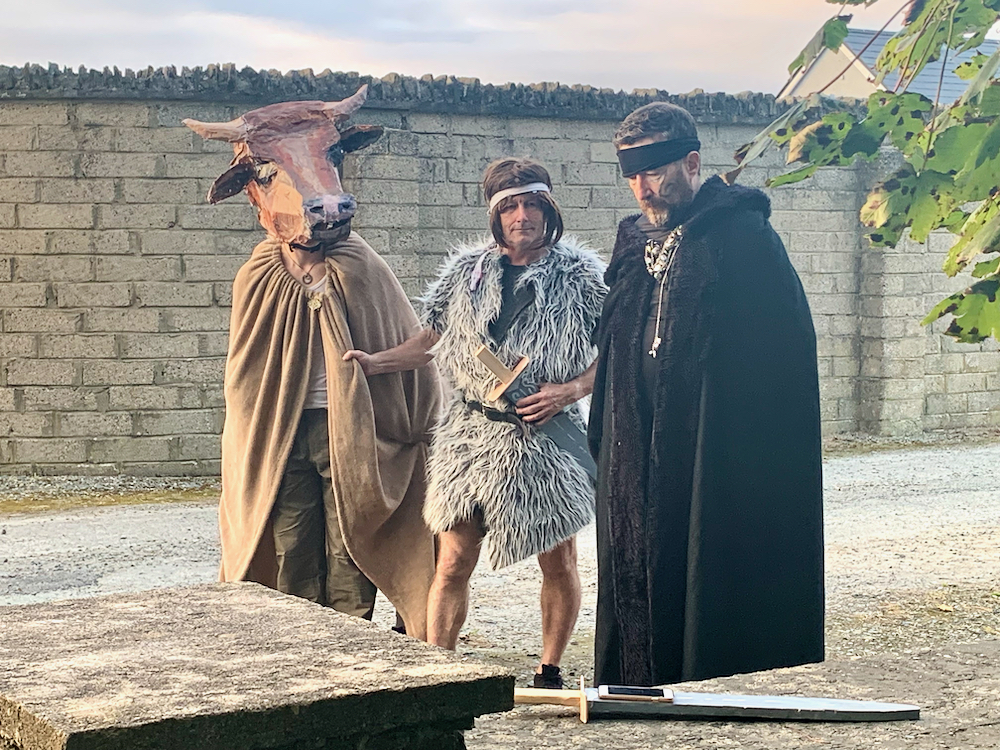
(l to r) Yanto and Rohan as the forever-giving milk cow, Mickey McHugh alias Lionel Messi and Denis Doohan as the face-decorated Balor consider their options.

Lugh, Balor’s grandson, was played wonderfully by Pierce Butler, especially impressive with his warlike cries and deadly sword fight with his grandfather, leaving his foe prostrate among a crowd of enthusiastic youngsters.  
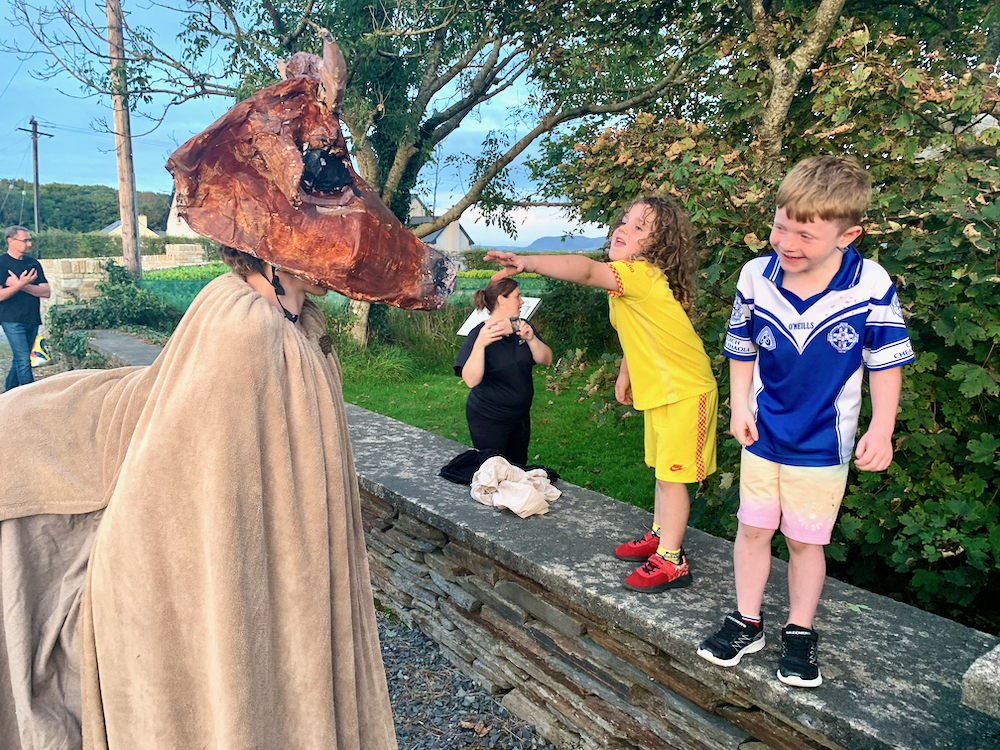
Legendary cow, Glas Gaibhnenn, receives a wee bit of attention off-stage.

Kudos also go to Maggie McKinney, a native of Castlewellan, County Down, who played not one, but two roles – the screeching witch, Biróg, who predicts Balor’s downfall, as well as the bold and brassy, what-are-ye-waiting-for-let’s-have-sex, Eithne, Balor’s daughter, who – in what must be Guinness World Record time – ‘enjoys relations’ with MacNeely and produces not one but three babies, one of which was Lugh. All done and dusted in thirty seconds.

‘Prepare to die’ says Lugh (Pierce Butler) to Balor (Denis Doohan) – but only one will emerge alive.

Mention must also be made of the cow – the beloved animal that was at the center of the entire conflict. As one who has never tried imitating a member of the bovine community, I can only presume that acting the role of a cow is not easy by any means. So many congratulations to Yanto and Rohan, members of Youthreach, for doing so.
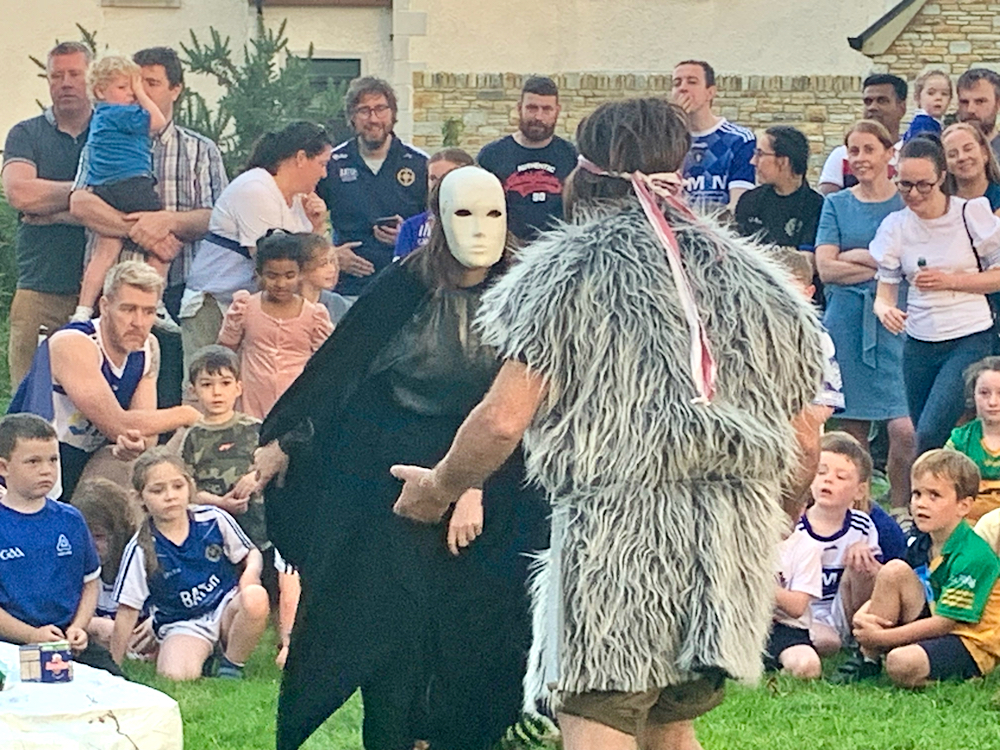
Birog the witch (Maggie McKinney) confronts MacNeely (Mickey McHugh).

Next on the dramatic circuit for the talented Cloughaneely Players is a production of the classic story, Casablanca, which I’m reliably informed may be staged sometime in November.

Photographing the entire dramatic proceedings on the evening was Annamarie Coyle, so watch out for her excellent images capturing one of the most tantalising struggles in Irish legendary history.
Donegal Creameries and Kerry Group to lock horns at Croke Park

I bought a lottery ticket a few weeks ago at a community festival in the tiny village of Limenaria on the Greek island of Thassos.

And promptly won.

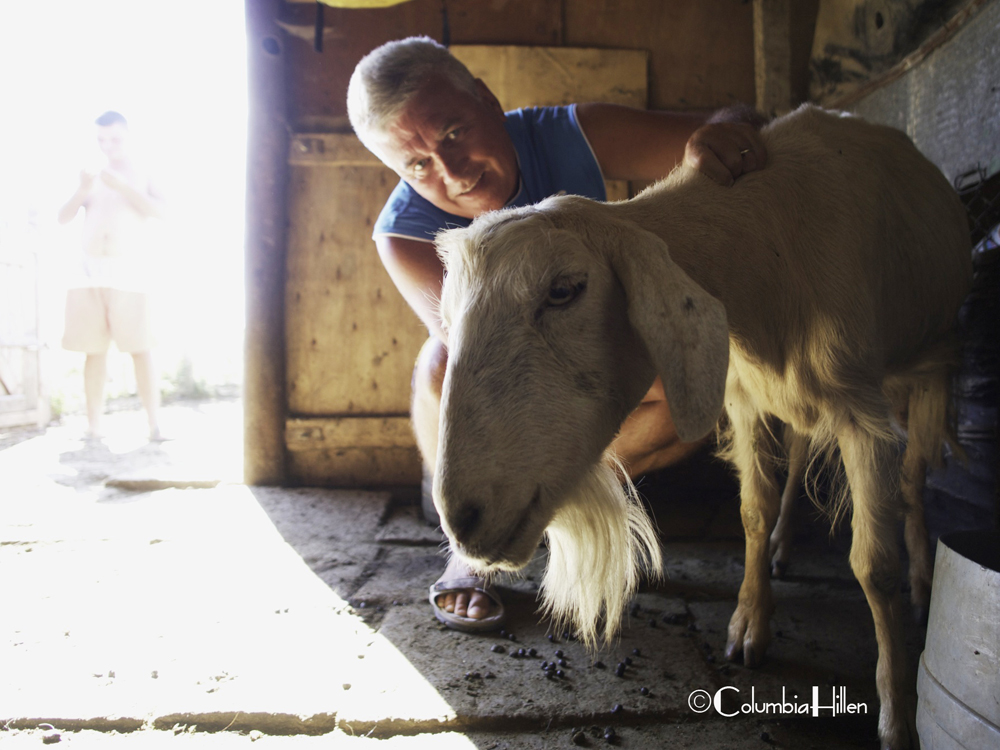
A goat.

Clover – a fond hello, a fond farewell

Friendly, a bit shy, Clover – as I chose to call her – gazed up at me out of big gentle eyes filled with an innocent curiosity about the world around her.

Unfortunately, as in the classic tales of summer romances, our time together was short-lived. Due to the labyrinth of EU regulations about the movement of animals across borders, I had to bid Clover a sad farewell and we parted company with a promise to see each other next year.

I was reminded of her while wandering leisurely along the dusty streets of Doi Mai, a rustic Romanian Black Sea coastal village Sunday evening while basking in the memory of Donegal’s glorious win over Dublin just an hour before.

That’s when I felt a soft nudge at my back.

OLYMPUS DIGITAL CAMERA

What’s happenin’ bro?

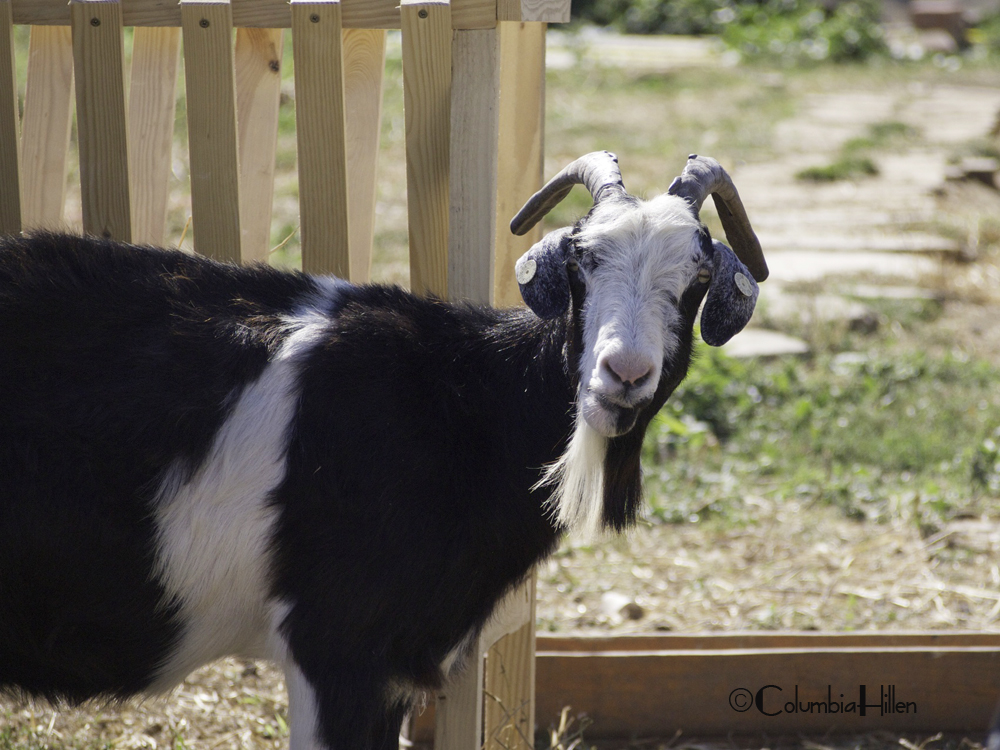
Turning, I looked down to see a pair of familiar eyes fixed upon me. At first, I thought, through sheer primordial instinct, Clover had managed to evade armed Greek, Bulgarian and Romanian border guards and leaped to freedom. Unfortunately, it was not so, but the eyes were just as inquisitive nonetheless. And behind the fellow before me were many more of his four-legged compatriots, all out for a leisurely afternoon stroll just like me. They seemed so content, easy-going and full of spirit I felt like exhorting them into a ‘Goats Don’t Shave’ rendition of ‘Jimmy’s Winning Matches’ in honour of the day’s stunning victory.

Then it dawned on me. Where are all the goats that used to roam the length and breadth of Donegal? There’s hardly any to be seen now even though historical records indicate there used to be literally thousands of them. Aside from singer Pat Gallagher and his wonderful group, we don’t seem to celebrate the many wonderful facets of this delightful creature anymore. Indeed, we seem to be downright biased against them – with no particular reason for being so.

OLYMPUS DIGITAL CAMERA

Shy but curious.

Even though grass is greener in Donegal than Romania’s or Greece’s scorched summer earth; even though rain is much more plentiful; even though, with the same amount of food, a goat gives around four litres of milk, four times more than a sheep; and even though ample medical evidence shows its milk and meat to be healthier in so many ways than that of both cow or sheep, we seem to be definitively an ‘anti-goat’ species. It’s tantamount to animal racism.

What can these innocent creatures possibly have done to us to merit such stark hostility? Is it linked to some warped religious notion about Satan and his horns? About Baphomet, the enigmatic, goat-headed figure linked to occultism and witchcraft? Looking down the sunlit street into the gentle, innocent eyes of those around me, so filled with undisguised curiosity, it was hard to imagine anything devilish about them at all.

In fact, rather than posing a threat to our moral or physical well-being, goats are our greatest asset, the list of their attributes being impressively substantial. For example, goat’s milk boasts a variety of health benefits, ranging from blood vessel support to cancer prevention. It eases the pain of migraines and premenstrual syndrome and reduces the chances of breast cancer.

OLYMPUS DIGITAL CAMERA

Hello, may we help you?

The ‘World’s Healthiest Foods’ website suggests people with lactose intolerance may have less trouble drinking goat’s milk, partly because it boosts copper and iron metabolism. This quality may also make goat’s milk useful against mineral absorption problems. ‘The Journal of Nutrition’ says goat’s milk can ease conditions such as bowel inflammation and arthritis and that the high level of potassium may also reduce the risk of high blood pressure and atherosclerosis.

Now, as goat’s milk has a higher concentration of calcium than cow’s milk which helps prevent bone loss and that there will be no shortage of bone-crunching tackles in three weeks time at the Croke Park finale, would it not be a good idea for someone with initiative to collect a few dozen litres of this fine liquid and start delivering them forthwith to the training camp of McGuinness, Murphy & Co? Also, it must be added, the he-goat is the epitome of masculine virility and creative energy,

With the Sam at stake and a confident Kerry as the opposition, every little helps. Donegal Creameries, are you listening? Get in there before the Kerry Group does.

OLYMPUS DIGITAL CAMERA

Waiting for a high ball