Michael the modern Messiah

With gray beard, tousled hair and wrinkled coat and pants, writer Michael Harding descended upon Donegal Friday night looking all the world like the modern risen Messiah and promptly mesmerized his disciples.

As one who enjoys a night at the theatre  – pointing my rickety but faithful jalopy weekly out my pebble-stoned driveway enroute to one venue or another – it has been a long while since I last saw An Grianan theatre so packed (a shame really as it hosts so many enjoyable performances).

Photo courtesy of Michael Harding

Photo courtesy of Michael Harding

On this occasion, rightly, theatre director Patricia McBride and her marketing adjutant, Daithi Ramsay, should be marching triumphantly all the way to the bank. Or at least to the office of Traolach O’Fionnan, arts officer at Donegal County Council, with hands outstretched for a somewhat larger annual stipend.

So what magical message did the Messiah from Cavan (via Leitrim) bring northwards to have created such a keen fan base that left nary a seat unoccupied. Notwithstanding the writer-cum-playwright-cum-columnist-cum-actor’s obvious charisma, down-to-earth homeliness and ageless, sage-like physical bearing, I’ve narrowed his popularity in Donegal down to several things –

  • Humanism:  Harding carries a soothing, spiritual message that – in the stress-bedraggled world we inhabit – is manna from heaven. In this respect, he is suitably qualified – as a priest, a calling he abandoned after some years, then as a Buddhist, a calling he continues still. Summing up his lifestyle message Friday night, the author of ‘Staring at Lakes’ and ‘Hanging with the Elephant,’ said, “The ultimate wisdom is that there is no wisdom, so fuck it, just relax,” adding that his secret to contented living was following what he termed “the ancient Gaelic tradition of meditation” – in a word, ‘dozing.’ “I think I’ll start organising workshops training people how to doze properly,” he said tongue-in-cheek.
  • Nostalgia – he recounts homespun, heart-warming tales about life, love and growing old; about mothers and families and childhood, suggestions of innocence reminiscent of our own youth, of those fading bygone years we’ll never experience again but in which we bathe joyously for the remembering and the re-telling. In this respect, Harding is a wistful humourist, the Irish equivalent of Garrison Keillor whose radio programme, ‘A Prairie Home Companion,’ I listened to faithfully on National Public Radio each Saturday evening when I lived across the Atlantic.

OLYMPUS DIGITAL CAMERA

  • Empathy – the performer’s first words after coming on stage Friday evening were, “I’m not well,” said with a downright doleful expression. Immediately he’d captured the audience’s undivided attention. After all, having all been sick at one time or another, hearing someone else who’s sick makes us feel both empathy for that person and better about ourselves, either because, fortunately, we are no longer sick or because we are still sick but as Mephistopheles tells Faustus in Christopher Marlowe’s classic tale “Misery loves company.”
  • Sympathy – one of Harding’s strengths is that he is unafraid to bear his soul, to show his vulnerable side. With a hint of melancholy, he touches – often poignantly – upon self-doubts, mistakes, indecisions, depression and the other suitcases of distress that life tends to carry with it. And we feel for him and support him and want him so dearly to succeed because – aside from altruism – if he emerges okay at the other end, then there’s hope for the rest of us.

OLYMPUS DIGITAL CAMERA

  • Hilarity – Harding can be belly-wobblingly funny – no more so when he is in a self-deprecating mood or on a sudden flight of fancy. The aisles rocked with fits of laughter Friday night as he launched into a story about how – in the muddled midst of a mid-life crisis  – he read that shaving one’s pubic hair helped expand exponentially one’s erotic experiences.  So, fortified by a bottle of wine, he sallied forth, “with a Wilkinson triple blade.” Unfortunately, the mirror he was using was not tall enough so he had to balance himself precariously on a chair to accomplish the feat. The result: “fresh breezes in the nether regions and a boil from an ingrowing hair that had to be pierced by a doctor – a lady.”

OLYMPUS DIGITAL CAMERA

  • Familiarity – Michael has been to Donegal on several occasions, last year at An Earagail Arts Festival with singer Tommy Sands and in late 2013, speaking after the launch of ‘Staring at Lakes.’ He also spent some time previously on holiday in the county and opened the Scoil Gheimhridh Ghaoth Dobhair a few months ago.

OLYMPUS DIGITAL CAMERA

Overall the evening with Michael Harding was a most enjoyable occasion ripe with amusing, philosophical ramblings that left the audience departing the theatre wrapped in added layers of warmth to fend off the cold, biting weather outside.

With but a mysterious suitcase on the floor stage centre, a padded armchair and his lectern as props, Harding took his listeners on a delightful stroll down ‘Nostalgia Avenue,’ his deft turns of phrase encapsulating many-layered meanings in a flurry of simple-seeming words.

His ability to mix ‘n match moods, swinging rapidly from melancholy to bittersweet to outright hilarity was impressive, all part and parcel of personal anecdotes gleaned from the trials and tribulations of his own life. One illustrative example was when he described how his mother would make him wait in the street in front of a draper’s shop while she went in to buy “women’s things” leaving him “to develop childhood neuroses outside,” then in response to the shop-owner asking if he was her son, she’d say yes but that she would have preferred a daughter.

OLYMPUS DIGITAL CAMERA

And how, not having sisters, it took a visit by three Letterkenny girls to his home for him to see “women’s things” first-hand. “Their bras hanging in the bathroom like a line of dead rabbits,” as he amusingly put it.

The writer’s description of rummaging through his mother’s belongs soon after her death was emotive by its sheer simplicity. “I found my dead mother in little boxes and drawers,” he said, before recounting exactly what he found.

Harding’s terse turns of phrase can be poetic as when he talks about his Aunt Molly, as “a woman like a tree with so many shaking bits” or love in Cavan as “not many hugs but a lot of apple tarts and extra portions of potatoes.” Or even a dead chicken hanging on an assembly line in a meat factory as “wrinkled and naked like an old man’s neck.” His sharp observations of everyday life are also impressive as when he describes his uncle sleeping as “heavy on the bed like a hammock” or the danger of men “having ideas” especially in the toilet, leading him to warn women to beware of men emerging saying, “I was just thinking…..”

His insights on Irish rural life are delightfully illuminating whether they about the tradition of “throwing cocks over neighbours walls” to keep a healthy gene pool or the differences between the rural walk (“with chakras open”) and the urban one – both of which were accompanied by amusing on-stage simulations. Or even the annual ‘Blessing of the Graves” which he describes as, “Getting out the deckchairs and sitting on top of the dead to keep them down.”

MICHAEL HARDING  07B

Photo courtesy of Michael Harding

Harding, not surprisingly, has a love for his native Cavan, though he admits, with himself foremost in mind, that, “you’re not going up in the world merely by going from Cavan to Leitrim,” adding that he is more “a refugee seeking asylum.”

An oft-quoted saying is that ‘one can never go back home,’ but Harding achieves the next best thing, resurrecting vivid memories of places and people from his past that help bring an audience on an enjoyable and entertaining journey of nostalgia.
Donegal Gaeltacht community spirit rises: but where’s the money?

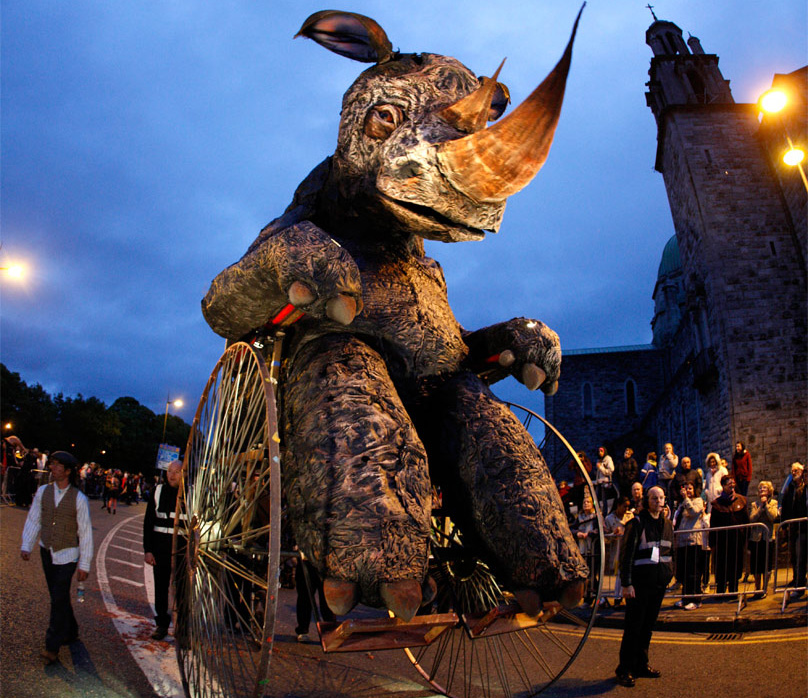
Some years ago, displaying immense creativity and skill, a local team of hard-working people in Galway created ‘Macnas,’ an organisation that produces a series of exciting, colourful outdoor parades and indoor shows filled with magnificent costumes and performers.
With generous funding from the Arts Council, Údarás na Gaeltachta, Culture Ireland and Galway Council, the company expanded rapidly; exciting and inspiring audiences worldwide with performances as diverse as U2’s Zooropa Tour; the Millennium parade in New York City; WOMADelaide, South Australia; Chaoyang Spring Carnival, Beijing; the President’s Garden Party, Áras an Uachtaráin; and in a host of festivals, towns and cities throughout Ireland and across Europe.

macnas 1

Macnas, Galway – an estimated 40,000 euro cost per festival show. (photo courtesy Macnas)

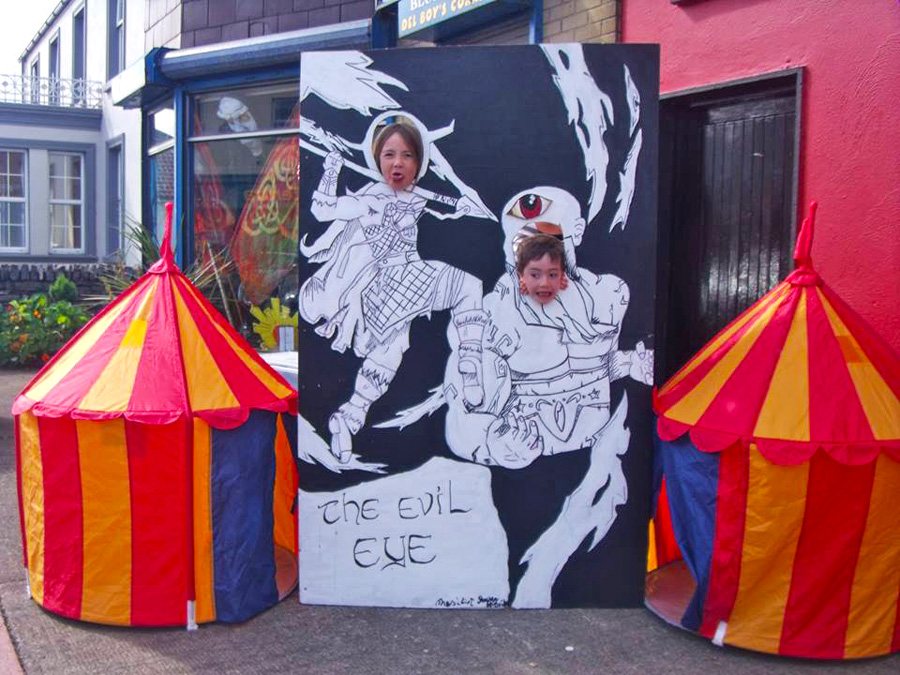
This weekend in the west Donegal town of Falcarragh, a similar group of local hard-working people, under the leadership of festival director, Kathleen Gallagher, and Sean Fitzgerald, will recreate a similar dazzlingly entertaining costume and culture filled show entitled ‘Evil Eye’ (Féile na Súile Nimhe). Featuring large-scale puppet characters, a samba band with Formorian soldiers (ancient sea-farers) and stilt walkers, it will highlight unforgettable Celtic legendary characters such as Balor of the Evil Eye and Lugh, the Sun God (thus ‘Lugh’s Mountain’ now known as Errigal) and the history of the Cloch Cheann Fhaola area.

balor 3 good

‘Evil Eye’ Festival Falcarragh, Donegal – organised on a budget of around 4,000 euro. A whopping ten times less than Galway’s Macnas (photo courtesy Eddie McFadden).

But there’s one major difference between the two festivals: while the Galway team hosts its show with pockets bulging with euro (an estimated 40,000 euro per festival, according to national news reports) – the Falcarragh one has a few pennies. And most of that was raised through its own activities, including determined people who tackled their first adventure race – the 23-kilometer combined run, kayak and cycling Mulroy Bay competition– and, later, the even more challenging 44-kilometer ‘Gael Force’ race.
So how does Údarás na Gaeltachta, the Arts Council and Donegal County Council view this admirable cultural tourism project?
Representatives of the above organisations came to enjoy the Falcarragh festival last year, full of praise for the creators of the extravaganza, a highlight in the west Donegal social calendar. But when asked for money, they all suddenly shied away. While more than 500,000 euro has been given to Macnas in Galway, the Arts Council finally granted a paltry 600 euro for ‘Evil Eye’ and around 1,250 euro is supposed to be donated from the council’s ‘The Gathering’ fund (money not received as of blog posting – two day before event begins).
In its turn, Údarás Donegal contacted the organisers earlier this year, but not to offer financial support. Instead, it called only to inform the team that the application deadline had passed (would it not have been more constructive to have contacted them before, not after, the deadline, especially has it had moved the date forward?).
Later, when approached for some space in one of its industrial estates in which to construct the festival’s giant puppets and store equipment and costumes, Udaras demanded 50 per cent of the commercial rate, which obviously – on such a tiny budget – the community group could not afford. Ironically, Údarás has thousands of square meters of space lying empty and unused in its industrial estates throughout the Gaeltacht for which it is already paying utilities, spaces that are supposed to be used for ‘community development.’ In the end, it was the generosity of local Falcarragh man, John ‘the Rake’ McFadden, that helped save the annual ‘Evil Eye’ festival. He donated his large agricultural shed to organisers.

balor 1

‘Evil Eye’ festival combines entertainment with education on Celtic history for both adults and children.

Faced with a severe lack of funding assistance, the hardworking festival team were forced to borrow and beg – costumes from the Northwest Carnival Initiative in Derry for 30 members of the Cloughaneely Marching Band who will act as seahorses in the historical re-enactment and other costumes from the Inishowen Carnival Group for 12 volunteer samba dancers. They also had to rely on the efforts of organisers of a childrens’ summer camp in Ballina Resource Centre at which local kids made shields and swords, 10 of whom will march in the festival. Nine members of the Curragh Club of Magheraroarty, as well as local plasterers, who will walk on stilts, are also helping out.
If this kind of creativity and community spirit had been displayed in other countries such as the US or Australia, it would probably be recognized immediately as such and funding made readily available (as indeed it is in other Irish counties such as Galway).
Yet Údarás in Donegal, with Fine Gael national board member, John Curran, living nearby, continue to ignore such culture tourism projects, projects with the potential for economic development through tourism, while at the same time wasting public money on generous expenses and junkets for its staff members (including a large delegation who traveled, with their spouses, on an all-expenses paid trip to Las Vegas – to meet officials of Dublin-based Enterprise Ireland).

balor 2

Údarás Donegal refused to give ‘Evil Eye’ organisers free space in its empty industrial estates for the construction and storage of giant puppets.

In a telephone interview yesterday, Gallagher voiced her frustration: “It seems to me that Údarás either has no interest whatsoever in tourism development or simply doesn’t understand its potential,” she said. “The tourism officer for Údarás, Gearoid O’Smaolain who lives in Falcarragh, has never even approached us to see if we needed help of any kind. He doesn’t belong on any of the local community committees or attend meetings to find out what is happening on the ground.”
She added, “I carried out comprehensive research into possible funding from Údarás and on which individual staff members I should approach, something that is not very clear from its materials. Many of their job descriptions certainly include the word ‘community,’ such as ‘community enterprise’ and ‘community development and marketing’ yet strangely, there doesn’t seem to be much community development going on at all.”
As multi award-winning actor Diarmuid de Faoite said of the festival: “The ‘Evil Eye’ is our ancient past and living present in all its wild beauty.”
It’s a shame the Arts Council, Donegal County Council and Údarás na Gaeltachta don’t seem to agree.

While misguided policies, cronyism and wastage of public money has been an unfortunate hallmark of Údarás almost since its inception, the good news in this instance is that due to the sterling efforts of Falcarragh volunteers, the ‘Evil Eye’ festival is going ahead.
So why not treat yourself, family and friends to a wonderful spectacle of colour, culture and heritage and pop along to Falcarragh between August 22nd and 24th.
A festival highlight will be a medieval banquet in St Ann’s Church Killult, the 1900’s structure providing an excellent setting for a magical evening of song, dance and drama. The festival will also pay tribute to the history of Muckish Mountain’s mining legacy with guided walks on the old Miners Path and disused railway tracks. It will also feature birds of prey and weaponry displays, complete with a pig on a spit in a ‘medieval field’ while skills of strength and agility will be tested in a range of quest games to find one of the story’s main characters, Lugh Lámhfhada.
For further information, see Evil Eye Festival site.

West Donegal whale protection group formed as threats to human health resurface

Following an often emotional public meeting held at Teac Jack in Glassagh earlier this week, a wildlife protection group has been formed in west Donegal to lobby for government policy changes towards stranded marine animals and to promote specialized training.

The ‘North West Whale & Dolphin Support Group,’ which was established at the Tuesday evening meeting, follows concerns by many local people about the treatment of a pod of 13 pilot whales that were left stranded on Ballyness beach near Falcarragh, which all died of slow suffocation after five days. It is the 13th such stranding this year in Donegal, including a sperm whale stranded off Machaire Rabhartaigh beach. Around 32 other whales died off Rutland Island two years ago and were cut up and transported to Cavan where they were incinerated.

Meanwhile, concerns have arisen as to what caused the mysterious deaths of all the whales amid a recent rise in the numbers of marine animals being stranded off Donegal’s coast.  And that, whatever it is, may also be a hazard to human health.

whale 2

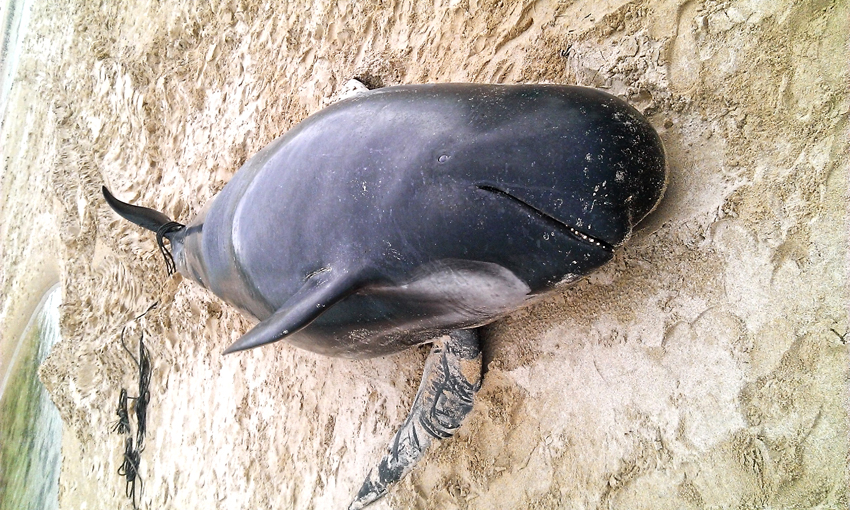
A stranded pilot whale struggles for life at Ballyness beach near Falcarragh, west Donegal. (Photo by Antonia Leitner).

Chairperson of the meeting, Amanda Doherty, with Selkie Sailing, who has also launched a petition that has attracted more than 230 signatures on the issue, said she was pleased by decisions those attending had made together.

“We want to raise community awareness and have the current policy regarding cetacean strandings in the area reviewed,” she said. “It should be a more flexible policy to allow for the particulars of different situations that occur. This is best practice according international standards and Ireland should follow it.”

Some people at the meeting – many of whom tried their best to save the dying whales – became emotional as they described the traumatic situation at Ballyness beach and the agony of the cetaceans as they slowly died of suffocation in shallow water.

Members of the National Parks and Wildlife Service (NPWS), led by Dave Duggan and Pat Vaughan, decided “to let nature takes its course” rather than try to save the whales or apply euthanasia to reduce the whales’ suffering. They also did not ask the coastguard for assistance to bring the whales out to sea, as has happened in other parts of Ireland. The state-funded Donegal county veterinary office under the leadership of Charles Kealey, chief veterinary officer, has also come under criticism for refusing to get involved in any way to help the whales, including making sure the mammals were dead before they were buried. (In contrast, see photo below of a cetacean (dolphin) being treated more humanely in another part of Ireland, with vets and the coastguard involved).

Strandedwm_shay-fennelly_2007

Westport-based Irish Coastguard assist with a stranded Common Dolphin which could not be refloated. A Mayo vet administered an injection to humanely end its suffering. Photo by Shay Fennelly

Pearse Doherty Sinn Fein TD for west Donegal, who has submitted a number of formal questions over the last week in the Dail to Ministers regarding the treatment of stranded whales and other cetaceans, attended the meeting and gave his advice on the best way forward for the group. Doherty said it was important the new group work with current organisations such as the Irish Whale and Dolphin Group (IWDG) and the National Parks and Wildlife Service (NPWS) and suggested a two-pronged approach – making sure policy at the IWDG matched international standards, and the establishment of  ‘first responders’ in the local area, recognized by the NPWS and IWDG – people who could take the lead in developing situations.

The newly-formed ‘North West Whale & Dolphin Support Group’ decided to hold monthly meetings and invite Simon Berrow, founder of the IWDG, to provide specialized training for members on how to best help stranded whales and other cetaceans and to meet with a small working group on the same day to discuss further action. Clare-based Berrow is a full-time lecturer at the Galway-Mayo Institute of Technology teaching on the Applied Freshwater and Marine degree course and project manager of the Shannon Dolphin and Wildlife Foundation.

After being contacted about the meeting, Berrow told the author of this blog, “We are delighted to hear of the formation of a local group. We look forward to working closely with them to prepare a better response to stranded cetaceans in the future and also to encourage local recording.”

Offshore toxic waste dumping? Military submarine activity?

At the same time, concerns regarding the health hazards to human life – as well as marine – from toxic dumping at sea and military submarine activity and experiments that may have caused the strandings have resurfaced locally.

dumping 2

Oceans that become graveyards for poisonous debris that pose dangers to human as well as marine life.

International regulations state that discharges of waste material – often poisonous by nature – should not be made within a certain distance of any landmass, according to the Seas at Risk. But who’s watching? Some major ports have cleaning facilities such as Edinburgh, Belfast and Dublin, but this costs money so some incorrigible corporations say ‘why bother’? As the coast of Donegal is in direct line of most transAtlantic ocean traffic between Europe and the Americas, the amount of waste dumped offshore is probably immense, one respected scientist saying ‘enough to create mountains under the sea.’ Much of this material contains cancer-causing chemicals (carcinogens) such as manganese, benzene, coal-tar, radium, petrolatum, parabens, vinyl chloride lead and zinc. With recent technological developments, many of these chemicals are in the form of deadly nanoparticles (particles less than the size of a human or animal cell) which, airborne, can then penetrate the cells, causing untold damage.

Nanoparticles: Technological and industrial development has outstripped health research into their potential dangers in everyday foods and consumer products.

Nanoparticles: Technological and industrial development has outstripped health research into their potential dangers in everyday foods and consumer products.

Could this be the cause or partial cause of disease in whales and other marine animals? Researchers say they have found large quantities of these chemicals in the whale tissue samples taken and tested. And doctors report larger than normal incidences of human cancer in local people.

In addition, some of the waste is in the form of non-biogradable plastics. Because they don’t dissolve but break up into smaller elements, these plastics have formed what scientists now call ‘plastic islands’ – often the size of countries, one is larger than the US state of Texas, which in itself is 17 times larger than Ireland – that float in our seas, causing disruption to the normal flow of currents. Consequently, the dangers to both human as well as marine animal health is high. For a long time, many people in northwest Donegal have suspected such dumping to have taken place offshore, with menacing results (see further information here).

A special group was established within the last two years at Ionad Naomh Pádraig in Dore by Freddie O’Donnell and Aodán Ó’Gallchoir to examine correlations between high levels of cancer in the Gaeltacht area and dumping of waste in coastal waters nearby. Known as ‘Scaoil Saor ó Ailse’ (Break Free from Cancer’), the group’s public relations officer, Joe Diver, said former local doctor Paddy Delap, said such waste was affecting peoples’ health, particularly cancers of the skin, lung and brain, with an abnormally high level of fatalities. A deep-sea diver then broke his decades-old silence on Raidó na Gaeltachta, describing how he found a large area of the sea bed littered with large black drums with hazardous signage on them in the waters off Tory Island, adding, “We were looking for shipwrecks, went down 40 to 45 metres and came across black drums with green stuff growing on them. There were a few thousand of them. They were heaped in a hill-like structure and had skull and crossbones on them. The diver said the drums would have since disintegrated and their hazardous material dissolved into the ocean off the Gaeltacht coast.”

submarine

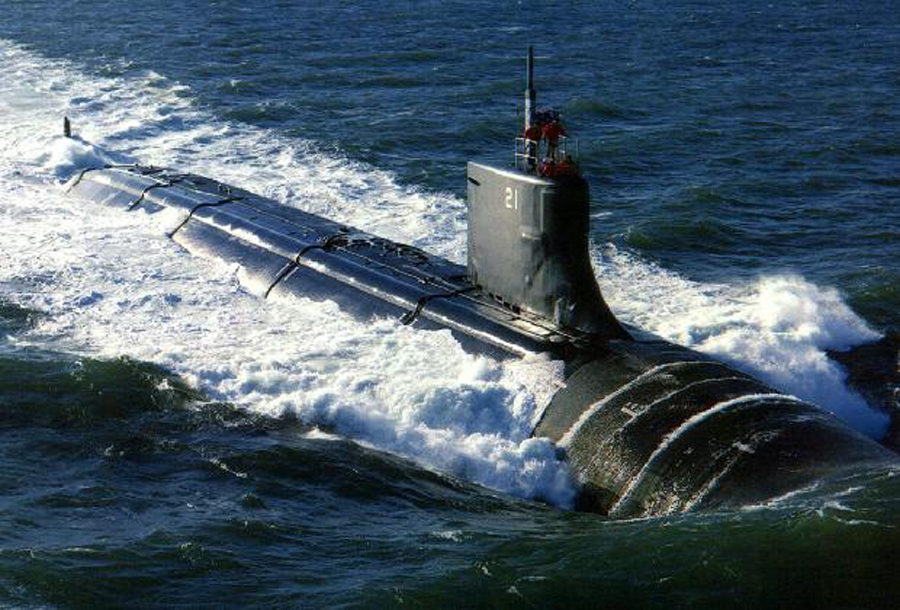
Military submarine activity and experiments at sea: what are the hazards for Man, Plant and Animal?

Areas affected could include Gaoth Dobhair, Cloughaneely and The Rosses. Calls for greater funding for a more comprehensive analysis were ignored by the relevant authorities, mainly on the instructions of Dublin, some say for economic and political reasons. Further, fearing such research could stir up waves of protest if the result became known, efforts were made by authorities, mainly Fianna Fail, then in power, to trivialize what little had become known. Politics and money trumped peoples’ health and once again the ‘Forgotten County’ was forced to live up to its unfortunate title.

Damage control became main concern for a certain cadre of elite: the party in power in the Dail and its big-business supporters. “This situation has been going on for far too long,” said one medical practitioner who has treated cancer patients in the area. “It is long past time national funding was made available to investigate this situation thoroughly. If it happened in certain other parts of the country, it probably would already have taken place long ago. Surely the deaths of so many marine animals and the high number of cancers affecting people means the issue should be looked at very closely.  To some extent, it’s in the hands of ordinary people. They should be lobbying their government representatives by e-mail, phone and letter. If not, nothing will be done.”

Several of the whales at Ballyness beach were found to have lesions, blemishes and lumps on its skin, but National Parks and Wildlife Service officials declined to say where any disease may have originated. As whales are highly social creatures that travel in communities, some say healthy whales may have refused to abandon sick or injured pod members and followed them into shallow water. “We can’t say for certain,” said Pat Vaughan, district conservation officer for the NPWS. “What we do know is that whales and other marine animals can have high levels of certain toxic elements in their bodies.”