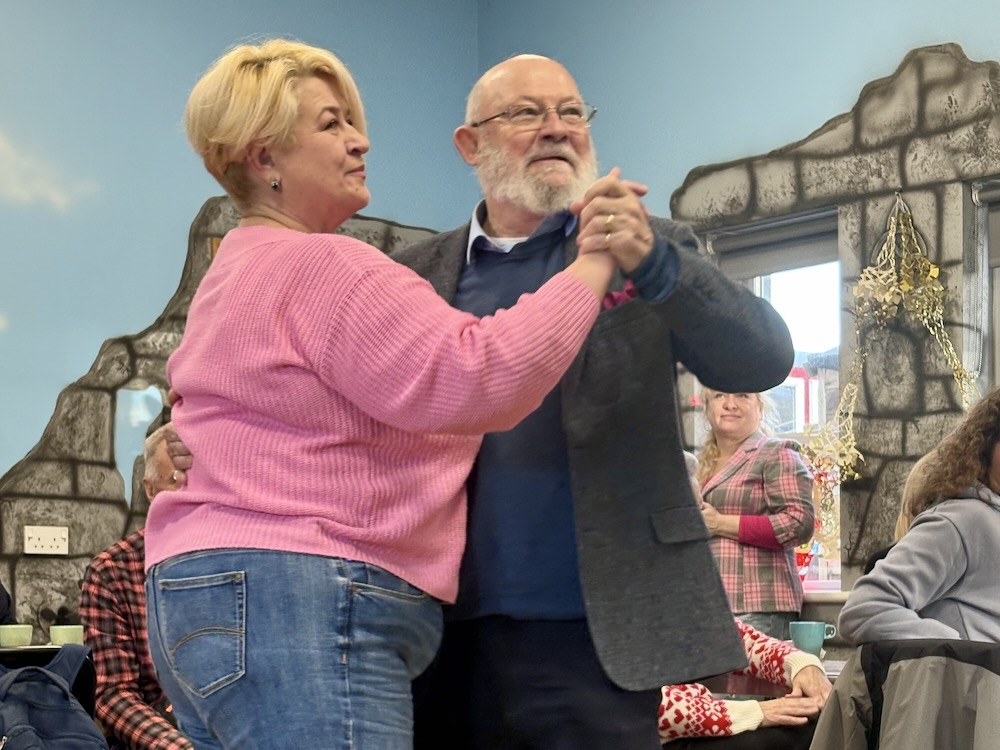
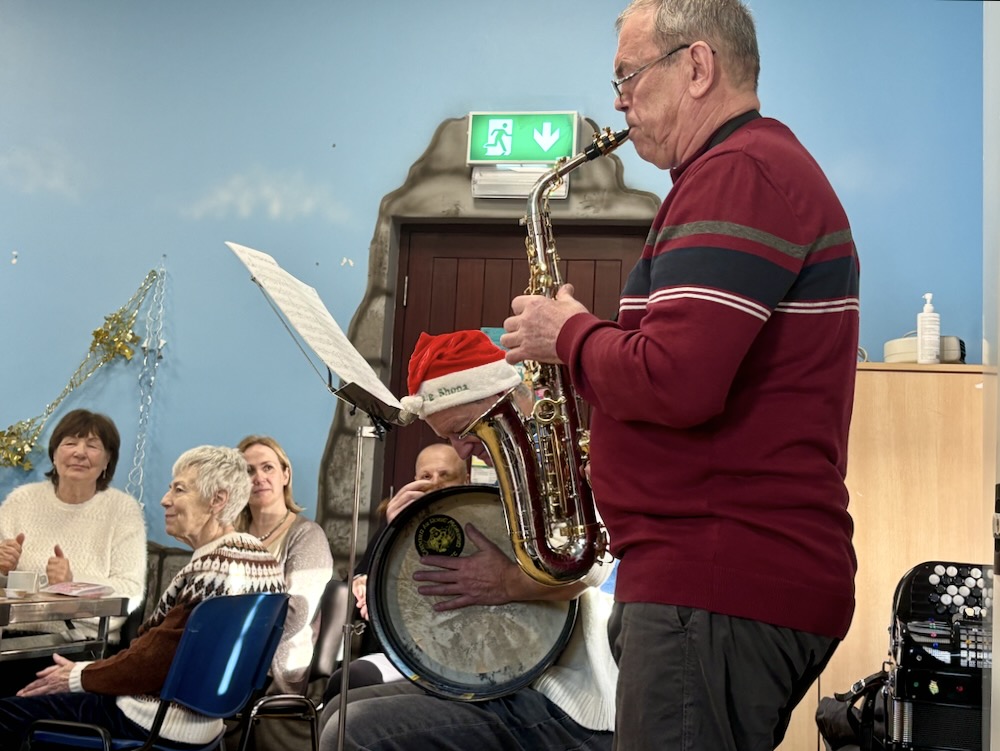
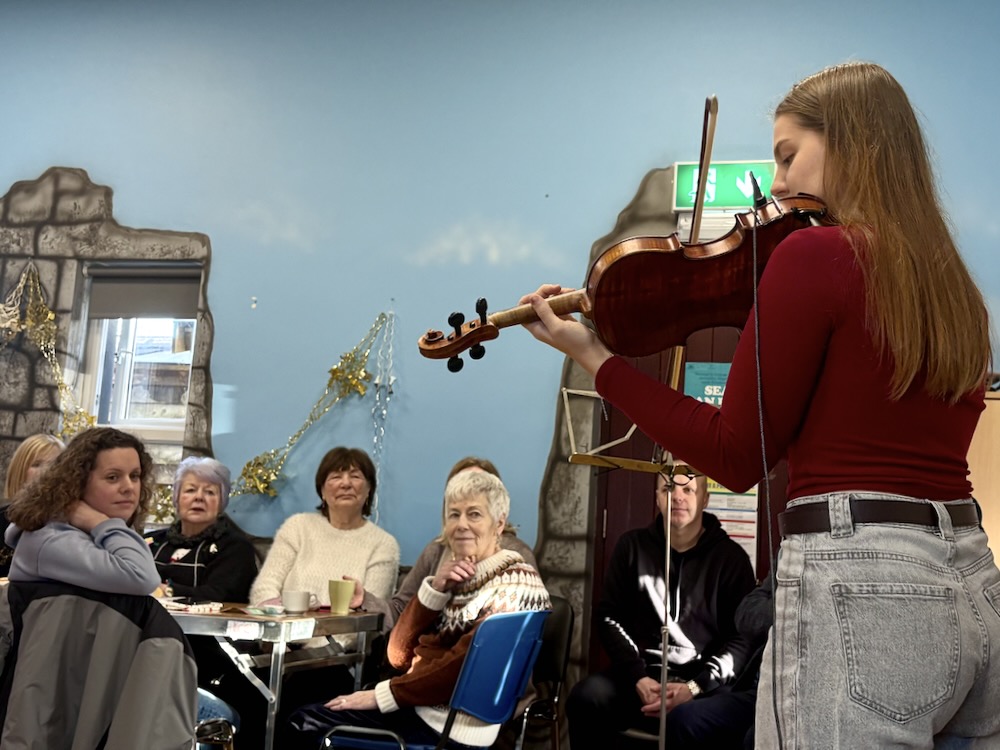
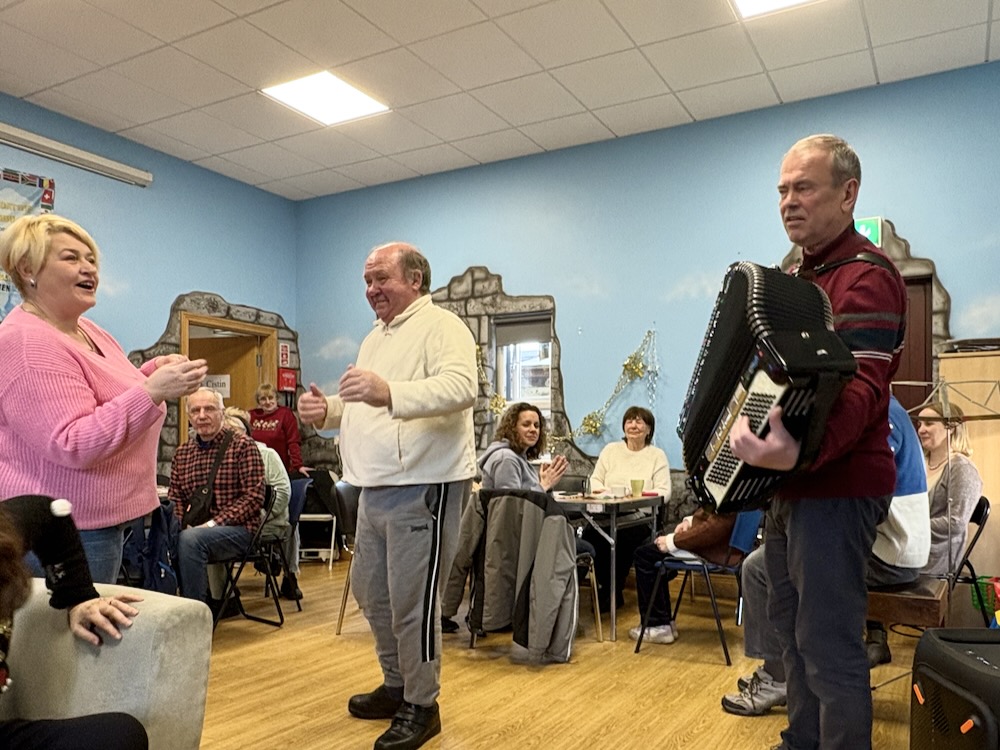
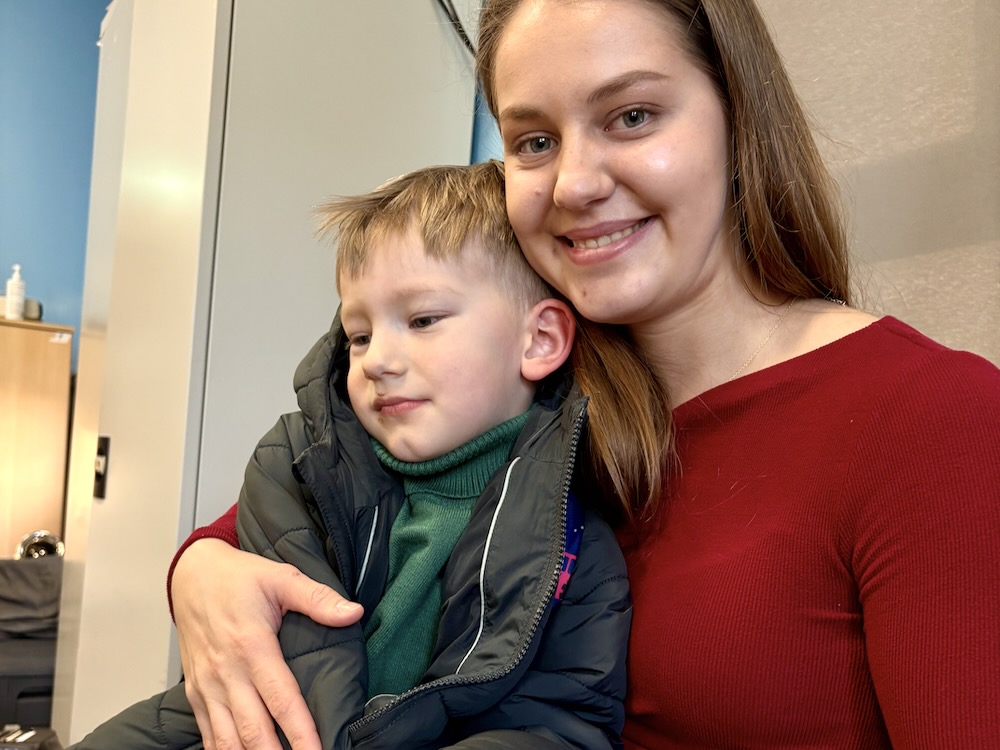
Probably never in the annals of musical history has a Ukrainian saxophonist-cum-accordionist, a classical violinist and an Irish bodhrán player come together as a highly-entertaining trio.
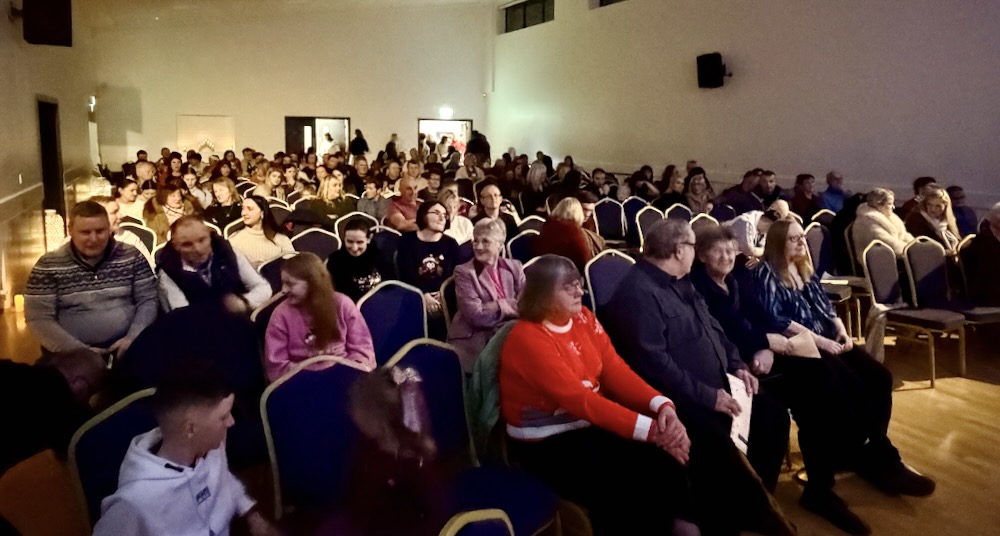
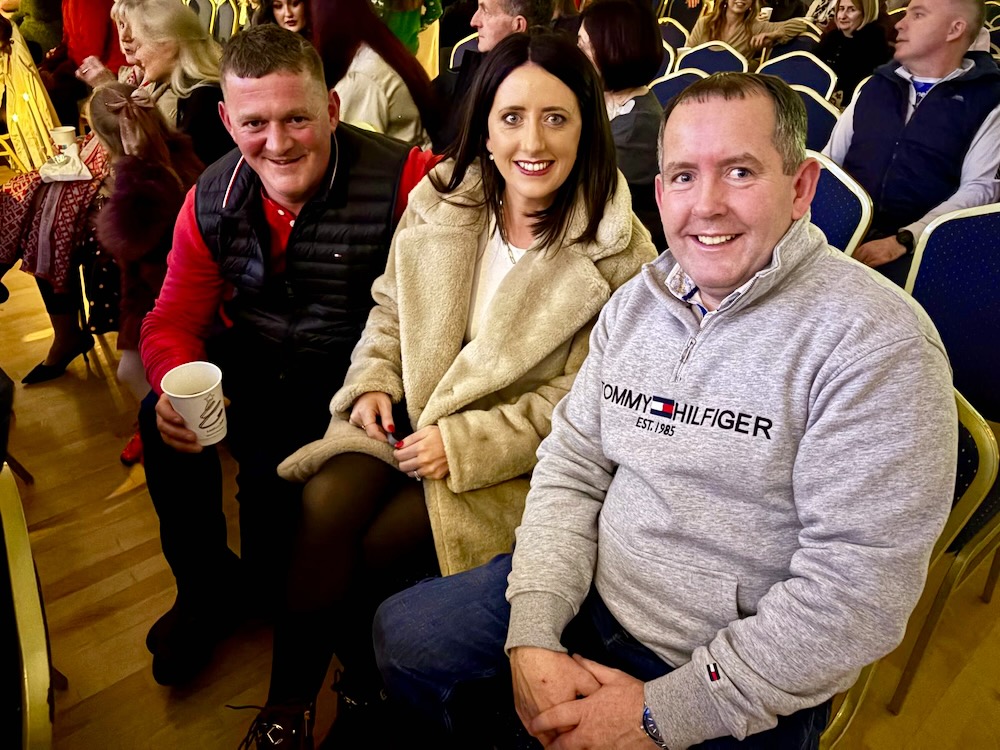
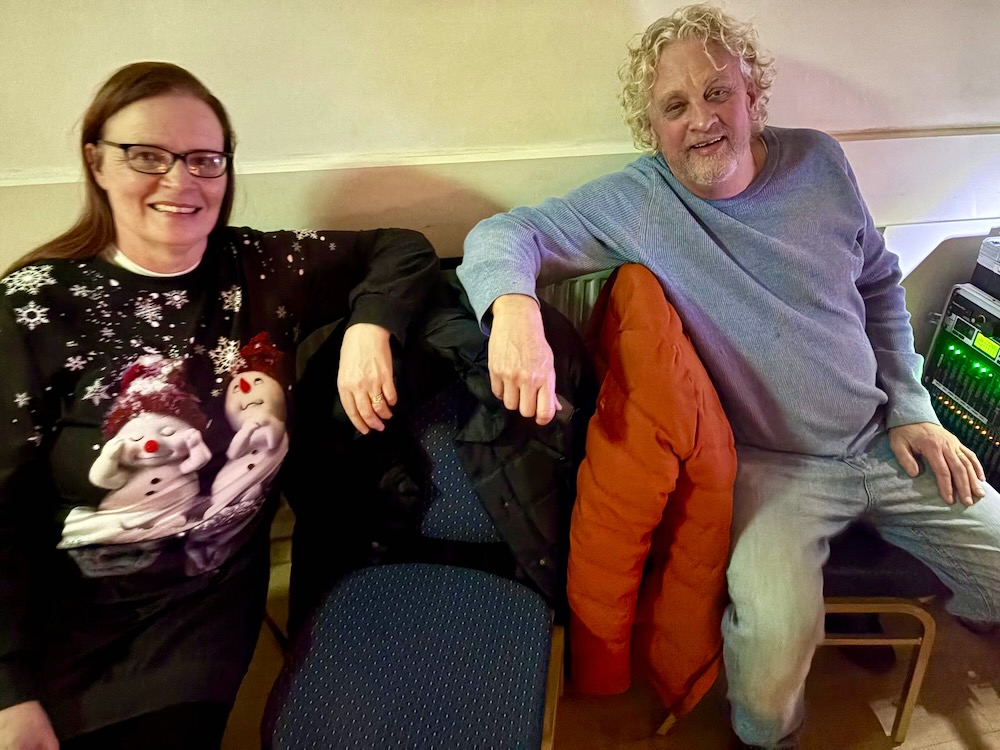
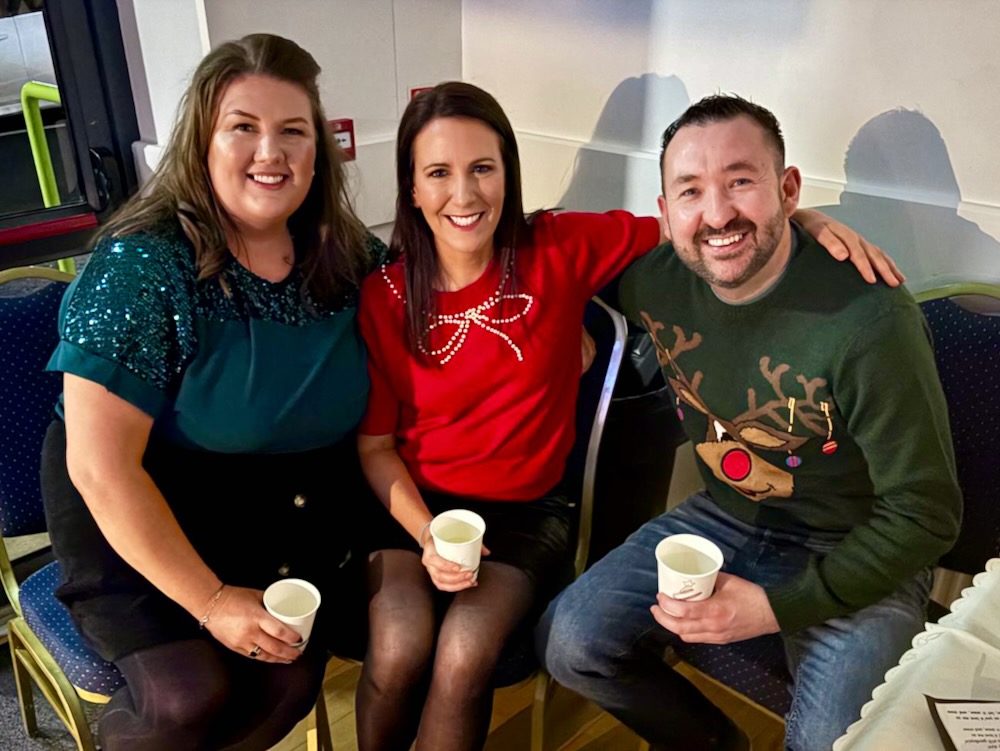
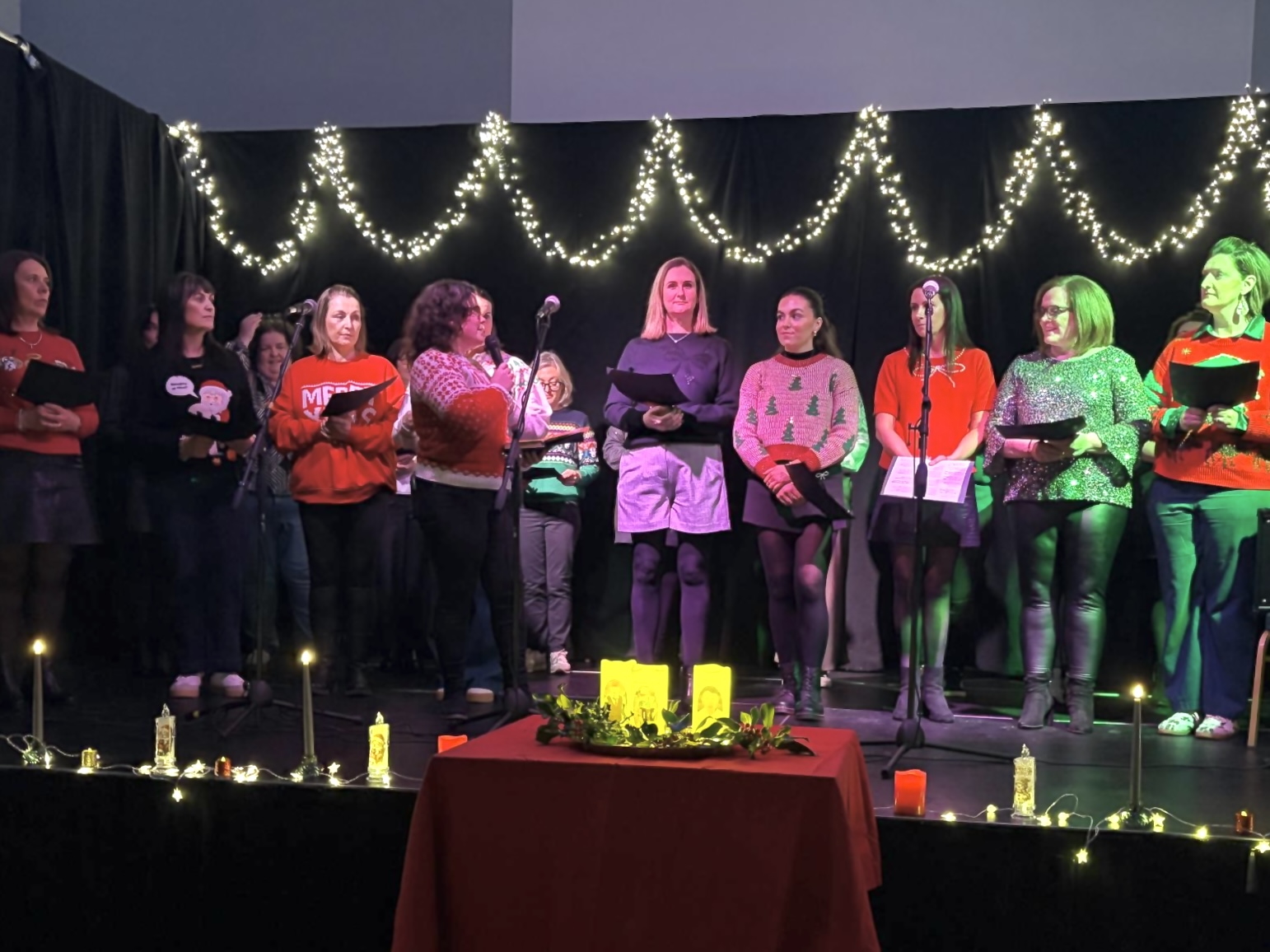
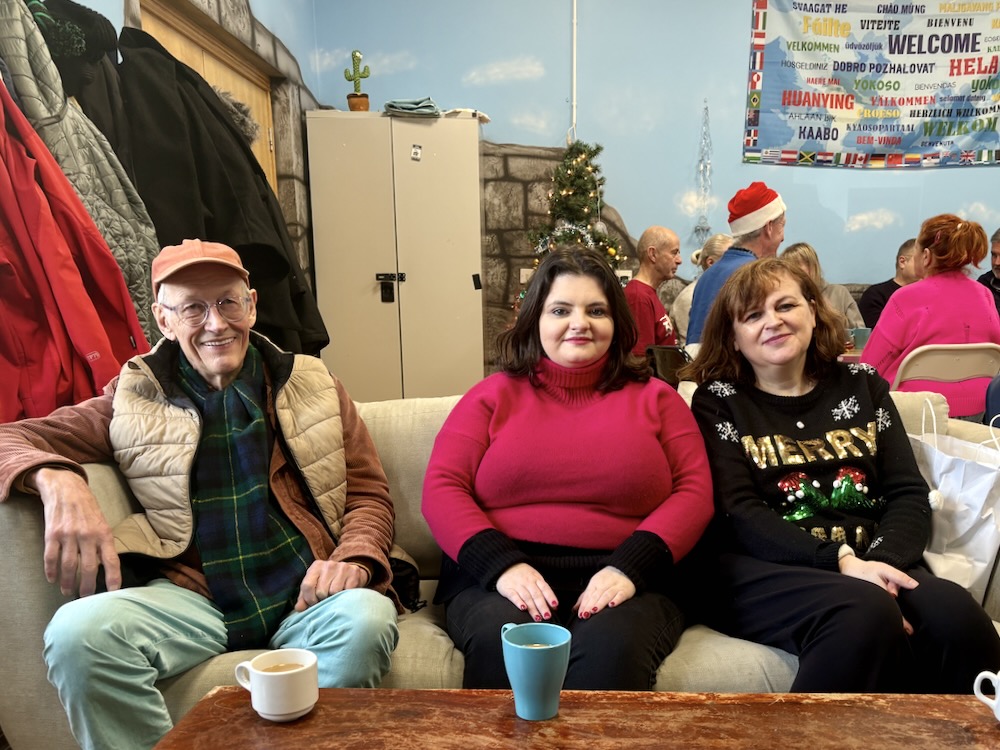
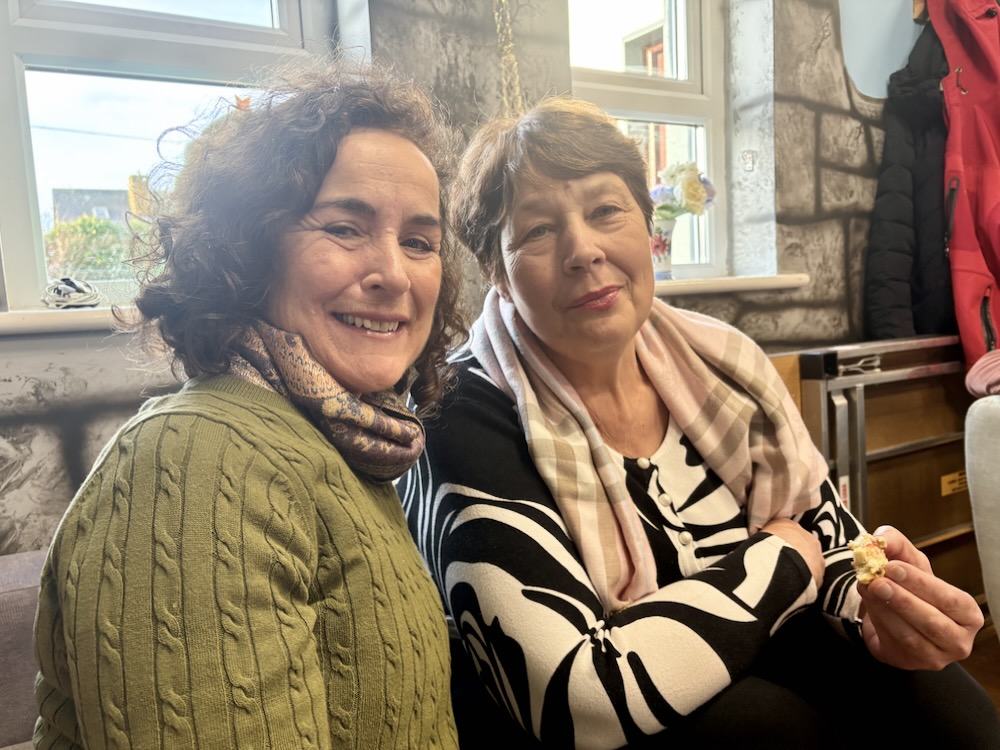
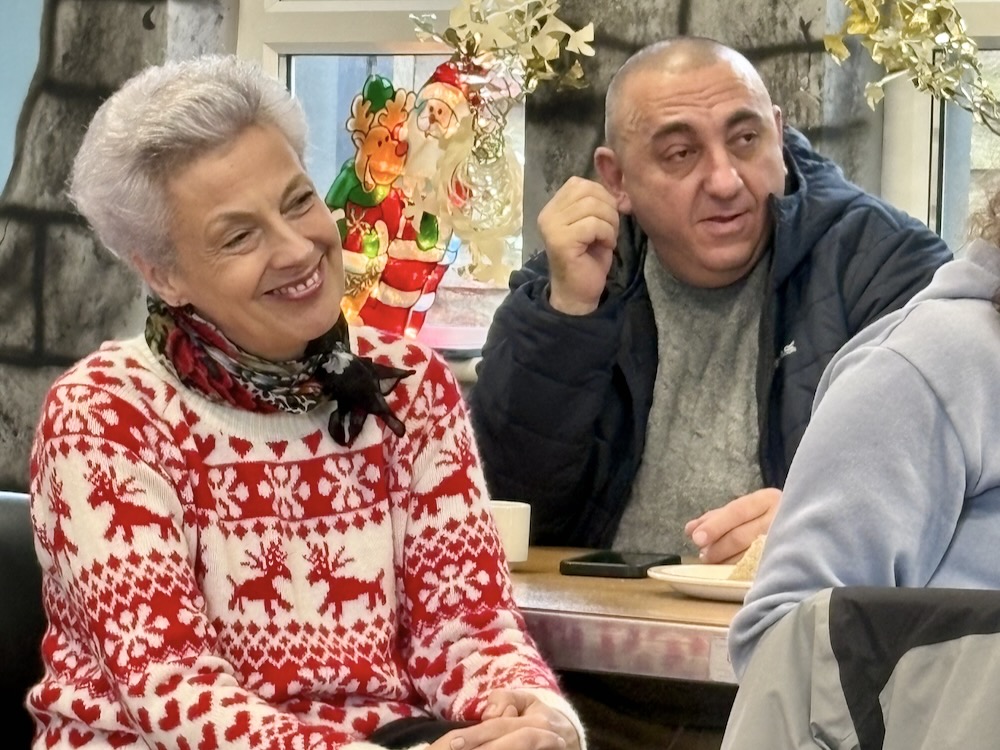
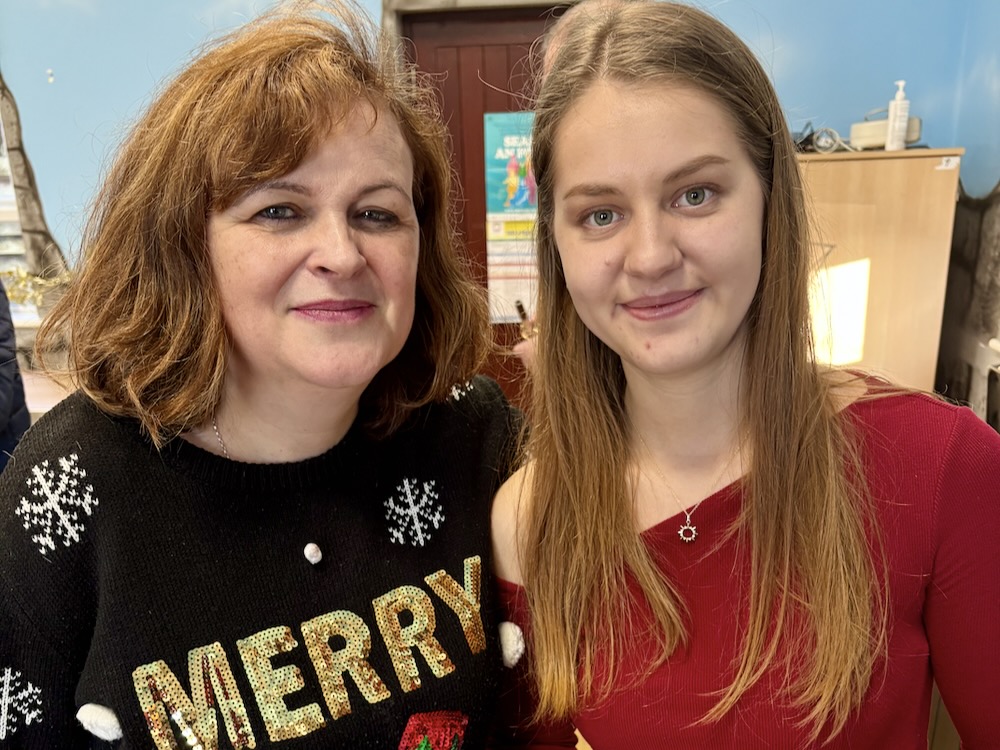
But they did this week at a celebratory Yuletide event at Garradh Colmcille in Falcarragh attended by women, men and children representing diverse nationalities including Canadian, South African, American, Irish, Ukrainian and English.
This unique occasion featured musicians, Reuben O’Conluain, Irish-language professor and cultural enthusiast, multi-instrumentalist Yuriii Hryhoriev and talented Olena Korotka, a classically-trained orchestral violinist from the now militarised region of Kherson in southern Ukraine.
The proceedings ranged from delightful musical renderings including traditional Irish tunes as well as Ukrainian folk songs such as ‘Chervona Ruta’ and ‘Cheremshyna,’ to contemporary ballads such as Leonard Cohen’s ‘Hallelujah,’ and ‘Until I Found You’ by Stephen Sanchez, with a few festive seasonal songs including ‘Jingle Bell Rock’ and ‘It’s Beginning To Look a Lot Like Christmas‘ tossed in for good measure.
Nimble dancers also took to the floor, shaking their booties in carefree abandon to the lively rhythms of the instruments played so wonderfully.
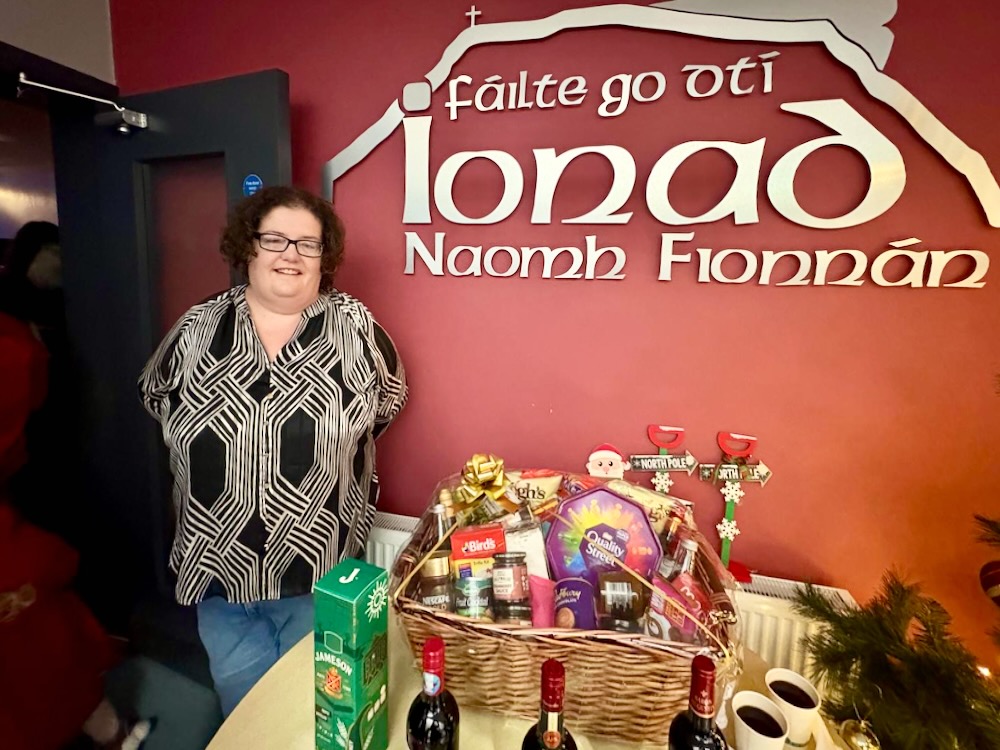
Many congratulations to Armen Galstyan, a refugee from Odessa, for organising the musicians, and local community activist at Pobal le Chéile, Rosemary Grain, and her enthusiastic support team for hosting the event so well.
For me, and I’m sure for many others attending, the event highlighted the interconnectedness of people across borders illustrating how humanity, regardless of language, skin colour, religion or nationality, is one and the same entity, each element dependent upon the other for peace, progress and prosperity.
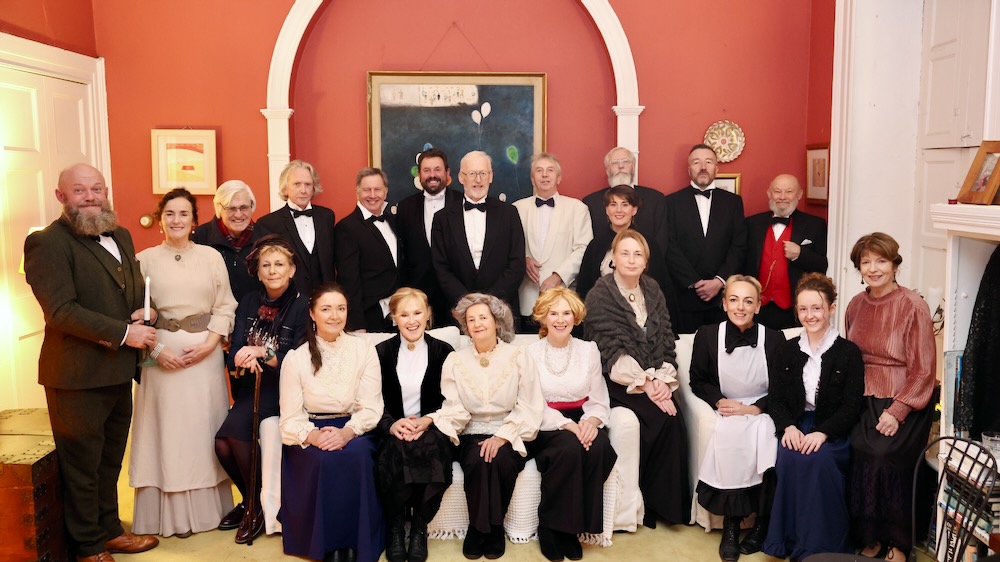
What a theatrical triumph this past weekend for local amateur drama company, The Cloughaneely Players, who meet close to my home here in the scenic northwest corner of Donegal.
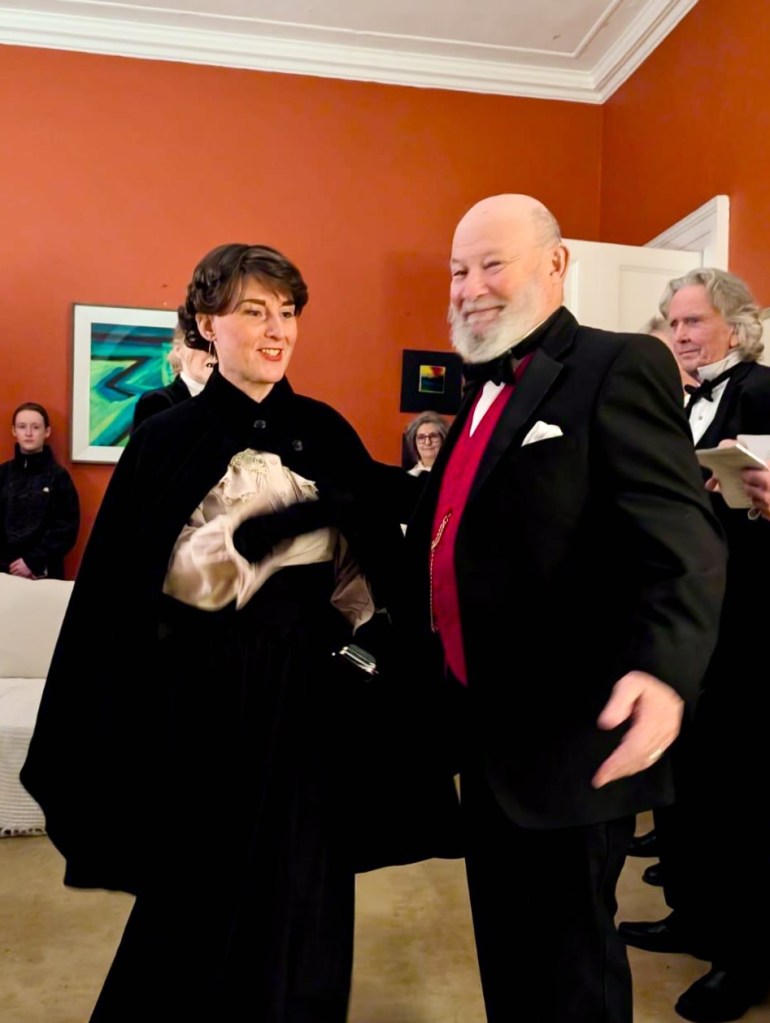
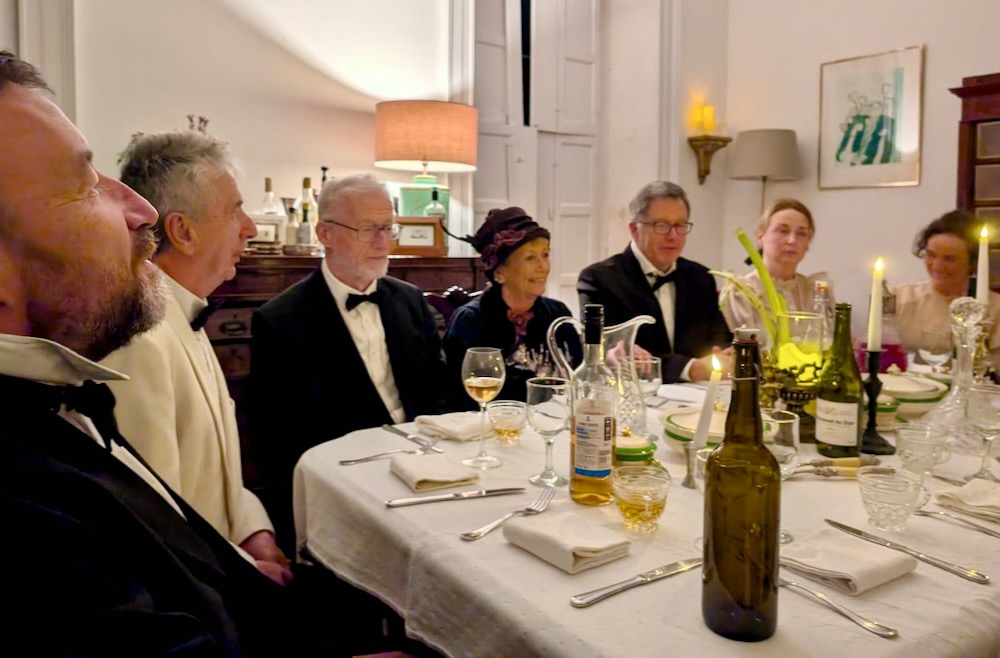
Not only did they host a superb re-enactment, complete with costumes and wigs, of James Joyce’s classic short story ‘The Dead’ set in 1904 in a most enjoyable manner, but they transformed a rural Donegal house into a 19th century multi-stage setting using most of the rooms in the house, both upstairs and downstairs, for various scenes.
Many congratulations to director Carmel MacGill, consultant director Murray Learmont, choreographer Caroline McGee, and more than twenty talented local amateur actors and musicians for a superb show.
And keep in mind, we’re not talking about well-paid West End or Broadway professional performers (though you might be mistaken that they were). We’re talking about a local bartender, a teacher, a nurse, a doctor or two, a real estate broker, a hypno-therapist, even a retired revenue sheriff, and many others, all of whom bring sheer enthusiasm and passion into treading the boards.
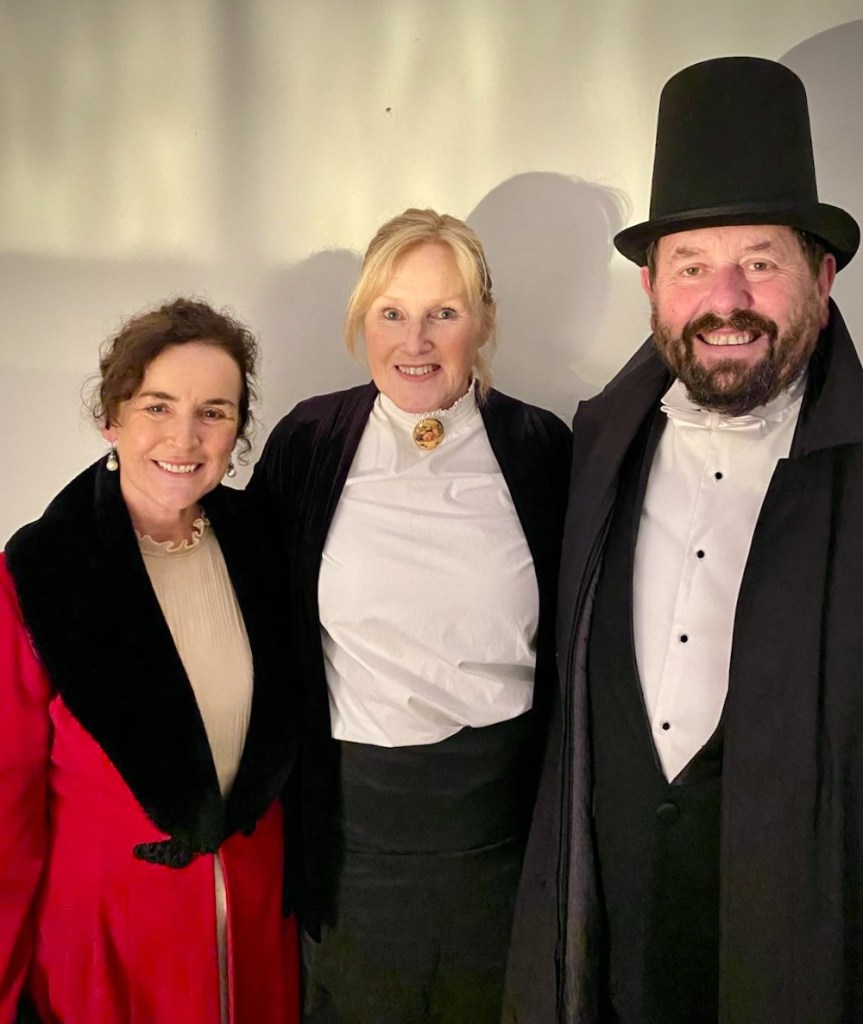
Here’s a few photographs to illustrate the weekend’s entertainment.
I’ve written a much more comprehensive article in tribute to these delightful women and men for this Thursday’s edition of the Donegal News on the Digest page so pick up a copy and have a read and rejoice we have such talented artists among us.
And don’t miss out on their next production. The tickets will be red hot, so buy early. No doubt they’ll be sold for high prices on the international black market.
Thank you to Catriona Kelly, Jake Campbell McLaughlin and Maggie McKinney for photographs.
Is Sinn Fein’s decision this weekend to support Independent candidate, Catherine Connolly, in November’s Irish Presidential elections a case of the tail wagging the dog?
It certainly seems so.
After much dithering and delay, Ireland’s third ranked political party – which not so long ago could have topped the polls nationwide and emerged as the nation’s leading party if they’d only put forward more candidates – could not even decide on its own Presidential candidate, party member or not.
Instead, it meekly followed in the wake of other smaller Left-leaning parties who have been supporting Connolly for many months.
Catherine Connolly – established Irish politician.
If that’s not the tail wagging the dog, what is?
No matter how well the story is spun – and sadly Sinn Fein party leader Mary Lou MacDonald offered an ‘over-the-top’ act to do so a few days ago, uttering the superlative cliché ‘game-changer’ – this non-decision decision may come back to bite her and her colleagues.
While they won’t say it publicly, the other Left wing parties in Ireland are now frothing at the mouth at the possibility of stealing parliament seats from Sinn Fein at the next election.
Unfortunately, Mary Lou made the situation even worse this weekend when she tried vainly to justify choosing Connolly by saying recent Irish presidents had been elected “from outside the political establishment” and that Connolly was following in that tradition.
What a load of nonsense.
Catherine Connolly has been an ‘established’ politician for the last quarter of a century, beginning as local councillor in Galway, then rising to Mayor five years later, then becoming a TD ten years ago. For goodness sake, she was even chairperson of Ireland’s national parliament for a full four years.
If that’s not ‘established’, what is?
Even the present President of Ireland Michael D. Higgins, elected not once but twice over the last 14 years, was a ‘classic established politician.’ For almost half a century including stints as Labour Party president, Senator, TD (Member of Parliament) and even as a Minister.
One has to ask oneself ‘Who the hell is writing Mary Lou’s scripts. And who’s conducting her research?”
I’ve always been Left of center in my political outlook, and would like Sinn Fein to be in Government and shake up the meagre mediocrity of Irish politics. But with poor decisions like this one over the Presidency, I fear that’s not going to happen any time soon.
Sinn Fein has shown itself in many instances to be a no-risk party, including its electoral management strategy in Donegal where I now live. In order for it to justify its claim as a leading party, it needs to take risks. But time and time again, it has shown itself to be very much risk averse.
My humble view is that Irish people are desperate for a fresh face in Áras an Uachtaráin, the official residence of the President of Ireland, someone truly not involved in Irish politics. Someone with the international experience necessary to conduct the role of Presidency in a strong diplomatic manner. They simply don’t want the Presidential race to be based along worn, age-old political party lines.
That’s why someone like Gareth Sheridan – a man whose US-based company has accumulated losses of 40 million dollars and who has himself already been fined for misleading people about his business and whose main business partner is said to have links with Russian oligarchs – has managed to get two county councils in Ireland to nominate him as a Presidential candidate.
That’s how desperate Irish people are to find someone new.
Mary Lou went half way by talking about the need for someone new.
But then she went right ahead and selected someone straight from the old political establishment. And to make matters worse, someone other parties had already selected a long time ago.
It seems Sinn Fein may have just bought the ruling coalition of Fianna Fail and Fine Gael an early Christmas present.
Sinn Fein’s President Mary Lou McDonald today described on national airwaves that her political party’s long-awaited, soon-to-be-named Irish Presidential candidate would be a ‘game changer.’
Sinn Féin leader Mary Lou McDonald has said that the party’s participation in the Presidential Election campaign will be a “game-changer”. Sinn Féin has been mulling over its approach to the race for Áras an Úachtaráin, with two options at its disposal – either run its own candidate or back Independent Catherine Connolly’s campaign. Speaking at the National Ploughing Championships in Screggan, Co Offaly, Ms McDonald said she already knew the proposal she would be bringing to the party, but that it would not be made public until Saturday. Go to link in bio for more #rtenews#ireland#presidentialelection#sinnfein
Having used this grandiose, hifalutin phrase, that’s exactly what supporters and would-be supporters of Sinn Fein will be expecting that person to be – a unique choice who will shock and surprise everyone.
The kind of individual a disillusioned electorate are hungry for. Someone whose name and background will light a fire under what has already become – albeit in its early stages – a timid, banal, utterly predictable and lukewarm election campaign.
To use such a superlative phrase as ’game-changer’ and not deliver an individual with the immense passion, innovative vision and creativity the term demands will be considered by most people to be a dismal failure. And show Sinn Fein to be a ‘has-been, once-was’ party, one whose rise in recent years has incontrovertibly stalled.
To come up with something less – such as merely supporting Independent Catherine Connolly – will help damn the party into endless Opposition. It will signal to a triumphant Fianna Fail-Fine Gael coalition Government that it has nothing to worry about from Ireland’s third-ranked party. That Sinn Fein is all bark and bluster. But no real bite.
Regardless of the spin about Left wing unity, Sinn Fein supporting Connolly will be seen as nothing less than inherent party weakness. That of a political party seeking to lead the country that cannot even find a suitable candidate for the most universally elected political position in the nation.
That’s not leadership. That’s impotence.
Supporting Connolly, Sinn Fein at this stage will also be seen as being led by the other Left wing parties who decided on her months ago. And they risk losing key votes at the next election as a result, probably leading to an inevitable decline in its parliamentary seats. A major, perhaps irrecoverable, blow to the party’s hardworking grassroots members.
Thus it’s all-important, not just for future success but for sheer survival, that Mary Lou and her colleagues in the upper ranks of Sinn Fein deliver what they’ve promise so confidently. Nothing less will do.
In doing so, hopefully, they’ll also make this rather boring Irish Presidential battle a bit more interesting than it is right now, raising it from its low-level drab ordinariness.
If they don’t, Sinn Fein may pay a heavy price at the next election. And possibly never recover from the fall.
For a party that is admirably ethical and honest in its dealings, with a central mission of equality and justice for all, they need to find the courage to take risk, something the party is not particularly known for, as not running a second candidate in the Gweedore-Cloughaneely area in the last election showed, with Pearse Doherty’s massive surplus votes going nowhere instead of towards electing a record third TD in Donegal.
This Presidential campaign is Sinn Fein’s Rubicon moment. It’ll be intriguing to see if they manage to cross over. Or drown in the effort.
Is it not reprehensible – the height of hypocrisy in fact – that Simon Harris the leader of the Irish Government – has the audacity to accuse Sinn Féin in recent weeks of ‘duping’ people when it expelled several party members for substandard social behaviour?
Simon Harris – the Dishonourable Duke of Duping.
The Cambridge dictionary definition of dupe is ‘to deceive’ and if anyone is guilty of deception, it is Harris and his colleagues in the coalition Government of Fine Gael, Fianna Fail and the Green Party.
Over the last four years since being in power – and for many years before that – these parties have been nothing less than ‘repeat offenders,’ constantly deceiving the ordinary hardworking people of Ireland with false promises of a quality lifestyle as befitting a nation that is one of the earliest members of the European Union, then called the European Economic Community, or EEC for short, back in 1973.
Instead, however, we have one of the most disastrous health systems on the continent, with people waiting years for life-saving surgeries, often dying before they receive it; we are awash in homelessness and poverty, with an estimated people 30,000 living on the streets, including thousands of young children and infants; we have a forsaken, forgotten, forlorn State where retirees and newlyweds alike are unable to afford the rent of a simple home, never mind the financial resources to even remotely consider buying one to end or begin their lives together in a modicum of comfort.
Not only does the Dishonourable Duke of Duping continue to deceive people that after all these years he’ll one day consider putting a roof over our heads, but he himself basks in the lap of luxury in one of the most expensive and elitist places in Ireland, the scenic coastal town of Greystones in county Wicklow, where he was born, where he lives and where houses cost up to two million euro, and more.
But is it not somewhat harsh of us to criticise the Dishonourable Duke of Duping for his lack of common decency? Is it not unfair to ask a man of such Royal blood living in such a high falutin’ environment to understand the plight of so many desperate Irish people? Is that not akin to asking King Charles of England to make his own cupán tae once in a while?
Shamefully, while the wealthy in Ireland (many of whom are the Dishonourable Duke of Duping’s closest neighbours) while away their days in decadent lifestyles with fancy homes in fancy places or travel in environmentally-damaging private jets (which the Dishonourable Duke of Duping does frequently) and indulge their whims in ostentatious holiday homes abroad (which the Dishonourable Duke of Duping often does), modern Ireland suffers the worst housing shortage in its entire 100-year history.
Studies show less than a third of 30-year-olds own their home. Over half of all newly-built homes in greater Dublin alone were bought or developed by global vulture investor funds, thus locking countless people out of ever attempting to buy one. These ‘vampire funds’ don’t buy homes to sell, they buy them to extract high rents in perpetuity. In other words, they suck the lifeblood out of decent Irish society.
And to make matters worse, the Dishonourable Duke of Duping and his cadre of Government lackeys allowed a temporary no-fault eviction ban in Ireland to lapse last March, thus opening the floodgates for more than 15,000 notices of termination to be issued last year, making the number of evictions higher than it was during the Famine in the mid-1800s.
For centuries, gutless, greedy, often absentee, landlords, have been the scourge of Ireland, rich, ruthless people who with the click of a finger, a scribbled signature on a sheet of paper, thoughtlessly tossed hungry families out into the ditches.
Now it seems the same is happening all over again in modern Ireland, this time under the dictatorial rule of the Dishonourable Duke of Duping and his ignoble entourage.
Instead of urgently dealing with these major social and health issues that are making the lives of so many Irish people intolerable, Harris and his well-to-do cohorts, including Government coalition leaders, Micheál Martin of Fianna Fail and Roderic O’Gorman of the Green Party, are pointing their grubby finger at Sinn Féin, an oft-used political ploy to distract popular attention away from the real issues, and their own failings on them.
In doing so, however, these ‘I’m-better-than-you’ leaders fail to realise something important. While the bitter winds of winter howl at our doors, while Storm Ashley batters the coast this weekend, Irish people are not bears. They are not hibernating. They are wide awake. And fearful. And hungry. And cold. And they remember the empty promises made to them from on high four years ago, and for many years before that.
Maybe, just maybe, we should ask Sinn Féin leader Mary Lou McDonald to re-tell the story of these empty promises once more, to remind us how easily we were taken for fools. And in doing so, help us make sure the Dishonourable Duke of Duping and his Royal patrons don’t sneak back into power through the back door and make jesters of us for another four years in their Court of Failure.
Maybe, just maybe, we’ve learned our lesson and are wide awake enough to elect Sinn Féin, the ‘Party of Change’ and improve things for the better. For each and everyone of us, our parents, our children and the generations who come after.
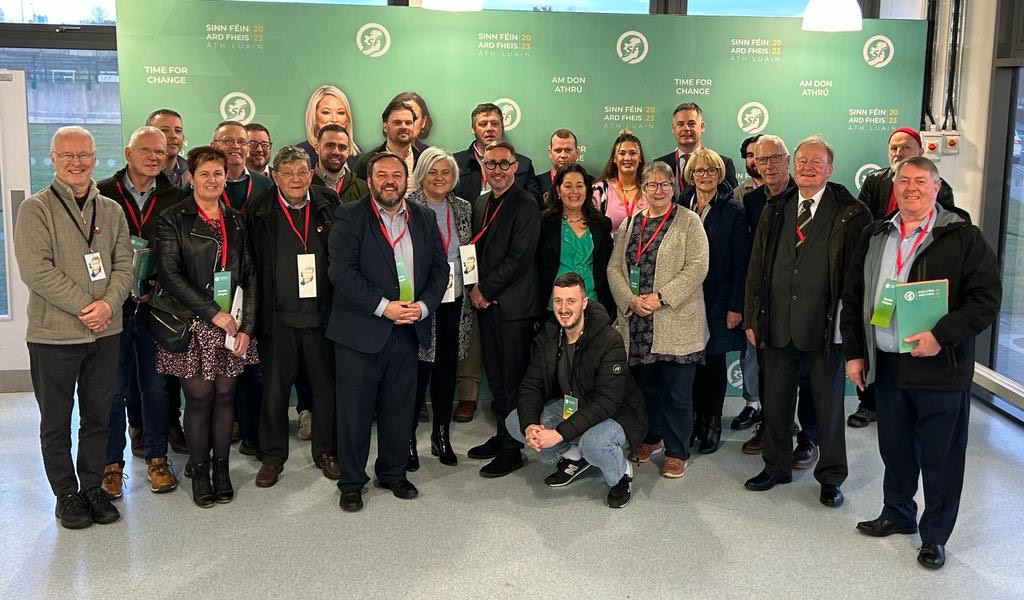
ATHLONE, WESTMEATH – A resounding ‘YES’ was the answer that rang out loud and clear all around me from around 1,500 enthusiastic and committed members, young and old, men and women, some teenagers, some retirees, gathered for the party’s annual Ard Fheis in Athlone, Westmeath several weeks ago.
A large Donegal delegation, the county where I live in northwest Ireland, attended the Ard Fheis.
I know from past experience in both Europe and the US that political party conferences can be full of hype and promise but I sensed something special in the air at this one. Positivity, definitely. Excitement, plenty. Anticipation, yes. Expectation, ditto. Even a little apprehension. Natural, considering it’s been 100 years since Sinn Fein last walked through the corridors of power as the undisputed political leader of Ireland.
Attending this annual meeting, I was extremely impressed with the overwhelming enthusiasm shown by members, their readiness to be in Government and make meaningful changes in Ireland for a better future for all and by the large number of women present, many of whom spoke incisively from the stage as delegates on a range of issues, from education to health, the high cost of living to homelessness.
With local and EU elections, and perhaps national ones as well, occurring next year, it seemed appropriate that a party that continues to rise in national popularity was holding its annual party meeting in Athlone, a town considered the geographical center of Ireland, with Sinn Féin hoping its influence radiates from there nationwide in all directions.
Led by two women, Mary Lou McDonald, the party’s president and TD for Dublin Central, and Michelle O’Neill, party vice-president and First Minister Elect in Northern Ireland, with TDs nationwide, would-be Ministers-in-waiting, including TDs Pearse Doherty and Pádraig MacLochlainn from Donegal where I now live and with whom I spoke during breaks in the formal proceedings, all aired their views on key issues such as the cost of living crisis, plight of the health system, mounting housing problems, and many more.
We want to build a new Ireland,” said McDonald in her keynote address after receiving a rousing reception. “A nation home for all. A unified nation of confidence and compassion, talent and ingenuity, claiming our future, our rightful place among the nations of the world. A new Ireland. The Orange and Green reconciled. No place for racism, Islamophobia, Antisemitism, sexism, homophobia, transphobia, or sectarianism.”
O’Neill spoke about the urgent need to kick-start the Stormont Assembly, the national parliament in Belfast, which has been boycotted by the Democratic Unionist Party (DUP), the main Unionist opposition, for the past year. “My message is one of positivity, one about the future, about building a better society for us all to live side by side,” she said. “My message to the DUP is that they need to be in the Executive with the rest of us, making politics work, making this a better place for everybody who lives here.”
Pearse Doherty, the party’s spokesperson on finance, thanked his fellow party members, saying, “You are the engine room of our organisation. Your work, your energy, your ideas, make Sinn Féin what it is – the only viable vehicle for the ordinary people of Ireland to achieve change in our country, and the only viable vehicle to achieve the unity of our country. We are focused on one thing – delivery for workers and family the length and breadth of our island. We are on the countdown to the general election, and we are setting out the type of change that a Sinn Féin government will deliver if the people give us that opportunity. We are setting out our plans to build a better, fairer country for all, for positive change and transformation.”
Pearse Doherty listens closely as Mary Lou McDonald gives her keynote address.
Paul Hayes, from Carrigart, Sinn Féin regional secretary in Donegal, was delighted with the weekend’s success, telling me that the Ard Fheis had brought together over 1,400 people, with more than 200 speakers over 300 issues voted on. “It’s a great success, I’m very happy,” he told me, smiling. Sitting beside me in the auditorium stalwart Pat Doherty, former Sinn Féin vice-president, wore a quiet, thoughtful – one might even say, contented – expression on his face. And no wonder. After many years of personal struggle and hard work towards the goal of a United Ireland Socialist Republic, the idea – once remote – of his party leading Government both in the north and south of of the nation seems rapidly becoming a reality.
(left to right) Paul Hayes, Sinn Féin regional secretary in Donegal, with Pat Doherty, the party’s former vice-president.Both were happy with the strong attendance and content at the Ard Fheis.
Thanking me for exclusive information I provided to Sinn Féin on RTE expenses, MacLochlainn, the party’s chief whip and spokesperson on fisheries and the marine, added, “We are mindful that this Sinn Féin Ard Fheis could be the last one before the next general election and the formation of a new government. We are confident, we are ready.”
Pádraig MacLochlainn, TD, is confident. “Sinn Féin is ready for Government,” he said.
Among the many motions passed was one affecting many people in Donegal. This pertains to an ongoing scandal – houses that are crumbling due to mica and pyrite in concrete. “Sinn Féin are determined to lead the next government so it is important to renew our commitment to one hundred percent redress and to spell out how we would implement that policy, if we get that chance,” said Sinn Féin housing spokesperson, Eoin Ó Broin. “We believe the Enhanced Defective Concrete Block Grant Scheme is another scheme that will deny redress to most affected homeowners.”
Aside from domestic issues, Sinn Féin also debated foreign policy issues with loud cheers of support and a prolonged standing ovation given to Dr. Jilan Wahba Abdalmajid, Ambassador of Palestine to Ireland, a VIP guest speaker.
Sinn Féin initially abstained at local council and national level from calling for the expulsion of the Israeli Ambassador to Ireland but in face of horrific stories of death and life-threatening injuries, including thousands of young children, and the wholesale destruction of home and hearth in Gaza, changed tack and formally backed those calls, as well as calling for Israel to be referred to the International Criminal Court by Ireland and the Irish government to formally recognise the State of Palestine.
“We call for an immediate ceasefire and stand firmly behind Palestine in its hopes and aspirations for its own homeland recognised by all international bodies and a long and lasting peace with all its neighbours,” said Matt Carthy, the party’s spokesperson on foreign affairs, who also thanked me for a proposal I made on a possible long-term solution to the Palestine question.
Young members of Sinn Féin show their support for Palestine.
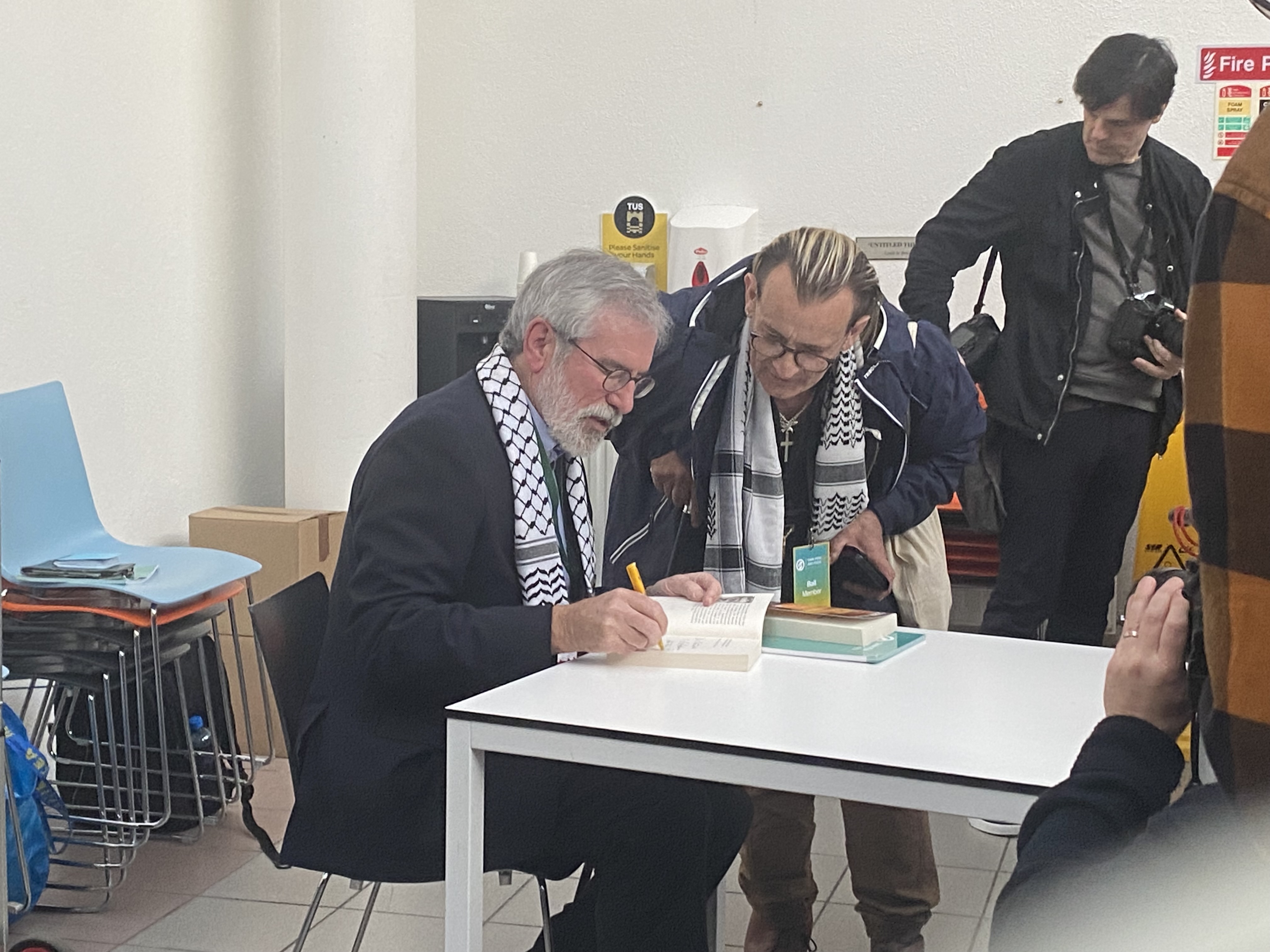
Elsewhere at the Ard Fheis, former Sinn Féin president, Gerry Adams, cheerfully met with a long line of well-wishers as he signed copies of his latest book, Black Mountain and Other Stories. Gerry has authored a number of books including Before the Dawn: An Autobiography; Cage Eleven: Writings From Prison;The Street And Other Stories; Falls Memories; and A Farther Shore: Ireland’s Long Road.
I am proud to say that Gerry’s Donegal holiday house lies less than 10 kilometers from my own home and that his mother and mine were very close friends as teenagers, working side-by-side in west Belfast and stayed together in the Donegal Gaeltacht on several occasions (with their interest in boys vying closely with their interest in the Irish language and culture, I am reliably informed).
Former Sinn Féin president, Gerry Adams, signs copies of his books.
An innovative drama project linking five different Irish theatres kicked-off this week with two performances at Amharclann in Donegal.
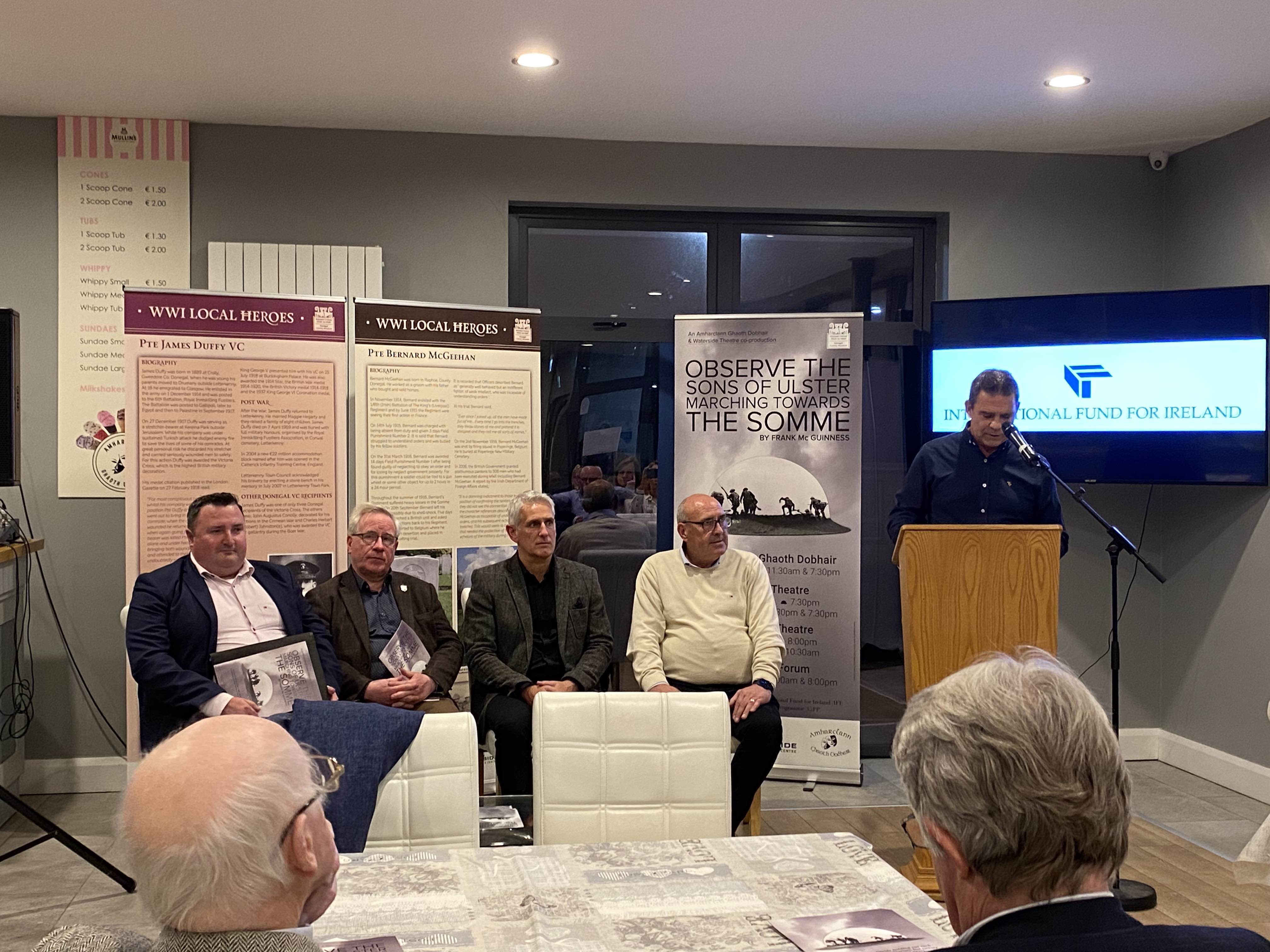
Supported by the International Fund for Ireland’s Communities in Partnerships Programme (CIPP), the project is a co-production between Amharclann in Bunbeg in the heart of the Donegal Gaeltacht and the Waterside Theatre and Arts Centre in Derry of the play ‘‘Observe The Sons Of Ulster Marching Towards The Somme’ by Donegal-born playwright Frank McGuinness.
This thought-provoking play, coincidentally hosted at the Amharclann on the same day as the United Nations International Day Of Peace, focuses on the experiences of a group of Ulstermen in the trenches of World War One who take part in the battle of the Somme. While a military setting, the play raises many themes including homosexuality, homophobia, the inner conflict of self-respect, bravery, patriotism, friendship and sacrifice.
Panel of speakers at an interesting post-performance Q&A event at the Amharclann.
Enjoying the play, one is left with a vexing question: Is the play about the futility of war? The nature of loyalty, friendship and heroism? Or an examination of the protracted Protestant-Catholic northern Irish conflict from a completely different perspective? Or all of the above?
Whichever it is, this production is a two-hour, richly-rewarding theatrical experience that offers a balanced mix of black humour and poignancy with credible characters well developed through very fine acting.
Director David Grant together with production and stage manger, Fiona Harkin, assistant director, Ronan Hamill, lightning designer JP Conaghan and composer, Rebecca Doherty and the rest of the team have re-created the moving story of ordinary men – among them a blacksmith, a weaver and a baker – who set off patriotically to fight ‘the Hun’ but become disillusioned with the myth about war they’ve been sold.
The play opens with a crippled man, Old Pyper, played by Shaun Byrne, who steps on stage alone, war medals pinned to his chest, and calls forth the ghosts of his former comrades who were all killed. Mystified as to how he survived the terrible battle, he is haunted by the images of those who died in the trenches, who then slowly, phantom-like, emerge from the shadows at the edges of the stage and stand motionless.
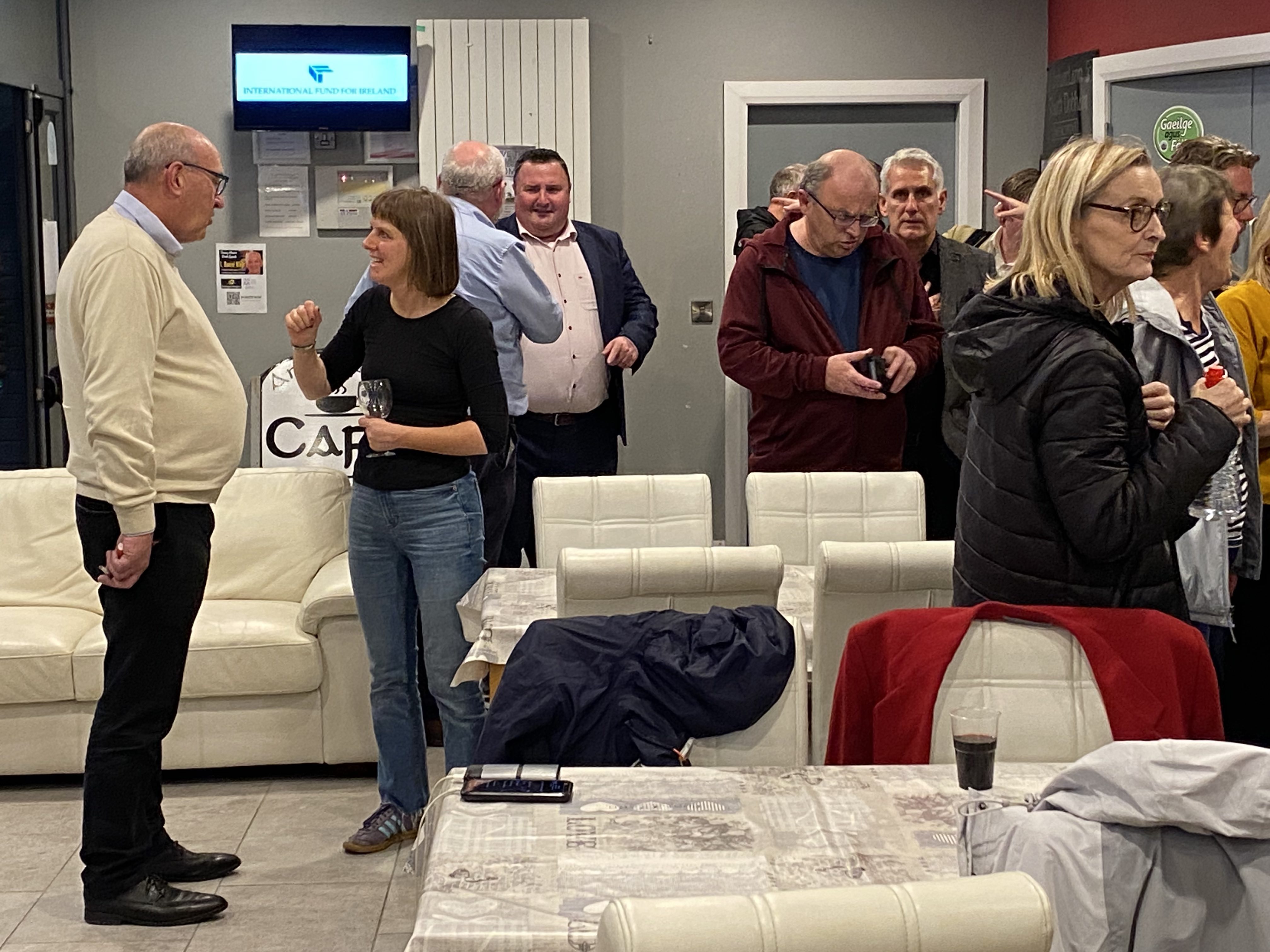
Theatre-goers mingle together for friendly discussions at the play’s intermission.
This sets the scene as to what follows, nostalgic flashbacks to the barracks where the men from places such as Derry, Armagh, Coleraine, Enniskillen and Belfast, gather for their first day of training and on to the sand-bagged first world war trenches where they face death together. Kudos go to Harkin and Conaghan who create a well-designed set, in which the barracks with wooden slats for beds is later transformed brilliantly into World War One trenches. Murals along the stage also add intriguing ambience, one of which depicts the ancient Celtic legendary hero, Cú Chulainn.
I particularly liked how a series of intense interlocking vignettes between couplets of men were enhanced by lighting and space, as well as by the thunderous roar of a Lambeg drum, a triumphalist symbol of the Protestant Orange Order in Northern Ireland. The military uniforms and equipment were also striking in their sheer authenticity.
The tone of the play is bittersweet and philosophic, with elements of both black humor and solemnity. Patrick Quinn plays the younger version of Pyper wonderfully. An openly-gay man of aristocratic background who volunteered for army service, Quinn grants him a carefree, reckless air behind which lurks a man of deep sentiment and a troubled mind. A multi-faceted person – cynical, seemingly on the brink of madness, brash, supercilious, bold to the point of foolhardy, wickedly direct, yet at the same time, a vulnerable and lost individual.
His anecdote about his three-legged French wife is highly amusing and a love scene involving him is touching in its quiet, side-stage minimalism. One character saying the ‘Huns’ speak Gaelic also creates a light-hearted moment. In contrast, depiction of one man’s despair and breakdown in the face of danger is touching, even more so as his friend tries to help.
While all the characters, except Pyper, are Northern Irish Protestant Unionists, one of the men admits something mid-way through the play which creates added intrigue and requires the attention of a military minister.
Pyper is the exception to the anti-Fenian rants of the other men, being unwilling to indulge in such narrow-minded northern Irish tribalism and more keenly aware of the ‘sandbag’ nature of their being sent ‘over the top’ and into battle. He even demands of his fellow soldiers to answer the question as to why they are there.
Some Irish Republicans may be upset by the anecdotal joke told about rebel leader, Padraig Pearse, executed after the 1916 revolution, as someone who told his enemies he was only posting a letter when he took over Dublin’s main post office to launch the revolution, but this reflects the wit Frank McGuinness is renown for.
Bulgarian visitors to Gaoth Dobhair – (l to r) Peter Petkov and Vanya Kovacheva – were among an enthusiastic audience at Amharclann theatre in Bunbeg, Donegal earlier this week
One of my favorite lines from the play, for reasons I’m not quite sure of, is ‘To hell with the truth as long as it rhymes.’
Ultimately, the play is about the fragility of life and the futility of war. In the end, one is left with the belief that the soldiers are united in one thing – fear of death – and that real heroes are ordinary people and unfortunately ordinary people remain ordinary because they don’t get recognised as much as they deserve.
Local Donegal ladies enjoy a wee bit of craic and an evening’s entertainment at the Amharclann.
The play will be hosted today (Saturday) at the Lyric Theatre in Belfast, tomorrow at An Grianan Theatre in Letterkenny and next week at the Millennium Forum in Derry.
In a post-event Q&A, Pol McCool, board chairperson of Amharclann theatre in Bunbeg, spoke about the need to build bridges between communities to help break down barriers and to appreciate shared history and values.
Director David Grant (l) enjoys the company of friends during intermission at the Amharclann.
Stephen Barrett, manager for Donegal of the International Fund for Ireland, talked about the role of community leaders in peace-building projects and described the evolution of this co-produced project. He also spoke eloquently about his own reaction upon seeing the graves of those who died in the trenches in Belgium and France during the First World War. The IFI was established in 1986 with financing from many countries including the US, Australia and Canada and the play was supported by the organisation’s.
Director David Grant talked about the challenges involved in creating the production and the overriding need for people to challenge mythology about wars.
Aine Ni Churrain, former presenter at RTE Raidió na Gaeltachta and a board member of Amharclann, thanked the audience for attending the two performances at the theatre, as well as everyone involved in developing and hosting the project and wished actors, director, producer and all the technical staff every success in the other theatres where it will be held.
Waterside Theatre CEO, Iain Barr, also thanked everyone for their concerted efforts in creating a memorable theatrical event with such an important social and moral message that contributes to greater peace and understanding among communities.
It’s an ancient Irish legend about the nasty, one-eyed mythical tyrant of a King on Tory Island in Donegal who’s killed by his grandson, Lugh – and there’s no better way to enjoy this suspense-filled story of life and death than when it’s hosted by the Cloughaneely Players, a delightful drama group in the local town of Falcarragh.
As part of its ongoing community service programme, this amiable band of actors and friends put on a wonderful outdoor show recently that had schoolchildren and adults alike both enchanted and enthralled.
And it took place, most appropriately, beside a 16-foot pedestal, a white limestone boulder with red veining atop a pillar known as the ‘Cloughaneely Stone (Cloich Cheann Fhaola)’, the red veining symbolising the petrified blood of a chieftain called MacKineely (Cian mac Cáinte) beheaded on the stone by Balor after he discovered he planned to kill him after he’d stolen one of MacKineely’s prized cows – Glas Gaibhnenn.
Under the astute direction of Murray Learmont and led by narrator, Joe Kelly, a leading folklorist, the actors had young schoolchildren jumping up and down like excited kangaroos just out of their pouches during the entire production (and a few adults too, though I dare not say who they were less I embarrass them).
Organiser of the event was Mark Boylan, co-manager of the Cloughaneely under 11 Irish GAA football team, with Kevin Scanlon, chairperson of the Cloughaneely Minor Board, giving a short speech to kick-off the evening.
A stellar cast, one with the creative ability to slip off-script and concoct amusing dialogue spontaneously, included Denis Doohan in the lead role of Balor (I particularly liked his joke about Balor having more defenders than Jim McGuinness, the recently-named manager of the Donegal Irish senior GAA football team.
The intrepid, Mickey McHugh, showing off his dainty, Lionel Messi-like legs and dressed in a costume that looked like it was woven from the hair of a banshee, acted as MacNeely. Insiders say Mister McHugh was specifically chosen for the role due to his lifelong, hard-won, cow-milking abilities which he displayed with tremendous exuberance – by spraying the entire audience with his own brand of the liquid.
(l to r) Yanto and Rohan as the forever-giving milk cow, Mickey McHugh alias Lionel Messi and Denis Doohan as the face-decorated Balor consider their options.
Lugh, Balor’s grandson, was played wonderfully by Pierce Butler, especially impressive with his warlike cries and deadly sword fight with his grandfather, leaving his foe prostrate among a crowd of enthusiastic youngsters.
Legendary cow, Glas Gaibhnenn, receives a wee bit of attention off-stage.
Kudos also go to Maggie McKinney, a native of Castlewellan, County Down, who played not one, but two roles – the screeching witch, Biróg, who predicts Balor’s downfall, as well as the bold and brassy, what-are-ye-waiting-for-let’s-have-sex, Eithne, Balor’s daughter, who – in what must be Guinness World Record time – ‘enjoys relations’ with MacNeely and produces not one but three babies, one of which was Lugh. All done and dusted in thirty seconds.
‘Prepare to die’ says Lugh (Pierce Butler) to Balor (Denis Doohan) – but only one will emerge alive.
Mention must also be made of the cow – the beloved animal that was at the center of the entire conflict. As one who has never tried imitating a member of the bovine community, I can only presume that acting the role of a cow is not easy by any means. So many congratulations to Yanto and Rohan, members of Youthreach, for doing so.
Birog the witch (Maggie McKinney) confronts MacNeely (Mickey McHugh).
Next on the dramatic circuit for the talented Cloughaneely Players is a production of the classic story, Casablanca, which I’m reliably informed may be staged sometime in November.
Photographing the entire dramatic proceedings on the evening was Annamarie Coyle, so watch out for her excellent images capturing one of the most tantalising struggles in Irish legendary history.
Spotlight on corruption inside Irish state institutions
Controversy surrounding Irish public broadcaster RTE involving hidden payments and secret slush funds for music concerts, sports tickets, car loans, expensive hotels and restaurants reminds me of an investigation I conducted into misspending by another state body.
The two examples underscore the constant need for vigilance over the spending of public money by such bodies.
Misuse of public money – a major problem in Ireland. Here RTE officials prepare to face a grilling.
Having moved to Donegal in the northwestern part of the country – an Irish speaking area known as a Gaeltacht, one of several in Ireland – I was approached as a journalist by many angry local people to investigate the spending of tens of millions of euro by Údarás na Gaeltachta, a national Irish-language organisation responsible for economic, social and cultural development.
After comprehensive research including a series of interviews and detailed Freedom of Information (FOI) requests, I was stunned to discover the extent of financial waste and utter misuse of public money by Údarás – corruption by any another name, some might say – including all-expenses paid holidays in Florida for some executives and board members and their spouses, which was counter to existing regulations.
During the year I conducted my investigation, pensions alone for 136 former Údarás employees amounted to 9.8 million euro, half that year’s entire budget, which caused then Public Accounts Committee (PAC) member Sinn Fein Senator Trevor Ó Clochartaigh to declare, “I nearly fell off the chair when I heard that.”
Five Donegal board members alone were paid more than half a million euro in fees and expenses over a five-year period between 2004 and 2009.
Shocking statistics I uncovered about spending on Údarás staff compared to project funding. Key question remains: has the situation changed?
Údarás said each job it helped create back then cost around 8,000 euro, but the actual figure turned out to be 88,000 euro, ten times that number. It also spent more than 30,000 euro on all-expenses paid trips including business-class flights to Halifax, Canada to look at seaweed projects, as well as hefty expenses to other international cities including Las Vegas, Shanghai, Los Angeles and Chicago. Such was the absolute accounting mess, Bernard Allen, former Fine Gael TD and head of the PAC back then told me the expenses system of Údarás was “simply incomprehensible.”
Údarás had become a free-for-all feeding trough for some board members and executive managers, with blatant conflicts of interest abundant. In short, the situation seemed to have become one of ‘you scratch my back and I’ll scratch yours.’
Liam O’Cuinneagain, chairperson of Údarás for ten years then and founder of Oideas Gael in in Glencolmcille, Donegal described the investigation into his organisation’s spending as “paranoia” and said he was “satisfied” with its performance.
After approaching the editor of the ‘Donegal News,’ a leading newspaper in the region, I completed a three-part investigation into the situation but then had to face highly-paid spin doctors for Údarás which did its very worst to prevent the series from being published, including threatening late-night calls to my home.
Padded expenses, lucrative pensions and international trips were only the tip of the ice-berg of misspending. Imagine how a small community centre or school offering classes and activities as Gaeilge or an Irish-language theatre such as Amharclann in Donegal could have used such scarce money.
Údarás na Gaeltachta, like RTE over the last few weeks, came under scrutiny by the Public Accounts Committee (PAC) back then but the government fell in the midst of the investigation, the PAC was disbanded and the investigation was never resumed after the subsequent election.
Some of those leading Údarás na Gaeltachta, both in Donegal and nationally at that time, have retired or resigned, all on very generous pensions, among the highest in Ireland’s civil service. It is hoped the present leaders are honest and transparent in their dealings. Only time will tell. Or another investigation by an enterprising journalist or a concerned citizen.
Shocking revelations at RTE and at Údarás na Gaeltachta should be a stark warning to us all. Sadly, leaders of such state and semi-state organisations with huge budgets at their disposal, if left unexamined, are tempted to misuse public money for personal gain. It is up to each one of us – private individuals and our elected representatives – to keep a close eye on how they spend that money. As both examples clearly demonstrated, we cannot rely on board member oversight alone.
Both RTE and Údarás na Gaeltachta managed for many years to avoid public examination, the former because it was the all-powerful state broadcaster with political cronyism being a major factor in executive employment there, the latter because it was involved in the Irish language, a sacred cow in Ireland not to be questioned or criticised and it had – and still has – a big bucket of money to hand out in grants which can, in itself, buy silence.
What saddens me most is that both these organisations – RTE and Údarás na Gaeltachta – have vital roles to play in the economic, cultural and social development of Ireland so when they mislead the public, the very people who pay their high salaries and expenses, it is even more unforgivable.
Suck key institutions should be supported, but not unquestionably so.
After the RTE shambles, should Údarás na Gaeltachta and other such state bodies not come under extensive examination on a regular basis to make sure public money is being spent properly?
Should Údarás na Gaeltachta, for its own benefit, not be subject to the oversight of the National Treasury Management Agency (NTMA)’s NewEra unit, which provides financial and commercial advice to Government ministers and departments, the primary goal of the NTMA being to deliver long-term value to the Irish people?
From 18th century blind Irish harpist Turlough O’Carolan to songs by contemporary musicians such as James Taylor, Tom Waits, Sting and Richard Thompson – a feast of entertainment was provided by talented Donegal duet, Ian Smith and Martin Crossin Friday evening.
The two artists – the former from the Rosses and the latter from Milford – received a standing ovation as they opened a packed weekend of activities as part of the annual arts and cultural festival at An tSean Bheairic (The Old Barracks) in the quiet coastal town of Falcarragh. The festival today (Saturday) features a sean-nos singing competition for children, a sean-nós dancing exhibition and workshops and a céilí mór (an Irish traditional dance). On Sunday evening there will be a multi-media presentation on Irish Republican martyr Wolfe Tone hosted by Paddy Cullivan.
Scottish-born Smith a fine guitarist and songwriter with a wide repertoire, has produced a number of CDs including ‘Restless Heart.’ In addition to work by other musicians, he performed some of his own songs Friday evening including ‘Grafton Street,’ about a homeless man on Dublin’s busiest shopping street. Belfast-born Crossin is both a skilful multi-instrumentalist and a master maker of handcrafted uilleann pipes. His rendition on tin whistle of the plaintiff Irish tune, ‘The Lonesome Boatman,’ was superb.
Leading traditional sean-nós dancers Frank and Eileen Sweeney added to the celebratory mood of the evening when they accompanied Smith and Crossin with a rousing performance on the floor.
Once a disused police barracks originally constructed in 1890, An tSean Bheairic was renovated 25 years ago and transformed into a vibrant community centre with its own library, cafe, gift and craft shop and heritage centre. It also hosts a wide range of conferences, workshops and seminars and is a Fáilte Ireland Visitor Information Point.
The festival was officially launched by manager of An tSean Bheairic, Paddy McHugh; Séamus Mac Aoidh, Secretary and Chairperson, Seosamh Ó Dubhchóin.