Support funding of cultural tourism projects in west Donegal

Protest and petition signing at Falcarragh crossroads today (Saturday) at 2pm

With west Donegal’s natural beauty, inspiring landscapes and rich heritage, this area is in an extremely favorable position to create jobs and a strong economy based on cultural tourism.
Such initiatives – of which there are plenty by local people – have the potential to attract tens of thousands of visitors to the area every year, creating a ‘clean’ industry as strong as in other parts of Ireland, including Cork and Galway.
Nowadays many tourists, national and international, are seeking greater ‘authentic’ experiences when they travel for leisure whether those experiences be based on natural scenery, history, archaeology, language, music or dance.
West Donegal offers these elements in abundance including being part of the ‘Wild Atlantic Way.’ What is lacking, however, is a committed long-term strategy incorporating generous funding to get these ideas off the ground and strengthen them.
Until now, funding has amounted in effect to ‘mere pennies’ when considered within the overall size of annual multi-million euro budgets of organizations such as Udaras, the largest economic group in the area (for the last two years, cultural tourism spend has amounted to less than three (3) percent of its budget). It is also interesting to examine the projects funded by the multi-million euro, EU-backed Donegal Local Development Company Ltd (DLDC).
In contrast, most Udaras funding has poured into industrial estates that now lie derelict and almost empty, yet still cost lots of money every year simply to maintain; largely outsider-owned manufacturing units, which simply pack-up and leave when free grants finish (Largo Foods); and call centers, many of which are short-lived before they move off to other cheaper places such as India.
While other areas of Ireland are creating strong environmentally-friendly economies and many jobs for their people within the hospitality industry based on cultural tourism – in cafes, museums, hotels, bars and bed and breakfast operations – west Donegal is lagging far behind.
It’s time we – all of us living here, wanting ourselves and our children to have decent, well-paying long-term ‘non-cabbage’ jobs – stood up and aired our views to the policy makers, including Udaras and DLDC officials as well as those standing for the upcoming County Council elections.
If we don’t speak out, we have less basis for blaming them for making decisions on economic development we disagree with.

Come to Falcarragh today between 2 and 4 pm to hear more about this subject or sign the online petition here.

This petition will be presented to our local political representatives as well as to leaders of key economic organizations such as Udaras and the DLDC.

Druids, faeries and a giant with a hole in his head – a witch’s brew of a carnival in Falcarragh

Possessing creative flair and organizational ability in abundance Kathleen Gallagher wanted to utilize her multi-faceted talents to support cultural and tourism development in Falcarragh – hey presto, some of the most colorful carnivals ever to grace the environs of this small, west Donegal Gaeltacht town.

Born in the tiny district of Carrowcannon, Kathleen (44), a teacher of early school leavers in Letterkenny, was a member of the Cosa Meata ‘Funky Feet’ Carnival Group and the more informal, self-named, tongue-in-cheek, ‘Creative Creaturs.’

Kathleen

As such, she was plum full of innovative ideas. And anyone who had the honor of witnessing the dramatic scenes as around 90 people dressed as zombies, vampires and creatures that go ‘boo’ in the night (with Kathleen as a zombie bride) emerged over the hill from the direction of the Bridge of Tears in the Muckish Gap, slouching into Falcarragh crossroads to the pulsating sounds of Michael Jackson’s ‘Thriller’ a few years ago know exactly what the term ‘innovative idea’ means. That particular event in 2010 raised more than 14,000 euro for the victims of the Haiti earthquake and also gained national recognition by featuring in the St. Patrick’s Day parade in Dublin watched by tens of thousands.

Haiti

Then there was the ‘Great Ball Race’ event on October 30, 2011, at which 4,000 numbered balls were released at the top of Falcarragh hill rolling down towards Gortahork and captured in a specially-designed collection chute, made by Dutchman, Rein de Groot. The event raised 4,230 euro for Concern to help reduce drought in Africa.

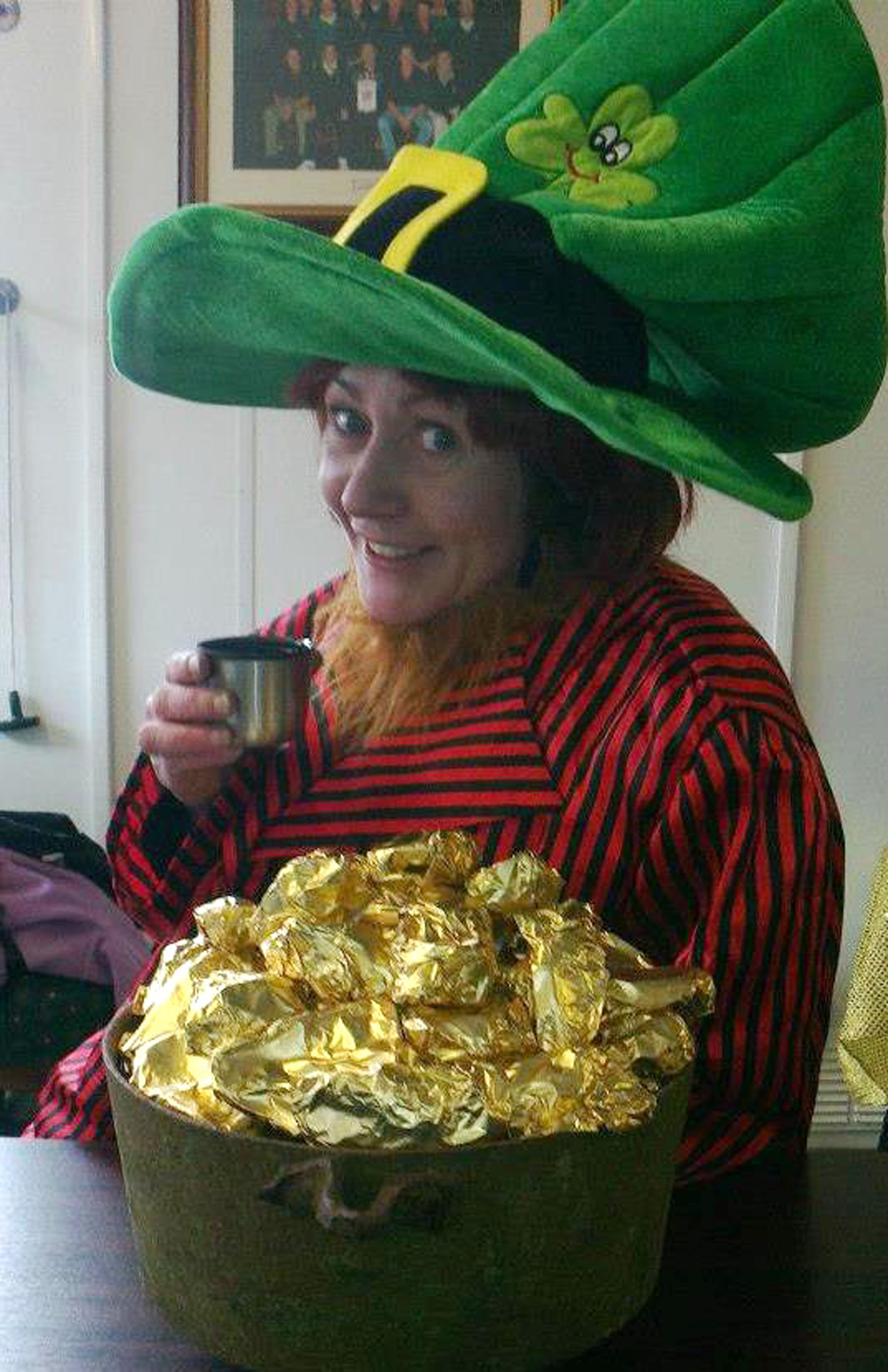
leprachaun

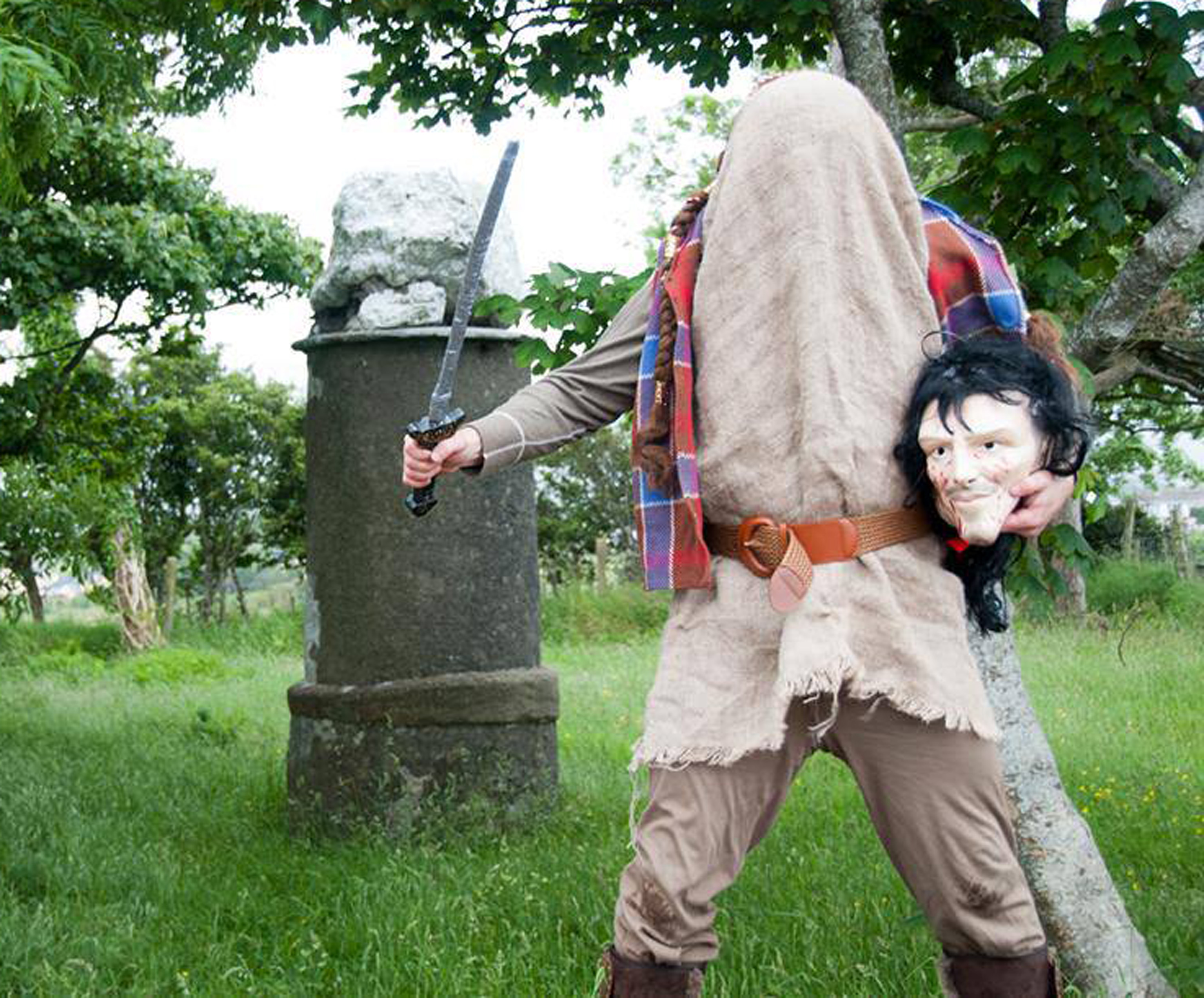
That brings us to the inaugural and intriguingly-entitled ‘Evil Eye Festival’ (Féile na Súile Nimhe) last year, which Kathleen and colleagues shaped to fit the national tourism campaign ‘The Gathering,’ and which will be repeated this year. Starring five impressive, 7-foot high puppets, two so complex they had to be operated by three people, a large cow structure made of timber and wire designed and made by Kerry Law and her partner Roger O’Shea and a 16-person squad of dynamic samba drummers representing the evil Balor’s army, as well as the assistance of the Cloughaneely Drama Group under the direction of Manus Diver and Joanne Butler and three of the area’s Irish schools of dancing (McCafferty, Maureen Byrne and Kavanagh), Kathleen and her team made local legendary history come to dynamic life. In the environs of Ballyconnell House estate (a verdant community preserve that may soon be turned into a Catholic Church-run drug addiction clinic), the story of the battle between Balor and his grandson, Lugh, son of Eithne, and the stealing of ‘An Glas Gaibleann’ (Cow of Plenty) from Mac Aneely, came to multi-colored life. Narration was in English and dialogue between characters ‘as Gaeilge,’ all replete with witches, faeries and a druidess (Biróg).

pupets 3

“It’s such a fantastic story, just waiting to be told in a multi-art form way,” is how Kathleen described the genesis of the event. “I knew we had a core of very creative people here who were well able to deliver a great spectacle. It was a case of building social capital in the area. We have plenty of local talent here. We just need the resources.”

The response to the festival last year was terrific, Kathleen recalls. “It worked out brilliantly. First of all, the weather stayed kind. And so many people – many of them locals, some of whom didn’t know the details of the legendary story of Balor and Lugh or the story about the stone behind the GAA field – came to enjoy the spectacle. Also, many people volunteered to help, even a plasterer, Martin Whoriskey from Gortahork, who saw us rehearsing at The Yard where he was working and happened to mention that he used stilts in his job to reach high spots. Immediately, we begged him to join us, which he did, playing the role of Balor – on stilts, of course. Aisling Friel from Gortahork, a former member of Cosa Meata Carnival Group, played the role of Eithne, daughter of Balor.”

headless man

For their efforts, the ‘Balor team’ was runners-up in the National Heritage Council award for ‘Most Innovative’ event, as well as the Me2U Donegal Volunteers Award.

Challenges, of course, were many, as they tend to be when launching such an ambitious idea. “It was a brand new project so people were initially a bit bewildered about it at the start. We also needed to find available space, both for the equipment and our life-size puppets, as well as for workshops such as the samba drumming training led by Roger. We were very thankful to Paul Kernan (coordinator) and his team at The Yard, who helped us very much. Sean Fitzpatrick, a wonderful designer, produced our posters and brochures.”

evil eye 1

With this year’s event due to take place between August 22 to 24, Kathleen and her committee – Sarah de Groot (treasurer), Angela Boyle (administrator), Finola Early (costume design), Kerry Law and Roger O’Shea (artistic design), Sean Fitzgerald (graphic design), and Moira Gallagher (public relations), are now focusing their minds on fund-raising, not an easy matter in these recessionary times we live in. Last year, they  raised €3,500 in fundraising for the three-day festival by organizing a ‘couch to circuit’ 5km training programme, a 9-week regime of three sessions of jogging a week; a “Santa spin,’ in which people dressed as the chubby fellow in red and chose any means of transport to move around the Falcarragh area (including ‘suitcases on wheels’ and go-karts); and a leprechaun hunt in the Ballyconnell House estate.

summer

Kathleen would like to develop her team’s ideas further and expand the yearly events’ calendar both to entertain members of the local rural community and attract more tourists to the area but urgently requires greater, guaranteed funds to do so. “So much effort goes into fund-raising before we even begin to embark on our ideas and there’s only so many times you can ask someone to volunteer their time and effort,” she said during an interview at An tSean Bheairic this week. “It would be so much easier if we were financially well supported and could focus our efforts more on creating great entertainment, with strong educational value, for young and old alike.”

Kathleen and her merry band of entertainers launch their fund-raising campaign soon. They deserve our full support. Delve deep into your pocket and give generously.

Flesh-eating plants, soaring eagles, Pagan wishing stones – all in a day’s work

His reputation was spoken of highly by good people – Mary McFadden, former headmistress and organizer of the lively ceilidh dances at Teac Jack’s and John Curran voluntary sector leader and aspiring politician. There seemed no-one better to uncover the anthropological and natural wonders of west Donegal for us than this fellow.

Seamus

So that’s how my wife, Columbia, our two small sheepdogs, Siog (‘fairy’ in Irish) and Lugh (who, according to Celtic legend, slew Balor of the Evil Eye) and myself ended up cowering for dear life under the branches of chubby furze bush as hailstones the size of a rabbit’s droppings – though much, much, much harder – pummeled down on us mercilessly from above.

But the drenching we got was worth the wetting (and sure didn’t the sun break out just a few minutes later as if to reassure us we’d be dry soon). For that’s how we got to know about flesh-eating plants, soaring eagles, Pagan wishing stones and Colmcille’s guide to the joy of sex all along the newly-Christened ‘Wild Atlantic Way.’ And many’s another thing that’s in Seamus Doohan’s head about our wee area tucked away in the far corner of this, the Forgotten County.

An electrical contractor by trade, the jolly, bald-headed 48-year-old became fascinated by the immense diversity of natural and anthropological features around him in his native Gaeltacht area of Cloughaneely after he participated in a sports endurance charity event for cancer victims three years ago. There and then he decided to study the local flora, fauna and history in greater depth and to launch a guided walks and navigation service, Walking Donegal, as an added attraction for visiting tourists and for local people. So far, he has taken several hundred on tours, including visitors from countries as diverse as Italy, the US and Japan, as well as guided walks with the Errigal Arts Festival and for schools.

Seamus 2

“We are spoiled for landscape choice in west Donegal, with such a wealth of intricate and colourful plant species and a fascinating history dating back to the time of primitive man and Pagan worship, not to mention the Christian era that came afterwards,” he said.  “There is something mysterious and magnetic about the mountains around us here, with so many routes for walkers of all ages and aspirations.”

Seamus’s walks, which include forest, island, hill and beach, range in duration from one to five hours and are graded 1 through 5 in terms of difficulty, from flat terrain to challenging gradients. They traverse places such as Horn Head, Ards Forest Park, Sli an Earagail, Dunlewey Glen, Tory, Innisboffin and Arranmore, as well as the Joey Glover Challenge, a walk from Muckish to Errigal “taking in all the mountains in between.”

devil's matchstick

Halting momentarily on the way up rolling fields to Lough Altan near Errigal, Seamus suddenly bends down and parts some blades of grass. Hidden beneath is a tiny plant with a vivid red head. ‘Devil’s matchstick, or cladonia cristatella,” he says, then points to a spot a few feet away. “And over there, some Devil’s chalices.”

devil's chalis

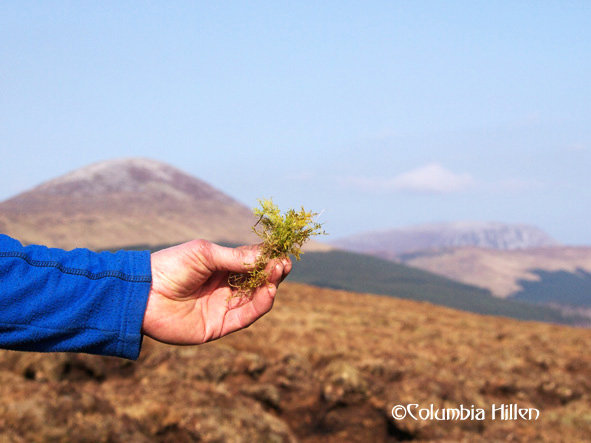
Running his fingers over a spread of soft lime-green moss, he adds, “Sphagnum. During the First World War there was a shortage of bandages and they used this to stem the flow of blood, especially from bayonet wounds. But there are a hundred other varieties.” He swings round on his hunkers to gaze at a small plant with what looks like a set of animal horns on top. “That’s staghorn. And there’s club and fern over there. Beside them, that’s bell and ling heather. You can dry their flowers and make healthy herbal teas out of them.” Turning again, his eyes searching closely, he adds, “There’s some tormentil flowers. They’re yellow in summer, natural antiseptic to ease toothaches. And there, sundew plants. They’re carnivorous, the glands on their leaves emit a sticky gel to traps insects. They then eat them to supplement the poor mineral nutrition of the soil in which they grow.”
Spagnum

Further along, by the side of an old pony and cart track used more than a hundred years ago to get to Altan Farm, he stops again, this time beside a strange rock formation that resembles the open pages of a book.  “I call this ‘leabhar cloch Cholm Ciolle’ (Colmcille’s book of stone). It’s believed the monk, who would have wandered these hills, secretly copied a mysterious text. Who knows? This could be it – magically petrified.” Somebody nearby says the book in question was probably ‘The Joy Of Sex” – a particularly delightful illustrative book that helped enlighten me greatly in the face of strict Catholic doctrine on the sacrosanct subject. But Seamus rightly ignores my nostalgic ramblings. And rambles on up the hill.

book

Below in the sunshine, the ruins of a once sturdy, castle-like structure stands at the head of the lough, still defying the elements after all these years. To our left a herd of deer dart away on to higher ground while above us two eagles glide effortlessly, on the sharp lookout for unwary prey.

eagles

Later, up a steep climb behind Gortahork, Seamus, who is secretary and training officer of the North West Mountaineering Club, points to two round indentations carved out of bare stone, resembling an alien’s head. “Cup or ring marks, prehistoric art,” he says. “Sometimes known as wishing stones in Pagan times. Supposedly the water that gathers in them heals warts, thus the Gaeilge name, Tober na bhFáithní (the Wart Stone). ”

alien

Out at Ray, he stops at a ruined church and flat run of fields beyond, “This is known as ‘Lag na gCnámh,’ the resting place of bones, after a massacre that occurred here in the 17th century,” he ssays. “No-one knows exactly where the bodies are but there’s a lot of them under this soil somewhere.” In a hillside graveyard outside Falcarragh, he stands in the wind and rain, gazing east, “Amazing to think that druids long ago in their big, flowing cloaks stood right here with this amphitheater of hills in front of them and prayed to Nature.”As he spoke and the hailstones started pouring down again, I wondered if he might just take on the role, burst into a chant and invoke the Sun God to smile upon us.

Ray church