Amharclann Donegal kicks-off innovative drama project linking five Irish theatres

by Sean Hillen

An innovative drama project linking five different Irish theatres kicked-off this week with two performances at Amharclann in Donegal.

Supported by the International Fund for Ireland’s Communities in Partnerships Programme (CIPP), the project is a co-production between Amharclann in Bunbeg in the heart of the Donegal Gaeltacht and the Waterside Theatre and Arts Centre in Derry of the play ‘‘Observe The Sons Of Ulster Marching Towards The Somme’ by Donegal-born playwright Frank McGuinness.

This thought-provoking play, coincidentally hosted at the Amharclann on the same day as the United Nations International Day Of Peace, focuses on the experiences of a group of Ulstermen in the trenches of World War One who take part in the battle of the Somme. While a military setting, the play raises many themes including homosexuality, homophobia, the inner conflict of self-respect, bravery, patriotism, friendship and sacrifice. 
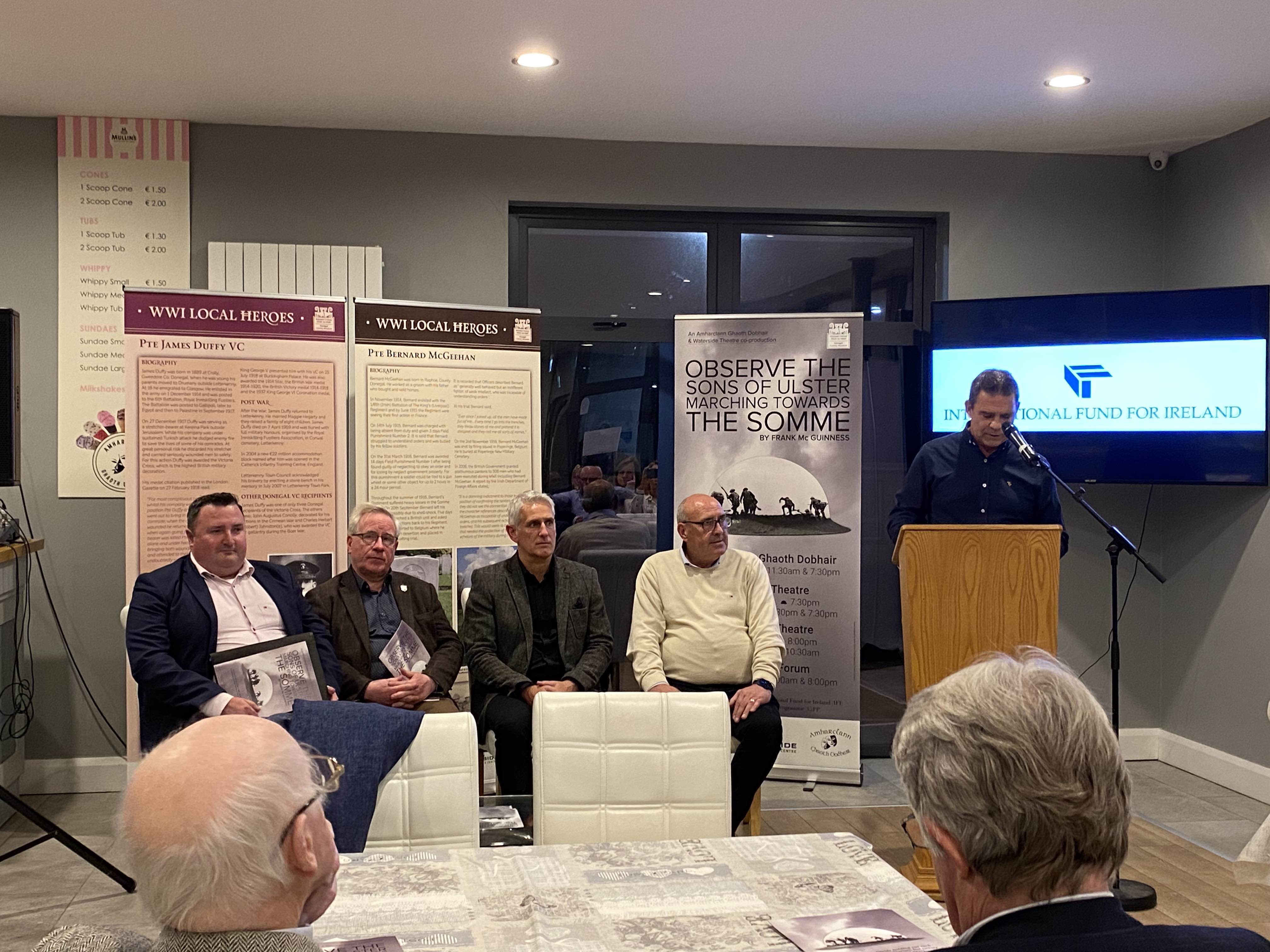
Panel of speakers at an interesting post-performance Q&A event at the Amharclann.

Enjoying the play, one is left with a vexing question: Is the play about the futility of war? The nature of loyalty, friendship and heroism? Or an examination of the protracted Protestant-Catholic northern Irish conflict from a completely different perspective? Or all of the above?

Whichever it is, this production is a two-hour, richly-rewarding theatrical experience that offers a balanced mix of black humour and poignancy with credible characters well developed through very fine acting.

Director David Grant together with production and stage manger, Fiona Harkin, assistant director, Ronan Hamill, lightning designer JP Conaghan and composer, Rebecca Doherty and the rest of the team have re-created the moving story of ordinary men – among them a blacksmith, a weaver and a baker – who set off patriotically to fight ‘the Hun’ but become disillusioned with the myth about war they’ve been sold.  

The play opens with a crippled man, Old Pyper, played by Shaun Byrne, who steps on stage alone, war medals pinned to his chest, and calls forth the ghosts of his former comrades who were all killed. Mystified as to how he survived the terrible battle, he is haunted by the images of those who died in the trenches, who then slowly, phantom-like, emerge from the shadows at the edges of the stage and stand motionless.

Theatre-goers mingle together for friendly discussions at the play’s intermission.

This sets the scene as to what follows, nostalgic flashbacks to the barracks where the men from places such as Derry, Armagh, Coleraine, Enniskillen and Belfast, gather for their first day of training and on to the sand-bagged first world war trenches where they face death together. Kudos go to Harkin and Conaghan who create a well-designed set, in which the barracks with wooden slats for beds is later transformed brilliantly into World War One trenches. Murals along the stage also add intriguing ambience, one of which depicts the ancient Celtic legendary hero, Cú Chulainn.

I particularly liked how a series of intense interlocking vignettes between couplets of men were enhanced by lighting and space, as well as by the thunderous roar of a Lambeg drum, a triumphalist symbol of the Protestant Orange Order in Northern Ireland. The military uniforms and equipment were also striking in their sheer authenticity. 

The tone of the play is bittersweet and philosophic, with elements of both black humor and solemnity. Patrick Quinn plays the younger version of Pyper wonderfully. An openly-gay man of aristocratic background who volunteered for army service, Quinn grants him a carefree, reckless air behind which lurks a man of deep sentiment and a troubled mind. A multi-faceted person – cynical, seemingly on the brink of madness, brash, supercilious, bold to the point of foolhardy, wickedly direct, yet at the same time, a vulnerable and lost individual. 

His anecdote about his three-legged French wife is highly amusing and a love scene involving him is touching in its quiet, side-stage minimalism. One character saying the ‘Huns’ speak Gaelic also creates a light-hearted moment. In contrast, depiction of one man’s despair and breakdown in the face of danger is touching, even more so as his friend tries to help.

While all the characters, except Pyper, are Northern Irish Protestant Unionists, one of the men admits something mid-way through the play which creates added intrigue and requires the attention of a military minister. 

Pyper is the exception to the anti-Fenian rants of the other men, being unwilling to indulge in such narrow-minded northern Irish tribalism and more keenly aware of the ‘sandbag’ nature of their being sent ‘over the top’ and into battle. He even demands of his fellow soldiers to answer the question as to why they are there.

Some Irish Republicans may be upset by the anecdotal joke told about rebel leader, Padraig Pearse, executed after the 1916 revolution, as someone who told his enemies he was only posting a letter when he took over Dublin’s main post office to launch the revolution, but this reflects the wit Frank McGuinness is renown for.   

Bulgarian visitors to Gaoth Dobhair – (l to r) Peter Petkov and Vanya Kovacheva – were among an enthusiastic audience at Amharclann theatre in Bunbeg, Donegal earlier this week

One of my favorite lines from the play, for reasons I’m not quite sure of, is ‘To hell with the truth as long as it rhymes.’

Ultimately, the play is about the fragility of life and the futility of war. In the end, one is left with the belief that the soldiers are united in one thing – fear of death – and that real heroes are ordinary people and unfortunately ordinary people remain ordinary because they don’t get recognised as much as they deserve. 

Local Donegal ladies enjoy a wee bit of craic and an evening’s entertainment at the Amharclann.

The play will be hosted today (Saturday) at the Lyric Theatre in Belfast, tomorrow at An Grianan Theatre in Letterkenny and next week at the Millennium Forum in Derry. 

In a post-event Q&A, Pol McCool, board chairperson of Amharclann theatre in Bunbeg, spoke about the need to build bridges between communities to help break down barriers and to appreciate shared history and values. 

Director David Grant (l) enjoys the company of friends during intermission at the Amharclann.

Stephen Barrett, manager for Donegal of the International Fund for Ireland, talked about the role of community leaders in peace-building projects and described the evolution of this co-produced project. He also spoke eloquently about his own reaction upon seeing the graves of those who died in the trenches in Belgium and France during the First World War. The IFI was established in 1986 with financing from many countries including the US, Australia and Canada and the play was supported by the organisation’s. 

Director David Grant talked about the challenges involved in creating the production and the overriding need for people to challenge mythology about wars.

Aine Ni Churrain, former presenter at RTE Raidió na Gaeltachta and a board member of Amharclann, thanked the audience for attending the two performances at the theatre, as well as everyone involved in developing and hosting the project and wished actors, director, producer and all the technical staff every success in the other theatres where it will be held.

Waterside Theatre CEO, Iain Barr, also thanked everyone for their concerted efforts in creating a memorable theatrical event with such an important social and moral message that contributes to greater peace and understanding among communities.

Video links to some of the speakers are on my Facebook – https://www.facebook.com/hillensean and https://www.facebook.com/worlditinerariespage
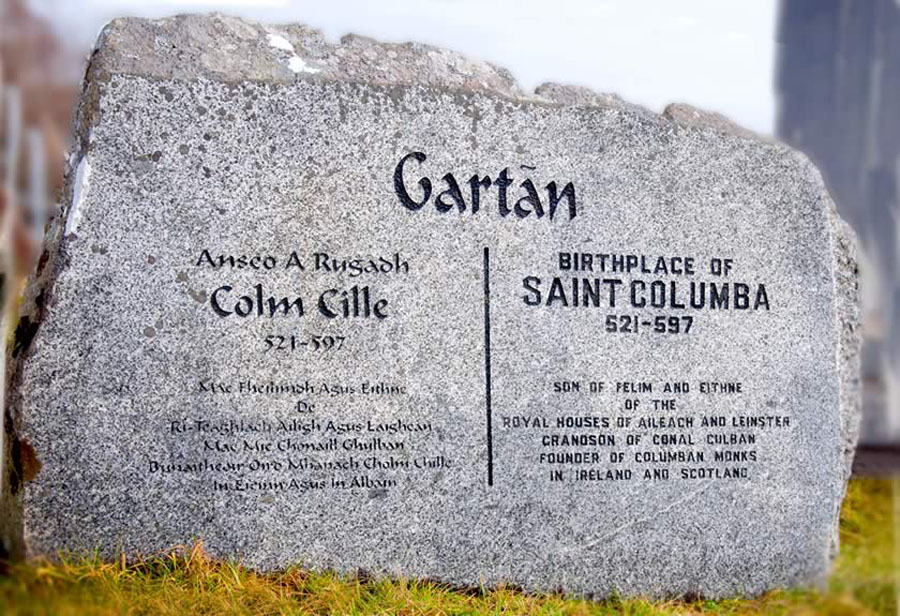
Columba: saint, soldier or New Age Pagan?

Columba, considered saintly by some, charismatic by others, was a bit of a ‘cute whore,’ a caustic and cantankerous character, a male chauvinist, thrifty to the point of miserliness and perhaps a non-entity who did diddly squat except be a pawn for powerful war lords vying over territory in early Ireland.

Such are the colorful views of some leading historians, archaeologists and writers gathered recently in what is considered the Celtic mystic’s ‘home place’ of west Donegal to deconstruct aspects of the legendary fellow’s life. The three-day conference at Loch Altan Hotel, Gortahork, was organized by The Islands Book Trust, led by John Randall, ably assisted by the ever-helpful Mairi NicChoinnich, in association with Colmcille Éirinn is Alba.

Photo by Alan Sproull

Rural west Donegal – the area is considered the ‘home place’ of the legendary Columba. Photo by Alan Sproull

So who then was responsible for some of the magnanimous stories about this larger-than-life character and his supposedly ‘unEarthly’ powers and their ultimate adoption as mainstream belief? A new, ambitious group hell-bent on making sure it rose to the top of the ‘Champions League of Religions’ table, that’s who. Not an easy task, mind you, for developing Christianity faced well-established teams of equally high calibre, many with loyal fan bases, catchy club anthems, ambient arenas and good-looking kits – all well-suited to the emotional needs and superstitions of Irish people around 2,000 years ago.

To compete with the Red Devils, Gunners, Barças, Reals, Inters and Juves of the religious world, Christianity had to go on the transfer market to strengthen its position. And it didn’t much waste time about doing so either, quickly transferring a bunch of Pagan symbols – wells, crosses, incense, wreaths, bells, chants, ceremonies – even wedding rings – under its spreading angelic wings.

But that wasn’t enough. With solid defensive work and fine attacking play, opposing teams held out well against them.

Then leaders of the new movement put their collective heads together and in an illuminated moment of intellectual brilliance (in lingo religiosa ‘the Holy Spirit came upon them’) realized the one vital ingredient missing from their strategy – the persuasive power of an ancient, as well as modern, condition known commonly as ‘celebratitis.’

picts

Using Pagan symbols such as the cross, Columba may have persuaded tribes-people to a different way of thinking.

So, as one does when one has rising aspirations of political greatness, they created a sub-committee. A subcommittee with the sole purpose of weaving together stories on selected individuals, stories so grandiose and wondrous they’d make celebrities out of any plain Peter, Paul and Mary, alive or dead. In fact, their preferred choice was the latter, for among all the beliefs abounding – then and now – there’s one you can be pretty damn sure of –- it’s difficult to argue with a corpse.

Thus was born the legend of Columba – about whom, conveniently for his ‘handlers,’ conjecture heavily outweighs fact.

Hell-bent on their mission, monks of the newly-fashioned Christian organization created a carefully-crafted chronology of the fellow’s life that they entitled ‘Chronicles of Iona’ but while others mention a library in Kilmacrennan where it might have been housed, no-one has found a single shred of evidence of it (or such evidence, for reasons of strategy, has been craftily shifted to location unknown). A censored part of it is in the ‘Annals of Ulster.’ In it is included details of what they purport to be miracles (seemingly the head gaffer put around a memo to his fellow brethren asking for submissions as they were a bit short on anecdotes) and other material supporting their cause, including their anti-woman crusade (all contributions welcome as to the origin of this particular stance). For example, Columba is supposed to have banished all women from Iona, warning others to be wary of them, not to give them too much power, or – interestingly – too much water, one conference speaker claimed.

As for his alleged saintliness, historians indicate Columba – like many other monks of the time – often believed the secular to be more sacred than the spiritual and were mere ciphers for rival, warring factions, at a time when churches were placed on territorial borders as symbolic deterrents or markers. It is believed Dai Riada, the king of the area associated with Columba, might have wanted to expand his holdings and used our fellow solely for that reason.

Fired up by his missionary zeal, Columba also supposedly skedaddled hither and thither all over Europe. But, just as in the case of saints’ relics, he’d have to have been cloned to be in all the places he is supposed to have been, doing the things he is supposed to have been doing. Some believers, for example, say he was not only involved in discovering the holy wells of Derry but was the actual founder of that particular northern Irish city. There’s little contemporary evidence of this. Due to the gap of years between his death (around 593) and the city’s founding, he’d have to have been a time-travelling vampire to have accomplished the task. Another monk, Augustine, is more central to Derry, having established a church there since the 600s AD. At best, Columba’s favorite Uncle Fiachra was Derry’s founder but again evidence even of this is severely lacking.

According to Christian slant, Columba is also thought to have brought back the so-called Gospel of Martin from Tours in France. Please don’t ask me to accept this on ‘blind faith.’ That’s like the blind leading the blind, and there’s no easier way to go astray than that. More likely, with spelling in those days being less than precise and Tory Island known in documents as Toraigh, Toirinis and Tourensis, it was a case of geographical misplacement (or story enhancement).

iona

Iona – a windswept Scottish island that reflects the heritage of the legendary Celtic mystic.

Even the much talked about Battle of Cúl Dreimne near Ben Bulben in Sligo – allegedly fought over Columba’s illegal copying of a book (‘to every cow its calf and to every book its copy’) and his banishment to Iona – this may simply have been the workings of an over-imaginative scribe in a cloistered scriptorium. Instead, the battle may have been over the killing of man, who was under Columba’s protection, by Diarmait mac Cerbaill, High King of Tara. Some say the leader of a monastic settlement in Inismurray Island, Sligo, then told Columba bluntly it would be‘better’ to high-tail it out of town and across the water (others say he may have left out of guilt at causing so much bloodshed).

Regardless, what seems to be true is that there was no love lost between Columba and Diarmait. Diarmait, the last High King to worship in the Pagan manner and who celebrated the Feast of Tara, the pagan inauguration ceremony, was not keen on this new Christian doctrine, seeing it as an opportunistic usurper. The Irish annals include a reference to him even building druid fences on the battlefield.

As for Columba being caustic and cantankerous, word has it that he’d simply curse people he didn’t like. One man who pretended he was asleep to avoid talking to him ended up snoozing for a year and a day. Poked in the eye by a reed while tying his shoe, Columba cursed all reeds, thus the reason they’re brown and no longer sharp. After slipping on a salmon…… well, I’ll let you conjure up for yourself what curse Columba might have bestowed upon those innocent little creatures.

Amidst all the fact, fiction and propaganda, what emerges is that Pagan leaders and Christian monks and their supportive warring chieftains battled each other for territorial advantage and the spoils of victory that came with it.

Whether you believe Columba was your average Joe Blow or a saint, a term open to so many interpretations (one speaker at the Gortahork conference referred to him as “a bit of a James Bond character”), the cult that grew around him makes for fascinating anthropological and sociological discussion.

That is why the Slí Cholmcille (Slighe Chaluim Chille) project, a partnership between Foras na Gaeilge and Bòrd na Gàidhlig, could be a boon for cultural tourism. After hundreds of years, wouldn’t it be nice for communities, and not only the church, to benefit from such a legendary figure? Developing Ireland’s very own ‘Santiago Columba’ into a successful pilgrimage project could attract thousands to both western Scotland and Ireland.

For further information, see the book by University College Cork’s Máire Herbert (Iona, Kells, and Derry: The History and Hagiography of the Monastic Familia of Columba) and Brian Lacey’s (Saint Columba: His Life & Legacy).

A note of caution: when reading about Columba and his exploits it is probably helpful to keep in mind the old adage – History is written by the victors.

A poem attributed to Columba is also worth musing upon –

“If poet’s verses be but fables

So be food and garments fables

So is all the world a fable

So is man of dust a fable.”