Gardeners And Herbalists Gather In Killybegs

Avid gardeners, herbalists and Nature lovers from countries as diverse as South Africa, England and Ukraine as well as many parts of Donegal gathered this week in Killybegs to share their knowledge about health-giving herbs and plants.

The well-attended event at the Niall Mór Community and Enterprise Centre was part of the Social Inclusion and Community Activation Programme supported by the Donegal Local Development Company, with more than 30 participants learning to integrate everyday garden flora into tasty dishes supporting digestion, blood circulation, cardiac issues and to help balance blood-sugar levels. 

“It’s very important we bring back the knowledge about harnessing the goodness of Nature as food and medicine,” said west-Donegal based Joanne Butler, Climate Action Officer with DLDC, and founder of OURganic Gardens who organised the event. “The benefits include nutrition, mental and physical health and community resilience and care for the environment. The DLDC programme started two years ago and my role is to coordinate community garden network events and help such initiatives with good governance, funding, awareness-raising and other supports they need.” 

Guest presenter at the Killybegs event was Columbia Hillen, a member of the Irish Register of Herbalists and the Association of Master Herbalists, who will also host various workshops at Anamcara Healing Herbs Garden in Gweedore. 

Columbia Hillen, medical herbalist who held the workshop.

Susanna Friel, from London, who bought an 8-acre smallholding in Donegal, said “The workshop helped transform the way we look at ‘weeds’ as ‘enemies’ and turn them into friends. Columbia showed how easily-recognisable plants such as dandelions and cleavers can be turned into – not just medicines – but delicious ingredients in our everyday diets to maintain robust, glowing health.“

Tish Yelland, a retired kinesiologist who arrived in Donegal from South Africa over two years ago and ‘bushwhacked’ farmland that was fallow for a decade, said, “Plants such as lawn daisies and bramble have healing superpowers used for centuries by our elders. How absolutely refreshing to know there is a herbalist right here in Donegal who educates and empowers people to re-discover a love of weeds. Columbia communicated her knowledge in a relaxed and fun manner but also invited us to share our experiences about foraging and best use of plants for nutrition. Mixing gorse in butter makes it taste even better. As for pesto made from nettles, it’s simply scrumptious. Who’d have thought such an irritating plant could be so good.”

Ronan McNern from Shy By Nature Farm, a community-based project in Inver that sells homegrown vegetable boxes in south Donegal, said, “Since attending the workshop, my volunteers have been busy making healing recipes from dandelions, gorse flowers and nettles. No better way to stay healthy.”
Halloween surprises and other encounters in the company of Dracula

Meeting someone who travels the world investigating fairytales and a Gothic expert who specialises in all things spooky and supernatural as well as seeing a vampire killing kit – these were among highlights of my pre-Halloween sojourn this past week in Dublin.

Asked to give a lecture separating historical fact from literary fiction associated with Irish author, Bram Stoker, his arch character, Dracula, and medieval warlord, Vlad the Impaler, I was delighted to stand Saturday afternoon before a capacity audience in the Mansion House, the Lord Mayor’s official residence, relating my adventures researching ‘Digging for Dracula.’

photo 1

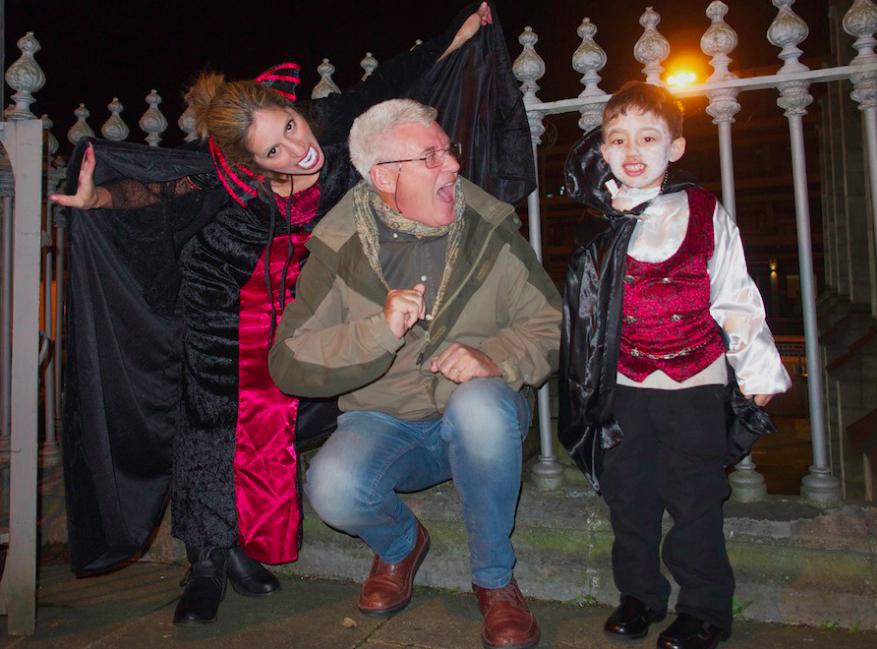
Imagine my surprise when confronted by Dracula Junior and his mother in the ghostly grounds of Dublin Castle last Friday night.

Now an annual event, the Bram Stoker Festival took place at various suitably atmospheric venues including the eerie, shadowy Chapel Royale inside the grounds of Dublin Castle and the Samuel Beckett Theatre deep within the cobbled-confines of Trinity College, where Ireland’s 19th century best-selling novelist was once a humble student.

photo 2

(l to r) Enjoying the company of Vanessa Fox O’Loughlin founder of the Inkwell Group and organiser of the festival’s literary programme; Professor Bill Hughes, Bath Spa University; and Angela Dinu, an authentic Transylvanian from Brasov.

Such is the fascination with Stoker’s immortal long-toothed Transylvanian Count, the festival events earlier this week attracted hundreds of people, both speakers and participants. Before and after my talk I was approached by people from places as diverse as Rome, Warsaw and Las Vegas, all keen to discuss ‘beyond-the-grave’ mysteries.

Christa Thompson, from Florida, travels throughout the world investigating and writing about folk stories, while Ed Mooney, from Kildare, combines his passion for photography with his deep interest in history, ancient sites, folklore and mythology. Much of Edwards’ free time is now spent traveling around the Irish countryside in search of his next adventure, which he fondly refers to as ‘ruin-hunting.

photo 3

(l to r) In the delightful company of Intrepid folklore investigators from Ireland and the US.

Lara Musto, a highly-qualified librarian and researcher, originally from Rome was among the participants. She said she had been fascinated by Bram Stoker’s work ever since she was a child, “Believe it or not, my father used to read me vampire stories at bed-time, and they helped me sleep. So you can imagine, I’ve really enjoyed the talks I’ve attended here in Dublin during the festival.”

Asked the inevitably question whether I believed in the infamous nocturnal blood-sucking creatures (known as ‘strigoi’ in Romanian folklore), I answered, both evasively and diplomatically, I must admit: “Just because something is written about doesn’t mean it’s true. But then again, just because we don’t see something doesn’t mean it’s not.” What else could I say? Not having seen either Donegal fairies or Transylvanian vampires, I remain doubtful but very much open-minded.

Credit must go to the Bram Stoker Festival organisers who provided a plethora of delightful activities for everyone. These ranged from walks with experienced guide, Pat Liddy who brought to life spine-chilling tales such as Stoker’s ‘Dracula;’ Irish Gothic writer Sheridan Le Faanu’s ‘Carmilla’ and Oscar Wilde’s ‘The Picture of Dorian Gray;’ book readings and a cosy Q&A with authors Lynne Truss  and Joanna Briscoe who penned ghostly tales for Hammer Classics, an imprint of Random House; and lively music every night. Light-hearted humor was the hallmark of a funky ‘Literary Death March’ at Smock Alley Theatre, where writers such as Lynn Shepherd read their work and competed with others before a panel of judges, with audience participation in a rousing literary quiz finale.

photo 4

Flying witches, goblins and vampires – all part of the Bram Stoker Festival in the Oak Room of the Mansion House in Dublin.

The festival – sponsored by Failte Ireland and Dublin City Council – also featured a tantalising discussion entitled ‘Madness and Sexuality’ at which Paul Murray, a former cultural attaché at the Irish Embassy in London and a Stoker biographer, and two doctors, one a psychiatrist, discussed Stoker’s state of sanity when he penned his macabre bestseller.

Much to my surprise, the ‘vampire killing kit’ was among strange artefacts at a special exhibit entitled ‘BLOOD’ at the Science Gallery beside Trinity College, hosted to coincide with the Stoker festival. The ‘kit’ was neatly arranged inside a glass case and included a gun with silver bullets and a hammer and wooden stake (best, I suppose, to be prepared for all eventualities).

photo 5

Gun with silver bullets, a crucifix and a hammer with wooden stakes of various sizes – all elements in a vampire killing kit.