Meet The Real Simon Harris – The Dishonourable Duke Of Duping

Is it not reprehensible – the height of hypocrisy in fact – that Simon Harris the leader of the Irish Government  – has the audacity to accuse Sinn Féin in recent weeks of ‘duping’ people when it expelled several party members for substandard social behaviour?

Simon Harris – the Dishonourable Duke of Duping.

The Cambridge dictionary definition of dupe is ‘to deceive’ and if anyone is guilty of deception, it is Harris and his colleagues in the coalition Government of Fine Gael, Fianna Fail and the Green Party.

Over the last four years since being in power – and for many years before that – these parties have been nothing less than ‘repeat offenders,’ constantly deceiving the ordinary hardworking people of Ireland with false promises of a quality lifestyle as befitting a nation that is one of the earliest members of the European Union, then called the European Economic Community, or EEC for short, back in 1973.

Instead, however, we have one of the most disastrous health systems on the continent, with people waiting years for life-saving surgeries, often dying before they receive it; we are awash in homelessness and poverty, with an estimated people 30,000 living on the streets, including thousands of young children and infants; we have a forsaken, forgotten, forlorn State where retirees and newlyweds alike are unable to afford the rent of a simple home, never mind the financial resources to even remotely consider buying one to end or begin their lives together in a modicum of comfort.

Not only does the Dishonourable Duke of Duping continue to deceive people that after all these years he’ll one day consider putting a roof over our heads, but he himself basks in the lap of luxury in one of the most expensive and elitist places in Ireland, the scenic coastal town of Greystones in county Wicklow, where he was born, where he lives and where houses cost up to two million euro, and more.

But is it not somewhat harsh of us to criticise the Dishonourable Duke of Duping for his lack of common decency? Is it not unfair to ask a man of such Royal blood living in such a high falutin’ environment to understand the plight of so many desperate Irish people? Is that not akin to asking King Charles of England to make his own cupán tae once in a while?

Shamefully, while the wealthy in Ireland (many of whom are the Dishonourable Duke of Duping’s closest neighbours) while away their days in decadent lifestyles with fancy homes in fancy places or travel in  environmentally-damaging private jets (which the Dishonourable Duke of Duping does frequently) and indulge their whims in ostentatious holiday homes abroad (which the Dishonourable Duke of Duping often does), modern Ireland suffers the worst housing shortage in its entire 100-year history. 

Studies show less than a third of 30-year-olds own their home. Over half of all newly-built homes in greater Dublin alone were bought or developed by global vulture investor funds, thus locking countless people out of ever attempting to buy one. These ‘vampire funds’ don’t buy homes to sell, they buy them to extract high rents in perpetuity. In other words, they suck the lifeblood out of decent Irish society.

And to make matters worse, the Dishonourable Duke of Duping and his cadre of Government lackeys allowed a temporary no-fault eviction ban in Ireland to lapse last March, thus opening the floodgates for more than 15,000 notices of termination to be issued last year, making the number of evictions higher than it was during the Famine in the mid-1800s. 

For centuries, gutless, greedy, often absentee, landlords, have been the scourge of Ireland, rich, ruthless people who with the click of a finger, a scribbled signature on a sheet of paper, thoughtlessly tossed hungry families out into the ditches. 

Now it seems the same is happening all over again in modern Ireland, this time under the dictatorial rule of the Dishonourable Duke of Duping and his ignoble entourage.

Instead of urgently dealing with these major social and health issues that are making the lives of so many Irish people intolerable, Harris and his well-to-do cohorts, including Government coalition leaders, Micheál Martin of Fianna Fail and Roderic O’Gorman of the Green Party, are pointing their grubby finger at Sinn Féin, an oft-used political ploy to distract popular attention away from the real issues, and their own failings on them. 

In doing so, however, these ‘I’m-better-than-you’ leaders fail to realise something important. While the bitter winds of winter howl at our doors, while Storm Ashley batters the coast this weekend, Irish people are not bears. They are not hibernating. They are wide awake. And fearful. And hungry. And cold. And they remember the empty promises made to them from on high four years ago, and for many years before that.  

Maybe, just maybe, we should ask Sinn Féin leader Mary Lou McDonald to re-tell the story of these empty promises once more, to remind us how easily we were taken for fools. And in doing so, help us make sure the Dishonourable Duke of Duping and his Royal patrons don’t sneak back into power through the back door and make jesters of us for another four years in their Court of Failure.

Maybe, just maybe, we’ve learned our lesson and are wide awake enough to elect Sinn Féin, the ‘Party of Change’ and improve things for the better. For each and everyone of us, our parents, our children and the generations who come after. 
Amharclann Donegal kicks-off innovative drama project linking five Irish theatres

by Sean Hillen

An innovative drama project linking five different Irish theatres kicked-off this week with two performances at Amharclann in Donegal.

Supported by the International Fund for Ireland’s Communities in Partnerships Programme (CIPP), the project is a co-production between Amharclann in Bunbeg in the heart of the Donegal Gaeltacht and the Waterside Theatre and Arts Centre in Derry of the play ‘‘Observe The Sons Of Ulster Marching Towards The Somme’ by Donegal-born playwright Frank McGuinness.

This thought-provoking play, coincidentally hosted at the Amharclann on the same day as the United Nations International Day Of Peace, focuses on the experiences of a group of Ulstermen in the trenches of World War One who take part in the battle of the Somme. While a military setting, the play raises many themes including homosexuality, homophobia, the inner conflict of self-respect, bravery, patriotism, friendship and sacrifice. 

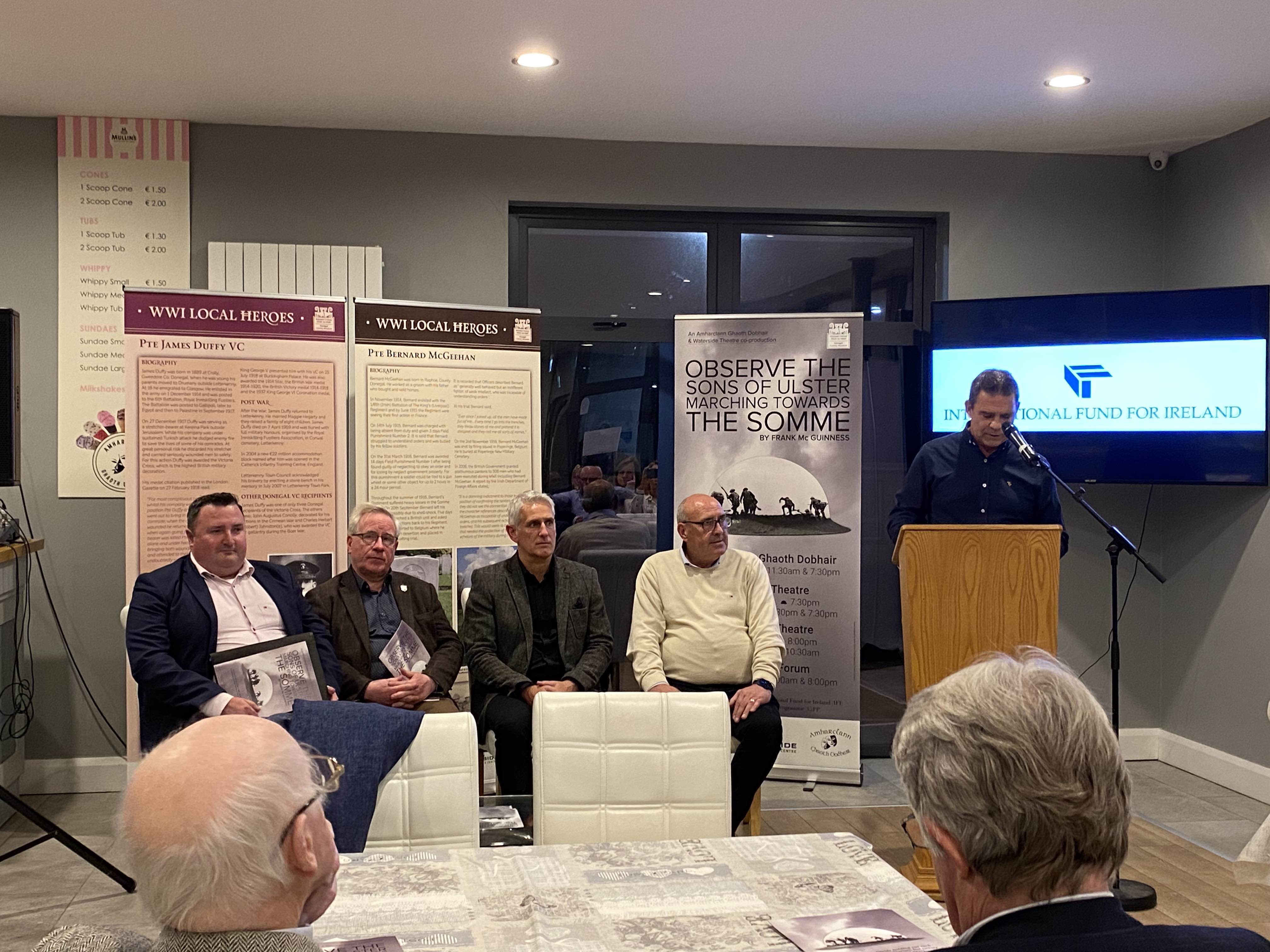
Panel of speakers at an interesting post-performance Q&A event at the Amharclann.

Enjoying the play, one is left with a vexing question: Is the play about the futility of war? The nature of loyalty, friendship and heroism? Or an examination of the protracted Protestant-Catholic northern Irish conflict from a completely different perspective? Or all of the above?

Whichever it is, this production is a two-hour, richly-rewarding theatrical experience that offers a balanced mix of black humour and poignancy with credible characters well developed through very fine acting.

Director David Grant together with production and stage manger, Fiona Harkin, assistant director, Ronan Hamill, lightning designer JP Conaghan and composer, Rebecca Doherty and the rest of the team have re-created the moving story of ordinary men – among them a blacksmith, a weaver and a baker – who set off patriotically to fight ‘the Hun’ but become disillusioned with the myth about war they’ve been sold.  

The play opens with a crippled man, Old Pyper, played by Shaun Byrne, who steps on stage alone, war medals pinned to his chest, and calls forth the ghosts of his former comrades who were all killed. Mystified as to how he survived the terrible battle, he is haunted by the images of those who died in the trenches, who then slowly, phantom-like, emerge from the shadows at the edges of the stage and stand motionless.

Theatre-goers mingle together for friendly discussions at the play’s intermission.

This sets the scene as to what follows, nostalgic flashbacks to the barracks where the men from places such as Derry, Armagh, Coleraine, Enniskillen and Belfast, gather for their first day of training and on to the sand-bagged first world war trenches where they face death together. Kudos go to Harkin and Conaghan who create a well-designed set, in which the barracks with wooden slats for beds is later transformed brilliantly into World War One trenches. Murals along the stage also add intriguing ambience, one of which depicts the ancient Celtic legendary hero, Cú Chulainn.

I particularly liked how a series of intense interlocking vignettes between couplets of men were enhanced by lighting and space, as well as by the thunderous roar of a Lambeg drum, a triumphalist symbol of the Protestant Orange Order in Northern Ireland. The military uniforms and equipment were also striking in their sheer authenticity. 

The tone of the play is bittersweet and philosophic, with elements of both black humor and solemnity. Patrick Quinn plays the younger version of Pyper wonderfully. An openly-gay man of aristocratic background who volunteered for army service, Quinn grants him a carefree, reckless air behind which lurks a man of deep sentiment and a troubled mind. A multi-faceted person – cynical, seemingly on the brink of madness, brash, supercilious, bold to the point of foolhardy, wickedly direct, yet at the same time, a vulnerable and lost individual. 

His anecdote about his three-legged French wife is highly amusing and a love scene involving him is touching in its quiet, side-stage minimalism. One character saying the ‘Huns’ speak Gaelic also creates a light-hearted moment. In contrast, depiction of one man’s despair and breakdown in the face of danger is touching, even more so as his friend tries to help.

While all the characters, except Pyper, are Northern Irish Protestant Unionists, one of the men admits something mid-way through the play which creates added intrigue and requires the attention of a military minister. 

Pyper is the exception to the anti-Fenian rants of the other men, being unwilling to indulge in such narrow-minded northern Irish tribalism and more keenly aware of the ‘sandbag’ nature of their being sent ‘over the top’ and into battle. He even demands of his fellow soldiers to answer the question as to why they are there.

Some Irish Republicans may be upset by the anecdotal joke told about rebel leader, Padraig Pearse, executed after the 1916 revolution, as someone who told his enemies he was only posting a letter when he took over Dublin’s main post office to launch the revolution, but this reflects the wit Frank McGuinness is renown for.   

Bulgarian visitors to Gaoth Dobhair – (l to r) Peter Petkov and Vanya Kovacheva – were among an enthusiastic audience at Amharclann theatre in Bunbeg, Donegal earlier this week

One of my favorite lines from the play, for reasons I’m not quite sure of, is ‘To hell with the truth as long as it rhymes.’

Ultimately, the play is about the fragility of life and the futility of war. In the end, one is left with the belief that the soldiers are united in one thing – fear of death – and that real heroes are ordinary people and unfortunately ordinary people remain ordinary because they don’t get recognised as much as they deserve. 

Local Donegal ladies enjoy a wee bit of craic and an evening’s entertainment at the Amharclann.

The play will be hosted today (Saturday) at the Lyric Theatre in Belfast, tomorrow at An Grianan Theatre in Letterkenny and next week at the Millennium Forum in Derry. 

In a post-event Q&A, Pol McCool, board chairperson of Amharclann theatre in Bunbeg, spoke about the need to build bridges between communities to help break down barriers and to appreciate shared history and values. 

Director David Grant (l) enjoys the company of friends during intermission at the Amharclann.

Stephen Barrett, manager for Donegal of the International Fund for Ireland, talked about the role of community leaders in peace-building projects and described the evolution of this co-produced project. He also spoke eloquently about his own reaction upon seeing the graves of those who died in the trenches in Belgium and France during the First World War. The IFI was established in 1986 with financing from many countries including the US, Australia and Canada and the play was supported by the organisation’s. 

Director David Grant talked about the challenges involved in creating the production and the overriding need for people to challenge mythology about wars.

Aine Ni Churrain, former presenter at RTE Raidió na Gaeltachta and a board member of Amharclann, thanked the audience for attending the two performances at the theatre, as well as everyone involved in developing and hosting the project and wished actors, director, producer and all the technical staff every success in the other theatres where it will be held.

Waterside Theatre CEO, Iain Barr, also thanked everyone for their concerted efforts in creating a memorable theatrical event with such an important social and moral message that contributes to greater peace and understanding among communities.

Video links to some of the speakers are on my Facebook – https://www.facebook.com/hillensean and https://www.facebook.com/worlditinerariespage