Expenses For Irish Presidency Cost 13,000 Euro Every Single Day

Thankfully, mercy of mercies, the Irish Presidential election is almost over. 

In a few hours, people throughout the Emerald Isle can breathe a sigh of relief. And get on with everyday things, knowing full well that the winning candidate will have barely a whisper of an effect on their day-to-day lives.

They may, however, be a wee bit miffed that election of a person in office for the next seven years with no power to affect their lives will cost them over 35 million euro, over five million a year in salaries and expenses. 

That’s over 13,000 euro for every single day. 

Put another way, it’s over 1,600 euro per hour based on an 8-hour working day.

That could pay salaries for a helluva lot of nurses and doctors to help strengthen Ireland’s woeful health system. Not to mention what it could do for struggling schools and community centres.

It begs the question – Is it worth it?

Sadly, this presidential contest, if one can dignify it with this word, is also probably the most boring in living memory, aside from a single mini-drama when one of only three candidates dropped out, no doubt realising being so far behind in the opinion polls, he’d probably come in fourth. 

It’s also sad that as the two candidates in the race have been well-established party supported national political figures for many years, real refreshing innovative change is obviously not on the Irish agenda for the foreseeable future. Something that’s probably welcome to some of Ireland’s politicians as their salaries and expenses are quite lucrative. Certainly compared to other countries.

This Presidential election has turned out to be the predictable cliche, Left Versus Right scenario, a pretty straightforward political party battle, with Catherine Connolly, who simply left the Labour Party because she wasn’t picked as an election candidate, head and shoulders intellectually above her rival, Heather Humphreys, former Minister for the Fine Gael coalition government partner. A lady who started her campaign with a fixed butter-wouldn’t melt-in-my-mouth regal smile until, seeing herself well behind her rival, suddenly grew fangs. Much too late.

What’s most depressing about this whole Presidential affair is that the leading parties in Ireland turned this election into ‘them-versus-us’ party political battle, thus making sure the next President of Ireland, the only position based on a national vote, would not be handed to a truly Independent candidate with experience on both the left and right of centre, someone from a working-class background but successful in business, someone with fresh new ideas, vision and comprehensive international experience, something sadly neither candidate possesses.

Welcome to Ireland. Land of the Status Quo!

Amharclann Donegal kicks-off innovative drama project linking five Irish theatres

by Sean Hillen

An innovative drama project linking five different Irish theatres kicked-off this week with two performances at Amharclann in Donegal.

Supported by the International Fund for Ireland’s Communities in Partnerships Programme (CIPP), the project is a co-production between Amharclann in Bunbeg in the heart of the Donegal Gaeltacht and the Waterside Theatre and Arts Centre in Derry of the play ‘‘Observe The Sons Of Ulster Marching Towards The Somme’ by Donegal-born playwright Frank McGuinness.

This thought-provoking play, coincidentally hosted at the Amharclann on the same day as the United Nations International Day Of Peace, focuses on the experiences of a group of Ulstermen in the trenches of World War One who take part in the battle of the Somme. While a military setting, the play raises many themes including homosexuality, homophobia, the inner conflict of self-respect, bravery, patriotism, friendship and sacrifice. 

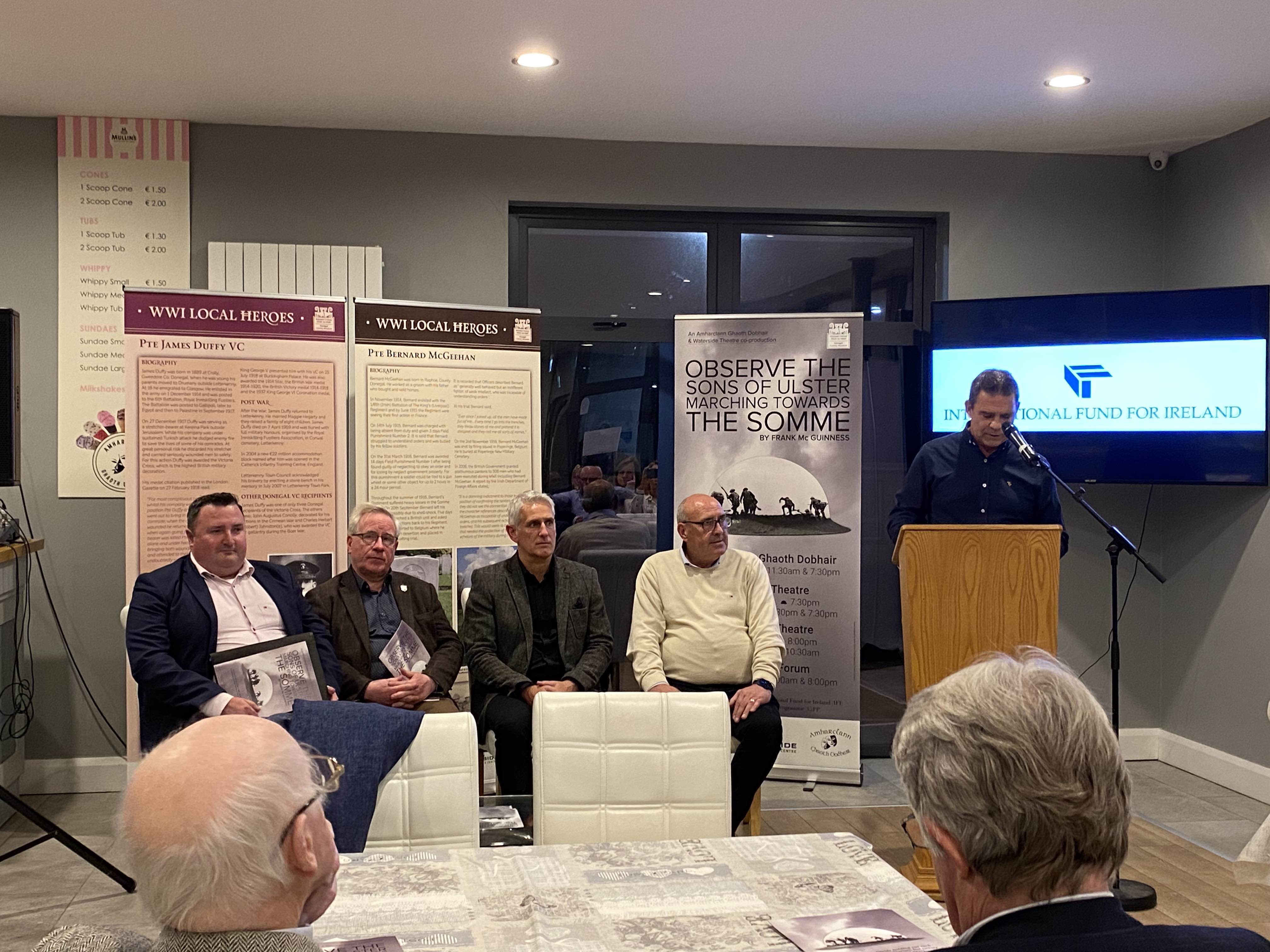
Panel of speakers at an interesting post-performance Q&A event at the Amharclann.

Enjoying the play, one is left with a vexing question: Is the play about the futility of war? The nature of loyalty, friendship and heroism? Or an examination of the protracted Protestant-Catholic northern Irish conflict from a completely different perspective? Or all of the above?

Whichever it is, this production is a two-hour, richly-rewarding theatrical experience that offers a balanced mix of black humour and poignancy with credible characters well developed through very fine acting.

Director David Grant together with production and stage manger, Fiona Harkin, assistant director, Ronan Hamill, lightning designer JP Conaghan and composer, Rebecca Doherty and the rest of the team have re-created the moving story of ordinary men – among them a blacksmith, a weaver and a baker – who set off patriotically to fight ‘the Hun’ but become disillusioned with the myth about war they’ve been sold.  

The play opens with a crippled man, Old Pyper, played by Shaun Byrne, who steps on stage alone, war medals pinned to his chest, and calls forth the ghosts of his former comrades who were all killed. Mystified as to how he survived the terrible battle, he is haunted by the images of those who died in the trenches, who then slowly, phantom-like, emerge from the shadows at the edges of the stage and stand motionless.

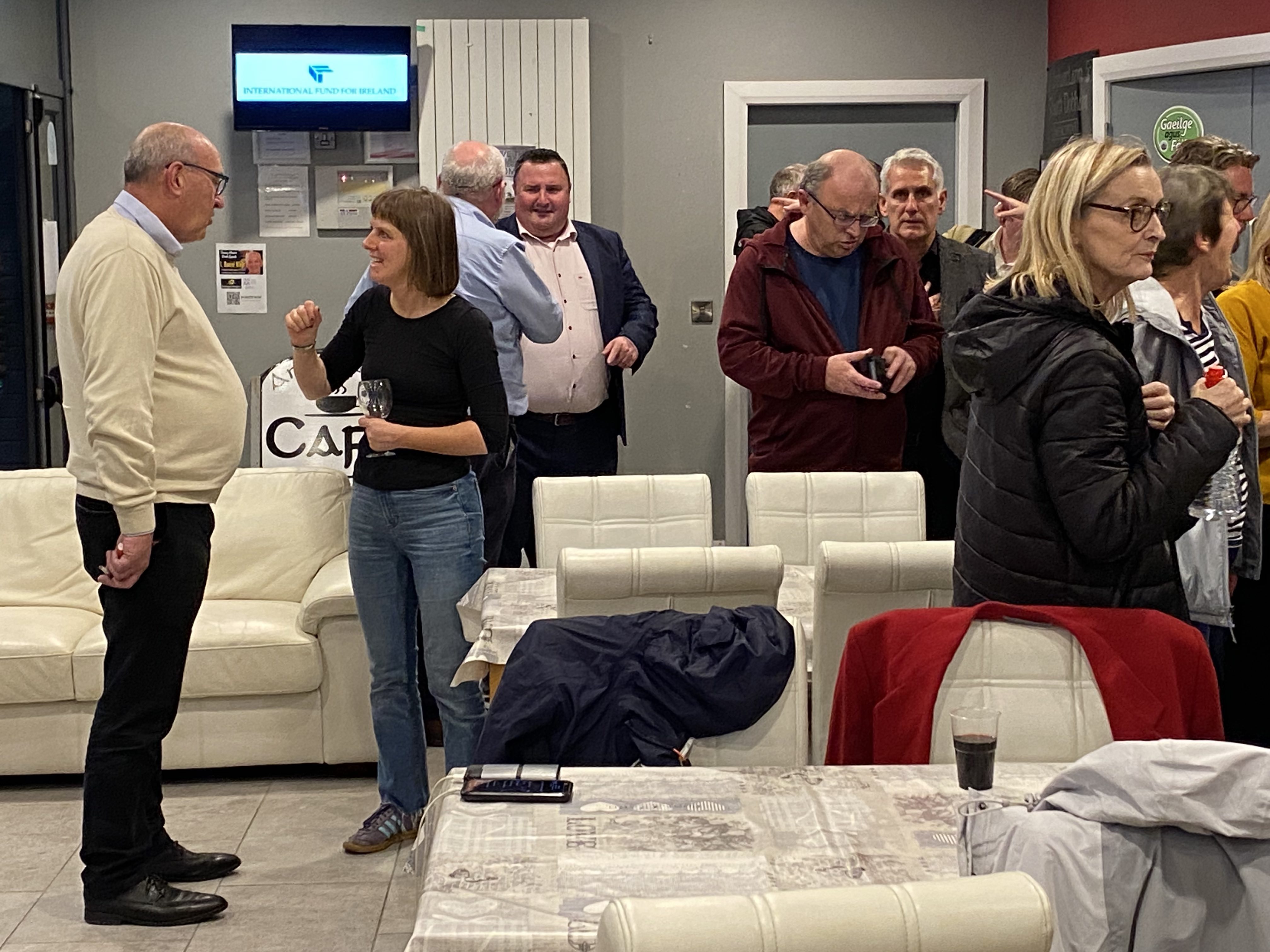
Theatre-goers mingle together for friendly discussions at the play’s intermission.

This sets the scene as to what follows, nostalgic flashbacks to the barracks where the men from places such as Derry, Armagh, Coleraine, Enniskillen and Belfast, gather for their first day of training and on to the sand-bagged first world war trenches where they face death together. Kudos go to Harkin and Conaghan who create a well-designed set, in which the barracks with wooden slats for beds is later transformed brilliantly into World War One trenches. Murals along the stage also add intriguing ambience, one of which depicts the ancient Celtic legendary hero, Cú Chulainn.

I particularly liked how a series of intense interlocking vignettes between couplets of men were enhanced by lighting and space, as well as by the thunderous roar of a Lambeg drum, a triumphalist symbol of the Protestant Orange Order in Northern Ireland. The military uniforms and equipment were also striking in their sheer authenticity. 

The tone of the play is bittersweet and philosophic, with elements of both black humor and solemnity. Patrick Quinn plays the younger version of Pyper wonderfully. An openly-gay man of aristocratic background who volunteered for army service, Quinn grants him a carefree, reckless air behind which lurks a man of deep sentiment and a troubled mind. A multi-faceted person – cynical, seemingly on the brink of madness, brash, supercilious, bold to the point of foolhardy, wickedly direct, yet at the same time, a vulnerable and lost individual. 

His anecdote about his three-legged French wife is highly amusing and a love scene involving him is touching in its quiet, side-stage minimalism. One character saying the ‘Huns’ speak Gaelic also creates a light-hearted moment. In contrast, depiction of one man’s despair and breakdown in the face of danger is touching, even more so as his friend tries to help.

While all the characters, except Pyper, are Northern Irish Protestant Unionists, one of the men admits something mid-way through the play which creates added intrigue and requires the attention of a military minister. 

Pyper is the exception to the anti-Fenian rants of the other men, being unwilling to indulge in such narrow-minded northern Irish tribalism and more keenly aware of the ‘sandbag’ nature of their being sent ‘over the top’ and into battle. He even demands of his fellow soldiers to answer the question as to why they are there.

Some Irish Republicans may be upset by the anecdotal joke told about rebel leader, Padraig Pearse, executed after the 1916 revolution, as someone who told his enemies he was only posting a letter when he took over Dublin’s main post office to launch the revolution, but this reflects the wit Frank McGuinness is renown for.   

Bulgarian visitors to Gaoth Dobhair – (l to r) Peter Petkov and Vanya Kovacheva – were among an enthusiastic audience at Amharclann theatre in Bunbeg, Donegal earlier this week

One of my favorite lines from the play, for reasons I’m not quite sure of, is ‘To hell with the truth as long as it rhymes.’

Ultimately, the play is about the fragility of life and the futility of war. In the end, one is left with the belief that the soldiers are united in one thing – fear of death – and that real heroes are ordinary people and unfortunately ordinary people remain ordinary because they don’t get recognised as much as they deserve. 

Local Donegal ladies enjoy a wee bit of craic and an evening’s entertainment at the Amharclann.

The play will be hosted today (Saturday) at the Lyric Theatre in Belfast, tomorrow at An Grianan Theatre in Letterkenny and next week at the Millennium Forum in Derry. 

In a post-event Q&A, Pol McCool, board chairperson of Amharclann theatre in Bunbeg, spoke about the need to build bridges between communities to help break down barriers and to appreciate shared history and values. 

Director David Grant (l) enjoys the company of friends during intermission at the Amharclann.

Stephen Barrett, manager for Donegal of the International Fund for Ireland, talked about the role of community leaders in peace-building projects and described the evolution of this co-produced project. He also spoke eloquently about his own reaction upon seeing the graves of those who died in the trenches in Belgium and France during the First World War. The IFI was established in 1986 with financing from many countries including the US, Australia and Canada and the play was supported by the organisation’s. 

Director David Grant talked about the challenges involved in creating the production and the overriding need for people to challenge mythology about wars.

Aine Ni Churrain, former presenter at RTE Raidió na Gaeltachta and a board member of Amharclann, thanked the audience for attending the two performances at the theatre, as well as everyone involved in developing and hosting the project and wished actors, director, producer and all the technical staff every success in the other theatres where it will be held.

Waterside Theatre CEO, Iain Barr, also thanked everyone for their concerted efforts in creating a memorable theatrical event with such an important social and moral message that contributes to greater peace and understanding among communities.

Video links to some of the speakers are on my Facebook – https://www.facebook.com/hillensean and https://www.facebook.com/worlditinerariespage

Raiders of the Lost Archives

Finding a killer is no easy matter – more so when government agencies don’t want you to.

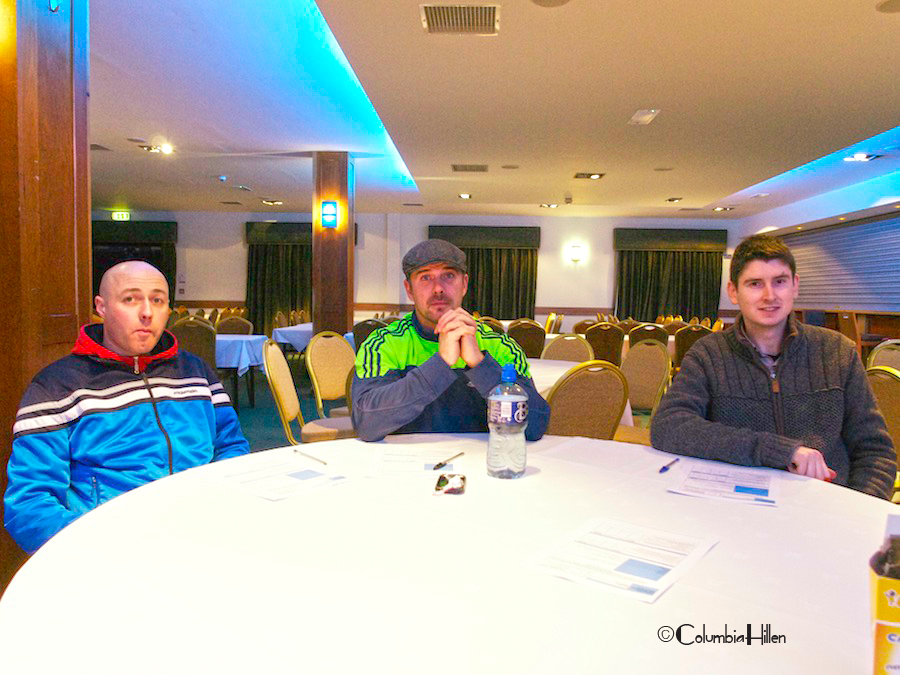
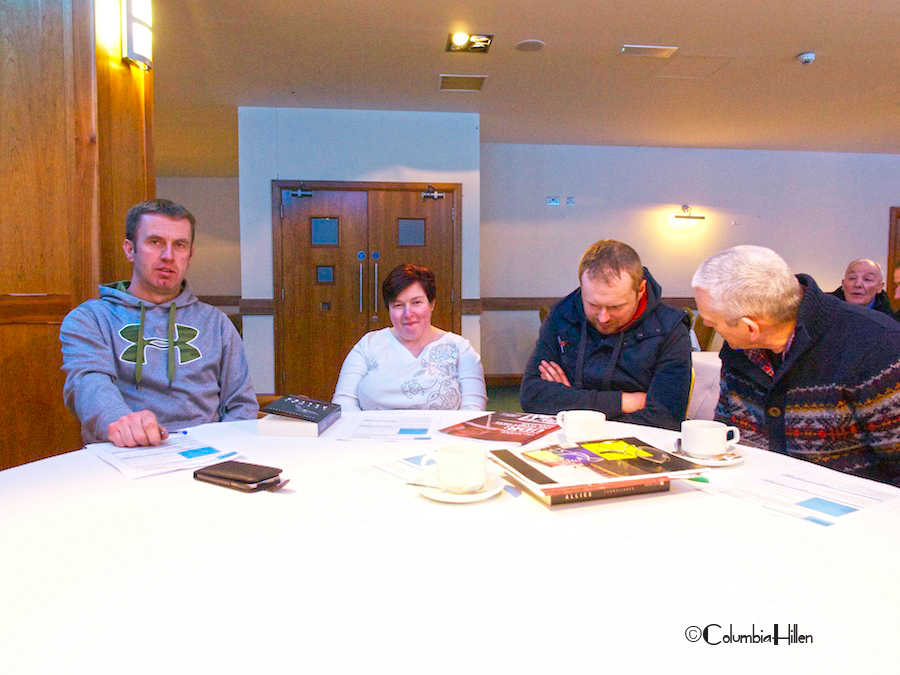
That’s why a small team of highly-committed people proudly refer to themselves as ‘raiders of the lost archives’ and this past weekend they arrived in Letterkenny to discuss what they’ve discovered through their painstaking murder investigations.

OLYMPUS DIGITAL CAMERA

Paul O’Connor and Anne Cadwallader are leading members of the Pat Finucane Centre, which, for many years, has been forensically examining sensitive British government documents and interviewing hundreds of people to expose the ruthless collusion between Protestant paramilitary extremists who murdered many Catholics, and the RUC, the former northern Irish police service, and the Ulster Defence Regiment (UDR), once the largest regiment in the British Army.

OLYMPUS DIGITAL CAMERA

Indeed, their investigations have revealed that some of the cold-blooded murderers were actually full-time or part-time members of the above mentioned ‘security forces’ with easy access to rifles, guns, grenades and other weapons used in the killings.

Some of their findings as revealed at the Station House Hotel Friday evening –

  • 120 paramilitary murders, one-third of which took place in the Republic, show RUC and UDR involvement;
  • At least two members of the UDR were involved in the roadside massacre of the Miami Showband music group in July 1975 in County Down;
  • Both members of the RUC and the UDR were involved in the bombing of ‘The Step Inn’ in the town of Keady that killed two people and injured more than twenty;
  • RUC officers and UDR members were part of a gang operating from two farms in south Armagh and Tyrone, responsible for the deaths of 120 people between 1972 and 1976;
  • British government documents acknowledge authorities knew some UDR and RUC members would also join extreme Loyalist paramilitary groups such as the Ulster Defence Association (UDA), the Ulster Volunteer Force (UVF) and the Ulster Freedom Fighters (UFF);
  • Compensation paid out to families of some of those whose loved ones were murdered amounted to a paltry 750 pounds sterling;
  • British government documents listing the amounts of arms that went  ‘missing’ from UDR armories showed a single gun was used to kill 11 people in 11 months;
  • No RUC officer has ever been convicted of any of the murders;
  • Four British soldiers have been convicted of murder in northern Ireland – all were released after serving less than five years of their life sentences. All were allowed to rejoin their regiments;
  • The Special Branch was allowed to operate as “a force within a force” and often decided not to give information to the Criminal Investigation Department;
  • The British government will not allow a review of its secret files on bombings that killed many people in Dublin and Monaghan, not even by an agreed judiciary figure;
  • In explaining the mere suspension of police officers involved in murder, Lord Chief Justice Lowry said, “…. more than ordinary police work was needed and was justified to rid the land of the pestilence which has been in existence.”
  • Scores of cases are now before the Office of the Police Ombudsman for Northern Ireland and civil cases are pending against the Chief Constable and the British government.

In concluding the evening, O’Connor, the centre’s director, and Cadwallader, a former BBC and RTE journalist, posed a number of questions:

  • Was truth covered up systematically by the British government to protect the reputation of the RUC?
  • Did the British government as a former colonial power adopt the technique of using one tribal group against another through counter gangs as it did in Kenya under General Frank Kitson, who also served in northern Ireland?
  • Was there a government policy to kill Catholics in an effort to turn popular opinion within that community against the IRA? In other words ‘if you can’t kill the fish, poison the water.’

Notes

The Pat Finucane Centre, a non-party political, anti-sectarian human rights group supported by the European Union’s PEACE III programme, is named after a Catholic lawyer who was shot dead by Protestant loyalists in front of his wife and children at his north Belfast home in 1989. A review of the case by Sir Desmond de Silva showed RUC officers proposed that Finucane, 39, be killed, passed information to his killers, then obstructed the murder investigation. The findings have been accepted by the Northern Irish Police Service. While describing the level of state collusion as “shocking,” British Prime Minister David Cameron ruled out a full public inquiry.

The event at the Station House Hotel was organized by Abhaile Arís, an EU funded programme supporting the Republican ex-Prisoner community.

A book produced by Anne Cadwallader (Mercier Press) entitled Lethal Allies: British collusion in Ireland, focuses on 120 killings attributed to loyalist groups between 1972 and 1976. It draws on investigations compiled by a specialist group, the Historical Enquiries Team (HET), which is re-examining deaths during the northern Irish conflict.

OLYMPUS DIGITAL CAMERA

OLYMPUS DIGITAL CAMERA

OLYMPUS DIGITAL CAMERA

OLYMPUS DIGITAL CAMERA

OLYMPUS DIGITAL CAMERA

OLYMPUS DIGITAL CAMERA

OLYMPUS DIGITAL CAMERA

Meeting the IRA chief of staff on the steps of a New York library

library

New York Library’s ornate limestone building – an unlikely place to to meet the IRA’s former chief of staff.

Standing on the broad steps of the New York Library on Fifth Avenue and 42nd Street awaiting the arrival of the IRA’s former chief of staff was quite an exciting experience, especially for a naïve teenage undergraduate such as I was then.

Living in west Belfast in the midst of ‘The Troubles,’ I imagined it could conceivably have been a key scene from a movie about a clandestine guerrilla operation.

But it was nothing like that.

By then, Seán Cronin, the IRA’s former chief of staff and mastermind of Operation Harvest, a campaign that carried out military operations on British security installations, was a well-respected author, academic and US correspondent for The Irish Times. In contrast, I was a humble humanities student at the Ulster Polytechnic, now the University of Ulster, working part-time in the Celtic Bar on the Falls Road for disco money.

Seán Cronin

Dungloe-born social activist Peadar O’Donnell – about whose  life a conference was held this week (see news story below) – had brought us together.

Months before, I had – by chance, for an undergraduate thesis – become one of the last persons to interview Peadar in Dublin just before his death. And Seán was writing a book about the 1930s, a tumultuous period in Irish history when Peadar with Frank Ryan, George Gilmore and others had launched the Irish Republican Congress (the subject of my thesis).

It being a time before Google, Facebook or e-mail – in fact, fax was a new-fangled machine I had only vaguely heard of – neither Seán nor I knew what each other looked like. And as there were scores of people lingering on those broad library steps that sunny summer’s day so many years ago, meeting up wasn’t so easy.

But eventually we did, Seán saying later – half-jokingly – that his past training had helped him scope out the situation and pick me out as “the Belfast boy among the Yanks.’

After introductory formalities including my proudly handing over my thesis (part of which he later published in his book), we retreated out of the hot sun into a nearby coffee house. There we spent some time chatting about this and that – his days in the IRA, his arrest and imprisonment, his work as a journalist and not least, the man who had brought us both together, Peadar O’Donnell. Little did I know then, of course, that I too would become an international journalist and live and work in west Donegal as Peadar had.


Peadar O’Donnell

Teacher, social activist, soldier, author

As people attending this past weekend’s annual conference in Dungloe learned, Peadar was one of the foremost radicals of twentieth-century Ireland. Born in that town into an Irish-speaking family, he was a teacher on Arranmore Island but by 1919 was a leading organiser of the Irish Transport and General Workers’ Union and had also attempted in Derry to set up a unit of the Irish Citizens Army. Later he joined the IRA and remained active during the Irish War of Independence, leading guerrilla activities in the border area, becoming commander of the IRA’s Donegal Brigade in 1921. He gained a reputation as being headstrong, and sometimes launching operations without orders. Summing up aspects of his character, a speaker at the conference this week said if at a wedding Peadar wanted to be the groom and if at a funeral, the corpse.

Opposing the 1922 Anglo-Irish Treaty, Peadar was among the IRA leaders who took over the Four Courts in Dublin and helped spark the outbreak of civil war. Imprisoned in Mountjoy, he participated in a mass Republican hunger strike, resisting for 41 days.

civil war photo

Turbulent times in Ireland’s revolutionary history – radical changes that deeply affected leaders like Peadar O’Donnell and Sean Cronin.

Through it all, the west Donegal man saw himself as closely following the principals of James Connolly, seeing the republican cause not solely in Irish nationalist terms. In 1923, while still in prison, he was elected as a Sinn Féin TD for Donegal and after his release took over as the editor of the republican newspaper, An Phoblacht. He did not take his seat in the Dáil and did not stand at the 1927 general election. He tried to steer the IRA in a left-wing direction and founded organisations such as the Irish Working Farmers’ Committee and the Anti-Tribute League, which opposed the repaying of annuities to the British government owed since the Irish Land Acts. He also founded the short-lived socialist republican party, Saor Éire.

The Irish Republic Congress that he helped establish was a left-wing movement that met with success in organising Belfast Protestants under the Republican Congress banner, leading to a march by the Shankill Road branch to Bodenstown churchyard in June 1934 to honour Theobald Wolfe Tone. The Congress ultimately split, however, on a proposal to turn it into a political party, O’Donnell rejecting this idea, arguing that it had more power as a united front. Like Gilmore and other Irish Republicans, he ended up fighting in the Spanish Civil War for the International Brigade against Franco.

After the 1940s, O’Donnell devoted more of his time to writing and less to politics, publishing his first novel, Storm, in 1925. This was followed by Islanders (1928), which received national and international acclaim, The New York Times describing it as a novel of ‘quiet brilliance and power’, the London Spectator ‘an intensely beautiful picture of peasant life.’ Other books followed – Adrigoole (1929), The Knife (1930); On the Edge of the Stream (1934); The Big Windows (1955) and Proud Island (1975). He also edited the Irish literary journal, The Bell, having founded it with well-known writer, Seán Ó Faoláin.

Peadar married Lile O’Donel in 1924, even though they had never met before. But they had communicated extensively during his time in prison. They began their honeymoon in a Dublin hotel that evening but by the following morning he was on the run once again as he had been identified.

Dying at the tender age of 93, he left strict instructions –  ‘no priests, no politicians and no pomp.’ His wishes were granted.

Looking back down the years, remembering my discussions on this larger-than-life character over a cup of tea in a downtown Manhattan café with someone as distinguished as Seán Cronin, whose own life was every bit as colorful and adventurous, seems now to have been a figment of a lively imagination.

I probably didn’t fully appreciate then the incredible opportunity that had been presented to me to turn the pages of history in the company of great men who wrote them. Now, with the wisdom of age and hindsight, I think I do.


Conference celebrating life of Peadar O’Donnell highlights key social issues

OLYMPUS DIGITAL CAMERA

(l to r) Clare Daly TD for Kerry and social activists Paula Leonard and Clarrie Pringle describe the struggle by women in Irish society to gain recognition.

Analysis of a women’s co-operative in the Rosses that attracted over 200 knitters and of a left-wing movement, the Irish Republican Congress, were elements of a three-day conference this week celebrating the life of Dungloe-born socialist, teacher and author, Peadar O’Donnell.

At a panel chaired by community leader, Paula Leonard, social activist Clarrie Pringle described how collective efforts “cut out greedy middlemen who took hefty profits from the hard work and knitting skills of local women.”

“Knitting needles were known as ‘poverty sticks’ then as Donegal women attempted to stave off hardship,” she said. “So successful was the co-operative that not only did women get more money for their work but greater independence by learning business skills, including working with banks and statutory bodies.” Later still, some women started their own small companies, quite unusual for the time, she added.

Also speaking on the panel entitled ‘Women in Struggle’ held at Ionad Teampaill Chroine in Dungloe, Clare Daly TD in Kerry, praised the efforts of Pringle and her colleagues “as showing what women can achieve if given a fair chance.” Daly said the key role women have played in Irish history, including the Ladies’ Land League, has been “skewed or silenced by certain bodies for political and social purposes, but now thinking must change to meet modern reality.”

The two speakers agreed that difficulty of divorce and restricted access to contraception in the emerging Irish state made it hard for women to progress socially and politically.
OLYMPUS DIGITAL CAMERA

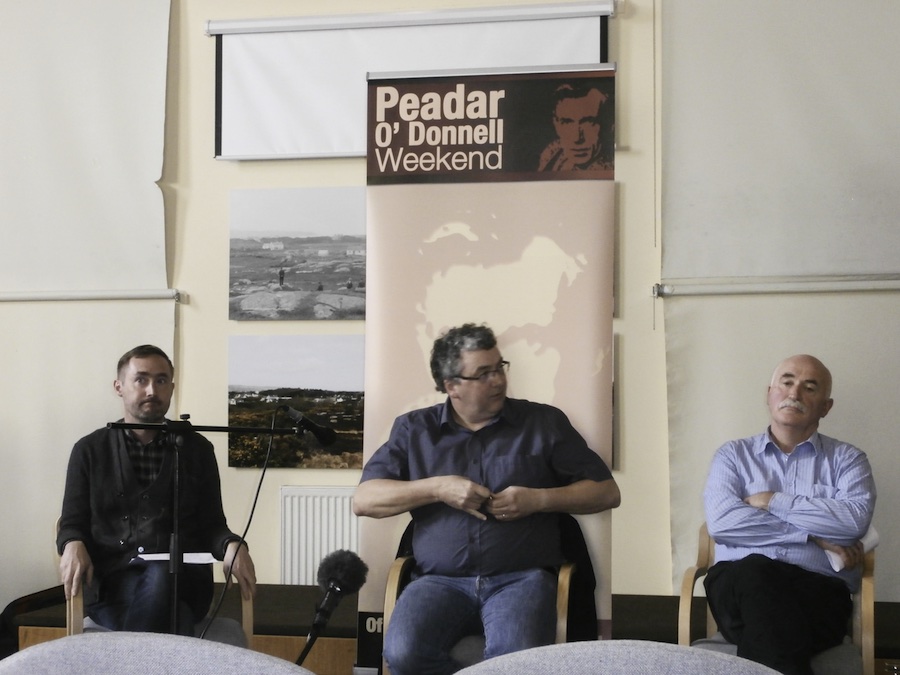
( l to r) Author and Dublin Sinn Fein councillor, Eoin O’Broin, TD Thomas Pringle and Eugene McCartan, General Secretary of the Communist Party of Ireland, analyze the success and failure of the Irish Republican Congress.

Both Daly and Pringle blamed the Catholic Church for “holding back the progress of women in Irish society.” Daly said, “There is no place for the church in political life, in selecting core curriculum in schools nor in governing women’s bodies” while Pringle added, “When we look back on the oppression of women and children in Ireland, we must inevitably view the Catholic church as a predominant influence. Shame of sexuality was bred into women for over a hundred years.”

They both called for a human rights module to be introduced into the national school curriculum,

In a second panel chaired by TD Thomas Pringle, Dublin Sinn Fein councillor, Eoin O’Broin, and Eugene McCartan, General Secretary of the Communist Party of Ireland, discussed the merits of the 1934 Irish Republican Congress, an effort by Peadar O’Donnell and others to create a stronger left-wing republican base to combat poverty and inequality.

“In many ways, the Congress, though short-lived, was a high point of left-leaning Republicanism of that era but it was also a lesson in abject failure,” said O’Broin. “It showed the immense challenges involved in linking nationalist and socialist traditions then and building socio-economic bridges, especially in northern Ireland.”

He added, “With the IRA’s ambivalence towards such a radical movement, Fianna Fail’s continued platform building then and the inability of Congress leaders to read the political situation and devise proper strategies, it, in effect, helped result in sixty years of Fianna Fail rule.” Saying there are “many lessons to be learned from the Congress,” McCartan added, “Greater appreciation of working-class issues is key to a fairer society as is the building of a common consciousness and a confidence in ordinary people that they can change things.”

John Crowley, who travelled from Scotland to attend the conference, said, “Overall, there were some very interesting analyses and from diverse viewpoints with many of the issues still relevant in today’s society.”