Meet The Real Simon Harris – The Dishonourable Duke Of Duping

Is it not reprehensible – the height of hypocrisy in fact – that Simon Harris the leader of the Irish Government  – has the audacity to accuse Sinn Féin in recent weeks of ‘duping’ people when it expelled several party members for substandard social behaviour?

Simon Harris – the Dishonourable Duke of Duping.

The Cambridge dictionary definition of dupe is ‘to deceive’ and if anyone is guilty of deception, it is Harris and his colleagues in the coalition Government of Fine Gael, Fianna Fail and the Green Party.

Over the last four years since being in power – and for many years before that – these parties have been nothing less than ‘repeat offenders,’ constantly deceiving the ordinary hardworking people of Ireland with false promises of a quality lifestyle as befitting a nation that is one of the earliest members of the European Union, then called the European Economic Community, or EEC for short, back in 1973.

Instead, however, we have one of the most disastrous health systems on the continent, with people waiting years for life-saving surgeries, often dying before they receive it; we are awash in homelessness and poverty, with an estimated people 30,000 living on the streets, including thousands of young children and infants; we have a forsaken, forgotten, forlorn State where retirees and newlyweds alike are unable to afford the rent of a simple home, never mind the financial resources to even remotely consider buying one to end or begin their lives together in a modicum of comfort.

Not only does the Dishonourable Duke of Duping continue to deceive people that after all these years he’ll one day consider putting a roof over our heads, but he himself basks in the lap of luxury in one of the most expensive and elitist places in Ireland, the scenic coastal town of Greystones in county Wicklow, where he was born, where he lives and where houses cost up to two million euro, and more.

But is it not somewhat harsh of us to criticise the Dishonourable Duke of Duping for his lack of common decency? Is it not unfair to ask a man of such Royal blood living in such a high falutin’ environment to understand the plight of so many desperate Irish people? Is that not akin to asking King Charles of England to make his own cupán tae once in a while?

Shamefully, while the wealthy in Ireland (many of whom are the Dishonourable Duke of Duping’s closest neighbours) while away their days in decadent lifestyles with fancy homes in fancy places or travel in  environmentally-damaging private jets (which the Dishonourable Duke of Duping does frequently) and indulge their whims in ostentatious holiday homes abroad (which the Dishonourable Duke of Duping often does), modern Ireland suffers the worst housing shortage in its entire 100-year history. 

Studies show less than a third of 30-year-olds own their home. Over half of all newly-built homes in greater Dublin alone were bought or developed by global vulture investor funds, thus locking countless people out of ever attempting to buy one. These ‘vampire funds’ don’t buy homes to sell, they buy them to extract high rents in perpetuity. In other words, they suck the lifeblood out of decent Irish society.

And to make matters worse, the Dishonourable Duke of Duping and his cadre of Government lackeys allowed a temporary no-fault eviction ban in Ireland to lapse last March, thus opening the floodgates for more than 15,000 notices of termination to be issued last year, making the number of evictions higher than it was during the Famine in the mid-1800s. 

For centuries, gutless, greedy, often absentee, landlords, have been the scourge of Ireland, rich, ruthless people who with the click of a finger, a scribbled signature on a sheet of paper, thoughtlessly tossed hungry families out into the ditches. 

Now it seems the same is happening all over again in modern Ireland, this time under the dictatorial rule of the Dishonourable Duke of Duping and his ignoble entourage.

Instead of urgently dealing with these major social and health issues that are making the lives of so many Irish people intolerable, Harris and his well-to-do cohorts, including Government coalition leaders, Micheál Martin of Fianna Fail and Roderic O’Gorman of the Green Party, are pointing their grubby finger at Sinn Féin, an oft-used political ploy to distract popular attention away from the real issues, and their own failings on them. 

In doing so, however, these ‘I’m-better-than-you’ leaders fail to realise something important. While the bitter winds of winter howl at our doors, while Storm Ashley batters the coast this weekend, Irish people are not bears. They are not hibernating. They are wide awake. And fearful. And hungry. And cold. And they remember the empty promises made to them from on high four years ago, and for many years before that.  

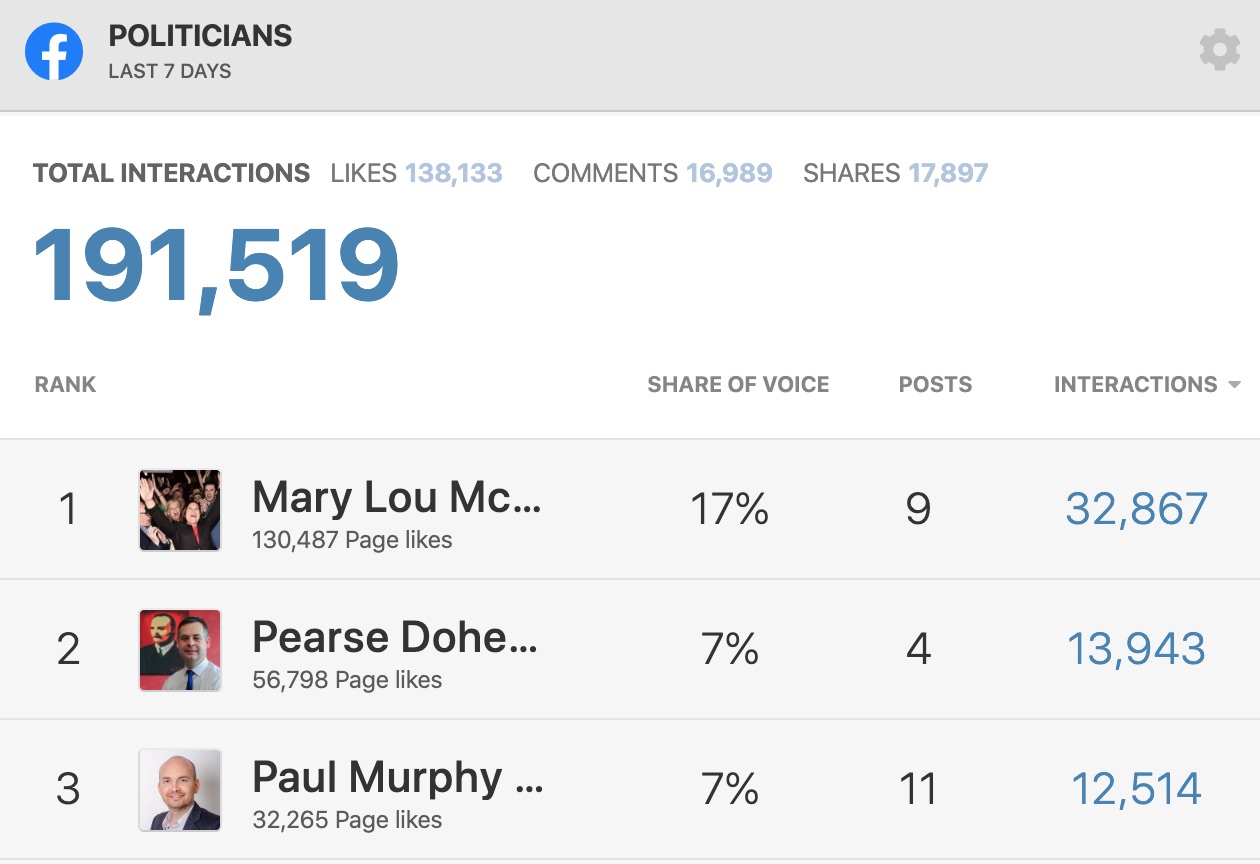
Maybe, just maybe, we should ask Sinn Féin leader Mary Lou McDonald to re-tell the story of these empty promises once more, to remind us how easily we were taken for fools. And in doing so, help us make sure the Dishonourable Duke of Duping and his Royal patrons don’t sneak back into power through the back door and make jesters of us for another four years in their Court of Failure.

Maybe, just maybe, we’ve learned our lesson and are wide awake enough to elect Sinn Féin, the ‘Party of Change’ and improve things for the better. For each and everyone of us, our parents, our children and the generations who come after. 

New Irish Government was decided BEFORE the elections

Weeks before the recent Irish election was even announced and long before the first votes were cast, representatives of Fianna Fail and Fine Gael met behind closed doors to cut a deal, with one solitary aim in mind – to keep Sinn Fein out of government.

At the same time, generously funded by major corporations, banks and developers, highly-paid public relations specialists in the pockets of these two same political parties were instructed to create what’s known as a ‘news camouflage.’

To avoid any fall-out from someone learning about these secret meetings, they spun a story through a web of overly acquiescent Irish media that these two political parties would instead discuss forming a coalition with other minor parties.

irish elections, elections in ireland

Coalition terms were discussed on behalf of these two men by their representatives BEFORE the Irish election was even announced.

It is a well-planned and co-ordinated charade to create a facade of democratic fairness.

Among those most wanting Sinn Fein side-lined at all costs was Jim O’Callaghan, wealthy Dublin barrister, senior counsel and Fianna Fail’s justice minister, a man who only managed to get elected on the eighth (8th) count, beaten by Sinn Fein candidate, Chris Andrews.

O’Callaghan is brother of millionairess and RTE presenter Miriam O’Callaghan who infamously grilled Sinn Fein leader, Mary Lou McDonald, on a pre-election ‘Leader’s TV Debate’ on – guess what – justice issues.

In doing so, she used an archaic 13-year-old audio report excavated from deep within the archives of the BBC as a weapon. It may come as no surprise to many whom Miriam’s husband, Steve, works for.

Yes, you guessed right. The BBC.

The O’Callaghans, like many wealthy people in Ireland today, would be required to pay a little more in taxes under a Sinn Fein led government, with loose tax avoidance loopholes used by many rich people closed. These taxes would help close the gap between rich and poor and ease the housing, health and education crises mainly affecting working-class people.

Reflecting growing popular interest in the economic inequalities in Ireland, a blog I wrote before the elections on the O’Callaghans attracted a massive 20,348 views from readers in just one week. More than 2,000 readers every single day.

 That being said, here is my prediction.

Within the next two weeks – after demonising Sinn Fein as a ‘cult’ through a slick and expensive media campaign (thus demonising half a million Irish people who voted for that party), Fianna Fail and Fine Gael will announce a new Centre Right government.

The word ‘change’ will be sprinkled liberally throughout their joint manifesto and media interviews and they will announce they ‘have put aside their differences —- in the interests of the country,’ thus positioning themselves as some kind of ‘national saviours.’ 

Sinn Fein President, Mary Lou McDonald, won more votes for Prime Minister than both existing PM Leo Varadkar and Fianna Fail leader, Micheal Martin.

I predict this development with sadness, but with confidence gleaned from 40 years of journalism experience in Ireland, the US and mainland Europe. 

And on this election issue, I’ve got things right so far.

I predicted Sinn Fein would get more than 30 seats.

I predicted the five politicians who would be elected in my own constituency of Donegal

I predicted Pat the Cope Gallagher, a Fianna Fail member of parliament for 40 years, a man with whom I had a public run-in would lose his seat, with many people telling me such a prediction was like Manchester United being relegated from the Premiership.

With the Cheltenham races coming up, perhaps I should make a few big bets for I even predicted the following two weeks ago in my blog –

“… on voting day tomorrow (Saturday), will the final outcome be any different from that over the last 100 years? Sadly, regardless of Sinn Fein receiving a well-deserved boost, hopefully above the 30 mark, I don’t think so.

If past results are anything to go by, we will remain with a Centre Right majority that kowtows to wealthy individuals, major corporations, banks, vulture funds and major land developers offering tax breaks and other incentives. A coalition that steadfastly fails to rectify the growing, severe inequalities in social life here.”

The truth is simple. Fianna Fail’s Micheal Martin wants to be Taoiseach, Fine Gael’s Leo Varadkar still wants to be in Government. And they both need to pay back their rich sponsors, both individuals and corporations.

Such was the huge turnout for this week’s Sinn Fein public meeting at Dublin’s Liberty Hall, site of many famous events hosted by socialist leaders such as 1916 Revolution leader James Connolly, people were addressed both inside and outside the Hall.

As they prepare to announce their Government, it is important to point out the following for context: 

*Sinn Fein elected 37 TD’s, out of 42 candidates;

*10 Sinn Fein candidates topped the polls;

*27 Sinn Fein candidates were elected in the first count.

*Sinn Fein doubled their vote in Dublin;

*Sinn Fein president Mary Lou McDonald won more votes last week for Prime Minister than both the present PM Leo Varadkar and Micheál Martin; 

*Sinn Fein’s Dublin West candidate, Paul Donnelly, elected in the first count, beat Leo Varadkar, who only got elected in the fifth count, the first time in Irish history a Prime Minister has lost his own constituency;

* Sinn Fein candidates in my constituency, Donegal, were both elected on first counts – Pearse Doherty with 21,044 votes, 8,000 over the quota, and Pádraig MacLochlainn, with 13,891 votes, a massive 45% of the total vote;

*Sinn Fein’s candidate in Clare Violet-Anne Wynne who received just 385 in the local elections, won over 10,000 votes in the national ones;

*Sinn Fein candidate Johnny Mythen won in Wexford, the first time in 100 years the party has won a seat there;

*Sinn Fein won 45,614 votes, a mere 2.5% of the total in the 1997 election. In 2020, that transformed into 535,595 or 24.5%;

Is it any wonder the O’Callaghan’s and wealthy people like them are fearful.

And so sadly it seems are the Irish media which, displaying its Right-wing bias, has failed miserably to fulfil its role as the Fourth Estate, to serve and protect the public interest.

It refused to report on the emerging banking crisis under Fianna Fail’s watch that left Ireland bankrupt and at the mercy of the IMF and it is now refusing to report the real reasons Sinn Fein is being excluded from Government.

Helluva commotion going on in Donegal over lovable little oysters

Oysters, those soft, jelly-like little creatures that are (to some people) delicious to eat and ingeniously produce glittering pearls, are causing some bother in Ireland, especially in Donegal – or at least the greedy corporations hunting them for profit are.

And it seems the partnership government of Fine Gael-Fianna Fail and its back-up civil service are doing their utmost to prevent concerned local communities from doing anything about it.

Sitting at a public meeting this week at Falcarragh Community Centre focusing on these issues, these were the thoughts that passed through my mind as I listened to speaker after speaker give their views on controversial shellfish farming practices at Ballyness Bay near the town of Falcarragh on the ‘Wild Atlantic Way’ in the Donegal Gaeltacht they consider are polluting and defacing the lovely, pristine scenery.

John Conaghan, spokesperson for the ‘Save Ballyness Bay’ committee, said four jobs would be created through aquaculture while more than 250 would be created via tourism, therefore “we should be protecting our area environmentally.” He also complained his committee had been denied inaccessibility to certain details, sometimes entire documents, pertaining to official comments made by both Donegal County Council and Údarás na Gaeltachta.

“An official comment from Donegal County Council stated that there would be no visual impact, but the document was simply signed by a clerk,” he said. “I’ve spoken to many councillors and nobody seems to know who authorized the comments. No visual impact? Maybe, lads, you should go to Specsavers.”

Politician after politician, both local and national, including TDs, Sinn Fein’s Pearse Doherty and Fianna Fail’s Pat the Cope Gallagher, told around 200 concerned people that they were unable to access key information relevant to the situation.

John Shéamais Ó Fearraigh Sinn Fein local councillor and Údarás na Gaeltachta board member said he would try with whatever powers he had to obtain the information required from the council and the Irish language organization. “I will do whatever I can to help,” he said.

Fine Gael local councillor, Michael McClafferty, said he had submitted questions to the local council but had not received any answers. “It looks as if we are being thrown under the bus,” he added.

The proposed shellfish scheme could cover more than 46 hectares of sea coast in the scenic Gaeltacht region, with bags on steel trestles containing millions of oysters, with sediment accumulation beneath them and large-scale congregation of dead shells, committee members said. Licenses for 20 hectares of oyster beds have already been granted, with one site alone being over 10 hectares.

Committee member, Caitlin Ni Bhroin, said “no cost-benefit analysis has been produced for us to see” and licenses have been granted on “unsound scientific criteria, including the idea that oysters are healthy water filters, but they actually emit waste.”

Conaghan said there were many contradictions in the government’s approach. “While it granted licenses for shellfish farming, Ballyness Bay is not designated a shellfish area, but it is a special area of conservation.” He said Inland Fisheries Ireland declared the bay a valuable fishing asset.

“We are against all oyster harvesting in Ballyness Bay, such activity will damage eco-tourism, which could bring much-needed jobs,” he said. “Gaps, mistakes and assumptions sums up the government’s approach. If community concerns had been addressed properly, we’d not be standing here talking.”

He said the ‘Save Ballyness Bay’ committee was being assisted by Belfast-based Pat Finucane Centre.

Commending the committee on its efforts, Sinn Fein’s Pearse Doherty stated clearly, “My firm belief is that this scheme is anti-community and the application process is not fit for purpose, they are not being given properly and there is a lack of clarity.” He said three years ago he had sent a letter to the relevant ministry and department questioning the decision process, adding “construction cannot begin until all appeals have been heard, which could take several years.”

Being a long time, staunch member of Fianna Fail, part the ‘partnership government,’ Pat the Cope Gallagher, was obviously in a bit of a conundrum. While he offered to find out more information and report back to committee members, he went into a bit of a tantrum when I asked him to say ‘yes or no’ whether he agreed with the ‘Save Ballyness Bay’ committee’s views.

Now, credit being given, Pat is a wily politician, that comes with being forty years and more in politics. Maybe I spoke harshly when I said that his spiel was (to quote myself) “pure politics, filled with generalities and trivialities.” That he took offence was his right. That he tossed the microphone down (as someone said, “like a baby throwing out its dummy-tit”) is also his democratic right.

But he still didn’t answer my question.

Instead, he said previous situations had occurred near his home in Dungloe similar to the one at Ballyness but he “didn’t get involved in them,” but said he did pass on letters he had received from local people to the relevant minister.

At the meeting, two members of Aontú pledged their support, with one young member saying as the shellfish farms were adding to the carbon footprint, people had a right to know more.

Local resident, Mary Attenborough, said while a proper environmental impact study was required, so-called experts were all vetted by the government, and that bias might occur in their reporting.

Committee members were still unsure if licenses already granted were strictly non-transferrable.

One challenge facing the committee is the expense involved in appealing licenses. Each one must be appealed separately at a cost of 200 euro each, with a time limit for appeals being four weeks from date of the government’s decision on December 4.

Columbia Hillen, my wife who is from Romania but concerned about the environment, stood up and asked if those local people who had applied for licenses would show support for the local committee by refusing to accept them even if they were granted. None of those applicants in the hall – and there were some present – said anything. One of the applicants, Seamus O’ Donnell who owns Cluain Na d’Tor (Seaside Nursery Garden) in Falcarragh had gone as far as saying he is “having second thoughts” about his application for over 4.4 hectares of aquaculture if granted. But has he withdrawn his application?

For full information on all applications see HERE.

One speaker said Ballyness Bay was one of the best surfing areas, comparable to Hawaii and western Australia, creating strong tourism income. “Let’s try to keep it that way by not spoiling the scenery.”

Another speaker summed up feelings of many people present, “Governments that treat people with disdain, usually get their comeuppance.”

Sean Hillen is co-founder of Gaoth Dobhair based ‘Ireland Writing Retreat and author of the contemporary novel, ‘Pretty Ugly,’  linking Donegal and the United States.