Expenses For Irish Presidency Cost 13,000 Euro Every Single Day

Thankfully, mercy of mercies, the Irish Presidential election is almost over. 

In a few hours, people throughout the Emerald Isle can breathe a sigh of relief. And get on with everyday things, knowing full well that the winning candidate will have barely a whisper of an effect on their day-to-day lives.

They may, however, be a wee bit miffed that election of a person in office for the next seven years with no power to affect their lives will cost them over 35 million euro, over five million a year in salaries and expenses. 

That’s over 13,000 euro for every single day. 

Put another way, it’s over 1,600 euro per hour based on an 8-hour working day.

That could pay salaries for a helluva lot of nurses and doctors to help strengthen Ireland’s woeful health system. Not to mention what it could do for struggling schools and community centres.

It begs the question – Is it worth it?

Sadly, this presidential contest, if one can dignify it with this word, is also probably the most boring in living memory, aside from a single mini-drama when one of only three candidates dropped out, no doubt realising being so far behind in the opinion polls, he’d probably come in fourth. 

It’s also sad that as the two candidates in the race have been well-established party supported national political figures for many years, real refreshing innovative change is obviously not on the Irish agenda for the foreseeable future. Something that’s probably welcome to some of Ireland’s politicians as their salaries and expenses are quite lucrative. Certainly compared to other countries.

This Presidential election has turned out to be the predictable cliche, Left Versus Right scenario, a pretty straightforward political party battle, with Catherine Connolly, who simply left the Labour Party because she wasn’t picked as an election candidate, head and shoulders intellectually above her rival, Heather Humphreys, former Minister for the Fine Gael coalition government partner. A lady who started her campaign with a fixed butter-wouldn’t melt-in-my-mouth regal smile until, seeing herself well behind her rival, suddenly grew fangs. Much too late.

What’s most depressing about this whole Presidential affair is that the leading parties in Ireland turned this election into ‘them-versus-us’ party political battle, thus making sure the next President of Ireland, the only position based on a national vote, would not be handed to a truly Independent candidate with experience on both the left and right of centre, someone from a working-class background but successful in business, someone with fresh new ideas, vision and comprehensive international experience, something sadly neither candidate possesses.

Welcome to Ireland. Land of the Status Quo!

Sinn Fein’s Presidential decision – a case of the tail wagging the dog

Is Sinn Fein’s decision this weekend to support Independent candidate, Catherine Connolly, in November’s Irish Presidential elections a case of the tail wagging the dog?

It certainly seems so.

After much dithering and delay, Ireland’s third ranked political party – which not so long ago could have topped the polls nationwide and emerged as the nation’s leading party if they’d only put forward more candidates – could not even decide on its own Presidential candidate, party member or not.

Instead, it meekly followed in the wake of other smaller Left-leaning parties who have been supporting Connolly for many months.

Catherine Connolly – established Irish politician.

If that’s not the tail wagging the dog, what is? 

No matter how well the story is spun – and sadly Sinn Fein party leader Mary Lou MacDonald offered an ‘over-the-top’ act to do so a few days ago, uttering the superlative cliché ‘game-changer’ – this non-decision decision may come back to bite her and her colleagues. 

While they won’t say it publicly, the other Left wing parties in Ireland are now frothing at the mouth at the possibility of stealing parliament seats from Sinn Fein at the next election.

Unfortunately, Mary Lou made the situation even worse this weekend when she tried vainly to justify choosing Connolly by saying recent Irish presidents had been elected “from outside the political establishment” and that Connolly was following in that tradition.

What a load of nonsense.

Catherine Connolly has been an ‘established’ politician for the last quarter of a century, beginning as local councillor in Galway, then rising to Mayor five years later, then becoming a TD ten years ago. For goodness sake, she was even chairperson of Ireland’s national parliament for a full four years.

If that’s not ‘established’, what is?

Even the present President of Ireland Michael D. Higgins, elected not once but twice over the last 14 years, was a ‘classic established politician.’ For almost half a century including stints as Labour Party president, Senator, TD (Member of Parliament) and even as a Minister. 

One has to ask oneself ‘Who the hell is writing Mary Lou’s scripts. And who’s conducting her research?”

I’ve always been Left of center in my political outlook, and would like Sinn Fein to be in Government and shake up the meagre mediocrity of Irish politics. But with poor decisions like this one over the Presidency, I fear that’s not going to happen any time soon.  

Sinn Fein has shown itself in many instances to be a no-risk party, including its electoral management strategy in Donegal where I now live. In order for it to justify its claim as a leading party, it needs to take risks. But time and time again, it has shown itself to be very much risk averse.  

My humble view is that Irish people are desperate for a fresh face in Áras an Uachtaráin, the official residence of the President of Ireland, someone truly not involved in Irish politics. Someone with the international experience necessary to conduct the role of Presidency in a strong diplomatic manner. They simply don’t want the Presidential race to be based along worn, age-old political party lines.

That’s why someone like Gareth Sheridan – a man whose US-based company has accumulated losses of 40 million dollars and who has himself already been fined for misleading people about his business and whose main business partner is said to have links with Russian oligarchs – has managed to get two county councils in Ireland to nominate him as a Presidential candidate. 

That’s how desperate Irish people are to find someone new. 

Mary Lou went half way by talking about the need for someone new. 

But then she went right ahead and selected someone straight from the old political establishment. And to make matters worse, someone other parties had already selected a long time ago.

It seems Sinn Fein may have just bought the ruling coalition of Fianna Fail and Fine Gael an early Christmas present.  

Meet The Real Simon Harris – The Dishonourable Duke Of Duping

Is it not reprehensible – the height of hypocrisy in fact – that Simon Harris the leader of the Irish Government  – has the audacity to accuse Sinn Féin in recent weeks of ‘duping’ people when it expelled several party members for substandard social behaviour?

Simon Harris – the Dishonourable Duke of Duping.

The Cambridge dictionary definition of dupe is ‘to deceive’ and if anyone is guilty of deception, it is Harris and his colleagues in the coalition Government of Fine Gael, Fianna Fail and the Green Party.

Over the last four years since being in power – and for many years before that – these parties have been nothing less than ‘repeat offenders,’ constantly deceiving the ordinary hardworking people of Ireland with false promises of a quality lifestyle as befitting a nation that is one of the earliest members of the European Union, then called the European Economic Community, or EEC for short, back in 1973.

Instead, however, we have one of the most disastrous health systems on the continent, with people waiting years for life-saving surgeries, often dying before they receive it; we are awash in homelessness and poverty, with an estimated people 30,000 living on the streets, including thousands of young children and infants; we have a forsaken, forgotten, forlorn State where retirees and newlyweds alike are unable to afford the rent of a simple home, never mind the financial resources to even remotely consider buying one to end or begin their lives together in a modicum of comfort.

Not only does the Dishonourable Duke of Duping continue to deceive people that after all these years he’ll one day consider putting a roof over our heads, but he himself basks in the lap of luxury in one of the most expensive and elitist places in Ireland, the scenic coastal town of Greystones in county Wicklow, where he was born, where he lives and where houses cost up to two million euro, and more.

But is it not somewhat harsh of us to criticise the Dishonourable Duke of Duping for his lack of common decency? Is it not unfair to ask a man of such Royal blood living in such a high falutin’ environment to understand the plight of so many desperate Irish people? Is that not akin to asking King Charles of England to make his own cupán tae once in a while?

Shamefully, while the wealthy in Ireland (many of whom are the Dishonourable Duke of Duping’s closest neighbours) while away their days in decadent lifestyles with fancy homes in fancy places or travel in  environmentally-damaging private jets (which the Dishonourable Duke of Duping does frequently) and indulge their whims in ostentatious holiday homes abroad (which the Dishonourable Duke of Duping often does), modern Ireland suffers the worst housing shortage in its entire 100-year history. 

Studies show less than a third of 30-year-olds own their home. Over half of all newly-built homes in greater Dublin alone were bought or developed by global vulture investor funds, thus locking countless people out of ever attempting to buy one. These ‘vampire funds’ don’t buy homes to sell, they buy them to extract high rents in perpetuity. In other words, they suck the lifeblood out of decent Irish society.

And to make matters worse, the Dishonourable Duke of Duping and his cadre of Government lackeys allowed a temporary no-fault eviction ban in Ireland to lapse last March, thus opening the floodgates for more than 15,000 notices of termination to be issued last year, making the number of evictions higher than it was during the Famine in the mid-1800s. 

For centuries, gutless, greedy, often absentee, landlords, have been the scourge of Ireland, rich, ruthless people who with the click of a finger, a scribbled signature on a sheet of paper, thoughtlessly tossed hungry families out into the ditches. 

Now it seems the same is happening all over again in modern Ireland, this time under the dictatorial rule of the Dishonourable Duke of Duping and his ignoble entourage.

Instead of urgently dealing with these major social and health issues that are making the lives of so many Irish people intolerable, Harris and his well-to-do cohorts, including Government coalition leaders, Micheál Martin of Fianna Fail and Roderic O’Gorman of the Green Party, are pointing their grubby finger at Sinn Féin, an oft-used political ploy to distract popular attention away from the real issues, and their own failings on them. 

In doing so, however, these ‘I’m-better-than-you’ leaders fail to realise something important. While the bitter winds of winter howl at our doors, while Storm Ashley batters the coast this weekend, Irish people are not bears. They are not hibernating. They are wide awake. And fearful. And hungry. And cold. And they remember the empty promises made to them from on high four years ago, and for many years before that.  

Maybe, just maybe, we should ask Sinn Féin leader Mary Lou McDonald to re-tell the story of these empty promises once more, to remind us how easily we were taken for fools. And in doing so, help us make sure the Dishonourable Duke of Duping and his Royal patrons don’t sneak back into power through the back door and make jesters of us for another four years in their Court of Failure.

Maybe, just maybe, we’ve learned our lesson and are wide awake enough to elect Sinn Féin, the ‘Party of Change’ and improve things for the better. For each and everyone of us, our parents, our children and the generations who come after. 

Gangsters, journalism and the Pulitzer prize

Kevin Cullen is my kind of journalist – unafraid to lay bare corrupt activities  – especially at public institutions that profess to be paragons of probity and morality such as the Catholic Church – yet also quick to highlight the extraordinary achievements of ordinary people.

When the twice Pulitzer-winning columnist for ‘The Boston Globe’ writes, his words leap off the page and with a resounding thump, smack you full in your emotional center, somewhere between heart and brain.
Such prose power is amply illustrated by his column on the quiet, dignified testimony of Bill Richard during the trial of Boston marathon bomber, Dzhokhar Tsarnaev, whose dastardly work killed the Dorchester father’s 8-year-old son, Martin, ripped the leg of his 6-year-old daughter, Jane, and blinded his wife, Denise, in one eye.

Kevin Cullen Boston Globe, Pullizer Prize winner

Kevin Cullen – one of the most informed American journalists on Irish affairs.

Or on Tim Davis from Taunton, who from the age of six lived in 15 different foster homes, was cruelly treated in some, yet went on to establish the ‘Teddy Bear Foundation for Foster Children,’ which, among other things, delivers gifts to kids every Christmas.
 
Irish culture in America faces challenges
 
As one of the most informed American journalists on Irish affairs, Cullen is also concerned about the dilution of Irish culture in the US due to the dramatic drop in the number of emigrants from here – a subject he’ll address this Friday evening at the ‘TransAtlantic Connections 3‘ conference in Bundoran. A multi-disciplinary event embracing the connections between Ireland and the US, it is organized by Drew University and hosted by the Institute of Study Abroad Ireland and takes place at the Atlantic Aparthotel and Bundoran Cineplex from Wednesday until Saturday.
Event speakers include Christine Kinealy, author of more than 16 books and director of Ireland’s Great Hunger Institute at Quinnipiac University in Connecticut, Mike Nesbitt, leader of the Ulster Unionist Party, authors, Michael MacDonald and Turtle Bunbury, Micheal O’hEanaigh, director of enterprise, employment and property at Údarás na Gaeltachta, Liam Kennedy, director of the Clinton Institute at UCD, Barbara Franz, politics professor at Rider University, New Jersey,  Mary Hickman, Irish Studies professor at St. Mary’s University, London and Tommy Graham, founder and editor of ‘History Ireland’ magazine.  
The institute’s founder, Professor Niamh Hamill, a lecturer in Irish history and culture, completed her Doctorate studies at the New Jersey-based Drew University and established the institute in Bundoran in 1996. “While there, I became aware that the narrative about Ireland in the US was somewhat outdated and that a more contemporary and accurate one was necessary, thus the idea for a multi-disciplinary conference such as this one and the formation of the institute itself,” she told me this week.

But why Donegal?

“I am from the county and my view is that a border location is essential for a comprehensive understanding of Ireland,” she replied. “This is an authentic yet undervalued corner of the country and – being close to cities such as Derry – a greater dimension, both culturally and historically, can be added to an educational endeavor such as this.”

Hamill said Donegal County Council helped fund this week’s conference and Fáilte Ireland helps fund an annual familiarization trip in October for American educators to come to Donegal to help her institute to establish relations with US schools and universities.

As for Cullen, he told me in a telephone interview from Boston this weekend. “Ten years ago, there were around a quarter of a million Irish-born people living in the US. That has now dropped by over one hundred thousand, with major cultural ramifications.” As evidence, he cited the reduction in the number of GAA teams in New York and Boston as well as fewer Irish pubs in what were once considered traditionally Irish neighborhoods such as Dorchester in Boston and Sunnyside in New York. “Fifteen years ago, there would have been Irish music sessions every night. Not now, and in those, very few Irish-born musicians.”
 Cullen is not optimistic this situation will change any time soon.
“Ever since the Famine the Irish diaspora has always been both wide and deep in the US, constantly replenishing itself, with historic deals such as the Donnelly and Morrison visas in the ‘80s and 90s a major benefit,” he said. “But since 9/11, the creation of Homeland Security and the Republican Party’s anti-emigration, anti-amnesty stance, the situation has changed radically and this trend is expected to continue even if the Democrats take over in Washington. This is in stark contrast to Australia and Canada where specific visa strategies for Irish emigrants have been established.”
His words sadden me deeply. I was one of those people lucky enough to emigrate to America in the 1980s, forging a decent career in print and broadcast media there and launching an Irish newspaper and cultural center. I also became an adviser to the Irish Immigration Reform Movement (IIRM) led by the effervescent and charismatic, Cork-born Sean Minihane, that performed such sterling work on behalf of Irish men, women and children, both legal and undocumented. Other IIRM leaders included Mae O’Driscoll and Sean Benson. 
While the developing situation as explained by Cullen is undoubtedly bad news, fortunately he doesn’t consider this dilution of Irishness in the US will affect American investment here. “Such investment has nothing to do with sentimentality. It is finance, pure and simple, in a phrase: low corporate tax rate and other tax shelter options that Ireland offers.”
National policies permitting such shady tax shelters, which companies like Starbucks, Google, Microsoft, Pfizer and Apple have taken full advantage of, are under siege by both EU and US authorities, perhaps rightly so, and may not last. They have cost America more than 500 billion euro in lost tax revenue over the last year alone.
 
Making of a Mafia
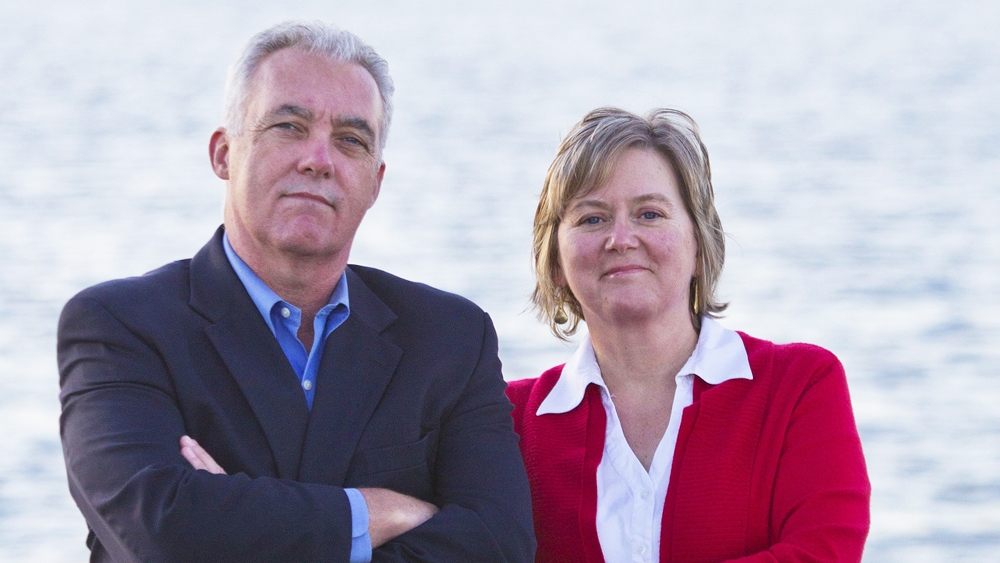
 
Cullen is co-author with fellow reporter, Shelley Murphy, of the New York Times best-seller, ‘Whitey Bulger: America’s Most Wanted Gangster and the Manhunt That Brought Him to Justice,’ focusing on one of the most infamous of American gangsters dramatically captured six years ago after eluding the FBI for 16 years. 

Kevin Cullen, Shelley Murphy, Boston Globe journalists

Kevin Cullen and Shelley Murphy, co-authors of a book on gangster, Whitey Bulger, relax on the South Boston waterfront. Photo by Stan Grossfeld

“I wrote the book with Shelley because between the two of us, we broke most of the stories about Bulger over his long criminal career,” Cullen informed me. “I was the one who first figured out he was a protected FBI informant, and Shelley broke everything about his 16 years on the run and the manhunt that finally led to his capture in 2011. The book we wrote was more than a biography of Bulger, it was a biography of South Boston, the Irish-American neighborhood that produced him, and the culture of law enforcement and politics in Boston at that time which allowed him to become the biggest gangster in the city at the same time his brother was the most powerful politician. The book was more about culture than crime.”
 
Brilliant investigative reporting
 
A model for Irish people and journalists in particular is Cullen’s persistence and that of his Globe colleagues which led to their winning the coveted Pulitzer Prize for Public Service in 2003 for revealing, through 600 articles 14 years ago, the horrendous cover-up by the Catholic Church in Boston of priests sexually abusing young children.
That five-month investigation, which is now the subject of a new movie to be released here over the next week or so, entitled ‘Spotlight,’ led to the resignation of Cardinal Bernard Law and a global crisis for the church that continues to this day, with scandals in more than 100 cities across America and at least 100 more around the world.

Cullen informed me, “Regarding the Catholic Church cover-up, as usual, whether you’re talking about Bloody Sunday or Watergate or whatever, it isn’t the crime, it’s the cover-up. The way that bishops, including Cardinal Law, enabled abusive priests by moving them from parish to parish was shocking. The way they treated victims and survivors was worse. As part of the investigative team, I spent much of my time trying to show the deference that was shown the church and the Catholic hierarchy by the leaders of law enforcement, politics and business, most of whom were Irish Catholic in Boston. We tried to explain that beyond the crimes of the priests and enabling bishops, the wider society was somewhat complicit in not challenging them more forcefully over the years. The same thing happened in Ireland.”
Cullen was also a member of ‘The Boston Globe’ reporting team that won another Pulitzer Prize for Breaking News Reporting in 2104 for its marathon bombing coverage. He was one of three finalists for the 2014 Pulitzer for Commentary.  “As it would have been for reporters in Ireland covering The Troubles, the Marathon bombings were very personal for us in the Globe newsroom, because we knew people who were injured,” he told me. “I knew several, and vaguely knew of the Richard family, which suffered so grievously in losing 8-year-old Martin. I was also very friendly with a number of first responders who were traumatized by what they saw. The Globe’s news coverage in that first week after the bombings was recognized for its depth and breadth, from the victims to the medical people who saved them. I was just part of that team, supplying a lot of information about the investigation and the shootout that ended the threat from the bombers.”
 
Lessons to be learned
 
In my discussion with Cullen and in my overall reading of the events mentioned above, one key element stands out – the importance of vigilance in holding powerful institutions and individuals accountable for their actions.
Admirably, the Globe’s ‘Spotlight’ investigation of the church started with four reporters and expanded to eight shortly after the initial stories were published. That group stayed on the story for the rest of the year. In contrast, newspapers today, mainly due to declining circulations and ad revenues, cannot afford to have investigative reporters. But it is vitally important that local, as well as national, newspapers do not shy away from controversial stories. They remain the trusted protectors of the public domain and such stories are the lifeblood of real journalism.
Also, as the US media commentator said, “The Boston Globe’s clergy abuse investigation provided an early lesson in the power of the Internet. Although it may seem all-too-obvious today, its decision to post church documents used in its reporting provided readers with powerful, direct evidence that Law and other church officials had spent decades covering up the abuses. The Internet also helped spread the Spotlight Team’s stories — and the church’s internal records — worldwide, spurring lawsuits, investigations by other news organizations, and complaints from thousands of victims.”
In this regard, a recent blog posted by me, ‘Crooks, citizens or celebrities?– which had key documents attached – attracted more than 1,000 dedicated readers, illustrating the kind of power that technology has provided us with to help right public wrongs.
The same US media commentator continued, “The Globe investigation underscored the importance of old-fashioned, shoe-leather reporting. Though new technologies have provided investigative reporters with an array of shiny tools, it showed there is no substitute for knocking on doors for face-to-face encounters with reluctant sources who needed to be assured of a reporter’s sincerity or determination. Perhaps most important, the investigation highlighted the need for vigilance, or a continuing commitment to cover and advance the story.”
Cullen himself added, “It’s important to write about process, it’s important to write about institutions …but I’m not going to sit and explain to you the ins and outs of our great political system. I will, however, tell you stories about people who got screwed by that same system, because I like writing columns that stick up for those who have no juice, no power, no influence.” 
We here in Donegal – already severely marginalized and ravaged by high unemployment, depression, alcoholism and suicide – cannot afford to stay quiet about greedy people placed in positions of trust who steal scarce money from the public pocket.
All of us – encouraged by passionate local councillors such as Dessie Shiels, Frank McBrearty Jnr. and Micheál Cholm Mac Giolla Easbuig – must constantly be on our guard and speak – nay shout – out, when we see something wrong.
 
In the end, we only get what we accept.