West Donegal whale protection group formed as threats to human health resurface

Following an often emotional public meeting held at Teac Jack in Glassagh earlier this week, a wildlife protection group has been formed in west Donegal to lobby for government policy changes towards stranded marine animals and to promote specialized training.

The ‘North West Whale & Dolphin Support Group,’ which was established at the Tuesday evening meeting, follows concerns by many local people about the treatment of a pod of 13 pilot whales that were left stranded on Ballyness beach near Falcarragh, which all died of slow suffocation after five days. It is the 13th such stranding this year in Donegal, including a sperm whale stranded off Machaire Rabhartaigh beach. Around 32 other whales died off Rutland Island two years ago and were cut up and transported to Cavan where they were incinerated.

Meanwhile, concerns have arisen as to what caused the mysterious deaths of all the whales amid a recent rise in the numbers of marine animals being stranded off Donegal’s coast.  And that, whatever it is, may also be a hazard to human health.

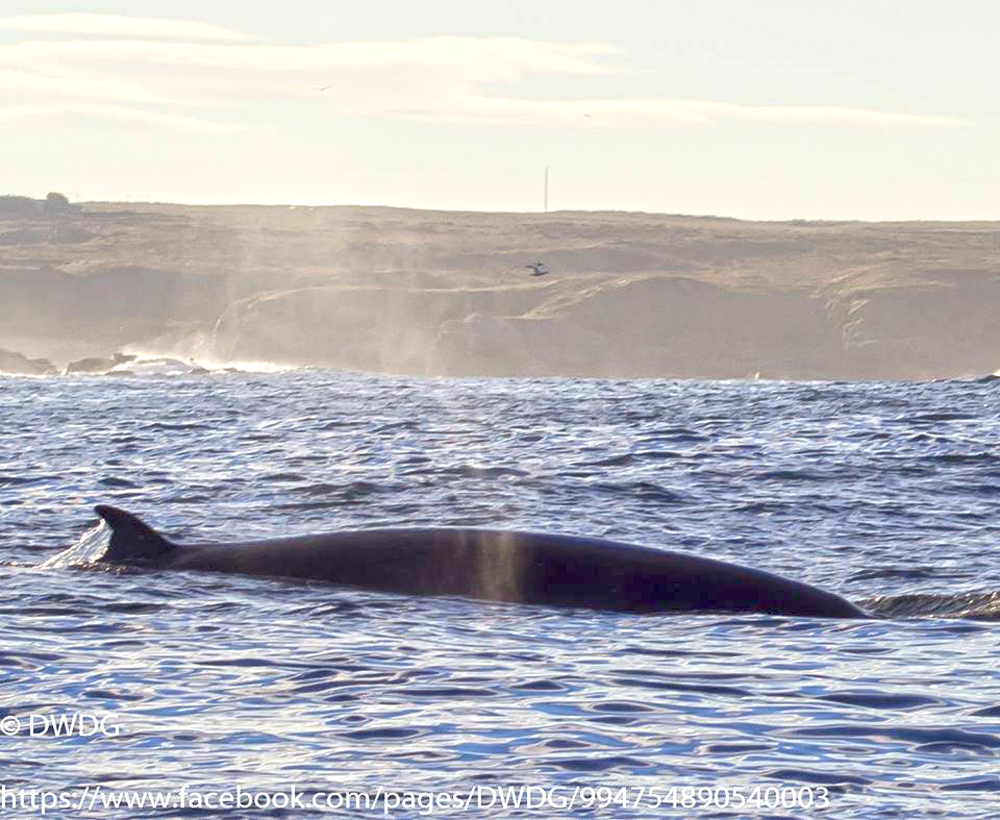
whale 2

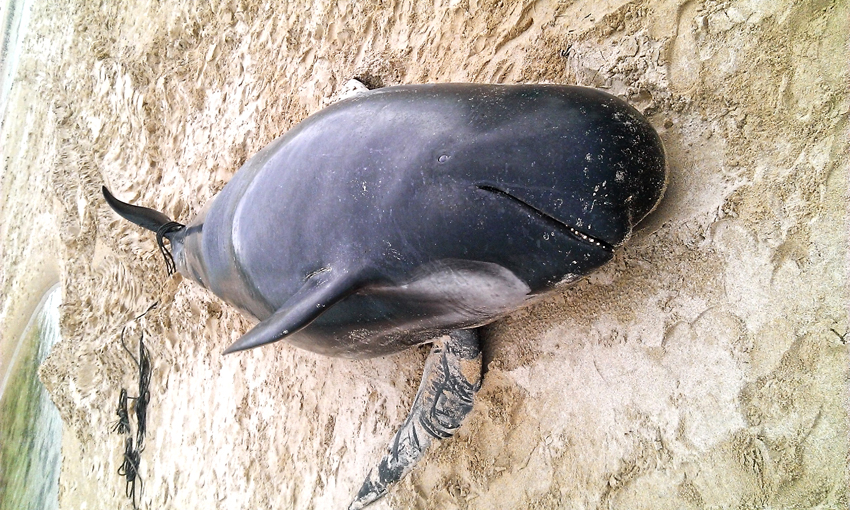
A stranded pilot whale struggles for life at Ballyness beach near Falcarragh, west Donegal. (Photo by Antonia Leitner).

Chairperson of the meeting, Amanda Doherty, with Selkie Sailing, who has also launched a petition that has attracted more than 230 signatures on the issue, said she was pleased by decisions those attending had made together.

“We want to raise community awareness and have the current policy regarding cetacean strandings in the area reviewed,” she said. “It should be a more flexible policy to allow for the particulars of different situations that occur. This is best practice according international standards and Ireland should follow it.”

Some people at the meeting – many of whom tried their best to save the dying whales – became emotional as they described the traumatic situation at Ballyness beach and the agony of the cetaceans as they slowly died of suffocation in shallow water.

Members of the National Parks and Wildlife Service (NPWS), led by Dave Duggan and Pat Vaughan, decided “to let nature takes its course” rather than try to save the whales or apply euthanasia to reduce the whales’ suffering. They also did not ask the coastguard for assistance to bring the whales out to sea, as has happened in other parts of Ireland. The state-funded Donegal county veterinary office under the leadership of Charles Kealey, chief veterinary officer, has also come under criticism for refusing to get involved in any way to help the whales, including making sure the mammals were dead before they were buried. (In contrast, see photo below of a cetacean (dolphin) being treated more humanely in another part of Ireland, with vets and the coastguard involved).

Strandedwm_shay-fennelly_2007

Westport-based Irish Coastguard assist with a stranded Common Dolphin which could not be refloated. A Mayo vet administered an injection to humanely end its suffering. Photo by Shay Fennelly

Pearse Doherty Sinn Fein TD for west Donegal, who has submitted a number of formal questions over the last week in the Dail to Ministers regarding the treatment of stranded whales and other cetaceans, attended the meeting and gave his advice on the best way forward for the group. Doherty said it was important the new group work with current organisations such as the Irish Whale and Dolphin Group (IWDG) and the National Parks and Wildlife Service (NPWS) and suggested a two-pronged approach – making sure policy at the IWDG matched international standards, and the establishment of  ‘first responders’ in the local area, recognized by the NPWS and IWDG – people who could take the lead in developing situations.

The newly-formed ‘North West Whale & Dolphin Support Group’ decided to hold monthly meetings and invite Simon Berrow, founder of the IWDG, to provide specialized training for members on how to best help stranded whales and other cetaceans and to meet with a small working group on the same day to discuss further action. Clare-based Berrow is a full-time lecturer at the Galway-Mayo Institute of Technology teaching on the Applied Freshwater and Marine degree course and project manager of the Shannon Dolphin and Wildlife Foundation.

After being contacted about the meeting, Berrow told the author of this blog, “We are delighted to hear of the formation of a local group. We look forward to working closely with them to prepare a better response to stranded cetaceans in the future and also to encourage local recording.”

Offshore toxic waste dumping? Military submarine activity?

At the same time, concerns regarding the health hazards to human life – as well as marine – from toxic dumping at sea and military submarine activity and experiments that may have caused the strandings have resurfaced locally.

dumping 2

Oceans that become graveyards for poisonous debris that pose dangers to human as well as marine life.

International regulations state that discharges of waste material – often poisonous by nature – should not be made within a certain distance of any landmass, according to the Seas at Risk. But who’s watching? Some major ports have cleaning facilities such as Edinburgh, Belfast and Dublin, but this costs money so some incorrigible corporations say ‘why bother’? As the coast of Donegal is in direct line of most transAtlantic ocean traffic between Europe and the Americas, the amount of waste dumped offshore is probably immense, one respected scientist saying ‘enough to create mountains under the sea.’ Much of this material contains cancer-causing chemicals (carcinogens) such as manganese, benzene, coal-tar, radium, petrolatum, parabens, vinyl chloride lead and zinc. With recent technological developments, many of these chemicals are in the form of deadly nanoparticles (particles less than the size of a human or animal cell) which, airborne, can then penetrate the cells, causing untold damage.

Nanoparticles: Technological and industrial development has outstripped health research into their potential dangers in everyday foods and consumer products.

Nanoparticles: Technological and industrial development has outstripped health research into their potential dangers in everyday foods and consumer products.

Could this be the cause or partial cause of disease in whales and other marine animals? Researchers say they have found large quantities of these chemicals in the whale tissue samples taken and tested. And doctors report larger than normal incidences of human cancer in local people.

In addition, some of the waste is in the form of non-biogradable plastics. Because they don’t dissolve but break up into smaller elements, these plastics have formed what scientists now call ‘plastic islands’ – often the size of countries, one is larger than the US state of Texas, which in itself is 17 times larger than Ireland – that float in our seas, causing disruption to the normal flow of currents. Consequently, the dangers to both human as well as marine animal health is high. For a long time, many people in northwest Donegal have suspected such dumping to have taken place offshore, with menacing results (see further information here).

A special group was established within the last two years at Ionad Naomh Pádraig in Dore by Freddie O’Donnell and Aodán Ó’Gallchoir to examine correlations between high levels of cancer in the Gaeltacht area and dumping of waste in coastal waters nearby. Known as ‘Scaoil Saor ó Ailse’ (Break Free from Cancer’), the group’s public relations officer, Joe Diver, said former local doctor Paddy Delap, said such waste was affecting peoples’ health, particularly cancers of the skin, lung and brain, with an abnormally high level of fatalities. A deep-sea diver then broke his decades-old silence on Raidó na Gaeltachta, describing how he found a large area of the sea bed littered with large black drums with hazardous signage on them in the waters off Tory Island, adding, “We were looking for shipwrecks, went down 40 to 45 metres and came across black drums with green stuff growing on them. There were a few thousand of them. They were heaped in a hill-like structure and had skull and crossbones on them. The diver said the drums would have since disintegrated and their hazardous material dissolved into the ocean off the Gaeltacht coast.”

submarine

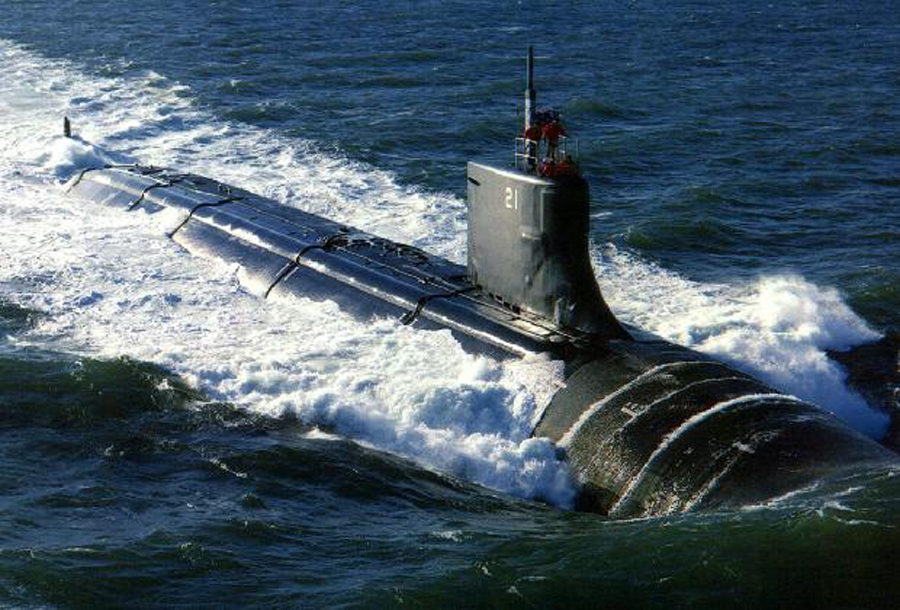
Military submarine activity and experiments at sea: what are the hazards for Man, Plant and Animal?

Areas affected could include Gaoth Dobhair, Cloughaneely and The Rosses. Calls for greater funding for a more comprehensive analysis were ignored by the relevant authorities, mainly on the instructions of Dublin, some say for economic and political reasons. Further, fearing such research could stir up waves of protest if the result became known, efforts were made by authorities, mainly Fianna Fail, then in power, to trivialize what little had become known. Politics and money trumped peoples’ health and once again the ‘Forgotten County’ was forced to live up to its unfortunate title.

Damage control became main concern for a certain cadre of elite: the party in power in the Dail and its big-business supporters. “This situation has been going on for far too long,” said one medical practitioner who has treated cancer patients in the area. “It is long past time national funding was made available to investigate this situation thoroughly. If it happened in certain other parts of the country, it probably would already have taken place long ago. Surely the deaths of so many marine animals and the high number of cancers affecting people means the issue should be looked at very closely.  To some extent, it’s in the hands of ordinary people. They should be lobbying their government representatives by e-mail, phone and letter. If not, nothing will be done.”

Several of the whales at Ballyness beach were found to have lesions, blemishes and lumps on its skin, but National Parks and Wildlife Service officials declined to say where any disease may have originated. As whales are highly social creatures that travel in communities, some say healthy whales may have refused to abandon sick or injured pod members and followed them into shallow water. “We can’t say for certain,” said Pat Vaughan, district conservation officer for the NPWS. “What we do know is that whales and other marine animals can have high levels of certain toxic elements in their bodies.”

Údarás na Gaeltachta – a secret society?

Living in Gaoth Dobhair, the heart of the Irish-speaking Gaeltacht area of Donegal in northwest Ireland, I take a strong interest in how this beautiful region – arguably the most scenic part of the entire country – is governed and develops, both economically and socially.

As such, I have vested considerable investigative journalistic experience, gained after 30 years in the media sector, in analyzing the workings of the largest economic development organization here – namely Údarás na Gaeltachta, an organization that has benefited from a spending budget of around one billion euro, mainly for job creation, since it was first established in 1980.

I have penned many news and feature articles on the organization over the last five years, the latest (below) published today (Friday) in the largest circulation newspaper in Donegal, the Donegal News.

For context, it’s probably worth reading the much more comprehensive, three-part series on Údarás that I wrote for the same newspaper. You’ll find it in the earlier posts below.

Pulling the ropes

Údarás na Gaeltachta – a secret society?

Like Br’er Rabbit, west Donegal’s largest economic development group is captive.

Captive to the belief that call centres and large manufacturing companies are the only way to create jobs – and to a golden circle that benefits from such thinking.

As such, Údarás na Gaeltachta is a Tar-baby, ever-more entangled in a sticky situation.

With the recent announcement that Largo Foods in the Gaoth Dobhair industrial estate will now close, with the loss of over 140 jobs, and after spending more than two million euro in the Donegal Gaeltacht over the last year, the Irish-language organisation has suffered a net loss of 78 jobs, according to its own figures, the worst record for many years.

So what has gone wrong? Seemingly, plenty!

Remoteness, poor infrastructure and a narrow skills’ set are the reasons most often given for few companies coming to the rural Gaeltacht of west Donegal. But does this excuse Údarás’ poor performance and lack of transparency as a public body?

After announcing recently it created 220 jobs in Donegal last year, Údarás promptly declined to give a breakdown of the figure. Following a Freedom of Information (FOI) request I made earlier this year seeking a list of funded companies and their job numbers, as well as pension payments, it replied, “For data protection and commercial sensitivity reasons. We do not release specific information collated for the purposes of the Údarás employment survey to the general public,” adding that pensions, while funded by the taxpayer, were private matters.

I asked Sinn Féin Senator Trevor Ó Clochartaigh of the Oireachtas Joint Committee, which revealed Údarás pays half its annual budget in pensions for 136 former executives, to follow-up. His party leader, Gerry Adams TD, submitted Dail question Nr. 127, as well as Questions 416 and 417, asking the Minister for Arts, Heritage and the Gaeltacht to “detail final salaries levels, lump sum or additional payments and the pension payments made to each chief executive officer or regional executive of Údarás who retired in the past three years.” Minister Jimmy Deenihan answered: “I have been advised by Údarás na Gaeltachta it considers the payments referred to are covered under the Data Protection Acts 1988 and 2003. Accordingly, it is not in a position to supply the information requested.”

Mary Lou Nolan, TD, Sinn Féin’s spokesperson on public expenditure and reform, then submitted yet another Parliamentary question, Nr. 148, asking the Minister to “reference the specific provisions of the Data Protection Acts to which he refers; the basis on which he believes Údarás na Gaeltachta does not, unlike all other senior managers across the civil and public sector, have to make public, details of public service pension arrangements.” A full answer is still awaited.

Such lack of co-operation by Údarás is disconcerting and leads inevitably to suspicion, making the words of its Arranmore Island-born chairperson Anna Ní Ghallchóir to me – “utter transparency is a given” – seem pale.

About one billion euro has poured into the Donegal Gaeltacht since Údarás was founded – for a population of 24,000. Result: the highest unemployment rate nationally, ugly, empty, ghost-like industrial estates blighting a rural landscape and a horrendously under-developed tourism sector.

Two years ago, under the Fine Gael-Labour ruling coalition, a new board promised change, with both ni Ghallchoir and fellow board member John Curran saying to me in separate interviews that widespread funding for ‘cultural tourism’ projects would be given to create sustainability by attracting more visitors to west Donegal. Two years later, less than five per cent of Údarás’ budget has gone to such projects, leading people at a recent EU-backed cultural tourism CeangalG (ConnectG) conference at An Chuirt Hotel in Gaoth Dobhair to complain of dwindling support.

In the case of Largo Foods, where is the sustainability that Údarás grants totaling 6.2 million euro to it (over 43,000 euro per job) should have created, and what business-sense does it make for Údarás to allocate half a million euro for two years for this company, which didn’t even bother to draw it down? With call centers and large manufacturing units merely band-aids for local unemployment problems, why has Údarás shown so little trust in small businesses forming the backbone of the local area’s economy? Especially so when a national economist who completed her Doctorate on Údarás operations, concluded, “on supply chain factors alone, a long-term, job creation strategy based on manufacturing was, and will continue to be, insane.” Could the fixation with short-term job numbers be linked to retention of Údarás’ own staff jobs, whose salaries average 80,000 euro annually, excluding expenses?

Instead of cultural tourism being expanded with serious money, Gearóid Ó Smaoláin, the organisation’s tourism officer, said in a recent public forum that “discussions are well-advanced” on building an alcohol and drug addiction clinic in the coastal town of Falcarragh, beside an existing golf course in the Ballyconnell House estate. It is believed Údarás, having already turned down several tourism ideas for the area, will allocate between several hundred thousand and one million euro to the project, which will be run by an arm of the Catholic Church.

Ultimately, decent Donegal people deserve better. How many more millions of euro must be wasted, how many more years lost, before Údarás changes its vision, and for transparency and accountability to be achieved? Perhaps only then will the ceaseless brain-drain halt and our native language escape from withering on the vine.

Published in Donegal News

Udaras na Gaeltachta consider challenges of creating new jobs

Meeting for the first time this morning (Friday), members of the new board of Udaras na Gaeltachta face the challenging tasks of analysing the organisation’s performance and brainstorming on ways to accomplish the goals for which the Irish-language body was established.

One priority is employment in Gaeltacht areas. “Job creation and language promotion go hand-in-hand,” Anna Ni Ghallchoir, 55, the new chairperson, told the Donegal News. “With my new board colleagues, I will be examining very closely if past strategies have been successful and come up with innovative ones to help us move forward.”

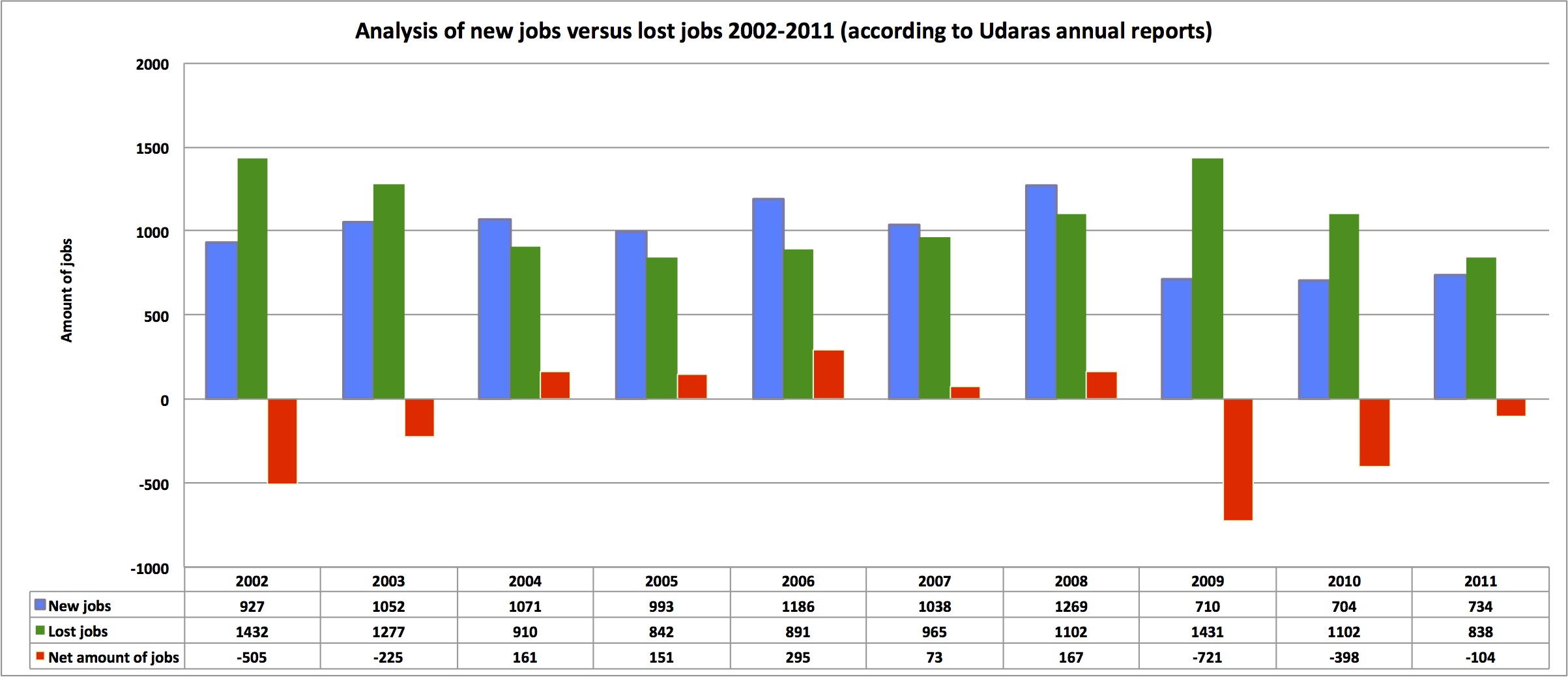
Depending on whom you speak to, Udaras has either an acceptable record on job creation, or a very poor one, reflecting the age-old comment that statistics are like sausages – they look good but you’re never quite sure what’s in them.

New jobs versus lost jobs

With total funding of around one billion euro so far, Udaras reported it had created 6,970 jobs as of last year in what it terms ‘client companies,’ defined as any company receiving support. When examined in the context of unemployment in Gaeltacht regions, this represents 7.75 per cent of the population there. As of last year, Udaras’ website shows it supported 1,876 jobs in the Donegal Gaeltacht, which represents 7.89 per cent of almost 24,000 people. Donegal Gaeltacht has the second largest number of Irish speakers, but ranks fifth in jobs created among the seven Gaeltacht regions.

Liam O‘Cuinneagain, Udaras chairperson for the last ten years, told the Donegal News he is “satisfied with our job creation performance,” adding, “It’s not easy to get companies to locate to rural Ireland, in part because of its remoteness and lack of transport links and limited skill-sets there.” As evidence in Donegal, he points to sectors Udaras has invested in – seafood processing, call centres (VHI), IT, sea angling, boat repair, even potato-crisp/fast food manufacturing (Largo Foods).

Other business analysts, however, are less satisfied with Udaras’ performance, including Tom Fitzgerald, fluent Irish speaker and business owner employing 50 people at Bard na nGleann, his information-management company in Béal Átha’n Ghaorthaidh in the Cork Gaeltacht. “A strong, well-run economic development organisation is important for the preservation and promotion of the Irish-language and for job creation in marginalized areas such as the Gaeltachts, including Donegal, but there’s no shying away from facts, Udaras is an extraordinarily expensive organisation,” Fitzgerald, whose company has an annual turnover of between one and two million euro, told the Donegal News. “There is little evidence of effectiveness in the statistics. By normal business practice standards, Udaras’ record so far is very poor.”
Expenditure

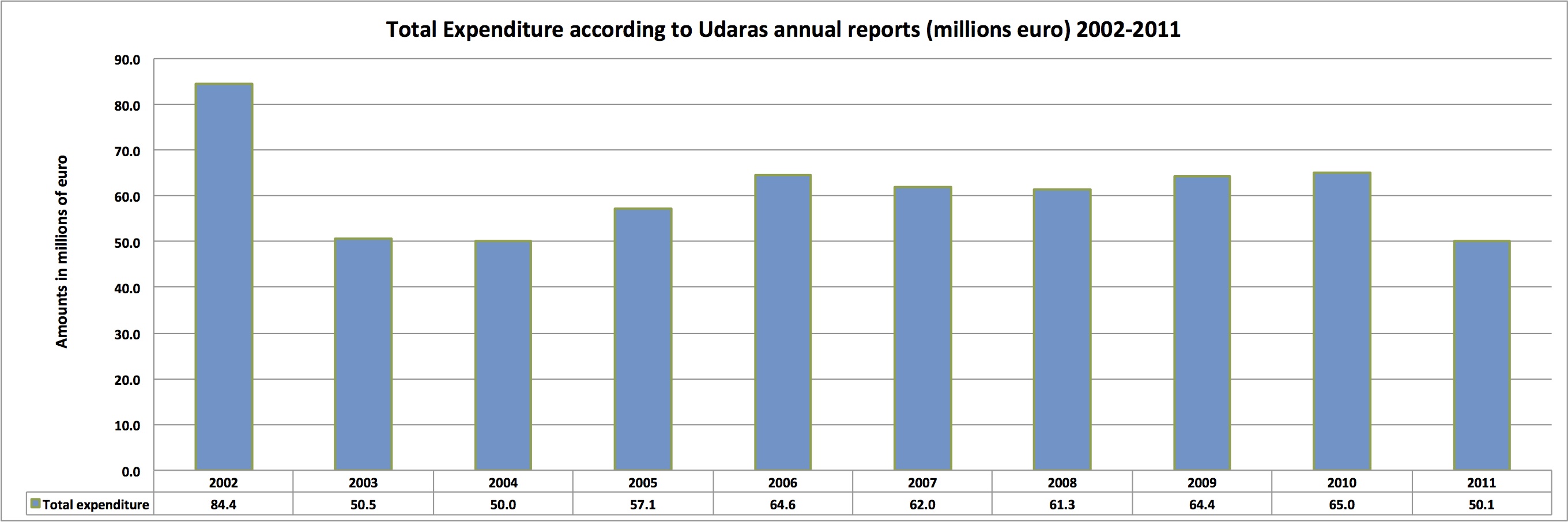
Fitzgerald points to the fact that the total number of jobs Údarás says it created was lower in 2010 than in 1996. “Furthermore, there’s no indication that the amount of money spent by Údarás in a single year has any impact on job creation in the Gaeltacht.  For example: Údarás spent more than 84 million euro in 2002 according to its own annual report. Yet there is no corresponding spike in jobs either in that year or following years.”

O‘Cuinneagain says during his tenure as chairperson, “cost per job was around eight thousand euro.” However, a simple look at Udaras’s total expenditure for the last ten years (613.5 million euro) relative to the number of jobs it reports creating by the end of last year (6,970) equates to 88,000 euro cost per job. As only around 10 per cent of budget goes to language-cultural activities, the final cost per job figure may be as much as ten times higher than stated. In Donegal, a case study in job costs is Largo Foods, headquartered in Ashbourne, Meath, but with facilities in the Gaoth Dobhair Industrial Estate. According to Udaras, it has received over 6.2 million euro in funding between 1999 and 2011 – with another half-million euro to be paid soon for automated equipment. Udaras said last year the company employed 120 people. Taking those figures, that works out to be over 55,000 euro investment per job created, not considering funding from other bodies for Largo. Ironically, following the installation of the automated equipment earlier this year, media reported 36 jobs were lost at Largo.

As some of Udaras’s ‘client companies’ are also the ‘client companies’ of other organisations, foreign and domestic, from whom they receive additional support, it is difficult to evaluate what specific job numbers Udaras contributions amount to. “The term ‘client companies’ is a loose one, easily manipulated to suit purpose,” said Fitzgerald. “Some organisations that partly support companies in the Gaeltachts often claim all the jobs as their own making, which is quite misleading.”

O’Cuinneagain acknowledges that criticisms of Udaras for not supporting enough micro companies – entrepreneurs wishing to hire a handful of people – are valid. “We’re not getting what we should be getting – smaller businesses,” he said. “We’ve focused too much trying to get big companies that might employ hundreds. Even though the finance and support system is there, Udaras has not been welcoming enough. Staff have not been as pro-active as they should be, have not scoured their Gaeltacht communities to find such entrepreneurs. Unfortunately, we have remained in a culture of factory jobs.”

Asked why, the director of Oideas Gael, a language group in Glencolmcille, lay the blame on factors outside Udaras ranging from lack of business teaching in education “Greek and Latin instead of entrepreneurialism” to lack of bank finance. But he did not rule out the possibility that as funding a small company with thousands of euro amounted to nearly as much paperwork for Udaras staff as funding large companies with millions of euro, there may have be a Udaras propensity for avoiding small business applications. Asked if the push for larger companies could have been simply a strategy to keep employment figures up and for Udaras to retain its all-important job-creation remit, which accounts for most of its annual budget, he said, “That’s ridiculous, sounds more like a conspiracy theory to me.”

Fitzgerald’s opinion differs, “About the only goal that Údarás is measured on is the creation of 800 or so new jobs per year, so they focus on doing just that. The problem is that this strategy doesn’t take into account what kind of jobs they are. In theory, Údarás is better off creating jobs that disappear quickly so they can place the same people again in a year or two.”

Analysts also say the Udaras board members may not have had enough business experience to spearhead a successful jobs-creation strategy. Of the Donegal members on the previous board, none could be identified as having long-time corporate management experience. O’Cuinneagain waved aside concerns that the previous national board was too large, numbering twenty, which some analysts said made it unwieldy to manage and hampered decision-making. “I did not find our board meetings too difficult to manage, but then again my experience as a teacher in inner city Dublin for many years helped a lot,” he said.

Lack of fiscal clarity within Udaras concerns some observers.

“I spent several years studying the organisation and found its finances extremely difficult to understand,” one leading business researcher told the Donegal News. “I also found frequent errors in its calculations. Some figures on spending simply did not add up. There’s really no excuse for that when we have so many accounting software programs such as Excel at our disposal.”

When the Donegal News requested a breakdown of Udaras spending for the seven Gaeltacht regions, particularly Donegal, for the last three years, Siubhán Nic Grianna, national communications and marketing manager, responded, “The distribution of total monies is not segregated on a county by county or Gaeltacht by Gaeltacht basis therefore I cannot provide breakdown for Donegal for this period.”

Bernard Allen, former TD and head of the multi-party Public Accounts Committee (PAC), which oversees the proper spending of public money, told the Donegal News that lack of transparency at Udaras may have hindered job-creation efforts. “We found its expenses system to be incomprehensible and could not understand how it was spending so much money on trips for so-called job creation efforts.”  Referring to the scandal over misspending by another state body, he added, “Udaras’ expenses read like a mini-FAS and it seemed to stymy our efforts to find out the truth and avoid disclosing pertinent facts and figures to us, especially related to board member, staff and associated expenses. With better accounting practices, perhaps its job creation efforts could have been more effective. ”

Some questions concerning expenses, including 30,000 euro over two years on trips to Halifax, Canada, to look at seaweed projects, costly business-class flights, trips to many international cities including Las Vegas, Shanghai, Los Angeles and Chicago, and expenses for spouses – which is counter to existing regulations – have still not been fully answered, Allen said.

Nic Grianna said such concerns lack basis. Describing the first story in this newspaper series as, “a slanted view, full of insinuations,” she added, “There was no reprimand from the Public Accounts Committee (PAC). We are very open and transparent and explained everything. There has been no abuse of public money.” In response, Allen said simply, “We did not get all our questions answered satisfactorily and a national election was called and the PAC disbanded before we could investigate fully.” Even though the information is in the public domain, Nic Grianna declined a request for a breakdown of pensions for 136 Udaras former executives costing around 4.3 million euro this year, half of this year’s current budget. Efforts to contact retired executives Cathal MacSuibhne in Donegal and CEO Padraig O’hAolain through Udaras for comment, were unsuccessful.

With allegations of cronyism and clintelism tainting many public bodies, O’Cuinneagain said he did not experience conflicts of interest while Udaras chairperson. “My organisation, Oideas Gael, did not receive any money from Udaras so I certainly did not feel the need to excuse myself from board discussions on funding, nor did any of the other board members as they did not receive any money either.”

As the Udaras board meeting gets underway this morning, Sean O’Cuirean, a new member from Falcarragh, remains optimistic. “A good thing about this board is that there are a new set of eyes looking at the situation. Such fresh perspectives often result in greater success and money well spent.”

Published in Donegal News