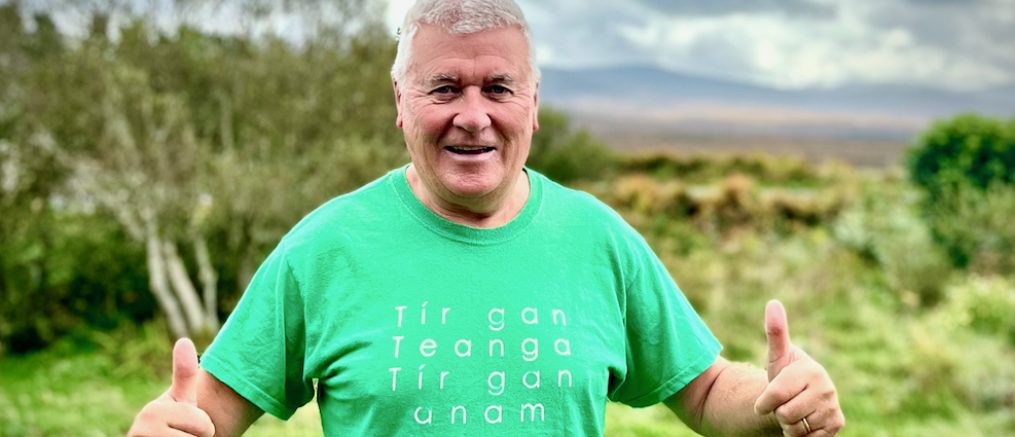
Owen Curran: well-respected Donegal community activist speaks out

Names his choices for local elections in the Glenties

Watching as stone cottages in England were leveled to make way for a nuclear power plant and seeing protestors trying to stop it being mistreated by police was the beginning of Owen Curran’s political awakening.

I was nineteen, living in England, but that planted a seed in me,” the 51-year-old explains simply during a recent two-hour interview at Lough Altan Hotel in Gortahork.

Owen, first from the left, looking at camera, displays his solidarity with protestors seeking greater equality and social justice.

In the intervening thirty-two years, that seed has grown into a sturdy tree, its branches used in the protection of basic civil and community rights and furtherance of a more equitable society. That’s why Curran, who was born in Glasgow but who grew up in Ray, west Donegal, and has lived the last 12 years in nearby Derryconnor, came to be one of the canvassers for a then aspiring Dublin political leader named Joe Higgins in the 1990s. That’s how he also ended up in the vanguard of the Cloughaneely ‘Can’t Pay, Won’t Pay’ campaign against the household and water taxes; among 15,000 people protesting outside the Fine Gael Ard Fheis two years ago in Dublin; and one of a small group of people behind the emergence of ‘May Day’ celebrations earlier this month in Falcarragh.

I suppose you could say I’ve always been involved in fighting for peoples’ rights and social fairness,” says the well-read, quiet-spoken Donegal county council employee. “These rights were hard-fought to get and keeping them is even more difficult, especially in times of economic crisis.

With the local elections but a few weeks away, Owen, who like many Irishmen before him has travelled to many places seeking work, including Neasden, Edinburgh, Bermondsey, Dunbar, Haddington and Port Seton, is eyeing the candidates with that view very much in mind. “I’m looking for people with genuine beliefs about social justice, the kind who get involved and don’t waver when things get tough, people like Pearse Doherty of Sinn Fein, the best politician we’ve ever had in Donegal,” he says, before adding philosophically, “democracy is a living, breathing, thing and should be borne out to its fullest. We’ve been told there is an economic upturn, but we don’t see it. Most of our working people have emigrated or are simply unemployed. How can we talk about rural Ireland if we don’t put people back to work? We need to get back to basics, back to looking at agriculture, tourism, the environment. We need open public forums where people can have the right to their say in how the community in which they live should move forward. We’re not going to come out of this crisis automatically. That requires serious, long-term spending.

So why hasn’t that happened already? Why has there been so little protest from Irish people who have undergone such dire difficulties over the last five years?

There are many reasons,” he explains. “With our colonial past, including landlordism, there has been a ‘do-what-you-have-to’ attitude to survive. Also, the Catholic Church, while it has done much good, has left us over-deferential to authority. Further, emigration has always been Ireland’s safety valve. It lets pressure off. Those who would traditionally stand up are gone away.

Owen also believes history went amiss for the people of Ireland. “After the so-called revolution here, the wrong people grasped power, not the people who did most of the fighting, but larger farmers and those who were better off. Some people like to make a devil out of Éamon de Valera but he wasn’t alone. Some of what he and others beside him did was progressive but there has been an absence of social change. Ireland is a Republic in name only and even though the phrase annoys me, we are a ‘class conscious’ nation. In a country in which we felt we were in it together, resisting the might of the British Empire, we found we were no better, no worse, than them. The green flag is still waiting to be raised. There are still things to do.

That includes, according to Owen, “all people being given choices.” “People are not given their rightful place. Minorities should be able to voice their opinion. That is vitally important. Cutting them off is dangerous and we have to be ever vigilant that does not happen. We also need to relearn a lot of stuff, things we knew in the past, like solidarity and standing up for each other. Irish people like to say they didn’t like Margaret Thatcher yet we’ve taken many of her policies and applied them, thus the Celtic Tiger and the Charlie McCreevy’s of this world. Unions ‘in partnership’ with government? What does that mean? We cannot sit on both sides of the fence. It’s as if we are delighted to be allowed to ‘join the club,’ join the ruling classes. We have become so deferential to authority we let off those clearly guilty of white-collar crime. It has just become too easy for them.

Locally, Owen is passionate about the unfortunate situation at Largo Foods in Gaoth Dobhair. “This is a case where skills were honed over forty years, yet now, it’s all gone. Crocodile tears were shed by many politicians, but it took eleven days for Udaras na Gaeltachta to host a first meeting on the factory’s closure. It should have organized a special task force back in the 1980s when manufacturing was going down. I mean, has there ever been an audit of skills in the Gaeltacht community, not to mention a series of public meetings to find job-creation ideas or special training seminars on how to apply properly for funding? Udaras has spent hundreds of millions of euro of public money over the years and much of it has been wasted. It is long past time for greater transparency and much more public scrutiny of the way this organisation operates.

To whom does Owen owe such thoughtful and mature political thinking? “In Ireland, the lives and writings of people like James Connolly and Jim Larkin, and, of course, Joe Higgins, which is why I canvassed for him all those years ago, but others outside Ireland who were very influential during their time,” he says. Among these, Owen adds, are James Cannon in the United States, whom he sees as “an early stalwart of American socialism in the 1930s and who wrote ‘Socialism on Trial,’ which Owen considers “a masterful explanation of the ‘red scare,’ and even the writer, Jack London, who wrote ‘The Iron Heel,’ about the strength of the individual and the collective. Owen also greatly admires Barack Obama, who, he says, “has made a tremendous difference.”

With local elections up ahead, how does the local activist – with two brothers and two sisters and now married to Sheila – feel about the future?

I remain optimistic. I believe in people, in the human spirit. But we need to build peoples’ confidence, to encourage them to get involved in making their communities better. They will find they are well able but it’s a long process. However, it can work. There is not simply dark and light. There’s rarely an outright victory. The ‘Can’t Pay, Won’t Pay’ campaign, for example, made a number of people active. We all learned how to debate issues. In many ways, it was a model for local democracy within a group. I saw people who were too shy to speak, get up and chair a public meeting.

Regarding the ‘Can’t Pay, Won’t Pay’ campaign, Curran gives great credit to a number of people who he says “have been pioneers in the struggle for greater equality as well as anti-austerity stalwarts, including Theresa and Caroline Woods, founders of the group; Mary Bridget Sharkey; Mary Attenborough; Moire McCarry; R.J. McLean; James Woods;  Gerard Gallagher; and Martin McEhlinny.”

He continues, “Back to the issue of deference – some people on the left wasted an opportunity this economic crisis presented. They disengaged over spurious reasons. The landscape changed but they didn’t take advantage of the opportunity it presented. Forcing Fine Gael and Fianna Fail together would have made way for a stronger Left alliance….. but maybe it’s not too late.

Owen’s choices in the upcoming local elections for the Glenties area are –

  1. Michael McClafferty – “a decent, hardworking person who got involved in this election because he believes change can only come about if people go into politics and fight for it.”
  2. Cllr. Marie Therese Gallagher and John Sheamais O’Fearraigh of Sinn Fein “because that party has shown consistent loyalty to its principles, as well as strong discipline, especially at last year’s council budget meeting.”
  3. Seamus Rogers – “a genuine community activist, and a decent man.”
‘Stirring up a Hornet’s Nest?’ Or open public debate on a key issue?

I’ve just finished a radio discussion today on the Shaun Doherty Show on Highland Radio with Udaras board member and Fine Gael local council candidate, John Curran, on the proposed drug and alcohol addiction clinic in Falcarragh in west Donegal.

While I meet with John frequently – and admire what he is accomplishing in the voluntary sector and wish him every success in his upcoming political campaign for local council elections on behalf of Fine Gael – his describing me as “stirring up a hornet’s nest” by bringing to public attention an important project near the main crossroads in Falcarragh was disappointing, especially coming from someone who stated on his Facebook a day ago when launching his campaign, “I have pledged to make no empty promises, all I will say to anyone who has an issue or a suggestion is thank you and that I will try to address your issue if and when I am elected.

After all, this clinic, which is expected to cost hundreds of thousands – perhaps over a million euro – in public money, has important long-term repercussions for the local community in west Donegal, socially, culturally and economically, including:

  • restricted future access to this lovely area for members of the public;
  • perhaps (no guarantee), decent paying jobs;
  • far less money for tourism projects, cultural, arts or others, as promised by John and his fellow board members when appointed two years ago (in a beautiful and inspiring area as west Donegal such clean, environment-enhancing development could be enriching if funded is on a serious scale);
  • added trauma for local clerical abuse victims (unfortunately, the highest rate of such abuse per population is west Donegal) due to the involvement of Catholic Church-operated Cuan Mhuire, the company who will run the clinic, and which is alleged to have allowed such offending priests to say Mass at their centres.

For all of the above reasons, and more, the proposal for this clinic and its ramifications on the local community should be discussed openly. And as often as possible.

Unfortunately, the term ‘stirring up a hornet’s nest’ stated by John seems to echo a sentiment prevailing at Udaras – namely that the less the public knows about how its money is being used the better. A public body, using citizens’ hard-earned money, this economic group still refuses to reveal specific job-creation figures on a company-by-company breakdown of the ones it funds. Or the amount of money paid out from the public purse to its present and former top executives, locally and nationally, in pensions and other benefits.

John mentioned on the Shaun Doherty Show Highland Radio programme less than an hour ago that public information meetings have been held regarding the addiction clinic project. According to people who approached me, this is an erroneous comment and should be withdrawn. If such meetings had taken place, such a project – costing so much money and with such important social ramifications – would have made its way into the public arena, via media reports. Instead, the idea has remained in the realm of rumor and counter rumor and, until the story broke last week with details, might have remained there.

As a journalist and concerned social commentator, I can only do so much to highlight key issues affecting our community. It is important that others speak out (otherwise we cannot completely blame politicians for making bad decisions).

Therefore, if anyone wishes to comment, please do so – either for or against the project – on my blog or on that of other local media such as Donegal Daily, which published the story yesterday), or Highland Radio, which aired the debate today. Or directly to John Curran.

Only by voicing opinions strongly along whichever pathways open to us, can we influence what is happening in our own community. And with local elections coming up soon and campaigns well underway, there seems no better time.


Údarás na Gaeltachta – a secret society?

Living in Gaoth Dobhair, the heart of the Irish-speaking Gaeltacht area of Donegal in northwest Ireland, I take a strong interest in how this beautiful region – arguably the most scenic part of the entire country – is governed and develops, both economically and socially.

As such, I have vested considerable investigative journalistic experience, gained after 30 years in the media sector, in analyzing the workings of the largest economic development organization here – namely Údarás na Gaeltachta, an organization that has benefited from a spending budget of around one billion euro, mainly for job creation, since it was first established in 1980.

I have penned many news and feature articles on the organization over the last five years, the latest (below) published today (Friday) in the largest circulation newspaper in Donegal, the Donegal News.

For context, it’s probably worth reading the much more comprehensive, three-part series on Údarás that I wrote for the same newspaper. You’ll find it in the earlier posts below.

Pulling the ropes

Údarás na Gaeltachta – a secret society?

Like Br’er Rabbit, west Donegal’s largest economic development group is captive.

Captive to the belief that call centres and large manufacturing companies are the only way to create jobs – and to a golden circle that benefits from such thinking.

As such, Údarás na Gaeltachta is a Tar-baby, ever-more entangled in a sticky situation.

With the recent announcement that Largo Foods in the Gaoth Dobhair industrial estate will now close, with the loss of over 140 jobs, and after spending more than two million euro in the Donegal Gaeltacht over the last year, the Irish-language organisation has suffered a net loss of 78 jobs, according to its own figures, the worst record for many years.

So what has gone wrong? Seemingly, plenty!

Remoteness, poor infrastructure and a narrow skills’ set are the reasons most often given for few companies coming to the rural Gaeltacht of west Donegal. But does this excuse Údarás’ poor performance and lack of transparency as a public body?

After announcing recently it created 220 jobs in Donegal last year, Údarás promptly declined to give a breakdown of the figure. Following a Freedom of Information (FOI) request I made earlier this year seeking a list of funded companies and their job numbers, as well as pension payments, it replied, “For data protection and commercial sensitivity reasons. We do not release specific information collated for the purposes of the Údarás employment survey to the general public,” adding that pensions, while funded by the taxpayer, were private matters.

I asked Sinn Féin Senator Trevor Ó Clochartaigh of the Oireachtas Joint Committee, which revealed Údarás pays half its annual budget in pensions for 136 former executives, to follow-up. His party leader, Gerry Adams TD, submitted Dail question Nr. 127, as well as Questions 416 and 417, asking the Minister for Arts, Heritage and the Gaeltacht to “detail final salaries levels, lump sum or additional payments and the pension payments made to each chief executive officer or regional executive of Údarás who retired in the past three years.” Minister Jimmy Deenihan answered: “I have been advised by Údarás na Gaeltachta it considers the payments referred to are covered under the Data Protection Acts 1988 and 2003. Accordingly, it is not in a position to supply the information requested.”

Mary Lou Nolan, TD, Sinn Féin’s spokesperson on public expenditure and reform, then submitted yet another Parliamentary question, Nr. 148, asking the Minister to “reference the specific provisions of the Data Protection Acts to which he refers; the basis on which he believes Údarás na Gaeltachta does not, unlike all other senior managers across the civil and public sector, have to make public, details of public service pension arrangements.” A full answer is still awaited.

Such lack of co-operation by Údarás is disconcerting and leads inevitably to suspicion, making the words of its Arranmore Island-born chairperson Anna Ní Ghallchóir to me – “utter transparency is a given” – seem pale.

About one billion euro has poured into the Donegal Gaeltacht since Údarás was founded – for a population of 24,000. Result: the highest unemployment rate nationally, ugly, empty, ghost-like industrial estates blighting a rural landscape and a horrendously under-developed tourism sector.

Two years ago, under the Fine Gael-Labour ruling coalition, a new board promised change, with both ni Ghallchoir and fellow board member John Curran saying to me in separate interviews that widespread funding for ‘cultural tourism’ projects would be given to create sustainability by attracting more visitors to west Donegal. Two years later, less than five per cent of Údarás’ budget has gone to such projects, leading people at a recent EU-backed cultural tourism CeangalG (ConnectG) conference at An Chuirt Hotel in Gaoth Dobhair to complain of dwindling support.

In the case of Largo Foods, where is the sustainability that Údarás grants totaling 6.2 million euro to it (over 43,000 euro per job) should have created, and what business-sense does it make for Údarás to allocate half a million euro for two years for this company, which didn’t even bother to draw it down? With call centers and large manufacturing units merely band-aids for local unemployment problems, why has Údarás shown so little trust in small businesses forming the backbone of the local area’s economy? Especially so when a national economist who completed her Doctorate on Údarás operations, concluded, “on supply chain factors alone, a long-term, job creation strategy based on manufacturing was, and will continue to be, insane.” Could the fixation with short-term job numbers be linked to retention of Údarás’ own staff jobs, whose salaries average 80,000 euro annually, excluding expenses?

Instead of cultural tourism being expanded with serious money, Gearóid Ó Smaoláin, the organisation’s tourism officer, said in a recent public forum that “discussions are well-advanced” on building an alcohol and drug addiction clinic in the coastal town of Falcarragh, beside an existing golf course in the Ballyconnell House estate. It is believed Údarás, having already turned down several tourism ideas for the area, will allocate between several hundred thousand and one million euro to the project, which will be run by an arm of the Catholic Church.

Ultimately, decent Donegal people deserve better. How many more millions of euro must be wasted, how many more years lost, before Údarás changes its vision, and for transparency and accountability to be achieved? Perhaps only then will the ceaseless brain-drain halt and our native language escape from withering on the vine.

Published in Donegal News

New start for Udaras na Gaeltachta

With its national board due to meet for the first time as early as next week and its all-important job-creation remit still intact, a new start seems in order for Udaras na Gaeltachta.

But controversy still bedevils the beleaguered organization with criticisms of misspending of public money and investigations into alleged petty corruption by former board members in Donegal hanging over its head.

Over the next few weeks, the Donegal News analyses the Irish-language organisation, with emphasis on its operations here, in an effort to understand whether it has accomplished its tasks with adequate self-governance or whether various criticisms it faces are justified. And what, if anything, can be learned from the findings.

On a positive note, Anna Ni Ghallchoir, from Arranmore, the newly-appointed national chairperson of Udaras, told the Donegal News, “We have a very committed team with varied experience on the board now and I have every confidence their combined efforts will lead to success.”

Udaras

Sean O’Cuirean, Falcarragh solicitor, manager of Donegal Volunteer Center, and new board member, added, “Selection of board members was via open, competitive applications. I’m really looking forward to working with my colleagues to build dynamic Gaeltacht communities.”

The two, alongside ten other members, including Eunan MacCuinneagain, manager of Westbic, in Kilcar and a yet-to-be selected Donegal Council representative, face what Ni Ghallchoir termed “some daunting and challenging tasks ahead.”

At present, several former Donegal Udaras board members are under investigation by respective public ethics bodies for allegedly padding their expenses.

Concern over board and employee expenses accrued came to the fore over the last week when TDs at an Oireachtas Joint Committee were told by Minister’s Jimmy Deenihan and Dinny McGinley that half this year’s budget (€9.8 million in 2012) goes towards paying pensions of 136 former employees. Details are forthcoming as yet as to how much of the remaining budget goes into salaries and expenses of the 90 full-time employees and board members. Sinn Fein Senator Trevor Ó Clochartaigh said, “I nearly fell off the chair when I heard that,” adding, this raises serious concerns regarding the levels of monies being paid. Mean salaries at Udaras are around 80,000 euro.

In addition, it has been revealed that five Donegal board members were paid more than half a million euro in fees and expenses over the five-year period, 2004 to 2009. In this regard, board member O’Cuirean  said, “It is a major step forward that we can save half a million euro on fees and expenses by reducing the board while maintaining full geographical representation and that the money saved can go towards worthy community or entrepreneurial projects.”

Frank McBrearty, Mayor of Donegal, bemoans the delay in having a council member appointed to the board. “It is a sad reality that investigations into former board members’ expenses, including our council nominee, David Alcorn, is underway but that means we are short one person on the Udaras board. That does not benefit the community here. It must also be remembered, those being investigated are innocent until proven guilty. I can understand Minister McGinley’s not wanting to have egg on his face by appointing someone until things are clarified.

Udaras has come under criticism in the past by various national bodies in the past including the Dail’s own multi-party Public Accounts Committee (PAC) which examines the spending of public monies. Bernard Allen, former Fine Gael TD and head of the PAC, who launched an examination of Udaras financial affairs that helped lead to the board’s restructuring, told the Donegal News this week, “I recall being very concerned about the lack of transparency in the accounts of Udaras, especially in terms of travel expenses and extra payments, both for trips within Ireland and abroad.” Those trips included, it was claimed, to Las Vegas, for officials to meet with representatives of the Irish Development Authority (IDA).

Speaking to the Donegal News, Liam O’Cuinneagain, chairperson for five years, defended his and the record of Udaras, “There was a lot of paranoia at the time about whether public bodies and semi-state ones were spending public money properly, a lot of exaggeration and misinformation. We have done a relatively successful job in helping Gaeltacht communities.”

New board members are reluctant to talk about the controversies, saying they occurred before their appointment. Chairperson Ni Ghallchoir, said, “I’d rather not comment on what went on before as I was not in any way involved with Udaras then, but to my mind, utter transparency is a given. Every citizen is fully entitled to as much information as they wish about public bodies such as Udaras and as chairperson I will make sure they have complete access to the workings of the organisation.”

Falcarragh’s O’Cuirean added, “Everyone is aware of the lack of transparency in Ireland in the past on certain matters and the unfortunate results for the country as a whole. My commitment is that in future Udaras will be completely open in its dealings so that projects – whether in culture, language or economics – are selected on merit and need, not on who certain people know. Cronyism should play no part in its affairs.”

Published in Donegal News