
One-Eyed One Irish legend recreated by talented Donegal drama group in Falcarragh

Ever heard about Balor of the Evil Eye?

It’s an ancient Irish legend about the nasty, one-eyed mythical tyrant of a King on Tory Island in Donegal who’s killed by his grandson, Lugh – and there’s no better way to enjoy this suspense-filled story of life and death than when it’s hosted by the Cloughaneely Players, a delightful drama group in the local town of Falcarragh.

As part of its ongoing community service programme, this amiable band of actors and friends put on a wonderful outdoor show recently that had schoolchildren and adults alike both enchanted and enthralled. 

And it took place, most appropriately, beside a 16-foot pedestal, a white limestone boulder with red veining atop a pillar known as the ‘Cloughaneely Stone (Cloich Cheann Fhaola)’, the red veining symbolising the petrified blood of a chieftain called MacKineely (Cian mac Cáinte) beheaded on the stone by Balor after he discovered he planned to kill him after he’d stolen one of MacKineely’s prized cows – Glas Gaibhnenn.

Under the astute direction of Murray Learmont and led by narrator, Joe Kelly, a leading folklorist, the actors had young schoolchildren jumping up and down like excited kangaroos just out of their pouches during the entire production (and a few adults too, though I dare not say who they were less I embarrass them).

Organiser of the event was Mark Boylan, co-manager of the Cloughaneely under 11 Irish GAA football team, with Kevin Scanlon, chairperson of the Cloughaneely Minor Board, giving a short speech to kick-off the evening. 

A stellar cast, one with the creative ability to slip off-script and concoct amusing dialogue spontaneously, included Denis Doohan in the lead role of Balor (I particularly liked his joke about Balor having more defenders than Jim McGuinness, the recently-named manager of the Donegal Irish senior GAA football team. 

The intrepid, Mickey McHugh, showing off his dainty, Lionel Messi-like legs and dressed in a costume that looked like it was woven from the hair of a banshee, acted as MacNeely. Insiders say Mister McHugh was specifically chosen for the role due to his lifelong, hard-won, cow-milking abilities which he displayed with tremendous exuberance – by spraying the entire audience with his own brand of the liquid. 
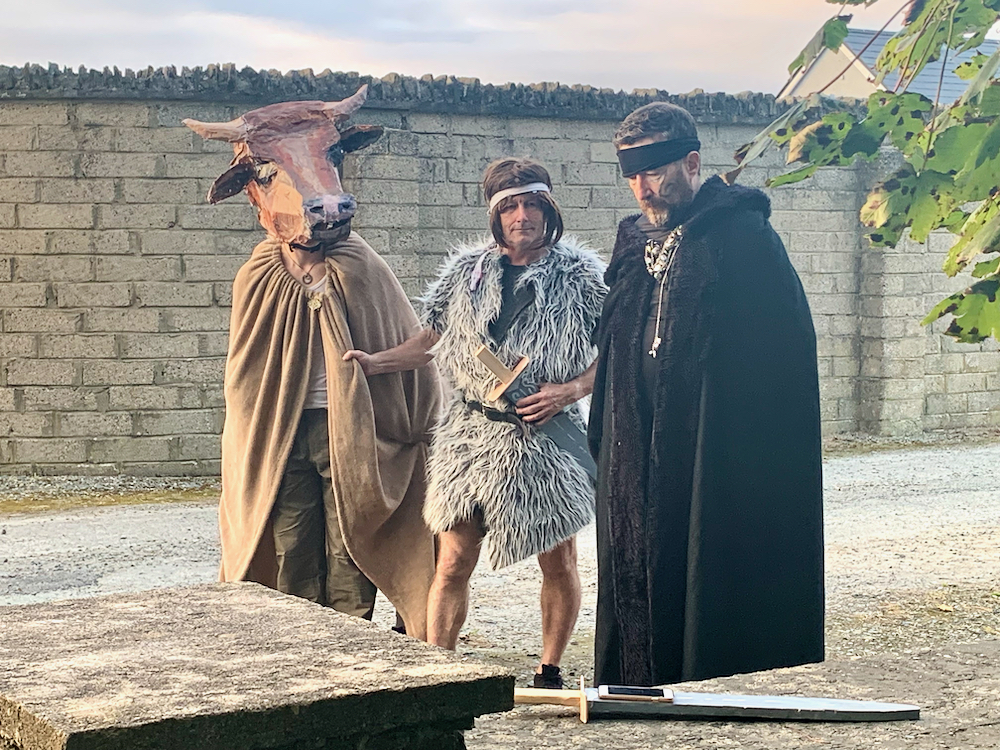
(l to r) Yanto and Rohan as the forever-giving milk cow, Mickey McHugh alias Lionel Messi and Denis Doohan as the face-decorated Balor consider their options.

Lugh, Balor’s grandson, was played wonderfully by Pierce Butler, especially impressive with his warlike cries and deadly sword fight with his grandfather, leaving his foe prostrate among a crowd of enthusiastic youngsters.  
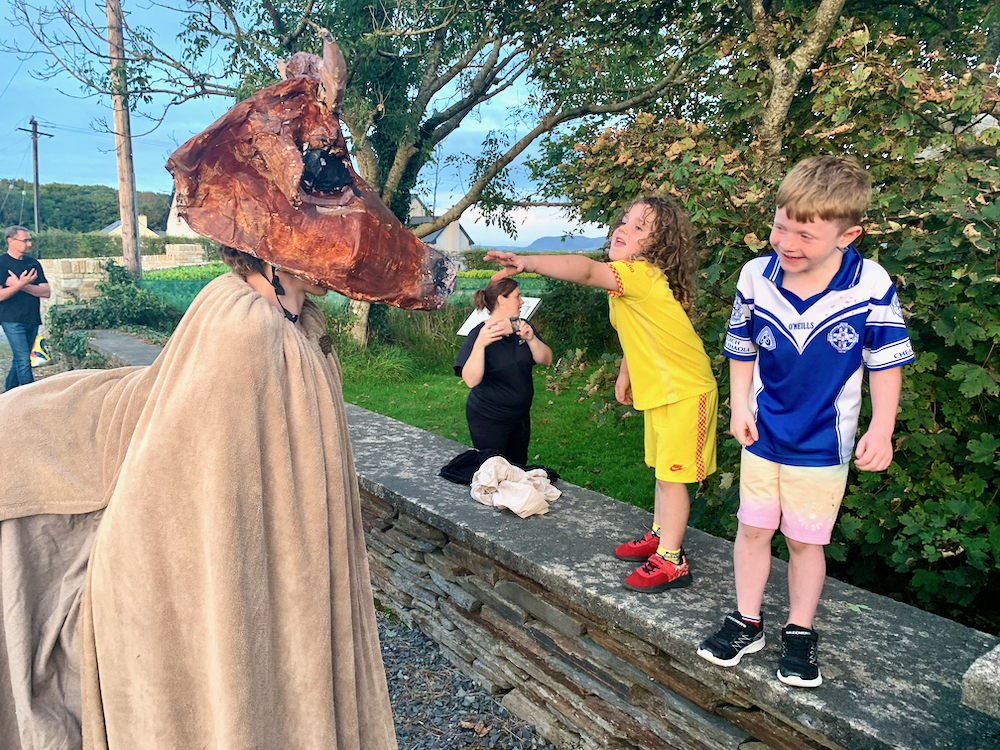
Legendary cow, Glas Gaibhnenn, receives a wee bit of attention off-stage.

Kudos also go to Maggie McKinney, a native of Castlewellan, County Down, who played not one, but two roles – the screeching witch, Biróg, who predicts Balor’s downfall, as well as the bold and brassy, what-are-ye-waiting-for-let’s-have-sex, Eithne, Balor’s daughter, who – in what must be Guinness World Record time – ‘enjoys relations’ with MacNeely and produces not one but three babies, one of which was Lugh. All done and dusted in thirty seconds.

‘Prepare to die’ says Lugh (Pierce Butler) to Balor (Denis Doohan) – but only one will emerge alive.

Mention must also be made of the cow – the beloved animal that was at the center of the entire conflict. As one who has never tried imitating a member of the bovine community, I can only presume that acting the role of a cow is not easy by any means. So many congratulations to Yanto and Rohan, members of Youthreach, for doing so.
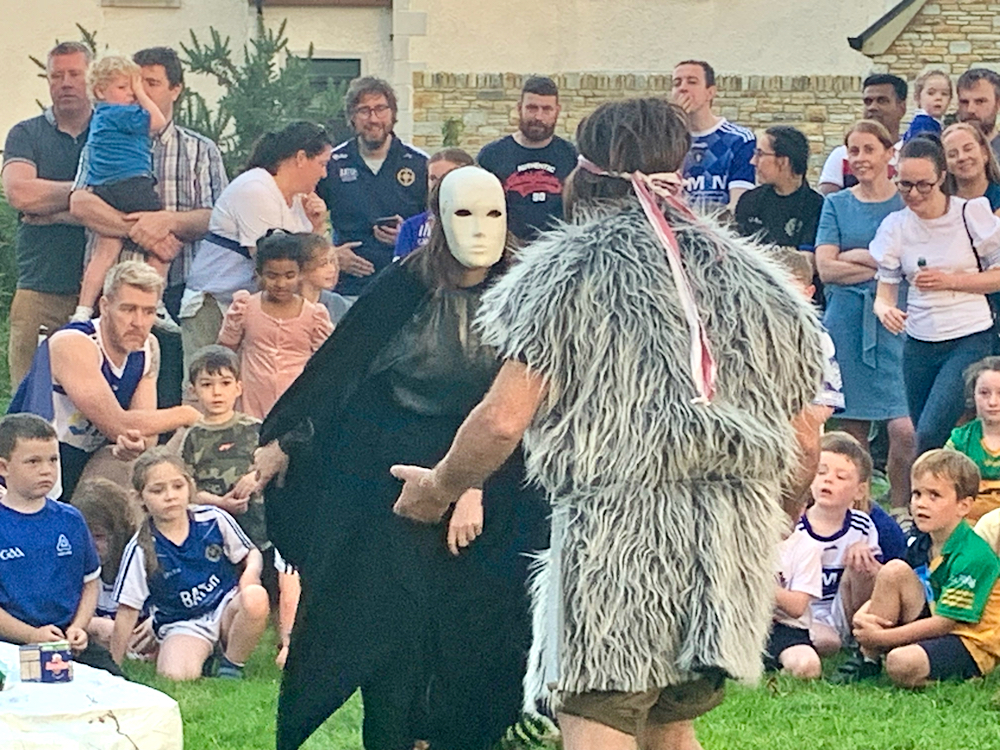
Birog the witch (Maggie McKinney) confronts MacNeely (Mickey McHugh).

Next on the dramatic circuit for the talented Cloughaneely Players is a production of the classic story, Casablanca, which I’m reliably informed may be staged sometime in November.

Photographing the entire dramatic proceedings on the evening was Annamarie Coyle, so watch out for her excellent images capturing one of the most tantalising struggles in Irish legendary history.

Mayo GAA: The Mighty and the Meek, They Shall Inherit the Earth

What I will write here may seem the realm of the fantastic, but bear with me and for a moment merely consider the possibility that it may be true.

Also, keep in mind, there is no existing evidence that it’s not true.

A few days ago, I had the utmost pleasure of sitting with novelist, playwright, radio and television social and political commentator and former public relations director of Sinn Fein, Danny Morrison, in the Upper Cusack Stand at the venerable Croke Park Coloseum to watch what – for me – was one of the most exciting, thrilling sporting spectacles I have every witnessed, either live or recorded.

Granted, my complete and utter support was with Mayo and I was devastated that particular, rather impoverished, mainly rural western county lost – especially in the aching way that it did. Though not half as heart-broken as the throngs of anguished people – hardy grown men, teenagers, young children, mothers and grandmothers – who shuffled past me for the exit gates at the final whistle, tears flowing profusely from their eyes.

For the purpose of this post, for those uninterested in Irish GAA football, Mayo – rank outsiders at 3-to1, considerable odds in view of the fact that there were only two teams on the pitch for this All-Ireland football final and both had 15 skilled, experienced able-bodied men each – lost its ninth final since 1989 and the chance to win its first Sam Maguire Cup in 66 years. Indeed, this was the third time in five years it has lost in the final (including a narrow defeat after a replay to Dublin last September, its rivals again this past Sunday). In sheer contrast, for Dublin Sunday’s victory marked their first three-in-a-row in 94 years.

In terms of probability, the cumulative odds of Mayo losing so many finals are probably calculated in the millions to one (not bad odds if you’re fond of punting a penny or two at the local bookmakers).

So how did this peculiar, bizarre defying-the-odds situation come to pass?

Let’s consider for a moment that it had nothing to do with football.

I know, I know you’re thinking: ‘that’s ridiculous, it’s football, one team wins and one team loses, that’s how the game is played, and the team that wins is the one that scores most goals/points.

But million to one odds of such a thing happening? By reason alone, is that even possible?

My contention is that something else – something strange, something far beyond football –could be at play here.

So, as a committed pantheist, this is my take on last Sunday’s fantastic football final.

It has been reported that there’s a curse on the Mayo football team that has prevented it winning the coveted All-Ireland football final since 1951. That curse, the reports go, was placed upon the team by an angry priest. The reason: the team on its victorious way back home across Ireland by bus with the Cup in safe stow came upon a funeral and failed to pay their rightful respects to the dead.

That story smells of a downright lie.

Why?

Because there are no funerals in Catholic Ireland on the Sabbath, the very day the football final is played. And don’t be telling me the Mayo team, any team, wouldn’t rush back home with the coveted trophy on the very day it won it.

You might then ask: ‘then where did this story originate, and why?

Credit where credit is due.

The Catholic Church, universally, not just in Ireland, has developed a highly-sophisticated propaganda machine over the centuries since it emerged from its ancient Egyptian forbearers (Google details on Isis and Osiris to find out how the Church unashamedly plagiarized and cunningly adapted an already existing mystery cult that also involved baptism in water).

mayo curse, GAA football

Thus, putting word out in the right circles, media and otherwise, that one of their priests had the power to curse a football team and prevent it from ever winning a national trophy after so many attempts is an easy-peasy task for such a rich and powerful institution.

But there’s another version, one that has been quashed quite easily by that same institution, for its own power-hungry, money-making purposes.

It’s not that the fine, upstanding people of Mayo – for which the players on the 1951 winning team are upstanding Ambassadors – are to blame. It’s not that they failed to pay their respects to the dead. As decent, honest people, they would surely have done so, with the same passion, dedication and sincerity that they showed last Sunday afternoon, even when three points down in the first 85 seconds and playing with just 14 men for almost the entire second half.

There is another possibility (remember, I merely asked at the beginning of this post that you humor me and consider a possibility).

That the players, coaches and management of that wonderful 1951 winning team were down-to-earth, honest-to-goodness people I have no doubt. And for this reason, I don’t agree for a second that they would not pay their sincere respects at the death of a fellow Man.

But what if it was not the dead person they didn’t respect (if there ever was one, which is now in grave doubt for the above mentioned reason), but the priest himself?

What if they didn’t believe, in their hearts of hearts, that this priest was neither dignified or decent enough to be a true representative of any God, regardless of its origin? Further, what if, in their heart of hearts, they actually believed they didn’t need Other Gods, that they themselves were Gods, mini-Gods all interlinked, like all of us here across the Earth, indeed throughout the Universe. That they were – to use Biblical terminology – among ‘the Mighty and the Meek, those who Shall Inherit the Earth.’

Mighty? Absolutely. Was there not more than ample evidence of that on the football pitch Sunday afternoon? In the way the Mayo players fought for every ball no matter how remote the chances were they’d catch it; supported each other so valiantly in every situation; placed themselves in considerable physical danger to capture every ball that came their way.

Meek? Absolutely. Was there not more than ample evidence of that on the football pitch Sunday afternoon? In the quiet, dignified way they accepted defeat, all the more admirable considering they were beaten by one single, solitary point scored by Dean Rock with mere seconds to go after six full minutes of extra time just after their own kicker, Cillian O’Connor, hit the woodwork in a grueling, hard-fought match.

You might now say: ‘it hardly makes a difference now anyway, the priest’s curse won the day, didn’t it?’ Maybe, or perhaps, just perhaps, it wasn’t the power of the priest at all. Maybe it was the misplaced power of belief in the priest by a mass of people. Maybe – as seems to be happening right now following multiple cases of horrendous clerical pedophilia resulting in lies and ruined lives – when more people stop believing in this misguided way, justice and righteousness will return to our Fair(y) Land.

All I ask, dear reader, is for you merely to consider the possibility that what I write here might just be true.

Then we can bang our drums for Mayo again in next year’s final –and hopefully cheer them on as they return Home to their Rightful place as Gods once again.