Amharclann Donegal kicks-off innovative drama project linking five Irish theatres

by Sean Hillen

An innovative drama project linking five different Irish theatres kicked-off this week with two performances at Amharclann in Donegal.

Supported by the International Fund for Ireland’s Communities in Partnerships Programme (CIPP), the project is a co-production between Amharclann in Bunbeg in the heart of the Donegal Gaeltacht and the Waterside Theatre and Arts Centre in Derry of the play ‘‘Observe The Sons Of Ulster Marching Towards The Somme’ by Donegal-born playwright Frank McGuinness.

This thought-provoking play, coincidentally hosted at the Amharclann on the same day as the United Nations International Day Of Peace, focuses on the experiences of a group of Ulstermen in the trenches of World War One who take part in the battle of the Somme. While a military setting, the play raises many themes including homosexuality, homophobia, the inner conflict of self-respect, bravery, patriotism, friendship and sacrifice. 
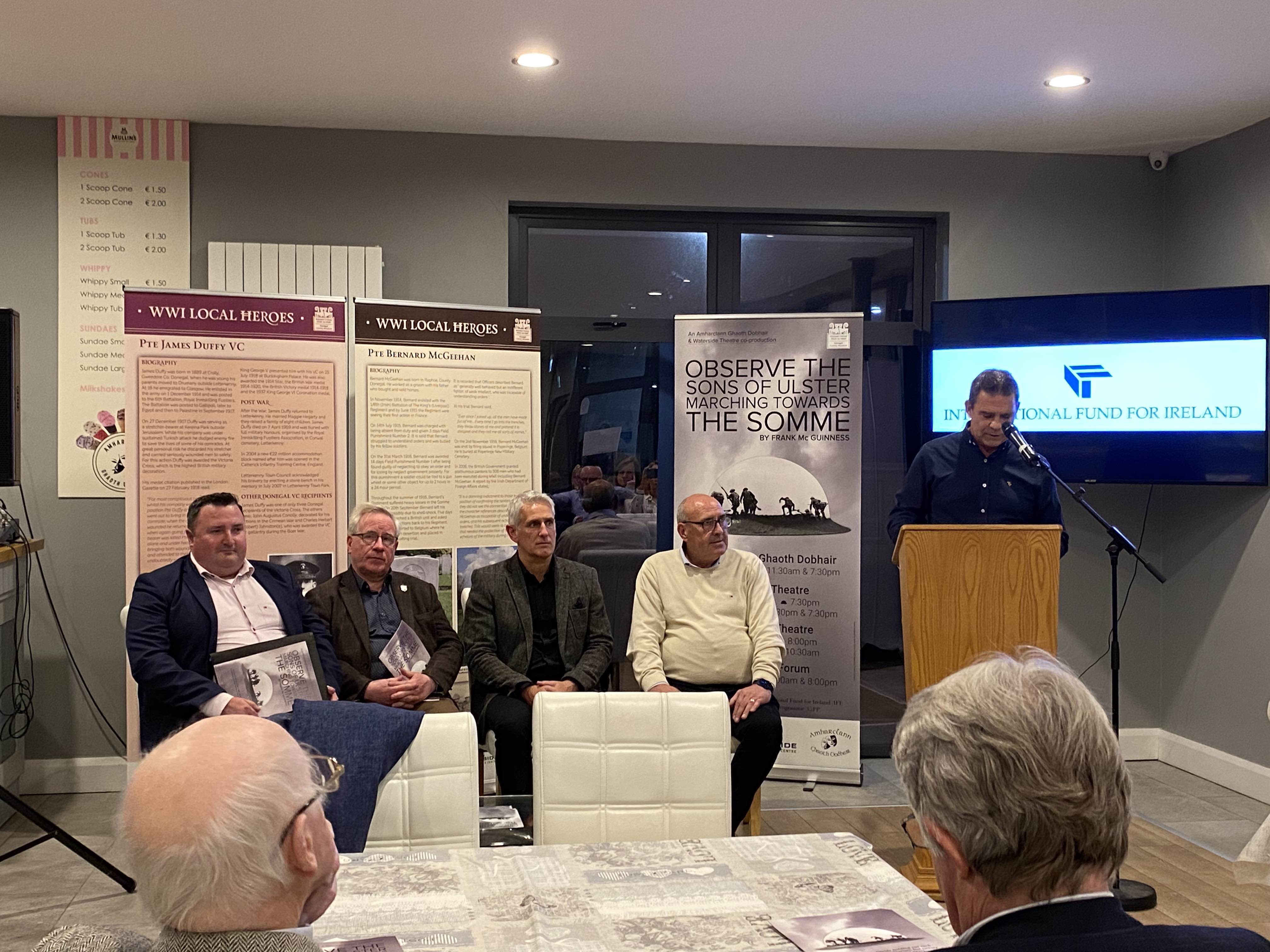
Panel of speakers at an interesting post-performance Q&A event at the Amharclann.

Enjoying the play, one is left with a vexing question: Is the play about the futility of war? The nature of loyalty, friendship and heroism? Or an examination of the protracted Protestant-Catholic northern Irish conflict from a completely different perspective? Or all of the above?

Whichever it is, this production is a two-hour, richly-rewarding theatrical experience that offers a balanced mix of black humour and poignancy with credible characters well developed through very fine acting.

Director David Grant together with production and stage manger, Fiona Harkin, assistant director, Ronan Hamill, lightning designer JP Conaghan and composer, Rebecca Doherty and the rest of the team have re-created the moving story of ordinary men – among them a blacksmith, a weaver and a baker – who set off patriotically to fight ‘the Hun’ but become disillusioned with the myth about war they’ve been sold.  

The play opens with a crippled man, Old Pyper, played by Shaun Byrne, who steps on stage alone, war medals pinned to his chest, and calls forth the ghosts of his former comrades who were all killed. Mystified as to how he survived the terrible battle, he is haunted by the images of those who died in the trenches, who then slowly, phantom-like, emerge from the shadows at the edges of the stage and stand motionless.

Theatre-goers mingle together for friendly discussions at the play’s intermission.

This sets the scene as to what follows, nostalgic flashbacks to the barracks where the men from places such as Derry, Armagh, Coleraine, Enniskillen and Belfast, gather for their first day of training and on to the sand-bagged first world war trenches where they face death together. Kudos go to Harkin and Conaghan who create a well-designed set, in which the barracks with wooden slats for beds is later transformed brilliantly into World War One trenches. Murals along the stage also add intriguing ambience, one of which depicts the ancient Celtic legendary hero, Cú Chulainn.

I particularly liked how a series of intense interlocking vignettes between couplets of men were enhanced by lighting and space, as well as by the thunderous roar of a Lambeg drum, a triumphalist symbol of the Protestant Orange Order in Northern Ireland. The military uniforms and equipment were also striking in their sheer authenticity. 

The tone of the play is bittersweet and philosophic, with elements of both black humor and solemnity. Patrick Quinn plays the younger version of Pyper wonderfully. An openly-gay man of aristocratic background who volunteered for army service, Quinn grants him a carefree, reckless air behind which lurks a man of deep sentiment and a troubled mind. A multi-faceted person – cynical, seemingly on the brink of madness, brash, supercilious, bold to the point of foolhardy, wickedly direct, yet at the same time, a vulnerable and lost individual. 

His anecdote about his three-legged French wife is highly amusing and a love scene involving him is touching in its quiet, side-stage minimalism. One character saying the ‘Huns’ speak Gaelic also creates a light-hearted moment. In contrast, depiction of one man’s despair and breakdown in the face of danger is touching, even more so as his friend tries to help.

While all the characters, except Pyper, are Northern Irish Protestant Unionists, one of the men admits something mid-way through the play which creates added intrigue and requires the attention of a military minister. 

Pyper is the exception to the anti-Fenian rants of the other men, being unwilling to indulge in such narrow-minded northern Irish tribalism and more keenly aware of the ‘sandbag’ nature of their being sent ‘over the top’ and into battle. He even demands of his fellow soldiers to answer the question as to why they are there.

Some Irish Republicans may be upset by the anecdotal joke told about rebel leader, Padraig Pearse, executed after the 1916 revolution, as someone who told his enemies he was only posting a letter when he took over Dublin’s main post office to launch the revolution, but this reflects the wit Frank McGuinness is renown for.   

Bulgarian visitors to Gaoth Dobhair – (l to r) Peter Petkov and Vanya Kovacheva – were among an enthusiastic audience at Amharclann theatre in Bunbeg, Donegal earlier this week

One of my favorite lines from the play, for reasons I’m not quite sure of, is ‘To hell with the truth as long as it rhymes.’

Ultimately, the play is about the fragility of life and the futility of war. In the end, one is left with the belief that the soldiers are united in one thing – fear of death – and that real heroes are ordinary people and unfortunately ordinary people remain ordinary because they don’t get recognised as much as they deserve. 

Local Donegal ladies enjoy a wee bit of craic and an evening’s entertainment at the Amharclann.

The play will be hosted today (Saturday) at the Lyric Theatre in Belfast, tomorrow at An Grianan Theatre in Letterkenny and next week at the Millennium Forum in Derry. 

In a post-event Q&A, Pol McCool, board chairperson of Amharclann theatre in Bunbeg, spoke about the need to build bridges between communities to help break down barriers and to appreciate shared history and values. 

Director David Grant (l) enjoys the company of friends during intermission at the Amharclann.

Stephen Barrett, manager for Donegal of the International Fund for Ireland, talked about the role of community leaders in peace-building projects and described the evolution of this co-produced project. He also spoke eloquently about his own reaction upon seeing the graves of those who died in the trenches in Belgium and France during the First World War. The IFI was established in 1986 with financing from many countries including the US, Australia and Canada and the play was supported by the organisation’s. 

Director David Grant talked about the challenges involved in creating the production and the overriding need for people to challenge mythology about wars.

Aine Ni Churrain, former presenter at RTE Raidió na Gaeltachta and a board member of Amharclann, thanked the audience for attending the two performances at the theatre, as well as everyone involved in developing and hosting the project and wished actors, director, producer and all the technical staff every success in the other theatres where it will be held.

Waterside Theatre CEO, Iain Barr, also thanked everyone for their concerted efforts in creating a memorable theatrical event with such an important social and moral message that contributes to greater peace and understanding among communities.

Video links to some of the speakers are on my Facebook – https://www.facebook.com/hillensean and https://www.facebook.com/worlditinerariespage

Kill the messenger?

There’s an old saying – ‘if you can’t deal with the message, deal with the messenger.

Usually it’s a strategy by people who are guilty of something, or who are inadequate or who have made a mistake and need to hide it somehow. 

Sadly, as a messenger, I was the brunt of such a ‘deal’ this weekend. 

My sin  – I dared speak out.

If I was wrong to do so, then I’ve only myself to blame.  Even though I do feel – if one cares enough about something – one should always speak out, even when your gut tells you you’ll be crucified for it. Otherwise, nothing in life changes.

In attempting to help Amharclann, my local theatre in Donegal and the work being done there, I suggested more than eight weeks ago that the theatre should organise a fund-raiser for the unfortunate families of people tragically killed in an explosion in the nearby town of Creeslough. That was October 9, two days after the tragedy occurred. 

As you can see, I also offered to help bring top national performers to the Amharclann from different parts of Ireland who would not normally have come to Donegal. Here is my message –

Two board members thanked me by return email for my idea, informing me a decision would be made by the board and someone would get back to me.

More than eight weeks later and still not a word from anyone on the board. 

This weekend in a Facebook post I said I was disappointed with the delay in responding and also suggested some simple marketing improvements based on my experience owning a multi-national publishing and events company that I thought might help attract more people to shows at the Amharclann. 

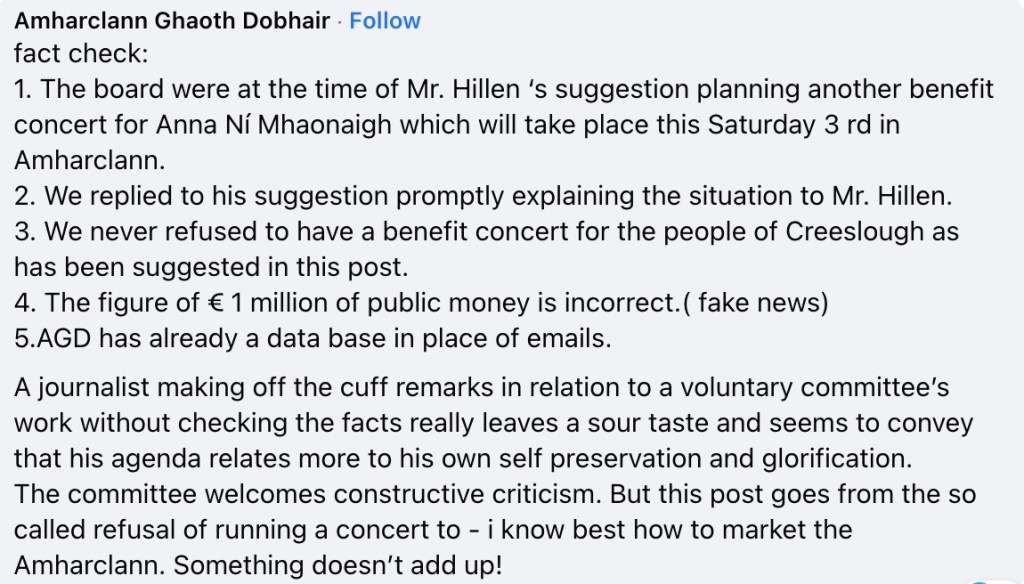
For this, I was accused by the powers that be at the theatre, the spokesperson and chairperson of the board I presume, of ‘self preservation and glorification,’ creating ‘Fake News’ and making ‘off the cuff’ remarks.’ See below.

I must admit, I was taken aback by the severity of the backlash, especially as I praised the hardworking of theatre staff in my Facebook post. As I have done for previous events, I also urged people to attend this evening’s special event (Saturday) in aid of a cancer victim. 

But those positive comments were conveniently overlooked by the person who wrote the response above on behalf of the theatre. 

I also received an aggressive text from the board chairperson saying my comments reminded him of ’hurlers on the ditch ….bellowing.’ Of course, he’s entitled to his opinion, but he’s conveniently forgetting that I have attended many events and written many articles supporting the theatre and have even helped organise a fund-raising event there. That’s hardly being in the ditch.

Here are just a couple of my articles – 

I simply couldn’t understand the furore that necessitated an urgent board brainstorming session within a few hours of my Facebook message being posted to compile such a negative response to me. 

In terms of timing, comparing a few hours to more than eight weeks, there seems to be what I’d call a ‘major time discrepancy ’ between the two. So why?

Last night, I happened to be reading my local newspaper and saw a full-page of photos and text in the Donegal News praising a successful event organised by Ionad Naomh Fionnan, a small community centre in the nearby town of Falcarragh, which raised more than 5,000 euro for the Creeslough Community Support Fund. 

That’s when the penny dropped. 

Did my Facebook post make a certain person at Amharclann, the largest theatre in northwestern Donegal, embarrassed at failing to organise themselves properly in more than two months to host a fund-raising event for the families of victims? And sadly, instead of taking what amounts to delayed action on the idea, not for my sake but for those in need in Creeslough, they decided to use their energies to deflect blame from themselves and attack the messenger – me – instead. 

It’s a tried and true trick, used since the days of Ancient Rome. And if it worked then, it could well work now, more than a millennium later. 

As for the moral of the story, I’m still not sure. 

It’s difficult for me to accept the obvious – ‘simply, keep your mouth shut.’ If we all did that, owners of homes destroyed by mica would not receive any compensation and be homeless over Christmas.

Some things are simply worth speaking out about.

Accepting praise is easy, it’s accepting constructive criticism that’s a true sign of character. I, like everyone else, want the Amharclann to succeed. It is my local theatre, after all, and I wouldn’t have written so many articles about it otherwise and praised those who worked so hard to attract the investment necessary to renovate it years after it closed.

But as my taxes and those of others helped pay for this renovation, shouldn’t we all have the right to voice our opinions and make sure the investment of so much public money is the very best it can be for all concerned?

I’m still waiting for the answers to my questions:

Intriguing to see how Amharclann can make a decision to respond within a few hours to my Facebook post. Yet still not make a decision on my suggestion for a fund-raiser for families of victims of the Creeslough tragedy made two months ago (October 9). While it’s disappointing to see Amharclann attacking me personally rather than dealing with the issue, let’s together try to make things clearer, point by point. These are my questions to the Amharclann representative who made the comment on behalf of the board.

  1. I still do not see how planning tonight’s event, which I fully support and which was due to take place in October, prevented the board making a decision about my suggestion for a fund-raiser for families of the Creeslough tragedy. Please explain.
  2. I have received no notification of a decision by you on the Creeslough fund-raising idea. 
  3. I never said the theatre refused to host a Creeslough fund-raiser. Not making a decision is a decision as there is no such event on the theatre’s future program.

4. Amharclann says costs for the theatre are not one million euro as my inside source informed me, which you label ‘Fake News.’ For transparency sake, please give a brief breakdown here of the real figure to justify your accusations.

5. Myself, my wife Columbia, friends and guests, have attended more than 25 events at Amharclann and I have written a series of articles promoting the theater. Never on any occasion has any of us been asked to leave our email/phone contact for marketing purposes. And we have never received any direct notification of events. Please explain how this database you mention was compiled and how is it used. Do only certain people receive notifications?

And lastly, for clarification purposes, please explain how a fund-raising concert for families of the Creeslough tragedy would benefit me personally, for my ‘self-preservation and glorification’ as you describe it. 

I simply don’t understand.

And for the record, I fully support the aims and mission of the Amharclann, as evidenced by my many articles and attendances at shows.

In the meantime, I wish Ann Mooney success with the medical treatment she is undergoing in Spain. This is the link if you, like me, would like to make a donation.

Help Ann Receive Vital Cancer Treatment

Feeling the pulse of the community

They say a picture tells a thousand words so, following this credo, here are some for you to peruse –

They’re from last Friday evening’s funky ‘Dracula & Friends’ event at the Amharclann Ghaoth Dobhair in Bunbeg, Donegal, enjoyed by all who attended.

This slideshow requires JavaScript.

The event featured a funny skit, a Houdini-like escape from a coffin by a vampire, played most credibly by talented actor, Tomás Mac Giolla Bhríde; a comedy drama entitled ‘He Is/He Isn’t’ adapted by Eoghan Mac Giolla Bhrighde and performed brilliantly by members of Aisteoirí Ghaoth Dobhair; and an on-screen multi-media presentation by yours truly entitled ‘Dracula: Legend Versus Truth’ based on my memoir ‘Digging for Dracula,’ with selected movie clips.

There were also make-up artists, a lobby transformed into a vampire’s den, as well as vampire-themed snacks and drinks.

The entire evening was devoted to two important causes – fund-raising for the community theatre itself, a key element of entertainment and education for the entire Gaeltacht region, and beyond, and promotion of the fine work being done by the Irish Blood Transfusion Service.

Preparations by everyone, the on-stage performers, and the hard-working off-stage staff, including chairperson Pól Mac Cumhaill and theatre manager, Manus O’Domhnaill, were superb.

It is important we all realize that the very life-blood (pardon the pun) of community theatre is ourselves, those living within easy reach of the venue.

It is fine for former Minister of the Gaeltacht, Joe McHugh, in face of stern opposition by some civil servants, to push through almost half a million euro for the resurrection of a theatre that lay dead for ten years. But for it to be sustainable in the long-run, people must recognize its value and attend, not one but as many events there as possible when possible.

Donegal is often accused of always having a ‘hand out’ for grants. Whether that is true or not depends on who you talk to and what statistics are presented. There is no doubt, however, that Donegal, especially the western part of the county, is largely ignored.

Political truth means any area with fewer voters will receive less attention. And less funding.

That means, for good or ill, we simply have to do it ourselves. To pull together.

Sustainability cannot rely simply on public money – and rightly so. Ultimately, a community must take care of itself. And there are many fine examples of that around Donegal. 

In essence, true sustainability means that venues, community centres or otherwise, must operate as if they were in the private sector. Basically, that they have products to sell, whether they be classes, concerts or cinema showings, and that they promote them in the right manner in the right place at the right price.

Tickets for ‘Dracula & Friends’ were priced at 8 euro for children and 12 for adults, with hefty discounts for parents with children. Is that too much to ask to support a local community theatre and promote blood donations, especially considering many of us may need both of them to flourish in mind and body?